




In this article, I will talk about the Best AI Red Teaming Software for testing and securing modern artificial intelligence systems. These platforms help organizations find vulnerabilities, including prompt injection, jailbreaks, data leakage, unsafe outputs, and agent-related risks. We will go over their key features, AI model support, red teaming capabilities, security features, reporting, deployment options and pricing.
What Is AI Red Teaming Software?
AI red teaming software is a security testing tool that is used to deliberately attack AI models, LLM applications, AI agents, and RAG systems to identify security flaws before they are exploited. It mimics adversarial methods including prompt injection, jailbreaks, leakage of sensitive data, malicious inputs, unsafe outputs and unauthorized agent actions.
These platforms can be used to automatically generate attacks, assess the performance of the models, detect security flaws and give risk based outcomes for remediation. Unlike traditional penetration testing tools, AI red teaming software is tailored to address the unique behavioral, application and security risks of generative AI and agentic systems.
Why Is AI Red Teaming Important in 2026?
Identifies Prompt Injection Vulnerabilities :AI red teaming is a method for testing whether an attacker can manipulate an AI system through malicious instructions, secret prompts, or carefully crafted inputs that change the model’s intended behavior.
Test Jailbreak Resistance: Red teaming is a deliberate effort to sidestep the safety controls of an AI model. This helps teams identify cases when a model might produce limited or harmful or inappropriate responses.
Safeguards Sensitive Data : AI applications can manage sensitive business information, customer details, or internal documentation. Red teaming can help to see if prompts that are crafted cleverly can reveal information that should be protected.
Identifies Vulnerabilities Before Deployment: Organizations can conduct adversarial testing during development to uncover weaknesses before an AI application goes into production, decreasing the likelihood of security problems becoming user-facing issues.
Improved AI Risk Management: Red teaming provides evidence of how an AI system performs under adversarial conditions. Teams can use the findings to prioritize vulnerabilities, strengthen defenses, and build more robust AI security processes.
Helps You Get Enterprise AI Off the Ground: As organizations adopt AI in customer service, software development, business operations and internal workflows, red teaming offers a pragmatic approach to test security risks before scaling AI access and capabilities.
Key Points
| Platform | Key Point |
|---|---|
| Promptfoo | Provides automated AI red teaming, adversarial prompt testing, and CI/CD-integrated security evaluation for LLM applications. |
| PyRIT | Microsoft’s Python Risk Identification Tool automates multi-turn AI security testing and adversarial attack orchestration. |
| Garak | Offers open-source vulnerability scanning for LLMs using extensive probe libraries to identify model |
| Mindgard | Delivers continuous AI red teaming and offensive security testing designed for enterprise AI environments. |
| HiddenLayer AISec | Provides enterprise-grade AI red teaming with adversarial attack simulations and AI security monitoring. |
| Lakera Red | Offers automated AI red teaming and continuous testing for LLM applications, prompt injection risks, and jailbreak vulnerabilities. |
| Protect AI Recon | Focuses on AI model security testing, vulnerability discovery, and pre-deployment risk assessment. |
| Cisco AI Defense (Robust Intelligence) | Combines AI security controls with red teaming capabilities to identify weaknesses in AI systems. |
| CalypsoAI Red Team | Provides AI governance, adversarial testing, and enterprise-focused AI risk assessment tools. |
| DeepTeam | Offers open-source AI red teaming with security evaluations aligned to common LLM risk frameworks. |
1. Promptfoo
Promptfoo An open-source AI testing and red teaming platform for LLM applications, APIs and AI workflows, with good support for automated adversarial testing. Its red teaming methodology uses configurable attack plugins and strategies for prompt injection, jailbreaks, PII, toxicity, bias, misinformation and other AI risks, enabling multi-turn techniques and custom strategies.
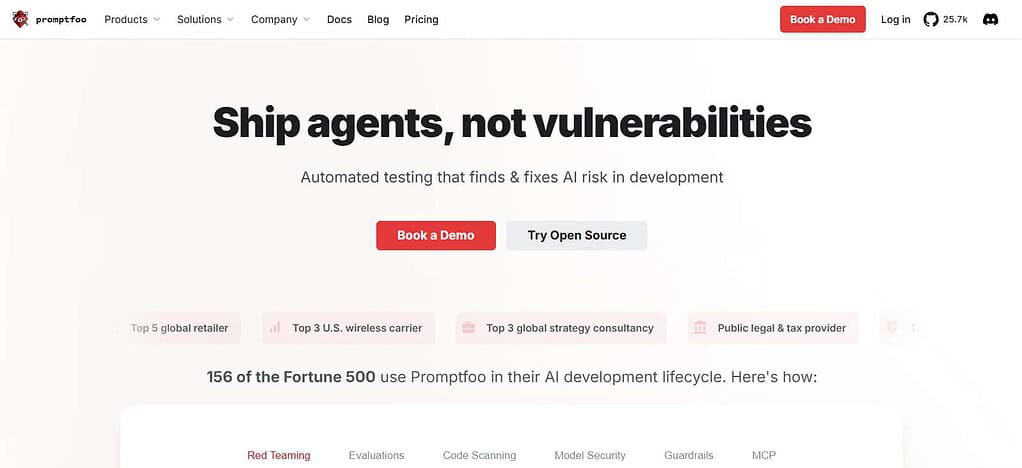
For Agent & RAG Security, it can test application-level behavior and custom endpoints, not just a single foundation model. Reporting & Risk Analysis offers test results, scoring, regression testing and CI/CD workflows.
Security & Enterprise Features – Custom testing – Cloud capabilities Core CLI is free / open source Enterprise / cloud functionality under paid plans or custom pricing.
| Feature | Details |
|---|---|
| AI Model & Application Support | Supports LLM applications, model providers, APIs, and AI agents through configurable targets and testing workflows. |
| Red Teaming | Plugin-based adversarial testing for jailbreaks, prompt injection, data leakage, harmful outputs, and other LLM risks. |
| Attack Coverage | Includes a broad library of red-team plugins and attack strategies mapped to common LLM security risks. |
| Agent Security | Supports testing of AI-agent behavior and application-level risks, including tool and workflow interactions. |
| RAG Security | Can be configured to test application-level RAG risks and retrieval-related prompt attacks. |
| Automation | Strong CI/CD orientation with CLI-based automated testing and regression checks. |
| Reporting | Provides structured test results and reports that help teams identify failed security tests and compare runs. |
| Integrations | Designed for developer workflows and CI/CD environments, with API/CLI-oriented integration. |
| Open Source | Core Promptfoo tooling is open source. |
| Pricing | Core open-source tooling is free; commercial/enterprise capabilities may have separate pricing. |
| Best For | Developers and security teams wanting repeatable AI security testing directly inside development and CI/CD workflows. |
2. PyRIT
PyRIT (Python Risk Identification Tool for generative AI) is an open source framework from Microsoft for adversarial testing of generative artificial intelligence systems, and is particularly well-suited for security researchers and teams who need to customize attack campaigns. Its red teaming methodology focuses on orchestrated, adaptive and multi-turn attacks, such as gradual escalation and branching attack strategies, rather than relying on static prompt lists alone.
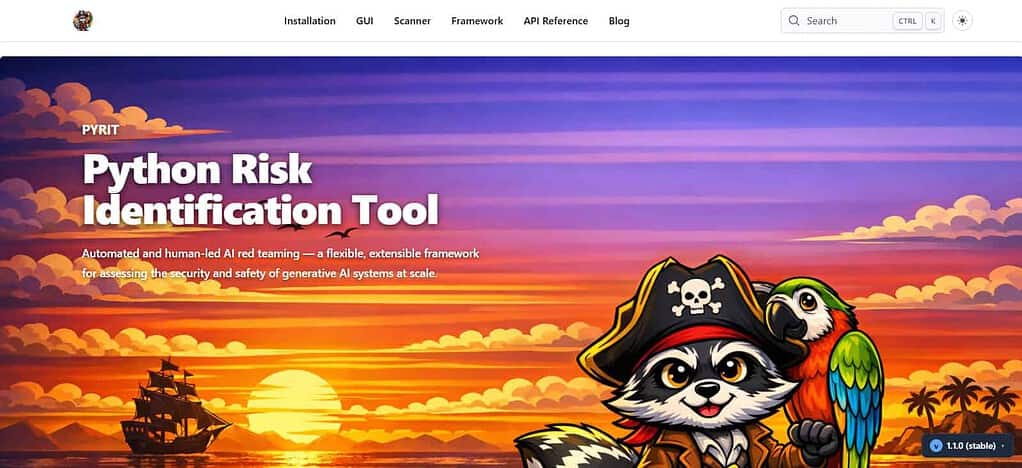
The target architecture of AI Model & Application Support enables extension to different model and application endpoints. For Agent & RAG Security, teams can create custom attack workflows against application endpoints, but implementation often requires more engineering.
Reporting & Risk Analysis is highly dependent on configured scorers and campaign outputs. Security & Enterprise Features are framework-based rather than a managed SaaS suite. Pricing is free under its open-source model; practical costs are for infrastructure and model/API use.
| Feature | Details |
|---|---|
| AI Model & Application Support | Python-based framework for testing generative AI systems through configurable targets and custom application endpoints. |
| Red Teaming | Focuses on orchestrated adversarial campaigns rather than only running static vulnerability scans. |
| Multi-Turn Attacks | Strong capability for adaptive and multi-turn attack scenarios, useful for testing how models respond across conversations. |
| Attack Customization | Developers can build custom attack strategies, converters, targets, scorers, and testing workflows. |
| Agent Security | Can be extended for agentic workflows and custom tool-use scenarios, although implementation may require engineering. |
| RAG Security | RAG applications can be tested through custom targets and attack workflows rather than a purely turnkey RAG scanner. |
| Scoring | Supports configurable scoring approaches for analyzing model responses and attack outcomes. |
| Automation | Python automation makes it suitable for repeatable research and security campaigns. |
| Open Source | Open-source framework available for security research and development. |
| Pricing | No software license fee for the open-source framework; compute, model/API and engineering costs can still apply. |
| Best For | Security researchers and teams requiring highly customizable, multi-turn adversarial testing. |
3. Garak
Garak is an open-source LLM vulnerability scanner from NVIDIA primarily intended for large-scale, repeatable testing of model endpoints. Its red teaming methodology leverages a diverse set of probes and attack techniques to identify vulnerabilities including jailbreaks, prompt injection, toxicity, encoding attacks, data leakage, and other problematic model behaviors.
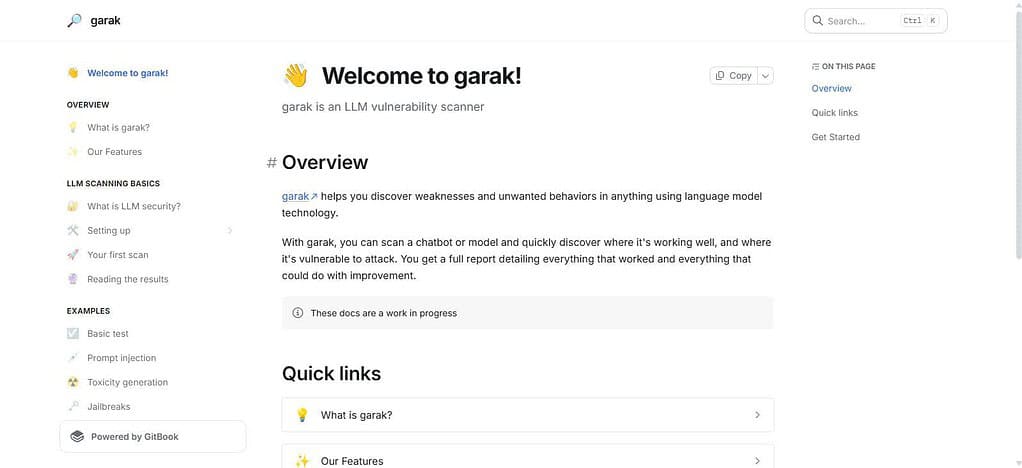
AI Model & Application Support is extensive at the model/API level and can work with various supported endpoints, which is useful for an initial security sweep. Agent & RAG Security is less mature than platforms built around full agentic applications, so teams may need application level testing on top.
Reporting & Risk Analysis covers the results of the probe and the discovered vulnerabilities. Security & Enterprise Features Inherited from its open-source framework, not a managed enterprise console. Pricing: Free, but you’ll still pay for infrastructure and inference.
| Feature | Details |
|---|---|
| AI Model Support | Designed primarily as an LLM vulnerability scanner that can test supported model providers and endpoints. |
| Red Teaming | Uses modular probes, detectors and evaluation components to identify weaknesses in model behavior. |
| Attack Coverage | Covers areas such as jailbreaks, prompt injection, encoding attacks, toxicity, data leakage and other vulnerability classes. |
| Scanning | Useful for quickly performing broad baseline vulnerability sweeps against an LLM endpoint. |
| Agent Security | Primarily model-focused, so complex agent workflows generally require additional application-level testing. |
| RAG Security | Can contribute to model/application testing but is less specialized for complete RAG pipelines. |
| Reporting | Produces test and vulnerability results that can be analyzed after scanning. |
| Automation | Command-line architecture supports repeatable automated security scans. |
| Open Source | Open-source project maintained within NVIDIA’s ecosystem. |
| Pricing | Free software; model inference, infrastructure and operational costs may still apply. |
| Best For | Teams wanting a fast and broad baseline vulnerability assessment of LLM endpoints. |
4 Mindgard
Mindgard is an enterprise AI security and automated red teaming platform for continuous testing of LLM applications, AI agents and multimodal artificial intelligence systems. Its red teaming methodology includes automated adversarial testing and an extensive research-backed attack library, allowing organizations to test evolving artificial intelligence systems repeatedly instead of just once.
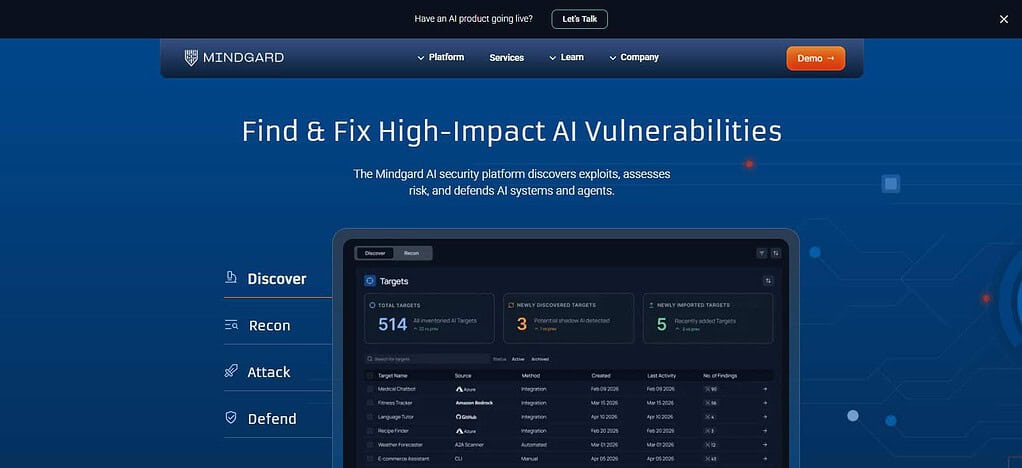
AI Model & Application Support is a cross-application capability for LLM, agents, and multimodal models. Its Agent & RAG Security capabilities are built for complex AI workflows and application level attack surfaces.
Reporting & Risk Analysis: Identify vulnerabilities, prioritize risks and produce security/compliance evidence. Security & Enterprise Features – Continuous testing, integration and security workflows at organizational scale. Pricing is usually custom and enterprise-focused rather than a simple public self-service subscription.
| Feature | Details |
|---|---|
| AI Model & Application Support | Enterprise platform designed to test LLM applications, AI agents and multimodal AI systems. |
| Red Teaming | Automated adversarial testing using a research-driven attack library and continuously updated testing techniques. |
| Continuous Testing | Designed for recurring security assessments rather than relying only on one-time penetration tests. |
| Agent Security | Supports security testing of modern AI applications and agentic systems. |
| RAG Security | Can assess AI application risks, including scenarios involving retrieval and application context. |
| Risk Analysis | Helps identify, prioritize and track vulnerabilities discovered during adversarial testing. |
| Reporting | Enterprise-oriented reports can support security teams, developers and compliance stakeholders. |
| Integrations | Designed to fit development and security workflows, including CI/CD environments. |
| Enterprise Security | Focuses on centralized AI security testing and organizational-scale deployments. |
| Pricing | Commercial enterprise platform with custom pricing rather than a standard public subscription. |
| Best For | Enterprises seeking continuous, automated red teaming across multiple AI systems. |
5. HiddenLayer AISec
HiddenLayer AISec is an enterprise AI security platform that combines automated red teaming with additional AI security capabilities, including model scanning and AI threat detection. Its red teaming methodology uses automated adversarial attacks to find flaws in conventional artificial intelligence systems, and can reduce the manual effort involved in repeated testing before deployment.
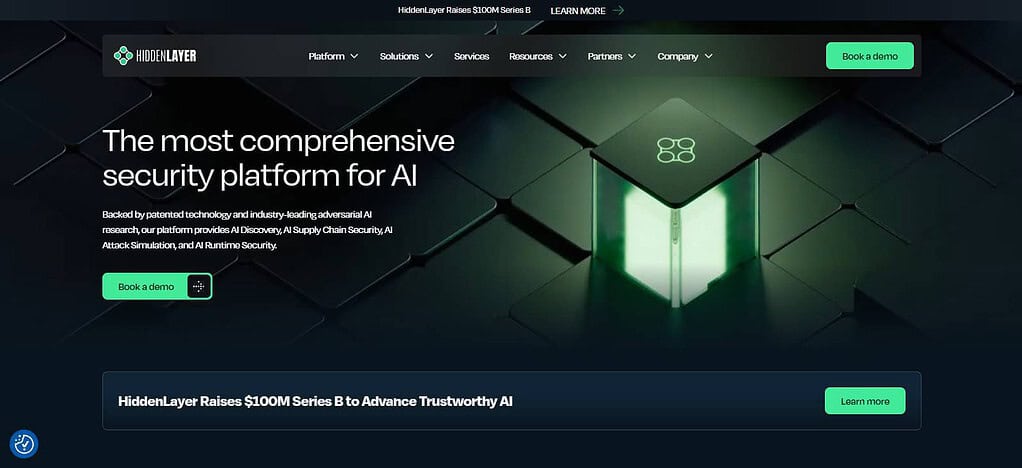
AI Model & Application Support is developed for enterprise AI environments and generative artificial intelligence systems, not only for individual developer experiments. Agent & RAG Security should be reviewed based on individual deployment and application architecture as its best positioning is not as a RAG development toolkit but more as a general AI security.
Reporting & Risk Analysis assists with security assessments and vulnerability analysis. Security & Enterprise Features links red teaming to model security and AI detection capabilities. Pricing is enterprise/custom, not a standard public free plan.
| Feature | Details |
|---|---|
| AI Security Platform | Provides broader AI security capabilities alongside AI red teaming and vulnerability assessment. |
| AI Model Support | Designed for enterprise AI environments and generative AI systems. |
| Red Teaming | Automated adversarial testing helps discover security and safety weaknesses in AI systems. |
| Attack Testing | Uses automated attack techniques to reduce manual effort in AI security assessments. |
| Agent Security | Can contribute to broader enterprise AI security assessment, depending on the application architecture. |
| RAG Security | RAG testing should be evaluated according to the specific deployment and supported application workflows. |
| Risk Analysis | Combines AI security assessment with broader vulnerability and threat analysis. |
| Enterprise Features | Enterprise-oriented AI security controls and integration with broader AI security workflows. |
| Deployment | Designed for organizations managing AI security across enterprise environments. |
| Pricing | Primarily enterprise/custom pricing. |
| Best For | Organizations wanting AI red teaming as part of a wider AI security program. |
6. Lakera Red
Lakera Red is an AI red teaming solution to discover security, safety and responsible-AI vulnerabilities in generative AI applications and agentic systems. Its red teaming methodology combines automated testing with application-specific attack objectives and can evaluate prompt injection, jailbreaks, data leakage, unauthorized actions, harmful outputs and other AI risks.
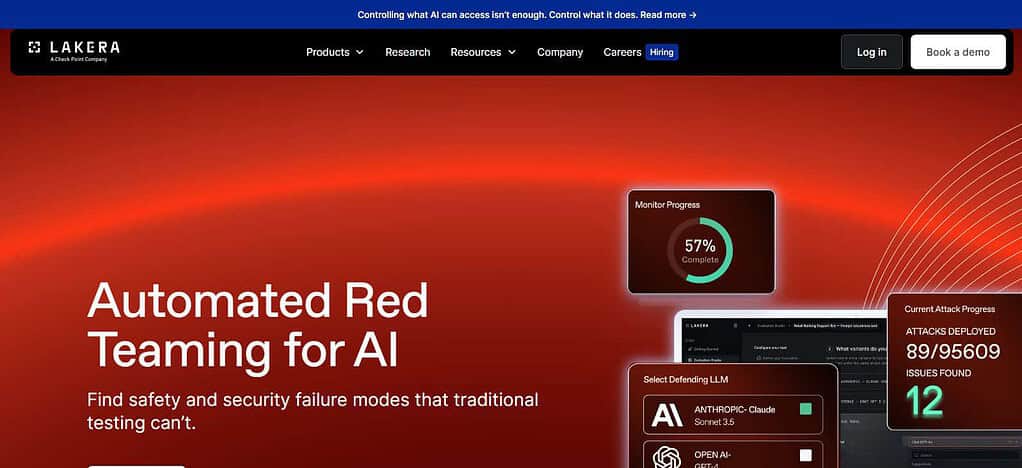
AI Model & Application Support includes direct model targets and custom AI-agent endpoints. Its focus on Agent & RAG Security is particularly relevant, as modern agent workflows can leave tools, memory, external data, and multi-step actions open to attackers.
Reporting & Risk Analysis offers structured findings, risk scoring and remediation guidance. Security & Enterprise Features integrate offensive testing into AI Guardrails and broader AI security workflows. Pricing is not a universal public price but is based on the applicable Lakera/Check Point offering and enterprise requirements.
| Feature | Details |
|---|---|
| AI Application Support | Designed for testing generative AI applications and modern AI/agent workflows. |
| Red Teaming | Automated adversarial testing targets security and safety weaknesses in AI applications. |
| Prompt Injection | Strong focus on identifying prompt-injection and related application-level attacks. |
| Jailbreak Testing | Can evaluate whether AI systems can be manipulated into producing restricted or unsafe responses. |
| Agent Security | Relevant to agentic systems where prompts, tools, external data and actions create additional attack surfaces. |
| RAG Security | Useful for testing application-level risks involving retrieved information and malicious context. |
| Reporting | Provides structured security findings and testing results for vulnerability analysis. |
| Enterprise Security | Fits into broader AI security and guardrail workflows. |
| Automation | Supports repeatable security testing rather than relying entirely on manual red-team exercises. |
| Pricing | Commercial/enterprise pricing varies by deployment and requirements. |
| Best For | Teams securing production LLM applications and agentic AI systems. |
7. Shield AI Recon
Protect AI Recon focused on finding and evaluating AI security risks across AI environments, and had features applicable to AI asset discovery, security assessment, and adversarial testing. In today’s market, it should be viewed as part of the larger Palo Alto Networks Prisma AIRS AI-security ecosystem, after the acquisition of Protect AI, not as a stand-alone product. Prisma AIRS provides AI Model & Application Support for models, applications and agents. Its red teaming methodology employs dynamic profiling and automated attack simulation.
Agent & RAG Security Agentic profiling, multi-turn attacks and testing of state-of-the-art AI workflows. Reporting & Risk Analysis Prioritized findings and risk scoring. Security & Enterprise Features: Runtime security, AI inventory & model supply-chain protection. Enterprise-oriented pricing, generally quote based.
| Feature | Details |
|---|---|
| AI Security Discovery | Focuses on discovering and assessing AI assets and associated security risks. |
| AI Model Support | Designed for enterprise AI models, applications and AI workloads. |
| Red Teaming | Current Prisma AIRS positioning includes AI red teaming to simulate real-world attacks against AI agents and applications. |
| Agent Security | Prisma AIRS includes agent security, identity controls and protection against unauthorized agent actions. |
| RAG Security | Can be considered within broader AI application and agent security workflows, depending on deployment. |
| AI Inventory | Provides visibility into AI workloads, resources and related activity. |
| Supply Chain Security | Current platform includes scanning of AI models, artifacts and other AI supply-chain components. |
| Risk Analysis | Helps organizations identify and prioritize AI security risks across the AI lifecycle. |
| Enterprise Security | Designed for centralized enterprise AI security, governance and runtime protection. |
| Pricing | Enterprise commercial pricing. |
| Best For | Enterprises seeking integrated AI discovery, red teaming, supply-chain and runtime security. |
8. Cisco AI Defense (Strong Intelligence)
Cisco AI Defense, leveraging technology from Robust Intelligence, offers a more holistic AI security platform that includes algorithmic red teaming as well as AI discovery, model and application validation, supply-chain security and runtime protection.
Its ** red teaming methodology ** systematically probes models for responses they should not produce through successive prompt variants , enabling automated security validation at scale . AI Model & Application Support is about AI models and applications in enterprise settings, Agent & RAG Security is evolving toward agentic workflows, MCP-connected systems and tool interactions.
Reporting & Risk Analysis can be embedded in larger AI risk management & validation workflows. Security & Enterprise Features include AI asset visibility, supply-chain assessment, and runtime controls. ** Pricing ** is enterprise-oriented, and typically based on Cisco’s commercial packaging and not a simple public self-service price.
| Feature | Details |
|---|---|
| AI Model & Application Support | Tests AI models, applications and agents as part of an organization-wide AI security architecture. |
| Algorithmic Red Teaming | Automatically performs adversarial testing at AI scale instead of relying entirely on manual testing. |
| Attack Coverage | Includes 45+ prompt-injection techniques, 30+ data-privacy categories, 20+ security targets and 50+ safety categories. |
| Agent Security | Tests agent vulnerabilities and extends security controls to agent actions and tool interactions. |
| RAG & Application Security | Designed for broader AI application validation, allowing organizations to test application-specific vulnerabilities. |
| Risk Scoring | Uses risk-oriented assessment to help organizations prioritize AI security issues. |
| Reporting | Provides vulnerability reporting for model, application and agent findings, including compliance-oriented reporting. |
| CI/CD | AI validation can be incorporated into existing CI/CD workflows. |
| Runtime Security | Includes protections for prompt injection, sensitive-data leakage and unsafe agent behavior during live interactions. |
| Pricing | Enterprise/Cisco commercial pricing. |
| Best For | Large organizations wanting AI red teaming integrated with broader AI security, governance and runtime protection. |
9. CalypsoAI Red Team
CalypsoAI Red Team is an enterprise-grade AI security testing capability that runs automated adversarial campaigns against generative artificial intelligence systems. It employs a red teaming methodology with large attack libraries and configurable security testing to observe how models respond to malicious or unsafe inputs.
AI Model & Application Support is for organizations trying out multiple models and AI environments, and not just a single developer endpoint. For Agent & RAG Security, coverage will depend on the specific deployment and application architecture being used, so organizations should confirm the agent and retrieval scenarios they need prior to purchasing.
A powerful feature is Reporting & Risk Analysis. This includes campaign summaries, per-prompt results, multi-model comparisons, and downloadable results. Security & Enterprise Features feature centralized AI security workflows and governance. Pricing is primarily enterprise/custom and not transparent consumer-style subscription.
| Feature | Details |
|---|---|
| AI Model Support | Designed for organizations assessing generative AI models and applications across enterprise environments. |
| Red Teaming | Uses automated adversarial campaigns to expose weaknesses in AI model behavior. |
| Attack Library | Provides multiple attack scenarios for testing security and responsible-AI risks. |
| Multi-Model Testing | Can support comparative security testing across different AI models and configurations. |
| Agent Security | Agent and application testing depends on the specific environment and connected AI architecture. |
| RAG Security | RAG-specific testing should be evaluated based on the organization’s implementation and required attack scenarios. |
| Reporting | Provides campaign results and security findings for analyzing adversarial test outcomes. |
| Risk Analysis | Helps security teams understand model vulnerabilities and prioritize remediation. |
| Enterprise Features | Enterprise governance and centralized AI security workflows are key parts of its positioning. |
| Pricing | Primarily enterprise/custom pricing. |
| Best For | Enterprises that want AI governance and automated red teaming within a centralized security workflow. |
10. DeepTeam
DeepTeam An open-source AI red teaming framework to test LLMs and AI applications, especially for developers who need programmable security testing along with their AI evaluation workflows. Its red teaming methodology includes multiple attack methods and vulnerability categories such as prompt injection, jailbreaks, privacy, toxicity, and other model risks.
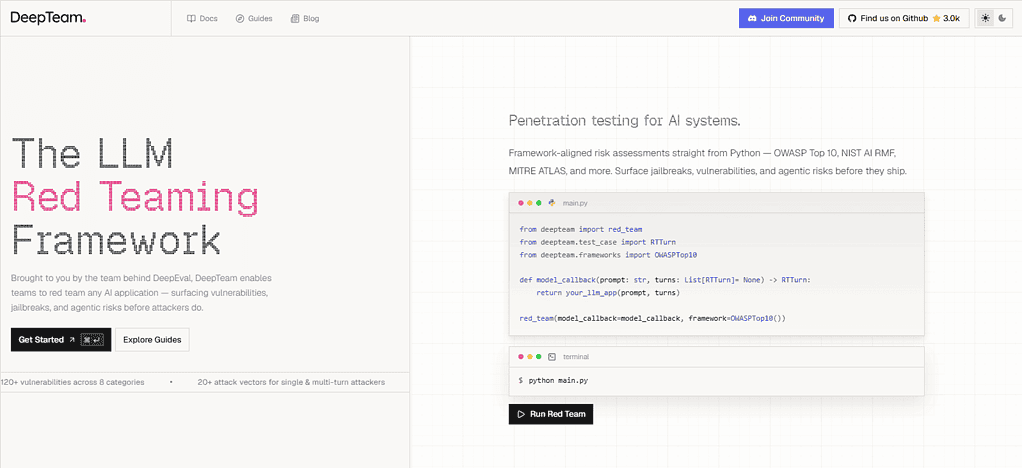
AI Model & Application Support is flexible, as the framework can be integrated into developer-controlled AI testing environments. Agent & RAG Security can be tested at the application level, but teams may need to create more complex scenarios for more complex agent workflows.
Reporting & Risk Analysis can be integrated with evaluation and scoring workflows to identify failed security tests. Security & Enterprise Features are less out of the box than commercial platforms **Pricing Pricing is free and open source with the main cost of operation being engineering, infrastructure and model/API usage.
| Feature | Details |
|---|---|
| AI Model & Application Support | Open-source framework for red teaming LLMs and AI applications, with flexible developer-controlled testing. |
| Vulnerability Testing | Provides numerous vulnerability categories for evaluating security and safety weaknesses. |
| Attack Methods | Supports multiple adversarial attack methods for systematically challenging AI systems. |
| Multi-Turn Testing | Supports multi-turn scenarios for testing how vulnerabilities develop across conversations. |
| Agent Security | Can be used for AI-agent testing and custom agentic attack scenarios. |
| RAG Security | Application-level configurations can be used to test RAG-related risks, although specialized scenarios may require customization. |
| Reporting | Integrates naturally with evaluation workflows to analyze failed security tests and results. |
| Developer Integration | Python-based workflow makes it suitable for programmatic testing and automation. |
| Open Source | Apache 2.0 open-source framework. |
| Pricing | Core framework is free; model/API usage, infrastructure and optional surrounding services can create costs. |
| Best For | Developers and AI teams wanting programmable red teaming alongside LLM evaluation workflows. |
Conclusion
By 2026, AI red teaming software has emerged as an essential component in securing modern AI models, applications, agents, and RAG systems. The platforms listed here utilize a variety of strategies to discover vulnerabilities, including open-source testing frameworks such as Promptfoo, PyRIT, Garak, and DeepTeam, as well as enterprise-focused solutions like Mindgard, Lakera Red, HiddenLayer AISec, Cisco AI Defense,
Protect AI, and CalypsoAI. In terms of selecting a solution, organizations should compare attack coverage, automation, agent and RAG testing, reporting, enterprise security, deployment options and pricing. The right platform can help security and development teams find weaknesses earlier and continuously improve the durability of standard artificial intelligence systems before and after deployment.
FAQ
What is AI red teaming software?
AI red teaming software helps security and development teams intentionally test AI models, applications, agents, and RAG systems for vulnerabilities. It can simulate attacks such as prompt injection, jailbreaks, data leakage, unsafe outputs, and other adversarial behaviors.
What does AI red teaming test?
AI red teaming can test prompt injection, jailbreak resistance, sensitive-data exposure, system-prompt extraction, harmful outputs, misinformation, model manipulation, RAG vulnerabilities, agent tool misuse, and other application-specific security risks.
Why is AI red teaming important in 2026?
AI applications are increasingly connected to business data, APIs, tools, and autonomous agents. AI red teaming helps organizations discover security and safety weaknesses before attackers can exploit them and supports continuous testing as models and applications change.
Can AI red teaming software test AI agents?
Yes. Some modern platforms can test AI agents for risks involving tool calling, permissions, multi-step actions, external integrations, prompt injection, and unauthorized behavior. The depth of agent testing varies between platforms.
Can AI red teaming tools test RAG applications?
Yes, depending on the platform. RAG-focused testing can examine risks such as malicious or manipulated context, sensitive information exposure, retrieval-related attacks, prompt injection through documents, and unintended model responses.