



In this article, I’ll talk about the Best AI Content Provenance Platforms that help businesses, creators, publishers and AI developers verify the origin of digital content, track changes, disclose AI involvement and establish authenticity. We will evaluate leading provenance technologies across features, supported content, security and verification, integrations, technology, pricing and overall fit for various content workflows.
What Is AI Content Provenance?
AI content provenance is the process of recording, maintaining and verifying information about the creation, modification and publication of digital content. It can tell who created it, how it was created, what role AI played, what editing was done, what software or tools were used, and other pertinent metadata.
Technologies like C2PA and Content Credentials use cryptographic signatures and structured provenance records to make this information both tamper-evident and verifiable. Provenance is not meant to detect AI content, but rather to provide evidence of where content came from and how it has been used. It’s useful for transparency, attribution, accuracy, copyright workflows, and responsible AI content management.”
Why Is AI Content Provenance Important in 2026?
Monitors Changes to Content: Provenance records can help show the changes an image, video, document or other digital asset has undergone during its lifecycle.
Assistance in Authenticating Content: Users may verify if related credentials have been altered through cryptographically signed provenance information.
Provides for Creator Attribution: Provenance can link content with creator or organization information, and assist in providing clearer attribution between digital platforms.
Works Against Manipulated Media: Provenance adds context to help assess images, videos, audio and documents that may have been modified or created by AI.
Enables Responsible AI Workflows: Businesses can use provenance records to track how content generated or assisted by AI enters their production and publishing workflows.
Allows Cross-Platform Validation: Standards such as C2PA are aimed at enabling provenance information interoperability across participating tools, platforms and content ecosystems.
Enhances Enterprise Content Governance Organizations may utilize provenance information for auditing, compliance workflows, asset management, and internal content policies.
How We Selected the Best AI Content Provenance Platforms
| Evaluation Criteria | What We Considered |
|---|---|
| Provenance Technology | Evaluated how each platform records, preserves, and verifies content origin and lifecycle information. |
| C2PA Support | Checked compatibility with the C2PA standard and Content Credentials for interoperable provenance. |
| AI Disclosure | Considered whether platforms can identify or communicate AI-generated and AI-assisted content. |
| Content Types | Compared support for images, video, audio, text, documents, and other digital assets. |
| Security & Verification | Examined cryptographic signatures, certificates, tamper-evident records, and verification mechanisms. |
| Creator Attribution | Assessed capabilities for recording creator, publisher, organization, or source information. |
| Modification History | Checked whether platforms can preserve information about edits, transformations, and content lifecycle events. |
| Integrations | Compared compatibility with creative software, CMS platforms, APIs, publishing platforms, and enterprise workflows. |
| Technology & Standards | Considered open standards, metadata, digital signatures, watermarking, and other provenance technologies. |
| Verification Experience | Evaluated how easily users can inspect, validate, and understand provenance information. |
| Enterprise Use | Considered scalability, governance, auditing, workflow compatibility, and organizational requirements. |
| Pricing & Availability | Compared free access, open-source availability, subscription models, enterprise pricing, and platform accessibility. |
| Interoperability | Evaluated how effectively provenance information can travel between compatible tools and platforms. |
| Ease of Use | Considered how easily creators, developers, publishers, and businesses can implement provenance workflows. |
| Overall Use Cases | Assessed suitability for creators, media companies, enterprises, AI developers, publishers, and content-verification teams. |
Key Points
| Platform | Key Point |
|---|---|
| Adobe Content Credentials | Provides content provenance and authenticity metadata based on the C2PA standard across Adobe’s creative tools and AI products. |
| C2PA (Coalition for Content Provenance and Authenticity) | Maintains the leading open standard for attaching cryptographically signed provenance information to digital content. |
| Content Authenticity Initiative (CAI) | Promotes adoption of Content Credentials and provenance technology across media, technology, and AI ecosystems. |
| Truepic | Provides authenticated media capture and provenance verification solutions for enterprise and trust-sensitive workflows. |
| Content Authenticity Verifier | Enables verification and inspection of C2PA Content Credentials and media provenance records. |
| Adobe Content Credentials Inspect | Allows users and organizations to view and validate provenance information attached to digital media. |
| Microsoft Content Credentials Ecosystem | Supports Content Credentials through AI-generated content experiences and C2PA-based provenance initiatives. |
| OpenAI Content Credentials Integration | Embeds C2PA credentials into supported AI-generated content to improve transparency and provenance tracking. |
| Google Content Credentials Support | Surfaces provenance information and Content Credentials through supported Google products and services. |
| LinkedIn Content Credentials Support | Preserves and displays Content Credential information as part of its provenance-aware content ecosystem. |
1. Adobe Content Credentials
Adobe Content Credentials provides provenance data about digital content, such as who created it, how it was created, what edits were made, and if generative-AI was used. Supported Content: images and other supported creative assets within Adobe workflows. Pricing: The Content Credentials feature is available for use with supported Adobe products.
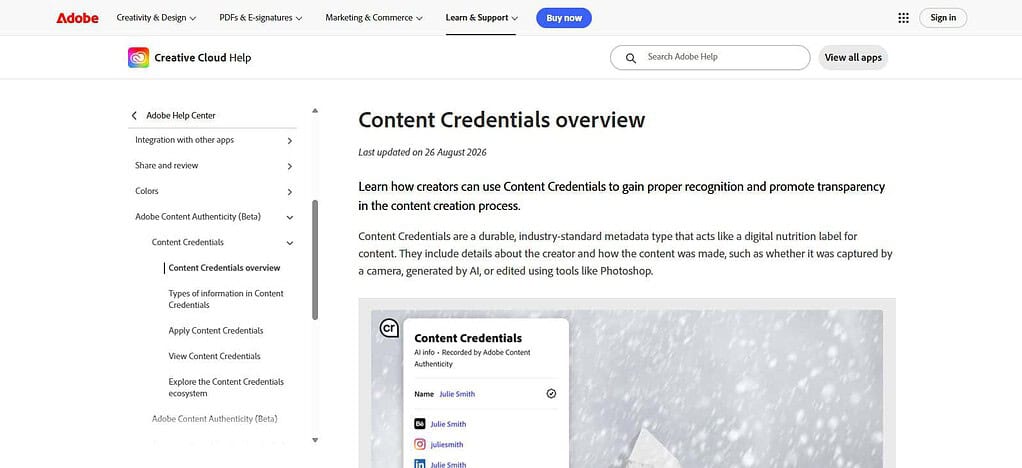
Adobe Content Authenticity offers related tools. Security & Verification: credentials use cryptographically signed tamper-evident information. Integrations: Photoshop, Lightroom, Illustrator, Premiere, Adobe Stock, Behance, Firefly and other Adobe services. Technology: C2PA Content Credentials, Metadata, Identity info and Durable provenance.
| Features | Pros | Cons |
|---|---|---|
| Records creator and creation information | Strong transparency for digital content | Best experience is within supported Adobe workflows |
| Records AI involvement and editing activity | Helps communicate AI use clearly | Not every external platform preserves all metadata |
| Uses C2PA-based cryptographic credentials | Tamper-evident provenance | Provenance does not prove factual accuracy |
| Supports identity information | Useful for creator attribution | Identity disclosure may create privacy considerations |
| Includes durable metadata and additional preservation technologies | Helps credentials remain associated with content | Ecosystem support varies across platforms |
| Works with Adobe creative workflows | Convenient for Adobe users | Less useful where receiving systems do not recognize credentials |
2. C2PA (Coalition for Content Provenance and Authenticity)
C2PA is an open technical standard, rather than a traditional commercial platform, built to verify the origin and modification history of digital content. Supported Content: images, video, audio, documents and other digital materials. Pricing: the specification itself is open to implementation. Security & Verification: Provenance is tamper-evident and verifiable through digitally signed claims and cryptographic manifests.
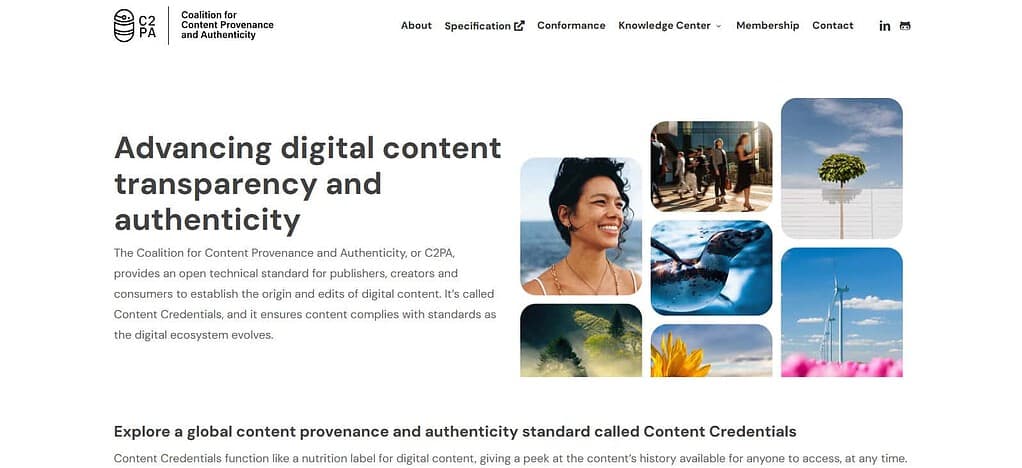
Integrations: can be implemented by creators, publishers, software companies, cameras, standard artificial intelligence systems, and online platforms. Technology: Content credentials, assertions, manifests, certificates and cryptographic signatures.
| Features | Pros | Cons |
|---|---|---|
| Open technical standard for content provenance | Interoperable across participating platforms | Requires ecosystem adoption |
| Uses cryptographically signed manifests | Makes provenance tamper-evident | Does not automatically establish that content is truthful |
| Supports images, audio, video, and documents | Broad media coverage | Complete provenance depends on participating tools |
| Records creation and modification information | Provides a verifiable content history | Metadata can be lost when unsupported workflows are used |
| Supports ingredient and multi-source provenance | Useful for complex content production | Full ingredient history may require access to each asset |
| Uses certificates and trusted issuers | Creates a structured trust model | Implementation and certification can add complexity |
3. Content Authenticity Initiative (CAI)
The Content Authenticity Initiative is a cross-industry community working to make provenance of digital content accessible through open technologies. **Supported Content: photography, digital art, generative AI content, and growing media workflows.
Pricing: Free software license fee for its open-source tools; free membership. Security & Verification: assets can be cryptographically hashed and signed to produce tamper-evident provenance. Integrations: Websites, applications, creative tools and C2PA compliant services. Technology: C2PA Content Credentials, open source SDKs, manifests, cryptographic signing, and interoperable provenance infrastructure.
| Features | Pros | Cons |
|---|---|---|
| Promotes open content provenance technology | Encourages industry-wide adoption | It is an initiative/community rather than one standalone SaaS platform |
| Provides open-source provenance tools | Developers can build custom workflows | Requires technical implementation for advanced use |
| Supports C2PA Content Credentials | Connects workflows to an open standard | Benefits depend on C2PA ecosystem adoption |
| Provides tools for validating and displaying credentials | Improves content transparency | Verification cannot establish factual truth |
| Supports creator and content attribution workflows | Useful for publishers and creators | Different implementations may expose different information |
| Works across participating content ecosystems | Encourages interoperability | Coverage is not universal |
4. Truepic
Truepic is dedicated to authenticating captured media and providing trustworthy provenance for real world digital content. Supported content: photographs, videos, inspections and visual evidence used through business workflows. Pricing: enterprise pricing is based on inspection type, volume and deployment requirements, with a flexible plan starting at a minimum monthly rate.
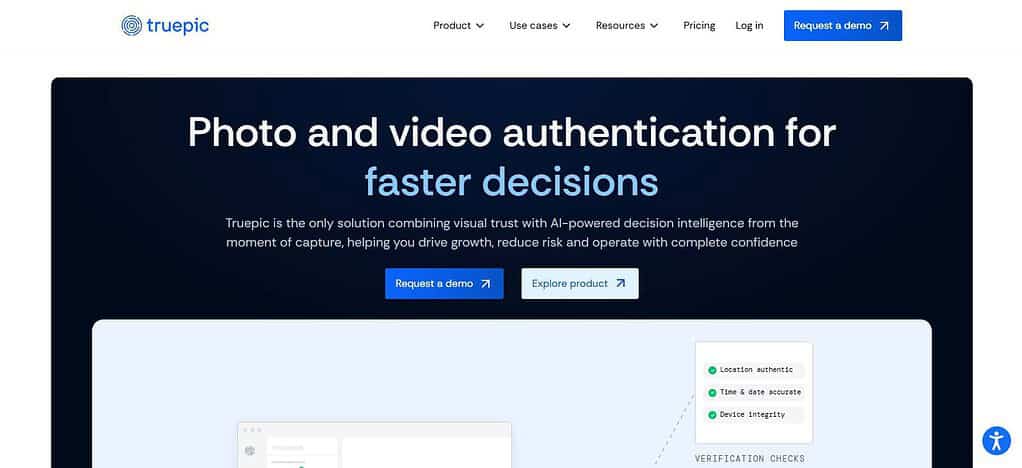
Security & Verification: its technology is designed to generate trusted capture and help detect manipulated or untrustworthy visual evidence. Integrations: APIs, webhooks, analytics, reporting, enterprise workflows. Technology: secure capture, provenance, verification and content authenticity capabilities related to C2PA.
| Features | Pros | Cons |
|---|---|---|
| Focuses on trusted digital-media capture | Strong fit for real-world visual evidence | More specialized than general creative provenance tools |
| Tracks origin and content history | Helps organizations establish media authenticity | Enterprise workflows may require integration work |
| Supports C2PA-related provenance initiatives | Aligns with industry standards | Value depends on compatible downstream systems |
| Designed for business verification workflows | Useful for inspections and evidence collection | May be more than creators need for basic provenance |
| Supports digital-media authenticity research | Strong focus on trustworthy capture | Not primarily a general-purpose editing platform |
| Can support enterprise media workflows | Useful for high-trust applications | Pricing and deployment depend on business requirements |
5. Content Authenticity Validator
Content Authenticity Verifier is better understood as a provenance-verification feature of the Content Credentials ecosystem than a typical content-creation platform. Supported Content: digital resources that include Content Credentials. Pricing: open provenance ecosystem’s verification tools are built to be broadly accessible.
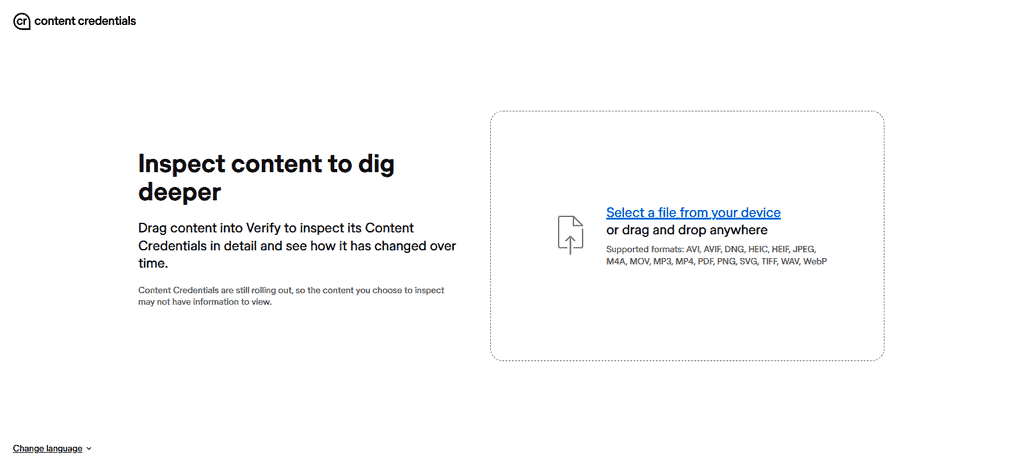
Security & Verification: certificates and cryptographic signatures are verified against trusted certificate authorities and C2PA trust lists. Integrations: verification functionality is available for compatible websites, applications, and C2PA workflows. Technology: C2PA, signed claims, certificates and trust lists, provenance validation to determine if credentials are valid and tamper evident.
| Features | Pros | Cons |
|---|---|---|
| Inspects Content Credentials | Provides direct provenance visibility | Only useful when compatible credentials are present |
| Validates C2PA information | Uses established provenance standards | A valid credential does not prove content is factually true |
| Checks cryptographic information | Helps identify tampering | Verification depends on available manifests and certificates |
| Displays provenance details | Makes technical information easier to understand | Information can be limited when provenance is incomplete |
| Works with C2PA ecosystem tools | Supports interoperability | Not a complete content-creation platform |
| Helps establish credential integrity | Useful for verification workflows | Does not replace broader content review |
6. Adobe Content Credentials Inspect
Adobe Content Credentials Inspect is a verification and inspection tool for reviewing provenance information attached to supported digital resources. Supported Content: supported image and media files with Content Credentials. Pricing: the Inspect experience is available through the Adobe Content Authenticity Beta.
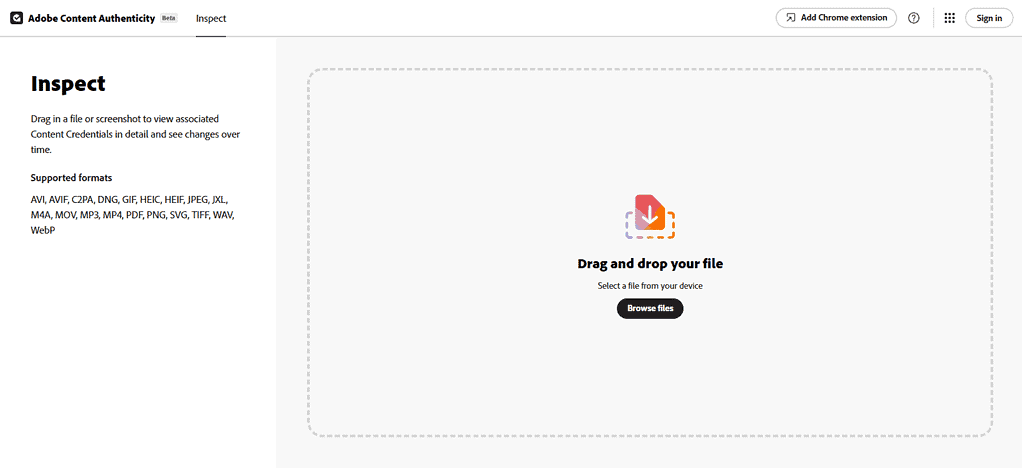
Security & Verification: C2PA credentials are cryptographically signed to help verify the integrity of content. Integrations: Adobe Content Authenticity Adobe’s Chrome Extension Behance LinkedIn and Adobe creative workflows Technology: Content Credentials, provenance manifest, history tracking, asset comparison. Users can review creator information, creation techniques, AI use, associated assets and modification history.
| Features | Pros | Cons |
|---|---|---|
| Lets users inspect Content Credentials | Simple way to review provenance | Requires content containing supported credentials |
| Shows content history | Useful for understanding modifications | Available history depends on captured provenance |
| Shows related files | Helps trace content relationships | Does not independently establish factual accuracy |
| Displays creator and AI information when available | Improves transparency | Available metadata varies by asset |
| Uses C2PA-based verification | Cryptographically verifiable credentials | Unsupported files may provide little or no information |
| Works with Adobe Content Authenticity | Integrated Adobe verification workflow | Primarily focused on inspection rather than content creation |
7. Microsoft ecosystem of content credentials
Microsoft’s Content Credentials ecosystem is the engine behind provenance and authenticity workflows for digital media and content produced by AI. ** Supporting Content: Digital images and other media supporting provenance information. Pricing: pricing depends on the Microsoft product or ecosystem service that is implementing the capability, not one universal standalone price. Security & Verification: C2PA-based credentials provide cryptographically verifiable provenance.
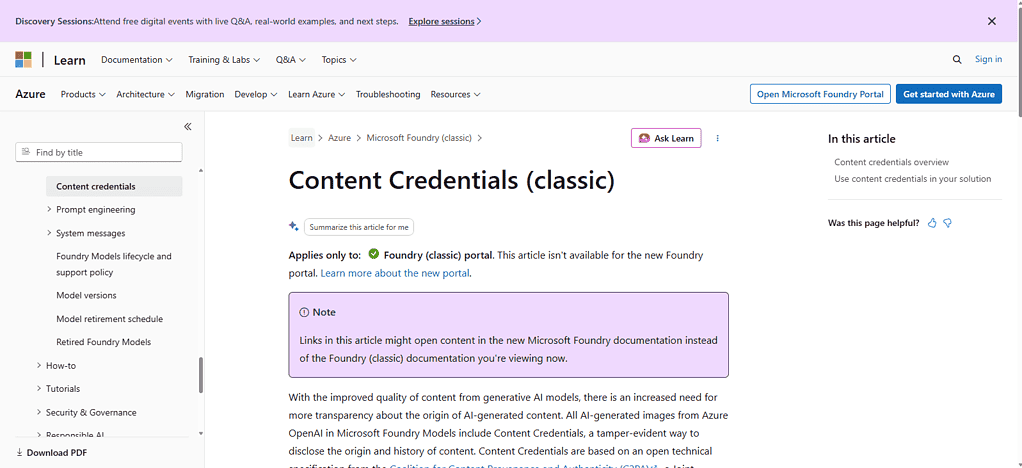
Integrations: Microsoft AI and content workflows can be part of a larger interoperable provenance ecosystem. Technology: C2PA Content Credentials, signed provenance information and ecosystem interoperability. Its core value is linking Microsoft’s AI and digital-content infrastructure to broader industry provenance standards.
| Features | Pros | Cons |
|---|---|---|
| Uses C2PA Content Credentials | Open-standard provenance | Coverage varies by Microsoft service and model |
| Adds cryptographically signed metadata | Strong integrity protection | Metadata can be lost during unsupported transformations |
| Uses invisible watermarking in supported workflows | Provides another provenance signal | Watermarks may require specialized verification |
| Records AI generation information | Improves AI transparency | Provenance does not establish whether content is truthful |
| Provides provenance detection capabilities | Useful for enterprise trust workflows | Detection is focused on supported Microsoft signals |
| Integrates with Microsoft AI infrastructure | Strong enterprise ecosystem | Best suited to supported Microsoft workflows |
8. OpenAI Content Credentials Integration
OpenAI integrates content provenance into supported generated media via Content Credentials and additional watermarking technology. Supported Content: OpenAI-generated images and supported audio including content created via ChatGPT and the OpenAI API. Pricing: provenance verification is tied to applicable OpenAI product or API usage, not a separate Content Credentials subscription.
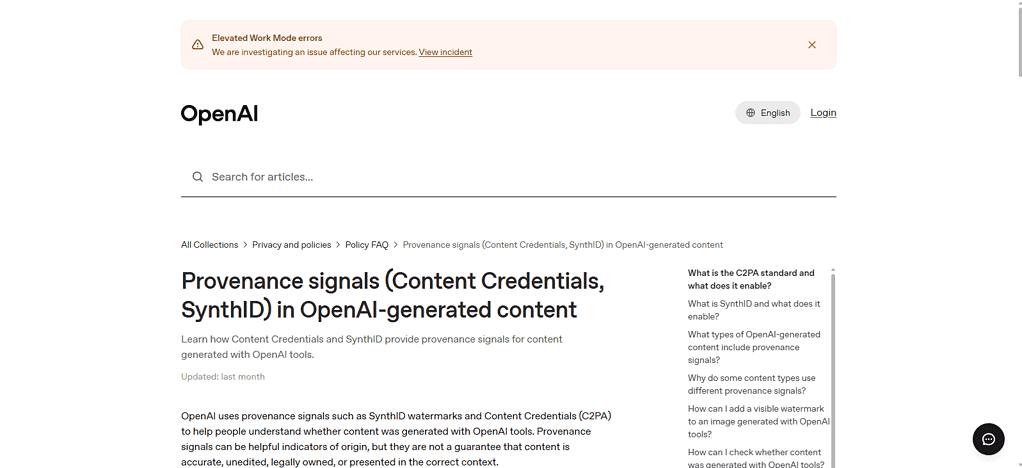
Security & Verification: C2PA offers signed metadata; SynthID adds embedded watermarking. Integrations: ChatGPT, OpenAI API, ImageGen, Sora, verification workflows. Technology: C2PA Content Credentials, cryptographic provenance, SynthID watermarking and verification APIs.
| Features | Pros | Cons |
|---|---|---|
| Adds C2PA Content Credentials to supported images | Provides machine-readable provenance | Not all OpenAI-generated content has identical coverage |
| Uses SynthID watermarking for supported media | Adds a second provenance signal | Signals can be weakened or lost under some transformations |
| Supports provenance verification | Helps confirm supported OpenAI-origin signals | It is not a general-purpose AI detector |
| Supports images and supported audio workflows | Expands provenance beyond images | Current signal coverage varies by product and format |
| Provides a public verification tool | Easy for users to check supported content | A negative result does not prove content is human-created |
| Provides API-based provenance checks | Useful for automated enterprise workflows | Verification only checks supported OpenAI provenance signals |
9. Support for Google Content Credentials
Google participates in the broader content provenance ecosystem, and supports technologies to help identify the source and history of digital media. Supported Content: digital media that carries provenance information and that is compatible, especially if it was generated or modified by AI. Pricing: Google Content Credentials is not a single, standalone subscription and its availability is dependent on the Google product or implementation.
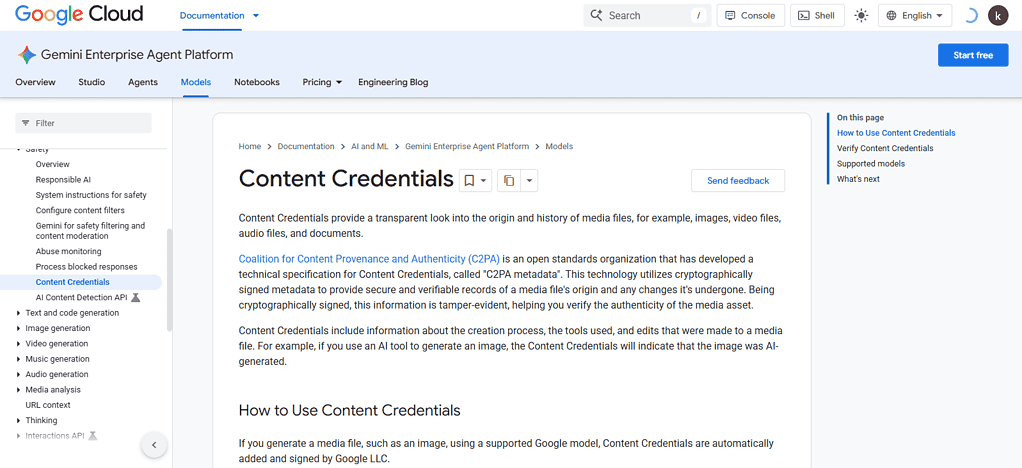
Security & Verification: C2PA uses cryptographic signatures and tamper-evident manifests, and Google’s broader approach to provenance also includes watermarking technologies like SynthID. Integrations: Google AI and digital-content ecosystems are interoperable with open provenance standards. Technology: C2PA, Content Credentials, cryptographic provenance and watermarking.
| Features | Pros | Cons |
|---|---|---|
| Participates in the broader C2PA ecosystem | Supports interoperable provenance | Google support varies across products and workflows |
| Works with content provenance standards | Helps establish content origin | Not every Google-generated or hosted asset necessarily has credentials |
| Uses provenance and watermarking approaches in relevant AI workflows | Multiple layers can improve resilience | Different technologies provide different types of signals |
| Supports transparency around AI-generated media | Helps users interpret digital content | Provenance does not guarantee accuracy |
| Connects with broader industry efforts | Useful for cross-platform provenance | Ecosystem adoption remains uneven |
| Supports technology designed for AI-content identification | Helps trust and safety workflows | Detection coverage depends on the specific implementation |
10. LinkedIn Content Credentials Help
To help members understand the origin and history of supported media published on its platform, LinkedIn supports Content Credentials. Supported Content Image and video content with C2PA information. Pricing: part of the platform experience of LinkedIn, not a separately priced provenance product.
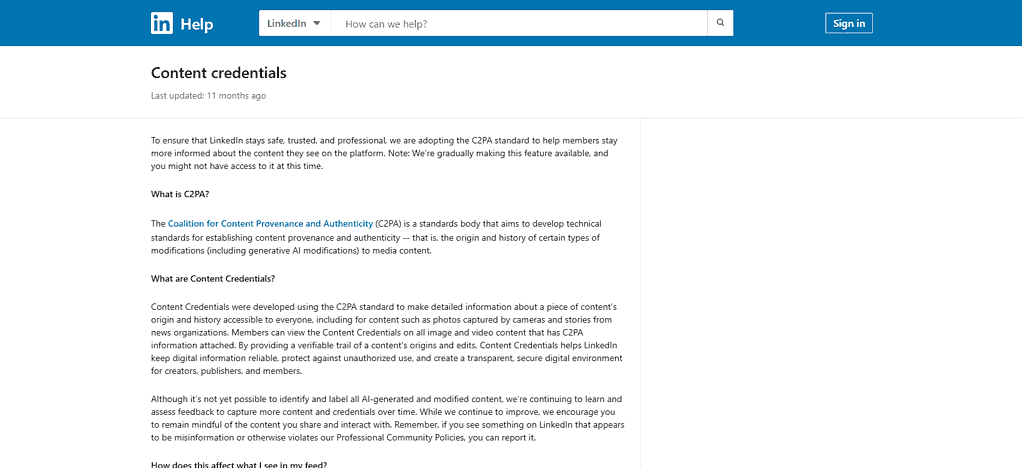
Security & Verification: LinkedIn uses C2PA to expose provenance information added to media. Integrations: Content Credentials can come from compatible creation tools and travel into LinkedIn’s publishing ecosystem. Technology: C2PA Content Credentials provide information about the origin, edits and generative-AI modifications of content, allowing users to make better choices about digital media.
| Features | Pros | Cons |
|---|---|---|
| Supports C2PA Content Credentials | Uses an established open standard | Availability is being rolled out gradually |
| Displays a C2PA icon on supported media | Makes provenance visible to users | Not all AI-generated or modified content can be identified |
| Supports images and videos containing C2PA information | Useful for professional content | Coverage depends on credentials being attached upstream |
| Shows AI-use information when provided | Improves transparency | Information comes from the entity that created and signed the credential |
| Can show creator, issuing entity, app/device, and timestamp | Provides useful provenance context | Metadata availability varies by credential |
| Integrates provenance into LinkedIn posts | Convenient for professional publishing | Does not determine whether content is true or accurate |
Conclusion
AI content provenance platforms are becoming more important for establishing confidence, transparency and accountability in digital media. Tools and standards like Adobe Content Credentials, C2PA, CAI, Truepic and provenance integrations from big tech companies enable users to see where content came from, if AI was used and how an asset has changed over the years.
Supported formats, verification methods, integrations, security, and pricing are where their approaches differ. When selecting a platform, organizations should evaluate C2PA compatibility, cryptographic verification, AI disclosure, creator attribution, metadata preservation, API access, and workflow integration. Together these technologies create a more robust basis for real and verifiable digital content.
FAQ
What Is AI Content Provenance?
AI content provenance is the process of recording and verifying information about digital content, including its creator, origin, AI involvement, editing history, and other changes. It helps users understand where content came from and whether its provenance information has been altered.
How Does AI Content Provenance Work?
AI content provenance typically uses metadata, cryptographic signatures, digital certificates, and provenance manifests to record information about an asset. Standards such as C2PA allow compatible platforms and applications to attach and verify this information throughout the content lifecycle.
What Is C2PA in AI Content Provenance?
C2PA, or Coalition for Content Provenance and Authenticity, is an open technical standard for establishing digital content provenance. It allows creators and technology platforms to attach verifiable information about content origin, creation methods, and subsequent modifications.
Is AI Content Provenance the Same as AI Detection?
No. AI detection generally analyzes content to estimate whether AI generated it, while provenance records information about the content’s origin and history. Provenance can provide verifiable evidence, whereas AI detection is generally an analytical prediction.