

In this article, I will talk about the Best AI Workflow Orchestration Platforms to build, manage and scale complex AI workflows. These platforms enable orchestrating AI agents, LLMs, tools, APIs, data sources, and human approvals, and improve reliability and automation. We will compare their key features, orchestration models, multi-agent support, deployment options, pricing, integrations and overall suitability for different AI use cases.
What Is AI Workflow Orchestration Platforms?
AI workflow orchestration platforms are software tools that orchestrate AI models, agents, APIs, databases, applications, and human actions across complex, multi-step processes. They control the triggering, routing, execution, monitoring, pausing, and completion of tasks while preserving workflow state and managing failures.
These platforms can support sequential and parallel execution, conditional branching, agent handoffs, tool calling, retries, scheduling and human approvals.
And they assist developers and businesses to take individual AI capabilities and combine them into reliable, scalable workflows for automation, customer support, research, data processing, content generation, software development, and other enterprise use cases.
Benefits Of AI Workflow Orchestration Platforms
Automates Complex AI Workflows – Orchestrates multiple AI agents, models, tools, APIs and business processes into multi-step workflows with less manual intervention.
Improves Workflow Reliability – Workflows can continue safely when individual tasks fail, thanks to features like retries, checkpoints, persistent state and failure recovery.
Multi-Agent Collaboration – Can talk to other agents and delegate work to pass work between them and run them in series or parallel with specialized AI agents.
Human-in-the-Loop Workflows – Organizations can insert human approvals, reviews, escalations and intervention points before sensitive AI actions are completed.
More Control Over Your Workflow – Conditional logic, routing, branching, loops, scheduling, and event-based triggers make it easier to manage complex AI processes.
Integrates Multiple AI Models – Teams can use different LLMs and AI services in a single workflow, rather than being tied to a single model provider.
Scalability – Orchestration platforms help to manage increasing numbers of AI tasks, agents, users and workflow executions without re-architecting the entire application.
Enhanced Monitoring and Debugging – Execution logs, traces, workflow history, and observability features allow developers to find bugs and optimize AI workflows.
Enhances Security and Governance – Enterprise platforms can provide authentication, permissions, control of access, audit trails, and policies around AI tools and data.
Reduces Development Complexity – Reusable workflow components, integrations, agent frameworks, and visual builders can reduce the effort to build production AI applications.
Key Points
| Platform | Best For | Orchestration Strength |
|---|---|---|
| LangGraph | Stateful AI agents and complex workflows | Graph-based orchestration, persistence, human-in-the-loop, durable execution |
| Temporal | Reliable production AI workflows | Durable execution, retries, state recovery, long-running workflows |
| Microsoft Agent Framework | Enterprise multi-agent applications | Sequential, concurrent, handoff, group-chat and manager-based orchestration |
| n8n | Visual AI workflow automation | Visual workflows, AI agents, integrations, MCP and human approvals |
| CrewAI | Role-based multi-agent workflows | Agent crews, task delegation and collaborative agent execution |
| OpenAI Agents SDK | OpenAI-based agent workflows | Agents, tools, handoffs, guardrails, sessions and tracing |
| Google Agent Development Kit (ADK) | Google Cloud and multi-agent development | Agent workflows, orchestration and Google ecosystem integration |
| LlamaIndex | Data and RAG-driven AI workflows | Agent workflows, retrieval, data connectors and tool orchestration |
| AWS Bedrock AgentCore | Enterprise AWS agent workloads | Agent runtime, tools, memory, identity and production deployment |
| Dify | Visual LLM and agent workflows | Visual workflow builder, agents, model integration and application deployment |
1. LangGraph
LangGraph, announced in 2024 by LangChain, is an open-source framework for creating stateful, long-running AI agents and workflows. It has a graph-based orchestration model with support for sequential steps, branching, loops, persistence, checkpoints, streaming, human-in-the-loop controls and durable execution. It can orchestrate multiple agents and supports multiple LLM providers with the broader LangChain ecosystem.
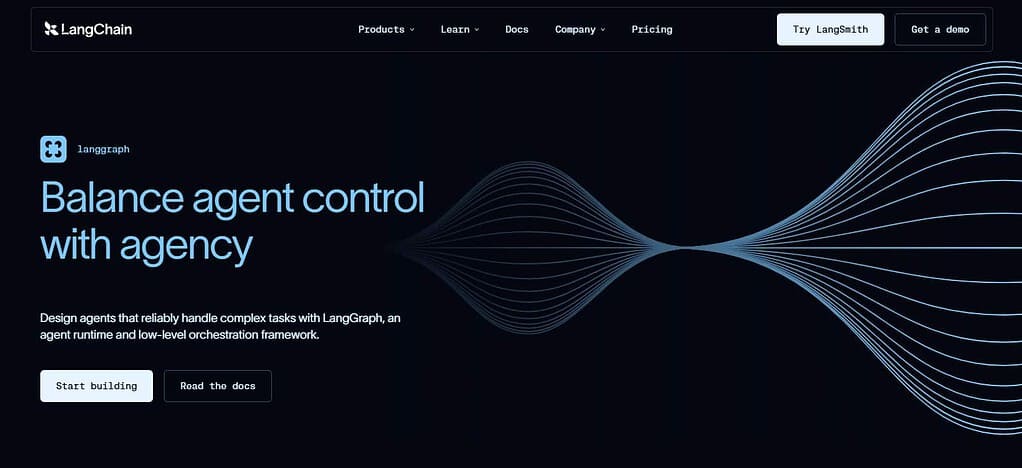
LangGraph can be self-hosted or run via LangSmith Deployment. The framework is free and open-source, with paid deployment and observability plans available from LangSmith. It is best suited for developers building highly customized production AI workflows.
LangGraph’s Features
- Graph-based orchestration for complex stateful AI pipelines
- Workflow recovery via state persistence and checkpointing
- Coordination between multiple agents and agent handoffs
- Human-in-the-loop workflow controls
- Streaming, debugging and production observability support
| Pros | Cons |
|---|---|
| Excellent control over complex stateful workflows | Requires strong programming skills |
| Supports persistent state and checkpointing | Can have a steeper learning curve |
| Strong support for multi-agent architectures | More setup than visual workflow tools |
| Flexible model and tool integration | Advanced deployments may require additional infrastructure |
| Suitable for production agent applications | Best suited to technically experienced teams |
2. Temporal
Founded in 2019, Temporal is a durable workflow orchestration platform for highly reliable, long-running applications. Not merely an AI-agent framework, its orchestration model is code-first, workflow-based. Temporal can coordinate AI model calls, agents, APIs, human tasks, timers, retries and external services while maintaining workflow state.
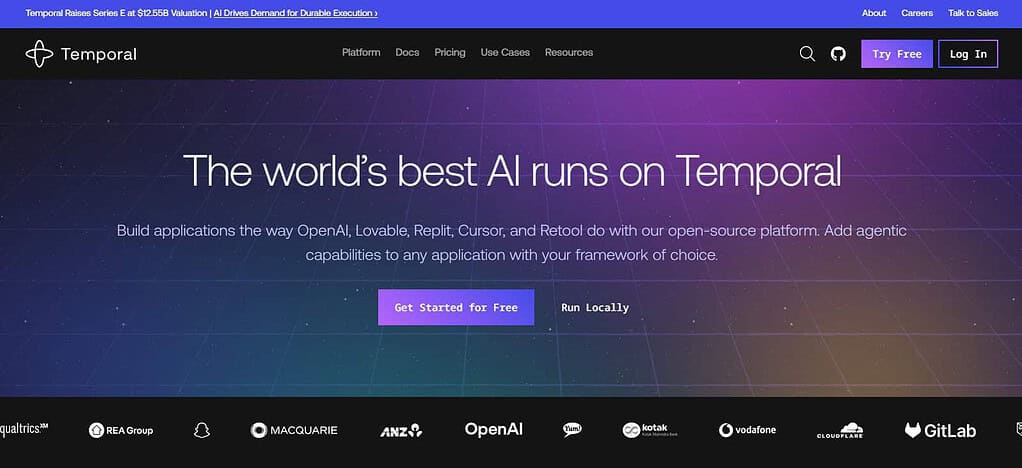
Its strongest reliability feature is durable execution in which workflows can be resumed after crashes or infrastructure failures. Deployment is available on Temporal Cloud or self-hosted Temporal Service. Temporal Cloud is priced on a consumption-based model, mainly on Actions and Storage. The open-source platform is available to self-host.
Temporal features
- Reliable execution of long-running AI workflows
- Automatic recovery and retry on failure
Durable task execution and persistent workflow state - Complex business process orchestration, code-first
- Deployment options, cloud and on-premises
| Pros | Cons |
|---|---|
| Excellent durable execution and reliability | Not specifically an AI-agent framework |
| Strong retry and failure-recovery capabilities | Requires developers to understand workflow concepts |
| Handles long-running workflows effectively | Can be complex for simple automations |
| Supports self-hosted and cloud deployment | Infrastructure management may add complexity |
| Strong fit for enterprise workloads | AI-specific features often require additional frameworks |
3. Microsoft Agent Framework
Microsoft Agent Framework (next-gen of AutoGen and Semantic Kernel) is a developer-focused framework to build AI agents and explicit multi-agent workflows. Its orchestration model supports Magentic patterns: sequential, concurrent, handoff, group-chat, and manager-based. It supports model providers like Microsoft Foundry, Azure OpenAI, OpenAI, Anthropic, Ollama etc.
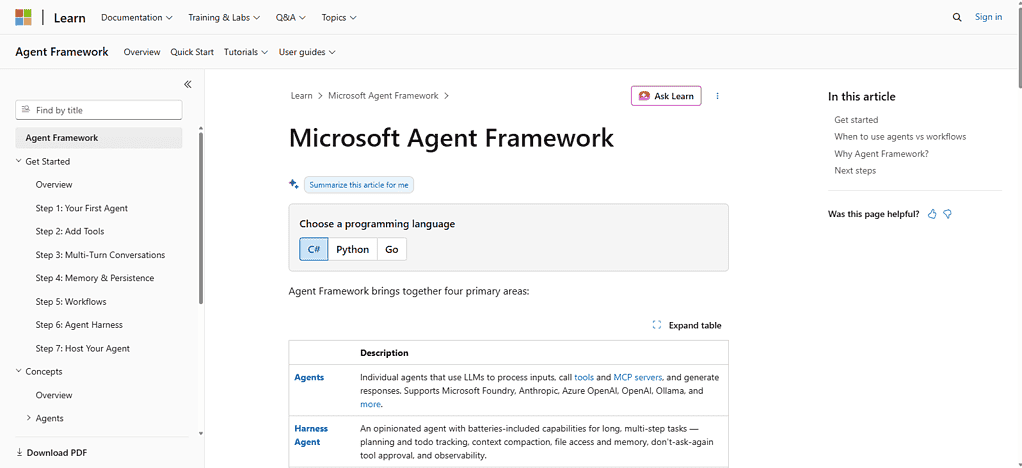
It has reliability features such as state management, checkpointing, middleware, telemetry and human-in-the-loop execution. Deployment can target Microsoft and other environments depending on the application architecture. The framework itself is made available as an open source developer framework but the use of the underlying model, cloud and infrastructure may incur separate fees.
Microsoft Agent Framework Features
- Sequential, concurrent, handoff and group-chat orchestration
- Development and coordination of workflows in multi-agent
- Checkpointing and managing state
human in the loop approval workflows - Microsoft and third party AI model
| Pros | Cons |
|---|---|
| Supports several multi-agent orchestration patterns | Relatively new compared with established frameworks |
| Strong Microsoft ecosystem integration | Can be complex for beginners |
| Supports sequential and concurrent workflows | Best experience may involve Microsoft services |
| Provides state and checkpointing capabilities | Rapid development can mean changing APIs |
| Suitable for enterprise AI applications | Requires programming knowledge |
4. n8n
n8n, a visual workflow automation platform that is open source, was launched in 2019 and has turned into an AI-agent and multi-agent orchestration. Its orchestration model combines deterministic workflow nodes with AI agents, conditional logic, triggers, APIs, tools and human approvals. n8n is great for connecting AI to business systems.
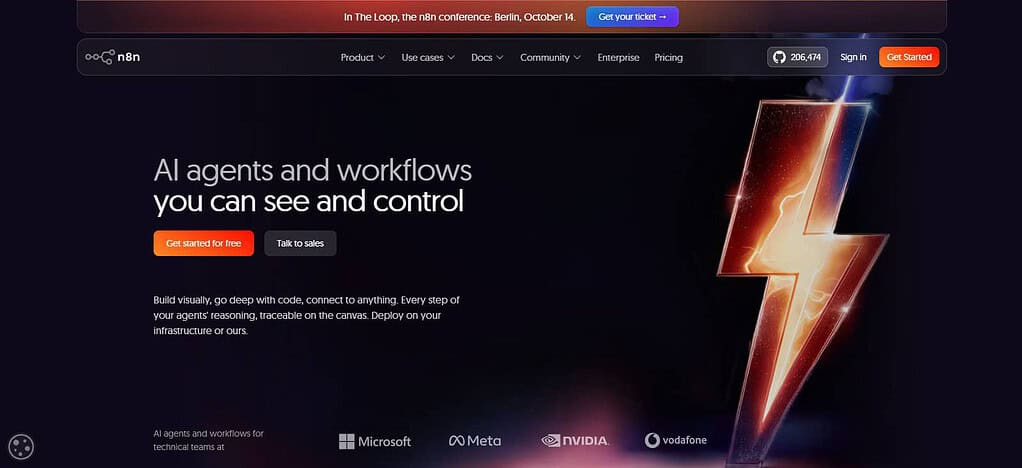
Support for multiple LLM providers, MCP, vector stores, HTTP APIs and hundreds of integrations. It provides cloud hosted and self-hosted deployment. The cloud version starts at €20/month billed annually for the Starter tier, and there’s also a Community Edition that you can self-host.
n8n Features
- Visual workflow designer for Automation & AI
- AI agents with tool and API integrations.
- Big ecosystem of app integrations
- Human approval workflow and condition steps
- Cloud or self-hosted deployment
| Pros | Cons |
|---|---|
| Visual workflow builder reduces coding requirements | Complex workflows can become difficult to manage visually |
| Large range of integrations | Self-hosting requires infrastructure management |
| Supports AI agents and tool calling | Advanced AI logic may require custom code |
| Offers cloud and self-hosted deployment | Pricing can increase with workflow usage |
| Useful for connecting AI with business applications | Less granular than code-first orchestration frameworks |
5. CrewAI
CrewAI was built in 2024 as an open-source multi-agent systems framework for collaborative AI agents and agentic workflows. Its orchestration model uses agents, tasks, crews and flows to orchestrate specialized agents, supporting sequential and asynchronous execution, memory, planning, checkpointing, MCP and A2A collaboration.
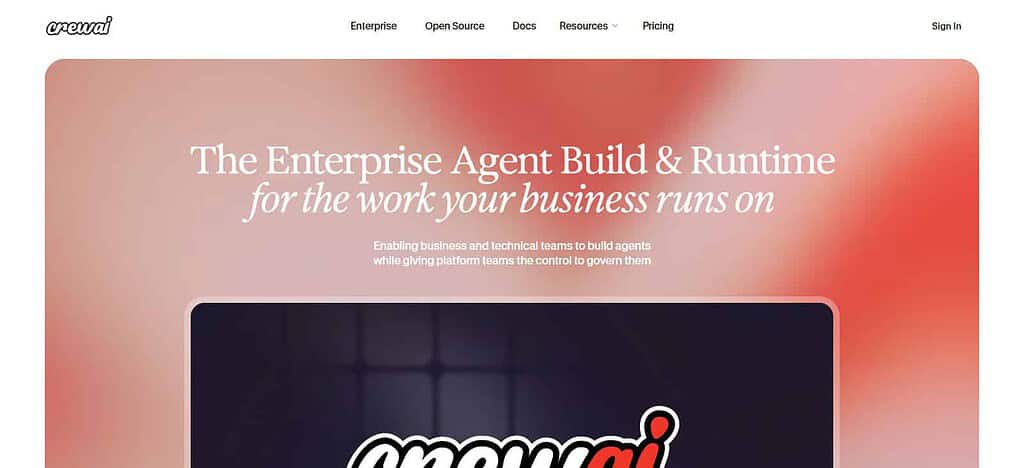
CrewAI supports different LLM providers, instead of limiting applications to a single model vendor. The deployment can be on CrewAI Cloud, customer infrastructure or VPC based enterprise environments. The open-source framework is free. The CrewAI platform offers a free tier with 50 workflow executions per month and custom enterprise pricing.
CrewAI Features
- Multi-agent cooperation based on roles
- Workflow orchestration, crew and task based
- Sequential and non-blocking task execution
- Agent memory, planning, and tool use
- Cloud and self-hosted deployment options
| Pros | Cons |
|---|---|
| Designed specifically for collaborative AI agents | Complex workflows can require careful architecture |
| Role-based agent design is easy to understand | Debugging multi-agent behavior can be challenging |
| Supports task delegation and agent collaboration | Resource usage can increase with multiple agents |
| Open-source framework available | Production deployment may require additional infrastructure |
| Useful for multi-agent business workflows | Less suitable for simple single-agent tasks |
6. OpenAI Agents SDK
OpenAI Agents SDK is the production-ready successor to Swarm, released in 2025 as a lightweight, code-first framework for building agentic applications. Its orchestration model is built around agents, tools, handoffs, agents-as-tools, guardrails, sessions, and runners. It supports multi-agent workflows via manager-style orchestration and specialist-agent handoffs.
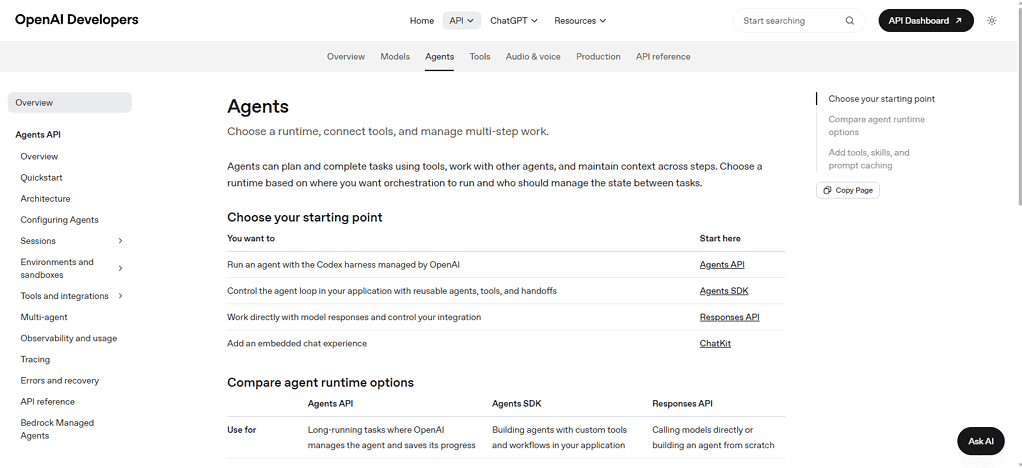
The SDK’s model interface supports OpenAI models as well as non-OpenAI providers. It includes trace, human-in-the-loop, persistent sessions, and integration of MCP tool. The SDK itself is an open-source developer package, with model and platform usage billed separately based on the services selected.
Open Assistant SDK for Agents Features
- Tools: agent handoffs and orchestration of agents
- Controls and built-in guardrails with a human in the loop
- Sessions to preserve agent and workflow state
- Agent execution tracing and debugging
| Pros | Cons |
|---|---|
| Lightweight approach to building agent applications | Developers need coding experience |
| Built-in agent handoffs and tool usage | Some advanced infrastructure must be built separately |
| Supports guardrails and human-in-the-loop patterns | Best optimized around agent-centric applications |
| Includes tracing for debugging and monitoring | Model and API costs are separate |
| Supports flexible agent architectures | Complex enterprise workflows may need additional components |
7. Google Agent Development Kit (ADK)
Google Agent Development Kit (ADK) is an open-source framework for the development, orchestration and deployment of AI agents, introduced by Google in 2025. It coordinates single- and multi-agent systems such as sequential, parallel and hierarchical agent structures.
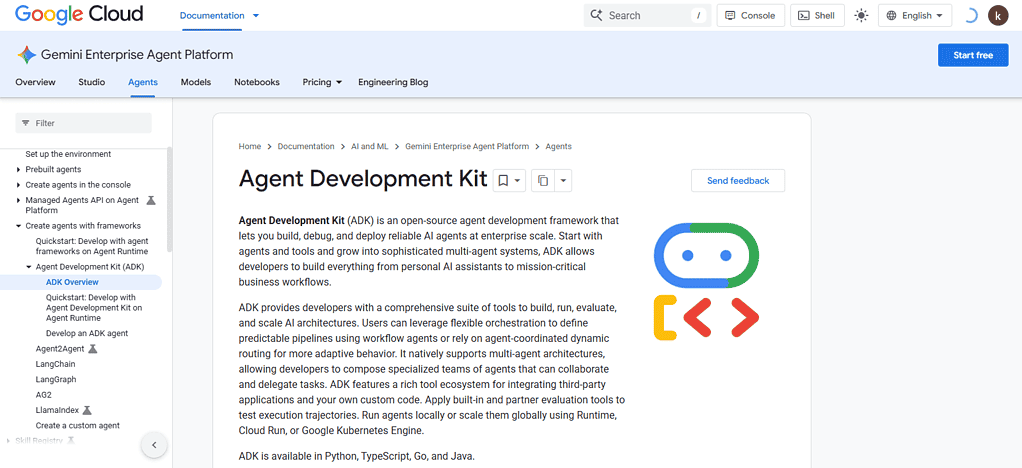
ADK is designed to work especially well with Google’s Gemini ecosystem, but also to support a broader set of model and tool integrations.
Developers are able to build agents and deploy them on Google Cloud environments and other supported infrastructure. The framework itself is open source, but you might get charged for additional usage like the Gemini API, Vertex AI, compute, storage and other deployment services.
Google Agent Development Kit (ADK) Features
- Code-first framework for building AI agents
- Agent orchestration: sequential, parallel and hierarchical
- Building multi-agent systems;
Gemini and multi-model provider support - Tooling, callbacks, sessions & deployment features
| Pros | Cons |
|---|---|
| Strong support for multi-agent development | Requires programming knowledge |
| Supports sequential, parallel, and hierarchical workflows | Google ecosystem can be more attractive for Google Cloud users |
| Designed for flexible agent architectures | Newer ecosystem has fewer mature resources than older frameworks |
| Strong Gemini integration | Complex applications may require additional Google Cloud services |
| Open-source development framework | Beginners may need time to understand agent architecture |
8. LlamaIndex
Founded in 2022, LlamaIndex is an AI application framework aimed at connecting agents and workflows to private and enterprise data. Its orchestration model includes agents, workflows, retrieval, tools, data connectors, and event-driven execution. It is useful for RAG-heavy and data-intensive applications.
It supports multiple LLM providers, not just one model ecosystem, and has hundreds of integrations. The LlamaIndex framework is open-source and can run locally or on a customer’s own infrastructure, and LlamaIndex also offers hosted services such as LlamaParse. So pricing depends on whether developers are using the open source framework or paid hosted services.
LlamaIndex Features
- Data-linked AI agents and workflows
Capabilities of RAG and retrieval workflow - Several data connectors and tool integrations
- Orchestration of event-driven workflows
- Support for multi LLM and embedding provider
| Pros | Cons |
|---|---|
| Strong integration with private and enterprise data | Broad feature set can increase learning complexity |
| Excellent fit for RAG applications | Some advanced capabilities require additional services |
| Supports agents, workflows, and data connectors | Data-heavy workflows may require more infrastructure |
| Works with multiple model providers | Configuration can become complex for large applications |
| Useful for knowledge-intensive AI applications | Less focused on pure workflow durability than Temporal |
9. AWS Bedrock AgentCore
Amazon Bedrock AgentCore (generally available since October 2025) is an enterprise agent infrastructure platform for building, deploying, and operating AI agents using different frameworks, models and protocols.
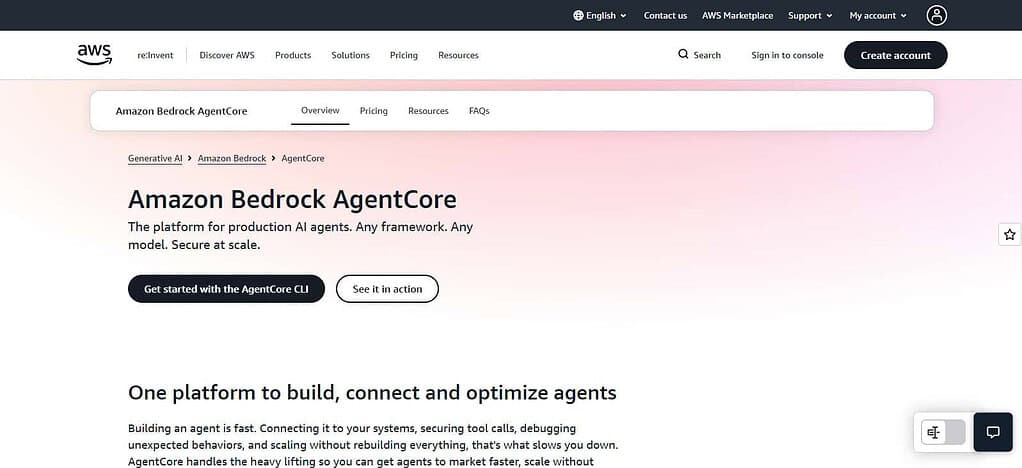
The orchestration model is modular (not tied to a specific agent framework) and supports runtimes, memory, gateway/tool connectivity, identity, browser automation, code execution, observability, and policy controls.
Compatible with frameworks such as LangGraph, CrewAI, LlamaIndex, Google ADK and OpenAI Agents SDK, as well as models from inside and outside Amazon Bedrock. It runs on managed AWS infrastructure and leverages serverless Runtime and VPC capabilities. It bills on a pay-as-you-go basis with no upfront commitment.
AWS Bedrock AgentCore Features
- Execution time for deploying AI agents
- Agents with memory and persistent context
- Secure tool and API connectivity over Gateway
- Identity, Authentication and Access Control Features
- Production monitoring and observability
| Pros | Cons |
|---|---|
| Designed for production AI-agent infrastructure | Primarily attractive to AWS-oriented teams |
| Supports multiple agent frameworks and models | AWS architecture can have a learning curve |
| Provides managed runtime and memory capabilities | Usage-based costs can become complex |
| Strong security and identity capabilities | Less suited to very simple AI workflows |
| Integrates naturally with AWS services | Vendor-specific cloud dependencies may increase |
10. Dify
Dify is an open-source platform for visual building, deploying, and managing AI applications, workflows, agents, and RAG systems, founded in March 2023. The orchestration model is visual and workflow-based, so you can connect LLMs, knowledge retrieval, tools, triggers, conditions, and application logic without having to build it all from code.
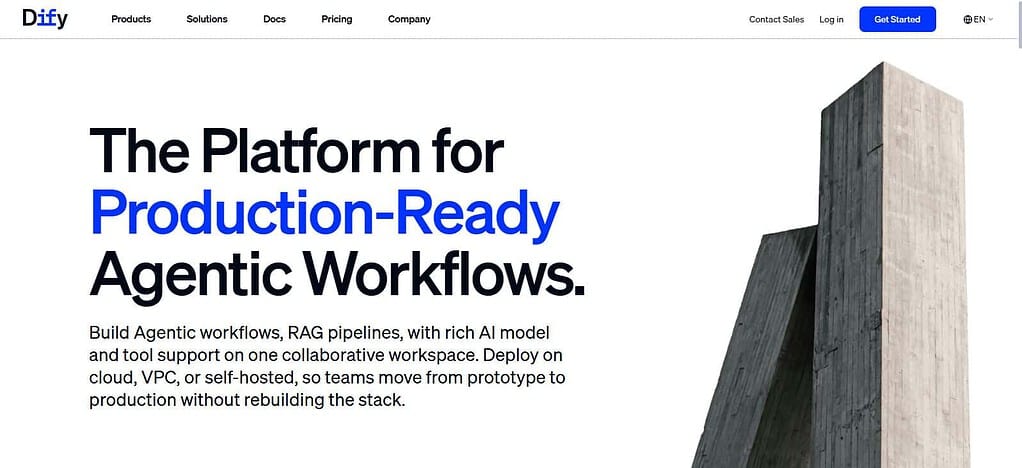
Dify supports models from providers like Open AI, Anthropic, Gemini, xAI, Tongyi, and can be used for agent and multi-step workflows. Deployments include Dify Cloud and self-hosting. Its current Cloud Sandbox is free, Professional is $59/month billed annually, and Team is $159/month billed annually.
Dify Features
- LLM, agent & tool integration
- AI application visual workflow designer
- Integrated RAG and knowledge-base features
- Workflow debugging and control of execution
- Cloud and on-premises deployment options
| Pros | Cons |
|---|---|
| Visual interface makes AI workflows easier to build | Highly complex workflows may outgrow the visual approach |
| Supports agents, workflows, and RAG applications | Advanced customization may require coding |
| Open-source and self-hosted options | Self-hosting requires technical maintenance |
| Supports multiple LLM providers | Large workflows can become difficult to organize |
| Good option for rapid AI application development | Enterprise requirements may need additional infrastructure |
Conclusion
In 2026, AI workflow orchestration platforms will be critical for developing reliable, scalable, and production-ready AI applications. LangGraph and Microsoft Agent Framework offer strong agent orchestration capabilities, while Temporal provides durable execution and reliability. n8n and Dify offer easy visual workflow creation, while CrewAI, OpenAI Agents SDK and Google ADK enable flexible multi agent development.
LlamaIndex is great for data and RAG workflows, and AWS Bedrock AgentCore gives you the enterprise infrastructure to deploy and run agents. Which is the right platform for you depends on how complex your workflow is, which models you want to use, how you want to deploy, how reliable it needs to be, what integrations you need and of course your budget.
FAQ
What is an AI workflow orchestration platform?
An AI workflow orchestration platform coordinates AI agents, LLMs, tools, APIs, data sources, and human actions across multi-step workflows. It manages execution, routing, state, errors, approvals, and workflow dependencies.
Which is the best AI workflow orchestration platform in 2026?
There is no single best platform for every use case. LangGraph is strong for complex stateful agent workflows, Temporal for durable execution, n8n for visual automation, and Microsoft Agent Framework for structured multi-agent applications.
What is the difference between AI agents and workflow orchestration?
An AI agent can make decisions and perform tasks using tools, while workflow orchestration controls how multiple tasks, agents, tools, and systems interact. Orchestration adds structure, routing, state management, retries, and execution control.
Which AI orchestration platform is best for multi-agent workflows?
Microsoft Agent Framework, LangGraph, CrewAI, OpenAI Agents SDK, and Google ADK are strong choices for multi-agent workflows. The right option depends on whether you need graph-based control, role-based agents, handoffs, or enterprise deployment.
Are AI workflow orchestration platforms suitable for enterprise applications?
Yes. Enterprise-oriented platforms can provide capabilities such as durable execution, authentication, access controls, monitoring, tracing, auditability, human approval, persistent state, and scalable deployment. Temporal and AWS Bedrock AgentCore are particularly focused on production infrastructure and reliability.