



Today I will be discussing the Best Deepfake Detection Software For Businesses to help organizations identify AI-generated images, videos, audio, and synthetic identities. We will evaluate their detection technology, business use cases, security, scalability, deployment options, integrations, pricing and key strengths to help businesses choose the right solution to protect digital identity, content and communications.
What Is Deepfake Detection Software for Businesses?
Business deepfake detection software utilizes artificial intelligence, machine learning, biometrics and digital forensics to identify AI-generated or manipulated audio, images, videos and voices. They analyze things like facial movements, voice patterns, visual inconsistencies, metadata, and elements of synthetic media to see if the content may have been tampered with.
They are used by businesses for KYC, fraud prevention, identity verification, customer support, cybersecurity, media authentication and executive impersonation protection. Enterprise solutions may also offer APIs, SDKs, real-time monitoring, risk scores, forensic reports, and scalable deployment that enable organizations to embed deepfake detection directly into their existing security and verification workflows.
Why Choose Deepfake Detection Software for Businesses
Avoid Identity Theft: Identify manipulated faces, synthetic identities and AI-generated media before they can be used for account creation, authentication or financial fraud.
Guard Against Voice Cloning: Detect synthetic voices and voice impersonation attempts that could affect executives, staff, clients and contact center operations.
Enhance KYC Verification: Leverage deepfake detection in identity verification workflows to detect fake selfies, face swaps, injected videos and dubious digital identities.
Stop Financial Losses: Identify AI-generated media used in payment fraud, fraudulent claims, account takeovers, and other financially motivated attacks.
Shield Executive Communications: Help organizations spot suspicious audio and video impersonation of executives or authorized personnel in critical business communications.
Assist in detecting in real time: Some enterprise platforms analyze live calls, video meetings and authentication sessions so organizations can respond while an attack is underway.
Improve Content Authenticity: Media companies, online marketplaces and platforms can verify uploaded images, videos and audio for manipulation before publishing or approving content.
Automated Screening at Scale: Companies can use APIs and SDKs to plug detection into their existing applications and automatically analyze large volumes of digital content.
Enhance Cybersecurity: Deepfake detection is an added security layer beyond authentication, biometrics, device intelligence, fraud monitoring and control of access.
Offer Forensic Evidence Advanced platforms can provide confidence scores, manipulation indicators, metadata findings and investigation reports to empower human review and security decisions.
Key Points
| Software | Key Point |
|---|---|
| Reality Defender | Provides enterprise-grade deepfake detection across audio, video, image, and uploaded media workflows. |
| Hive AI | Offers AI-powered detection of synthetic media for content moderation, platform security, and business risk management. |
| Sensity AI | Specializes in deepfake detection, identity fraud prevention, and synthetic media analysis for enterprises. |
| Pindrop | Focuses on voice deepfake detection and fraud prevention for contact centers, financial institutions, and enterprises. |
| GetReal Security | Provides forensic analysis and deepfake detection tools designed to verify the authenticity of digital media. |
| Resemble AI | Offers deepfake detection and synthetic media security tools for audio, video, image, and enterprise communications. |
| iProov | Delivers biometric verification and liveness detection technology to help identify AI-generated identity fraud. |
| Sumsub | Combines identity verification with deepfake and synthetic-media detection capabilities for compliance and onboarding. |
| Attestiv | Provides media authenticity verification and tamper-detection solutions for enterprises and insurers. |
| Deepware Scanner | Offers deepfake detection technology for analyzing video content and identifying AI-generated manipulations. |
1. Reality Defender
Founded in 2021, Reality Defender is an enterprise deepfake detection platform designed to detect AI-generated and manipulated audio, video and images across business workflows. It employs an ensemble of models and platform-agnostic techniques to perform multimodal analysis for its detection technology.

It supports real-time calls, meetings, uploaded media, APIs & SDKs, allowing flexible deployment in enterprise environments. Security use cases include KYC, call-center fraud, executive impersonation and video conferencing. Enterprise plans aren’t publicly priced. Its API offers a free tier of 50 audio or image scans per month.
Best For Reality Defender
- Deepfake detection for audio, video and image for enterprise
- Real-time protection for calls, meetings and communications
- Fraud prevention teams and financial institutions
- KYC, identity verification and customer protection workflows.
- Organizations that need multimodal media screening through an API
Key Strengths Reality Defender
- Multimodal detection on audio, video, and images
Deepfake detection in real-time live communication
Enterprise Integration with API and SDK Support - Built for fraud, impersonation and identity-risk use cases
- Allows for automated detection within existing security workflows
2. Hive AI
Hive AI is a company established in 2013 that offers AI-powered content detection and visual intelligence services to businesses and developers. The deepfake capabilities include AI-generated images, video and audio, with detection models outputting classifications and confidence scores.
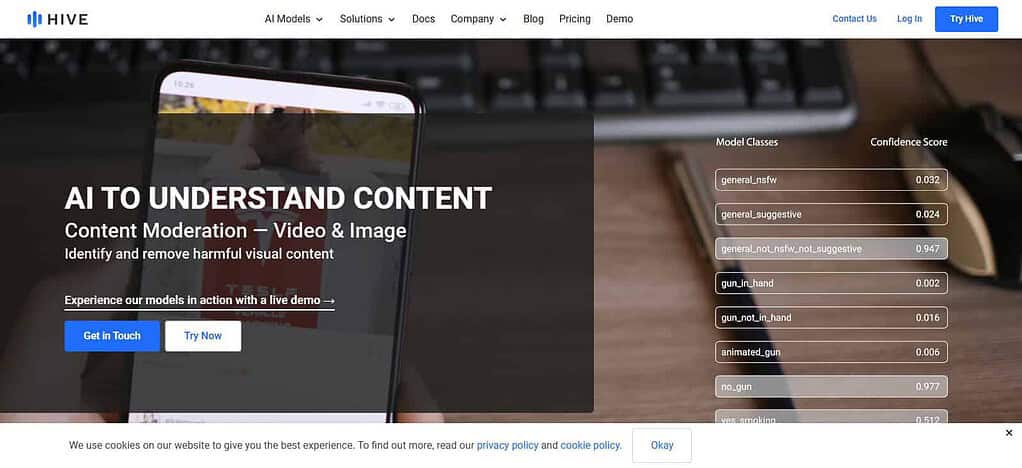
Hive is built for deployment via API, and scales from developer experimentation to enterprise workloads with usage based infrastructure and higher rate limits. The security model supports enterprise content review and controlled workflows, with pricing at $6 per 1,000 image requests, $6 per 1,000 video frames, and $10 per processed audio hour, and enterprise pricing available for larger deployments.
Best For Hive AI
- Detection of AI generated images, videos and audio
- Safety teams and content moderation teams on platform
- Automated large scale media screening
- Developers using AI detection through APIs
- Companies monitoring synthetic content across digital channels
Key Strengths Hive AI
- API-first for developers to integrate with
- *AI generated image, video and audio detection
Good for large scale automated content analysis - Fast classification and confidence based detection results
- Wide-ranging AI content moderation and safety capabilities
3. Sensity AI
Sensity AI provides forensic-level deepfake detection for business via an API designed to analyze video, images and audio. Its technology fuses four independent detection services including Face Manipulation, Content produced by AI, Voice Analysis and File Analysis enabling a multilayered authenticity assessment from a single submission.
The platform produces suspicious or valid results, with confidence scores, visual explanations, metadata, provenance, and file-structure findings. Deployment is mostly API-based supporting direct upload or public URL. Sensity is designed for scalable media verification, investigations, fraud prevention and automated enterprise workflows.
Best For Sensity.ai
- Digital media forensics (investigating suspicious digital media).
- Detecting deepfakes in images, video and audio
- Verification and authenticity processes for the media
- Police and investigative units
- Businesses that require detailed detection reports and analysis
Key Strengths Sensity AI (formerly Deeptrace)
- Deepfake and Synthetic-Media Analysis, Multimodal
- Reports on forensic analysis and detection
- Identification of AI-generated material and editing of faces
Automated workflows through API-based integration - Strong focus on media verification and investigation
4. Pindrop
Founded in 2011, Pindrop is a cybersecurity company that specializes in real-time digital communications, identity verification, and deepfake protection. The company’s platform combines voice intelligence, biometrics, and deepfake detection to help businesses detect synthetic voices and impersonation risks in contact center and communications environments.
It is designed for enterprise deployment, integrating into communication and security workflows, not just as a consumer scanner. Pindrop doesn’t publish enterprise pricing. Businesses typically need to negotiate a custom commercial agreement based on deployment scale, security requirements, and usage volume.
Best For Pindrop
- Voice deepfake detection and voice cloning detection
- Contact centers and customer service operations
- Financial and banking institutions
- Protection from impersonation of executives and customers
- Voice security and fraud prevention in real time
Key Strengths Pindrop
- Audio and voice intelligence next level
- Voice cloning and synthetic speech security is strong
- Real-time fraud detection in Contact Center
Combines fraud signals with voice biometrics - Built for enterprise-grade communication security
5. GetReal Security
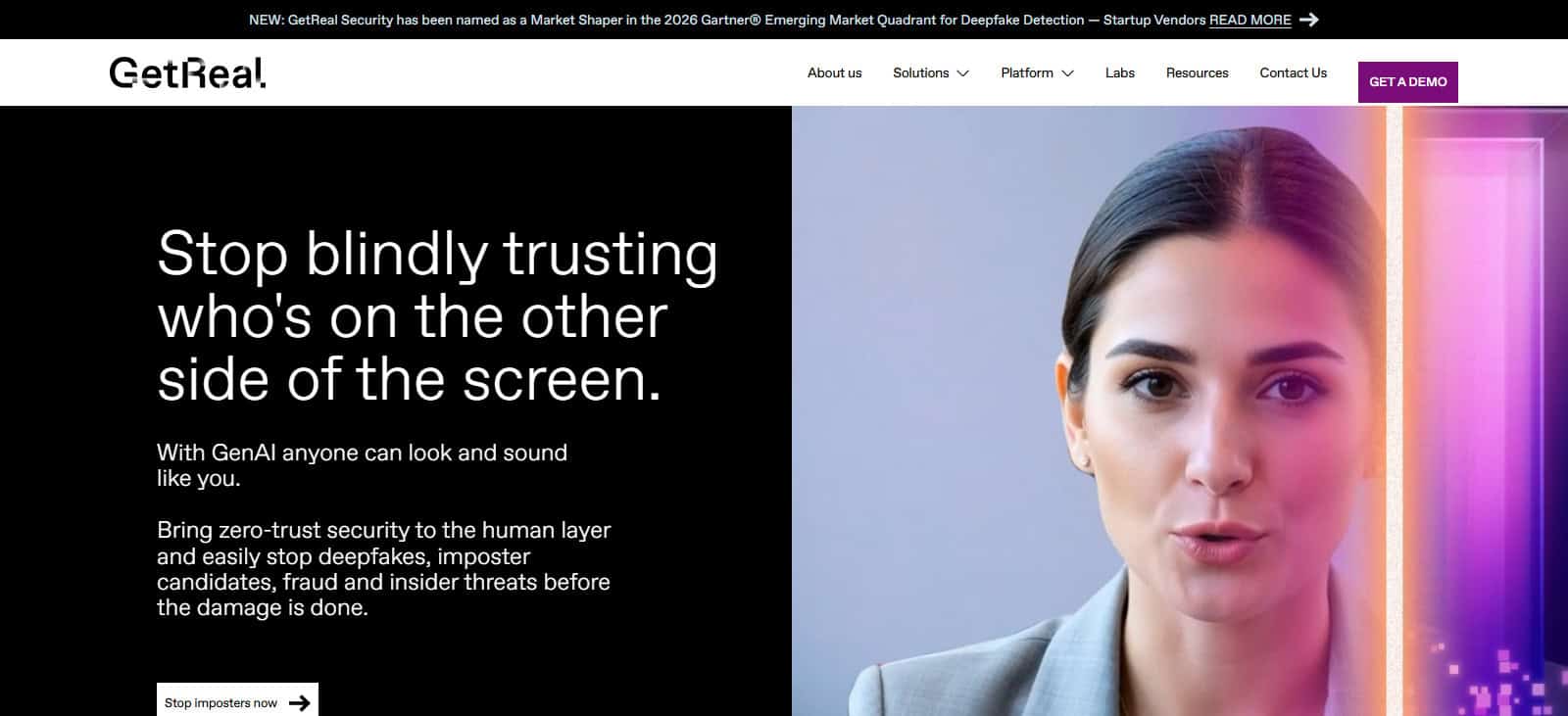
GetReal Security, founded in 2022 by Ted Schlein and Hany Farid, aims to protect enterprises, governments and media organizations from synthetic media and identity manipulation. Its technology uses AI, cybersecurity and digital forensics to analyze suspicious image, audio and video content.
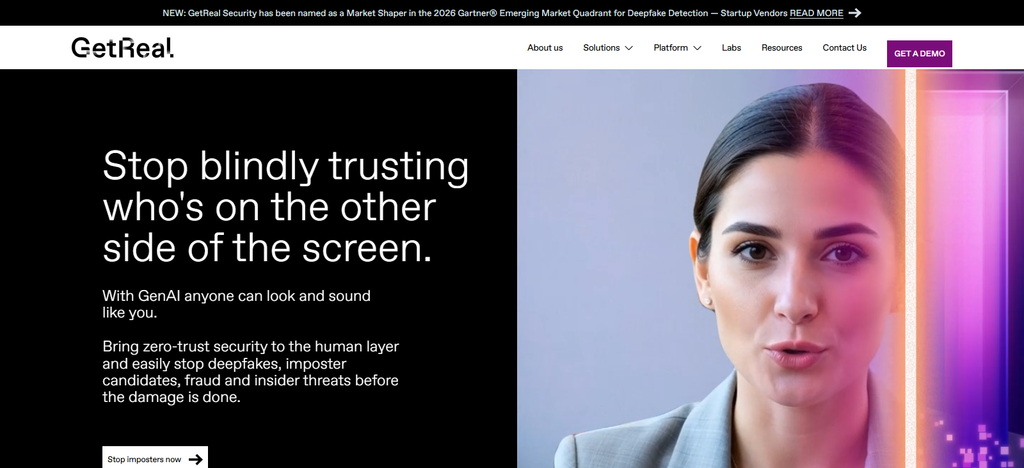
The platform supports prevention, inspection and response workflows, including real-time verification of audio and video streams, and more detailed forensic investigations. It is enterprise-focused deployment with security workflows for high assurance environments. Pricing is not standardized and is tailored to suit the needs of organizations requiring specialized protection and forensic capabilities.
Best For GetReal Security
- Synthetic media risk management in the enterprise
- Spoofing of executives and safe communication
- Government and high security bodies
- Digital forensics and media authentication
- Workflows for prevention and response for organizations
Key Strengths GetReal Security
- Emphasize enterprise synthetic-media threats
Integrates detection into security and response workflows - Enables analysis of images, videos and audios
- Useful in protecting against executive impersonation
- Designed for high-risk enterprise and government deployments
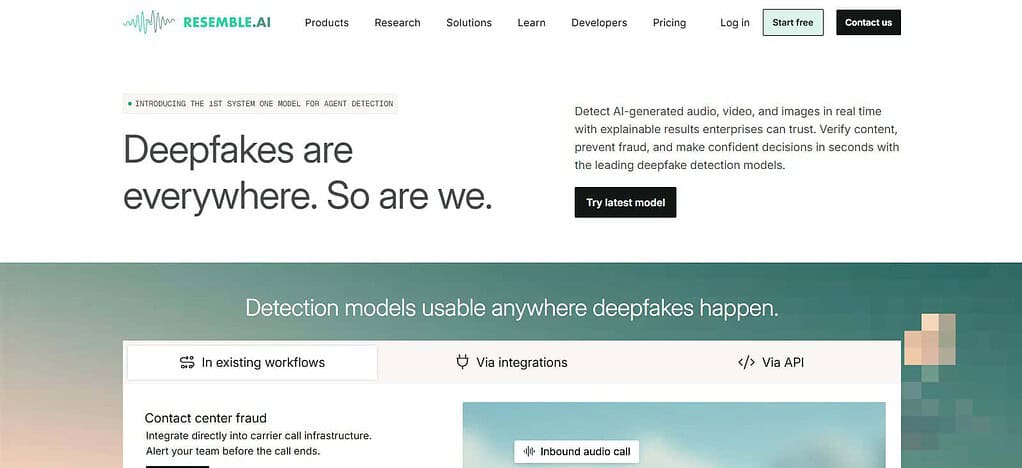
6. Resemble AI
Zohaib Ahmed and Saqib Muhammad founded Resemble AI in 2019, initially building synthetic voice generation before moving heavily into AI misuse detection. Its detection technology can evaluate audio, images and video for synthetic manipulation, and it can also detect watermark evidence such as SynthID if enabled.
APIs are provided for individual files, batches and streaming audio making scalable developer and enterprise deployment possible. Security features include secure media upload options and enterprise controls, and its pricing starts with free access and paid plans, with Business at $1,000/month or $800/year billed monthly equivalent.
Best For Resemble AI
- AI-generated/Cloned Voice Detection
Audio authentication and content checking - Developers embedding detection in applications
- Media & Entertainment industry companies
- Businesses seeking multimodal detection APIs
Key Strengths Resemble.ai
- Powerful AI voice detection
- Support for multi-media detection
- Developer API and streaming features
- Useful for detecting voice cloning and synthetic media
- Merges generative-AI know-how with detection technology
7. iProov
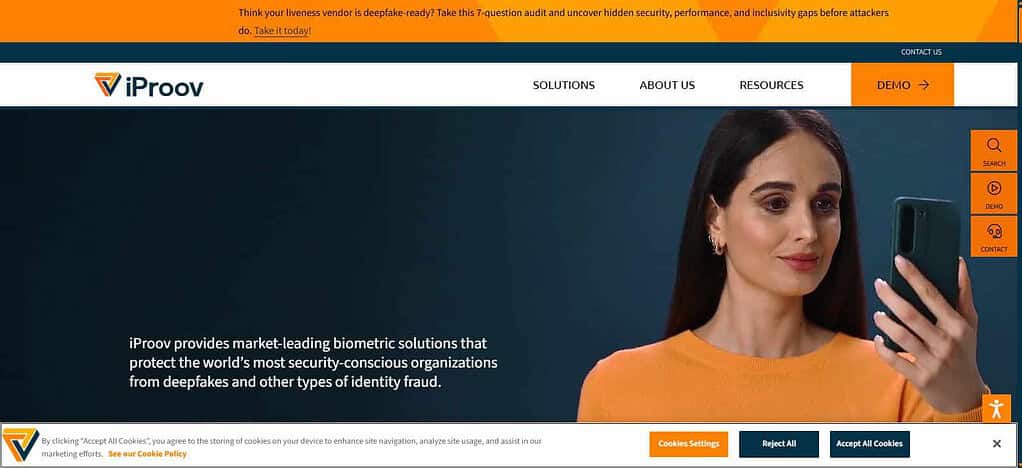
iProov, founded in 2011, specializes in biometric identity verification, authentication, liveness and protection against advanced presentation and injection attacks. Its Dynamic Liveness technology uses patented Flashmark technology to confirm real human presence and help protect against deepfakes, face swaps, masks, presented videos, virtual cameras and other spoofing techniques.
Deployment is enterprise API and SDK based with regional service infrastructure in multiple locations. Security and privacy are fundamental to its architecture, and scalability enables financial institutions, governments, healthcare, fintech and other high-assurance identity workflows. Enterprise pricing is typically on a contract basis.
Best For iProov
- Client onboarding and KYC
- Financial services, fintechs & banks
- Government and high assurance identity programs
- Protection against face swaps, injection attacks and presentation attacks
Key Strengths iProov
- Sophisticated biometric liveliness technology
- Strong protection against face spoofing attacks
- Designed for high assurance identity verification
- Enterprise APIs and SDK’s
- Suitable for KYC, authentication & digital onboarding
8. Sumsub
Founded in 2015, Sumsub has grown from manipulated-image detection to a full-cycle KYC, identity verification, fraud prevention and compliance platform. Its deepfake detection leverages adaptive AI, pixel analysis, pattern recognition, facial biometrics, liveness, device signals, and data from wider fraud networks.

The platform is designed for real-time identity workflows and can be plugged into existing verification stacks with its technology and APIs. Security includes encryption , penetration testing and defense against replay and injection attacks . Sumsub is highly scalable for digital businesses processing large volumes of verification. Enterprise pricing is generally customized based on requirements and usage.
Best For Sumsub –
- KYC, AML & identity verification
- Financial services and fintech platforms
- Preventing fraud and detecting synthetic identities
- Customer Onboarding at Scale
- Businesses that need integrated verification and compliance workflows
Key Strengths Sumsub
- Robust liveness and biometric verification features
Integrated fraud and compliance workflow - Great for customer onboarding at scale
- Provides enhanced KYC and AML protection beyond deepfakes
9. Attestiv
Attestiv was founded in 2018 to provide business workflows using photos, documents, audio and video, with digital-file authenticity. Its DeepScan platform combines AI analysis, forensic signals, metadata review, duplicate and reuse detection, configurable business rules and workflow-data validation.
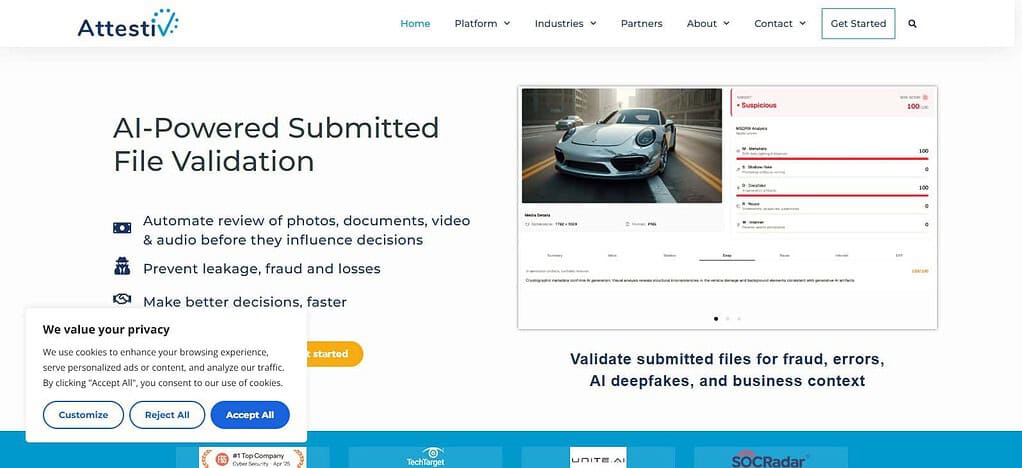
Rather than just providing a deepfake score, it can help organizations decide whether submitted evidence should pass, be flagged, need more information or be escalated. Deployment supports API integration and cloud-scale analysis making it suitable for insurance, lending, claims, compliance, fraud and media workflows. Pricing is customized for each organization rather than being published as a fixed public rate.
Best For Attestiv
- Verifying insurance claims and documents
- Authentication of submitted photos and videos
Fraud detection and validation of evidence - Lending and financial document workflow
- Companies using API-based digital media verification
Key Strengths Attestiv
- stresses digital media authenticity
- Combines AI, metadata and forensic analysis
- Helpful for insurance and claims fraud detection
- Supports automated procedures for evidence validation
- Business integration with API architecture
10. Deepware Scanner
Deepware Scanner is focused on detection of manipulated or synthetically generated video content. Its core workflow allows users to upload a suspicious video to be checked for deepfakes, so it’s more focused than general identity-verification platforms.

The technology is built to detect deepfake video and can be used in media verification, cybersecurity investigations, content moderation and digital authenticity workflows.
Deepware also offers on-premise solutions for organizations wanting controlled deployment. Public enterprise pricing is not clear so businesses should ask for commercial terms directly. Its more narrow focus on video can be helpful when video authenticity is the main requirement.
Best For Deepware Scanner
- Detecting deepfake videos
- Authenticity checking of media
- Cybersecurity and Forensics Teams
- Content moderation and review of suspicious videos
- Organizations that are primarily focused on manipulated video detection
Key Strengths Deepware Scanner
- Expertise in detecting deepfake videos
- Lightweight workflow for suspicious videos analysis
- Good for checking media
- Pertinent to cyber security and investigative workflows
Targeted approach for organizations mostly concerned with manipulated video content
Comparison Table
| Software | Best For | Detection Coverage | Deployment | API / SDK | Pricing |
|---|---|---|---|---|---|
| Reality Defender | Enterprise fraud & impersonation protection | Audio, Video, Images | Cloud, API | Yes | Custom / API options |
| Hive AI | Large-scale AI content detection | Image, Video, Audio | Cloud, API | Yes | Usage-based / Enterprise |
| Sensity AI | Forensic media analysis | Image, Video, Audio | API / Cloud | Yes | Custom |
| Pindrop | Voice fraud & deepfake detection | Voice, Audio | Enterprise / API | Yes | Custom |
| GetReal Security | Enterprise synthetic-media security | Image, Video, Audio | Enterprise | Yes | Custom |
| Resemble AI | Voice cloning & synthetic-media detection | Audio, Image, Video | Cloud, API | Yes | Free / Paid / Enterprise |
| iProov | Biometric identity verification | Face, Video, Liveness | Cloud, SDK / API | Yes | Custom |
| Sumsub | KYC & identity fraud prevention | Face, Video, Identity | Cloud, API / SDK | Yes | Usage-based / Custom |
| Attestiv | Media authenticity & claims fraud | Image, Video, Documents | Cloud, API | Yes | Custom |
| Deepware Scanner | Deepfake video detection | Video | Cloud / Enterprise | Limited / Enterprise | Custom |
Conclusion
Deepfake detection software is a critical security layer for companies that deal with digital identity, customer verification, communication and online content. Each platform on this list brings a different set of strengths to the table, including multimodal deepfake detection, real-time voice protection, biometric liveness, forensic analysis, and API-based screening.
Before picking a solution, compare detection coverage, technology, scalability, deployment options, security and privacy controls, integrations, pricing, and reporting capabilities. The right platform depends on the organization’s own risks and workflows. Using automation to detect and human review in high-risk environments can make for a more robust defense against the growing threat of AI generated fraud.
FAQ
What is deepfake detection software?
Deepfake detection software uses AI, machine learning, biometrics, and digital forensic techniques to identify manipulated or AI-generated images, videos, audio, and voices. Businesses use these tools to reduce fraud, impersonation, identity attacks, and misinformation risks.
Why do businesses need deepfake detection software?
Businesses need deepfake detection to protect customer identities, financial transactions, employees, executives, communications, and digital content. It can help identify synthetic voices, face swaps, manipulated videos, and other AI-generated media before they cause financial or reputational damage.
Can deepfake detection software detect AI-generated voices?
Yes. Some enterprise platforms specifically analyze audio and voice signals to identify synthetic speech and voice cloning. However, detection capabilities vary between providers, so businesses should verify whether a platform supports the specific audio formats and real-time scenarios they need.
Can deepfake detectors work in real time?
Some platforms support real-time or near-real-time detection for video calls, voice calls, identity verification, and other live workflows. Other tools primarily analyze uploaded files. Businesses should check latency, supported media types, and integration options when real-time detection is required.
Is deepfake detection 100% accurate?
No deepfake detector should be assumed to be 100% accurate. Performance can vary depending on the type of manipulation, media quality, compression, generation technology, and whether the content resembles examples used during model evaluation. Human review can provide an additional layer for high-risk decisions.