

In this article, I will discuss the Best AI Fine Tuning Platforms for Businesses covering their training data support, fine tuning methods, customization controls, pricing, deployment options, security, scalability and integrations. These platforms assist companies in tailoring AI models to specific tasks, proprietary datasets and industry requirements, enhancing accuracy, consistency, efficiency and overall performance in real-world applications.
What Are AI Fine-Tuning Platforms for Businesses?
Enterprise AI fine-tuning platforms are tools that enable organizations to adapt pre-trained AI models to specific tasks, industries and workflows using their own data. These platforms offer infrastructure for preparing training datasets, selecting fine-tuning methods, configuring training parameters, evaluating model performance, and deploying customized models.
They can be used by businesses to improve accuracy, response style, domain knowledge and task consistency without building an AI model from scratch. Depending on the platform, they may also offer security controls, model monitoring, APIs, governance, scalable compute, and integrations with existing enterprise systems.
Why Choose AI Fine-Tuning Platforms for Businesses
Improved Task Performance: Businesses can fine-tune pre-trained models for specific tasks, resulting in more consistent and better performance for specialized workflows.
Industry-Specific Customization: Organizations can train models to learn the language, processes, style of communication, and other needs specific to their industry.
Use your proprietary data: Companies may utilize pertinent internal datasets to customize model behavior for use cases such as customer support, document processing, coding, and analytics.
More Reliable Results: Fine-tuned models are more likely to follow your preferred instructions, formats, tone, and response patterns across your business applications.
Less Time Developing: Managed platforms offer training infrastructure, datasets tools, evaluation, and deployment so you don’t have to go through the pain of building all of that yourself.
Production-ready deployment: Companies can deploy customized models from training to APIs, managed endpoints, private environments, or existing cloud infrastructure.
Enterprise Security: Top platforms offer enterprise-grade capabilities like access control, encryption, governance, monitoring, and more for managing AI workloads.
Scalable AI Operations: With growing application demand, businesses can scale training and inference resources without having to run all underlying infrastructure themselves.
Cost Optimization: Parameter-efficient techniques such as LoRA and QLoRA can reduce the compute resources required for some customization workloads.
Accelerated AI Development: Fine-tuning tools reduce the time from a general-purpose foundational model to a targeted business application.
Key Points
| Platform | Key Strength |
|---|---|
| Microsoft Foundry (Azure AI Foundry) | Enterprise-grade AI platform with model customization, governance, security controls, and large-scale fine-tuning capabilities. |
| Google Vertex AI | Unified AI platform offering model tuning, AutoML, MLOps, and Gemini-based customization workflows. |
| Amazon Bedrock | Multi-model AI platform supporting fine-tuning and customization of foundation models within AWS environments. |
| Databricks Mosaic AI | Enterprise platform for fine-tuning, training, evaluation, and deployment of open-source and proprietary models. |
| Together AI | Cost-effective managed fine-tuning platform with support for open-source LLMs and integrated deployment workflows. |
| Hugging Face | Industry-standard ecosystem for model training, fine-tuning, model sharing, and deployment across thousands of AI models. |
| OpenAI | Provides fine-tuning capabilities for selected models alongside enterprise AI APIs and customization tools. |
| Fireworks AI | Managed platform known for efficient fine-tuning and deployment of open-weight AI models. |
| DataRobot AI Platform | Enterprise AI lifecycle platform with model customization, governance, monitoring, and deployment automation. |
| IBM watsonx.ai | Enterprise-focused AI studio for building, tuning, governing, and deploying foundation models. |
1. Microsoft Foundry (Azure AI Foundry)
Microsoft Foundry, which debuted as Azure AI Foundry in 2024, offers an enterprise setting for tailoring and deploying AI models. Supported models Fine-tuning Fine-tuning options with labeled training and validation datasets.
Fine-tuning options Supervised fine-tuning LoRA You can customize the training, evaluation, monitoring, and deployment of the model. Pricing includes training token costs, and hosting and inference costs based on the type of deployment. Foundry can be deployed onto Azure infrastructure, giving enterprises governance, scalability, security and integration with Microsoft services.
| Feature | Details |
|---|---|
| Model Catalog | Access to Microsoft, OpenAI, Anthropic, Meta, Hugging Face, Fireworks, and other models. |
| Fine-Tuning | Supports model customization using task-specific datasets, with supported methods including supervised fine-tuning and DPO. |
| Parameter-Efficient Training | Uses LoRA for supported fine-tuning workflows to reduce training complexity and resource requirements. |
| Training Data | Businesses can prepare custom datasets for specific tasks and use cases. |
| Customization Control | Provides model selection, training configuration, evaluation, monitoring, and model lifecycle controls. |
| Deployment | Fine-tuned models can be deployed through Azure infrastructure and managed endpoints. |
| Evaluation | Provides evaluation capabilities for assessing model and application quality. |
| Enterprise Features | Azure identity, governance, monitoring, security, and integration with the broader Azure ecosystem. |
| Business Value | Suitable for enterprises that need customized models while maintaining centralized governance and production management. |
2. Google Vertex AI
Google Vertex AI, launched in 2021, offers managed model tuning for businesses as part of Google Cloud’s AI ecosystem. Training data is a set of labeled examples that are modeled around particular business tasks. The data sets should be representative of real production inputs and outputs.
Vertex AI offers supervised fine-tuning and preference tuning, and parameter-efficient methods can reduce training resources compared to full fine-tuning. Businesses gain control of task-specific customization, evaluation and model serving. Pricing depends on the model, and tuning is charged based on training tokens for the tuning workload.
| Feature | Details |
|---|---|
| Model Ecosystem | Provides access to Google’s Gemini models and other models through the Vertex AI Model Garden. |
| Fine-Tuning | Supports model tuning for improving performance on specialized business tasks. |
| Training Approaches | Offers parameter-efficient tuning and full fine-tuning for supported models. |
| Training Data | Uses high-quality, task-specific datasets that should reflect the data and context encountered in production. |
| Customization Control | Businesses can customize model behavior, syntax, instructions, domain-specific rules, and task performance. |
| Evaluation | Allows businesses to evaluate model performance and identify recurring errors before or after tuning. |
| Deployment | Tuned models can be deployed through Google Cloud infrastructure and managed endpoints. |
| Integration | Works with Google Cloud data, storage, AI, analytics, and application services. |
| Business Value | Strong option for businesses already using Google Cloud that need scalable model customization and production AI deployment. |
3. Amazon Bedrock
Launched in 2023, Amazon Bedrock allows AWS customers to customize foundation models with a managed service. Training data may include labeled prompt-response examples; reinforcement fine-tuning can utilize reward functions, Bedrock invocation data.
Supported customization techniques: supervised fine-tuning, reinforcement fine-tuning and model distillation. You are able to configure training parameters such as number of epochs, batch size, learning rate, warmup steps (if supported). Pricing is typically based on processed training tokens and model storage . Custom models are also available for on-demand inference deployment .
| Feature | Details |
|---|---|
| Foundation Models | Provides access to models from Amazon and multiple third-party providers, with fine-tuning availability varying by model. |
| Fine-Tuning | Supports supervised fine-tuning for adapting models to specific business tasks. |
| Reinforcement Fine-Tuning | Uses reward functions and feedback-based learning to improve responses against defined business objectives. |
| Model Distillation | Transfers knowledge from a larger teacher model to a smaller, faster, potentially lower-cost student model. |
| Training Data | Supports training and validation datasets stored through AWS services such as Amazon S3. |
| Customization Control | Provides hyperparameters, validation configuration, model naming, tagging, and customization-job controls. |
| Security | Supports IAM permissions, encryption, KMS keys, and optional VPC protection for customization workflows. |
| Deployment | Custom models can be configured and deployed for inference and managed throughout their lifecycle. |
| Business Value | Particularly useful for AWS-based enterprises that want customized models with strong cloud security and infrastructure integration. |
4. Databricks Mosaic AI
Founded in 2013, Databricks provides the Mosaic AI platform for organizations building and customizing models in their data and machine-learning environment. Enterprises can train models on proprietary datasets and embed training workflows that leverage MLflow,
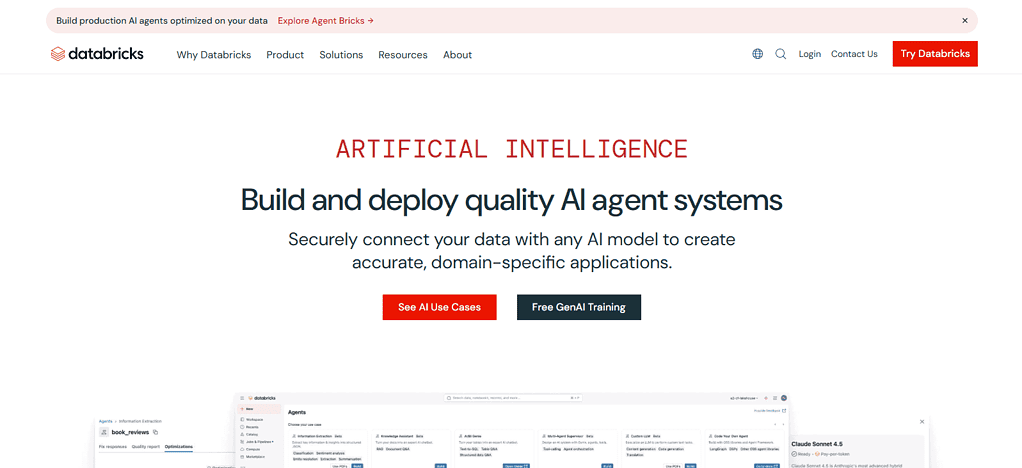
Unity Catalog, distributed GPU infrastructure, and model-management capabilities. Depending on the workflow you choose, fine-tuning can support open models and parameter efficient approaches.
You can control and customize each step—from preparing your data, to tracking experiments, to evaluating and deploying models. Pricing depends on Databricks compute, storage, GPU consumption and services selected and is particularly suitable for data-heavy companies.
| Feature | Details |
|---|---|
| AI Development | Provides an enterprise environment for developing, customizing, evaluating, and deploying AI models. |
| Model Customization | Supports customization workflows for organizations using proprietary enterprise data. |
| Open Models | Provides workflows for working with open-source and foundation models within the Databricks ecosystem. |
| Training Data | Businesses can use their governed enterprise datasets for model training and customization. |
| MLflow Integration | Integrates model experimentation, tracking, evaluation, registry, and lifecycle management through MLflow. |
| Data Governance | Unity Catalog helps organizations manage data, models, permissions, and governance. |
| Customization Control | Gives teams control over training workflows, experiments, evaluation, model versions, and deployment. |
| Deployment | Supports production model serving and integration with Databricks workloads. |
| Business Value | Strong fit for data-intensive enterprises that want AI customization closely connected to their existing data and machine-learning infrastructure. |
5. Together.ai
Together AI was founded in 2022 to specialize in fine-tuning and deploying open-source models for production use. You can train models on proprietary datasets, using either LoRA or full fine-tuning, with supervised fine-tuning and Direct Preference Optimization available for supported models.
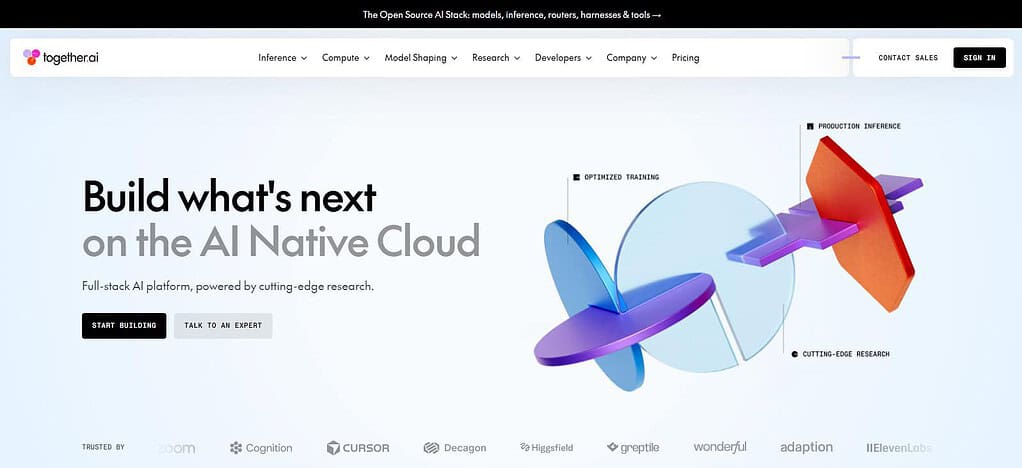
You can customize the model, the training setup, the evaluation datasets, and the deployment options. Pricing is based on tokens and varies based on model size and tuning method. Hosted fine-tuned models may incur additional endpoint charges. Its business value lies in flexible open-model customization, scalable infrastructure and API-based deployment.
| Feature | Details |
|---|---|
| Open-Model Focus | Built around open-source and open-weight models for AI development and deployment. |
| Fine-Tuning | Provides fine-tuning workflows for supported models and business-specific datasets. |
| Training Methods | Supports supervised fine-tuning and parameter-efficient approaches such as LoRA for supported models. |
| Preference Optimization | Supports preference-based customization for selected workflows and models. |
| Training Data | Businesses can use proprietary datasets to specialize models for their applications and domains. |
| Customization Control | Offers control over model selection, training configuration, datasets, and customized model deployment. |
| Deployment | Fine-tuned models can be deployed through Together’s inference infrastructure and APIs. |
| Developer Experience | API-first workflows make it suitable for teams building AI applications programmatically. |
| Business Value | Useful for businesses seeking flexible open-model customization without building the entire GPU training and inference infrastructure themselves. |
6. Hugging Face
Founded in 2016, Hugging Face offers an end-to-end ecosystem for companies building open-source AI models and custom training workflows. Depending on the chosen model and training framework, the training data can be company-specific text, instruction, conversational, classification or domain datasets. Its wider toolbox ecosystem allows for fine-tuning using parameter efficient methods such as LoRA.
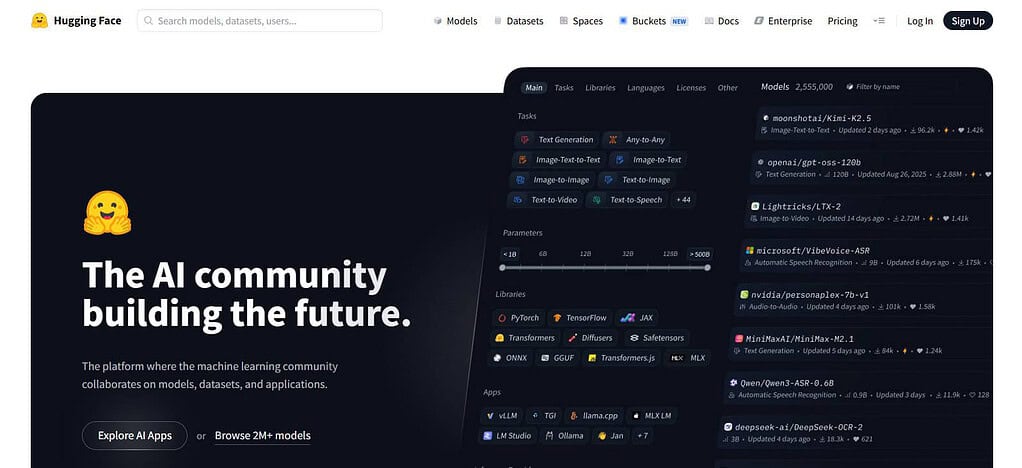
Businesses gain powerful control over customization of models, datasets, training libraries and deployment infrastructure. Pricing varies for compute, hosting and enterprise services, with deployment pricing based on the infrastructure and cloud resources chosen.
| Feature | Details |
|---|---|
| Model Hub | Provides access to a large ecosystem of open-source and open-weight models. |
| Fine-Tuning | Supports extensive model customization through its training ecosystem and libraries. |
| Training Frameworks | Transformers, PEFT, TRL, Accelerate, and related tools support different customization workflows. |
| Parameter-Efficient Training | LoRA and other PEFT techniques can reduce the number of parameters that need to be trained. |
| Training Data | Supports custom datasets for instruction tuning, conversational training, classification, and other specialized tasks. |
| Customization Control | Developers can control model selection, datasets, training configuration, adapters, evaluation, and model versions. |
| Deployment | Models can be hosted through Hugging Face infrastructure or deployed using compatible cloud and self-managed environments. |
| Open Ecosystem | Gives businesses substantial flexibility over models, datasets, libraries, and training infrastructure. |
| Business Value | Best suited to technical teams that want maximum control and flexibility when customizing open models. |
7. Open AI
Founded in 2015, the company has provided model customization through its fine-tuning platform, though current API documentation says the fine-tuning platform is being wound down for new users. Users who already created eligible training jobs can continue to create eligible training jobs for a limited time and keep fine-tuned models available for inference until their base models are deprecated.
Training uses task specific datasets , reinforcement fine-tuning uses graders and reinforcement learning . Pricing is based on active training time and model-grader token costs (if applicable).
| Feature | Details |
|---|---|
| Model Customization | OpenAI has provided fine-tuning capabilities for supported models and business-specific tasks. |
| Training Data | Fine-tuning workflows use task-specific examples prepared in supported formats. |
| Fine-Tuning Methods | Available customization methods depend on the model and current OpenAI API availability. |
| Customization Control | Businesses can customize supported models for specific behaviors, formats, and task requirements. |
| Evaluation | Fine-tuning workflows can be assessed using validation and task-specific evaluation approaches. |
| Deployment | Customized models can be accessed through the OpenAI API when the relevant fine-tuning workflow is available. |
| Developer Integration | API-based deployment makes integration into software applications relatively straightforward. |
| Business Value | Can be useful when a business wants model customization without managing its own training infrastructure. |
| Important 2026 Consideration | OpenAI’s current fine-tuning availability should be checked for the specific model and account because its fine-tuning offerings have changed over time. |
8. Fireworks AI
Founded in 2022, Fireworks AI provides managed infrastructure for tailoring and deploying open AI models. Depending on the model, businesses may utilize proprietary training datasets for supervised fine-tuning, preference optimization, and reinforcement fine-tuning. Teams can choose between LoRA and full-parameter training, offering different trade-offs between cost, speed, and control.
Training costs per million tokens for supervised and preference training and per GPU time for reinforcement training. Fireworks infrastructure can be leveraged to serve fine-tuned models enabling production workloads requiring scalable inference and flexible model customization.
| Feature | Details |
|---|---|
| Open Models | Focuses heavily on open and customizable AI models for production applications. |
| Fine-Tuning | Provides managed fine-tuning workflows for supported models. |
| Training Methods | Supports supervised fine-tuning and other customization approaches depending on model availability. |
| Parameter-Efficient Training | LoRA-based customization can provide a more resource-efficient approach for supported models. |
| Training Data | Businesses can provide proprietary datasets to specialize models for their applications. |
| Customization Control | Offers control over training configuration and the resulting customized model. |
| Inference | Designed for production inference with API-based model access. |
| Deployment | Fine-tuned models can be served through Fireworks infrastructure for application workloads. |
| Business Value | Attractive for companies wanting open-model flexibility combined with managed training and high-performance inference infrastructure. |
9. DataRobot AI Platform
Founded in 2012, DataRobot offers an enterprise AI platform to build, govern, deploy and manage machine learning and generative AI applications. Businesses can bring their proprietary datasets into AI workflows and customize models based on their chosen foundation models and use cases.
Its customization control is not only for model training, but also for enterprise experimentation, evaluation, governance and production management. Pricing is primarily enterprise-centric and varies with platform capabilities, deployment needs, and usage. DataRobot is ideal for companies that need integrated AI governance, workflow management, and operational control.
| Feature | Details |
|---|---|
| Enterprise AI Platform | Provides an integrated environment for building, evaluating, deploying, and governing AI applications. |
| Generative AI | Supports enterprise generative-AI development alongside traditional machine-learning workflows. |
| Model Customization | Businesses can customize AI solutions around proprietary data and specific operational requirements. |
| Training Data | Supports enterprise datasets used for model development, evaluation, and AI workflows. |
| Customization Control | Emphasizes experimentation, model evaluation, governance, monitoring, and production management. |
| Deployment | Designed for deploying AI models and applications into enterprise environments. |
| Governance | Strong focus on AI governance, monitoring, risk management, and lifecycle control. |
| Enterprise Integration | Designed to fit into existing business data, analytics, and operational workflows. |
| Business Value | Particularly suitable for organizations prioritizing centralized AI governance and operational management rather than only low-level model training. |
10. IBM watsonx.ai
IBM watsonx.ai, which was launched in 2023 as a component of IBM’s watsonx portfolio, offers enterprise tooling for foundation models, generative AI, machine learning and model customization. Businesses can work with proprietary datasets and fine-tune supported models with LoRA or QLoRA, with additional controls for model hosting and deployment.
IBM has both pay-as-you-go and enterprise pricing options. Essentials starts at $0/month and Standard starts at $1,110/month (subject to usage and availability). Its business value is governed development, customization, deployment and enterprise support of AI.
| Feature | Details |
|---|---|
| Foundation Models | Provides access to IBM and selected third-party foundation models for enterprise AI development. |
| Fine-Tuning | Supports customization of supported models using business-specific training data. |
| Parameter-Efficient Methods | Supports techniques such as LoRA and QLoRA for compatible models and workflows. |
| Training Data | Businesses can use proprietary enterprise data to adapt models to specific domains and tasks. |
| Customization Control | Provides controls for model development, experimentation, evaluation, tuning, and deployment. |
| AI Governance | Integrates with IBM’s broader governance capabilities for enterprise AI lifecycle management. |
| Deployment | Supports deployment and serving of customized models within enterprise environments. |
| Hybrid Cloud | Designed for organizations operating across cloud, hybrid, and enterprise infrastructure. |
| Business Value | Strong choice for regulated and large enterprises that need model customization combined with governance, security, and lifecycle management. |
Comparison Table: Best AI Fine-Tuning Platforms for Businesses
| Platform | Best For | Fine-Tuning | Training Data | Customization Control | Deployment | Business Strength |
|---|---|---|---|---|---|---|
| Microsoft Foundry | Large enterprises | SFT, LoRA, DPO on supported models | Custom business datasets | High | Azure endpoints and enterprise infrastructure | Governance, security, and Azure integration |
| Google Vertex AI | Google Cloud businesses | Fine-tuning and parameter-efficient tuning | Labeled task-specific datasets | High | Google Cloud managed deployment | Scalable AI development and evaluation |
| Amazon Bedrock | AWS enterprises | SFT, reinforcement fine-tuning, distillation | Training and validation datasets | High | AWS-managed infrastructure | Foundation-model choice and AWS integration |
| Databricks Mosaic AI | Data-driven enterprises | Model customization and open-model tuning | Proprietary enterprise data | Very High | Databricks model serving | Data, ML, governance, and AI in one ecosystem |
| Together AI | Open-model developers | SFT, LoRA, preference optimization | Custom proprietary datasets | High | Managed API and inference | Flexible open-model customization |
| Hugging Face | AI developers and research teams | SFT, LoRA, QLoRA, PEFT and other workflows | Custom text, instruction, and conversational datasets | Very High | Cloud, hosted, or self-managed | Maximum open-source flexibility |
| OpenAI | API-based AI applications | Available methods vary by supported model | Task-specific training datasets | Medium–High | OpenAI API | Simple integration and managed infrastructure |
| Fireworks AI | Production AI applications | SFT and supported customization methods | Proprietary business datasets | High | Managed inference APIs | Open-model customization plus fast inference |
| DataRobot AI Platform | Enterprise AI teams | Model-specific customization workflows | Enterprise datasets | High | Enterprise deployment environments | Governance, monitoring, and AI lifecycle management |
| IBM watsonx.ai | Regulated enterprises | Fine-tuning, LoRA, QLoRA for supported models | Proprietary enterprise data | High | Cloud and hybrid environments | Governance, security, and enterprise AI management |
Conclusion
The best AI fine-tuning platform for you depends on your business goals, model requirements, training data, budget and deployment requirements. If you are an enterprise looking for governance and scalable infrastructure, platforms like Microsoft Foundry, Google Vertex AI, Amazon Bedrock, Databricks Mosaic AI and IBM watsonx.ai are strong choices. Open-source model customization is more flexible with the trio of AI, Hugging Face and Fireworks AI.
DataRobot is all about enterprise AI management. Businesses should compare fine-tuning methods, customization controls, security, pricing, evaluation tools, integrations and production deployment before making a decision. Ultimately, the best platform is one that can reliably run the model and keep customization and operational costs in check.
FAQ
What is an AI fine-tuning platform?
An AI fine-tuning platform provides tools and infrastructure for adapting a pre-trained AI model to a specific business task, domain, dataset, or response style. These platforms typically handle training, evaluation, model management, and deployment.
Which AI fine-tuning platform is best for businesses?
The best platform depends on business requirements. Microsoft Foundry, Google Vertex AI, Amazon Bedrock, and IBM watsonx.ai are strong options for enterprises, while Together AI, Hugging Face, and Fireworks AI offer flexible options for open-model customization.
How much does AI model fine-tuning cost?
AI fine-tuning costs vary based on the platform, model size, training dataset, compute requirements, training duration, and inference usage. Some providers charge by training tokens, while others use GPU-time, compute, endpoint, or enterprise pricing.
What training data is needed for fine-tuning?
Businesses generally need high-quality task-specific examples, such as instruction-response pairs, conversations, classifications, or domain-specific text. The required format and dataset size depend on the model and fine-tuning method being used.