

In this article, I am going to review the Top Deepgram Alternatives for Speech-to-Text. I will compare the top platforms on the basis of transcription accuracy, language support, real-time capabilities, pricing, custom vocabulary, speaker diarization, deployment options and API capabilities. These alternatives can help developers, businesses, and enterprises find suitable speech-to-text solutions for voice agents, meetings, call analytics, media transcription, and multilingual apps.
What Is Deepgram Alternatives?
Deepgram alternatives are speech-to-text platforms that offer similar or complementary functionality for converting spoken audio to written text. These solutions can provide real-time transcription, batch processing, multilingual recognition, speaker diarization, timestamps, custom vocabulary and speech intelligence features.
Popular options include AssemblyAI, Google Cloud Speech-to-Text, Amazon Transcribe, OpenAI Whisper, Speechmatics, Azure AI Speech, ElevenLabs Scribe, Gladia, Soniox and Rev AI. Developers may look to these alternatives for other pricing models, language coverage, deployment options, customization, latency, or integrations.
Depending on the application, a Deepgram alternative can power voice agents, meetings, customer calls, captions, media workflows and other audio-based applications.
Benefits Of Deepgram Alternatives for Speech-to-Text
Language Support Extended: Some alternatives offer broad multilingual coverage, enabling businesses to transcribe conversations in various languages, accents, and regional differences.
Further Customization: Many platforms allow for custom vocabulary, terminology adaptation, prompts, and custom speech models to accommodate industry-specific words, names, products, and technical language.
Live Transcription: Using streaming API options, speech can be converted to text as it is spoken, unlocking new possibilities for voice agents, live captions, call-center use cases, and interactive experiences.
Speaker Segmentation: Speaker identification features segment and label speakers in conversations, enabling applications like meetings, interviews, customer calls, and multi-speaker recordings.
Multiple Deployment Options Businesses can choose cloud APIs, containers, private environments, or self-hosted models, depending on the provider, giving them more control over their infrastructure and data.
Speech Intelligence Capabilities: Some alternatives provide more than just transcription with features such as sentiment analysis, summarization, entity extraction, topic detection, translation and content moderation.
Open Source Flexibility: Developers are able to run open-source models like Whisper to do speech recognition in their own infrastructure and create custom workflows without being completely dependent on a managed API.
Cloud Ecosystem Integration: Google Cloud, AWS and Microsoft Azure services can be easily integrated with existing cloud applications, databases, storage systems, authentication and analytical tools.
Improved workload matching: Teams can compare alternatives and select a speech-to-text platform that matches their needs, including multilingual transcription, voice agents, call analytics, media processing, or privacy-sensitive applications.
Key Points
| Alternative | Best For | Core Speech-to-Text Features |
|---|---|---|
| AssemblyAI | Developers and voice AI applications | Speech-to-text APIs, speech understanding, audio intelligence |
| Google Cloud Speech-to-Text | Enterprise and Google Cloud users | Real-time and batch transcription |
| Amazon Transcribe | AWS-native applications | Real-time transcription, call analytics |
| OpenAI Whisper | Open-source and multilingual projects | Automatic speech recognition and translation |
| Speechmatics | Enterprise and regulated industries | Cloud, on-premises, and offline transcription |
| Microsoft Azure AI Speech | Microsoft ecosystem users | Speech recognition, custom speech models |
| ElevenLabs Scribe | Multilingual transcription workloads | Speech-to-text with diarization and timestamps |
| Gladia | Multilingual and code-switching audio | Real-time speech recognition APIs |
| Soniox | Real-time multilingual applications | Streaming transcription and translation |
| Rev AI | Media, interviews, and transcription services | Automated speech recognition APIs |
1. AssemblyAI
AssemblyAI is a cloud-based AI speech platform founded in 2017 and offers speech-to-text models, Universal-2 and Universal-3.5 Pro. Universal-2 supports 99 languages, and Universal-3.5 Pro focuses on higher accuracy transcription in 18 languages with code-switching. $0.15/hour for Universal-2 and $0.21/hour for Universal-3.5 Pro, starting at.
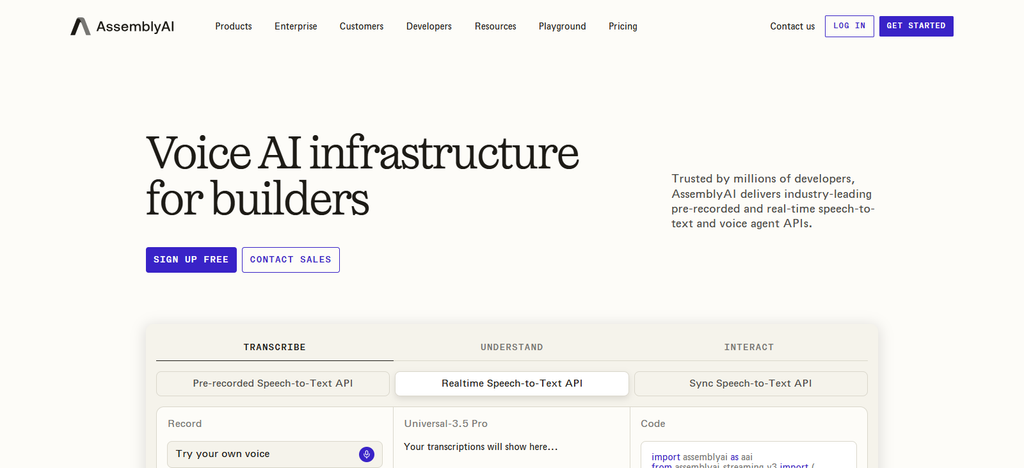
It supports keyterms prompting, custom spelling, word timestamps, language detection, PII redaction, and speaker diarization . The deployment is largely API based cloud infrastructure with SDK support for developers. AssemblyAI also offers real-time transcription through WebSocket-based APIs designed for voice applications and conversational systems.
| Feature | Details |
|---|---|
| Platform Type | AI speech-to-text and Speech Understanding API |
| Speech-to-Text Models | Universal-3.5 Pro and Universal-2 |
| Language Support | Up to 99 languages with Universal-2 |
| Real-Time STT | Yes, including streaming for voice applications |
| Speaker Diarization | Yes, with speaker labels and timestamps |
| Speaker Identification | Yes |
| Custom Vocabulary | Keyterms prompting and domain-specific controls |
| Timestamps | Word-level timestamps |
| Language Detection | Automatic language detection |
| Translation | Transcript translation available |
| PII Redaction | Yes, including transcript and audio redaction |
| Speech Intelligence | Summaries, chapters, sentiment, entities, topics, action items |
| Deployment | Cloud API and self-hosted options |
| Best For | Voice AI, meetings, call intelligence, searchable audio |
2. Google Cloud Speech to Text
Google Cloud Speech-to-Text is an enterprise cloud speech-recognition service powered by models including Chirp 3 for synchronous, asynchronous and streaming transcription. It supports 85+ languages and variants. It is good for multilingual applications.
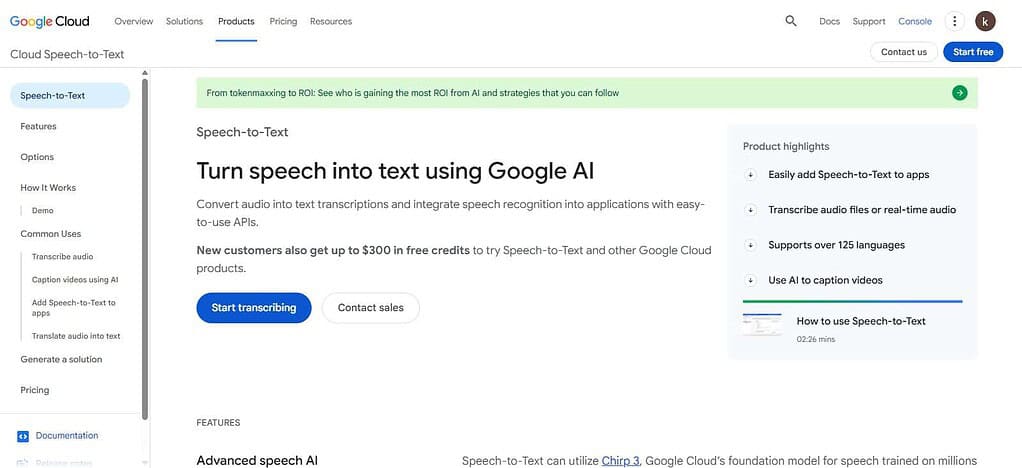
The price is based on usage and on the amount of audio successfully processed. Different API versions, models and processing methods have different prices. Google offers model adaptation to enhance the recognition of words and phrases specific to a domain. Speaker diarization is used to identify the speakers in conversations. Cloud deployment through Google Cloud APIs, enterprise security, and regional processing.
| Feature | Details |
|---|---|
| Platform Type | Enterprise cloud speech-recognition API |
| Speech-to-Text Models | Chirp 3 and other Google speech models |
| Language Support | 85+ languages and variants |
| Real-Time STT | Yes |
| Batch/Long Audio | Yes |
| Speaker Diarization | Available depending on model/configuration |
| Custom Vocabulary | Speech adaptation/model adaptation |
| Timestamps | Supported |
| Language Detection | Available for supported configurations |
| Streaming | Yes |
| Enterprise Integration | Strong Google Cloud integration |
| Deployment | Google Cloud infrastructure |
| Security | Enterprise cloud security and regional processing |
| Best For | Global applications, enterprise workloads, multilingual STT |
3. Amazon Transcription
Amazon Transcribe AWS announced Amazon Transcribe, an automatic speech-recognition service that uses machine-learning speech models to convert recorded or streaming audio into text. It supports both batch transcription from Amazon S3 and real-time streaming . The language support depends on the selected transcription mode. Pricing is pay-per-second, but additional charges may apply for features such as custom language models and PII redaction.
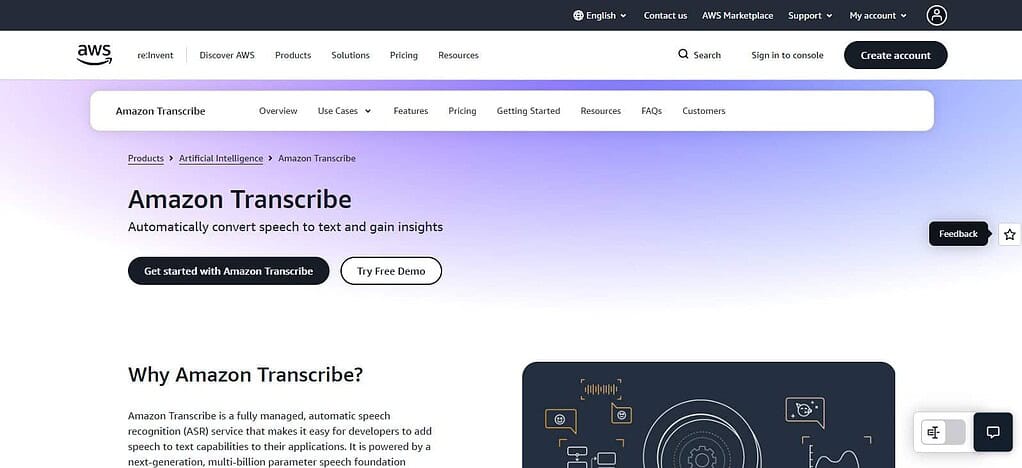
Customization includes language customization and controls on terminology for specialized vocabulary. Amazon Transcribe features include speaker partitioning/diarization, analysis of multiple channels, content filtering, and privacy-centric transcription workflows. It easily integrates with the rest of the AWS ecosystem.
| Feature | Details |
|---|---|
| Platform Type | AWS automatic speech-recognition service |
| Speech-to-Text Model | AWS speech foundation models |
| Language Support | 100+ languages across supported capabilities |
| Real-Time STT | Yes |
| Batch Transcription | Yes |
| Speaker Diarization | Yes |
| Channel Identification | Yes |
| Custom Vocabulary | Yes |
| Custom Language Models | Available |
| Timestamps | Word-level timestamps |
| Language Identification | Supported |
| PII Redaction | Supported |
| Content Filtering | Yes |
| Call Analytics | Yes through Amazon Transcribe Call Analytics |
| Medical STT | Amazon Transcribe Medical |
| Deployment | AWS cloud |
| Best For | AWS applications, calls, media and enterprise workflows |
4. Whisper by Open Assistant
The general-purpose speech recognition model trained on a large dataset of diverse audio, intended for speech recognition, speech translation, and language identification, is called the OpenAI Whisper. The Whisper model is available via the OpenAI API, and the open source model can also be run independently by developers. Whisper API pricing is currently $0.006/minute.
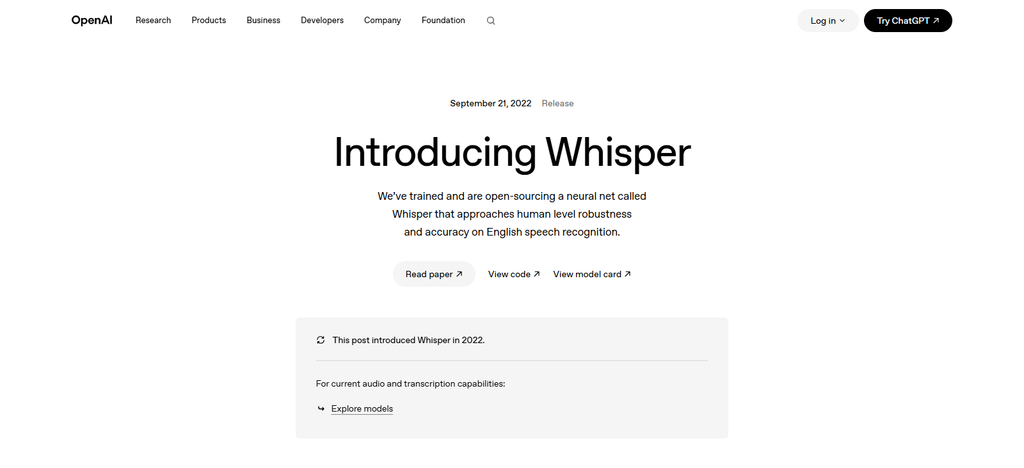
While Whisper supports many languages, it doesn’t have the same built-in customization layer as a dedicated enterprise STT platform, so custom vocabularies and speaker diarization generally require additional application logic or processing. The deployment can therefore vary from using the OpenAI API to self-hosting model infrastructure.
| Feature | Details |
|---|---|
| Platform Type | Open-source automatic speech-recognition model |
| Model Architecture | Encoder-decoder Transformer |
| Training Data | 680,000 hours of multilingual and multitask audio |
| Language Support | Multilingual |
| Speech Transcription | Yes |
| Speech Translation | Yes, including translation to English |
| Real-Time Capability | Requires application/infrastructure implementation |
| Speaker Diarization | Not native to the base Whisper model |
| Custom Vocabulary | Not a built-in enterprise vocabulary feature |
| Timestamps | Phrase-level timestamps |
| Deployment | Self-hosted/local or API-based workflows |
| Customization | Developers can build additional processing around the model |
| Best For | Open-source projects, research, custom speech applications |
5. Speechmatics
Speechmatics is a speech recognition platform providing batch, real-time and agent-centric transcription via its speech-to-text APIs. We have 55+ languages in its current models and Melia 1 has multilingual transcription and automatic language switching. The pro pricing begins at $0.129/hour for the Melia 1 batch model, with different prices for other standard and enhanced models.
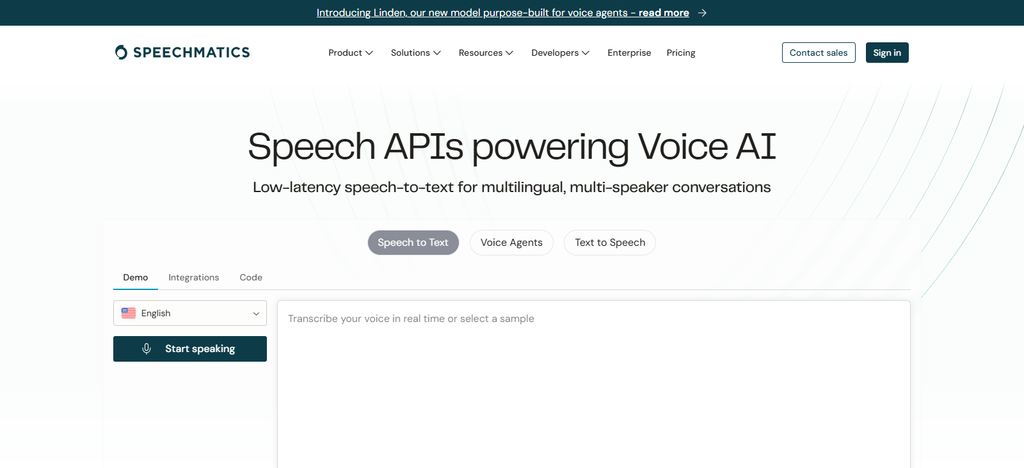
It includes custom dictionaries, language identification, speaker and channel diarisation, accurate timestamps, formatting and number normalization. Highly flexible deployment with cloud, private infrastructure, containers, virtual appliances and on-device options depending on the product and plan, making it suitable for enterprise and privacy-sensitive applications.
| Feature | Details |
|---|---|
| Platform Type | Enterprise speech-to-text API |
| Speech-to-Text Models | Enhanced, Standard and Melia 1 |
| Language Support | 56+ languages |
| Real-Time STT | Yes |
| Batch STT | Yes |
| Agent STT | Yes |
| Speaker Diarization | Yes |
| Channel Diarization | Yes |
| Custom Vocabulary | Custom dictionary |
| Code-Switching | Melia 1 supports multilingual code-switching |
| Timestamps | Word-level timestamps |
| Confidence Scores | Yes |
| Translation | Supported |
| Summarization | Supported |
| Deployment | Cloud, on-premises and on-device options |
| Best For | Voice agents, multilingual applications, enterprise transcription |
6. Microsoft Azure AI Speech
Microsoft Azure AI Speech is a cloud-based speech platform that offers speech-to-text, text-to-speech, translation, and custom speech services. Its speech recognition services include real-time and batch transcription, and Custom Speech allows organizations to customize recognition using their own acoustic and language data.
The pricing is usage based, generally based on audio processing time and includes free monthly usage for the F0 tier. Features include language identification, speaker diarization, pronunciation assessment, custom models, and enterprise security controls.
Deployment options include Azure cloud services and disconnected/container options for qualified scenarios. It works especially well for applications that already use Microsoft Azure infrastructure.
| Feature | Details |
|---|---|
| Platform Type | Enterprise cloud speech platform |
| Speech-to-Text | Real-time, fast and batch transcription |
| Custom Speech | Yes |
| Language Support | Broad multilingual support |
| Real-Time STT | Yes |
| Batch STT | Yes |
| Speaker Diarization | Supported |
| Custom Vocabulary | Yes |
| Custom Models | Acoustic, language and pronunciation customization |
| Translation | Speech translation available |
| SDK | Speech SDK |
| APIs | REST APIs |
| Deployment | Cloud and edge/container environments |
| Enterprise Integration | Microsoft Azure ecosystem |
| Best For | Enterprise apps, custom speech and Microsoft workloads |
7. ElevenLabs’ Scribe
ElevenLabs Scribe is a speech-to-text service on the ElevenLabs voice platform. Scribe v2 and Scribe v2 Realtime for recorded and live transcription. Scribe v2 supports ** 90+ languages ** and the realtime model provides low-latency streaming transcription.
The API is priced at $0.22 per hour for Scribe v2 and $0.39 per hour for Scribe v2 Realtime. Key features include keyterm prompting, word level time-stamps, speaker detection, entity detection, PII redaction and dynamic audio tagging for non-speech events. It is mostly implemented via ElevenLabs APIs and SDKs. It is useful for voice agents, captions, media processing and conversational applications.
| Feature | Details |
|---|---|
| Platform Type | AI speech-to-text API |
| Speech-to-Text Models | Scribe v2, Scribe v2 Realtime and Scribe v2 Medical |
| Language Support | 90+ languages |
| Real-Time STT | Yes with Scribe v2 Realtime |
| Keyterm Prompting | Yes, up to 1,000 terms in Scribe v2 |
| Speaker Diarization | Yes, up to 32 speakers |
| Entity Detection | Yes |
| Timestamps | Precise word-level timestamps |
| Audio Event Detection | Yes |
| Multilingual Transcription | Yes |
| Indic-English Handling | Improved code-switching support |
| Deployment | API and ElevenLabs platform |
| Best For | Voice agents, captions, meetings and multilingual media |
8. Gladia
Gladia is a multilingual speech-to-text API platform. It offers asynchronous and real-time transcription via its Solaria models. It supports 100+ languages, automatic language detection, mid-sentence code-switching, word-level timestamps and speaker diarization.
Starter pricing is $0.61/hour for asynchronous transcription and $0.75/hour for real-time processing. Growth pricing starts lower with volume commitments. You can add your own vocabulary, your own prompts, and the platform has added speech-intelligence capabilities.”
Deployment includes managed cloud infrastructure and custom hosting and on-premises deployment for enterprise plans Gladia also offers data control and compliance capabilities for enterprise workloads.
| Feature | Details |
|---|---|
| Platform Type | Multilingual speech-to-text API |
| Core Focus | Real-time and asynchronous transcription |
| Language Support | Broad multilingual coverage |
| Real-Time STT | Yes |
| Batch/Async STT | Yes |
| Speaker Diarization | Yes |
| Language Detection | Yes |
| Code-Switching | Supported |
| Custom Vocabulary | Supported |
| Timestamps | Word-level timestamps |
| Translation | Available |
| Speech Intelligence | Post-transcription analysis capabilities |
| API Integration | Developer-focused API |
| Deployment | Managed cloud with enterprise deployment options |
| Best For | Multilingual apps, meetings, voice AI and transcription workflows |
9. Soniox
Soniox is a speech AI platform for real-time and asynchronous multilingual transcription, with its stt-rt-v5 speech recognition model. It supports 60+ languages in its API with automatic language detection, multilingual speech, speaker diarization, timestamps, and translation features.
Soniox pricing is based on tokens, and its publicly available pricing is approximately $0.10/hour for asynchronous transcription and $0.12/hour for real-time transcription depending on usage. The API rates above include speaker diarization, language identification and smart formatting.
The deployment is mainly API-driven, with real-time and batch workflows for applications that need multilingual speech processing and conversational AI.
| Feature | Details |
|---|---|
| Platform Type | Multilingual speech AI and transcription API |
| Speech-to-Text Model | Soniox real-time STT models |
| Language Support | Multilingual speech recognition |
| Real-Time STT | Yes |
| Multilingual Processing | Yes |
| Language Identification | Yes |
| Speaker Diarization | Yes |
| Translation | Real-time translation capabilities |
| Timestamps | Supported |
| Confidence Information | Supported |
| Customization | Context and vocabulary-oriented controls |
| Streaming | Designed for live audio |
| Deployment | API-based cloud integration |
| Best For | Multilingual voice agents, meetings and live translation |
10. Rev AI
Rev AI (founded 2010) offers developer-oriented speech-to-text APIs for asynchronous files and real-time streaming. Its existing Reverb ASR model supports English and Rev AI’s multilingual offerings support 57+ languages across supported products. Public pricing is $0.20/hour for Reverb Transcription, $0.10/hour for Reverb Turbo, and $0.30/hour for foreign-language transcription.
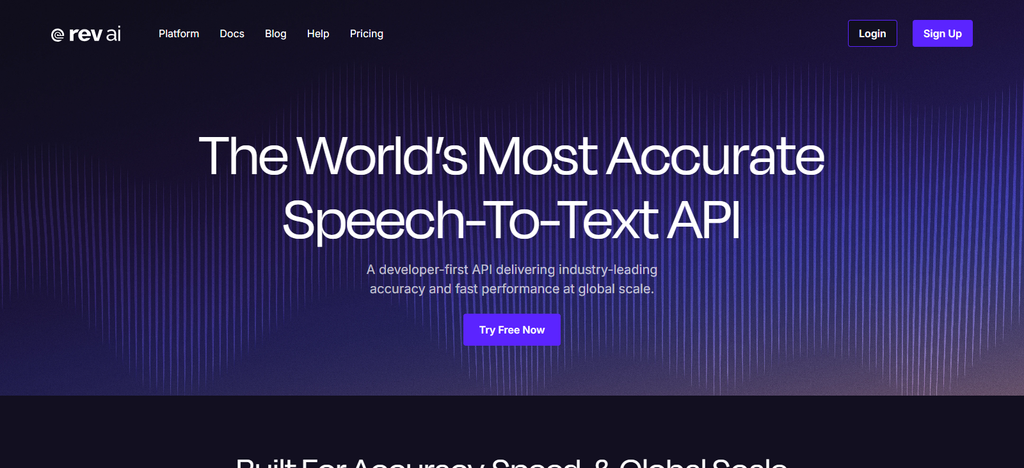
Rev AI supports custom vocabulary, word-level timestamps, punctuation, inverse text normalization, speaker diarization and language detection. We offer deployment through cloud APIs or self-hosted for eligible customers. Its APIs include REST integration, SDKs, webhooks, JSON, SRT, VTT and more.
| Feature | Details |
|---|---|
| Platform Type | Developer-focused speech-to-text API |
| Speech-to-Text | Asynchronous and real-time transcription |
| Language Support | Multilingual support |
| Real-Time STT | Yes |
| Batch STT | Yes |
| Speaker Diarization | Speaker separation available |
| Custom Vocabulary | Yes |
| Timestamps | Word-level timestamps |
| Language Identification | Supported in applicable workflows |
| Formatting | Punctuation and transcript formatting |
| Webhooks | Supported |
| API Integration | REST/API-based development |
| Output Formats | JSON and caption-oriented formats |
| Deployment | Cloud API |
| Best For | Media, captions, calls and developer applications |
Quick Feature Comparison
| Platform | Real-Time | Multilingual | Diarization | Custom Vocabulary | Self/Private Deployment | Key Strength |
|---|---|---|---|---|---|---|
| AssemblyAI | Yes | Yes | Yes | Yes | Yes | Speech intelligence |
| Google Cloud STT | Yes | Yes | Available | Yes | Cloud | Enterprise scale |
| Amazon Transcribe | Yes | Yes | Yes | Yes | Cloud | AWS ecosystem |
| OpenAI Whisper | Custom setup | Yes | Not native | Limited | Yes | Open-source flexibility |
| Speechmatics | Yes | Yes | Yes | Yes | Yes | Deployment flexibility |
| Azure AI Speech | Yes | Yes | Yes | Yes | Cloud/containers | Custom Speech |
| ElevenLabs Scribe | Yes | Yes | Yes | Yes | API/enterprise | Multilingual STT |
| Gladia | Yes | Yes | Yes | Yes | Enterprise options | Multilingual workflows |
| Soniox | Yes | Yes | Yes | Yes | API | Real-time multilingual |
| Rev AI | Yes | Yes | Yes | Yes | Cloud API | Developer transcription |
Conclusion
The Best Deepgram Alternative For You is determined by your speech-to-text needs, including accuracy, latency, language coverage, pricing, customization, deployment, and speaker diarization. AssemblyAI and Speechmatics provide more advanced transcription and speech intelligence.
Google Cloud Speech-to-Text, Amazon Transcribe and Microsoft Azure AI Speech are best suited for organizations already invested in the major cloud ecosystems. OpenAI Whisper allows for flexible model deployment, while ElevenLabs Scribe, Gladia, Soniox and Rev AI target multilingual, real-time and developer workloads.
Try out a sample of representative audio before choosing a provider. Compare quality and latency of transcription, pricing at your expected volume, and verify language, privacy, API, and deployment requirements.
FAQ
What are the best Deepgram alternatives for speech-to-text?
Popular Deepgram alternatives include AssemblyAI, Google Cloud Speech-to-Text, Amazon Transcribe, OpenAI Whisper, Speechmatics, Microsoft Azure AI Speech, ElevenLabs Scribe, Gladia, Soniox, and Rev AI. The right option depends on accuracy, languages, latency, pricing, customization, and deployment requirements.
Which Deepgram alternative is best for real-time transcription?
AssemblyAI, Speechmatics, Google Cloud Speech-to-Text, Azure AI Speech, ElevenLabs Scribe, Gladia, Soniox, and Rev AI offer real-time transcription capabilities. Compare streaming latency, language support, diarization, API features, and pricing for your specific workload.
Is OpenAI Whisper a good alternative to Deepgram?
Yes, Whisper can be an alternative for multilingual speech recognition and transcription. Its open-source availability allows developers to run the model on their own infrastructure, while API access provides a simpler managed approach.
Which Deepgram alternatives support speaker diarization?
Several alternatives provide speaker diarization, including AssemblyAI, Google Cloud Speech-to-Text, Amazon Transcribe, Speechmatics, Microsoft Azure AI Speech, ElevenLabs Scribe, Gladia, Soniox, and Rev AI. Whisper generally requires additional processing for speaker identification.
Which Deepgram alternatives support multiple languages?
Multilingual options include AssemblyAI, Google Cloud Speech-to-Text, Speechmatics, ElevenLabs Scribe, Gladia, Soniox, Rev AI, and Whisper. However, language counts and supported features vary, so individual language requirements should be checked before choosing a provider.