



In this article, I will be discussing the Best Together AI Rivals for Model Inference. I will compare the leading platforms based on inference performance, pricing, supported models, customization, deployment flexibility, context windows, and API compatibility. This guide will help developers and businesses understand the differences between these alternatives and help them find the inference platforms that fit their AI application needs, workloads and scalability requirements.
What Is Together AI Rivals?
Competitors for Together AI include AI infrastructure and model-inference platforms offering alternatives for running, serving and scaling generative AI models. These platforms may vary in terms of supported models, inference speed, pricing models, GPU infrastructure, customization options, deployment models, compatibility with APIs, etc.
Some are aimed at high-performance inference, others at serverless GPUs, dedicated endpoints, multi-model routing or enterprise cloud integration. Common areas of evaluation include latency, throughput, context windows, fine-tuning, custom model deployment, autoscaling and production reliability.
The AI rivals can therefore jointly serve different workloads, including chatbots, RAG applications, coding agents, AI search, multimodal applications, batch processing, and high-volume model inference.
Key Points
| Rival | Best For | Core Inference Offering |
|---|---|---|
| Fireworks AI | Low-latency LLM deployments | Hosted model inference APIs |
| Anyscale | Enterprise AI workloads | Serverless LLM serving and fine-tuning |
| Modal | Custom AI applications | Serverless GPU inference |
| OpenRouter | Multi-model access | Unified inference routing platform |
| RunPod | Self-managed AI infrastructure | GPU-based inference and deployment |
| Replicate | Open-source AI deployment | Hosted model execution platform |
| DigitalOcean GenAI Platform | Developers seeking integrated cloud services | AI inference with cloud infrastructure |
| Amazon Bedrock | AWS-centric enterprises | Managed foundation model APIs |
| Hugging Face Inference Endpoints | Open-source AI builders | Managed model inference endpoints |
| OpenAI API | Production AI applications | Proprietary model inference APIs |
1. Fireworks AI
Fireworks AI, founded in 2022, is an AI inference platform that serves open and custom models at high performance. Pricing: Serverless inference per token, on-demand deployments billed per GPU-second. Its inference technology includes optimized kernels, quantization, speculative decoding, KV-cache optimization, and disaggregated prefill/decode.
Customization: Fine-tuning, Multi-LoRA, Reinforcement Learning, Custom Models The context window is dependent on the model you choose, and there are a few models available today that can handle 128K+ tokens. OpenAI and Anthropic APIs: API compatibility. Supports production inference workloads with serverless, on-demand, and reserved-capacity deployments.
Features
- High Performance Inference: Optimized inference stack including custom kernels, quantization, caching, speculative decoding and disaggregated prefill/decode.
- Large model selection: Supports hundreds of models for text, vision, audio, image and embedding workloads.
- Multiple Deployment Modes: Provides serverless, on-demand and reserved-capacity inference.
- Model Customization: Fine-tuning, Custom Models, Multi-LoRA Deployments.
- API Compatibility: Compatible with both OpenAI and Anthropic APIs, easing the migration of applications.
Pros
- High performance inference infrastructure for production.
- Wide coverage of open-model and multi-modal.
- Supports multiple deployment options for different traffic patterns.
- Strong ability to customize and fine-tune.
- Easy migration with OpenAI-compatible integration
Cons
- Large model and deployment choices can add complexity in configuration.
- Dedicated deployments might require more infrastructure planning.
- Pricing depends on model and mode of deployment.
- Some advanced capabilities are more applicable for production teams rather than simple prototypes.
*Availability and specifications of models are subject to change with new model releases.
2. Anyscale
Founded in 2019 by the creators of Ray, Anyscale is a production model for distributed AI infrastructure platform. Pricing is consumption-based and depends on infrastructure and resources consumed. Its inference engine is a blend of Ray Serve, vLLM, continuous batching, PagedAttention, optimized CUDA kernels, quantization and autoscaling.
Customization Supports custom models, dynamic LoRA adapters and configurable GPU deployments. Context window depends on the deployed model. Current examples include models supporting up to 256K tokens. API compatibility Endpoints compatible with OpenAI. It supports single-GPU up to multi-node deployments, suitable for scalable production inference.
Features
- High Performance Serving: Ray Serve + vLLM for scalable inference
- Automatic Scaling: Can scale model replicas based on traffic, including to zero.
- Multi-LoRA Support: A base model can be shared across multiple fine-tuned adapters.
- OpenAI-compatible API: Offers a familiar API interface for applications built around the same style of requests as used by the original open source implementation.
Pros
- Good basis for distributed computing.
- High-throughput inference.
- Supports batch and real time inference.
- Support for flexible GPU and cloud deployment.
- Useful for complex AI applications with Ray .
Cons
- Ray adds an additional infrastructure layer.
- May be more complex than simple serverless inference APIs.
Pricing is determined by the resources deployed and the usage. - Best for teams that are comfortable with distributed systems.
- May require more engineering effort for simple inference use cases.
3. Modal
Founded in 2021, Modal provides a code-first serverless infrastructure platform for AI inference and machine-learning workloads. Pricing is mostly based on actual compute usage, GPU billing is per second. Current GPU rates vary by hardware. Its inference technology supports custom serving infrastructure, low-latency endpoints, elastic scaling and globally distributed workloads .
Customization is a big feature as developers are able to package their own models, dependencies and GPU configurations using Python. Context window depends on the deployed model and is not a limit across the platform. API compatibility is possible with custom endpoints. Modal scales workloads from 0 to thousands of GPUs.
Features
- Code-First Inference: Execute inference workloads directly from Python.
- Custom Model Support: Supports open-source and custom models with configurable dependencies and GPUs.
- Elastic Scaling: Scale your GPU capacity up or down as needed including scaling down when idle.
- Real-Time Inference: Infrastructure that’s optimized for low-latency serving and streaming.
- Batch Processing: Support large scale offline inference workloads that are dynamically batched.
Pros
- Deployment environment is highly flexible.
- Well-documented support for custom models.
- Automatic scaling of infrastructure.
- Handles both real-time and batch workloads.
For developers, inference is handled with familiar Python workflows.
Cons
- requires developers to follow Modal’s programming model.
- Additional configuration may be required for custom infrastructure.
- Sustained usage of GPU workloads can be expensive.
- More than just a marketplace with a multi-provider model.
- Teams might need to optimize deployments for their particular workload.
4. OpenRouter
OpenRouter is a multi-model inference and routing platform launched in the 2020s that offers a unified API for accessing models from multiple providers. Pricing is model/provider based with Standard accounts currently adding a platform fee and Enterprise pricing customized. Its inference technology includes provider routing, automatic model selection, fallback capabilities and configurable routing policies.
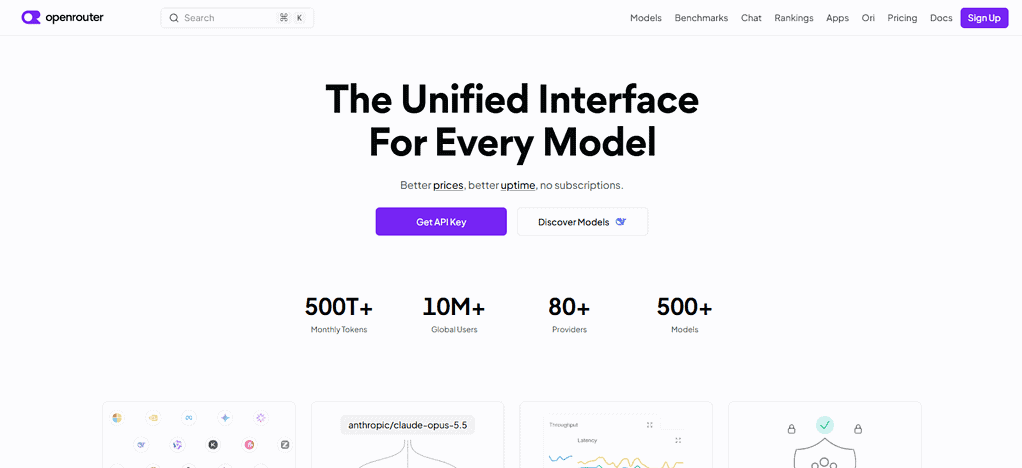
Customization includes preferred providers, routing controls, and model-selection settings. The context window is model specific and is shown for each model, not as a universal setting for the whole platform. API compatibility is for OpenAI style integrations, so migration is fairly easy. Its main value is unified access to hundreds of models and providers.
Features
- Unified Model API: Provides a single API for accessing models from multiple providers.
- Provider Routing: Routes requests across numerous providers according to configurable preferences.
- Automatic Fallbacks: Can use fallback providers when the preferred provider becomes unavailable.
- Auto Router: Automatically selects models based on task requirements and configured cost-quality preferences.
- Model Comparison: Provides model-level information covering pricing, context windows, capabilities, and benchmarks.
Pros
- One integration can provide access to many models.
- Reduces dependence on a single inference provider.
- Supports provider-level routing controls.
- Useful for testing different models quickly.
- Simplifies switching between model providers.
Cons
- It is primarily a routing layer rather than dedicated model infrastructure.
- Performance depends partly on the selected underlying provider.
- Model-specific features can vary.
- Routing configurations may require testing and monitoring.
- Total cost depends on the selected models and provider pricing.
5. RunPod
RunPod was founded by Pardeep and his co-founder as a GPU-focused cloud platform, and has evolved into an AI developer cloud for inference, training and GPU workloads. Pricing varies by GPU, with Serverless billed per second, and current options range from low-memory GPUs to B300-class hardware. Inference technology uses containerized serverless GPU endpoints, FlashBoot, autoscaling and pre-warmed workers.
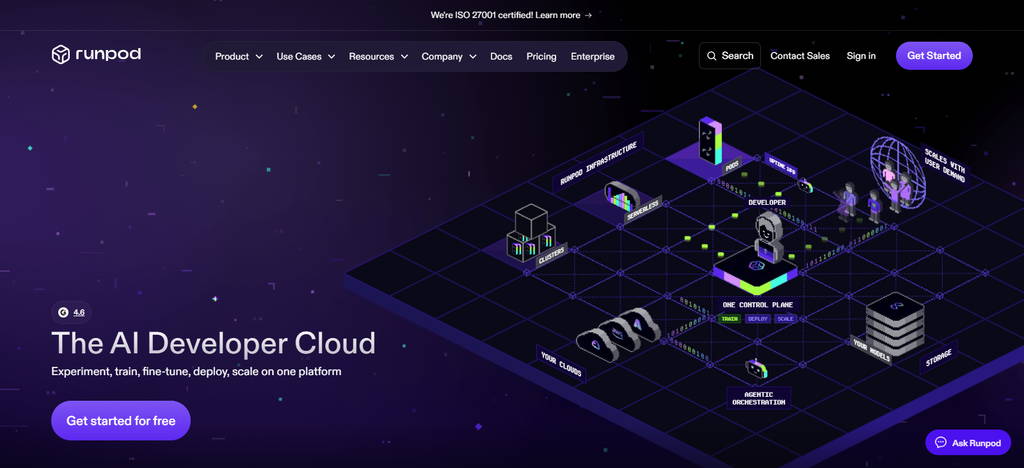
Customization lets developers deploy their own containers and inference workloads. Context window varies depending on the model you select and your available GPU memory. API compatibility is endpoint based and configurable. RunPod is a good choice for variable inference traffic and custom model serving because serverless can scale from zero to hundreds of workers.
Features
- Serverless GPU Inference: Runs containerized inference workloads behind APIs.
- Wide GPU Selection: Offers multiple GPU tiers for different model sizes and workloads.
- Autoscaling: Serverless workers can scale according to incoming demand.
- Per-Second Billing: Serverless GPU usage is metered by the second.
- Custom Containers: Developers can package and deploy their own inference environments.
Pros
- Broad GPU hardware selection.
- Flexible custom model deployment.
- Suitable for bursty inference workloads.
- Per-second billing can suit variable traffic.
- Strong infrastructure control compared with simple model APIs.
Cons
- Users have more infrastructure responsibility than with fully managed model APIs.
- GPU selection requires workload planning.
- Custom containers can require DevOps knowledge.
- Costs can rise with continuously running workloads.
- Performance depends on the selected hardware and deployment configuration.
6. Replicate
Launched in 2019, Replicate is a platform that lets you run open-source and proprietary machine-learning models via APIs, without having to manage the infrastructure yourself. Pricing varies per model: some public models are charged based on hardware runtime, some are charged based on input/output.
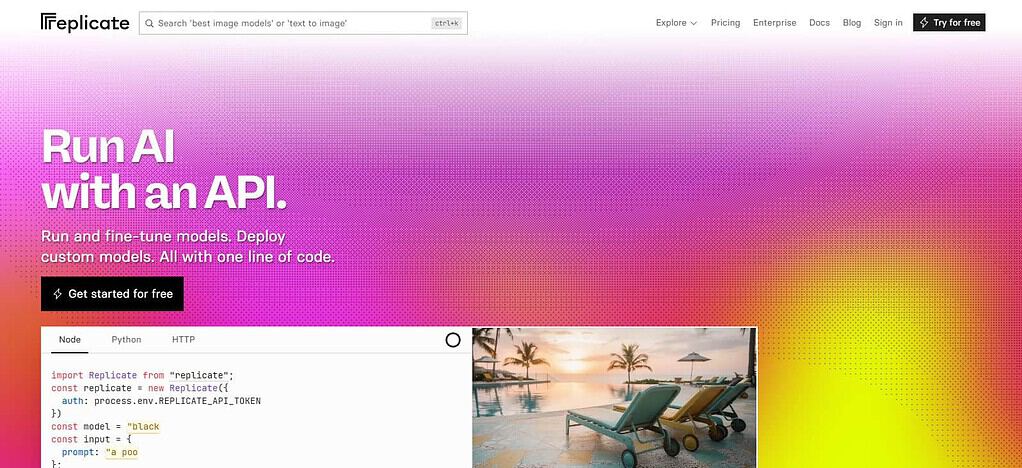
Its inference technology abstracts away model execution behind APIs and supports official models built for stable, always-on serving. Customization Customized model deployments, training workflows. The context window is specific to each model. API compatibility Replicate’s REST API and Official Python and JavaScript clients. Its model ecosystem encompasses generative AI workloads in language, image, video, audio and more.
Features
- Large Model Ecosystem: Provides access to thousands of community and proprietary models.
- API-Based Inference: Models can be called through Replicate’s HTTP API and client libraries.
- Custom Models: Developers can create public or private models and deploy custom weights.
- Flexible Billing: Models may use hardware-time or input/output-based pricing.
- Multiple Modalities: Supports language, image, video, audio, and other machine-learning workloads.
Pros
- Very broad model ecosystem.
- Simple API-based development experience.
- Supports custom and private models.
- Suitable for experimenting with emerging models.
- Hardware options are available for custom deployments.
Cons
- Pricing differs significantly between models.
- Model quality and maintenance can vary across community models.
- Context windows depend on individual models.
- Custom deployments require packaging and infrastructure decisions.
- Large model catalogs can make model selection more difficult.
7. DigitalOcean GenAI Platform
DigitalOcean was founded in 2011 and offers cloud infrastructure for developers, as well as AI inference through its GenAI/Inference platform. Pricing is usage based: serverless inference is charged per million tokens or by model, and dedicated inference is charged per GPU-hour. The inference technology offers a common control plane, model catalog, routing, serverless inference and dedicated deployments. Customization includes BYOM and imported model weights saved through the service.
Context window is model-dependent, with long-context models supported up to approximately 1M tokens at present. API compatibility provides OpenAI-compatible access to its entire model catalog. It supports models like: OpenAI, Claude, Llama, DeepSeek, Qwen, Kimi and others.
Features
- Single inference control plane: A single interface to manage inference workflows.
Model Catalog: Includes foundation models from DigitalOcean and third-party vendors. - Model Routing: Routes requests to models, based on their capabilities and cost.
- Serverless and dedicated inference: Allows both ways of deployment.
- OpenAI-Compatible Endpoints: The text models we support are available through the OpenAI-compatible endpoints.
Pros
- Basic model discovery and comparison
- supports both serverless & dedicated deployments
- OpenAI compatibility can ease migration.
- Covers models from several major manufacturers.
- Existing users get the familiar DigitalOcean cloud environment
Cons
- model availability is dependent on current catalog
- Features may vary by supported model.
- Capacity planning is needed for dedicated infrastructure.
- Routing adds an extra dimension to model selection.
- If you need a highly customized inference stack, you may need lower-level infrastructure.
8. Amazon Bedrock
In 2023, Amazon Bedrock was launched and became generally available in September 2023 as a fully managed AWS foundation-model service. You can usually choose from on-demand to provisioned throughput pricing models, which are based on the model and usage. Its inference technology provides a managed way to access multiple foundation-model providers via AWS infrastructure and APIs.
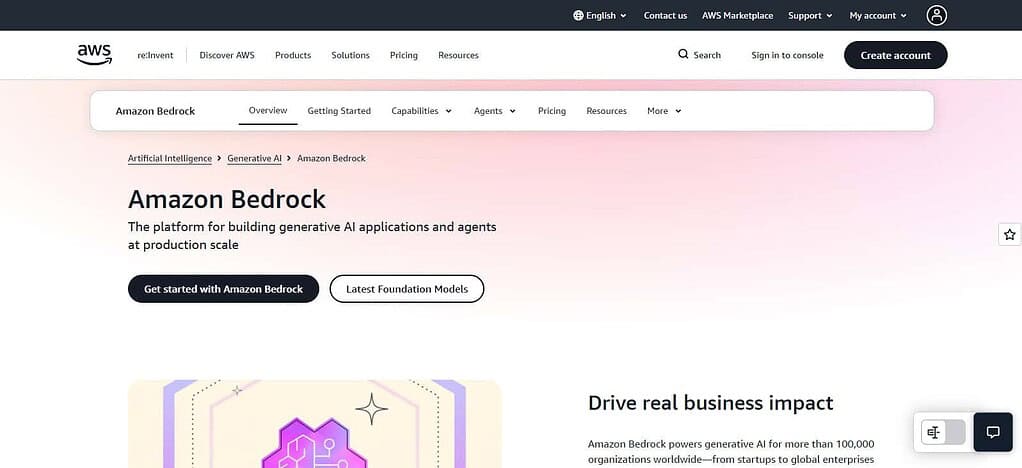
Customizability (fine-tuning, knowledge bases, RAG, agents, and other AWS integrations) The context window depends on the selected foundation model, not one universal limit. API compatibility – Amazon Bedrock APIs and SDKs are used, but request formats are model-specific. It connects with services like CloudWatch and CloudTrail, making it particularly useful for enterprise applications that need AWS-native security and operational controls.
Feature
- Multi-Model Access: Managed access to foundation models on AWS.
- Managed Inference: Developers are able to use foundation models without having to manage model-serving infrastructure.
- Customization: Customizes models and AI workflows native to AWS.
- Enterprise Integration: Integrates with other AWS services for security, monitoring, governance, and infrastructure.
- Application Services: Enables features like agents and knowledge-based AI workflows.
Pros
- Deep integration with AWS infrastructure.
- Broad, enterprise-wide controls.
- Reduced infrastructure management through managed model inference.
- Compatible with multiple foundation model providers.
- For organizations already utilizing AWS.
Cons
- AWS services can introduce a lot of configuration complexity.
- Pricing depends on model and inference mode.
- Architecture specific to AWS can increase platform dependency.
- Complex deployments may require deep knowledge of the cloud.
Models have different capabilities depending on provider and model.
9. Hugging Face Inference Endpoints
Hugging Face was founded in 2016 and provides Inference Endpoints to deploy machine-learning models on dedicated infrastructure. Pricing depends on the compute instance and hourly rate chosen, but billing is done by the minute.
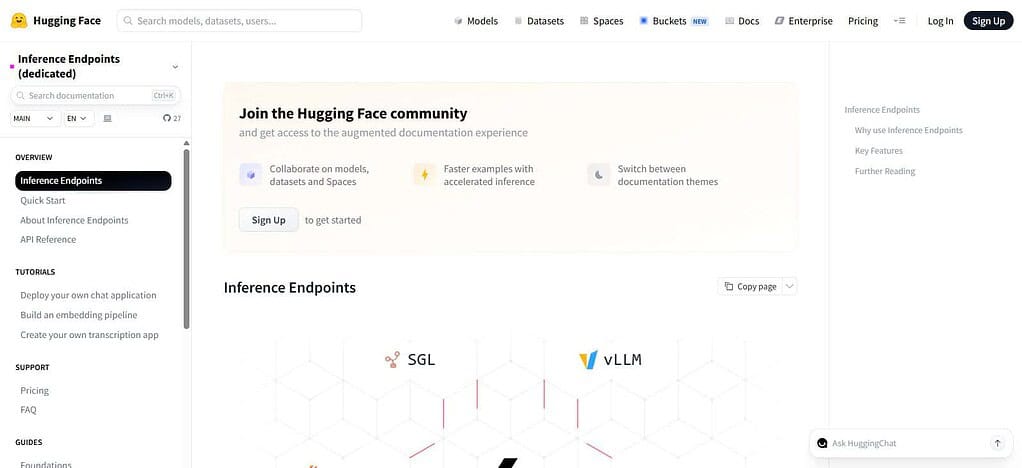
Its inference technology offers managed dedicated endpoints, configurable hardware, scaling and production model serving. The customization is very big: users can deploy models coming from the Hugging Face ecosystem and choose the infrastructure that better fits their workloads.
The context window is determined by the deployed model and its serving configuration. Endpoint APIs and standard HTTP access provide API compatibility. The platform is especially useful for teams that want to manage open-source model deployments without having to worry about the underlying GPU infrastructure themselves.
Features
- Managed Infrastructure Model Deployment: It deploys Hugging Face Hub models on managed infrastructure.
- Autoscaling: Supports dedicated infrastructure that can scale up/down based on workload needs .
- Model Support: Supports Transformers, Sentence Transformers, Diffusers and other compatible models
- Configurable hardware: Choose infrastructure that fits your model.
- API Access: Endpoints are accessible through REST, Hugging Face clients, and other supported interfaces.
Pros
- Great access to the Hugging Face model ecosystem.
*With dedicated infrastructure, you have more control. - Support for open source and custom models.
- Managed deployment takes infrastructure work.
- The hardware can be selected according to the model requirements.
Cons
- Model performance varies based on the serving configuration that you select.
- Even dedicated compute can incur costs when capacity is not fully utilized.
- You need technical knowledge to choose the hardware.
- Some advanced deployments need infrastructure optimization.
Enterprise features may include custom pricing and contracts
10. OpenIA API
OpenAI was founded in 2015 and provides a managed platform to access its proprietary AI models via the OpenAI API. Pricing: Generally calculated using model-specific input and output token rates. Pricing varies by model and usage characteristics.
Its inference technology is built on OpenAI’s hosted model infrastructure and enables text, reasoning, multimodal, and agent-oriented workloads. Customization can mean fine-tuning for supported models, as well as API-level configuration like structured outputs and tools.
Context window varies widely by model so check the current specifications for the selected model. API compatibility relies on the own APIs and SDK ecosystem from the company itself, making it a direct reference point for other OpenAI compatible inference platforms.
Features
- Hosted Foundation Models: Provides managed access to OpenAI’s current model family.
- Multimodal Inference: Current models support capabilities including text and image inputs, with model-specific features.
- Large Context Windows: Some current models support context windows exceeding one million tokens.
- Developer APIs: Supports Responses API and SDK-based integrations.
- Production Features: Models can support streaming, function calling, structured outputs, and other API capabilities depending on the model.
Pros
- Strong managed inference experience.
- Broad developer tooling and SDK support.
- Advanced reasoning and multimodal model options.
- Large context windows on supported models.
- Multiple pricing modes and model choices for different workloads.
Cons
- Primarily centered on OpenAI’s proprietary model ecosystem.
- Pricing differs considerably between models and processing modes.
- Customization options vary by model.
- API usage can become expensive for high-volume workloads depending on model selection.
- Teams requiring direct control over GPU infrastructure may prefer infrastructure-oriented inference providers.
Conclusion
AI challengers in 2026 are taking different approaches to model inference, including dedicated low-latency serving, serverless GPUs, managed enterprise platforms, and multi-model routing.
Fireworks AI, Anyscale, Modal, OpenRouter, RunPod, Replicate, DigitalOcean GenAI Platform, Amazon Bedrock, Hugging Face Inference Endpoints, and OpenAI API are different in terms of pricing, model availability, customization, deployment flexibility, and API support. When comparing these platforms, developers should consider inference latency, throughput, context requirements, model compatibility, scaling options, control of infrastructure, and total usage costs.
In the end, the right platform depends on the model requirements of the application, the traffic pattern, the deployment needs, the level of customization and the requirements of the production infrastructure.
FAQ
What are the best Together AI rivals for model inference in 2026?
Popular Together AI rivals include Fireworks AI, Anyscale, Modal, OpenRouter, RunPod, Replicate, DigitalOcean GenAI Platform, Amazon Bedrock, Hugging Face Inference Endpoints, and OpenAI API. Each platform differs in model availability, pricing, latency, deployment, and customization.
Which Together AI alternatives support custom models?
Fireworks AI, Anyscale, Modal, RunPod, Replicate, and Hugging Face Inference Endpoints provide options for deploying or serving customized models. The exact capabilities depend on the platform and model architecture.
How do Together AI competitors charge for inference?
Pricing models vary. Providers may charge per input/output token, GPU-second, GPU-hour, model runtime, or provisioned capacity. Some platforms combine multiple pricing approaches depending on the deployment type.
Which Together AI rivals offer OpenAI-compatible APIs?
Several inference providers offer OpenAI-compatible endpoints or interfaces, including Fireworks AI, Anyscale, OpenRouter, and DigitalOcean’s inference services. Compatibility can vary by endpoint, model, and supported API features.