


This article will analyze the Best AI Customer Service Platforms for Enterprises and the ways that Intercom Fin, Zowie, and Rasa are innovating enterprise support for 2026. Automating resolution, streamlining workflows, and incorporating omnichannel engagement helps organizations lower costs while increasing customer satisfaction and scale globally. Organizations are quick to incorporate these tools to help them remain competitive in the increasingly digital and customer centric universe.
What Are AI Customer Service Platforms?
AI-driven customer service software integrate natural language processing, machine learning, robotic process automation and predictive analytics to deliver more efficient customer support. They also provide personalized service through automatic analyses of customer feedback.
Their ability to provide real-time customer service support 24/7 contrasts the traditional system of customer support which is primarily based on the availability of agents during a set number of working hours. The support software can provide real-time answers to customer issues, process orders, update records and even perform back end work flows such as processing refunds or scheduling appointments.
They use interpretive data to understand customer intent in order to become more accurate in anticipating future customer needs, thus reducing the need for costs associated with hiring agents. AI customer service software helps make support systems pro-active and self-servicing.
Why Enterprises Are Adopting AI Customer Service Platforms
Cost Implementation
The deployment cost of AI agents is significantly lower than that of human agents. Employing AI agents for answering thousands of customer queries results in a 70% decrease in support costs
24/7 Support
AI customer support is available across time zones allowing enterprises to operate globally.
Scalability
Increases in support ticket demand does not require a support staff increase.
Quick Relief
AI customer support platforms support a high volume of customers and reduce the average customer support wait time.
Platform Automation
There are customer support automation platforms that eliminate the manual efforts for order updates, returns, and claims.
–Intent Personalization
Customer support solutions analyze customer interactions and provide support based on intent.
Regulated Deployment
The customer support solution allows for a self-hosted or regulation compliant deployment.
Integration with Ecosystems
Zendesk AI and Salesforce Agentforce customer support solutions integrate with CRM systems.
Analytics & Insights
Behavioral data captured by AI platforms allow customer support functions to improve.
Competitive Differentiation
Speed and reliability in customer support become a key differentiator.
Key Points
| Platform | Best For | Key Strengths |
|---|---|---|
| Intercom Fin | Accuracy & resolution | Highest autonomous resolution rate (AIRI 88/100), outcome-based pricing |
| Zowie | Full workflow automation | 90% resolution at Aviva, deterministic decision engine |
| Rasa | Regulated industries | Self-hosted, flexible LLM governance, strong voice/chat |
| Gorgias Automate | Ecommerce | Native Shopify/WooCommerce actions, WISMO ticket automation |
| Twig | SaaS/technical support | RAG-powered documentation queries, audit trails |
| Zendesk AI | Knowledge management | Deep CRM integration, multi-channel support |
| Salesforce Agentforce | Call centers | Einstein GPT, CRM-native workflows |
| Freshdesk Freddy AI | SMB to enterprise scaling | Affordable entry, strong omnichannel |
| Ada CX | Containment automation | Strong ecosystem-native tier, scalable |
| Tidio Lyro | Budget-friendly SMB | $29/mo entry, 70%+ resolution rate |
1. Intercom Fin
Intercom (now Fin) automates customer conversations across different channels with its AI Agent. It was launched in 2023. It uses natural language to converse with the customers. In 2026, Fin charges $0.99 per resolution, and seat plans start at $39 per agent per month (Essential), $99 (Advanced), and $139 (Expert).
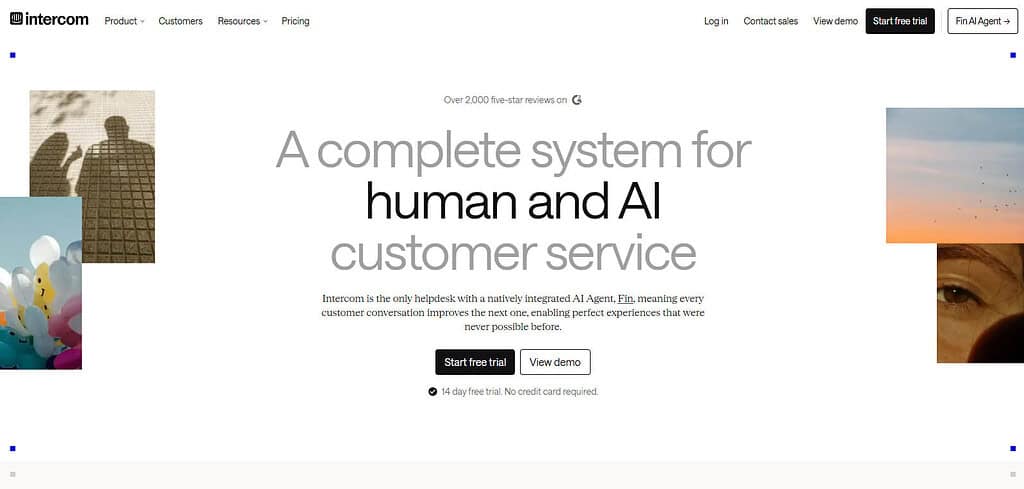
Fin has an average resolution rate of 76%, and many enterprises claim to have a resolution rate of more than 85%. Fin has 350+ integrations with applications such as Salesforce, HubSpot, Slack, and Stripe. Customers can also purchase covers to protect against negative impacts resulting from breaches of contract. Its pricing model is one of the most appealing to enterprises for its transparency.
Intercom Fin Features, Pros & Cons
| Features | Pros | Cons |
|---|---|---|
| Outcome-based pricing ($0.99/resolution) | Transparent cost model | Can be expensive at very high volumes |
| 350+ integrations (Salesforce, HubSpot, Slack) | Strong ecosystem fit | Complex setup for smaller firms |
| 76–85% resolution rate | High automation accuracy | Requires enterprise adoption for full ROI |
| Voice, chat, email support | Omnichannel coverage | Limited customization for niche workflows |
| Founded 2011 | Long market presence | Acquisition may change roadmap |
| AI-first agent (Fin) | Autonomous resolution | Still evolving in voice |
| Pricing tiers ($39–$139/agent) | Flexible scaling | Higher tiers needed for advanced features |
| Salesforce acquisition (2026) | Stronger CRM integration | Vendor lock-in risk |
| SOC 2, GDPR compliance | Enterprise-grade security | Compliance costs |
| AI learning loop | Improves over time | Needs training data |
2. Zowie
Founded in 2019, Zowie is a New York-based automation for enterprises and eCommerce. With proprietary technology, Zowie is able to manage orders, process returns, and respond to product queries on a variety of communication platforms (including social media). Zowie has outcome-focused pricing with contracts that scale based on how many conversations the customer wants to automate.
Some of Zowie’s best features include Spanish and English language support and integrations with Shopify, Zendesk, and Magento. Certain enterprises have reported having an over 90% ticket resolution rate with Zowie, making it very popular with high volume eCommerce companies.
Zowie Features, Pros & Cons
| Features | Pros | Cons |
|---|---|---|
| Founded 2019 | Modern architecture | Less legacy experience |
| Ecommerce-native | Best for Shopify/Magento | Limited outside ecommerce |
| 90% resolution rate | High automation | May need fine-tuning |
| Custom pricing | Scales with usage | Lack of transparent pricing |
| Multilingual support | Global reach | Language accuracy varies |
| Deterministic workflows | Zero hallucination | Less flexible for open queries |
| Social channel integration | Covers WhatsApp, FB, IG | Limited enterprise CRM |
| Case studies (Aviva) | Proven at scale | Few non-retail references |
| Refunds & returns automation | End-to-end workflows | Complex setup |
| AI-first design | Fast deployment | Requires ecommerce data |
3. Rasa
In 2016, Rasa was started by Alan Nichol and Alex Weidauer. Rasa provides an open source framework for conversational AI. This framework provides visibility into prompts and policies as well as the underlying code. Because of this visibility, Rasa serves regulated industries well.
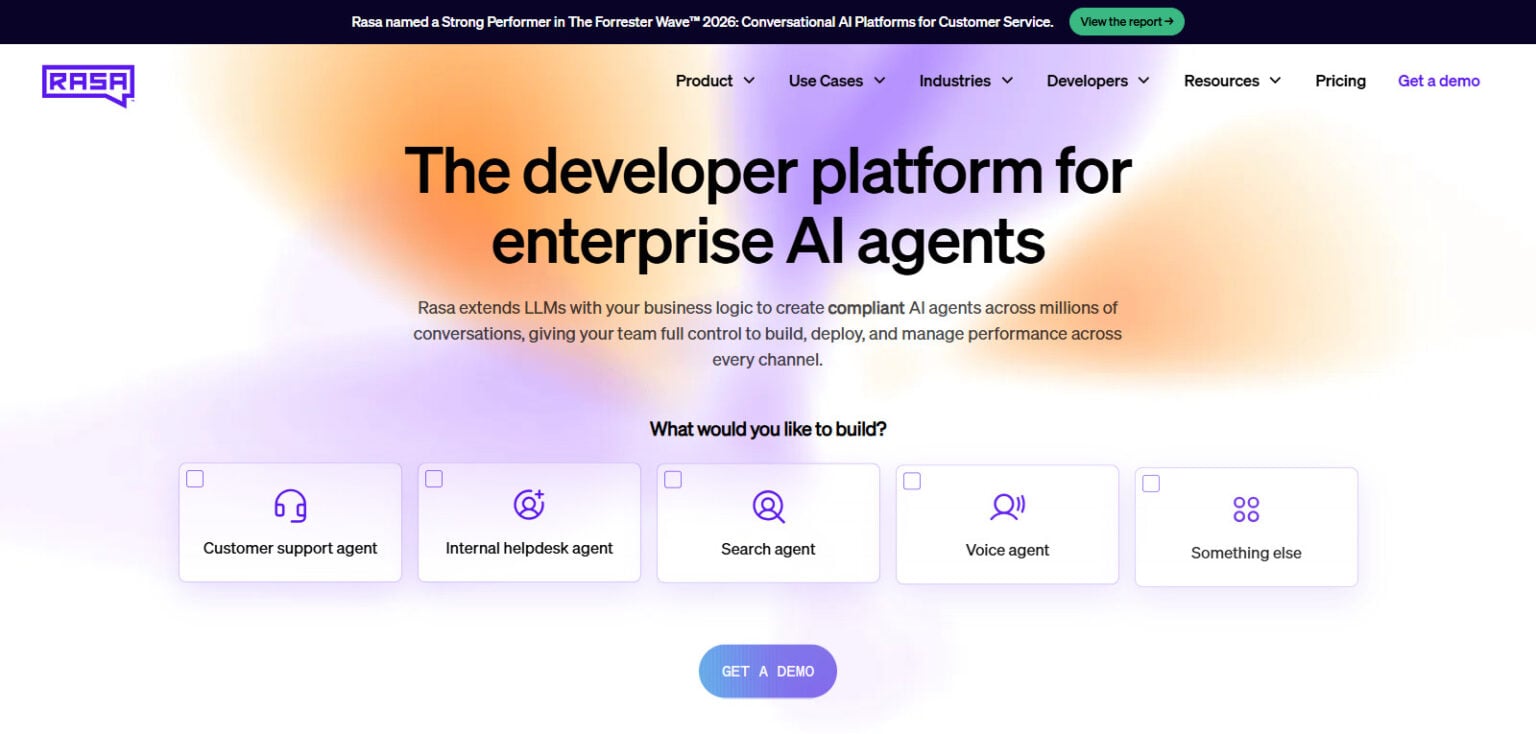
The Developer Edition allows up to 1,000 conversations a month for free, and the Growth Edition starts at $35,000 per year. Customers including Adobe and Deutsche Telekom perform self-hosted, air-gapped deployments of Rasa to retain control of their data and ensure compliance.
Rasa Features, Pros & Cons
| Features | Pros | Cons |
|---|---|---|
| Founded 2016 | Established open-source | Community-driven updates |
| Free developer edition | Cost-effective entry | Limited support |
| Growth tier $35K/year | Predictable pricing | High enterprise cost |
| Self-hosted | Full data control | Requires infra investment |
| Regulated industry focus | Compliance-ready | Complex deployment |
| Open-source framework | Customizable | Needs developer expertise |
| Voice + chat support | Flexible channels | No native email |
| Used by Adobe, Telekom | Enterprise adoption | Niche industries |
| Transparent prompts/policies | Governance clarity | Steeper learning curve |
| RAG integration | Accuracy boost | Requires tuning |
4. Gorgias Automate
Established in 2015, Gorgias is a helpdesk for Shopify with 17,000+ clients. Gorgias has a ticket-based pricing system. It costs $10/month for the Starter plan (50 tickets), $60/month for Basic (300), $360/month for Pro (2,000), and $900/month for Advanced (5,000).
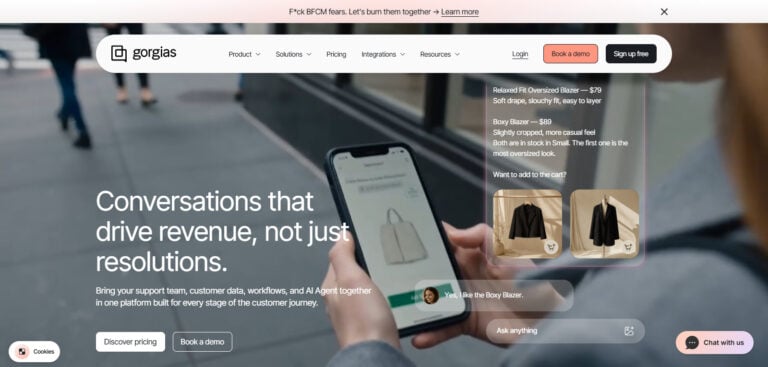
An additional addon for AI Agent costs $1 for each ticket automatically resolved. Gorgias’s strength lies in its Shopify integration. This allows refunds, order edits, and exchanges to be processed within the same ticket. Gorgias is best for ecommerce brands with needs for automation requiring extensive order awareness.
Gorgias Automate Features, Pros & Cons
| Features | Pros | Cons |
|---|---|---|
| Founded 2015 | Mature ecommerce tool | Limited outside retail |
| Shopify-native | Deep integration | Vendor lock-in |
| Ticket-based pricing | Flexible scaling | Can get costly at scale |
| AI add-on $1/resolution | Affordable automation | Adds complexity |
| Refunds/exchanges automation | End-to-end workflows | Limited beyond orders |
| 17,000+ brands | Wide adoption | Mostly SMB/mid-market |
| WooCommerce integration | Multi-platform | Limited enterprise CRM |
| Email + chat support | Omnichannel | No voice |
| SOC 2 compliance | Secure | Limited advanced AI |
| Easy onboarding | Fast setup | Less customizable |
5. Twig
Chandan Maruthi started Twig in 2022 to help B2B SaaS and fintech businesses. Twig charges companies $5 per ticket and includes a free tier of 100 answers. Self-Serve costs $19 per seat per month, while Managed Onboarding and Outcomes cost $499 and $999 per seat respectively.
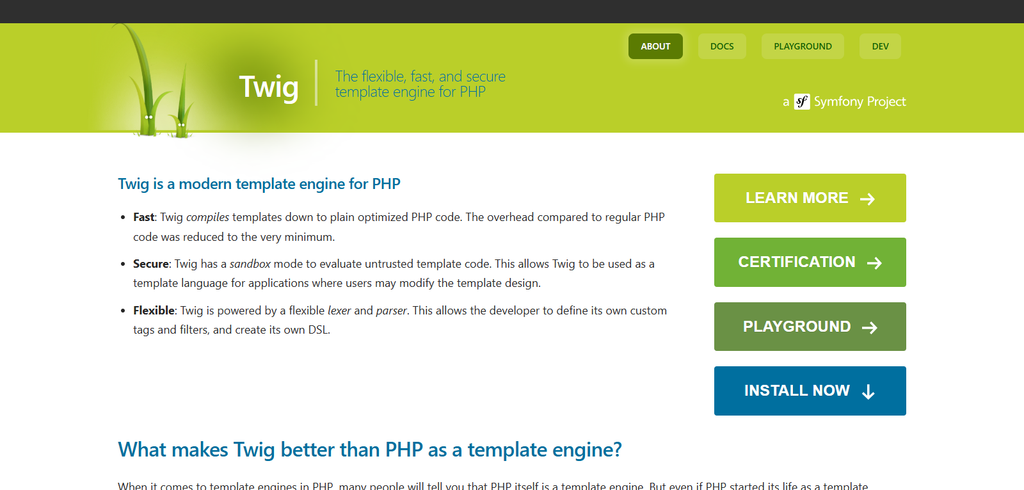
Zendesk, Salesforce, and Intercom are the integrations Twig currently offers. At this stage, Twig’s AI can automate 70% of Tier 1 Tickets. Twig uses retrieval augmented generation (RAG) to minimize hallucinations and answer with more confidence.
Twig Features, Pros & Cons
| Features | Pros | Cons |
|---|---|---|
| Founded 2022 | Modern AI-first | Newer player |
| $5 per ticket | Transparent pricing | Expensive at scale |
| Free tier (100 answers) | Easy entry | Limited free usage |
| SaaS/fintech focus | Niche expertise | Not for ecommerce |
| RAG-powered AI | Accuracy boost | Needs documentation |
| Integrates with Zendesk, Salesforce | Ecosystem fit | Limited integrations |
| 70% Tier 1 resolution | Strong containment | Lower than Zowie |
| Managed onboarding $499 | Affordable setup | Adds cost |
| SOC 2 compliance | Secure | Limited certifications |
| Transparent audit trails | Governance | Requires setup |
6. Zendesk AI
Zendesk is a customer support platform founded in 2007 that has since become the most widely adopted support platform in the world. 2026 Pricing: Suite Team $55/mo/agent, Professional $115, with Copilot add-on $50/mo/agent. AI agents are charged at ~$1.50-$2per resolution.

Zendesk AI has Resolution Learning Loop which self adjusts accuracy, supports 80+ languages and uses continuous learning. Works best for companies who are using the Zendesk ecosystem.
Zendesk AI Features, Pros & Cons
| Features | Pros | Cons |
|---|---|---|
| Founded 2007 | Long-standing leader | Legacy complexity |
| Suite Team $55/agent | Affordable entry | Add-ons increase cost |
| Copilot $50/agent | Strong AI layer | Adds per-agent cost |
| $1.50–$2 per resolution | Predictable | Higher than Fin |
| 80+ languages | Global reach | Accuracy varies |
| Resolution Learning Loop | Improves over time | Needs data volume |
| CRM-native | Seamless integration | Vendor lock-in |
| Omnichannel | Covers all | Complex setup |
| SOC 2, GDPR | Secure | Compliance overhead |
| Large ecosystem | Wide adoption | Slower innovation |
7. Salesforce Agentforce
Agentforce, Salesforce’s AI agent framework, launched in 2024, utilizing the Atlas Reasoning Engine. The pricing model incorporates a free Foundations tier with 2.5M Flex Credits annually, priced at $500 for 100,000 credits (approximately $0.10/action) or $2 for each conversation.
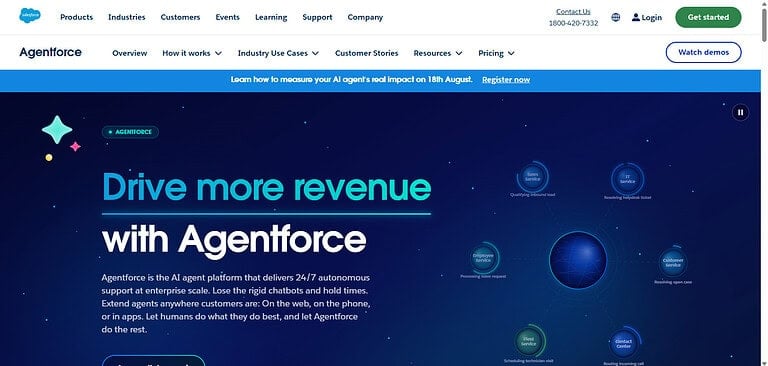
Employee-centered agents cost $125–$150/user per month. Agentforce is the first Salesforce native agent to navigate autonomously across Salesforce Clouds for automated case resolution, lead qualification, and order processing. By 2026, Agentforce reached $800M ARR and approximately 29,000 large enterprise contracts.
Salesforce Agentforce Features, Pros & Cons
| Features | Pros | Cons |
|---|---|---|
| Launched 2024 | Modern AI-first | Newer product |
| $2 per conversation | Transparent | Costly at scale |
| $0.10 per action | Flexible | Complex billing |
| Free tier (2.5M credits) | Generous entry | Requires Salesforce infra |
| CRM-native | Deep integration | Vendor lock-in |
| Atlas Reasoning Engine | Strong AI | Proprietary |
| Case resolution automation | End-to-end | Complex setup |
| Lead qualification | Sales workflows | Limited outside CRM |
| $800M ARR | Proven adoption | Mostly Salesforce users |
| SOC 2, GDPR | Secure | Compliance costs |
8. Freshdesk Freddy AI
Freshworks started Freshdesk Freddy AI in 2010 by combining AI Agent, Copilot, and Insights in San Mateo. Pricing is Growth plan is $19/agent/month; Pro plan is $55; Enterprise plan is $89; with Copilot add-on is $29–$35/agent/month.
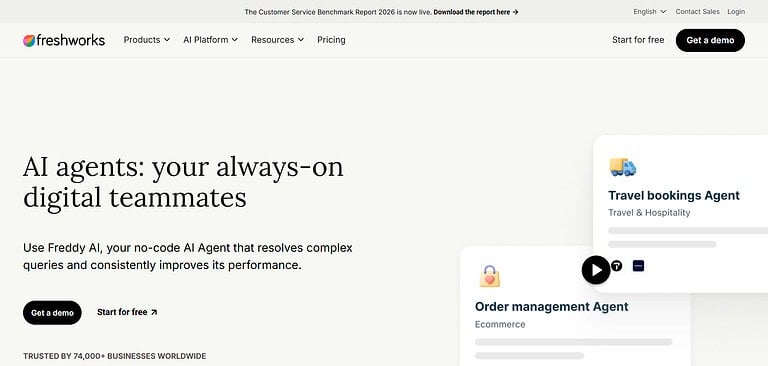
AI Agent sessions are $0.49 per session after the initial 500 free sessions. Freddy AI is best for small to medium-sized businesses (SMBs) scaling into enterprises. Freddy AI has numerous omnichannel support and compliance certifications (SOC 2, ISO 27001, GDPR).
Freshdesk Freddy AI Features, Pros & Cons
| Features | Pros | Cons |
|---|---|---|
| Founded 2010 | Mature platform | Competes with Zendesk |
| Growth $19/agent | Affordable | Add-ons increase cost |
| Pro $55, Enterprise $89 | Flexible tiers | Higher enterprise cost |
| Copilot $29–$35/agent | Strong AI | Adds per-agent cost |
| $0.49 per AI session | Cost-efficient | Limited free sessions |
| Omnichannel | Covers all | Complex setup |
| SMB scaling | Easy entry | Limited enterprise depth |
| SOC 2, ISO 27001 | Secure | Compliance overhead |
| GDPR-ready | Global | Limited advanced AI |
| Fast onboarding | Easy adoption | Less customizable |
9. Ada CX
Ada CX launched in 2016 in Toronto as an enterprise AI platform that uses multi-LLM Reasoning Engines. Its starting price in the AWS Marketplace is $33,000 for 60,000 conversations, while enterprise contracts are typically $70,000 to $300,000 annually.
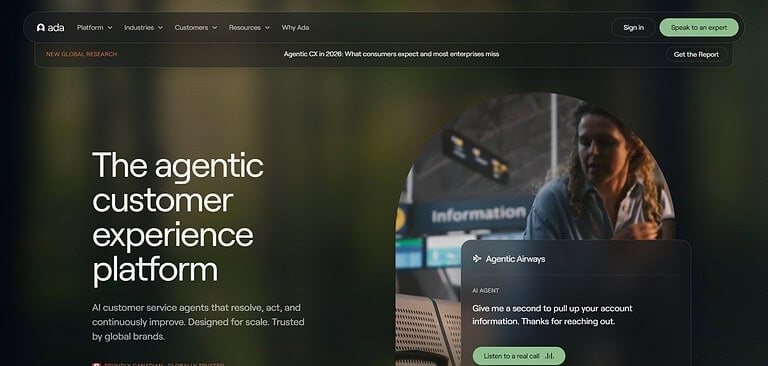
They offer over 60 languages, have omnichannel deployment, and adhere to best practices such as SOC 2 and GDPR. Ada CX is used by companies to solve up to 83% of their enterprise support conversations, incentivizing large users of Zendesk or Salesforce.
Ada CX Features, Pros & Cons
| Features | Pros | Cons |
|---|---|---|
| Founded 2016 | Mature AI-first | Competes with Fin |
| $33K/year entry | Predictable | High upfront cost |
| $70K–$300K enterprise | Scalable | Expensive |
| 83% resolution rate | High containment | Lower than Zowie |
| 60 languages | Global reach | Accuracy varies |
| SOC 2, HIPAA, GDPR | Compliance | Adds overhead |
| Omnichannel | Covers all | Complex setup |
| Multi-LLM engine | Accuracy boost | Proprietary |
| AWS Marketplace | Easy procurement | Vendor lock-in |
| Enterprise adoption | Proven | Limited SMB |
10. Tidio Lyro
Tidio was established in Poland in 2013 and currently has over 300,000 clients. Lyro, Tidio’s AI-powered support agent built upon Anthropic Claude, automates up to 67% of guest queries. From $29/month (50 conversations) to $2,999/month (limitless conversations), Starter, Growth, Plus, and Premium plans are offered by Tidio.
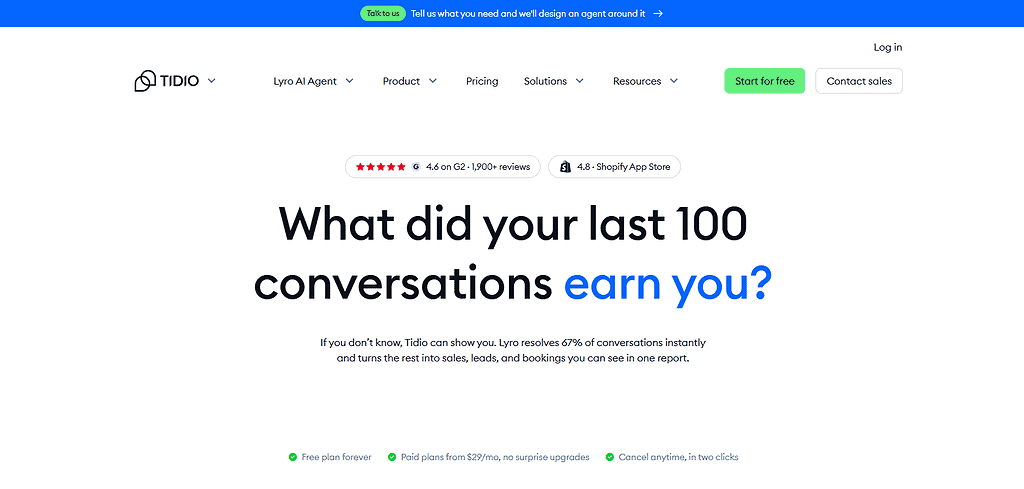
Lyro comes with 50 free conversations and integrates with Shopify, WooCommerce, and Magento. SMBs wanting cost efficient AI integrations and strong ecommerce integrations can benefit from Lyro.
Tidio Lyro Features, Pros & Cons
| Features | Pros | Cons |
|---|---|---|
| Founded 2013 | Established SMB tool | Less enterprise |
| Starter $29/month | Affordable | Limited volume |
| Growth $59–$349 | Flexible | Adds cost |
| Plus $749, Premium $2,999 | Scalable | Expensive at top tier |
| 67% resolution rate | Strong SMB automation | Lower than enterprise peers |
| Anthropic Claude-powered | Modern AI | Limited customization |
| Shopify/WooCommerce integration | Ecommerce fit | Limited CRM |
| 50 free conversations | Easy entry | Small allowance |
| 300K+ businesses | Wide adoption | Mostly SMB |
| Omnichannel | Covers chat/email | No voice |
AI Customer Service Channels to Consider
AI customer support systems span tools for live chat, email automation, voice assistants, and social media messaging. Live chat tools deliver instant answers via a website or application. Email automation helps businesses manage their support tickets and follow-ups.
Voice assistants help call center agents answer customer questions more quickly and with greater efficiency using NLP. Real time engagement with customers is critical for ecommerce and global businesses, and use of social media with solutions like WhatsApp, Facebook Messenger, and Instagram DMs, is a small part of a larger strategy in combination with providing an AI powered self-help knowledge base and web portals.
The aim of the different support systems is to provide an omnichannel support system that shortens ticket resolution times and improves customer satisfaction.
Conclusion
In summary, the 10 best AI customer service platforms for enterprises in 2026 – Intercom Fin, Zowie, Rasa, Gorgias Automate, Twig, Zendesk AI, Salesforce Agentforce, Freshdesk Freddy AI, Ada CX, and Tidio Lyro – offer the most progressive ecosystem of automated services for businesses.
Each program has its own area of expertise. For instance, Zowie and Intercom Fin are most proficient in automated solutions for case resolution. Rasa has an open source option that is most appropriate for regulated industries. Gorgias Automate and Tidio Lyro have the most developed services for e-commerce. For integrating with customer service applications within vendors’ existing CRMs, Zendesk AI and Salesforce Agentforce are the most adept.
Ada CX and Freshdesk Freddy AI have leading services for omnichannel and growing customer support. Twig has unique services for SaaS and fintech industries. These services have been developed using AI. What was once reactive customer service has been addressed using AI, resulting in cost savings and compliance with changing legislation for the service provider, and greater customer satisfaction for the business.
FAQ
What is Intercom Fin?
Intercom Fin, founded in 2011, is an AI-first customer service platform acquired by Salesforce in 2026. Its Fin AI Agent autonomously resolves conversations with $0.99 per resolution pricing, making it one of the most cost-efficient enterprise solutions.
How does Zowie differ from other platforms?
Zowie, founded in 2019, specializes in ecommerce automation. It integrates with Shopify and Magento, achieving 90% resolution rates. Pricing is custom outcome-based, ideal for enterprises with high-volume support.
Is Rasa free to use?
Yes. Rasa, founded in 2016, offers a free open-source edition and enterprise plans starting at $35,000/year. It is best for regulated industries needing self-hosted AI agents with full governance.
What makes Gorgias Automate unique?
Founded in 2015, Gorgias Automate is Shopify-native, enabling refunds and order edits directly in tickets. Pricing starts at $10/month with AI add-ons at $1 per resolution, making it perfect for ecommerce brands.
Who should use Twig?
Twig, founded in 2022, is designed for SaaS and fintech support. It uses RAG-powered AI for accuracy and charges $5 per ticket. Enterprises needing technical documentation automation benefit most.