


This article focuses on the Best AI Automation Companies for Enterprise Workflows in 2026. With enterprises more and more inclined to automating work processes to reduce more costs, scale more effectively, and maintain process efficiency, the selection of a workflow-automating technology becomes important. LuMayAI all the way on the other end of the spectrum from the Fortune 500 companies are using AI to outfit their workflows and streamline effectively.
How to Choose the Right AI Automation Company
Founding Year & Stability
Longevity in the market matters. Companies such as UiPath (2005) or Microsoft Power Automate (2016) have established a stronger market presence and stability vs. newer players such as LuMay AI (2024) who might lack market trust but can bring innovation.
Pricing Transparency
Check if there are hidden costs. Pricing for services like Zapier is based on subscription tiers. LuMay AI employs an enterprise quoting system, whereas n8n charges based on execution. Transparent pricing avoids hidden costs.
Service Specialization
Determine if the company focuses on offering RPA solutions (UiPath), conversational AI (Kore.ai), ERP integrations (Celigo), or project workflow management (Wrike). Align specialization with your business needs.
Deployment Flexibility
Some automation platforms are cloud-only (Zapier), while others provide freedom to deploy the system locally self-hosting (n8n), offer air-gapped deployments (LuMay AI) for highly regulated clients.
Integration Ecosystem
Number of integrations determines scalability of service. Zapier provides 8,000+ app connectors. n8n and Celigo offer 1,700+ connectors, Celigo specializes in integrating ERP/CRM platforms.
Compliance & Security
For highly regulated industries, choose a company such as LuMay AI that has zero data retention or Iternal that offers an Air Gap deployment.
Scalability & Performance
Can the platform handle enterprise-level automation workloads? Companies such as UiPath and Microsoft Power Automate provide scalable automation services to meet workload demands. n8n offers scaling for workload automation for technical automation teams.
Ease of Use
Non-technical teams automatically lean toward Zapier which provides workflow automation. n8n is more flexible offering automation for technical teams.
Support & Training
Companies such as LuMay AI and UiPath maintain training and support resources. Others like n8n rely more heavily on community-based resources.
Security & Compliance
Data Retention Policies
- Companies that adopt the zero data retention policy, such as LuMay AI, ensure enterprise data is never retained on their systems, important to trust in processing sensitive data for healthcare, finance, and government workflows.
Encryption Standards
- Look for platforms that offer end-to-end encryption and secure API communication. n8n offers self-hosting, meaning enterprises can maintain control over their encryption keys.
Compliance Certifications
- Key certifications include SOC2, ISO 27001, and GDPR compliance. Kore.ai and UiPath are certified, therefore more appropriate for regulated industries.
Deployment Options
- LuMay AI and Iternal offer air-gapped deployments making them ideal for defense and government deployment. Deploying on a cloud-only platform, such as Zapier, will not meet compliance requirements for some frameworks.
Access Control and Governance
- Enterprise offerings, such as UiPath and Microsoft Power Automate, provide frameworks for role-based access control (RBAC), auditing, and governance to an enterprise offering.
Audit and Monitoring
- Platforms should provide the ability to audit and monitor activities. Wrike and Celigo provide controls to monitor workflows with auditing compliance.
Third-Party Integrations
- Due to their open source nature, platforms like Zapier and n8n should be analyzed, in addition to the integration security.
Regulatory Alignment
- Regulated industries like banking, healthcare, and defense require compliance. Iternal provides a product built with compliance first, focused on government-grade workflows.
Key Points
| Company | Core Focus | Best For | Key Advantage |
|---|---|---|---|
| LuMay AI | Custom autonomous AI agents & pipelines | Mid-market enterprises & CTOs | Private vector stores, zero data retention, bespoke agentic builds |
| UiPath | Enterprise RPA + agentic automation | Large legacy IT teams | Multi-app UI/API automation bots |
| Kore.ai | Multi-agent conversational workflows | HR, ITSM & customer support | Pre-built agentic modules, model-agnostic engine |
| n8n | Open-source workflow engine | Technical teams, DevOps | Self-hostable canvas, custom code nodes, predictable pricing |
| Microsoft Power Automate | RPA + Copilot Studio | Microsoft 365 enterprises | Deep Azure/Office integration, attended & unattended automation |
| Zapier | No-code automation | Non-technical teams | 9,000+ app connectors, fastest idea-to-live path |
| Iternal | Document-heavy automation | Government contractors, regulated enterprises | Strong compliance, document AI workflows |
| Wrike | AI-driven project management | Enterprise PMOs | Workflow visibility, AI task orchestration |
| Celigo | Integration automation | SaaS-heavy enterprises | 1,000+ prebuilt connectors for ERP/CRM |
| Screendragon | AI-powered enterprise workflows | Global enterprises | Governance-first workflow orchestration |
1. LuMay AI
LuMay AI, founded in 2024 by Palanisamy Ramasamy, markets itself as an enterprise AI agent factory. It develops secure, autonomous AI agents for highly regulated industries, such as healthcare, finance, and the legal profession. Among its offerings are voice AI agents, multi-agent orchestration, and execution layers designed with a compliance focus.
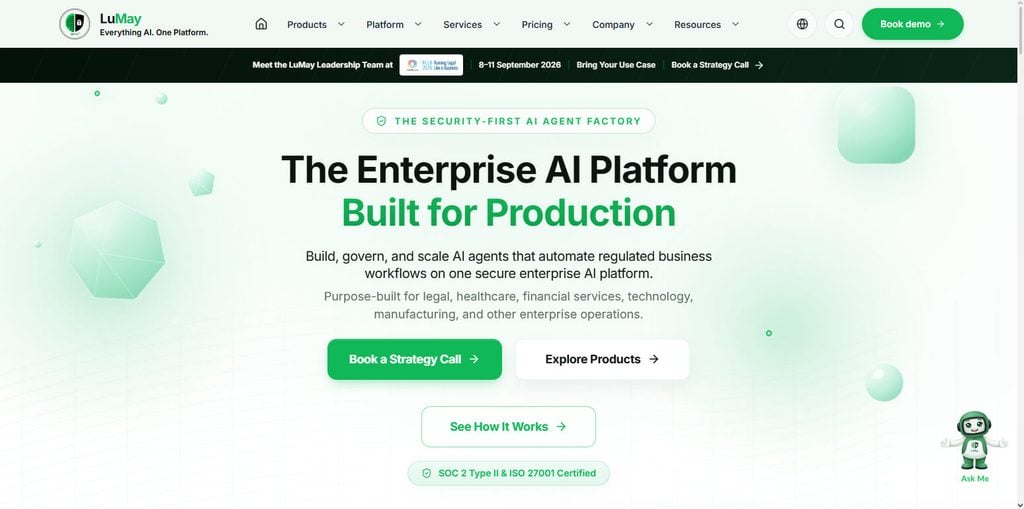
Clients can choose from a range of deployment options including SaaS and air-gapped environments. LuMay AI uses enterprise-only, quote-based pricing, with costs determined during a direct engagement with the company. Clients have reported a 75% reduction in costs and a 90% increase in productivity. This has made LuMay AI one of the fastest growing agentic AI providers in 2026.
LuMay AI Attribute, Benefit & Drawback
| Attribute | Benefit | Drawback |
|---|---|---|
| Founded 2024 | Modern architecture, built for agentic AI | Newer player, less legacy trust |
| Autonomous AI agents | Customizable workflows | Requires enterprise-level expertise |
| Zero data retention | Strong compliance for regulated industries | Limits analytics on historical data |
| Voice AI agents | Ultra-low latency interactions | Niche use cases only |
| Multi-agent orchestration | Handles complex enterprise workflows | Higher setup complexity |
| Deployment flexibility | SaaS or air-gapped | Air-gapped costs are high |
| Enterprise-only pricing | Tailored solutions | No SMB accessibility |
| LuMay Academy | Training for enterprise teams | Limited global reach |
| Compliance-first | Ideal for healthcare/finance | Slower adoption in non-regulated sectors |
| Quote-based pricing | Custom scalability | Lack of transparent pricing |
| High ROI | 75% cost reduction reported | Still early-stage adoption curve |
2. UiPath
UiPath, founded in 2005, in Bucharest, is the largest RPA vendor worldwide, and is making a shift toward agentic automation. Offerings include UiPath Studio, Orchestrator, Robots, AI Center, as well as Autopilot and Maestro for agent orchestration, with intelligent bots and processes, and pricing starting at $25/month for the basic cloud.
However, enterprise pricing is quote-based and usually costs clients from the hundreds of thousands to millions per year. For FY2026, UiPath reported $1.85B ARR. This company caters to clients in finance, healthcare, and the public sector. For companies with legacy IT systems, and a need for advanced automation governance, UiPath is often the preferred supplier.
UiPath Attribute, Benefit & Drawback
| Attribute | Benefit | Drawback |
|---|---|---|
| Founded 2005 | Long-standing enterprise trust | Legacy-heavy architecture |
| RPA leader | Robust automation for legacy IT | Less agile than open-source |
| UiPath Studio | Developer-friendly | Steep learning curve |
| Orchestrator | Centralized control | Complex governance setup |
| AI Center | Intelligent document processing | Requires add-ons for AI |
| Autopilot | Agentic automation | Still evolving |
| Pricing tiers | Starts at $25/month | Enterprise costs very high |
| Process mining | Deep workflow insights | Expensive licensing |
| Global clients | Used by Fortune 500 | Vendor lock-in risk |
| Large ARR ($1.85B) | Financial stability | Pricing escalates quickly |
| Attended/unattended bots | Flexible automation | Maintenance overhead |
3. Kore.ai
With a foundation year of 2014, Kore.ai has its roots with conversational AI, and has since developed a holistic agentic AI platform. Customer service,
Pricing is tiered: small deployments start at $29–$60 per user/month, but enterprise bundles average $90K+ annually. Kore.ai offers services such as multi-engine NLU, omnichannel deployment, governance scanners, and SOC2/ISO compliance. Kore.ai is a leader in enterprise conversational and agentic AI, handling 20 billion+ interactions yearly.
Kore.ai Attribute, Benefit & Drawback
| Attribute | Benefit | Drawback |
|---|---|---|
| Founded 2014 | Decade of AI expertise | Competes with giants |
| XO Platform | Conversational + agentic AI | Requires customization |
| GALE generative layer | Model-agnostic | Complexity in tuning |
| Multi-engine NLU | High accuracy | Costly at scale |
| Omnichannel support | HR, ITSM, customer service | Limited outside these domains |
| Pricing tiers | $29–$60/user/month | Enterprise bundles expensive |
| Compliance | SOC2/ISO certified | Slower innovation cycles |
| 500+ global clients | Strong adoption | Focused on large enterprises |
| 20B+ interactions yearly | Proven scalability | SMB adoption limited |
| Pre-built modules | Faster deployment | Less flexibility |
| Governance scanners | Strong oversight | Adds cost overhead |
4. n8n
n8n launched in 2019 in Berlin by Jan Oberhauser as an open-source workflow automatation platform offering self-hosting under a fair-code license, making it a unique alternative to Zapier and similar services. It has 600+ integrations, AI agent nodes, LangChain, and code extensibility with JavaScript/Python.
Pricing begins at €20/month for Starter, €50/month for Pro, and €667/month for Business. The self-hosted, Community Edition is free and Enterprise pricing is customized. n8n is widely adopted among technical teams because of the flexibility and security that it offers. It raised $180M in a Series C in 2025 for a total of $2.5B valuation and has since been funded by SAP.
n8n Attribute, Benefit & Drawback
| Attribute | Benefit | Drawback |
|---|---|---|
| Founded 2019 | Modern open-source | Less enterprise legacy |
| Fair-code license | Self-hosting freedom | Requires technical expertise |
| 600+ integrations | Broad connectivity | Smaller ecosystem vs Zapier |
| AI agent nodes | LangChain support | Still maturing |
| Code extensibility | Custom JS/Python | Developer dependency |
| Free community edition | Cost-effective | No enterprise support |
| Paid plans | €20–€667/month | Pricing jumps for scale |
| SAP investment | Strong backing | May shift focus |
| Technical adoption | DevOps-friendly | Not ideal for non-technical teams |
| Predictable pricing | Per-execution model | Can spike with heavy use |
| Open-source flexibility | Avoids vendor lock-in | Requires hosting resources |
5. Microsoft Power Automate
Microsoft launched Power Automate (formerly Microsoft Flow) in 2016 as part of the Microsoft Power Platform. Power Automate deeply integrates with all components of the Power Platform, with cloud flows, RPA, and process mining available.
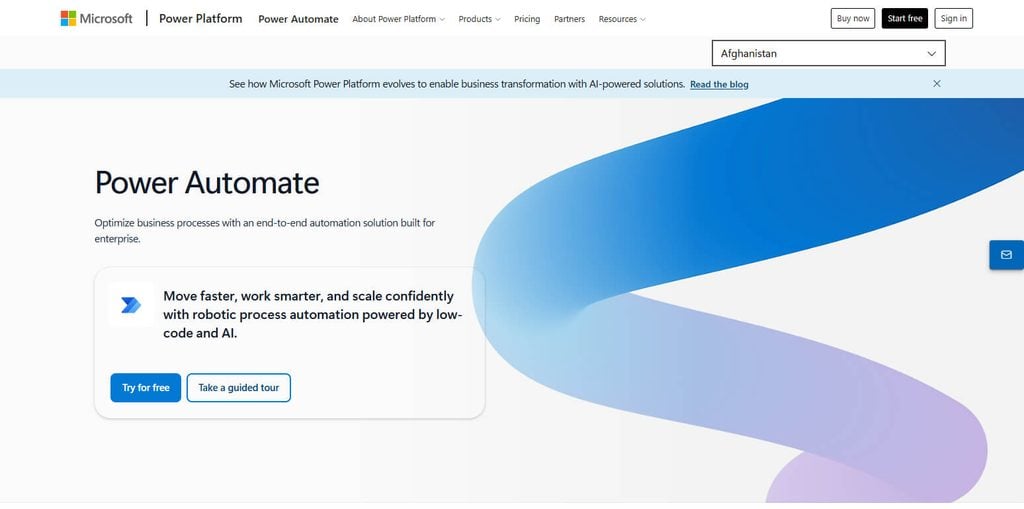
Additional elements, such as AI Builder, approvals, and Copilot (Natural-Language Workflow creation with OpenAI), are available. Power Automate includes pricing in most Microsoft 365 licenses, premium pricing at $15/user/month, and unattended RPA bots at $150/bot/month.
Executions of flows in Pay-as-you-go are priced at $0.60 per execution. Power Automate is best optimized for enterprise customers within the Microsoft ecosystem, and competes with UiPath and Zapier, but is less costly for M365 users.
Microsoft Power Automate Attribute, Benefit & Drawback
| Attribute | Benefit | Drawback |
|---|---|---|
| Launched 2016 | Deep Microsoft ecosystem | Limited outside M365 |
| Cloud flows | Easy automation | Limited advanced AI |
| Desktop RPA | Legacy automation | Requires Windows |
| AI Builder | No-code AI | Basic compared to competitors |
| Copilot Studio | Natural-language workflows | Early-stage adoption |
| Pricing | $15/user/month | Costs escalate with bots |
| Unattended RPA | $150/bot/month | Expensive at scale |
| Pay-as-you-go | $0.60 per flow | Unpredictable billing |
| Office/Dynamics integration | Seamless enterprise use | Vendor lock-in |
| Azure synergy | Cloud-native | Requires Azure adoption |
| Governance tools | Enterprise-ready | Complex setup |
6. Zapier
Zapier connects over 8,000 applications and services the needs of over 700 employees. Raising an impressive $1.3B, it operates totally remote, and is considered the most user friendly automation app. Established in 2011, it has services including multi-step Zaps, AI Guardrails, AI Agents, and custom Python functions.
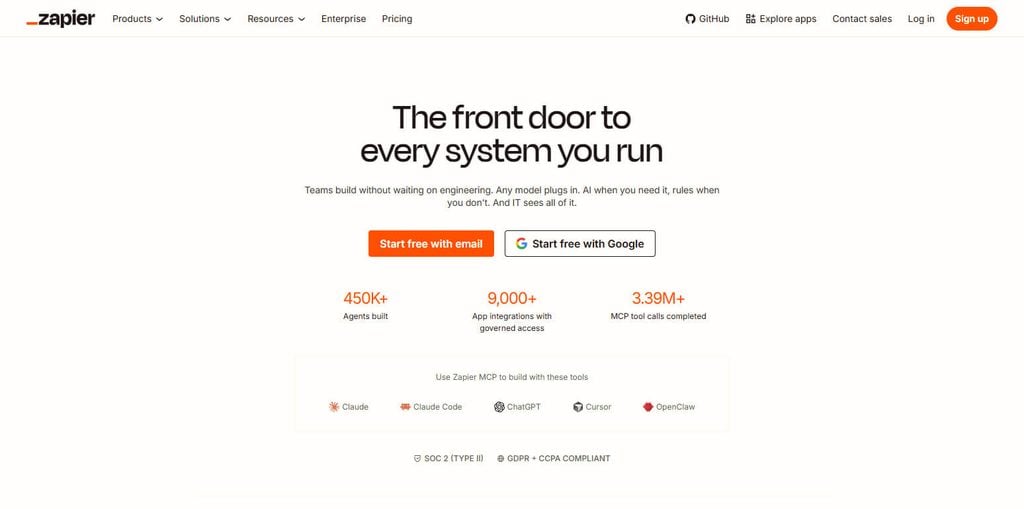
Non-technical teams looking for easy automation have the choice of steps and pricing accommodating their functions and budgets: Free (5 Zaps, 100 tasks a month), Starter, $19.99-$29.99 a month, Pro $73.50 a month, Team $299 a month and Enterprise $599 a month. There is a definite cost increase as Zapier is scaled, but it is still the most viable option compared to all competitors.
Zapier Attribute, Benefit & Drawback
| Attribute | Benefit | Drawback |
|---|---|---|
| Founded 2011 | Pioneer in no-code | Less enterprise focus |
| 8,000+ connectors | Largest ecosystem | Overwhelming for SMBs |
| Multi-step Zaps | Complex workflows | Limited governance |
| AI Guardrails | Safer automation | Still basic |
| AI Agents | Expanding capabilities | Early-stage |
| Free tier | Accessible | Very limited |
| Paid plans | $19–$599/month | Costs escalate fast |
| Remote-first company | Agile innovation | Less enterprise support |
| User-friendly | Non-technical adoption | Limited customization |
| Fast deployment | Quick ROI | Not compliance-heavy |
| Large funding | Stable growth | Pricing transparency issues |
7. Iternal
Iternal was founded in 2012 and is an Austin, Texas-based provider of enterprise AI-driven workflow automation solutions. Their solutions and services include Blockify, AirgapAI, Waypoint, AutoReports, and the Nebulous Prioritization Engine. Unlike others in the market, pricing is quote-based and driven based on a solution for a regulated industry.
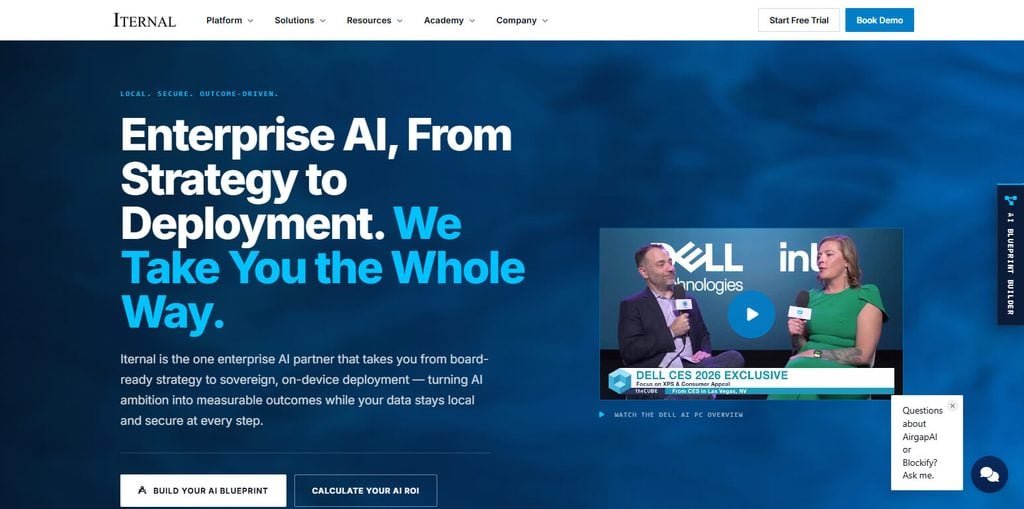
As a SaaS B2B provider, Iternal faces Genpact and NTT Data as primary competitors. Iternal’s tools are geared towards heavily document-based workflows, compliance, and the intelligent use of AI in an increasingly regulated world. Their employee count is less than 10, but their highly specialized offerings draw regulated industries and government contractors.
Iternal Attribute, Benefit & Drawback
| Attribute | Benefit | Drawback |
|---|---|---|
| Founded 2012 | Specialized workflows | Small company size |
| Blockify | Content modularization | Niche use case |
| AirgapAI | Secure local LLMs | Expensive deployment |
| Waypoint | Proposal automation | Limited outside gov/defense |
| AutoReports | Automated reporting | Narrow focus |
| Nebulous Engine | Prioritization AI | Complex setup |
| Enterprise-only pricing | Tailored solutions | No SMB access |
| Compliance focus | Government-ready | Slow innovation |
| SaaS B2B | Cloud-native | Limited integrations |
| Quote-based pricing | Custom scaling | Lack of transparency |
| Niche adoption | Strong in regulated sectors | Limited global reach |
8. Wrike
Founded in 2006, Wrike is a project management tool developed by Andrew Filev. Citrix purchased it in 2021 for $2.25 billion. Currently, it has over 20,000 clients and 2.4 million users. Wrike has a large number of features including its automation engine and AI Copilot, also Gantt charts, Kanban boards, and over 400 integrations.
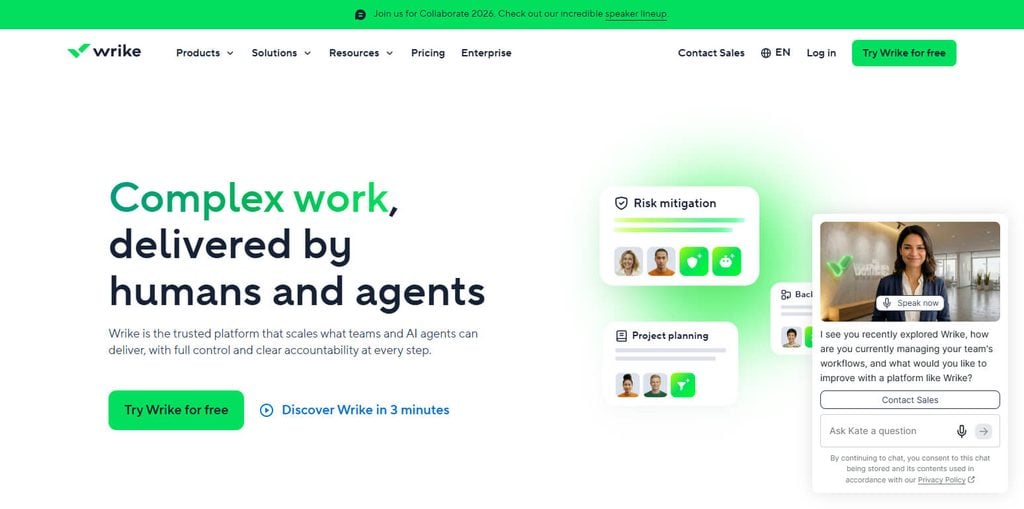
It has a freemium model for basic tasks, the Team plan costs $10 per user, Business costs $25 per user, and Pinnacle and Apex cost custom enterprise pricing. Wrike is best for PMOs and large companies needing task orchestration, resource planning, and AI.
Wrike Attribute, Benefit & Drawback
| Attribute | Benefit | Drawback |
|---|---|---|
| Founded 2006 | Long-standing PM tool | Competes with Asana/Jira |
| Citrix acquisition | Strong backing | Integration complexity |
| AI Copilot | Smart task orchestration | Still evolving |
| Automation engine | 50–3,000 actions/user | Costs scale quickly |
| Gantt charts | Project visibility | Traditional UI |
| Kanban boards | Agile workflows | Limited customization |
| 400+ integrations | Broad ecosystem | Not as wide as Zapier |
| Free tier | Accessible | Limited features |
| Paid plans | $10–$25/user/month | Enterprise pricing opaque |
| 20,000+ clients | Proven adoption | Focused on PMOs |
| Resource planning | Strong governance | Steep learning curve |
9. Celigo
Celigo is an iPaaS integration platform that started in 2010 and is built around its product Integrator.io. It is a NetSuite integration platform with over 1,000 connectors and API management, error dashboards, and AI features. It has a quote-based pricing model, but it is estimated that the Standard and Professional tiers cost $600 and $1,200 per month, respectively, with custom pricing for enterprise.
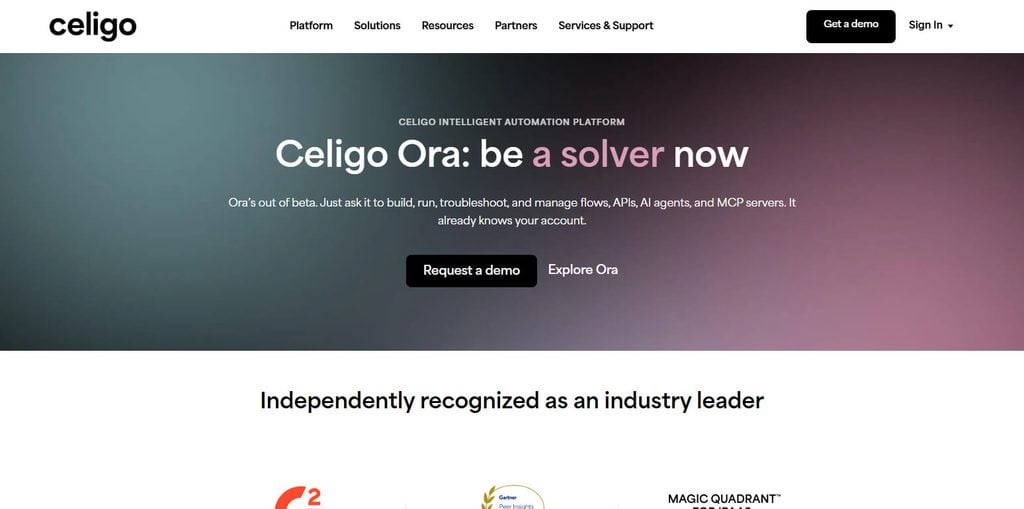
Custom pricing is offered for the enterprise level as well, and Celigo raised a total of $48 million in Series C in 2021, with Francisco Partners acquiring the company in 2023. Celigo is mainly for mid-market companies that run NetSuite and simplifies the order-to-cash and procure-to-pay workflows.
Celigo Attribute, Benefit & Drawback
| Attribute | Benefit | Drawback |
|---|---|---|
| Founded 2010 | ERP integration focus | Niche NetSuite-centric |
| Integrator.io | Core iPaaS platform | Requires ERP knowledge |
| 1,000+ connectors | Broad SaaS coverage | Smaller vs MuleSoft |
| ERP workflows | Order-to-cash automation | Limited outside ERP |
| API management | Strong governance | Complex setup |
| Error dashboards | Visibility | Adds overhead |
| AI-assisted mapping | Faster integration | Still basic |
| Pricing | ~$600–$1,200/month | Enterprise opaque |
| Francisco Partners backing | Stable growth | Less innovation |
| Mid-market focus | Affordable | Not ideal for SMB |
| SaaS-native | Cloud-first | Vendor lock-in risk |
10. Screendragon
Screendragon was launched in 2011 and offers marketing and agency workflow automation. This includes workflow configurators, resource, digital asset, and AI approuval management. AI Approvals eliminates the need for back and forth approval flows. This service even offers pre-built workflows.
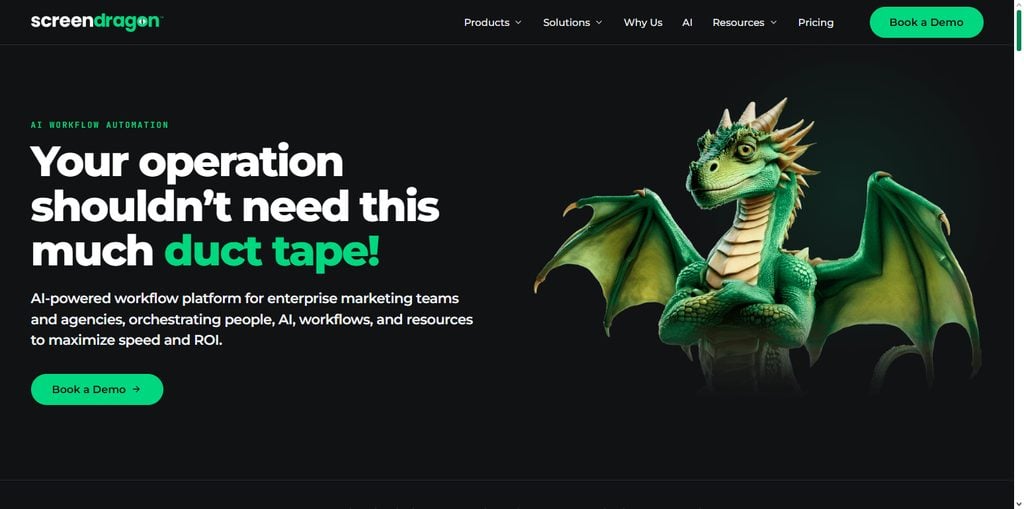
Pricing is $20 a month per user and enterprise contracts will require a quote and a one time implementation fee. Screendragon offers many integrations like Microsoft Teams, and Power BI and others through Zapier integrations. They boast clients like BP, McCann Worldgroup, Kellogg, and Clorox and hold a place as one of the strong players in the creative and marketing workflow automation landscape.
Screendragon Attribute, Benefit & Drawback
| Attribute | Benefit | Drawback |
|---|---|---|
| Founded 2011 | Marketing workflow focus | Niche industry |
| Configurable workflows | Tailored automation | Setup complexity |
| Resource management | Strong planning | Limited AI depth |
| Digital asset management | Creative teams | Not enterprise-wide |
| AI approvals | Faster governance | Early-stage |
| Pricing | $20/user/month | Enterprise opaque |
| Integrations | MS Teams, Slack, Zapier | Smaller ecosystem |
| Global clients | BP, Kellogg, McCann | Focused on marketing |
| SaaS platform | Cloud-native | Vendor lock-in |
| Quote-based enterprise | Custom scaling | Lack of transparency |
| Creative workflow leader | Strong niche adoption | Limited outside marketing |
Risks and Challenges of Enterprise AI Automation
Differences in security:
Sensitive data might be exposed if platforms do not offer advanced encryption or compliance safety mechanism.
Compliance gaps:
AI automation tools might pose a risk to companies in regulated industries due to vendors not adhering to stringent requirements (i.e GDPR, SOC2, HIPAA).
Vendor lock-in
Ecosystems owned by vendors (Microsoft, UiPath) can easily impose a lock-in contract on a company due to the nature of their offerings.
Integration complexity
Legacy systems that have to be integrated with modern AI automation require a lot of extra customization and incur high costs.
Cost escalation:
Unpredictable costs can occur due to subscription or execution-based pricing models, especially when a high volume of workflows are automated.
Skills gaps:
Some automation tools are built for technical users (i.e. Zapier) and some for non-technical users (i.e. n8n).
Automation unreliability:
Automation of workflows relies on APIs and can become unstable if the systems also experience downtime or poor error handling.
Resistance to change:
It takes time to develop a company culture where employees accept AI-driven automation tools (i.e. change management).
Limitations to scale:
Automation tools such as UiPath and Microsoft have a high level of scalability, while others such as Zapier and Screendragon reach their limits at enterprise level.
Conclusion
In 2026, the enterprise automation landscape will include enterprise RPA leaders, open source innovators, and agentic AI pioneers. LuMay AI is creating new approaches to automation by incorporating custom autonomous agents within a strict compliance framework. UiPath and Microsoft Power Automate still have the dominant position in enterprise grade RPA and orchestration in companies with legacy systems.
n8n and Zapier have created a new paradigm by democratizing automation regardless of technical prowess. Meanwhile, Kore.ai, Iternal, Wrike, Celigo, and Screendragon have created automation and integration of enterprise systems for multiple domains including project management and ERP systems, as well as conversational AI.
Automation is no longer just about increasing efficiency. Enterprise systems now incorporate platform tools that allow automation with a focus on scalability, governance, and flexibility. The ten companies listed here represent the first line of innovation of enterprise AI systems in 2026, and differ from one another based on integration depth, open source flexibility, and the tradeoff between speed and security.
FAQ
What is LuMay AI?
LuMay AI, founded in 2024, is an enterprise-focused AI automation company specializing in autonomous agents and compliance-first workflows. It offers secure deployments, zero data retention, and quote-based pricing for regulated industries.
When was UiPath founded?
UiPath was founded in 2005 in Bucharest. It is the global leader in RPA and agentic automation, serving enterprises with process mining, bots, and orchestration. Pricing starts at $25/month, but enterprise contracts are quote-based.
What does Kore.ai provide?
Kore.ai, founded in 2014, delivers conversational AI and agentic automation through its XO Platform. It supports HR, ITSM, and customer service workflows. Pricing ranges from $29–$60 per user/month, with enterprise bundles averaging $90K+ annually.
What does Celigo specialize in?
Celigo, founded in 2010, is an iPaaS platform specializing in ERP and SaaS integrations, especially NetSuite. Pricing is quote-based, with estimates around $600–$1,200/month for standard plans.
Who uses Screendragon?
Founded in 2011 in Dublin, Screendragon is trusted by BP, Kellogg, and McCann Worldgroup. It automates marketing workflows with pricing starting at $20/user/month, scaling to enterprise contracts.