
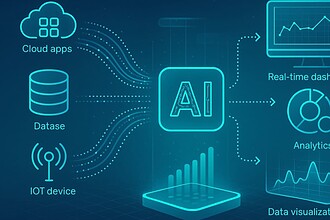


This article covers the Best AI Model Hosting Companies in 2026. I will be discussing how these companies provide speed, compliance, scalability, and ecosystems that developers enjoy using.
From highly recognizable and established companies including Amazon SageMaker, Google Vertex AI, and Microsoft Azure ML, to up-and-coming companies like NetCity AI Cloud, SiliconFlow, and Groq, I will be going over the features, prices, and performance of each of the companies so that developers and businesses can determine which hosting service best fits their needs.
Why Choose AI Model Hosting Companies
Scalability – Hosting models offers developers enterprise ready tools to scale ideas from prototypes without worrying about infrastructure.
Speed – Providers such as Groq and SiliconFlow offer real time inference and high performance with very low latency for their applications.
Compliance – platforms such as NetCity AI Cloud and Azure ML provide compliance for data sovereignty, GDPR and HIPAA.
Cost – Model hosting providers offer various pricing models that allow startups and enterprise customers to manage their costs.
Ecosystem Integration – seamless integration with developer tools and APIs and data lake such as AWS, Google Cloud, Azure, and Hugging face
Community & Innovation – Platforms such as Huge Face and Replicate are focused on collaboration and fast experimentation.
Technology – Coreweave and Fireworks AI are pioneering in GPU optimized multimodal inference technology.
Reduced Burden on Developers – Developers only have to worry about building applications and no longer need to worry about managing compliance or infrastructure.
Key Points
| Company | Strengths | Best For |
|---|---|---|
| NetCity AI Cloud | Sovereign data residency, domain datasets, human engineer support | Regulated industries, startups needing fast production |
| SiliconFlow | Ultra-fast inference engine, low latency | Developer teams focused on speed |
| Hugging Face | Largest model hub, community-driven, flexible endpoints | Researchers, open-source projects |
| Amazon SageMaker | End-to-end ML lifecycle, autoscaling, multi-model endpoints | Enterprises with AWS ecosystem |
| Google Vertex AI | Unified ML lifecycle, BigQuery integration, explainable AI | Data-heavy enterprises |
| Microsoft Azure ML | Enterprise-grade compliance, hybrid deployment, MLOps | Large corporations, public sector |
| CoreWeave | GPU rental at scale, optimized inference | High-performance compute workloads |
| Groq | LPU-based inference, extreme speed | Real-time AI applications |
| Fireworks AI | High-volume inference endpoints, OpenAI-style APIs | SaaS platforms, consumer AI apps |
| Replicate | Simple “run this model” hosting, community-driven | Developers testing community models |
1. NetCity AI Cloud
Founded 2026 in the United Arab Emirates, NetCity AI Cloud is a hosting platform for AI in designed for highly regulated industries. Each client has access to more than 200 pre-built models, 10 domain datasets, and a coding agent.

Pricing is subscription with a free, early bird account at launch. Datasets are built with compliance for healthcare, finance, real estate, and governmental services. 1-click deployment with human engineers on standby is a major speed advantage. NetCity Cloud ensures data residency, making it an excellent choice for those in the Gulf Cooperation Council and other regions with mandated data sovereignty.
NetCity AI Cloud Characteristics
- Sovereign data compliance and on‑shore data hosting
- 200+ pre-made models and 10 domain datasets
- Human engineers provide deployment assistance
- Instant URLs that can scale with one-click hosting
- Subscription offers with a free early adopter plan
| Advantages | Disadvantages |
|---|---|
| Sovereign compliance with on‑shore data residency | Limited global presence (focused on GCC) |
| Human engineer support for deployment | New entrant, less proven than AWS/Google |
| 200+ pre‑built models and domain datasets | Smaller ecosystem compared to Hugging Face |
| 1‑click live URL hosting | Subscription pricing may be higher for startups |
| Strong focus on regulated industries | Limited GPU variety |
| Fast deployment speed | Less community adoption |
| Free early‑bird accounts | Limited integrations outside compliance sectors |
| Built‑in coding agent | Still building developer community |
2. SiliconFlow
Founded Beijing August 2023, and a top provider of inference infrastructure, SiliconFlow also provides access to more than 170 models and support for both NVIDIA and domestic chips, such as Huawei Ascend. Pricing is low-cost token billing with small models for free. Large models are billed per token or GPU time.
Services also support the SiliconLLM inference engine, OneDiff for image generation, and private deployments. Their company ecosystem integrates with LangChain, Dify, and other developer tools. By 2026, the company boasts a client base of more than 10 million users and 13,000 enterprises. Company speed is benchmarked with a competitive advantage of 10X faster inference and 3X image generation.
SiliconFlow Characteristics
- 10x faster benchmark inferences
- Supports both NVIDIA and Huawei Ascend
- Token-based pricing and free models
- LangChain and Dify integrations, plus 100+ others
- Enterprise level deployment for 13,000+ companies
| Advantages | Disadvantages |
|---|---|
| Ultra‑fast inference engine (10× faster benchmarks) | Primarily China‑focused, limited global reach |
| Supports NVIDIA + Huawei Ascend chips | Pricing transparency can be complex |
| Token‑based pricing with free small models | Less enterprise compliance certifications |
| Ecosystem integrations with LangChain, Dify | Smaller Western developer community |
| Enterprise private deployments | Limited documentation in English |
| 170+ models supported | Competition from Groq in speed |
| 10M+ users and 13,000 enterprises | Less mature than AWS/Google |
| Optimized image generation (OneDiff) | May face geopolitical restrictions |
3. Hugging Face
Founded in New York in 2016, Hugging Face, known as the “GitHub of AI”, has more than 2.4 million models and over 730,000 datasets. Pricing is free for hub access, $9/month for Pro, $20/month per user for Team, $50/user/month for enterprise, and GPU inference pricing is $0.10/hr up to $23/hr.
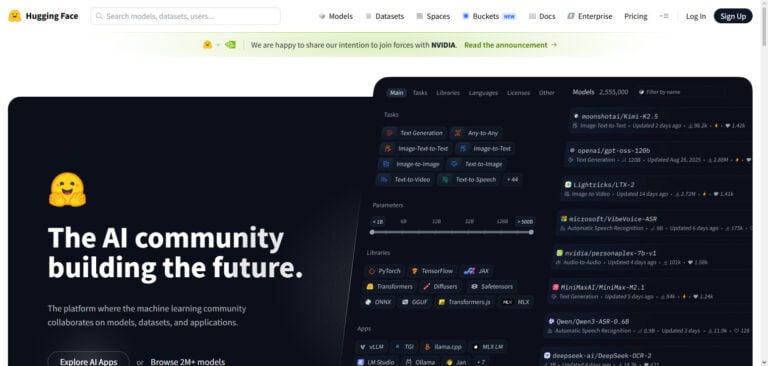
Services cover the Transformers library, Spaces for apps, and Inference Endpoints. Their ecosystem is extensive, with integrations across AWS, Google, Microsoft, and Startups. The speed largely depends on the routing provider (Groq, Cerebras, Together) who offer scalable inference APIs. Hugging Face enjoys community lock-in to ascertain it remains the go-to open-source AI developer resource.
Hugging Face Characteristics
- 2.4 million open-source models
- 730k open-source datasets
- Model hosting on the open-source platform
- Enterprise and team pricing, and free tiers
- AWS, Google, and Microsoft integration
| Advantages | Disadvantages |
|---|---|
| Largest open‑source hub (2.4M+ models) | Enterprise support weaker than AWS/Google |
| Flexible pricing tiers | GPU inference costs can be high |
| Services: Transformers, Spaces, Endpoints | Community models vary in quality |
| Strong ecosystem partnerships | Limited compliance tools |
| Community‑driven innovation | Speed depends on external providers |
| Free tier for developers | Less predictable uptime vs enterprise clouds |
| Integrations with AWS, Google, Microsoft | Vendor lock‑in risk for hosted endpoints |
| Open‑source leadership | Requires technical expertise to scale |
4. Amazon SageMaker
Amazon SageMaker is the flagship ML service from AWS and was launched in 2017. The pricing is pay-as-you-go and can save you up to 64%. It provides over 30 different services and components, including 1,000+ models via JumpStart, HyperPod, and Clarify.
The ecosystem is integrated with AWS (S3, EC2, IAM, CloudWatch). Speed tests show up to 90% savings via spot training, and inferencing can be done in sub-second times with SageMaker serverless endpoints. For managing the entire ML lifecycle, SageMaker is best for the enterprise class market.
Amazon SageMaker Characteristics
- Integration across the AWS stack
- ML lifecycle with price discounts
- Enterprise Heap, AI tools, and infrastructure
- Serverless AI endpoints with sub-second latency
| Advantages | Disadvantages |
|---|---|
| End‑to‑end ML lifecycle | Complex pricing structure |
| Pay‑as‑you‑go with savings plans | Steep learning curve |
| Services: JumpStart, HyperPod, Clarify | Vendor lock‑in with AWS ecosystem |
| Tight AWS integration | Spot training requires expertise |
| Sub‑second inference | Costs can spike with scaling |
| Enterprise‑grade compliance | Less community openness |
| 90% cost savings with spot training | Limited free tier |
| Global availability | Heavy reliance on AWS ecosystem |
5. Google Vertex AI
As Google Cloud’s unified ML platform, Vertex AI was launched in 2021. Pricing is per token/compute hour, for example, Gemini Flash is $0.075/M input, Pro at $1.25/M input. Services include Gemini models, AutoML, Agent Builder, along with Vector Search. The ecosystem integrates with BigQuery, along with Looker, Salesforce, SAP and Kubernetes.
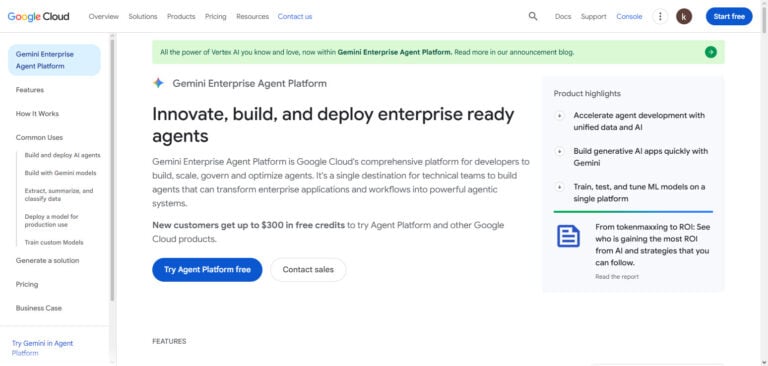
The speed is enhanced by TPU acceleration. Compared with GPUs, they have a cost reduction of 30-50%. By 2026, Google’s Search can RAG along with enterprise-grade compliance and multimodal grounding. For enterprises wanting scalable pipelines and generative AI agents, Vertex AI is very suitable.
Google Vertex AI Characteristics
- All-in-one ML lifecycle with AutoML and Gemini models
- Charge based on token and compute hours (Gemini Flash/Pro)
- Build AI agents and product search with vector AI
- Ecosystem integrations with BigQuery, Looker, SAP, Salesforce
- Training with TPUs at a faster and low cost
| Advantages | Disadvantages |
|---|---|
| Unified ML lifecycle | Pricing per token can be expensive |
| Gemini models integrated | Limited free tier |
| Services: Agent Builder, Vector Search | TPU availability limited to Google Cloud |
| Ecosystem: BigQuery, Kubernetes, SAP | Vendor lock‑in risk |
| TPU acceleration reduces costs | Complex billing |
| Enterprise compliance | Requires Google Cloud expertise |
| Multimodal RAG pipelines | Less community adoption vs Hugging Face |
| Strong AI research backing | Limited hybrid deployment options |
6. Microsoft Azure ML
Azure ML was first previewed in 2014, and re-released in 2018. It charges compute units only, and has no platform fee. Services include AutoML, Responsible AI dashboards, ML Pipelines, and Managed Endpoints. The ecosystem integrates with Azure DevOps, GitHub, Power BI, and Microsoft 365.
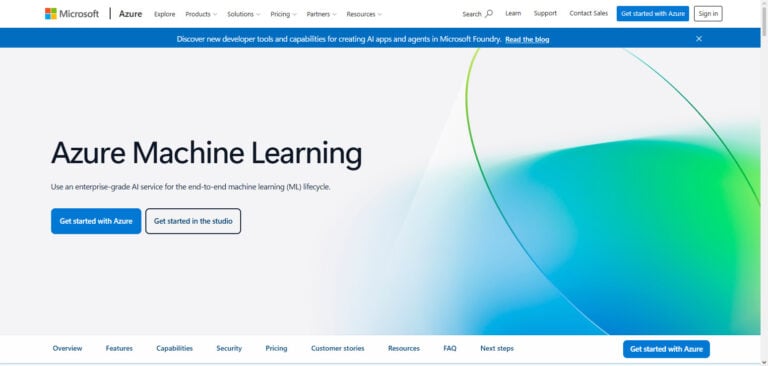
Speed is competitive, with distributed GPU clusters (A100/H100) and auto-scaling inference. Azure ML has responsible AI focused features and tools for fairness and interpretability, and therefore, is well-positioned for highly regulated enterprises.
Microsoft Azure ML Characteristics
- Damage control on enterprise training
- Auto prompt generation, Responsible AI
- AI co-pilot integrations (Designer and Prompt Flow)
- Azure DevOps, GitHub, Power BI, Microsoft 365
- Azure Arc for hybrid deployment (multi‑cloud/on‑prem)
- Distributed GPU clusters with 99.9% uptime SLA
| Advantages | Disadvantages |
|---|---|
| No platform fee, compute‑only billing | Pricing complexity with Azure services |
| Services: AutoML, Designer, Prompt Flow | Less open‑source community adoption |
| Ecosystem: Azure DevOps, GitHub, Power BI | Requires Microsoft ecosystem alignment |
| Hybrid deployment via Azure Arc | Learning curve for non‑Microsoft users |
| Distributed GPU clusters | Limited free tier |
| Responsible AI dashboards | Less flexibility vs Hugging Face |
| 99.9% uptime SLA | Vendor lock‑in with Azure |
| Strong compliance tools | Higher costs for startups |
7. CoreWeave
CoreWeave started in New Jersey in 2017 and transitioned from crypto mining to GPU cloud. Their estimated valuation for their IPO in 2025 was $35B. Their pricing is GPU‑hour based, e.g. H100 PCIe at $4.25/hr, HGX nodes at $49/hr.
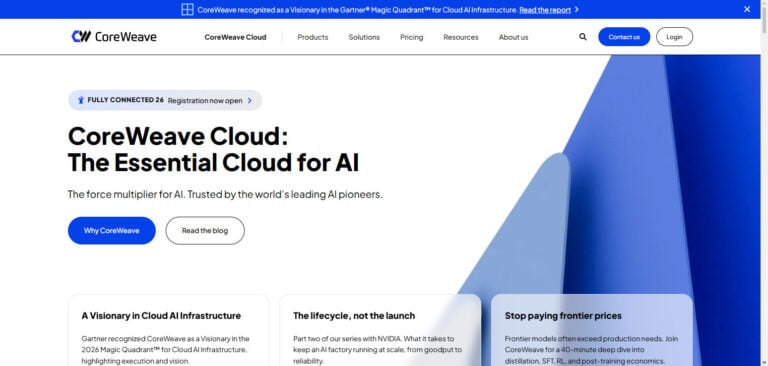
They provide GPU‑only clusters, dedicated to AI training and inference. Their ecosystem has joint ventures with OpenAI, Microsoft, Anthropic, Meta. Their speed benchmarks have shown as much as 75% cost savings compared to AWS/Azure for large clusters. CoreWeave is preferred by labs and enterprises for dedicated GPU infrastructure.
CoreWeave Characteristics
- AI cloud built on GPU Prime optimized for workloads
- Pricing %. H100, HGX nodes
- Services: dedicated GPU clusters, inference optimization
- Open partnerships with OpenAI, Anthropic, Meta
- 75% more cost efficient than AWS/Azure for large clusters
| Advantages | Disadvantages |
|---|---|
| GPU‑only cloud optimized for AI | Limited services beyond GPU hosting |
| Pricing per GPU hour | No free tier |
| Dedicated GPU clusters | Smaller ecosystem vs AWS/Google |
| Partnerships with OpenAI, Anthropic, Meta | Vendor concentration risk |
| 75% cost savings vs AWS/Azure | Focused mainly on enterprise labs |
| IPO valuation $35B | Less developer‑friendly APIs |
| High‑performance compute | Limited compliance certifications |
| Flexible scaling | Narrow service scope |
8. Groq
Founded in 2016 in Mountain View with Jonathon Ross, Groq is focused on Language Processing Units (LPUs). Pricing is per token starting with $0.05/M tokens and free tiers for developers. Services with a deterministic inference architecture expose batch APIs.
They support open-weight models like Llama and Qwen. Speed shows 2× faster inference than GPUs for ultra low latency real-time applications. In 2026, Groq plans to serve over 5M developers and operate 13 data centers around the world, despite Nvidia licensing its IP in 2025.
Groq Characteristics
- Language processing units(LPUs) for ultra low latency
- Pricing per token with developer tier for free
- Services: GroqCloud API, deterministic inference
- Open ecosystem of models (Llama, Qwen)
- 2x inference speed over GPUs with real time performance
| Advantages | Disadvantages |
|---|---|
| LPUs for ultra‑low latency | Limited ecosystem compared to GPUs |
| Pricing per token | Smaller enterprise adoption |
| GroqCloud API | Limited model diversity |
| Deterministic inference | Less compliance focus |
| 2× faster than GPUs | Vendor lock‑in with proprietary hardware |
| Real‑time performance | Limited global data centers |
| Free developer tiers | Less mature than AWS/Google |
| Open‑weight model support | Niche use cases only |
9. Fireworks AI
Fireworks AI builds products focused on inference, founded in 2022, and developed by employees of Meta. Their pricing structure includes pay-per-token priced at $0.10 per million tokens with GPU rentals varying from $2.90 to $12 per hour. Some services include low latency inference, fine-tuning, and support for compound AI systems.
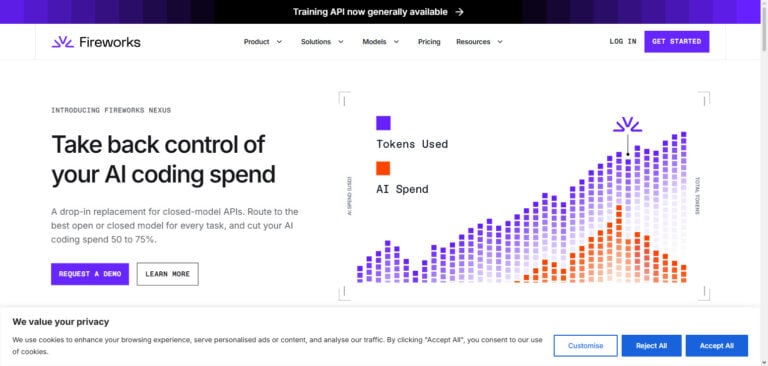
Their ecosystem includes Uber, Shopify, Samsung, and DoorDash. At Fireworks, they claim to have 4X lower latency compared to vLLM and 12X faster inference for multimodal workloads. By 2026, Fireworks processes 40T+ tokens daily and raised $1.5B Series D at $17.5B valuation.
Fireworks AI Characteristics
- Inference APIs for production workload with low latency
- Pricing: $0.10/M cents, GPU rentals ranged $2.90 – $12/ hr
- Services: fine-tuning, multimodal inference, compound AI
- Partnerships with Uber, Shopify, Samsung, DoorDash
- 4x lower latency than vLLM, 12x faster speed for multimodal
| Advantages | Disadvantages |
|---|---|
| Low‑latency inference APIs | Pricing per token can scale quickly |
| GPU rentals $2.90–$12/hr | Less compliance certifications |
| Fine‑tuning support | Smaller ecosystem vs AWS/Google |
| Multimodal inference | Limited free tier |
| Ecosystem: Uber, Shopify, Samsung | Still growing developer community |
| 4× lower latency vs vLLM | Vendor lock‑in risk |
| 12× faster multimodal speed | Less open‑source presence |
| Raised $1.5B Series D | Focused mainly on enterprise SaaS |
10. Replicate
Founded in 2019, Replicate is an API model deployment service based out of San Francisco. They charge for GPU use on a per-second basis. For example, they will charge $0.0001 for use of a CPU for a second and $0.0014 for the use of an A100. Services include open-source model packaging and deployment for persistent model serving, as well as a community model repository with over 100,000 models.

Their ecosystem will (post-2026 acquisition) integrate Cloudflare for globally distributed edge hosting. Speeds are adjustable, with idle models able to scale to zero, and outputs able to be streamed. They are best suited for developers wanting to quickly prototype AI applications without having to maintain back-end infrastructure.
Replicate Characteristics
- API hosting with distributed endpoints that scale to zero
- Pricing: GPU billing on a per-second basis (CPU, A100, multi-GPU)
- Services: Cog packaging, deployments, async pipelines
- Post 2026 Cloudflare edge hosting
- Flexible speed with streaming outputs combined with idle scaling
| Advantages | Disadvantages |
|---|---|
| Simple API hosting | Limited enterprise compliance |
| Per‑second GPU billing | Costs unpredictable for large workloads |
| Cog packaging for models | Smaller ecosystem vs AWS/Google |
| Deployments with scale‑to‑zero | Limited enterprise support |
| Cloudflare edge hosting | Less speed than Groq/SiliconFlow |
| Streaming outputs | Community models vary in quality |
| Async pipelines | Limited free tier |
| Developer‑friendly | Less suited for regulated industries |
Conclusion
The AI model hosting landscape of 2026 features a balanced relationship with innovative challengers and big corporate competitors. Both NetCity AI Cloud and SiliconFlow are disrupting the hosting market with ultra-fast inference and sovereign compliant hosting, while Hugging Face continues its dominance of the open-source ecosystem.
For enterprise clients, scale, control, and integration bringAmazon SageMaker, Google Vertex AI, and Microsoft Azure ML into the picture. Speed, flexibility, and competitive pricing bring CoreWeave, Groq, Fireworks AI, and Replicate into the picture.
The first ten companies of this list are the companies that will dominate the market of AI hosting.The market will be won with the combination of speed, compliance, cost efficiency, and ecosystem integration. The clientele will be served based on enterprise reliability, open-source flexibility, and cutting edge performance.
FAQ
What is AI model hosting?
AI model hosting is the process of deploying machine learning or generative AI models on cloud platforms so they can be accessed via APIs or endpoints. It ensures scalability, speed, and compliance for production use.
Which AI hosting company is cheapest in 2026?
For developers, Replicate offers the lowest entry cost with per‑second GPU billing. SiliconFlow also provides free access to small models and low‑cost token billing, making them budget‑friendly options.
Which platform is fastest for inference?
Groq leads with its Language Processing Units (LPUs), delivering ultra‑low latency. SiliconFlow and Fireworks AI also benchmark at 3–10× faster inference compared to traditional GPU hosting.
Which AI hosting is best for enterprises?
Enterprises prefer Amazon SageMaker, Google Vertex AI, and Microsoft Azure ML due to their compliance, integration with existing cloud ecosystems, and enterprise‑grade governance.