





This article focuses on the top AI chip companies for Enterprise AI. I will analyze strengths, architectures, deployments, and workloads. NVIDIA, AMD, Intel Gaudi3 / Xeon AI, Google TPU, AWS Trainium & Inferentia, Microsoft Azure Maia, Apple, Qualcomm, Graphcore, and Tenstorrent are a few of the companies leading the way for enterprise AI. each of these companies provides something different and plays an important role of innovation.
What is AI Chip Companies ?
AI Chip Companies create chips specifically designed to run AI workloads more quickly over traditional CPUs. These chips (such as GPUs, TPUs, and custom ASICs) excel at deep learning, natural language processing, and real-time inference.
Companies require scalable and efficient solutions for AI processing, and these organizations offer technologies tailored to accelerate cloud or edge workloads. AI companies rely on companies like NVIDIA, AMD, Intel’s Gaudi3 / Xeon AI, Google TPU, or AWS Trainium & Inferentia to offer services helping businesses train enormous models and deploy huge scale AI inference across multiple verticals.
How To choose AI Chip Companies for Enterprise AI
Evaluate enterprise strength
Maturity of leadership in market, maturity of ecosystem, and track record of deployments are key indicators of enterprise strength. NVIDIA and AMD dominate GPU architecture and Google, AWS, and Microsoft, cloud-native AI.
Assess architecture
Determine if the architecture is GPU, ASIC, CPU integrated, or other (such as IPU). Architecture affects tradeoffs for training vs inference.
Consider deployment options
Consider if you need on-premises, cloud-native, or edge AI deployment. For example, TPUs and Trainium are cloud-only, while Apple and Qualcomm dominate the Edge.
Match primary workloads
Make sure chip architecture aligns with your enterprise workloads (i.e. LLM training, LLM inference, recommendation systems, edge AI) — NVIDIA specializes in LLMs, while Amazon has a strong preview of scalable inference.
Analyze cost & vendor lock-in
Cost and flexibility of the ecosystem (i.e. vendor lock-in) are also important to evaluate. Cloud chips often mean you are locked in with other services, whereas AMD ROCm and Tenstorrent are open-source and flexible.
Key Points
| Company | Flagship AI Chip | Core Strength | Best For |
|---|---|---|---|
| NVIDIA | H200 / Blackwell GPUs | Dominant in training & inference, CUDA ecosystem | Enterprises scaling LLMs |
| AMD | MI300X | High‑bandwidth memory, ROCm stack | Cost‑efficient AI compute |
| Intel | Gaudi3 / Xeon AI | Enterprise CPU + AI accelerators | Hybrid AI + HPC workloads |
| Google (TPU) | TPU v5e | Cloud‑native AI accelerators | AI workloads on Google Cloud |
| AWS (Trainium & Inferentia) | Trainium2 / Inferentia2 | Optimized for AWS AI services | Cloud‑based enterprise AI |
| Microsoft (Azure Maia) | Maia 100 | Custom silicon for Azure AI | Enterprises on Azure |
| Apple | M3 Ultra Neural Engine | On‑device AI acceleration | Enterprise mobile + edge AI |
| Qualcomm | Snapdragon X Elite AI | Edge inference, low power | Enterprise IoT + mobile AI |
| Graphcore | IPU Mk3 | Parallel AI compute architecture | Specialized enterprise AI R&D |
| Tenstorrent | Ascalon AI cores | Open architecture, RISC‑V based | Custom enterprise AI deployments |
1. NVIDIA
NVIDIA’s offerings of CUDA and GPUs of the A100 and H100 specifically target large scale deep learning. They emphasize architecture built around optimization for matrix operations and training neural networks. NVIDIA uses the GPU architecture and extensively uses Tensor Cores.
Their ecosystem is built around cuDNN and TensorRT and extends across hyperscaler and enterprise adoption. Their primary workloads target generative AI, large language models, and exercises in autonomous driving as well as scientific simulations. NVIDIA’s dominance across the industry illustrates the value of seamless integration and commitment to scalability.
NVIDIA Features
- Market dominant position in enterprise GPU-based AI acceleration
- CUDA framework and Tensor Cores for accelerating deep learning
- Apps deployed across cloud systems, HPC, edge AI
- Leading enterprise LLM, generative AI, driving AI workloads
- Mature software for seamless app integration (cuDNN, TensorRT)
| Pros | Cons |
|---|---|
| Industry leader in GPU-based AI acceleration | High cost compared to alternatives |
| Mature CUDA ecosystem with strong developer support | Heavy reliance on proprietary software |
| Wide deployment across cloud, HPC, and enterprise | Power consumption is significant |
| Optimized Tensor Cores for deep learning workloads | Supply chain constraints during high demand |
| Strong ecosystem with cuDNN, TensorRT, and libraries | Competition from custom ASICs and CPUs |
2. AMD
AMD has developed Instinct MI series accelerators to challenge NVIDIA in the enterprise market. AMD has established cost-effectiveness and supports AI workloads, especially with its open-source framework ROCm, which provides developers flexibility and avoids vendor lock-in. AMD’s architecture relies on its GPUs that are designed for high memory bandwidth and scalability to handle large sets of data.
AMD’s primary deployment is in enterprise computing HPC clusters and cloud services{“.} AMD’s primary workloads are machine learning, scientific computing and AI, in addition to media and entertainment workloads. AMD has targeted HPC and enterprise computing cluster demand with its focus on performance within a reasonable price range.
AMD Features
- Instinct MI series GPUs for AI workloads
- ROCm open-source platform
- Large memory bandwidth
- AI workloads deployed in HPC and cloud AI services
- Training and inference of ML workloads and scientific computations
| Pros | Cons |
|---|---|
| Cost-effective alternative to NVIDIA | Smaller ecosystem compared to CUDA |
| ROCm open-source platform reduces lock-in | Limited adoption in enterprise AI |
| High memory bandwidth for large datasets | Performance gap in some workloads |
| Strong presence in HPC clusters | Less optimized software stack |
| Competitive pricing for scalability | Slower ecosystem growth |
3. Intel Gaudi3 / Xeon AI
Intel’s Gaudi3 accelerators and Xeon AI processors target enterprise AI with a focus on performance efficiency and workload optimization.

Gaudi3 supports frameworks for deep learning, high throughput interconnects, and services to optimize AI. Xeon AI places AI accelerators in CPUs to execute inference workloads without discrete GPUs. Intel’s strength is it’s data center dominance and its ability to include AI along with its product offerings.
Deployment encompasses cloud, enterprise, and hybrid servers. Major workloads are natural language processing, recommendations systems, and applications that use a lot of inference and where AI-based acceleration on CPUs reduces costs.
Intel Gaudi3 / Xeon AI Features
- Gaudi3 optimised for acceleration of deep learning training
- Xeon AI CPUs with inference acceleration
- Strong enterprise presence via existing Intel infrastructure
- Cloud, enterprise servers, hybrid environments deployment
- Naturally occurring language processing and recommendation systems
| Pros | Cons |
|---|---|
| Gaudi3 optimized for deep learning training | Less mature ecosystem than NVIDIA |
| Xeon AI integrates inference into CPUs | Limited GPU-class acceleration |
| Strong enterprise presence via Intel servers | Adoption slower in AI-first companies |
| Cost-effective inference workloads | Performance gap in large-scale training |
| Hybrid deployment flexibility | Competes against specialized accelerators |
4. Google (TPU)
Google’s Tensor Processing Units (TPUs) are custom ASICs that Google exclusively designed to speed up their AI offerings. TPUs can leverage Google Cloud easily, which enables businesses to do scalable AI training and inference. TPUs can parallelize deep learning tasks quickly and efficiently. Since they are primarily cloud-based,
TPUs require no on-premises hardware, and businesses simply have to access Google Cloud’s AI APIs to use them. TPUs train large-scale language models, recognize images, and build recommendation systems. TPUs enable Google to build their AI products, like Search and Translate, which indicates their extreme scalability and efficiency.
Google TPU Features
- Custom ASICs for tensor processing and integrating Google Cloud AI services
- Specialized for parallelism in deep learning
- Deployed primarily in cloud-native Google Cloud
- LLM training, image processing, recommendation services
| Pros | Cons |
|---|---|
| Custom ASICs optimized for tensor operations | Only available via Google Cloud |
| High efficiency for deep learning workloads | Limited on-premise deployment |
| Tight integration with Google AI services | Vendor lock-in to Google ecosystem |
| Scalable for large language models | Less flexible than GPUs |
| Proven use in Google products | Limited accessibility outside cloud |
5. AWS (Trainium & Inferentia)
With Trainium and Inferentia chips, AWS provides specialty hardware to train and infers AI models in the cloud respectively. AWS’s Enterprise unit excels in the seamless integration with the service offerings, thus facilitating scale of workloads easy for the customers.
Trainium is specifically designed for high throughput of AI models, while Inferentia concentrates on low latency inference. These chips are designed to be cloud native and deployed inside computing/AI services on EC2 instances and Sagemaker. Along with recommendations engines and other AI services, real time inference is one of the major use cases for these purpose built chips. AWS is pricing these chips in the market to compete with GPUs and aims to draw budget focused customers to them.
AWS Trainium & Inferentia Features
- Trainium for AI training, Inferentia for AI inference
- Cost effective cloud-native AI acceleration
- Integration with SageMaker and EC2
- Exclusively in the AWS Cloud ecosystem
- Generative AI, real-time inference, recommendation services
| Pros | Cons |
|---|---|
| Cost-efficient AI acceleration | Only available in AWS ecosystem |
| Trainium optimized for training | Limited hardware customization |
| Inferentia optimized for inference | Less versatile than GPUs |
| Seamless integration with EC2 & SageMaker | Vendor lock-in to AWS |
| Scalable cloud-native deployment | Limited adoption outside AWS |
6. Microsoft (Azure Maia)
Azure Maia chips make optimizations for large-scale models and cloud-scale AI. Azure’s integration with Copilot and OpenAI, as well as other Azure services, builds enterprise-ready tools. Training and inference of large models utilize energy efficient and scalable designs. Deployments are cloud native as they are designed to run in Azure data centers.
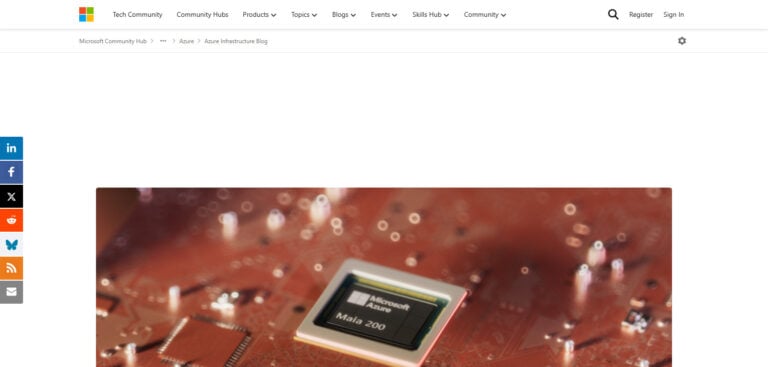
This gives enterprises the ability to utilize advanced AI tools that require no additional hardware. Primary work loads include generative AI and enterprise productivity tools. Microsoft uses Maia to help differentiate Azure and give Enterprises the ability to run advanced cloud AI tools seamlessly.
Microsoft Azure Maia Features
- Custom accelerators for Azure AI workloads
- Optimized for training and inference at scale
- Energy-efficient architecture for cloud deployments
- Integrated with Azure Copilot and OpenAI services
- Workloads: enterprise productivity AI, generative models
| Pros | Cons |
|---|---|
| Custom accelerators for Azure workloads | Exclusively tied to Azure cloud |
| Optimized for large-scale AI training | Limited hardware availability |
| Energy-efficient architecture | Less flexible than GPUs |
| Integrated with Copilot & OpenAI | Vendor lock-in to Microsoft ecosystem |
| Strong enterprise productivity focus | Limited adoption outside Azure |
7. Apple
Apple includes AI Acceleration, Neural Engine, directly in its consumer devices. Vertical Integration of hardware and software mean enterprise strength in performance optimization. The Neural Engine is architected on Apple Silicon. All of these components are designed for efficient, on-device AI inferences. Neural Engine deployment is in iPhones, iPads and Macs, enabling Edge AI.

The primary Edge AI workloads in consumer devices are image recognition, natural language processing and real time translation. The indirect benefit to the enterprise stemming from consumer-centric AI Hardware is Edge AI and privacy preserving applications.
Apple Features
- Apple neural engine
- On-device AI, personal privacy
- Consumer device efficiency
- Deployed in iPhones, iPads, Macs
- Image recognition, NLP, real-time translation
| Pros | Cons |
|---|---|
| Neural Engine embedded in Apple Silicon | Consumer-focused, not enterprise-scale |
| On-device AI ensures privacy | Limited training capabilities |
| Efficient inference workloads | Restricted to Apple ecosystem |
| Optimized for mobile and edge AI | Not suitable for large-scale AI |
| Seamless integration with iOS/macOS | Enterprise adoption indirect |
8. Qualcomm
Qualcomm’s focus has been on low-power and mobile edge AI hardware, integrating AI acceleration with Snapdragon processors. Its strength in the enterprise segment is its stronghold on smartphone and IoT device markets. Qualcomm AI Engines are able to run high-speed low-power inference for real-time AI on edge devices.
These engines run the gamut of mobile devices, automotive systems, and IoT edge devices. Their primary use cases are computer vision and speech interfaces along with edge inference. Companies building large scale AI-powered consumer and industrial products view Qualcomm’s position on power efficiency as a critical differentiator.
Qualcomm Features
- Snapdragon AI Edge
- Edge inference
- IoT integrated systems, smartphones, automotive
- Deployed in mobile, IoT, automotive systems
- Computer vision, speech recognition, AI on the edge
| Pros | Cons |
|---|---|
| Dominant in mobile and IoT AI | Limited enterprise-scale adoption |
| Low-power AI acceleration | Focused mainly on inference |
| Strong presence in smartphones | Less suited for large-scale training |
| Optimized for edge workloads | Smaller ecosystem for developers |
| Automotive and IoT integration | Competes with specialized accelerators |
9. Graphcore
Graphcore’s IPUs bring innovation to the chip architecture scene for Artificial Intelligence (AI) workloads. With a focus on fine-grained parallelism, they offer an alternative to GPUs and TPUs. IPUs strive to improve the training time of complex AI models.
You can find them deployed in research labs and companies that want to try the newest AI hardware. Primary workloads of IPUs are deep learning research, graph models, and advanced AI projects. Graphcore’s goal is to disrupt the performance that companies think they can get with GPU architectures. Because of this, they appeal the most to companies that want better AI performance.
Graphcore Features
- Intelligent Processing Units (IPUs) parallel architecture
- Architecture beyond GPU
- Research and AI lab deployment
- Adoption in advanced AI enterprise hardware
- Deep learning, graph-based models, advanced AI research
| Pros | Cons |
|---|---|
| Innovative IPU architecture | Smaller ecosystem compared to GPUs |
| Fine-grained parallelism for AI | Limited enterprise adoption |
| Strong presence in research labs | Less proven in production workloads |
| Optimized for graph-based models | Competes against established vendors |
| Disruptive approach to AI hardware | Higher risk for enterprises |
10. Tenstorrent
Tenstorrent AI processors place an emphasis on scalability and open-source software. The experience of their leadership team and partnerships across AI ecosystems add enterprise strength. Tenstorrent chips emphasize flexibility and support different AI workloads ranging from training to inference.
The chips are deployed at startups, research institutions, and enterprises that are looking for alternatives to NVIDIA and AMD. The primary workloads are generative AI and reinforcement learning, as well as other custom AI applications.
Tenstorrent aims to offer flexible hardware in the form of chips to integrate with open-source frameworks. This appeals to enterprises and attracts more customers who are looking to innovate and offer independence to clients from the large AI service providers.
Tenstorrent Features
- Workload-flexible AI processors
- Industry veterans leading
- Open-source integration
- Startup, enterprise and research institution deployment
- Generative AI, reinforcement learning, custom AI apps
| Pros | Cons |
|---|---|
| Flexible AI processors | Ecosystem still developing |
| Open-source integration | Limited enterprise-scale deployments |
| Leadership under industry veterans | Competes against established giants |
| Supports diverse workloads | Less proven in large-scale production |
| Focus on innovation and adaptability | Adoption mainly in startups/research |
Conclusion
The best AI chip companies for Enterprise AI build a pathway for uniqueness within the innovation of AI. NVIDIA and AMD command GPU acceleration, but most of the racing enterprises use custom silicon for cloud-scale workloads. These firms are Intel Gaudi3 / Xeon AI, Google TPU, AWS Trainium, and Inferentia.
Improving enterprise productivity is Azure Maia. Apple and Qualcomm are building edge AI. Others crash the racing game with unconventional architectures like Graphcore and Tenstorrent. Innovation in Enterprise AI is scalable and transformative across multiple industries.
FAQ
What are AI chips?
AI chips are specialized processors designed to accelerate artificial intelligence workloads such as training and inference, offering higher efficiency than traditional CPUs.
Which company leads enterprise AI hardware?
NVIDIA currently leads with its GPU ecosystem, but competitors like AMD, Intel, Google, AWS, and Microsoft are rapidly innovating with custom architectures.
Why do enterprises need AI chips?
Enterprises require AI chips to handle large-scale workloads like generative AI, natural language processing, recommendation systems, and edge inference efficiently.
Are cloud AI chips different from consumer AI chips?
Yes. Cloud AI chips like Google TPU or AWS Trainium are optimized for large-scale training, while consumer chips like Apple Neural Engine focus on edge inference.
Which emerging companies are disrupting AI hardware?
Graphcore and Tenstorrent are notable disruptors, offering innovative architectures like IPUs and flexible AI processors to challenge established players.