



In this article, I am going to identify and analyze the Best AI Startups in Europe. Some of the leading AI companies are Helsing, Mistral AI, Wayve, Ineffable Intelligence, AMI Labs, Recursive, Synthesia, Quantum, Parloa, and ICEYE. All of them are implementing disruptive technologies in defense, mobility, generative media, quantum computing, and Earth observations.
What is AI Startups in Europe?
AI Startups in Europe are innovative technology companies that are developing groundbreaking solutions in the field of artificial intelligence.
With the help of billions of dollars in funding, they try to make breakthroughs every day and transform several industries, including defense, healthcare, finance, mobility, and space.
Such startups as Helsing, Mistral AI, Wayve, ICEYE, among others, are turning to governments, research institutions, and corporations to secure investment and promote their products, including large language models, autonomous vehicles, video AI, quantum computers, and space telescopes.
These companies are growing fast, having valuable assets and strong connections with different international partners, so that they can be considered serious players in the region, supporting Europe’s ambitions to become digitally sovereign and innovative on a global scale.
Key Points
| Startup | HQ | Valuation (2026) | Category | Strengths |
|---|---|---|---|---|
| Helsing | Munich, Germany | $14.1B | Defence AI | AI-enabled defence systems |
| Mistral AI | Paris, France | $13.7B | Foundation models | Advanced LLMs, open-source focus |
| Wayve | London, UK | $8.6B | Autonomous driving | Mapless, hardware-agnostic driving AI |
| Ineffable Intelligence | London, UK | $5.1B | Foundation models / superintelligence | Frontier AGI research |
| AMI Labs | Paris, France | $4.5B | World models | Holistic AI systems |
| Recursive Superintelligence | London, UK | $4.0B | Foundation models / superintelligence | Recursive reasoning frameworks |
| Synthesia | London, UK | $4.0B | Generative video AI | AI-driven video creation |
| Quantum Systems | Gilching, Germany | $3.5B | Defence AI | Autonomous aerial systems |
| Parloa | Berlin, Germany | $3.0B | Agentic AI / CX | AI-powered customer experience |
| ICEYE | Espoo, Finland | $2.8B | Defence / EO + analytics | Satellite imaging + AI analytics |
1. Helsing
Helsing is a relatively new defense AI company that was founded in 2021 in Munich, Germany. The company has already raised €1.37B ($1.58B) in multiple funding rounds, and its current valuation is estimated at €18B, making it the biggest defense company in Europe.
The company develops battlefield intelligence systems that form the foundation of military operations. Some of the company’s products are HX-2 strike drone, CA-1 Europa autonomous aircraft, and AI software for Eurofighter and FCAS aircraft.
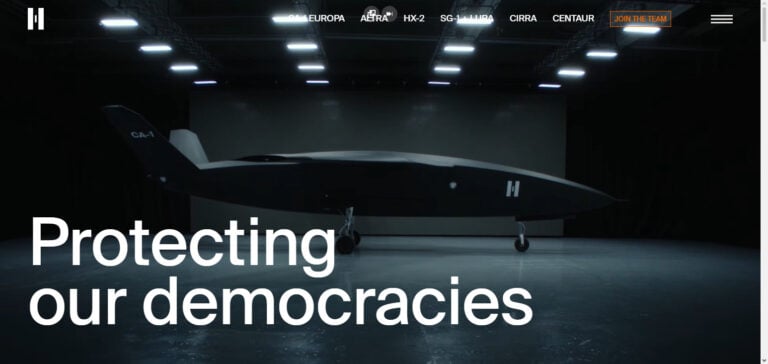
Additionally, Helsing’s battlefield awareness technology processes data from sensors on the ground, in the air, and on warships and produces real-time situational information. The company has already supplied thousands of drones to Ukraine and is collaborating with Airbus, Saab, and Loft Orbital.
However, despite multiple controversies about the reliability of the firm’s products, it has already grown to a company with over 900 employees and has secured hundreds of millions of dollars in defense contracts with European countries.
Helsing Details
- What: Defense AI, drones, battlefield intelligence
- Best for: Governments, defense contractors
- Strengths: €1.3B+ funding, partnerships with Airbus & Saab, rapid growth
- Weaknesses: Controversial reputation, ethical concerns
- Market traction: Government contracts, 900+ employees, drones used in Ukraine
| Pros | Cons |
|---|---|
| Strong funding (€1.3B+) | Reliability concerns in battlefield AI |
| Partnerships with Airbus, Saab | Ethical debates around military AI |
| Rapid scaling to 900+ employees | Limited transparency in deployments |
| Contracts with European governments | Heavy reliance on defense sector |
2. Mistral AI
Found in Paris, France, and incorporated in 2023, Mistral AI is an organization that creates open-sourced and proprietary large language models (LLMs). The company raised over $3B in under three years, hitting a valuation of $14B as of 2025, making it one of the most valued AI startups in Europe.
The organization has created several products, including the Mistral Large 3 (675B parameter model), Mixtral 8x7B, and specialized Codestral for coding. Backed by ASML, Microsoft, Nvidia, Andreessen Horowitz, and BNP Paribas, Mistral aims to achieve digital sovereignty.
The chatbot Mistral Vibe is positioned as a competitor to ChatGPT, while the open-weight models disrupt the market. With over 1000 employees, international offices, and government partnerships, Mistral AI emerges as one of the leading AI companies in Europe capable of challenging American competitors.
Mistral AI Details
- What It Does: Develops open-source and proprietary large language models (LLMs).
- Best For: Enterprises, developers, and governments seeking sovereign AI solutions.
- Strengths: $3B+ funding, cutting-edge models (Mistral Large 3, Mixtral 8x7B).
- Limitations: Competes directly with US giants; scaling infrastructure is costly.
- Market Traction: Valued at $14B, partnerships with Microsoft, Nvidia, BNP Paribas.
| Pros | Cons |
|---|---|
| $3B+ funding, $14B valuation | Competes with US giants (OpenAI, Anthropic) |
| Cutting-edge LLMs (Mistral Large 3, Mixtral 8x7B) | Infrastructure scaling costs |
| Open-source + proprietary models | Risk of fragmentation in ecosystem |
| Partnerships with Microsoft, Nvidia | Regulatory challenges in AI governance |
3. Wayve
Founded in 2017 in London, UK, Wayve is a company that has been developing mapless autonomous driving artificial intelligence (AI). The company has been growing rapidly, accumulating a valuation of $2.86B, with a $8.6 billion in 2026.
The company has raised a sum of $1.5 billion in its latest Series D funding led by Mercedes-Benz, Stellantis, Nissan, Uber, Microsoft, and Nvidia. The company’s products include the AI Driver Platform, the Fleet Learning Loop, and the LINGO-1 simulator.
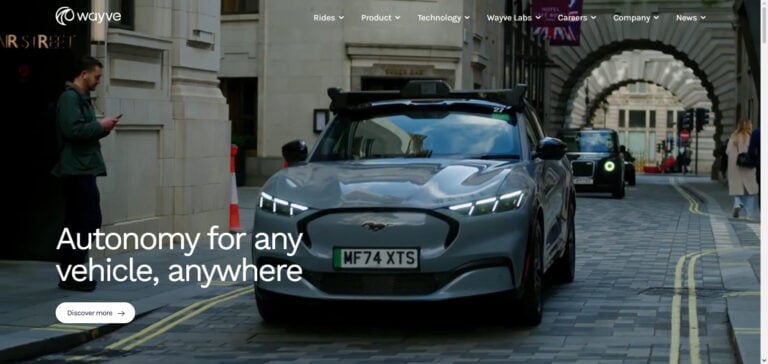
The company has pioneered the development of zero-shot driving technology that enables autonomous driving in over 500 cities without the use of HD maps.
Wayve has secured partnerships with major automakers and technology companies, including Nissan, which has integrated Wayve’s ProPilot system into its vehicles, and Uber, which has been testing robotaxis in London.
The company has 1,000 employees and is positioned as a key player in the autonomous vehicle industry, alongside competitors such as Waymo and Tesla.
Wayve Details
- What It Does: Builds mapless autonomous driving AI using deep learning.
- Best For: Automotive OEMs and mobility platforms.
- Strengths: Zero-shot driving in 500+ cities, $2.8B funding, strong OEM partnerships.
- Limitations: Regulatory hurdles and safety validation challenges.
- Market Traction: Deals with Nissan, Uber, Microsoft; $8.6B valuation.
| Pros | Cons |
|---|---|
| Mapless AI driving in 500+ cities | Safety validation challenges |
| $2.8B funding, $8.6B valuation | Regulatory hurdles in autonomous driving |
| Partnerships with Nissan, Uber | Competition from Waymo & Tesla |
| Scalable deep learning approach | Still limited commercial rollout |
4. Ineffable Intelligence
Founded in 2025 in London, UK, by David Silver, the creator of AlphaGo/AlphaZero, Ineffable Intelligence is a new startup that makes no claim to developing large language models (LLMs). Rather, the company is working on reinforcement learning superlearners.
The company raised a record-breaking $1.1B seed round at $5.1B valuation, making it Europe’s largest-ever seed financing, with investors including Sequoia, Lightspeed, Nvidia, Google, and the UK Sovereign AI Fund. Ineffable Intelligence’s product is a self-learning AI agent that learns on its own and can reach superintelligence.
The company has a small team of 11 to 50 researchers and is still pre-product. It is seen as a potential rival to OpenAI, Anthropic, and DeepMind and is growing at a scientific frontier, with revenues not being a significant metric.
Ineffable Intelligence Details
- What It Does: Focuses on reinforcement learning superagents.
- Best For: Frontier AI research and scientific discovery.
- Strengths: Founded by AlphaGo creator David Silver, $1.1B seed funding.
- Limitations: Pre-product, small team, high-risk research focus.
- Market Traction: Valued at $5.1B, seen as a bold bet in superintelligence.
| Pros | Cons |
|---|---|
| Founded by AlphaGo creator David Silver | Pre-product, no commercial traction yet |
| $1.1B seed funding, $5.1B valuation | Small team (11–50 researchers) |
| Focus on reinforcement learning superagents | High-risk research direction |
| Seen as frontier AI pioneer | Long timeline to commercialization |
5. AMI Labs
Founded in 2025 in Paris by Yann LeCun (Turing award winner), AMI Labs builds World Models using Joint Embedding Predictive Architecture. This company has raised funds, including an investment led by Nvidia, Toyota Ventures, Bezos Expeditions, Temasek, Samsung, and Bpifrance.
This round valued AMI Labs at $1.03B seed funding at $3.5B, making it one of the largest European seed-stage financing deals. Their products include reasoning engines built upon JEPA to empower robots, therapeutics, and manufacturing systems.
Their approach to developing physically grounded, common-sense reasoning systems is fundamentally different from large language models.
Furthermore, AMI Labs wants to avoid hallucination by grounding in physical reality. The team size is estimated to be between 10-50, while the office locations are Paris, New York, Montreal, and Singapore.
AMI Labs Details
- What It Does: Builds world models using JEPA (Joint Embedding Predictive Architecture).
- Best For: Robotics, healthcare, industrial automation.
- Strengths: Founded by Yann LeCun, $1B seed funding, contrarian approach.
- Limitations: Early-stage, limited commercial deployments.
- Market Traction: Global hubs in Paris, New York, Montreal, Singapore.
| Pros | Cons |
|---|---|
| Founded by Yann LeCun | Early-stage, limited deployments |
| $1B seed funding | Competes against dominant LLM paradigm |
| Focus on JEPA world models | Commercial applications still unclear |
| Global hubs in Paris, NY, Montreal, Singapore | Small team size |
6. Recursive
Founded in 2025 in London & SF by Richard Socher (Former Chief Scientist at Salesforce), Recursive AI is a company which was at the forefront of creating self-improving artificial intelligence.
In 2026, Recursive has a $ $650M Series A at $4.7B valuation, having secured funding from GV, Greycroft, Nvidia, AMD Ventures, and others.

The company works on a recursive engine (which can rewrite its own code, architecture, and overall research trajectory) to automate scientific discovery.
While only having 25-30 people on board, Recursive is still one of the most ambitious projects in frontier AI, working on open-ended evolutionary algorithms, inspired by biology, to compete with the likes of Ineffable Intelligence, AMI Labs, and Safe Superintelligence.
Recursive Details
- What It Does: Creates self-improving AI systems that rewrite their own code.
- Best For: Scientific research automation and frontier AI labs.
- Strengths: $650M Series A, led by Richard Socher, unique recursive engine.
- Limitations: Pre-revenue, experimental technology.
- Market Traction: Valued at $4.7B, small elite team of researchers.
| Pros | Cons |
|---|---|
| Founded by Richard Socher | Pre-revenue, experimental stage |
| $650M Series A, $4.7B valuation | Small elite team, limited scale |
| Unique recursive AI engine | High uncertainty in outcomes |
| Ambitious self-improving AI vision | Long-term commercialization unclear |
7. Synthesia
Synthesia is a company engaged in developing AI-based video creation solutions. The firm was founded in 2017 and is headquartered in London, United Kingdom.
In terms of the market performance, the company has raised $530M, reaching a $4B valuation as of 2026 after raising $200M in Series E funding. On the product front, Synthesia offers a suite of enterprise-grade video creation solutions, including Synthesia Studio, Expressive Avatars, and AI Video Assistant, which allow users to generate videos from text in 140+ languages.
The company’s clients include 90% of the Fortune 100 companies, among them are Amazon, SAP Group, Bosch, and Johnson & Johnson. The underlying technology utilizes neural rendering to imbue avatars with human-like facial expressions and emotions, which allows Synthesia to offer training and marketing solutions to its clients.
With over 500 employees and an annual revenue exceeding $100M in 2025, the company has established itself as a key player in the video creation space.
Synthesia Details
- What It Does: AI video generation platform for enterprises.
- Best For: Corporate training, marketing, and communication.
- Strengths: 140+ languages, Fortune 100 clients, $530M funding.
- Limitations: Competition from other generative video startups.
- Market Traction: $4B valuation, ARR $100M+, 500+ employees.
| Pros | Cons |
|---|---|
| $530M funding, $4B valuation | Competition from other video AI startups |
| Fortune 100 clients (Amazon, SAP, Bosch) | Risk of deepfake misuse |
| 140+ languages supported | Limited creative flexibility vs human video |
| ARR $100M+, 500+ employees | Dependence on enterprise adoption |
8. Quantum
Europe’s quantum artificial intelligence landscape is dominated by quantum computing start-ups Pasqal and Q.ANT. Both companies were founded in the late 2010s.
The French-based company, Pasqal, was established in 2019 and has already raised over $445M in funding and is valued at $2B by 2026. It has developed a novel approach to quantum computing that utilizes neutral-atom quantum processors.
The company has already built more than 7 quantum computers and is preparing to enter the industrial and governmental markets as its technology has been tested and verified by major companies such as BMW, Airbus, and Aramco.
On the other hand, the German-based start-up, Q.ANT, was founded in 2018 and has already raised $80M. It has developed photonic quantum processors and sensors that can make AI models run ten times faster.
Therefore, both companies have the potential to become the most promising quantum AI start-ups in Europe as they continue to scale their operations both locally and internationally while also utilizing cutting-edge technology.
Quantum (Pasqal & Q.ANT) Details
- What It Does: Builds quantum processors (neutral-atom & photonic).
- Best For: Industrial optimization, AI acceleration, HPC.
- Strengths: Pasqal ($445M funding, $2B valuation), Q.ANT ($80M funding).
- Limitations: Quantum hardware still early-stage, commercialization slow.
- Market Traction: Clients include BMW, Airbus, Aramco; 7+ quantum computers deployed.
| Pros | Cons |
|---|---|
| Pasqal: $445M funding, $2B valuation | Quantum hardware still early-stage |
| Q.ANT: $80M funding, photonic processors | Commercialization timeline uncertain |
| Clients include BMW, Airbus, Aramco | High R&D costs |
| 7+ quantum computers deployed globally | Niche industrial applications |
9. Parloa
Founded in Berlin, Germany, in 2018, Parloa is a startup that develops Agentic AI for customer service automation. The company has raised $561M, reaching a $3B valuation in 2026, following a $350M Series D. Products include the Parloa Agentic AI Platform, Voice AI, and Chat AI, enabling autonomous reasoning and workflow execution.
Customers include Allianz, Swiss Life, Decathlon, and Booking.com. With 300–500 employees and ARR surpassing $50M in 2025. It is set to benefit from the growing US market for enterprise AI agents. The company offers one of the few voice AI solutions with ultra-low latency and extensive system integration.
Parloa Details
- What It Does: Agentic AI for customer service automation.
- Best For: Enterprises needing scalable voice/chat AI.
- Strengths: $561M funding, ultra-low latency voice AI, strong enterprise integration.
- Limitations: Competition from US-based contact center AI firms.
- Market Traction: Clients include Allianz, Decathlon, Booking.com; $3B valuation.
| Pros | Cons |
|---|---|
| $561M funding, $3B valuation | Competition from US contact center AI |
| Ultra-low latency voice AI | Limited brand recognition globally |
| Clients: Allianz, Booking.com, Decathlon | Scaling challenges in US market |
| Strong enterprise integration | Dependence on enterprise adoption |
10. ICEYE
Founded in 2014 in Espoo, Finland, ICEYE is one of the most promising AI-driven space startups in Europe. This company has attracted more than 300 million dollars in funding from the venture capital funds True Ventures and OTB Ventures and the Finnish government.
The company has developed its own constellation of satellites using synthetic aperture radar (SAR) technology.
They have more than 30 such satellites, allowing them to achieve outstanding results in the field. Today, the company provides its services to the insurance, defense, and environmental sectors. For example, it is possible to monitor floods and oil spills in real-time and track changes to provide information to organizations such as FEMA, Lloyd’s, and several European defense organizations.
Despite its young age, ICEYE has had significant success in the international marketplace. The company employs more than 500 people and has good revenues and profit, making it one of the most promising startups in the AI field in Europe.
ICEYE Details
- What It Does: Operates SAR satellite constellation for Earth observation.
- Best For: Insurance, defense, disaster response, environmental monitoring.
- Strengths: 30+ satellites, $300M+ funding, unmatched imaging capabilities.
- Limitations: High capital expenditure, niche focus on SAR.
- Market Traction: Global clients (FEMA, Lloyd’s), 500+ employees, €1B+ valuation.
| Pros | Cons |
|---|---|
| Largest SAR satellite constellation | High capital expenditure |
| $300M+ funding, €1B+ valuation | Niche focus on SAR imaging |
| Global clients (FEMA, Lloyd’s, defense agencies) | Limited consumer applications |
| 500+ employees, rapid growth | Strong competition in space-tech |
Conclusion
Europe’s AI Startup Ecosystem Is Home to Truly Multifactorial, Ambitious, and Rapidly Growing Companies That Operate across Numerous Sectors. From Defense, Where Helsing Is Revolutionizing Battlefield Intelligence, to Mistral AI, Which Is Challenging the Status Quo of Giant Language Models and the Sovereignty of Data.
From Mapless Driving and Generative Video Production to Frontier Research in Superintelligence and Self-Improving AI Systems Led by Ineffable Intelligence, AMI Labs, and Recursive – Europe’s Startups Are Taking on Some of the Most Sought-after and Competitive Arenas in Modern Tech.
Meanwhile, Synthesia Is Dominating the Generative Video Space, Quantum Startups Pasqal and Q.ANT Are Taking on Quantum Computing, Parloa Automates Customer Service, and ICEYE’s Sar Satellites Are Transforming the Field of Earth Observation.
The companies highlighted above represent a thriving ecosystem of research, development, and capital deployment at the leading edge of artificial intelligence and its economic, social, and strategic transformation. These companies are key players in an increasingly competitive geopolitical and commercial environment and offer exposure to multiple growth opportunities and strategic assets.
FAQ
u003cstrongu003eWhat does Helsing do?u003c/strongu003e
Helsing develops u003cstrongu003eAI-powered defense systemsu003c/strongu003e, including autonomous drones and battlefield intelligence platforms. It is best known for its partnerships with Airbus and Saab and its contracts with European governments.
u003cstrongu003eWhat is Mistral AI’s focus?u003c/strongu003e
Mistral AI builds u003cstrongu003elarge language models (LLMs)u003c/strongu003e, both open-source and proprietary. It is Europe’s strongest competitor to US AI giants, with models like Mistral Large 3 and Mixtral 8x7B.
u003cstrongu003eHow is Wayve different from other autonomous driving startups?u003c/strongu003e
Wayve uses u003cstrongu003emapless AI driving technologyu003c/strongu003e, enabling cars to learn and adapt without HD maps. This makes it scalable across hundreds of cities worldwide.
u003cstrongu003eWhat makes Ineffable Intelligence unique?u003c/strongu003e
Founded by David Silver (creator of AlphaGo), Ineffable Intelligence focuses on u003cstrongu003ereinforcement learning superagentsu003c/strongu003e rather than LLMs, aiming to pioneer the next wave of superintelligence.
u003cstrongu003eWhat is AMI Labs working on?u003c/strongu003e
AMI Labs, founded by Yann LeCun, develops u003cstrongu003eworld models using JEPA (Joint Embedding Predictive Architecture)u003c/strongu003e, designed to give AI systems common sense and reasoning beyond text.