


This article will present recommendations for the greatest AI podcast tools that assist producers with overall podcast creation. From beginner podcasters to business owners, these tools automate essential aspects of creating and editing a podcast including transcription, audio enhancement, and recording. Launching a podcast is a lengthy process, and these advanced AI podcast tools accelerate the process to help podcasters produce more content.
What is AI Podcast Tools?
AI Podcast Tools rely on various technologies such as natural language processing, voice synthesis, and machine learning to help podcast creators automate the various stages of podcast production such as recording, editing, transcription, audio improvement, and content generation and even publishing.
These technologies assist creators to develop their script and improve the audio quality of their podcasts, as well as remove background noise and summarize content. They can even help construct a professional podcast with minimal time and technical skills.
Benefits Of AI Podcast Tools for Creators
Faster Podcast Release with Little Editing
AI tools create flawless episodes with just a click so creators can skip difficult editing. Transcription, audio enhancement, and noise removal are automated. All creators need to do is upload an audio file and click publish.
Clean Backgrounds
While human editors can reduce background noise, AI technologies can eliminate all background noise and balance audio levels making voices audible and clear.
Automatic Transcription and Show Notes
Creators can save valuable time producing episodes using AI tools to transcribe, caption, provide timestamps, and create notes. They can also improve how accessible their content is.
Cover More Ground with One Episode
AI tools can transform your content and help you reach a wider audience. Content can be repurposed into multiple formats and posted to several different platforms.
Never run out of content ideas
AI technologies can suggest topics, create scripts, and episode outlines to assist creators with new ideas and eliminating the creative block. This helps improve content consistency.
Professional Voice Enhancement
AI voices can improve and edit vocal quality and encourage creators to produce studio quality content on their own.
Quality Without the Cost
AI-powered podcast solutions are a lot less expensive than hiring a professional editor or renting an audio studio. Most of these tools combine multiple audio production tools all in one.
Creativity and Community
AI tools create automatic transcriptions and eliminate tedious work. Podcasters can focus their creative energy on their community and the continued growth of their podcast brand and business.
Multilingual Podcast Support
Many AI tools provide camera and voice features to producers to help them make multiple-language podcasts to reach a wider audience globally.
Data-Driven Audience Insights
AI may help producers get insights into their viewers by analyzing what their audiences liked most, what podcasts they clicked on, and how they behaved. This may help producers to create audience-targeted episodes.
Key Point & Best AI Podcast Tools
| Tool | Best For | Key Features |
|---|---|---|
| Descript AI | Editing + transcription | Text‑based editing, overdub voice cloning |
| Podcastle AI | End‑to‑end podcasting | Recording, editing, AI noise removal |
| Riverside AI Studio | Remote interviews | Studio‑quality recording, AI background cleanup |
| Cleanvoice AI | Audio polishing | Removes filler words, stutters, background noise |
| Auphonic AI | Audio mastering | AI loudness leveling, EQ, metadata automation |
| Sonix AI | Transcription | Multilingual transcripts, searchable archives |
| Resemble AI | Voice cloning | Synthetic voices, multilingual dubbing |
| Podbean AI Growth | Hosting + analytics | AI audience insights, monetization tools |
| Castmagic AI | Content repurposing | Auto‑generate show notes, blog posts, clips |
| Alitu AI | Beginner creators | Automated editing, publishing workflows |
1. Descript AI
Descript AI is the podcast editing software of choice for its text-based editing, Studio Sound and Overdub voice cloning. It only costs $24/month, making it an easy choice for professionals. Descript has been able to capture the majority of the editing market, and the 68% of podcasters that now use AI tools is evidence of Descript’s ability to grow.

Its technology uses transcripts for editing, and removes filler sounds. It integrates videos seamlessly as well. As the first and only company to provide a complete solution for podcast editing, its rapid market growth is expected to continue as the predicted AI audio editing market of $1.3 billion by 2027 draws near.
Features:
- Uses AI to perform video and audio editing and text-based edits.
- Easily generates text transcripts of podcast episodes and interviews.
- Voices can be cloned and/or overdubbed for voice corrections.
- Filler words and unwanted pauses are eliminated as well as sound quality enhanced, all automatically.
- Converts entire podcast episodes or sections into captions and social media posts.
Best Fits:
- Video editing beginners that are also podcasters.
- People that want seamless and easy-to-use editing workflows.
- Content teams that wish to publish short or long video content.
- Business podcasts run by basic or novice editing staff.
| Pros | Cons |
|---|---|
| Text-based editing makes podcast editing simple and fast. | Advanced features may require a paid subscription. |
| Accurate AI transcription helps save editing time. | AI voice cloning features have usage limitations. |
| Removes filler words and improves workflow efficiency. | Can feel complex for complete beginners initially. |
| Supports audio and video podcast editing in one platform. | Requires a stable internet connection for cloud features. |
| Creates clips, captions, and social content easily. | Less focused on advanced professional audio mastering. |
2. Podcastle AI
Podcastle AI’s user interface is great for beginners along with their AI assisted recording and editing. At $11.99 a month it is an inexpensive option. Beginner level creators are the most enthusiastic about this service due to the fact that it produces content quickly with little to no technical knowledge required.

It offers transcription, audio cleansing, and one-click publishing. With the increasing global trend towards 4.3M active podcasts, accessibility is the perfect way to gain new users with PodCastle.
Features:
- AI-based podcast recording, editing, and publishing.
- Realistic text-to-voice AI.
- AI noise cancellation and audio enhancement.
- Remote recording with high-quality audio recording.
- Transcribes and captions podcasts automatically.
Best Fits:
- Novice podcasters that need simplification and lack technical knowledge.
- Professional podcasters that are solo.
- People that need to create marketing podcasts for their businesses.
- Educators that create audio courses.
- Creators that don’t want to employ multiple services to get their podcast published.
| Pros | Cons |
|---|---|
| Provides an all-in-one podcast creation workflow. | Some advanced AI features are limited to premium plans. |
| Easy interface for beginners and creators. | AI-generated voices may require customization for natural results. |
| Offers AI voice generation and audio enhancement. | Professional editors may need additional tools. |
| Supports remote recording and transcription. | Large projects can require more processing time. |
| Helps create podcasts without technical skills. | Limited advanced audio mixing controls. |
3. Riverside AI
Riverside AI stands out in the remote recording space by providing separate high-quality local tracks for each host. This makes it ideal for interview or panel podcasts, and costs just $15 a month.
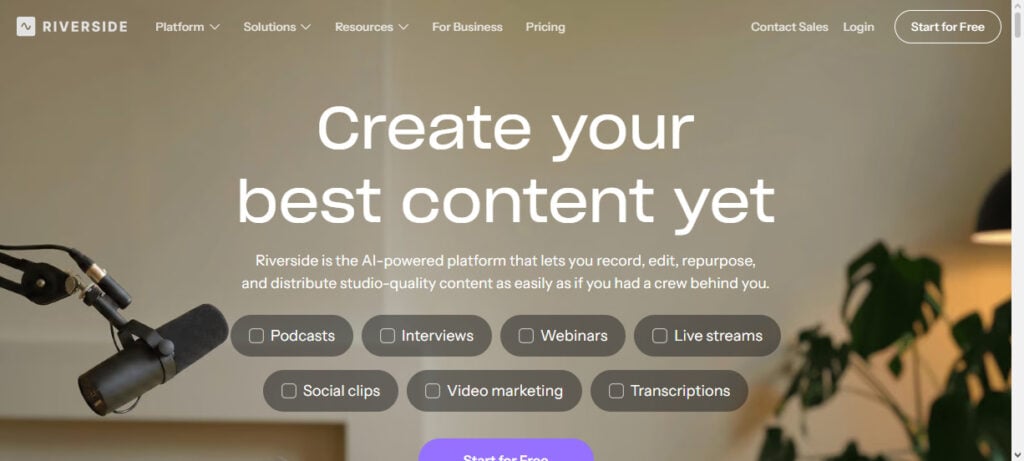
As remote work and remote content creation becomes more common, it has become the go-to recording tool. Now with its AI editing features and top notch reliability, it is the must have podcaster tool.
Features:
- Remotely records podcasts with professional studio quality. Each participant records their own track separately.
- Automatically transcribes and highlights important segments of the recording.
- Easily generates optimized video clips for social media posts and platforms.
- High-quality video podcasts with background removal.
- Offers background noise cancellation and audio enhancement.
Best Fits:
- Remote participants of an interview-based podcast.
- Podcast teams that work remotely.
- Video podcasters.
- Expert interview-based podcasts run by businesses.
- Remote participants that are interested in publishing on YouTube and social sites.
| Pros | Cons |
|---|---|
| Records high-quality remote podcast interviews. | Premium plans can be expensive for beginners. |
| Separate audio and video tracks improve editing quality. | Requires good internet for smooth remote recording. |
| AI clips help create social media content quickly. | Mainly focused on recording rather than full production. |
| Supports video podcast creation with professional quality. | Some AI editing features have limitations. |
| Ideal for interviews with multiple guests. | Storage management can become challenging for frequent creators. |
4. Cleanvoice AI
Cleanvoice AI automatically removes filler words, reduces silences, and improves audio quality. At under $10-$15 a month, it is simple and cost effective. Growth has been rapid in the creator space for quality audio that doesn’t require manual edits.
Faster workflows and higher listener retention are just some things that Cleanvoice’s technology prioritizes with AI automation of repetitive work.
Key Features:
- Removes filler words.
- Removes audio pauses.
- Edits background noise and improves audio quality.
- Edits podcast audio and enhances interview conversations.
- Supports several languages.
Best For:
- Interview-based podcasts.
- Users looking for quick, simple audio editing.
- Video recording beginners and hobbyists.
- Agencies and businesses needing quick podcast production.
- Podcasters wanting to improve raw audio recordings.
| Pros | Cons |
|---|---|
| Automatically removes filler words and unnecessary pauses. | Mainly focused on audio cleanup, not complete podcast creation. |
| Saves significant manual editing time. | Advanced editing options are limited. |
| Improves speech clarity with AI processing. | Results may need manual review for complex recordings. |
| Supports multiple languages for audio enhancement. | Not suitable for video podcast production. |
| Simple interface for beginners. | Less customization compared to professional audio editors. |
5. Auphonic AI
Auphonic AI is well-respected in audio engineering and subjects its services to the benchmark tests of loudness normalization, mastering, and encoding. Its pricing plans start at $11/month. As podcasting itself matures and more publishers seek ‘Broadcast-Level’ sounding content, they flock to Auphonic.
Their AI mastering technology also guarantees that loudness levels satisfy or even exceed broadcast standards. This makes Auphonic AI technology essential for professional upscaling of podcasts.
Key Features:
- Normalizes audio levels to a standard volume.
- Reduces unwanted audio like background noise and echoes.
- AI processing for enhanced speech and audio clarity.
- Automates loudness level normalization for various platforms.
- Does batch audio file processing.
Best For:
- Podcast creators of all levels.
- Agencies and organizations needing consistent audio quality.
- Multi-interview audio recorders.
- Users needing flexible, advanced audio production.
- Large scale podcast production.
| Pros | Cons |
|---|---|
| Provides professional-level audio processing automatically. | Interface may seem technical for beginners. |
| Excellent noise reduction and volume balancing. | Free usage hours are limited. |
| Improves consistency across podcast episodes. | Does not provide complete podcast creation features. |
| Supports batch audio processing. | Requires external recording software. |
| Useful for professional audio workflows. | Limited creative editing capabilities. |
6. Sonix AI
Sonix AI has a price range of $10–15 per month, with a focus on transcription and translation. Sonix has been utilizing accessibility and SEO to drive growth.
Transcription increases discoverability, so Sonix AI works well for podcasters whose audience expands beyond borders. Localization is a growing trend, making Sonix a key player in the podcasting industry for transcription.
Key Features:
- Accurate AI speech to text conversion.
- Provides speech to text conversion in many languages and dialects.
- Creates searchable transcripts.
- Automatically generates subtitles and captions.
- Does transcript editing in the browser.
Best For:
- Users needing searchable content.
- Podcasters wanting accurate transcripts.
- Blog and content creators needing quick transcripts.
- Multilingual teams.
- Creating searchable content libraries.
| Pros | Cons |
|---|---|
| Provides fast and accurate AI transcription. | Mainly focused on transcription rather than editing. |
| Supports multiple languages and translations. | Pricing depends on transcription usage. |
| Creates captions and searchable transcripts. | Audio enhancement features are limited. |
| Easy browser-based transcript editing. | Not an all-in-one podcast production platform. |
| Helps repurpose audio into written content. | Requires additional tools for advanced podcast editing. |
7. Resemble AI
Resemble AI pricing starts at $30/month for voice cloning and synthetic narration. Growth will rely on multilingual podcasting and AI storytelling.
Resemble AI’s tech offers podcasters the ability to generate voices, automate narration, and start multilingual podcasts. Combining creativity and automation, Resemble AI builds an innovative platform for audio automation.
Key Features:
- Creates realistic AI-generated human voices.
- Supports custom voice cloning technology.
- Generates voice content in multiple languages.
- Provides emotional voice control and customization.
- Offers AI voice solutions through API integration.
Best For:
- Creators needing AI narration.
- Businesses building voice-based experiences.
- Audio storytelling projects.
- Game and media developers.
- Companies requiring scalable voice generation.
| Pros | Cons |
|---|---|
| Produces realistic AI-generated voices. | Voice cloning requires careful permission management. |
| Supports custom voice creation. | Pricing can be high for professional usage. |
| Offers multilingual voice generation. | Not designed for complete podcast editing workflows. |
| Provides API access for developers. | AI voices may still need human review for emotions. |
| Useful for scalable voice content production. | Requires technical knowledge for advanced features. |
8. Podbean AI
Podbean AI combines hosting, distribution, and ad monetization in a singular ecosystem. Podbean AI includes advanced AI tools for audience insights that creators use for ad revenue optimization in the $4B podcast ad market.
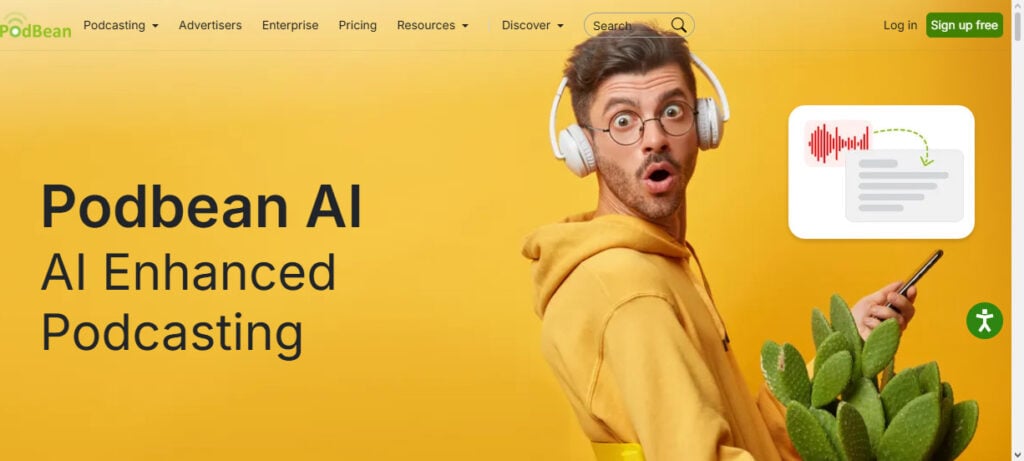
Pricing starts at $9/month and increases with the addition of advanced features. Podbean AI’s strong growth is largely attributed to their use of AI.
Key Features:
- AI-assisted podcast creation and content management.
- Podcast hosting with distribution support.
- AI-powered title, description, and content suggestions.
- Audience analytics tools and monetization features.
- Live podcast streaming and audience engagement tools.
Best For:
- Creators needing hosting and publishing.
- Creators building audience.
- Creators monetizing content.
- Beginner podcasters.
- Podcasters needing support for workflow management.
| Pros | Cons |
|---|---|
| Combines podcast hosting, publishing, and AI tools. | Advanced editing features are limited. |
| Helps distribute podcasts across platforms. | AI features are not as extensive as dedicated AI tools. |
| Provides audience analytics and monetization options. | Less suitable for complex audio production. |
| Beginner-friendly podcast management system. | Customization options may be limited. |
| Supports live streaming and audience engagement. | Professional creators may need additional software. |
9. Castmagic AI
Castmagic AI, for $23/month, automates the generation of show notes and podcast episode summaries, as well as the process of repurposing content.
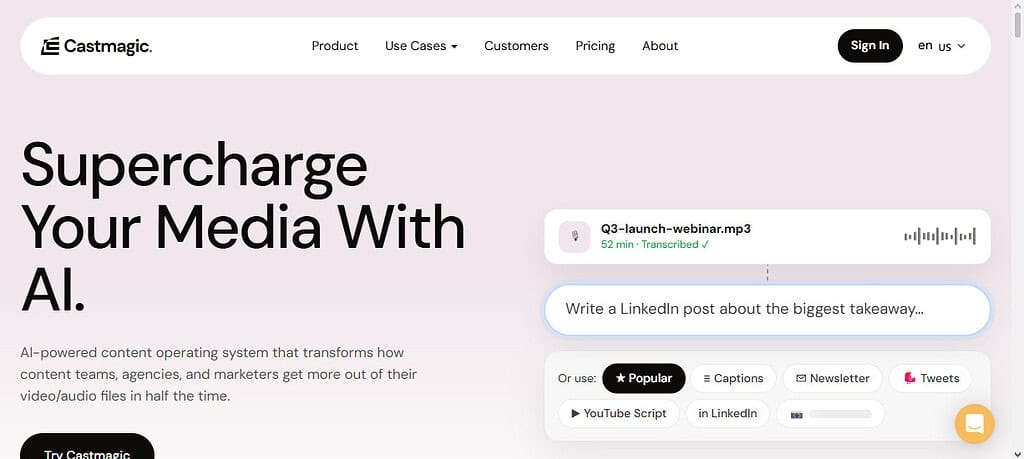
The industry is growing due to the increasing interest in short-form content, with 47% of users discovering podcasts via content clips. With Castmagic AI, podcasters can repurpose content, effectively maximize engagement, reach, and value for each episode of their content.
Key Features:
- Automatically turns podcast audio into written content.
- Generates summaries, show notes, social posts, and newsletters.
- Automatic extraction of important content and posts.
- AI for post and conversation repurposing.
Best For:
- Creators scaling distribution.
- Creators needing social media AI assistants.
- Agencies with podcast clients.
- Companies needing assisted content repurposing.
- Creators needing assistant social media posting.
| Pros | Cons |
|---|---|
| Quickly converts podcasts into multiple content formats. | Does not focus on audio recording or editing. |
| Generates summaries, blogs, and social media posts. | Best value comes with regular content production. |
| Helps marketers maximize podcast content. | Output quality depends on original audio quality. |
| Saves time on content repurposing. | Less useful for creators only needing audio tools. |
| Useful for scaling podcast marketing campaigns. | AI-generated content may need editing before publishing.+6 |
10. Alitu AI
Alitu AI offers an end-to-end podcast production system for $32/month. It’s a great choice for independent podcast creators that prefer a hands-off approach. The system integrates recording, editing, post-processing, and publishing.

Alitu AI is a one-stop solution. As podcasting has quickly become a tool for independant storytellers, Alitu AI’s automation gives creators more time to craft their stories and leaves production to the AI.
Key Features:
- Automates podcast recording and editing.
- Automated podcast episode creation.
- Automated podcast hosting and publishing.
Best For:
- First time podcasters.
- Non-technical users.
- Small podcasters.
- Podcasters building a personal brand.
- Seekers of simple podcast automation.
| Pros | Cons |
|---|---|
| Simple podcast editing workflow for beginners. | Advanced editing controls are limited. |
| Automatically processes and cleans audio. | Not ideal for professional audio engineers. |
| Includes recording, editing, and publishing features. | AI capabilities are less extensive than newer AI platforms. |
| Reduces technical complexity for creators. | Limited customization options. |
| Helps beginners launch podcasts quickly. | May not suit large podcast production teams. |
Conclusion
As of 2026, tools for podcasts that utilize AI reflect trends in automation, accessibility, and audio technology for professionals. Podcasts utilities like Descript AI and Riverside AI have a stronghold in remote recording and editing for professionals. On the other hand, Podcastle AI and Alitu AI specialize in making workflows for beginners and solo creators more streamlined.
Other tools like Cleanvoice AI and Auphonic AI allow for that final polish on your audio. Reaching a larger audience is easier with Sonix AI and Resemble AI thanks to transcription and voice cloning.
Podbean AI does the heavy lifting in terms of hosting and ad placement. Finally, Castmagic AI makes it simple to repurpose old content. All of these tools show how the market for podcasts is growing thanks to AI that makes everything easier and totally scales the industry while making it even more accessible and profitable.
FAQ
What is Descript AI?
Descript AI is a text-based editor with Overdub voice cloning and Studio Sound. Pricing starts at $24/month, and it leads the AI editing market with strong adoption.
Is Podcastle AI good for beginners?
Yes, Podcastle AI offers simple recording and editing at $11.99/month, making it ideal for new podcasters.
Why use Riverside AI?
Riverside AI ensures high-quality remote recording with local tracks. Pricing begins at $15/month, popular for interviews and panels.
What does Cleanvoice AI do?
Cleanvoice AI automatically removes filler words and silences. It costs around $10–15/month, saving creators hours of manual cleanup.