

I will discuss the Best AI Knowledge Retrieval Platforms for Enterprises in this article. These platforms are built to help businesses retrieve, file, and retrieve information from multiple sources in the quickest time possible. I will look into their key features, AI technologies, means of retrieving data, integrations, security, and enterprise case uses to understand how these platforms will support my organization in integrating knowledge management and search AI.
Why Choose AI Knowledge Retrieval Platforms for Enterprises
Easy Information Retrieval – Access relevant information across multiple documents, databases, emails, business applications, and systems.
Building AI Search Capabilities – Understand natural language questions and related search results.
Unified Knowledge System – Bring information from various locations into a single search and knowledge space.
Improved Employee Efficiency – Decrease time spent by employees locating business documents, company policies, reports, and other internally published company information.
Enhanced AI Answers – Answer questions using retrieval-augmented generation (RAG) to rely on enterprise relevant data for AI responses.
Permission Aware – Ensure information is accessed by enterprise employees based on the access granted to business data.
Informed Support – Enable members of the support team to access required product information and customer records to reduce mean time to resolution (MTTIR).
AI Carrier Support – Provide the knowledge and context to support AI in answering queries and performing tasks and workflow support.
Scalable Knowledge Management – Improve availability of enterprise data without being restricted to manual or automated mechanisms.
Effective Business Decisions – Improve data retrieval and answer time to aid make data driven decisions.
Key Points
| Platform | Best For | Key 2026 Strength |
|---|---|---|
| Glean | Enterprise-wide knowledge search | Permission-aware enterprise search, AI answers, agents and broad application connectivity |
| Microsoft 365 Copilot / Copilot Search | Microsoft-centric enterprises | Deep Microsoft 365 and Microsoft Graph integration with enterprise knowledge |
| Coveo | Customer service, commerce & enterprise search | AI relevance, personalized retrieval, RAG and permission-aware knowledge access |
| Elastic | Custom enterprise retrieval infrastructure | Hybrid search, vector search, Elasticsearch-based retrieval and AI/agent tooling |
| Google Agent Search | Google Cloud AI applications | Managed enterprise search and grounding/retrieval capabilities for AI applications |
| Guru | Governed company knowledge | Knowledge management, verification workflows and AI-powered answers |
| Atlassian Rovo | Jira & Confluence environments | Enterprise knowledge discovery using Atlassian’s connected work context |
| Amazon Bedrock Knowledge Bases | AWS-based RAG applications | Managed retrieval layer for building enterprise generative-AI applications |
| Algolia | Digital/product search | AI-enhanced search and retrieval for websites, applications and commerce |
| Vectara | Managed enterprise RAG | Developer-focused retrieval and grounded generation without building the complete retrieval stack |
1. Glean
Glean is a knowledge retrieval system for enterprise applications. Retrieval Types provide semantic-based understanding and a company knowledge graph along with enterprise search rather than relying on classic keyword search. Glean supports over 250 connections to enterprise applications through native and MCP connectors.
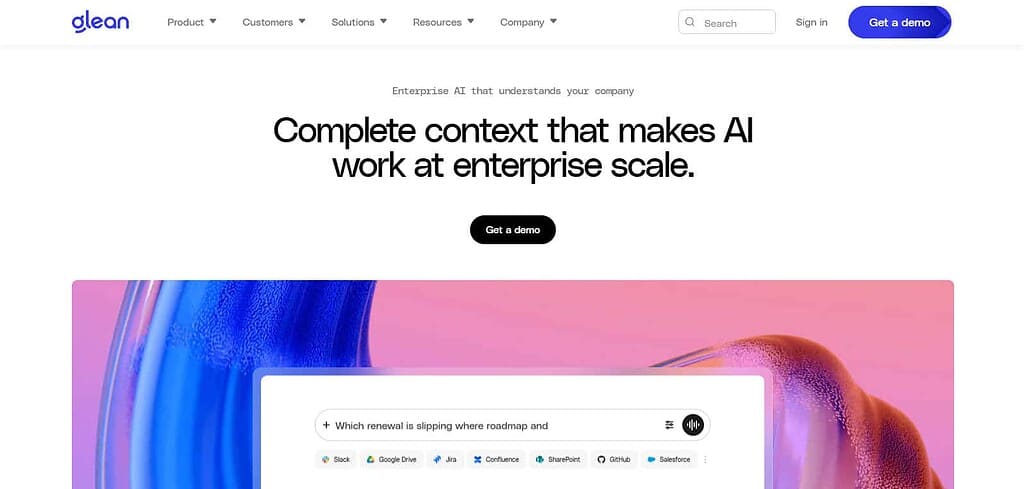
They also support permission-aware retrieval, which means Glean adjusts permissions inherited from the source system when syncs occur. Glean uses AI/RAG to provide answers, contextualize summaries, chat, and agentic actions. Glean is predominantly cloud based but offers other deployment options to support enterprise deployments based on the customer’s architecture.
| Feature | Details |
|---|---|
| Enterprise Search | Searches across company information and provides AI-grounded answers from enterprise knowledge. |
| AI-Powered Search | Understands the context of a query and surfaces relevant information rather than relying only on exact keyword matching. |
| Enterprise Graph | Maps relationships among people, content, systems and business processes to provide contextual information to AI. |
| Connectors | Connectors capture enterprise information from multiple applications and systems. |
| Knowledge Graph | Builds a company knowledge graph connecting people, content and interactions. |
| AI Answers | Provides concise answers and summaries based on information available across connected company applications. |
| Glean Chat | Lets users ask follow-up questions and explore company knowledge conversationally. |
| Personalization | Search results can be personalized according to the user’s role, projects and available company context. |
| Enterprise Memory | Glean describes enterprise memory as continuously learning from organizational context to support AI work. |
| Agents & Actions | Glean’s platform extends enterprise context to AI agents that can perform work rather than only retrieve information. |
| Security | Glean Protect is designed to safeguard sensitive content and help keep AI agents aligned with enterprise security requirements. |
| Real-Time Knowledge | Glean positions its enterprise search around retrieving current information from connected company applications. |
2. Microsoft 365 Copilot / Copilot Search
Microsoft 365 Copilot and Copilot Search would work best for companies that already work extensively with Microsoft products and services. The type of retrieval for both is enterprise search and contextual retrieval for Microsoft 365 and connected enterprise data. Rather than a standalone vector database.
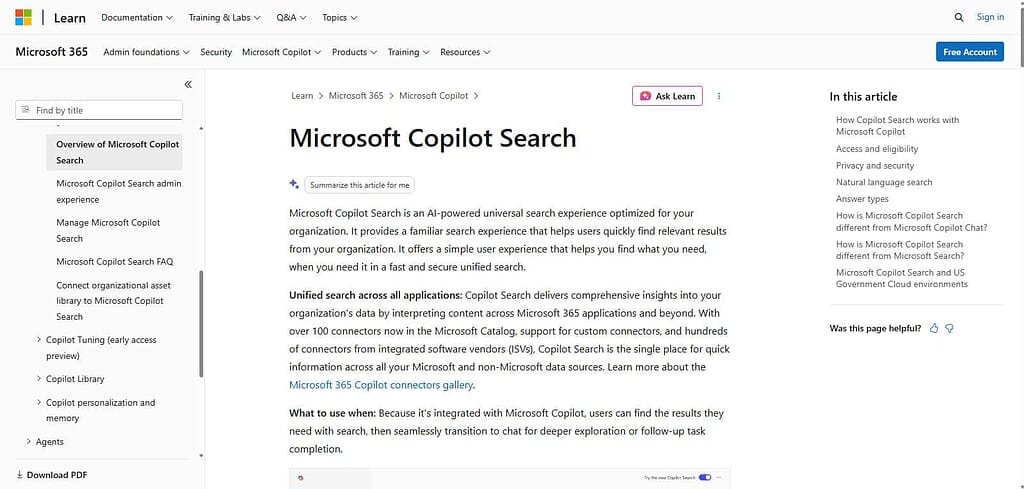
Data sources would include Microsoft 365 applications and other systems exposed through Microsoft Graph. Copilot Search allows access to supported third-party systems. Permission Aware access is directly aligned to the user’s access to the organization’s data. This is important for enterprise level usage.
The AI/RAG technology provides assisted answers and discovery of data in the enterprise. Microsoft cloud is the base for the deployment and is integrated into the Microsoft Copilot and Microsoft 365 experiences. Microsoft documentation has confirmed Copilot Search can access Microsoft 365 data and the supported third-party systems.
| Feature | Details |
|---|---|
| Universal Search | Searches across Microsoft 365 and connected third-party enterprise information from a unified interface. |
| Semantic Search | Uses semantic understanding to interpret user intent and provide contextual results. |
| Microsoft Graph Integration | Uses Microsoft Graph as a key layer for organizational and connected enterprise information. |
| Copilot Connectors | Supports connectors that bring external enterprise information into Microsoft Graph and Copilot experiences. |
| Third-Party Search | Connectors can expose information from systems such as Salesforce, ServiceNow, Confluence, Jira, GitHub and Google Drive. |
| Natural-Language Queries | Users can search using normal conversational language rather than constructing complex search syntax. |
| AI Answers | Can provide summarized answers based on information retrieved from organizational sources. |
| Source Citations | Copilot can cite the sources used to generate answers from connected enterprise information. |
| Personalization | Results can be tailored using Microsoft Graph signals, organizational relationships and user context. |
| Search-to-Chat | Users can move from Copilot Search into Copilot Chat for deeper exploration and follow-up tasks. |
| Enterprise Security | Respects access controls so users see only information they are authorized to access. |
| Multiple Access Points | Available through the Microsoft Copilot experience across desktop, web and mobile. |
| Custom Connectors | Microsoft supports custom connector scenarios in addition to its connector ecosystem. |
3. Coveo
Coveo is an enterprise search and relevance platform that helps organizations retrieve information for their customers, employees and digital experience better. Its Retrieval Type offers relevance driven search and AI enhanced retrieval with keyword, semantic and machine learning based relevance options. Data Sources can include websites, databases, SharePoint, CRM systems and other repositories through Coveo connectors.
Permission-Aware retrieval is a significant aspect of the platform: Coveo can index item-level permissions and produce results to only the users who have access those items. The AI/RAG capabilities can help build an AI enhanced search and generative experiences. The primary way of deployment is through the Coveo Platform with most flexibility given to connectors and APIs to integrate search within enterprise applications.
| Feature | Details |
|---|---|
| Intelligent Search | Retrieves relevant information from a unified index and uses relevance technology to improve search results. |
| Unified Index | Brings information from different enterprise repositories into a unified searchable index. |
| Generative Answering | Uses large language models to generate answers from enterprise content instead of returning only a list of documents. |
| Semantic Capabilities | Coveo supports semantic and AI-powered retrieval capabilities for understanding user intent. |
| Machine Learning | Uses machine learning to improve relevance, recommendations and search experiences. |
| Personalization | Search and recommendations can take user behavior and context into account. |
| Dynamic Navigation | Search interfaces can dynamically adjust filters and navigation according to query relevance. |
| Search Analytics | Search interactions can be captured as analytics events and used to understand search behavior. |
| Recommendations | Provides AI-powered recommendations for products, content and information. |
| Conversational Search | Coveo Search Agent supports follow-up questions while maintaining conversational context. |
| Relevance Generative Answering | Coveo’s RGA capabilities generate answers using retrieved enterprise content. |
| Search UI Frameworks | Coveo provides tools such as Atomic and Headless for building customized search interfaces. |
| Multiple Use Cases | Supports commerce, website search, customer service and workplace search scenarios. |
4. Elastic
Elastic is a good fit for companies that prefer more autonomy over their search and retrieval systems. Elastic’s Retrieval Type allows for traditional full-text, vector and hybrid search. It also allows for the integration of keyword and semantic search. Data can be put into Elasticsearch via content connectors built by Elastic. These connectors pull data from a variety of sources like Confluence, Jira, and GitHub, to name a few.
Permission-aware search with document-level security is built into some connectors. Organizational customers will need to configure security to realize document-level security. Hybrid and vector search are good retrieval layers for AI/RAG applications. Self-managed Elastic and Elastic Cloud hosting provide a lot of flexibility for on-premises deployments to the architecture team.
| Feature | Details |
|---|---|
| Full-Text Search | Supports traditional BM25-based full-text retrieval for exact and textual matching. |
| Vector Search | Supports semantic/vector retrieval for finding conceptually similar information. |
| Hybrid Search | Combines full-text and vector search into a single ranked result set. |
| Reciprocal Rank Fusion | RRF can combine rankings from different retrieval methods to produce a balanced result list. |
| Semantic Reranking | Supports semantic reranking to improve the relevance of retrieved results. |
| MMR / Diversification | Maximum Marginal Relevance can diversify results to reduce repetitive results. |
| Content Connectors | Connectors can bring enterprise content from supported business applications into Elasticsearch. |
| Search APIs | Applications can query Elasticsearch using REST APIs and client libraries. |
| Query DSL | Provides a flexible query language for advanced search requirements. |
| **ES | QL** |
| RAG Infrastructure | Hybrid and semantic retrieval can serve as the retrieval layer for RAG applications. |
| Deployment Flexibility | Available through Elastic Cloud as well as self-managed deployments. |
| Custom Relevance | Developers can control retrieval, ranking and search logic according to application requirements. |
5. Google Agent Search
Google Agent Search builds customized search and AI tools on Google Cloud. Its Retrieval Type operates as more than a vector database; instead, it searches and generates answers using structured and indexed enterprise data. Cloud Storage, BigQuery, Google Drive, Gmail, Google Sites, Google Calendar, Google Groups, Cloud SQL, Spanner, Firestore, Bigtable, and AlloyDB are some examples of data sources. Other sources can be integrated using connectors.
Permission-Aware retrieval operates on data source access control, including Google Cloud IAM. How the data source is set up determines the level of support. Enterprise data information retrieved by AI/RAG workflows can be used to ground AI’s answers. It can be deployed on Google Cloud, making it an excellent choice for work within Google Cloud for organizations that are already utilizing this infrastructure.
| Feature | Details |
|---|---|
| Google-Quality Search | Designed to provide high-quality information retrieval using Google’s search expertise. |
| Natural-Language Search | Understands complex and conversational queries rather than depending solely on exact keywords. |
| Keyword + Semantic Search | Combines keyword matching with semantic search to improve retrieval. |
| Website Search | Can index websites and provide search experiences over website content. |
| Structured Data Search | Supports structured information such as databases, JSON files and BigQuery data. |
| Unstructured Data Search | Supports documents and other unstructured content such as PDFs, HTML, TXT and image files. |
| Blended Search | Can search across multiple data stores and combine results from different data types. |
| Grounded AI Answers | Generates AI answers grounded in indexed enterprise information. |
| Citations | AI-generated answers can include citations to source documents. |
| Follow-Up Questions | Users can continue asking questions based on previous search context. |
| Personalization | Can use user interaction signals such as clicks and conversions to improve ranking. |
| Custom Search Experience | Provides customization options for search and browse experiences. |
| Agent/AI Integration | Designed to act as a retrieval and grounding component for generative AI applications and agents. |
6. Guru
Guru’s strengths include governed internal knowledge access as opposed to just building basic search engines. At the heart of Guru’s retrieval is searching and retrieving governed internal knowledge and the connected data sources from which AI provides answers.
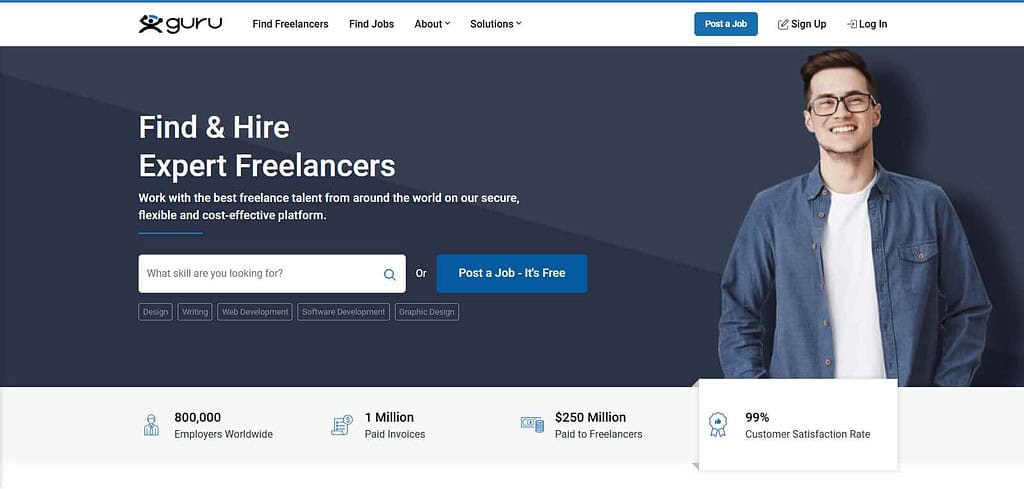
Users connect data sources through Guru integrations; organizations choose which content they wish to sync. Guru Groups and, for supported sources, permissions inheritance from the original system provides permission-aware access. The AI/RAG functionality uses the connected knowledge to provide AI Answers and knowledge-based responses.
The main deployment methodology is SaaS/cloud. A key enterprise advantage is governance. Administators can choose to expose indexed content to users or groups that have access to specific knowledge sources, rather than exposing everything.
| Feature | Details |
|---|---|
| Enterprise AI Search | Searches information distributed across company applications, chats and documents. |
| AI Answers | Provides direct answers rather than requiring employees to manually open and compare multiple documents. |
| Cited Answers | Guru provides answers with citations to the underlying information. |
| Permission-Aware Search | Guru describes its enterprise search as permission-aware, helping ensure users receive information they are authorized to access. |
| Knowledge Verification | Combines AI retrieval with expert verification to improve trust in organizational knowledge. |
| Connected Sources | Can connect information from business applications and knowledge repositories. |
| Natural-Language Search | Users can ask questions in natural language rather than relying exclusively on keyword queries. |
| Personalized Results | Guru describes its search as using contextual signals such as role and other organizational information. |
| Knowledge Management | Retrieved information can become part of an organization’s governed knowledge environment. |
| Workflow Integration | Designed to bring company information directly into employee workflows. |
| Security Controls | Guru highlights enterprise security and compliance capabilities including SSO, encryption and data protection controls. |
| AI Knowledge Layer | Combines company knowledge, connected applications and AI answers into a unified knowledge experience. |
7. Atlassian Rovo
Atlassian Rovo is an AI-based platform for discovering knowledge and organizing work answer especially well for companies that use Jira and Confluence. It offers enterprise search that integrates AI-based answers with chat and agent interfaces. Datasources can include Jira, Confluence, connected apps like Google Drive and Slack.
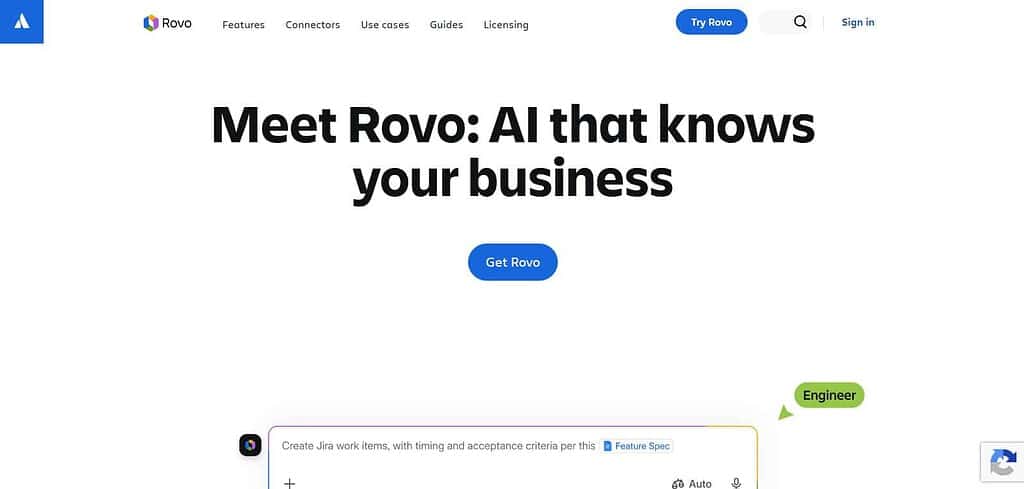
If that isn’t enough, Atlassian has Rovo Connectors. Permission-Aware Retrieval is one of Rovo’s key features; they say they honor permissions for Atlassian and connected third-party systems. When it comes to AI/RAG solutions, Rovo offers Rovo chat, knowledge cards and AI agents that can use retrieved information.
The Rovo experience can be found through the web, browser extensions, Slack, Teams, and apps for your mobile device. All of this is built on top of Atlassian’s cloud.
| Feature | Details |
|---|---|
| Rovo Search | Searches across Atlassian applications and connected third-party applications from one interface. |
| Jira & Confluence Search | Provides unified discovery across important Atlassian work-management and knowledge systems. |
| Third-Party Connectors | Can bring information from connected services such as Google Drive and Slack into search. |
| Permission-Aware Search | Search respects permissions in Atlassian and connected applications. |
| Rovo Chat | Allows employees to ask questions, explore information and interact with company knowledge conversationally. |
| Smart Answers | Provides natural-language answers with sources and suggested follow-up prompts. |
| Knowledge Cards | Surfaces contextual information about people, projects, teams and other entities. |
| Definitions | Helps employees understand company-specific terminology, acronyms and project language. |
| Rovo Agents | AI agents can perform specialized tasks using defined knowledge and skills. |
| Rovo Studio | Provides a workspace for creating agents, automations and apps. |
| Automations | Allows workflows to trigger agents and actions across connected tools. |
| Deep Research | Rovo Deep Research can search, reason and synthesize information into cited reports. |
| Browser Extension | Provides Rovo access while users work in their browser. |
8. Amazon Bedrock Knowledge Bases
Amazon Web Services Bedrock Knowledge Bases is more developer – and application – focused than workplace search tools such as Glean and Guru. It is the most efficient retrieval method for use with Retrieval-Augmented Generation (RAG) in that a query pulls relevant pieces of enterprise data that can then be sent to a foundation model for generation.
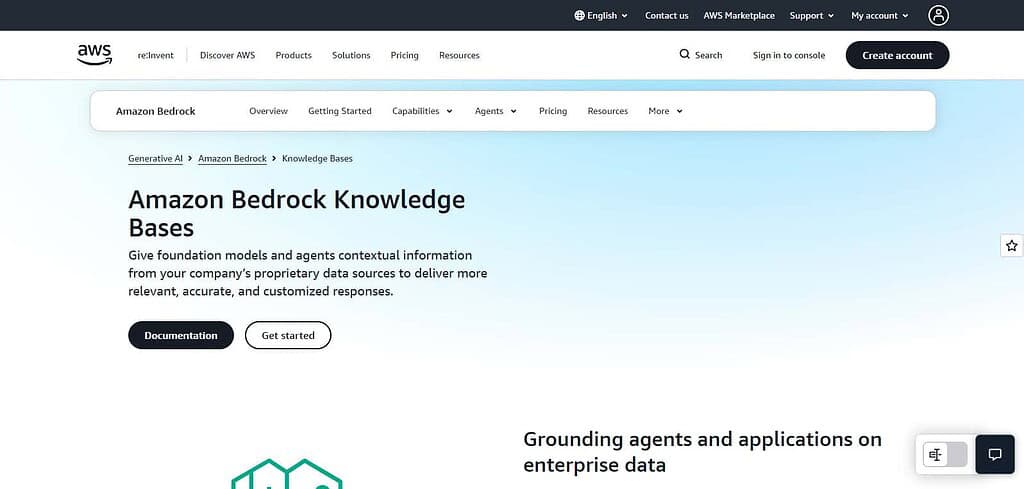
Supported data sources are Amazon S3 and other enterprise sources that include Confluence, SharePoint, Salesforce, OneDrive, and Google Drive. Permission Aware access is primarily configured with AWS IAM and distinguishes the roles that manage and access knowledge bases and their data sources.
The primary service and focus of Bedrock is AI/RAG, including the Retrieve and RetrieveAndGenerate APIs. It is a service built for deployment within AWS and is most adequate for organizations developing custom AI applications and agents on Amazon Bedrock to easily take advantage of integrated services.
| Feature | Details |
|---|---|
| RAG | Designed specifically to retrieve enterprise information and use it to improve foundation-model responses. |
| Managed Knowledge Base | AWS manages ingestion, indexing, storage and retrieval infrastructure. |
| Customer-Managed Knowledge Base | Organizations can manage their own RAG pipeline and underlying vector infrastructure. |
| Multi-Modal Data | Managed Knowledge Bases support multimodal content including documents with text, images, tables, charts and other visual information. |
| Smart Parsing | Automatically selects parsing strategies based on document types and content. |
| Embeddings | Converts enterprise information into representations used for retrieval. |
| Reranking | Supports reranking to improve the relevance of retrieved information. |
| Agentic Retrieval | Can break complex questions into subqueries and retrieve information iteratively across knowledge bases. |
| Multi-Hop Reasoning | Agentic retrieval supports more complex retrieval workflows requiring information from multiple sources. |
| Third-Party Connectors | Managed Knowledge Bases support sources such as S3, SharePoint, Confluence, Google Drive, OneDrive and Web Crawler. |
| Document-Level Permission Filtering | Supported connectors can use access-control lists to filter documents during retrieval. |
| AgentCore Integration | Managed Knowledge Bases can integrate with AgentCore Gateway for MCP-compatible agent frameworks. |
| Observability | AgentCore Observability provides retrieval traces, agentic traces and knowledge-base metrics. |
| Vector Store Choice | Customer-managed knowledge bases can use supported vector stores such as OpenSearch Serverless, Aurora and Neptune. |
9. Algolia
Algolia is a search and discovery platform, although it could be used by companies to develop top-performing custom search systems. Algolia’s Retrieval Type contains both keyword search as well as AI-based vector retrieval with NeuralSearch, where semantic and keyword-based signals can be processed concurrently. Application managed indexed records are typically the Data Sources.
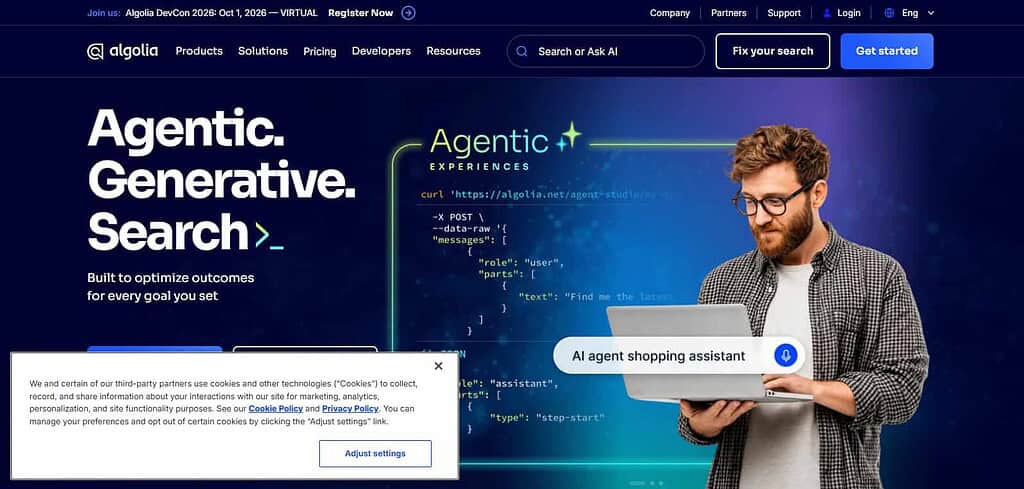
Permission-Aware is largely dependent on the design of the application and index. As such, it is incorrect to think of Permission-Aware as a substitute for a workplace platform that takes permissions from all systems of interest. Algolia can facilitate search and retrieval workflows with AI/RAG. Cloud based and API-based Algolia make it very attractive for use in customer-facing sites, applications, e-commerce, and digital customer experiences.
| Feature | Details |
|---|---|
| AI Search | Provides AI-powered search experiences for applications and websites. |
| NeuralSearch | Combines semantic/vector retrieval with keyword search. |
| Hybrid Search | Combines semantic understanding with the precision of keyword matching. |
| AI Ranking | Uses machine learning to improve result relevance while retaining human controls. |
| Personalization | Adapts results based on user behavior, preferences and context. |
| AI Synonyms | Uses AI to identify and improve synonym relationships. |
| Query Categorization | Categorizes queries to support more relevant search and merchandising experiences. |
| Dynamic Re-Ranking | Can dynamically adjust rankings based on relevance and user behavior. |
| Autocomplete | Helps users discover relevant queries and content as they type. |
| Rules | Allows businesses to control and optimize ranking for specific searches. |
| Analytics | Provides search analytics to understand user behavior and identify optimization opportunities. |
| A/B Testing | Allows organizations to compare relevance strategies and search experiences. |
| Generative Experiences | Combines LLM-powered experiences with search and product/content data. |
| Ask AI | Turns search interfaces into conversational experiences that provide direct answers. |
| Agent Studio | Provides tools to create, test and deploy AI agents. |
| MCP Server | Allows agents to query, analyze and update search indexes through MCP. |
10. Vectara
Vectara is an AI retrieval tool to build search applications and create RAG and AI agents. Semantic Retrieval by default supports hybrid search when the exact terms like product IDs, commands, and technical terminology are important, and traditional keyword search is mandatory. Applications generally treat data sources as Vectara corpora and documents for ingestion and retrieval.
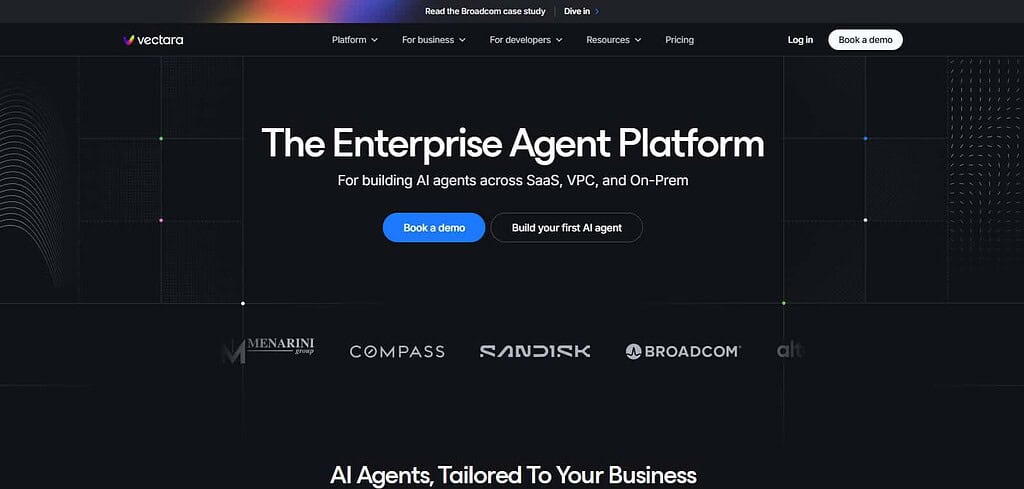
Permission-Aware architecture enables support for document-level ACLs within the framework and complements both RBAC and ABAC. Within its architecture, Vectara notes that document-level ACLs are not supported at this time, and fine-grained access is implemented using metadata.
The primary focus of the platform is AI/RAG and includes grounded answers and agent workflows. Deployment options include managed private clouds and mechanisms for on-premises installations in private networks (VPC), air-gapped environments, and Kubernetes.
| Feature | Details |
|---|---|
| End-to-End Retrieval | Provides an integrated retrieval layer for AI and RAG applications. |
| Hybrid Search | Combines semantic retrieval with keyword matching to handle both conceptual and exact-term queries. |
| Semantic Search | Uses semantic understanding to retrieve relevant information based on meaning. |
| Reranking | Retrieved results can be reranked to improve relevance before generation. |
| Metadata Filtering | Allows retrieval to be refined using metadata filters. |
| Grounded Generation | Generates responses based on information retrieved from the user’s indexed data. |
| Citations | Supports source citations to show the information behind generated responses. |
| Cross-Language Retrieval | Vectara describes support for cross-language search across more than 100 languages. |
| RAG Applications | Designed specifically for building production RAG applications. |
| AI Agents | Provides retrieval and generation capabilities for agentic AI applications. |
| Guardian Agents | Vectara provides agent-oriented capabilities designed to help maintain reliable retrieval and generation. |
| Factual Consistency | Vectara describes a Factual Consistency Score for evaluating generated answers. |
| RBAC | Provides role-based access controls for enterprise environments. |
| Multiple Deployment Options | Available as SaaS, VPC and on-premises deployments. |
| Real-Time Data Updates | Supports updating indexed information for applications that require current retrieval. |
Comparison Table: 10 Best AI Knowledge Retrieval Platforms for Enterprises in 2026
| Platform | Retrieval Type | Data Sources | Permission-Aware | AI / RAG | Enterprise Search | AI Agents | Deployment | Best For |
|---|---|---|---|---|---|---|---|---|
| Glean | Semantic + enterprise search + knowledge graph | SaaS apps, documents, business systems, connected applications | ✅ Yes | ✅ Yes | ✅ Strong | ✅ Yes | Cloud | Company-wide knowledge discovery |
| Microsoft 365 Copilot / Copilot Search | Semantic + contextual enterprise search | Microsoft 365 + supported third-party sources | ✅ Yes | ✅ Yes | ✅ Strong | ✅ Yes | Microsoft Cloud | Microsoft-centric enterprises |
| Coveo | AI relevance + semantic + machine learning | Enterprise repositories, websites, business systems | ✅ Yes* | ✅ Yes | ✅ Strong | ✅ Yes | Cloud | Customer service, commerce & enterprise search |
| Elastic | Keyword + vector + hybrid search | Enterprise connectors, databases, documents, applications | ✅ Yes* | ✅ Yes | ✅ Strong | ✅ Yes | Cloud / Self-managed | Custom retrieval infrastructure |
| Google Agent Search | Keyword + semantic + blended retrieval | Google Cloud, Google Workspace and supported enterprise data | ✅ Yes* | ✅ Yes | ✅ Strong | ✅ Yes | Google Cloud | Google Cloud AI applications |
| Guru | Enterprise knowledge + semantic retrieval | Business apps, documents and connected sources | ✅ Yes* | ✅ Yes | ✅ Strong | Limited/Yes | SaaS | Governed company knowledge |
| Atlassian Rovo | Enterprise + semantic/AI search | Jira, Confluence, Slack, Google Drive and supported connectors | ✅ Yes | ✅ Yes | ✅ Strong | ✅ Yes | Atlassian Cloud | Jira & Confluence-based enterprises |
| Amazon Bedrock Knowledge Bases | Vector + semantic + RAG retrieval | S3, SharePoint, Confluence, Google Drive, OneDrive and others | ✅ Yes* | ✅ Core capability | ⚙️ Application-focused | ✅ Yes | AWS Cloud | Custom RAG & AI agents |
| Algolia | Keyword + vector + NeuralSearch | Indexed application/content data | ⚙️ Application-dependent | ✅ Yes | ✅ Strong | ✅ Yes | Cloud | Ecommerce & customer-facing search |
| Vectara | Semantic + hybrid + reranking | Documents and indexed enterprise knowledge | ✅ Yes* | ✅ Core capability | ⚙️ Application-focused | ✅ Yes | Cloud / VPC / On-premises | Production RAG & AI applications |
Best Platform by Enterprise Requirement
| Enterprise Requirement | Recommended Platform |
|---|---|
| Best overall enterprise knowledge search | Glean |
| Best for Microsoft ecosystem | Microsoft 365 Copilot / Copilot Search |
| Best for search relevance & personalization | Coveo |
| Best customizable search infrastructure | Elastic |
| Best for Google Cloud organizations | Google Agent Search |
| Best for governed internal knowledge | Guru |
| Best for Jira & Confluence environments | Atlassian Rovo |
| Best for AWS-based RAG | Amazon Bedrock Knowledge Bases |
| Best for ecommerce & digital search | Algolia |
| Best for production RAG infrastructure | Vectara |
Conclusion
AI knowledge retrieval systems will be integrated into enterprise AI strategies in 2026. These systems aid organizations in extracting relevant knowledge from multiple business systems. There are many platforms to serve these business needs from workplace knowledge search to custom built RAG applications and AI-augmented knowledge retrieval systems.
Glean, Microsoft 365 Copilot, Coveo, Elastic, Google Agent Search and many others such as Atlassian Rovo, Amazon Bedrock Knowledge Bases, Algolia, Vectara, Guru and others, provide varying levels of service.
The right solution for your specific business needs depends on a host of factors such as the type of data sources, number of permitted users, extensibility, governance, and AI/RAG frameworks. Careful consideration is necessary when choosing a solution rather than simply selecting whichever one is the most popular, or has the most features.
FAQ
What is an AI knowledge retrieval platform?
An AI knowledge retrieval platform helps enterprises find relevant information from multiple business data sources and use that information to generate context-aware, grounded AI responses. These platforms can combine search, semantic retrieval, vector search, knowledge graphs, RAG, and enterprise permissions.
Which is the best AI knowledge retrieval platform for enterprises in 2026?
There is no single best platform for every enterprise. Glean is strong for company-wide knowledge discovery, Microsoft 365 Copilot for Microsoft-centric organizations, Elastic for customizable search infrastructure, and Amazon Bedrock Knowledge Bases for organizations building custom RAG applications.
What is the difference between enterprise search and AI knowledge retrieval?
Traditional enterprise search primarily helps users locate documents or information using search queries. AI knowledge retrieval goes further by retrieving relevant information and providing contextual answers through AI. Modern platforms can also use semantic search, vector retrieval, reranking, citations, and RAG to improve the usefulness of retrieved information.
Do AI knowledge retrieval platforms support enterprise permissions?
Yes, many enterprise platforms support permission-aware retrieval, but the implementation differs. Some platforms inherit permissions from connected applications, while others rely on IAM, metadata filters, roles, or application-level access controls. Enterprises should verify how permissions are synchronized and enforced before deployment.
What data sources can AI knowledge retrieval platforms connect to?
Depending on the platform, enterprise data can come from applications such as Google Drive, Microsoft 365, SharePoint, Confluence, Jira, Slack, Salesforce, ServiceNow, databases, cloud storage, websites, and internal document repositories. Connector availability varies significantly between platforms.