




This article explores the best AI model deployment platforms for enterprises, emphasizing scalability, pricing, security, and edge case examples. AI model deployment has become a key consideration for enterprises as they decide to scale and the vendor they partner with for model deployment plays an important role in achieving their goals faster and easier. It covers on-premise and cloud-based services such as AWS SageMaker, Microsoft Azure, Google Vertex AI, and others like Run.ai and Cerebras Cloud that have unique offerings based on enterprise requirements.
How To Choose AI Model Deployment Platforms for Enterprises
Scalability
Ensure the platform can handle a wide variety of deployment sizes. The platform should offer distributed training and GPU-based orchestration as well as support for hybrid cloud deployments.
Pricing Model
Take a look at the pay-as-you-go model and subscription model, and determine which pricing model is the most advantageous to your organization. Some organizations prefer a consumption-based model whereas some prefer a more predictable pricing model to avoid runaway costs.
Security & Compliance
The platform must meet the standards for security and compliance such as HIPAA, ISO, and SOC 2, as well as FedRAMP. For governance, look for encryption and auditing.
Integration Ecosystem
Find a platform that integrates with the tools that you already use as opposed to finding a tool that fits into your enterprise. This may be tools built on AWS, Microsoft, Google, or Snowflake.
Performance Optimization
Tools that allow for GPU-based inference are extremely useful to evaluate performance in an AI-based model deployment. Another useful platform to evaluate performance is Run.ai.
Key Points
| Platform | Strengths | Best Use Cases |
|---|---|---|
| AWS SageMaker | Fully managed ML deployment, integrates with AWS stack | Enterprise ML pipelines, real-time inference |
| Microsoft Azure ML | Enterprise-grade, compliance-ready, hybrid cloud | Regulated industries, large-scale AI workloads |
| Google Vertex AI | Unified ML lifecycle, strong MLOps | AI-driven SaaS, predictive analytics |
| IBM Watsonx | Governance, explainability, enterprise trust | Financial services, healthcare, compliance-heavy AI |
| Databricks MLflow | Open-source MLOps, strong data integration | Data lakehouse AI, collaborative ML teams |
| Snowflake Cortex | AI-native data cloud, secure deployment | Enterprise analytics, embedded AI in data workflows |
| Run.ai | GPU orchestration, cost optimization | AI infrastructure scaling, model training + deployment |
| OctoML | Automated model optimization, multi-cloud | Edge AI, performance-critical deployments |
| Anyscale (Ray) | Distributed AI deployment, scalable APIs | LLM serving, reinforcement learning |
| Cerebras Cloud | Wafer-scale AI compute, ultra-fast inference | GenAI, large-scale language models |
1. AWS SageMaker
AWS SageMaker is Amazon’s fully managed ML service that offers pay as you go pricing. Prices generally range from $0.001 to $0.06 per 1K tokens or per compute usage. It has excellent scalability and features like SageMaker HyperPod provides 99.9% availability for large models.

There is a robust security framework that includes AWS IAM, KMS, and VPC, along with HIPAA and FedRAMP compliance. The service is appropriate for businesses that utilize other AWS services extensively, but costs can add up for longer, continuous workloads.
SageMaker has built-in tools such as Clarify and Model Monitor which help with governance. However, as the pipelines are coupled with various other AWS services, the tool provides very little to no portability. It is strongly balanced in the flexibility and compliance space, however, there is essentially no cost management.
| Feature | Details |
|---|---|
| Founded Year | 2017 |
| Pricing | Pay-as-you-go, compute + token usage |
| Scalability | HyperPod clusters, 99.9% uptime |
| Security | AWS IAM, KMS, VPC, HIPAA, FedRAMP |
| Strength | Full ML lifecycle with governance tools |
AWS SageMaker Pros & Cons
Pros:
- Automated management of ML lifecycle
- Excellent compatibility with the AWS ecosystem
- Utilizes dynamic scaling with HyperPod clusters
- Supports various enterprise-level compliance
- Monitors ML performance with built-in tools
Cons:
- Expensive for extensive workloads
- Relies substantially on AWS
- Pricing is disorganized
- Difficult to master
- Little flexibility for deployment beyond AWS
2. Microsoft Azure
Microsoft Azure ML was released in 2010 and has a number of integrations with the Microsoft suite. Pricing is done through pre-pay tokens with an enterprise agreement, making enterprise-related services predictable. Azure ML scales well and can easily run across multiple cloud and on-premises environments. It’s Security offerings are robust.

They provide Entra ID identity, audit-ready artifacts, and tools within the Responsible AI Dashboard. They also have compliance with ISO 27001, HIPAA, and FedRAMP. Azure ML is great for companies that primarily use Microsoft services, like Office and Dynamics, because it easily works with Fabric. The UI is robust, but this is balanced out by the systems governance and compliance offerings, making it great for large companies.
| Feature | Details |
|---|---|
| Founded Year | 2010 |
| Pricing | Token-based + enterprise subscriptions |
| Scalability | Hybrid cloud + on-premises |
| Security | Entra ID, Responsible AI Dashboard, ISO/HIPAA/FedRAMP |
| Strength | Deep Microsoft ecosystem integration |
Microsoft Azure Pros & Cons
Pros:
- Integrates deeply with the MS ecosystem
- Scale with hybrid cloud
- Extensive compliance (ISO, HIPAA)
- Offers a governance tool called the Responsible AI dashboard
- Pricing predictable due to enterprise level subscriptions
Cons:
- Complicated UI for newbies
- Costly for complex advanced workloads
- Less flexible beyond MS ecosystem
- Less agile for startups than AWS & GCP
- Requires substantial MS licensing
3. Google Vertex AI
Launched in 2021, Google Vertex AI was built to make heavy-duty ML processes easier. With a range of $0.001 to $0.06 for every 1K tokens, pricing is flexible. Scalability is strong, with the use of Google Cloud and BigQuery for data-heavy cloud services. IAM is available for security, but clients concerned with compliance can check ISO and HIPAA standards.
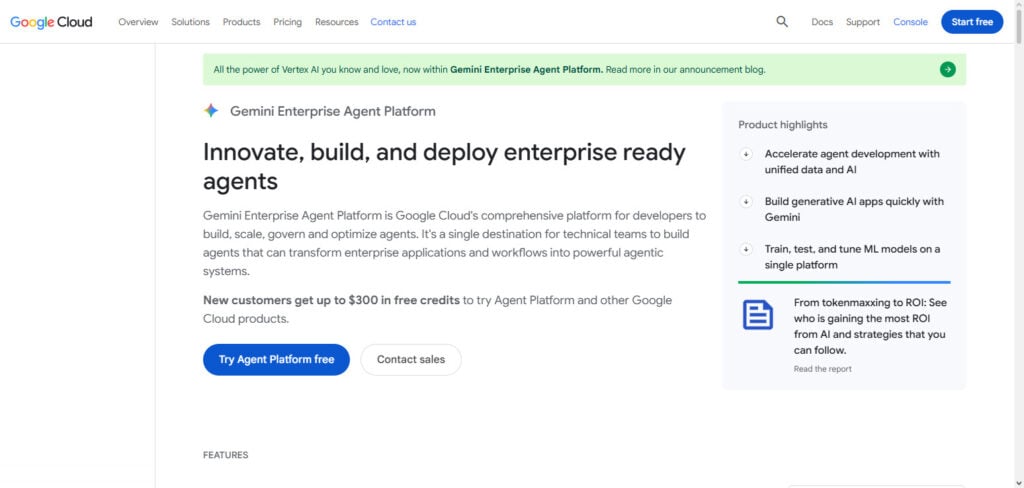
Vertex AI supports multimodal pipelines and Kubeflow portability, but can be slow for users not part of GCP. Google Cloud is strong for teams looking for GPU-based services, especially when it comes to cost and compliance. It attracts a lot of research-oriented organizations with its flexibility in model training and deployments.
| Feature | Details |
|---|---|
| Founded Year | 2021 |
| Pricing | Consumption-based, committed-use discounts |
| Scalability | BigQuery + GCP infra, multimodal pipelines |
| Security | IAM, encryption, ISO/HIPAA |
| Strength | Data-heavy ML with Kubeflow portability |
Google Vertex AI Pros & Cons
Pros:
- Integrates with Google BigQuery
- Scales easily with ML
- Easy to use with Kubeflow
- Cost-efficient GPUs
- Supports pipelines with multiple modes
Cons:
- Difficult to onboard GCP users
- Complex pricing for committed use
- Less focus on enterprise than AWS & Azure
- Less mature governance features than Azure & IBM
- Heavily focuses on Google Cloud
4. IBM Watsonx
IBM Watsonx launched in 2023 and provides control and enterprise compliance with its AI platform. Users pay a subscription with flexibility to meet enterprise requirements. Use cases range from tools for hybrid and multicloud to services and apps for financial and healthcare sectors. Deep security and compliance infrastructure make Watsonx stand out.
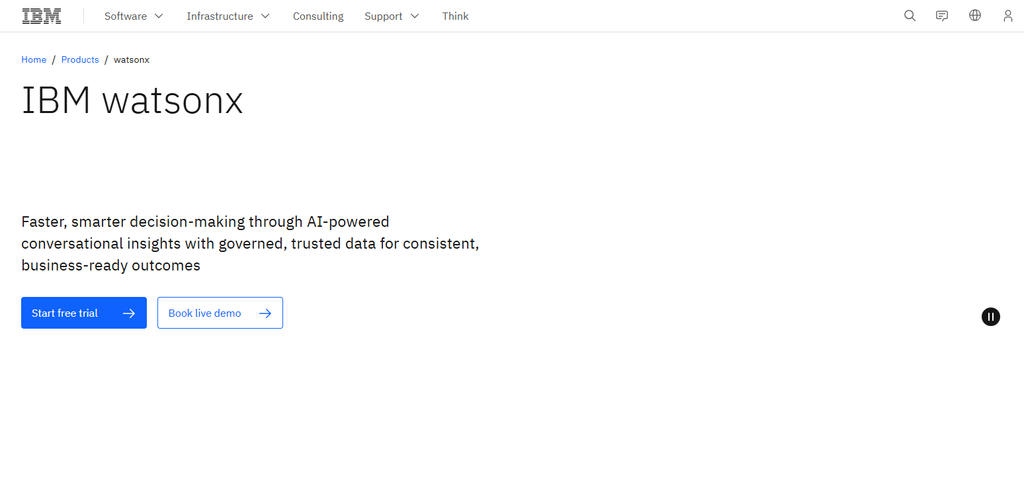
An emphasis on responsible AI makes Watsonx unique, as other services do not provide explainability and auditability. Though Watsonx does not have considerable market share, enterprises that focus on trust and governance over speed of deployment are inclined to choose Watsonx. It stands out as a strategic option for organizations that seek to integrate AI compliance services with IBM offerings and services.
| Feature | Details |
|---|---|
| Founded Year | 2023 |
| Pricing | Subscription-based enterprise tiers |
| Scalability | Hybrid + multi-cloud |
| Security | Strong compliance for finance & healthcare |
| Strength | Governance, explainability, audit trails |
IBM Watsonx Pros & Cons
Pros:
- Governance tools for enterprise
- Supports hybrid & multi-cloud
- Audit trails with explainable AI
- Designed for use in Finance and Healthcare
- Supports services offered by IBM consulting
Cons:
- Smaller adoption than AWS & Azure
- Costlier for enterprises
- Less suitability for startups.
- Limited offerings compared to major players.
- Long development cycle.
5. Databricks MLflow
In 2016, Databricks launched the open source tool MLflow for managing the ML lifecycle. Pricing for Databricks Mosaic AI services begins at $0.07 per DBU (consumed). The Databricks Lakehouse has remarkable scalability when it comes to moving from data tables to features to models. Security is assured with Unity Catalog, while governance, lineage, and compliance are assured.
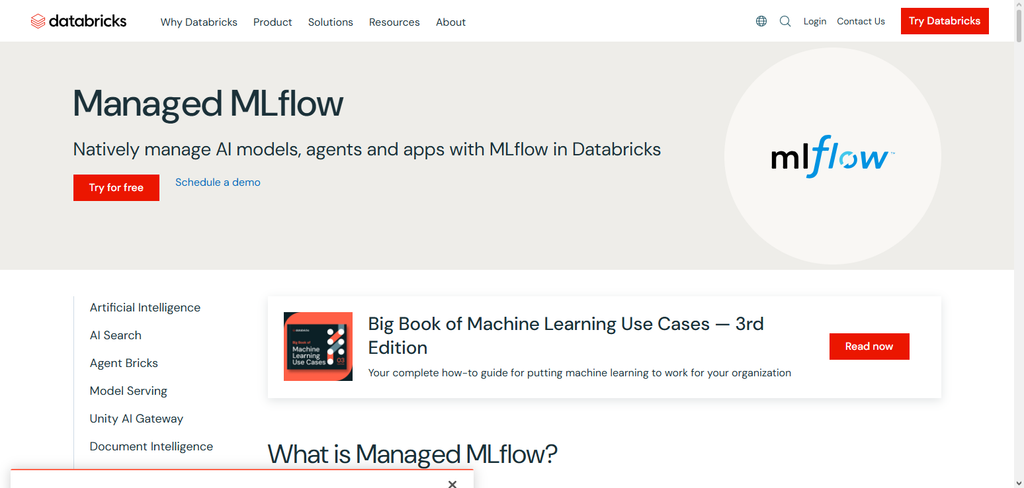
While MLflow is highly portable, the same can’t be said about Databricks, locking users in to its ecosystem. It is especially suitable for organizations Greenstone that is data engineering intensive and has Databricks. Databricks is a leader in enterprise MLOps as it integrates ML lifecycle management well and has strong governance.
| Feature | Details |
|---|---|
| Founded Year | Databricks 2013, MLflow 2016 |
| Pricing | $0.07 per DBU (consumption) |
| Scalability | Seamless within Lakehouse |
| Security | Unity Catalog for lineage + governance |
| Strength | ML lifecycle management in data workflows |
Databricks MLflow Pros & Cons
Pros:
- Open-source option for ML lifecycle management
- Easier with Lakehouse
- Unified Catalog provides excellent control
- Can use outside of Databricks
- Good choice for engineering-heavy organizations
Cons:
- Requires Databricks for complete MLflow features.
- High compute costs
- Difficult for users unfamiliar with MLflow
- Large-project centric
- Requires significant engineering of data
6. Snowflake Cortex
Snowflake, established in 2012, released Cortex AI in 2025. Cortex charges using a consumption-based model and is integrated into Snowflake’s SQL-native environment. Since Cortex runs inside the Snowflake data perimeter, there is no infrastructure to scale and systems are easy to run.
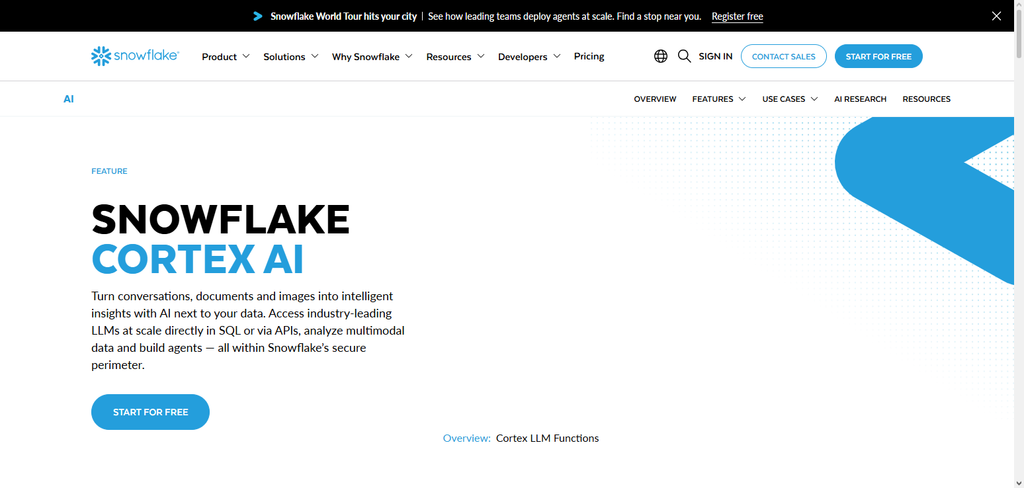
Snowflake has enterprise-grade compliance, which offers a variety of certifications including SOC 2, HIPAA, and the GDPR. Cortex is designed for organizations that use Snowflake for data warehousing and is a good choice to implement AI technologies without moving data.
Cortex’s simplicity and governance is cost-effective, but of course flexibility is more limited in comparison to other, broader, platforms, such as SageMaker. Cortex is a good choice for a business’s first AI driven solution integrated into their data workflow with low operational impact.
| Feature | Details |
|---|---|
| Founded Year | 2012 (Snowflake), Cortex 2025 |
| Pricing | Consumption-based, SQL-native |
| Scalability | Runs inside Snowflake perimeter |
| Security | SOC 2, HIPAA, GDPR |
| Strength | Embedded AI in data warehousing |
Snowflake Cortex Pros & Cons
Pros:
- Embedded AI within Snowflake
- Pay for what you use
- Good controls for data privacy
- No user infrastructure
- Good for users comfortable with SQL
Cons:
- Limited use outside of Snowflake
- New product, unfinished
- Not good for custom ML
- Smaller ecosystem than Azure or AWS
- Only good if Snowflake is good
7. Run.ai
Run.ai, in 2018, started dealing with CPU orchestration for AI workloads. Their service charges subscriptions according to the enterprise’s GPU consumption. It offers good scaling options to distribute GPU resources across teams and projects dynamically.

Security options include enterprise-based tools and compliance for regulated sectors. Run.ai is ideal for organizations that have considerable GPU consumption. It helps organizations optimize their GPU use and control costs.
It can help match the Amazon Web Services (AWS) SageMaker or Vertex AI when dealing with GPU orchestrations. It might not be a full ML services platform, but it offers excellent options for enterprises to maximize their GPU investments with innovative management techniques.
| Feature | Details |
|---|---|
| Founded Year | 2018 |
| Pricing | Subscription tailored to GPU usage |
| Scalability | Dynamic GPU allocation |
| Security | Enterprise-grade controls |
| Strength | GPU orchestration + efficiency |
Run.ai Pros & Cons
Pros:
- Good control for GPU-Heavy workloads
- Low cost for GPU usage
- Control integrations
- Good for ML on top of other platforms
Cons:
- Not a full ML platform
- Pricing based on usage
- Limited integrations
- High focus on GPU workloads
- Less control compared to other platforms.
8. OctoML
Founded in 2019, OctoML does model optimization and deployment. OctoML charges based on usage, which includes optimization runs and deployments. OctoML has good scaling able to perform efficient inferences across cloud and edge environments. OctoML offers security, which includes enterprise-grade compliance, plus encryption, and governance features.
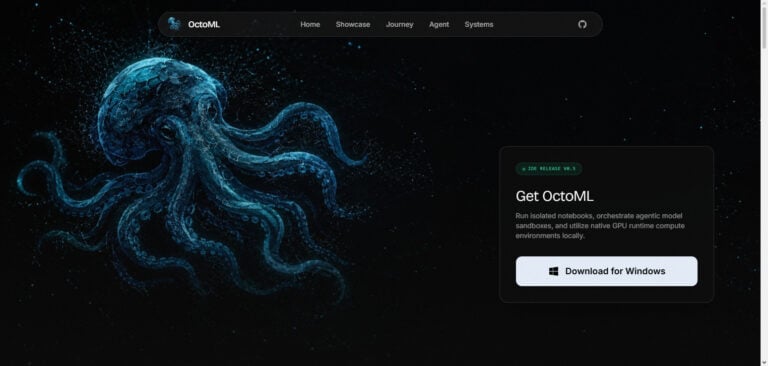
Organizations that need to decrease inference costs and increase performance will benefit the most from OctoML. OctoML is very flexible across ML frameworks, which is something developers will benefit from. While this is not a full-stack ML platform, it does model optimization for production, which adds value. OctoML’s efficiency and portability make it great for enterprising scaling of AI workloads.
| Feature | Details |
|---|---|
| Founded Year | 2019 |
| Pricing | Usage-based, per optimization run |
| Scalability | Efficient inference across cloud + edge |
| Security | Encryption + compliance |
| Strength | Model optimization + portability |
OctoML Pros & Cons
Pros:
- Good for deploying ML across multiple edges
- Good for optimizing ML
- Good for compliance
- Reduces cost of optimizing ML
- Good for optimizing ML with multiple frameworks
Cons:
- Not a full ML platform
- Cost of usage unpredictable
- Less widely adopted
- Limited control mechanisms
- Focus on optimizing rather than ML training.
9. Anyscale (Ray)
Anyscale, a 2019 company, products Ray, an open-source distributed computing and AI on-platform framework. It has scale and excels in driving multi-cloud execution as well as distributed Python workloads. Enterprise-grade security is available, but governance is less robust when put side-by-side with Azure and AWS offerings.

Anyscale targetesthe research-heavy enterprise that runs high resource ML workloads. Its product flexibility allows for distributed training and serving, but has costs that can be unpredictable. This makes Anyscale suitable for teams that have solid foundation in Python, and want to deploy an infrastructure of scalable distributed AI.
| Feature | Details |
|---|---|
| Founded Year | 2019 |
| Pricing | Variable, distributed workload usage |
| Scalability | Multi-cloud distributed execution |
| Security | Enterprise-grade, lighter governance |
| Strength | Distributed Python + ML workloads |
Anyscale (Ray) Pros & Cons
Pros:
- Best in class for distributed scalable systems
- Support for executing in multiple clouds
- Workloads in a flexible form using Python
- Heavy research organizations friendly
- Ray is an open-source project
Cons:
- Some pricing concerns
- Governance not as deep as Azure/IBM
- High Python proficiency needed
- Less enterprise reach than AWS/Azure
- Workloads are complex to manage
10. Cerebras Cloud
Since its founding in 2016, Cerebras Systems developed Cerebras Cloud in 2024. Its offerings are priced based on consumption with respect to its proprietary Wafer-Scale Engine (WSE). Its infrastructure allows large models to be trained in parallel with a minimal number of nodes, with unmatched scaling.

Security incorporates enterprise-grade compliance, along with encryption and governance controls. Because of its unique flexibility, it offers a cost-effective solution for large organizations with a focus on pushing the boundaries of AI research. Its solution differs from AWS and Azure, but, it offers the opportunity to deploy unique capabilities within AI. Because of its unique hardware, its price reflects the research focused on developing extreme-scale models.
| Feature | Details |
|---|---|
| Founded Year | Cerebras 2016, Cloud 2024 |
| Pricing | Consumption-based, tied to WSE hardware |
| Scalability | Trillion-parameter model training |
| Security | Enterprise compliance, encryption |
| Strength | Extreme-scale AI research hardware |
Cerebras Cloud Pros & Cons
Pros:
- Wafer-Scale Engine allows for extreme computations
- Can train models at a trillion parameters
- Enterprise compliance
- Specialized hardware
- Supports advanced AI research
Cons:
- High cost due to hardware
- Limited applications
- Smaller than the cloud’s big ecosystems
- Poor general enterprise workloads fit
- Difficult to integrate other systems
Conclusion
In summary, the market for AI/ML platforms is diverse. Every provider has their own area in which they excel. AWS SageMaker, Azure, and Google Vertex AI have breadth of scalability and security, among others, which makes them ideal for mass adoption. Watsonx and Snowflake Cortex work well for more regulated markets due to their strong governance and AI capabilities.
Databricks MLflow works well with data engineering, and there are also specialized solutions for extreme-scale training, GPU orchestration, optimization, and distributed workloads provided by Run.ai, OctoML, Anyscale (Ray), and Cerebras Cloud. This creates an ecosystem for industry that allows companies to choose their focus in areas such as security and scalability at optimal cost.
FAQ
When was SageMaker founded?
Launched in 2017 by Amazon Web Services.
How is pricing structured?
Pay-as-you-go, based on compute and token usage.
What about security?
Integrated with AWS IAM, KMS, VPC, HIPAA/FedRAMP compliance.
When was Vertex AI launched?
In 2021.
When was Watsonx founded?
In 2023.