


This article will cover what are considered the best AI compute providers for enterprises and analyze their offerings in terms of GPU accelerators, scalability, pricing models, storage, and AI performance. Some of the major players in this space including Lambda Labs, Meta AI Data Centers, CoreWeave, IBM Cloud, HPE GreenLake, Equinix, Digital Realty, NVIDIA, Google Cloud, and OVHcloud, provide critical infrastructure for enterprise AI innovation.
Why Choose AI Compute Providers for Enterprises
High-Performance GPUs: Enterprises can avoid the cost and hassle of purchasing and managing hardware by paying to use GPUs and other AI hardware accelerators.
Scalable AI Infrastructure: Compute capacity can be dynamically changed based on the requirements of model training and inference.
Faster AI Model Training: The time required to train and fine-tune large AI models can be significantly reduced with the assistance of high-performance computing and optimized networking.
Cost-Effective Infrastructure: Flexible and usage-based pricing models can help enterprises avoid large up-front costs associated with data-center and hardware investments.
Enterprise-Grade Security: Some of the leading providers in this space offer features such as encryption, private networking, access controls, and supporting compliance efforts.
Flexible Deployment Options: Enterprises can choose from a range of deployment options including public cloud, private infrastructure, bare metal, colocation, and hybrid environments.
Support for Multiple AI Workloads: AI compute infrastructure can support LLM training, generative AI, inference, RAG, computer vision, AI agents, and HPC workloads.
Global Infrastructure Availability: There are multiple data center locations and regions to help organizations deploy AI applications to be close to users and satisfy data residency requirements.
High-Speed Networking and Storage: Advanced networking and high-performance storage help move large datasets across AI clusters quickly.
Reduced Infrastructure Management: Providers manage a good deal of the underlying infrastructure, and enterprise teams can focus on AI models and applications.
Key Points
| AI Compute Provider | Key Point |
|---|---|
| Lambda Labs | GPU cloud infrastructure focused on AI training, inference, and developer-friendly GPU access. |
| Meta AI Data Centers | Large-scale AI infrastructure designed to support Meta’s AI models, research, and high-performance computing workloads. |
| CoreWeave | Specialized GPU cloud provider offering scalable infrastructure for AI training, inference, and demanding compute workloads. |
| IBM Cloud | Enterprise-focused cloud platform combining AI compute with security, hybrid cloud, compliance, and business infrastructure. |
| HPE GreenLake | Hybrid cloud platform providing flexible AI and HPC infrastructure for enterprises seeking on-premises and cloud-like deployment. |
| Equinix | Global digital infrastructure provider offering colocation and interconnected environments for deploying enterprise AI infrastructure. |
| Digital Realty | Data center and colocation platform supporting scalable AI infrastructure, connectivity, and high-density compute deployments. |
| NVIDIA | AI computing leader providing GPUs, accelerated computing platforms, networking, and a broad AI software ecosystem. |
| Google Cloud | Cloud AI platform offering GPUs, TPUs, AI infrastructure, and integrated services for enterprise training and inference. |
| OVHcloud | European cloud provider offering GPU-based infrastructure with a focus on scalable AI workloads, data sovereignty, and competitive costs. |
1. Lambda Labs
Lambda Labs provides GPU cloud infrastructure that is specifically optimized for AI workloads. They offer NVIDIA A100 and H100 accelerators with high-bandwidth memory for deep learning. Their compute scale spans from researchers to large organizations, and can range from single GPU instances to supercomputers made up of multiple nodes.
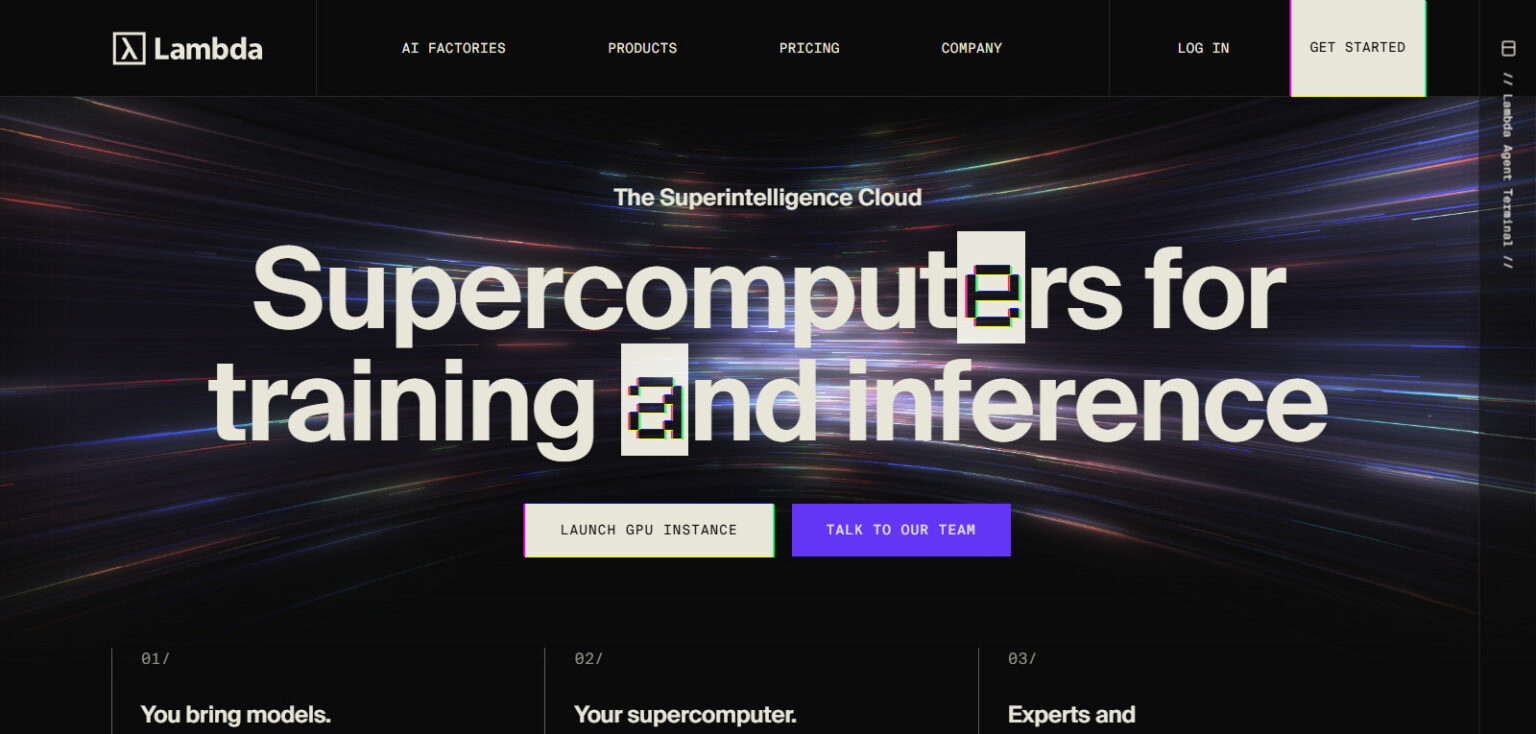
Their pricing model is competitive to the hyperscalers, and provides discounted rates for reserved instances and GPU hours with an hourly pricing model. Their storage provides NVMe SSDs and scalable object storage.
Customers save money with Lambda Labs due to the bare-metal GPU access, which removes the overhead of virtualization. They are focused on AI compute with pre-configured environments for PyTorch and TensorFlow. Lambda Labs is a great option for research labs and startups due to the affordable and scalable GPU compute.
Lambda Labs Attributes
- GPU/Accelerator: NVIDIA A100, H100 clusters
- Compute Scale: Elastic clusters from single GPU to multi-node setups
- Scalability: Kubernetes orchestration, rapid scaling for AI workloads
- Pricing: Transparent hourly GPU rates, discounted reserved capacity
- AI Focus: Deep learning, LLM training, diffusion models
| Advantages | Disadvantages |
|---|---|
| Transparent GPU pricing with hourly rates | Smaller global footprint compared to hyperscalers |
| Optimized for AI frameworks like PyTorch/TensorFlow | Limited enterprise integrations |
| Bare‑metal GPU access for maximum performance | Less diverse service portfolio |
| Flexible scaling from single GPU to clusters | Focused mainly on AI, not general workloads |
| Cost‑effective for startups and researchers | Limited compliance certifications |
2. Meta AI Data Centers
Meta AI Data Centers are built for hyperscale AI workloads, specifically with NVIDIA H100 GPUs and custom accelerators for large scale models like LLaMA. With computing scale at exascale, interconnected clusters can support training for models with trillions of parameters. Scalability is provided by innovative networking fabrics and liquid cooling systems.
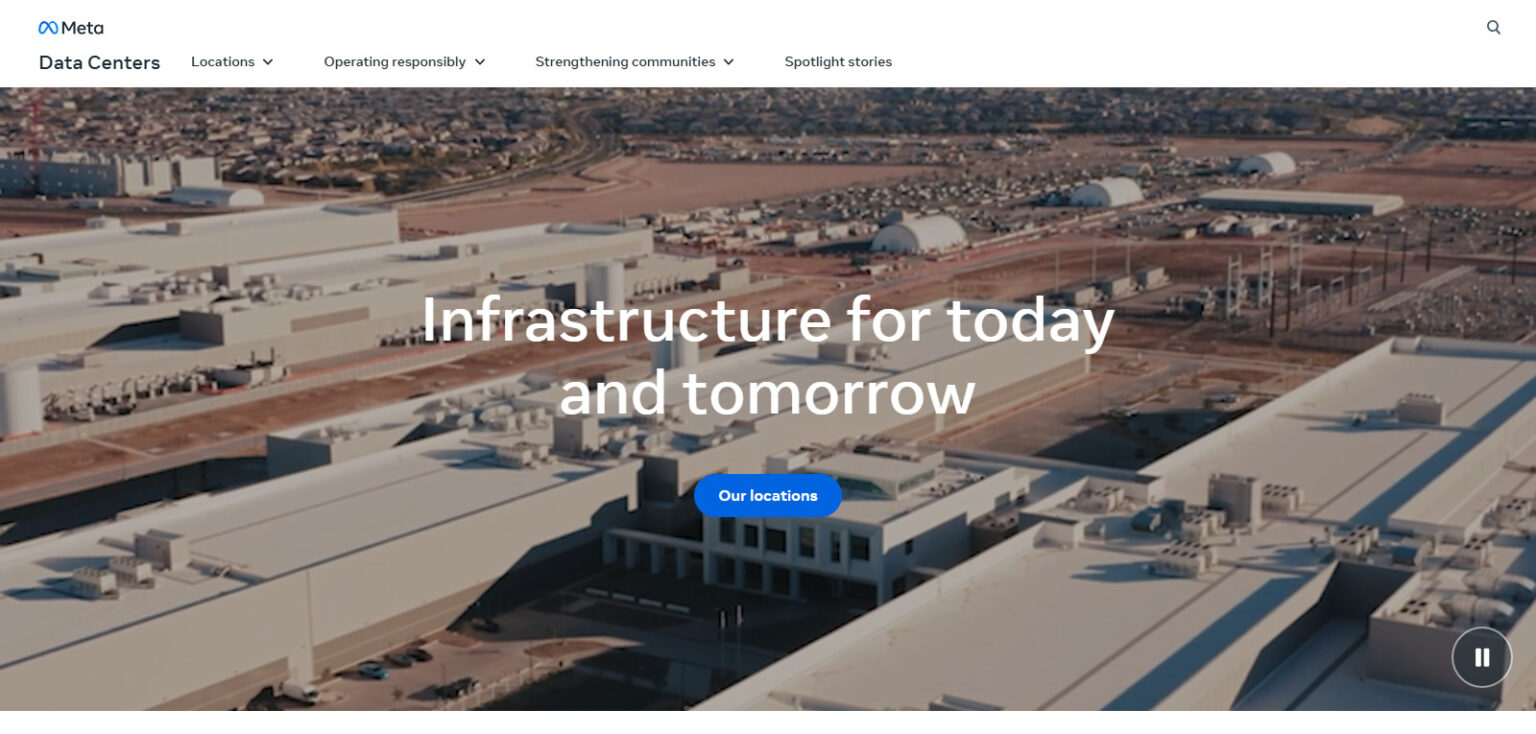
While Meta AI Data Center pricing is unavailable, it is assumed their infrastructure is optimized for cost efficiency with custom hardware and massive energy savings from use of renewable energy. vertical integration and proprietary optimization.
Vertical integration and customization also make the data centers cost efficient. The data centers are focused on AI compute with foundation models and large scale inference, especially multimodal systems. This focuses Meta in AI research on the forefront of generative AI.
Meta AI Data Centers Attributes
- GPU/Accelerator: NVIDIA H100, custom Meta accelerators
- Compute Scale: Exascale clusters for trillion-parameter models
- Scalability: Advanced networking fabrics, liquid cooling
- Pricing: Internal, efficiency via vertical integration
- AI Focus: Foundation models, multimodal generative AI
| Advantages | Disadvantages |
|---|---|
| Exascale compute for trillion‑parameter models | Not publicly available for external users |
| Custom accelerators optimized for AI | Pricing and access not transparent |
| Advanced cooling and energy efficiency | Limited to Meta’s internal research |
| Strong focus on generative AI | No enterprise customer offerings |
| Cutting‑edge performance in foundation models | Lack of flexibility for external workloads |
3. CoreWeave
CoreWeave provides NVIDIA A100, H100, and RTX GPUs for rendering, AI training, and inference. Their compute scale is elastic, with the ability to scale clusters to thousands of GPUs. Kubernetes-based orchestration and low-latency networking make their cloud offering scalable. Flexible pricing gives customers to option to choose from pay-as-you-go or contracted capacity, with prices usually being lower than AWS or Azure for GPU workloads.
Their cloud offering includes high-performance NVMe storage as well as scalable object storage. Being GPU-specialized makes their cloud offering focused and more efficient. CoreWeave is focused on AI compute, serving enterprises, startups, and researchers. Because of this, they are an up and coming AI cloud provider.
CoreWeave Attributes
- GPU/Accelerator: NVIDIA A100, H100, RTX GPUs
- Compute Scale: Thousands of GPUs for rendering and AI
- Scalability: Kubernetes-based orchestration, low-latency networking
- Pricing: Flexible, cheaper than hyperscalers for GPU workloads
- AI Focus: AI inference, VFX rendering, large-scale training
| Advantages | Disadvantages |
|---|---|
| Specialized GPU cloud cheaper than hyperscalers | Smaller ecosystem compared to AWS/Azure |
| Elastic scaling to thousands of GPUs | Limited global data center presence |
| Optimized for AI inference and rendering | Less enterprise compliance certifications |
| Flexible pricing models | Narrower focus on GPU workloads |
| Kubernetes orchestration for scalability | Less mature support ecosystem |
4. IBM Cloud
IBM Cloud’s hybrid solutions integrate AI accelerators with NVIDIA GPUs to provide AI compute at the enterprise level. Compute scale allows for public cloud and on-premises deployments with Red Hat OpenShift. Scalability is achieved with hybrid orchestration, allowing enterprises to span workloads across private and public clouds.
Enterprise pricing models, subscription and consumption, are provided with storage encryptiion which includes resilient block, file, and object storage. Cost efficiency is achieved with vendor lock-in reduced hybrid flexibility. AI compute is focused on trustworthy AI and industry solutions, with compliances, making IBM Cloud a great option for the financial services, healthcare and government AI deployments.
IBM Cloud Attributes
- GPU/Accelerator: NVIDIA GPUs, enterprise AI accelerators
- Compute Scale: Hybrid cloud with OpenShift integration
- Scalability: Extend workloads across private/public environments
- Pricing: Subscription & consumption models for enterprises
- AI Focus: Trustworthy AI, compliance, regulated industries
| Advantages | Disadvantages |
|---|---|
| Strong hybrid cloud integration with OpenShift | Higher pricing for enterprise services |
| Enterprise‑grade compliance and security | Smaller AI ecosystem compared to Google/AWS |
| Flexible subscription and consumption models | Less focus on consumer/startup workloads |
| Trusted in regulated industries | Limited GPU variety compared to competitors |
| Focus on trustworthy AI | Slower adoption of cutting‑edge AI accelerators |
5. HPE GreenLake
HPE GreenLake offers AI compute as a service, which uses NVIDIA GPUs on HPE’s infrastructure for hybrid deployments. Computing power scales from single GPUs to enterprise clusters. Scalability is achieved through on-premise deployment with cloud-like elasticity. You only pay for what you use. Storage is combined with HPE Alletra and scalable object storage.
Cost efficiency is achieved by avoiding over-provisioning. The compute is performance optimized for enterprise AI workloads. GreenLake focuses on hybrid AI, so enterprises can run workloads on-premises and smoothly extend to the cloud, making it a great option for enterprises looking to strike a balance between compliance, performance, and cost efficiency.
HPE GreenLake Attributes
- GPU/Accelerator: NVIDIA GPUs integrated with HPE systems
- Compute Scale: From single GPU nodes to enterprise clusters
- Scalability: Hybrid expansion with cloud-like elasticity
- Pricing: Consumption-based, pay-per-use flexibility
- AI Focus: Hybrid AI, edge AI, enterprise workloads
| Advantages | Disadvantages |
|---|---|
| Pay‑per‑use consumption model | Requires on‑premises infrastructure investment |
| Hybrid scalability with cloud‑like elasticity | Less global reach compared to hyperscalers |
| Integration with HPE storage solutions | Limited GPU variety |
| Strong for edge and enterprise AI | Focused mainly on enterprise workloads |
| Avoids over‑provisioning costs | Less attractive for startups |
6. Equinix
With Equinix, customers can build GPU clusters using NVIDIA A100/H100 and custom accelerators in their colocation environments. How much compute customers deploy is dictated by their specific use case, and Equinix has the global data center capacity to support customers’ needs. Once customers are interconnected to the clouds, they can deploy their workloads across multiple providers.
Storage is customer managed but is backed by Equinix’s high-performance infrastructure. There are cost efficiencies due to low latency and optimal interconnection. Being colocated with the cloud and financial services providers improves performance. Equinix is focused on providing AI compute for customers to build GPU clusters to support their hybrid and multi-cloud AI use cases and provide direct connectivity to hyperscalers for their flexible AI workloads.
Equinix Attributes
- GPU/Accelerator: NVIDIA A100/H100, customer-deployed clusters
- Compute Scale: Global colocation capacity for enterprise AI
- Scalability: Interconnection fabrics linking to hyperscalers
- Pricing: Depends on colocation space, power, and connectivity
- AI Focus: Hybrid/multi-cloud AI with low latency
| Advantages | Disadvantages |
|---|---|
| Global colocation capacity | Customers must manage their own GPU clusters |
| Strong interconnection fabrics | Pricing based on colocation, not compute |
| Low latency to hyperscalers | No native AI services |
| Flexible hybrid/multi‑cloud deployments | Requires enterprise IT expertise |
| Reliable infrastructure backbone | Limited direct AI focus |
7. Digital Realty
Digital Realty provides hyperscale colocation facilities where enterprises can deploy GPUs powered by NVIDIA accelerators. Their computing scale supports facilities designed for AI supercomputers and cloud interconnects. They offer modular data center designs with a global presence to provide a flexible and scalable solution. Pricing is dependent on colocation, power, and connectivity services.
While customer storage infrastructure is driven by server designs, it is supported by services provided by Digital Realty with a resilient facility design. Renewable energy and economies of scale make the facility cost effective. Performance is improved by Digital Realty’s global AI infrastructure with a focus on large scale GPU clusters, enabling enterprises and research institutions, and supporting cloud providers.
Digital Realty Attributes
- GPU/Accelerator: NVIDIA GPUs, enterprise supercomputing clusters
- Compute Scale: Hyperscale facilities for AI supercomputers
- Scalability: Modular expansion, global reach
- Pricing: Colocation, power, and connectivity services
- AI Focus: Enterprise AI, cloud interconnects, HPC workloads
| Advantages | Disadvantages |
|---|---|
| Hyperscale facilities for AI supercomputers | Customers must deploy and manage hardware |
| Global reach with modular expansion | Pricing based on colocation services |
| Renewable energy integration | No native AI platform |
| Strong enterprise and research support | Less flexibility for small teams |
| Low‑latency connectivity | Focused on infrastructure, not AI services |
8. NVIDIA
NVIDIA is a provider of GPUs and DGX systems for AI compute. Their accelerators include the A100, H100, and Grace Hopper Superchips. Their compute scale ranges from single GPUs to DGX SuperPODs for exascale AI. Scalability is achieved through NVLink, NVSwitch, and InfiniBand networking. The cost of GPUs increases with the enterprise solution.
Storage is compatible with NVIDIA DGX systems using NVMe and scalable parallel file systems. Their systems are cost efficient with excellent performance per watt for AI workloads. Their systems outperform the competition and train trillion parameter models. Their focus on AI compute for generative AI and LLMs solidifies their position as the foundation of the global AI infrastructure for scientific computing.
NVIDIA Attributes
- GPU/Accelerator: A100, H100, Grace Hopper Superchips
- Compute Scale: DGX SuperPODs delivering exascale AI
- Scalability: NVLink, NVSwitch, InfiniBand networking
- Pricing: Premium enterprise GPU solutions
- AI Focus: Generative AI, LLMs, scientific computing
| Advantages | Disadvantages |
|---|---|
| Industry‑leading GPUs (A100, H100, Grace Hopper) | Premium pricing |
| DGX SuperPODs deliver exascale AI | Hardware‑centric, not full cloud services |
| Optimized for generative AI and LLMs | Requires integration with cloud providers |
| Strong ecosystem with CUDA, libraries | High entry cost for enterprises |
| Scientific computing leadership | Limited direct storage solutions |
9. Google Cloud
Google Cloud provides NVIDIA GPUs, TPUs, and custom AI accelerators for large-scale compute. Compute scale can reach exascale with clusters of TPU v5. Scalability is Kubernetes and global networking. Flexible pricing provides choices of on-demand, committed use, and spot instances. Integrated storage provides Cloud Storage and high-performance persistent disks.
Cost savings come from sustained-use discounts and AI-optimized infrastructure. TPUs are optimized for AI training and inference, and deep learning, making Google Cloud a great option for AI compute. Generative AI, Vertex AI, and foundation model deployment focus make Google Cloud one of the best providers for scalable AI services for both enterprises and startups.
Google Cloud Attributes
- GPU/Accelerator: NVIDIA GPUs, TPU v5 clusters
- Compute Scale: Exascale TPU clusters for deep learning
- Scalability: Kubernetes, global networking infrastructure
- Pricing: On-demand, committed use, spot instances
- AI Focus: Vertex AI, foundation model deployment
| Advantages | Disadvantages |
|---|---|
| TPU v5 clusters for deep learning | Pricing complexity with multiple models |
| Vertex AI for managed AI services | Higher costs for large GPU workloads |
| Global scalability with Kubernetes | Less transparent for specialized GPU pricing |
| Flexible pricing (on‑demand, spot, committed) | Strong competition from AWS/Azure |
| Strong AI ecosystem and foundation models | Dependence on Google’s proprietary stack |
10. OVHcloud
OVHcloud’s GPUs with NVIDIA accelerators let you run AI workloads on our affordable GPU cloud services. Our compute scale spans from single GPUs to clusters. We provide flexible cloud orchestration for smooth scalability. Our pricing is compliant with the EU, energy-efficient, and offers competitive hourly rates.
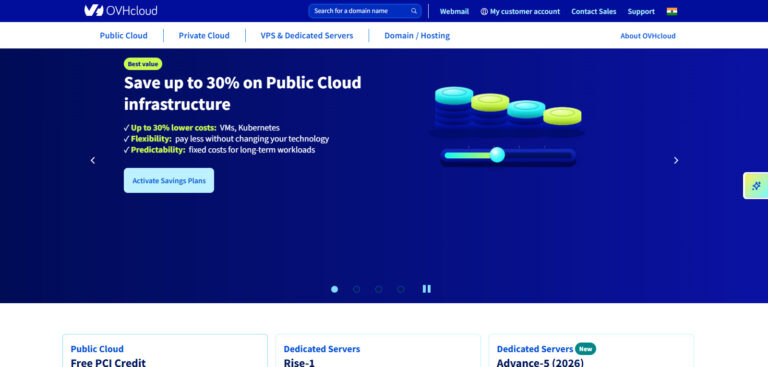
Our storage uses high-performance SSDs and scalable object storage. Our data centers are energy-efficient. We focus on AI training and inference as well as HPC workloads. We utilize our AI compute to provide EU startups, researchers, and enterprises access to GPU compute, making OVHcloud cheaper than the hyperscalers for AI workloads.
OVHcloud Attributes
- GPU/Accelerator: NVIDIA GPUs for AI workloads
- Compute Scale: From single GPU to scalable clusters
- Scalability: Flexible orchestration, European compliance
- Pricing: Transparent, highly competitive hourly rates
- AI Focus: Democratizing GPU compute for startups and researchers
| Advantages | Disadvantages |
|---|---|
| Affordable GPU pricing | Smaller global presence |
| Transparent hourly rates | Limited enterprise compliance certifications |
| Energy‑efficient European data centers | Narrower AI ecosystem |
| Flexible orchestration for startups | Less performance at hyperscale |
| Democratizes GPU compute access | Limited advanced AI services |
Conclusion
Each GPU cloud and AI infrastructure provider has their own strengths and trade-offs. Lambda Labs provides bare-metal GPUs at prices accessible to startups and researchers, while Meta AI Data Centers innovate with exascale computers, but keep their technologies internal to Meta. Meanwhile, CoreWeave offers lower priced GPU computing compared to hyperscalers, with IBM Cloud and HPE GreenLake focusing on AI with compliance and pay-per-use models, hybrid and enterprise offerings.
Colocation giants Equinix and Digital Realty focus on connectivity and scale when deploying GPU clusters for their customers, offering AI services, but not as strong offerings as some other providers. NVIDIA has the best AI computers with their GPUs and DGX systems, with Google Cloud following up with their AI computers, TPUs, and related services. OVHcloud provides access to GPUs at a lower price, attracting European startups and researchers.
When looking at the options available, the best choices are Lambda Labs and OVHcloud if your concern is cost and accessibility. If your concern is enterprise hybrid flexibility and compliance, IBM and HPE GreenLake are better choices. CoreWeave and Google Cloud offer specialization with large scale GPU computing. Finally, if you are looking for innovations in exascale computing and infrastructure, Meta and Digital Realty are better choices. Each company in the AI compute industry fulfills a niche.
FAQ
What GPUs does Lambda Labs provide?
NVIDIA A100 and H100 accelerators optimized for AI workloads.
Is Lambda Labs cost‑effective?
Yes, it offers transparent hourly GPU pricing, cheaper than hyperscalers.
Does Lambda Labs support scalability?
Yes, from single GPU instances to multi‑node clusters.
Are Meta AI Data Centers public?
No, they are internal to Meta’s research.
What makes CoreWeave unique?
Specialized GPU cloud cheaper than AWS/Azure.