



In this article, I will discuss the Best AI Evaluation Tools for LLMs that help developers evaluate model quality, accuracy, safety and reliability. To help teams make the right choice of evaluation solution, we will compare leading tools along evaluation metrics, RAG and agent testing, LLM-as-a-Judge support, human evaluation, integrations, deployment options, pricing, and production monitoring capabilities.
What Is AI Evaluation Tools for LLMs?
AI evaluation tools for LLMs are software frameworks and platforms that can be used to assess the quality, reliability, accuracy, safety and performance of large language model applications.
They support developers in assessing generated responses, prompts, RAG pipelines, AI agents, and production workflows through automated metrics, predefined tests, custom criteria, human feedback, and LLM-as-a-Judge methods.
These tools can catch problems like hallucinations, irrelevant responses, bad retrieval, inconsistent responses, unsafe outputs, and failed agent tasks. Depending on the platform, they also provide datasets, regression testing, tracing, observability, benchmarking and continuous evaluation features for development and production environments.
Key Points
| Tool | Key Strength |
|---|---|
| DeepEval | Comprehensive open-source LLM evaluation framework with CI/CD integration |
| LangSmith | End-to-end tracing, monitoring, and evaluation for LLM applications |
| Arize Phoenix | Open-source AI observability and evaluation platform |
| Braintrust | Experiment tracking and evaluation-driven LLM development |
| RAGAS | Specialized evaluation framework for RAG applications |
| Promptfoo | Prompt testing, red teaming, and multi-model benchmarking |
| TruLens | LLM and RAG evaluation with feedback-based quality metrics |
| Weights & Biases Weave | LLM experimentation, monitoring, and evaluation workflows |
| OpenAI Evals | Open-source benchmark framework for model and prompt assessment |
| Comet Opik | Open-source evaluation and observability platform for AI agents |
1. DeepEval
DeepEval, started in 2023, is an open-source framework to evaluate LLMs, built for evaluating LLM Apps, RAG systems, AI agents, conversational AI and multimodal workflows. It adopts a pytest style approach and offers 50+ evaluation metrics across correctness, relevance, hallucination, safety, RAG, tool use and agent trajectories.
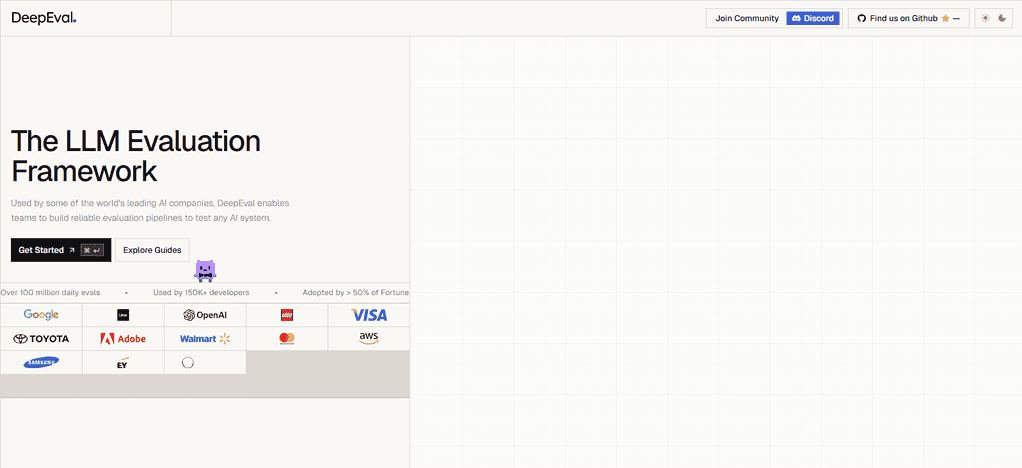
DeepEval supports LLM-as-a-Judge and customizable evaluation criteria, and human evaluation can be integrated via connected workflows. It is mostly local-first and can run on a developer machine, while Confident AI provides managed collaboration and production. Open source framework is free, advanced managed features are paid plans.
Characteristics
- Framework for LLM evaluation open source.
- Supports RAG, agents and conversational AI testing .
- Offers configurable evaluation metrics.
- Supports LLM-as-a-Judge evaluation .
- Supports automated regression testing workflows
Advantages
- Wide range of evaluation metrics.
Strong backing for RAG and agent evaluation - You can create custom metrics.
- CI/CD evaluation support.
Disadvantages
- Advanced managed features require a separate platform *
- Large evaluation suites can lead to cost blowups for models / API.
- Some metrics need to be carefully set up.
It may take some time for beginners to learn about evaluation methodology. - Accompanying tooling for improved production observability.
2. LangSmith
LangSmith, a platform for LLM development, observability, testing and evaluation, launched in 2023 and is tightly coupled with LangChain and LangGraph. – Supports datasets, experiments, regression testing, production tracing, online evaluation, human annotation, pairwise comparison, custom evaluators and LLM-as-a-Judge scoring LangSmith can evaluate single responses, full agent runs, and multi-turn threads.
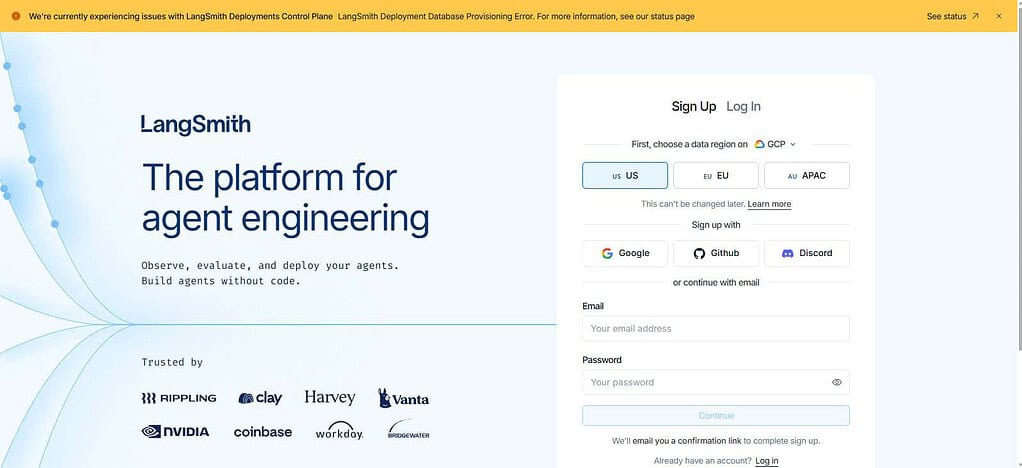
The main deployment is cloud-based, but there are hybrid and self-hosted options for enterprise users. • Integrations with LangChain, LangGraph, major model providers, tracing workflows, datasets and evaluation pipelines. Pricing Free usage, paid plans for higher-scale development & enterprise requirements.
Characteristics
- LLM observability and development platform
- Enables tracing, datasets, and experiments.
- Has online and offline assessments.
• Supports human feedback and LLM-as-judge. - Heavy integration with LangChain and LangGraph.
Advantages
- End-to-end evaluation workflow with solid support.
- Application and agent tracing in depth
- Useful in regression testing.
- Tracks production.
- Strong ecosystem integrations .
Disadvantages
- Advanced features require paid plans.
- Best experience is seamlessly integrated with its ecosystem.
- Costs can increase with heavy usage.
- Tracing extensively can generate a lot of data.
Difficult to setup for first time users.
3. Phoenix Arize GT
Arize Phoenix released as an open-source platform for AI observability and evaluation, supporting LLM experimentation, tracing, debugging, RAG evaluation, and agent evaluation.
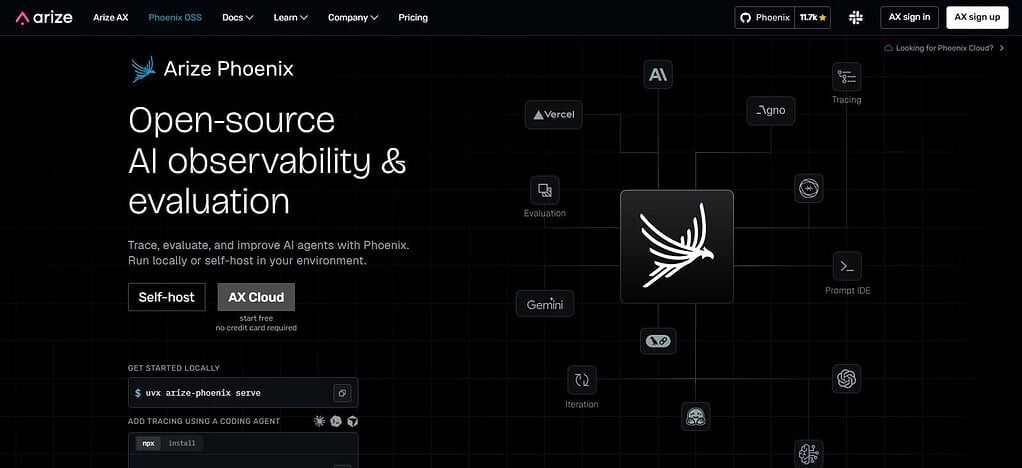
It can evaluate response quality, retrieval performance, prompt experiments, datasets, and LLM-as-a-Judge workflows. Phoenix also supports human annotations of spans, traces and sessions, making it useful for combining automated and human evaluation. It uses the OpenTelemetry and OpenInference standards and can be deployed locally, on Docker, Kubernetes or on cloud environments.
Integrations: OpenAI, Anthropic, Google, AWS Bedrock, LangGraph, LlamaIndex, CrewAI, DSPy and other popular frameworks. The Phoenix deployment is open-source and there are no standard subscription requirements.
Characteristics
- Open-source LLM observability platform.
- Focuses on tracing and evaluation.
- Strong RAG evaluation capabilities.
- Supports agent and application tracing.
- Uses OpenTelemetry and OpenInference standards.
Advantages
- Open-source deployment option.
- Strong observability capabilities.
- Useful for debugging RAG applications.
- Supports LLM-as-a-Judge evaluation.
- Flexible integration with AI frameworks.
Disadvantages
- Self-hosting requires infrastructure management.
- Advanced workflows may require technical expertise.
- Observability data can become expensive to store at scale.
- Configuration can be complex for beginners.
- Some enterprise requirements may need managed services.
4. Braintrust
Braintrust is a 2023 founded AI evaluation and observability platform around datasets, experiments, scoring, production traces and continuous evaluation. It supports automated evaluators, custom scoring functions, human review, comparison testing, regression detection and LLM-as-a-Judge evaluation. Braintrust can evaluate individual outputs, complete application traces, and production workflows, making it a helpful tool for teams moving from development to deployment.
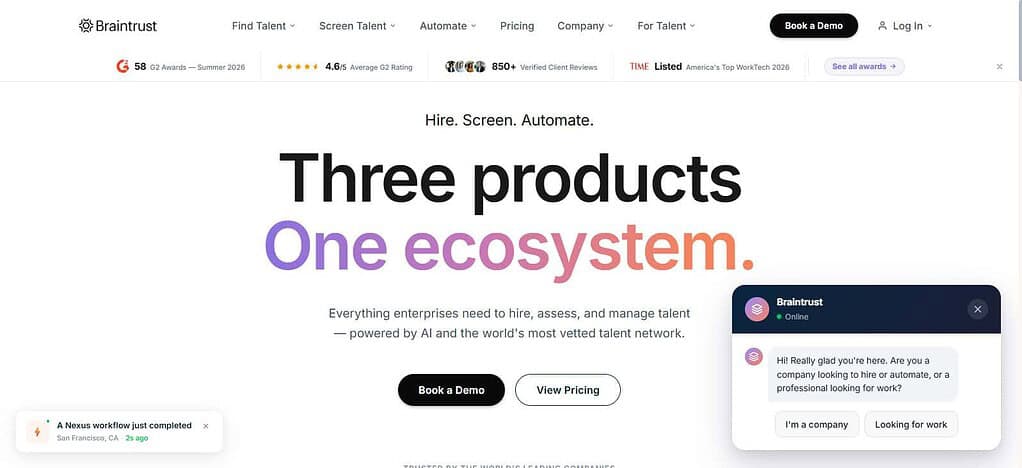
It is mainly a managed platform, with options for enterprise deployment based on the requirements. It has integrations with major LLM providers, SDKs, application frameworks, datasets and CI/CD workflows. Pricing is based on usage and varies by platform needs, evaluation volume and enterprise capabilities.
Characteristics
- AI evaluation and observability platform.
- Uses datasets and experiments for testing.
- Supports production trace evaluation.
- Provides custom scoring and LLM-as-a-Judge.
- Supports continuous evaluation workflows.
Advantages
- Combines development and production evaluation.
- Strong experiment comparison capabilities.
- Supports custom evaluation logic.
- Useful for regression detection.
- Good fit for engineering teams.
Disadvantages
- Primarily oriented toward managed workflows.
- Pricing can increase with evaluation volume.
- Requires understanding of datasets and experiments.
- Advanced features may be more suitable for larger teams.
- Large-scale tracing requires careful cost management.
5. RAGAS
RAGAS is an open-source evaluation framework, primarily built for RAG and LLM application quality. It was founded in 2023. It has measures of faithfulness, answer relevance, context precision, context recall, context relevance and other retrieval-and-generation qualities.
RAGAS supports reference-based and reference-free evaluation, and may utilize LLM-as-a-Judge approaches for evaluating generated responses and retrieved context. Human evaluation is possible through datasets and external annotation workflows, not its central interface.
It can run locally in Python, and integrates in common LLM and RAG development stacks. The core framework is open source and free to use. However, the external model APIs used for automated judging may cost money.
Characteristics
- Mostly directed for RAG applications.
- Open-source llm evaluation framework.
- Measures generation and retrieval quality.
- Supports reference-based and reference-free metrics.
- Supports evaluation methods based on LLM.
Advantages
- RAG evaluation (high focus).
- Useful metrics of retrieval quality
- Open source and developer friendly
- Simple to integrate into Python workflows.
- Useful for RAG pipeline comparison.
Disadvantages
- More specific than generic evaluation platforms.
Not mainly focused on human evaluation.
Some metrics are judge model dependent. - External API usage may incur other charges.
Supporting tools are required for production observability.
6. Promptfoo
Promptfoo (founded in 2024) is an open-source LLM evaluation, testing, security and red-teaming platform. It enables developers to compare prompts and models, run regression tests, evaluate outputs against custom criteria, and conduct adversarial security testing.
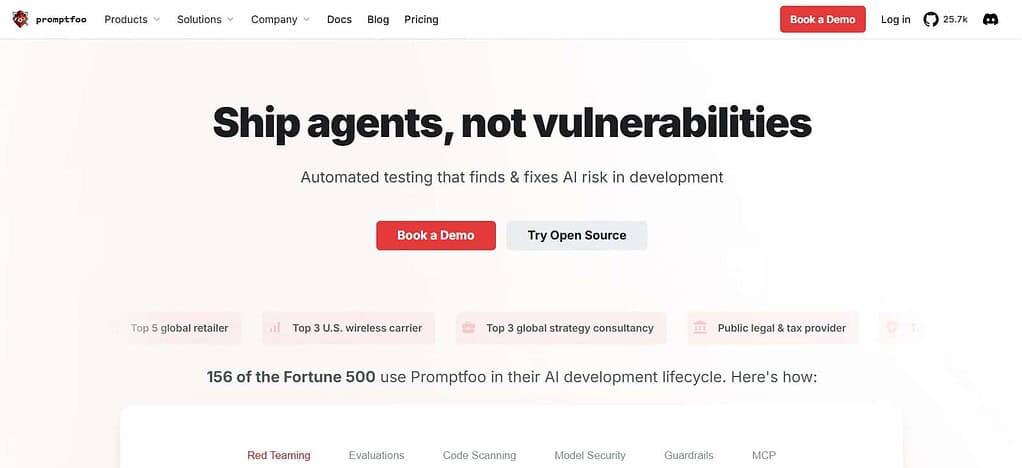
It supports LLM-as-a-Judge, deterministic assertions, custom providers, vulnerability scanning and automated evaluation in development and CI/CD workflows. Human evaluation can be part of broader testing processes but it is primarily for automated testing.
You can deploy on-premises, on your own infrastructure and enterprise users can take advantage of managed cloud capabilities. The community version is free and the Enterprise and on-premise versions are available with custom pricing. Integrations support many model providers and application environments.
Characteristics
- Open source platform for testing LLMs.
- Easy to compare prompts and models quickly.
- Provides regression tests.
- Includes red teaming and security testing.
Supports automated evaluations and CI/CD.
Advantages
- Powerful prompt-testing capabilities.
- Useful for adversarial test.
*Supports a lot of model providers.
Works well in automated development pipelines.
Runs locally and supports self-managed environments.
Disadvantages
- Less important is human evaluation.
- Maintenance of complex test suites.
Judge-model evaluations may increase API costs.
Enterprise features may require paid plans.
7. TruLens
TruLens is an open source LLM evaluation and observability framework born in 2022 to measure quality of LLM applications, RAG pipelines and agent workflows. It offers feedback functionality, and evaluation metrics for relevance, groundedness, context quality, correctness and application behavior.
TruLens supports LLM-as-a-Judge evaluation and integrates with human evaluation workflows and automated feedback. It can be used locally or embedded into application environments for development and production evaluation.
Integrations cover major LLM providers and popular LLM application frameworks, with a strong focus on instrumenting application components and traces. The open-source framework is usable without a subscription to the standard platform, but enterprise capabilities may rely on the surrounding TruEra ecosystem.
Characteristics
- Offers application observability.
- Open source framework for evaluation of LLMs
- Supports RAG assessment.
- Feedback functions for measuring quality.
- Supports LLM-as-a-Judge evaluation.
Advantages
- Strong emphasis on app-level evaluation.
- Good for RAG pipeline evaluation.
Open source foundation.
Support for application instrumentation. - Can combine tracing and evaluation.
Disadvantages
- Needs technical knowledge to customize.
Advanced observability may require additional infrastructure.
Some concepts can be hard for beginners. - Automated feedback might need external model calls.
More complex workflows will require more tooling.
8. Weights & Biases Forge
Weights & Biases Weave is a platform for LLM application evaluation, tracing, and observability in the Weights & Biases ecosystem, released in 2024. It supports datasets, experiments, evaluations, tracing, prompt & model comparisons, custom scorers, and production monitoring.
Weave supports LLM-as-a-Judge evaluation and can incorporate automated scoring with human review workflows for analyzing outputs from applications. Deployment is mostly handled by the W&B platform, with enterprise options for organizations that require extra controls. Integrations include major model providers,
Python-based AI applications, evaluation frameworks, and the larger Weights & Biases ecosystem. Pricing is based on W&B plans and usage needs, with free access for qualifying dev workflows and paid access for larger teams.
Characteristics
- LLM tracing and evaluation platform.
- Part of the Weights & Biases ecosystem.
- Supports datasets and experiments.
- Provides custom scorers and evaluations.
- Includes production monitoring capabilities.
Advantages
- Strong experiment tracking ecosystem.
- Useful for comparing models and prompts.
- Supports tracing of AI applications.
- Custom evaluation logic is available.
- Suitable for teams already using W&B.
Disadvantages
- Best suited to teams familiar with W&B.
- Usage can become costly at larger scale.
- Cloud-oriented workflows may not fit every deployment.
- Advanced functionality can require configuration.
- Full platform capabilities may be more than small projects need.
9. OpenAI Evals
2023: Released an open source framework and benchmark system for evaluating the performance of LLMs and AI applications, called OpenAI Evals. It allows developers to build evaluation datasets, compare models, test specific behaviors and build custom evaluation implementations.
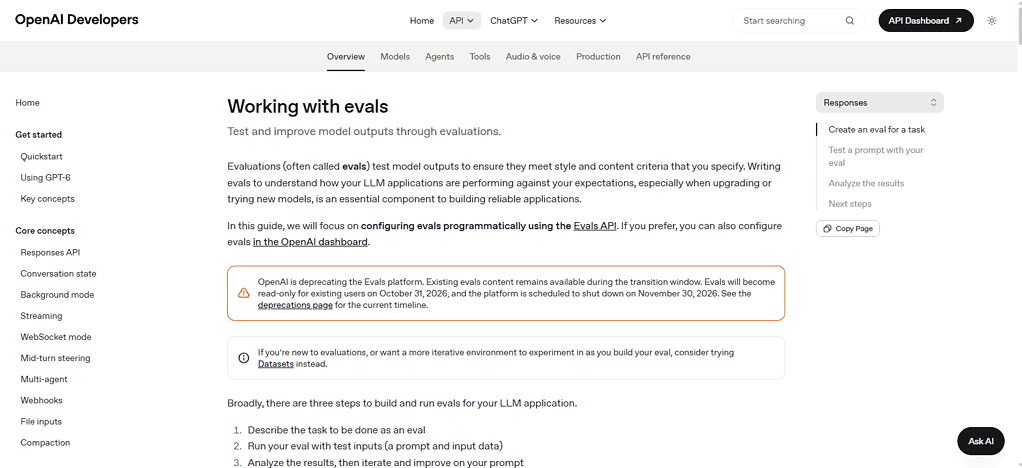
The framework can support automated judging with LLM-as-a-Judge type approaches while human evaluation can be introduced through manually reviewed datasets and customized workflows. OpenAI Evals is more developer-focused, can be run locally, and has integrations focused on OpenAI models and custom evaluation implementations.
The framework itself is open-source and does not need a separate platform subscription, but the API usage may incur model-inference costs. It is especially useful for teams that are building repeatable, code-based evaluation suites.
Characteristics
- Intended for model and application evaluation.
- Open-source evaluation framework.
- Custom evaluation implementations are supported.
Supports repeatable benchmark testing. - Can support automated model based evaluation.
Advantages
- Open source and customizable.
- Useful to construct evaluation datasets.
- Enables repeatable testing.
- Useful for dev-controlled eval pipelines.
- Good for testing behavior of models.
Disadvantages
- Requires programming knowledge.
- Not as turn-key as managed evaluation platforms
There is no production observability without additional tooling. - API-based evaluations could incur usage costs.
It takes engineering effort to build sophisticated evaluation workflows.
10. Comet Opik
Comet Opik is an open-source LLM observability, evaluation and AI-agent tracing platform launched in 2024, built for development through production. It supports automated evaluations, RAG testing, prompt management, datasets, agent traces, production monitoring and LLM as a Judge scoring. Human evaluation can be incorporated by using annotation and review workflows in conjunction with automated metrics.
Opik is available as a managed cloud service or fully self-hosted (Apache 2.0 license) Integrations: OpenAI, LangChain, LlamaIndex, Ragas, Promptfoo, LiteLLM, Pinecone, AI dev tools, etc. The self-hosted version is free, and Comet provides managed and enterprise options with additional features and support.
Characteristics
- Open source LLM observability and evaluation platform.
LLM and agent tracing enabled. - Provides RAG evaluation support.
- Provides support for LLM-as-a-Judge scoring.
- Available for on-premises and in the cloud.
Advantages
- Good combination of evaluation and observability.
- Supports self-hosted deployment.
- Useful for monitoring AI-agents.
- Integrates with popular AI frameworks
- Good for development and production work flow.
Disadvantages
- Self-hosting means dealing with infrastructure.
- May require configuration for advanced features.
- With large volumes of trace, storage requirements increase.
- Automated judging may incur model API costs.
Additional resources may be required for enterprise scale deployments.
Conclusion
Building reliable LLM applications will require 2026 AI evaluation tools. Which right platform depends whether you need RAG evaluation, agent testing, prompt regression, safety checks, production monitoring or human feedback. Tools such as DeepEval, LangSmith, Arize Phoenix, Braintrust, RAGAS, Promptfoo, TruLens, Weave, OpenAI Evals and Comet Opik provide various methods for automated and human-assisted evaluation.
When evaluating a solution, consider evaluation metrics, LLM-as-a-Judge support, integrations, deployment options, scalability, pricing, and CI/CD capabilities. A proper evaluation workflow can help teams identify hallucinations, measure application quality, detect regressions, and continuously improve LLM performance across development and production.
FAQ
What are AI evaluation tools for LLMs?
AI evaluation tools help developers measure the quality, reliability, safety, and performance of large language model applications. They can evaluate responses, prompts, RAG pipelines, AI agents, and production traces using automated metrics, human feedback, or LLM-as-a-Judge methods.
What should you evaluate in an LLM?
Common evaluation areas include accuracy, relevance, correctness, faithfulness, hallucination, context quality, toxicity, safety, task completion, tool usage, latency, and consistency. The appropriate metrics depend on the type of LLM application being tested.
What is LLM-as-a-Judge?
LLM-as-a-Judge uses one language model to evaluate another model’s output against defined criteria. It can provide scalable scoring for qualities such as relevance, correctness, helpfulness, and factual consistency.
Which tools support RAG evaluation?
Tools such as DeepEval, RAGAS, LangSmith, Arize Phoenix, TruLens, and Comet Opik support different aspects of RAG evaluation, including retrieval quality, context relevance, faithfulness, and generated-answer quality.