

In this article, we will go over the Best Data Posture Management Platforms that help organizations discover, classify, monitor, and protect sensitive data across cloud, SaaS, databases, and hybrid environments. I’ll compare their key features, security capabilities, integrations, pricing, data lineage, AI capabilities, and overall strengths to help businesses choose the right platform for their data-security needs.
What Are Data Posture Management Platforms?
Data Posture Management platforms are security tools that help organizations discover, classify, monitor and protect sensitive data across cloud, SaaS, databases, data warehouses and hybrid environments. They provide insight into where critical data resides, who can access it, how it is used and whether it is exposed to security or compliance risks.
Modern platforms can also analyze permissions, find misconfigurations, map data relationships, prioritize high-risk exposures, and automate remediation. By marrying data discovery with security context, these platforms allow organizations to continuously improve their overall data-security posture.
Key Points
| Platform | Key Strength |
|---|---|
| Wiz DSPM | Data exposure analysis integrated with cloud security graph |
| Cyera | AI-powered data discovery and classification at scale |
| BigID | Unified DSPM, AI governance, privacy, and remediation |
| Sentra | Cloud-native DSPM with automated risk remediation |
| Securiti | Enterprise-grade data security and privacy management |
| Varonis Unified Data Security Platform | Deep access governance and data exposure monitoring |
| Microsoft Purview | Native DSPM capabilities across Microsoft environments |
| IBM Guardium | Enterprise data protection, monitoring, and compliance |
| Concentric AI | AI-driven semantic analysis and data risk detection |
| Palo Alto Networks DSPM (Dig Security) | Cloud-first DSPM integrated with security operations |
1. Wiz DSPM
Wiz DSPM (Data Security Posture Management) is a cloud-native platform released by Wiz in 2022. Wiz is based in New York City. It also includes agentless data discovery, sensitive data classification, exposure detection, attack path analysis, and risk prioritization. DPM/DSPM coverage includes IaaS, PaaS, DBaaS, cloud storage, code and AI environments across cloud and security ecosystems.
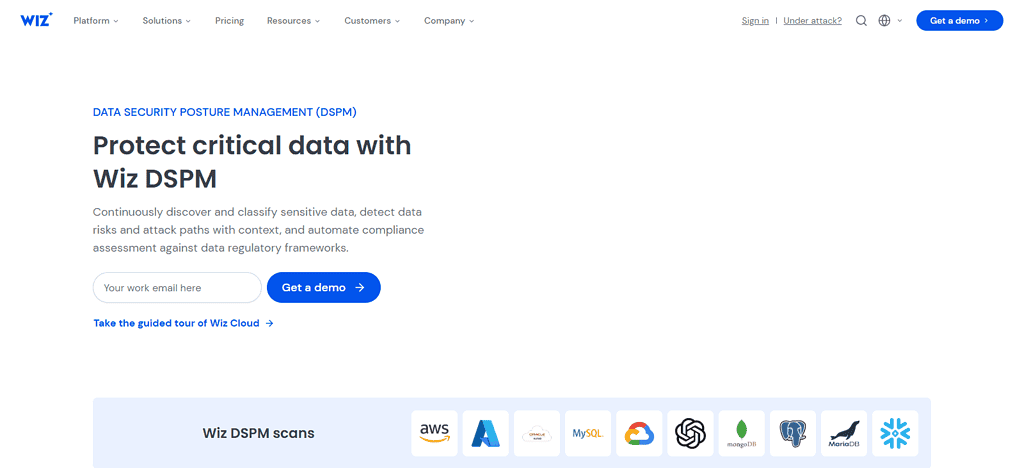
Data lineage is less about a traditional governance catalog and more about contextual data-flow and attack-path visibility. Wiz doesn’t have a standard DSPM pricing model but generally offers custom quotes depending on the needs of the customer.
Wiz DSPM Functions
- Continuous Data Discovery: Continuously discovers sensitive data across cloud infrastructure, databases, code repositories, and AI environments, without the need for traditional agents.
Sensitive Data Classification: Classifies PII, PHI, PCI information, secrets and other sensitive data with built-in and custom classifiers. - Data Risk Assessment: Links sensitive data to cloud exposure, identities, vulnerabilities, malware and lateral movement to prioritize real attack paths.
- Data Access Governance: Defines who can access sensitive data and helps security teams detect excessive permissions and risky identities.
- Compliance and AI Security: Meets regulatory requirements for sensitive data used in AI training and other pipelines.
| Pros | Cons |
|---|---|
| Strong cloud-native data discovery | Pricing is generally quote-based |
| Connects data risks with cloud attack paths | Primarily optimized for cloud environments |
| Agentless deployment approach | Can require broader Wiz adoption for maximum value |
| Strong identity and exposure context | Enterprise feature depth can increase complexity |
2. Cyera
Cyera was founded in 2021 and went public in 2022 with headquarters in New York. It bills itself as a modern DSPM and a more full-featured data security platform with discovery, classification, access governance, DLP, risk monitoring and automated remediation.
Cyera connects data intelligence to identities and access, across cloud, SaaS, on-prem, collaboration and automation environments. New capabilities include Data Lineage for files and Cyera MCP to build security agents. Pricing is generally quoted rather than publicly available. Coverage for database, SaaS and cloud is designed for enterprise data stores and modern AI environments.
Cyera Features
- AI-Native Data Discovery: Automatically discovers and understands sensitive data across distributed enterprise data environments.
- Data Classification: Classifies sensitive, regulated and business-critical information using context and AI.
- Data Risk Prioritization– Links data sensitivity to exposure, access, permissions and other security context to help teams focus on the most important risks.
- Cloud and SaaS Visibility – Visibility into cloud, SaaS, IaaS and other enterprise data environments.
- AI Data Security: Enables transparency into data security in AI environments, giving organizations an understanding of the sensitive data that is being used in emerging AI applications and workflows.
| Pros | Cons |
|---|---|
| AI-driven data discovery and classification | Enterprise pricing is not publicly standardized |
| Strong visibility across distributed data | Advanced capabilities may require higher-tier deployment |
| Connects data with identity and access context | Implementation can require security-team involvement |
| Strong focus on modern AI-data security | Less established than some long-standing enterprise vendors |
3. BigID
Founded in 2016 and based in New York City, BigID has 200 employees. Its DPM category includes DSPM, data discovery, classification, privacy, access governance, AI security and data catalog capabilities. BigID finds sensitive, regulated and business-critical data across cloud, SaaS, hybrid and on-prem and connects data with ownership, access, activity, exposure and lineage.
It has broad data-source integrations and offers APIs for programmatic management. Quote-based pricing is the standard, not publicly standardized pricing. Its wider architecture makes it a good fit for organizations that want DPM mixed with privacy, governance and data-security workflows.
BigID Features
- Data Intelligence: Links sensitive data to ownership, access, business context, and security information for a better understanding of risk.
Privacy & Compliance: Includes data-security features and privacy management and regulatory workflows. - Broad Data Support: Supports cloud, SaaS, hybrid and on-premises environments with a broad ecosystem of connectors.
Data Risk Management: Helps organizations identify exposed or poorly managed information and prioritize actions to improve the overall data-security posture.
| Pros | Cons |
|---|---|
| Extensive data discovery and classification | Broad feature set can create a learning curve |
| Strong privacy and compliance capabilities | Enterprise pricing is generally custom |
| Large connector ecosystem | Configuration can become complex in large environments |
| Supports hybrid and multi-cloud environments | May require dedicated expertise for advanced deployments |
4. Sentra
Sentra is a data-security platform for DSPM, sensitive data discovery, classification, risk detection and AI data-readiness. The company was founded in 2021 and has its headquarters in New York. Its modern platform is designed to secure data used by enterprise AI and provides visibility into sensitive data across cloud data environments.
Sentra uses API-based connections to find and classify information without requiring traditional endpoint agents and can integrate into existing enterprise data infrastructure. Pricing is usually custom quote-based for enterprise deployments. Its DPM approach includes data discovery, risk reduction, governance and preparing sensitive data for safe AI adoption.
Sentra Features
- Automated Data Discovery: Enables data-first discovery across cloud, hybrid, SaaS and other enterprise environments.
- Sensitive Data Discovery: Finds sensitive data and uses contextual intelligence for improved classification and risk analysis.
Data Detection & Response: Gives security teams the ability to detect data exposure and respond to security risks as opposed to just building an inventory.
Data Access Governance: correlates data with access and identity information to detect over- or inappropriate access. - AI Data Security: Extends DSPM capabilities to AI environments to help organizations understand and protect sensitive data used by AI applications and pipelines.
| Pros | Cons |
|---|---|
| Strong focus on cloud data security | Pricing is generally quote-based |
| AI-focused data-security capabilities | Smaller ecosystem than some established vendors |
| Automated sensitive-data discovery | Advanced functionality may require configuration |
| Useful for modern AI environments | Less focused on traditional database security than specialized platforms |
5 Securiti
Securiti was founded in 2019 and is headquartered in San Jose, California. Its DPM category consolidates data security, privacy, governance and AI-data controls in a single data intelligence architecture. The platform discovers sensitive data across cloud, SaaS, hybrid and on-premises environments to help organizations find data, understand relationships, manage access and automate privacy and security workflows.

Data lineage and data mapping are important aspects of its architecture because they link assets, processing activities and business context. Securiti offers quote-based pricing and deployment and integrations requirements depend on the enterprise environment.
Securiti Features
- Data Classification: Classifies personal, sensitive, regulated, and business critical information to aid security and governance.
Privacy and Compliance: Merges data-security posture capabilities with privacy management and regulatory compliance workflows.
Data Intelligence: Provides a more in-depth view of enterprise data by mapping relationships, context, ownership, and usage of data. - AI Data Governance: Assists in meeting security and governance needs for AI-related data, and links data protection with wider enterprise controls.
| Pros | Cons |
|---|---|
| Combines security, privacy, and governance | Broad platform can take time to learn |
| Strong data mapping and intelligence | Enterprise pricing can be difficult to estimate |
| Supports cloud and hybrid environments | More capabilities can mean greater implementation complexity |
| Strong AI-data governance direction | May be more extensive than needed for smaller teams |
6. Varonis Unified Data Security Platform
Varonis was founded in 2005 and is headquartered in Miami, Florida. It adds the DSPM, data discovery and classification, data-access intelligence, threat detection, remediation and privacy features to its Unified Data Security Platform.
It is especially strong for enterprise unstructured data as it covers major cloud and on-premises data stores, identity repositories and SaaS applications. The DSPM capability offers insight into data-security posture and facilitates prioritization of remediation.
Varonis also ties sensitivity, permissions and activity to understand data-access risk. Pricing is mostly enterprise quote-based with API and integration capabilities that allow broader security and data ecosystems
Varonis Unified Data Security Platform Features
- Data Discovery: Finds sensitive data in file systems, Microsoft environments, cloud repositories and other enterprise data stores.
- Data Classification: Discovers business critical and sensitive data so you know what data needs a higher level of protection.
Access Intelligence: Reviews permissions and user access to pinpoint over- or under-permissions to sensitive data. - Data Risk Detection: Leverages sensitivity, permissions and activity context to help identify high-risk data exposures.
- Automated Remediation: Resolves excessive permissions and other data security weaknesses, enabling organizations to minimize unnecessary exposure.
| Pros | Cons |
|---|---|
| Strong visibility into sensitive enterprise data | Can be more complex for smaller organizations |
| Excellent permissions and access analysis | Enterprise pricing is typically custom |
| Strong automated remediation capabilities | Deployment may require careful configuration |
| Mature data-security ecosystem | Particularly strong in file and unstructured data environments |
7. Microsoft Purview
Microsoft Purview is Microsoft’s integrated data governance, security and compliance platform, not a standalone DSPM product. It includes data discovery, classification, lineage, governance, DLP, insider-risk controls, compliance and protection across Microsoft and other data environments.
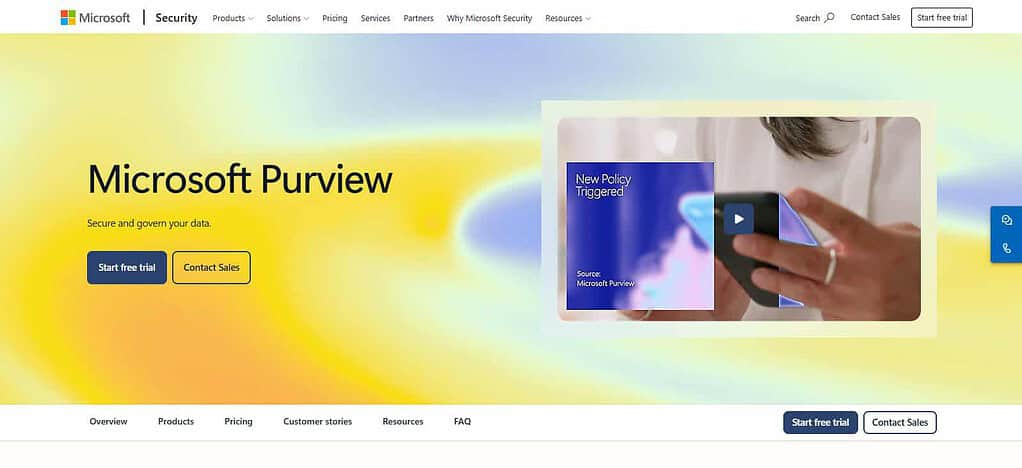
Its ecosystem spans Microsoft 365, Azure, databases, cloud data and enterprise applications with deep native integration and API capabilities for Microsoft. Pricing varies by capability, with options like Microsoft 365 E5 @ $51.45/user/month and the Purview Suite @ $12/user/month, and some governance and security capabilities priced on a consumption basis.
Microsoft Purview Features
- Data discovery and classification: Enables organizations to discover and classify sensitive data across their digital estate.
- Single View of Data Risks: Gives you a consolidated view of sensitive-data risks, policy coverage, and posture trends.
AI and Agent Security: Get visibility into AI applications and agents and understand how organizations access and use sensitive information. - Guided Remediation: Offers suggestions and workflows that help teams investigate and mitigate data-security risks.
- Third-Party Data Coverage: Extends visibility beyond Microsoft environments to select third-party SaaS and IaaS platforms including Google Cloud, Snowflake, and Databricks.
| Pros | Cons |
|---|---|
| Deep integration with Microsoft 365 and Azure | Best experience is often within the Microsoft ecosystem |
| Strong classification and data governance | Licensing can be complex |
| Extensive compliance capabilities | Some advanced capabilities use separate or consumption-based pricing |
| Strong data lineage and catalog capabilities | Configuration across large environments can require expertise |
8. IBM Guardium
IBM Guardium is an enterprise data-security portfolio that provides data discovery, classification, database security, vulnerability assessment, encryption, monitoring and DSPM capabilities. It is particularly effective for organizations who manage large and complex estates of databases.
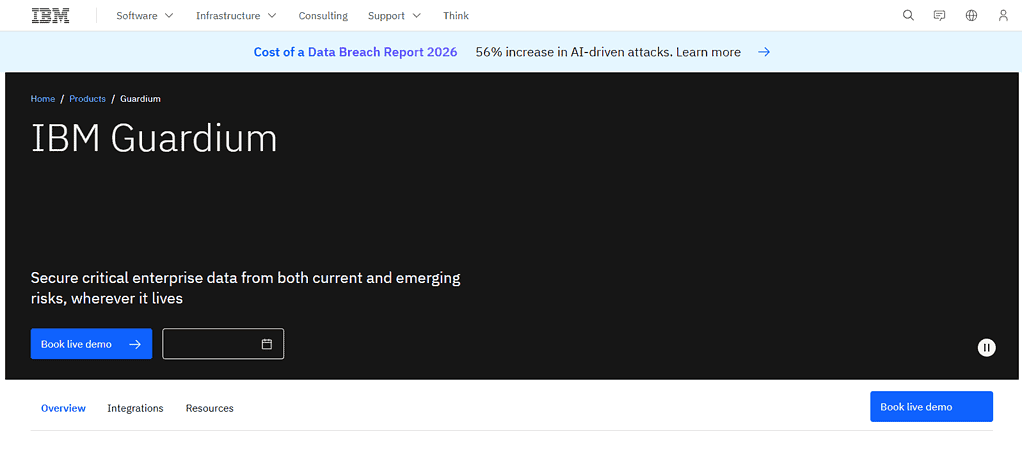
Guardium connects with AWS, Microsoft SQL Server, Oracle, PostgreSQL, SAP, Snowflake, Cassandra, Databricks, Google Cloud and other data technologies. It has wider database support than many cloud-focused DSPM products, so it is a good fit for hybrid environments.
Pricing depends on the Guardium product, deployment, and usage. IBM usually provides custom enterprise quotes rather than a single price for the platform.
IBM Guardium Features
- Database Security: Enables monitoring and protection of enterprise databases and other critical data environments.
- Data Discovery & Classification: Enables identification of sensitive data and awareness of where critical data exists.
- Data Activity Monitoring: Monitors data activity to notify security teams of suspicious or unauthorized access.
Hybrid Environment Support: Built for complex enterprise environments including databases, cloud and on-premises infrastructure. - Broad Data Ecosystem Compatibility: Allows you to integrate with AWS, Microsoft SQL Server, Oracle, PostgreSQL, SAP, Snowflake, Databricks, and Google Cloud.
| Pros | Cons |
|---|---|
| Strong database-security capabilities | Can be complex to deploy and manage |
| Extensive support for enterprise data environments | Pricing can be difficult to estimate |
| Strong monitoring and activity analysis | User experience can feel more enterprise-oriented |
| Suitable for hybrid infrastructure | May require specialized security/database expertise |
9. Concentric AI
Concentric AI was founded in 2018 and is based in San Jose, California. Its focus is on the DPM segment with AI-based data security governance through its Semantic Intelligence platform. It discovers, categorizes and classifies structured and unstructured information by analyzing data context, ownership, exposure and business value.
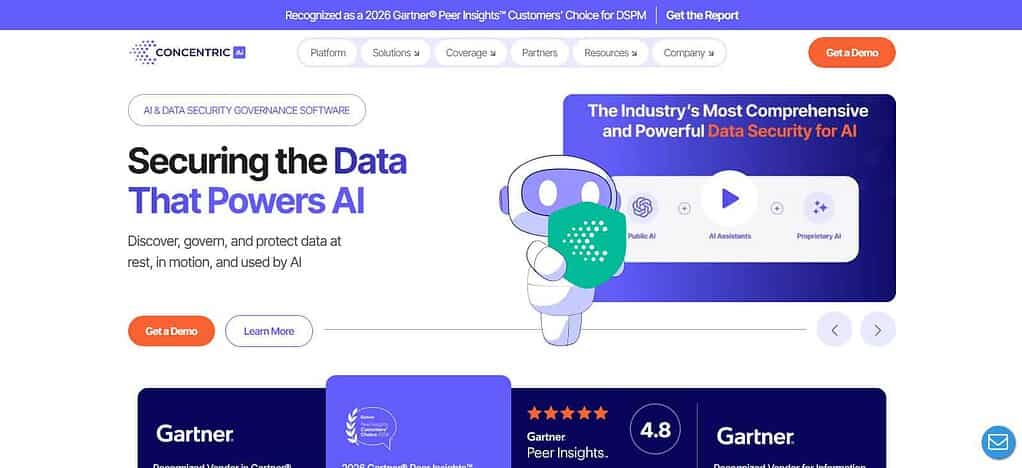
The platform supports cloud, SaaS and on-premises repositories and integrates with Microsoft 365, Box, Snowflake, SQL Server, Windows File Server, Databricks and AWS S3. It also offers data-lineage transparency and autonomous remediation. The cost depends on how much data you scan. For the Semantic DLP part you pay by user.
Concentric AI Features
- AI-Powered Data Discovery: Discovering and understanding of sensitive and business-critical data using semantic intelligence.
- Contextual Classification: It considers the context and the meaning of data, instead of traditional pattern-based classification.
- Unstructured Data Governance: Provides deep insights of unstructured information across enterprise repositories.
- Data Risk Analysis: Helps identify sensitive data exposure, ownership, access issues and governance risks.
Automated Data Governance: Leverages AI-powered analytics and remediation capabilities to assist security teams in minimizing unnecessary exposure and enhancing data governance.
| Pros | Cons |
|---|---|
| Strong AI-based semantic classification | Less established than some large security vendors |
| Effective focus on unstructured data | Enterprise pricing varies by deployment |
| Helps identify business-critical information | Advanced configuration may require expertise |
| Supports automated data-governance workflows | Smaller overall ecosystem than major platform vendors |
10. Palo Alto Networks DSPM (DigSec)
Palo Alto Networks DSPM is built on the foundation of Dig Security, a cloud DSPM company founded before being acquired by Palo Alto Networks in 2023. Palo Alto Networks, based in Santa Clara, California, has integrated Dig’s technology into Prisma Cloud.
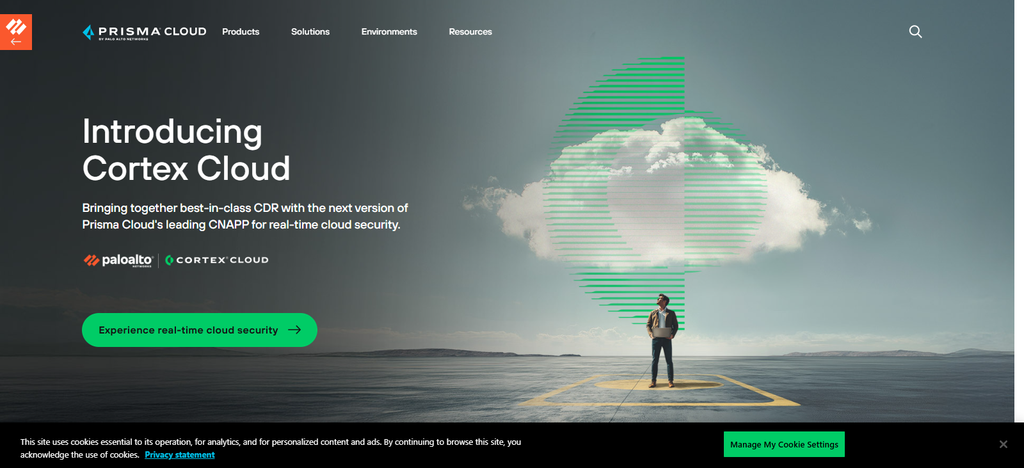
The platform is focused on cloud data discovery, sensitive-data classification, data exposure, access context and near real-time protection across cloud environments. Its DPM category is very cloud native, with distributed databases, cloud services and modern AI related data environments.
Pricing is usually a custom quote from Palo Alto Networks. The key benefit is the integration of DSPM with wider CNAPP and cloud security context.
Palo Alto Networks DSPM (Dig Security) Features
- Cloud Data Discovery: Discovers sensitive data across cloud environments and correlates findings to broader cloud-security context.
- Sensitive data classification Identifies sensitive data in cloud databases, storage, and other supported data stores.
- Data Risk Context: Merges data-security findings with cloud-configuration, identity, and attack-path context.
- Prisma Cloud Integration: Adds DSPM capabilities to the larger cloud-security platform of Palo Alto Networks after its acquisition of Dig Security.
- AI and Cloud Data Protection: Extends data security capabilities to modern cloud and AI environments, helping security teams prioritize exposed sensitive data.
| Pros | Cons |
|---|---|
| Strong integration with Prisma Cloud | Best value may come with broader Palo Alto adoption |
| Strong cloud data-security capabilities | Pricing is generally custom |
| Connects data risks with cloud-security context | Can be complex for organizations new to CNAPP |
| Useful for cloud-native security teams | Less focused on traditional standalone data governance |
Conclusion
The decision of which is the best Data Posture Management platform in 2026 will come down to an organization’s data environment, security requirements, cloud adoption, compliance needs, and automation goals. Wiz DSPM, Cyera, BigID, Sentra, Securiti, Varonis, Microsoft Purview, IBM Guardium,
Concentric AI and Palo Alto Networks DSPM all have different approaches to discovering, classifying, monitoring and protecting sensitive data. Before choosing, organizations should consider cloud and SaaS coverage, database support, data lineage, integrations, AI capabilities, remediation, deployment options and pricing.
The best platform is one that gives you clear visibility to your data, helps you accurately prioritize risk, and gives you practical controls over your organization’s most critical data assets.
FAQ
What is Data Posture Management?
Data Posture Management (DPM) is a security approach that helps organizations discover, classify, monitor, and protect sensitive data across cloud, SaaS, databases, and other environments. It helps security teams identify exposure, excessive access, misconfigurations, and data-related risks.
What is the difference between DPM and DSPM?
DPM and DSPM are closely related terms. Both focus on understanding where sensitive data exists, who can access it, and what risks surround it. DSPM generally emphasizes the security posture of data, while DPM can include broader governance, compliance, privacy, and data-management capabilities.
Which Data Posture Management platform is best in 2026?
There is no single best platform for every organization. Wiz and Palo Alto Networks are strong choices for cloud-focused environments, while Varonis and IBM Guardium can be suitable for complex enterprise data estates. BigID, Securiti, and Microsoft Purview are useful when governance and compliance are major requirements.
What data can DPM platforms discover?
DPM platforms can discover sensitive information such as personally identifiable information, financial records, credentials, health-related information, intellectual property, regulated data, and business-critical files across databases, cloud storage, SaaS applications, data warehouses, and other repositories.