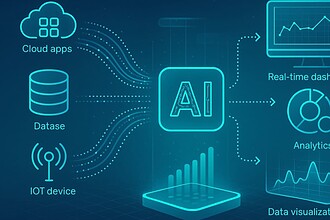


In this article I will discuss Best AI Data Pipeline Platforms for Enterprises and how they support scalable data workflows, AI applications, machine learning, governance and real-time processing. I will compare leading platforms, in terms of key features, integrations, scalability, deployment, observability, data quality, pricing, and enterprise requirements, to help readers understand their differences.
What Are AI Data Pipeline Platforms?
AI data pipeline platforms are enterprise software solutions that automate the collection, integration, cleaning, transformation, validation, governship and delivery of data for machine learning and artificial intelligence workloads. They connect databases, APIs, cloud storage, applications, data lakes and warehouses, and support batch or real-time processing.
These platforms can also deliver orchestration, data quality checks, lineage, security, monitoring and observability. For enterprise AI, they help to make large-scale data workflows more manageable and reliable while preparing structured and unstructured data for model training, analytics, generative AI, and production applications.
Why Do Enterprises Need AI Data Pipeline Platforms?
Process Large Data Sets: Companies create data in databases, applications, cloud services, devices and customer systems. AI data pipelines automate data processing at scale, removing repetitive manual data operations.
Integrate Several Data Sources: There are many disconnected systems in modern enterprises. AI data pipeline platforms aggregate data from APIs, databases, SaaS applications, data lakes, warehouses and event streams into unified workflows.
Data Preparation for AI Models: The data needed for standard artificial intelligence systems must be structured, relevant and clean. Pipeline platforms automate the cleaning, transformation, validation, enrichment and preparation prior to data being used in machine-learning or generative AI workloads.
Facilitate Real-Time AI Applications: Fresh information may be required for other AI applications like fraud detection, recommendation, monitoring, personalization etc. Streaming pipelines transfer and process data with low latency.
Enhance Data Quality: Incomplete, duplicated, outdated or inconsistent data can affect AI results . Enterprises can ensure reliable datasets with automated validation, schema checks, freshness monitoring and quality rules.
Enhance Data Governance: Enterprise data often requires control regarding access and traceability. Pipeline platforms can give you permissions, lineage, auditing, security policies and governance controls over data workflows.
Automate Complicated Processes: Data pipelines can automate ingestion, transformation, scheduling, dependencies, validation and delivery. It cuts down on duplicate engineering work, and results in more consistent AI data processes.
Monitor Production Data Flows: Enterprise pipelines require constant monitoring to identify failures, delays, atypical data volumes and quality issues. Observability tools give visibility into pipeline health and operational performance.
Control Data and AI Costs: Automation pipelines can help organizations more efficiently manage compute, storage, processing, and data movement. Usage monitoring also enables teams to identify costly workloads and optimize infrastructure utilization.
Key Points
| Platform | Best For | Key Strength |
|---|---|---|
| Databricks | Enterprise AI and lakehouse architectures | Unifies data ingestion, engineering, analytics, machine learning, and AI workloads on a single Lakehouse platform with strong governance capabilities. |
| Microsoft Fabric | Microsoft-centric organizations | Combines data integration, engineering, analytics, and business intelligence within a unified SaaS environment integrated with Power BI. |
| Snowflake | Cloud-native data operations | Provides scalable data pipelines, governed data sharing, and AI-ready data infrastructure through its Data Cloud platform. |
| AWS SageMaker | AWS enterprises | Supports end-to-end data preparation, machine learning workflows, model deployment, and AI operations within the AWS ecosystem. |
| Google Vertex AI | AI-driven analytics teams | Offers managed AI pipelines, model lifecycle management, and integration with Google Cloud data services. |
| Azure Machine Learning | Large-scale enterprise AI projects | Delivers enterprise-grade MLOps, model governance, deployment automation, and integration with Microsoft’s AI ecosystem. |
| Dataiku | Collaborative AI development | Enables business and technical teams to build, manage, and operationalize AI-powered data pipelines with strong governance controls. |
| DataRobot | Automated machine learning pipelines | Provides AutoML, AI governance, and deployment capabilities that accelerate enterprise AI adoption. |
| Palantir Foundry | Complex enterprise data integration | Connects disparate data sources into operational workflows, supporting analytics, AI applications, and decision-making at scale. |
| Cloudera Data Platform (CDP) | Hybrid and multi-cloud environments | Delivers secure data engineering, streaming, governance, and AI pipeline management across cloud and on-premises infrastructure. |
1. Databricks
Founded in 2013, Databricks is a unified Data and AI platform built on lakehouse architecture. It supports data engineering, analytics, machine learning, generative AI, batch processing and streaming workloads. Pricing is consumption based, costs vary according to workloads and resources. Scalability supports large enterprise data and AI workloads on cloud infrastructure.
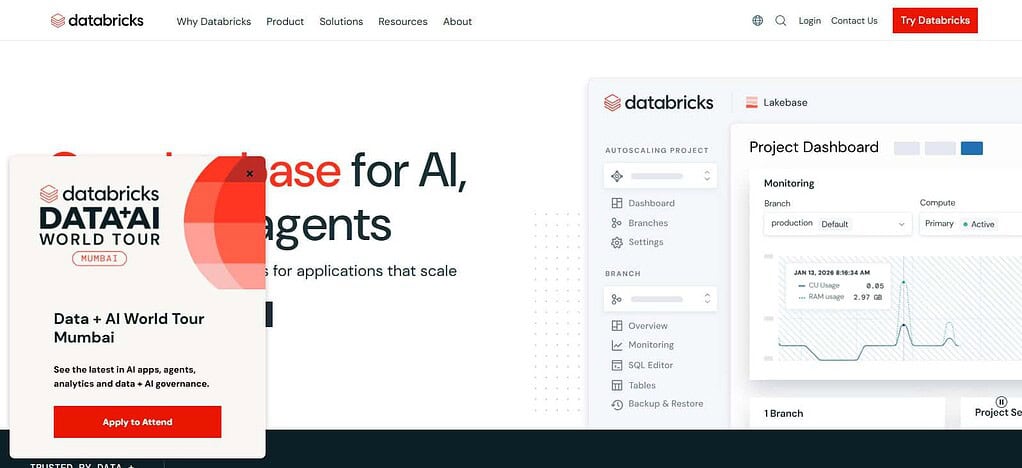
Deployment available via all major cloud environments. Integrations include Amazon S3, Google Cloud Storage, BigQuery, Snowflake, Power BI, Tableau and many data sources. Observability includes usage, cost and data monitoring. Unity Catalog has data governance and offers capabilities for validation, lineage, discovery and data health to support data quality.
Databricks Features
- Unified Data & AI Platform – Brings together data engineering, analytics, machine learning and AI workflows.
- Lakehouse Architecture – Combines the flexibility of a data lake with the management and performance features of a data warehouse.
- Batch & Streaming Pipelines – Handles scheduled batch & real-time data workloads.
Unity Catalog – Offers centralized governance, access control, discovery, and data lineage. - Scalable AI Workloads – ML development and generative AI applications for large-scale data processing.
| Pros | Cons |
|---|---|
| Unified data engineering, analytics, and AI platform | Can have a steep learning curve |
| Strong lakehouse architecture | Costs can rise with intensive workloads |
| Supports batch and streaming pipelines | Requires experienced data teams |
| Strong data governance with Unity Catalog | Configuration can become complex |
| Scales well for large AI workloads | May be more than needed for smaller projects |
2. Microsoft’s Fabric
Microsoft Fabric, launched in 2023, is a unified cloud data and analytics platform that brings together data engineering, integration, warehousing, data science, real-time analytics and business intelligence. Pricing is primarily based on capacity.
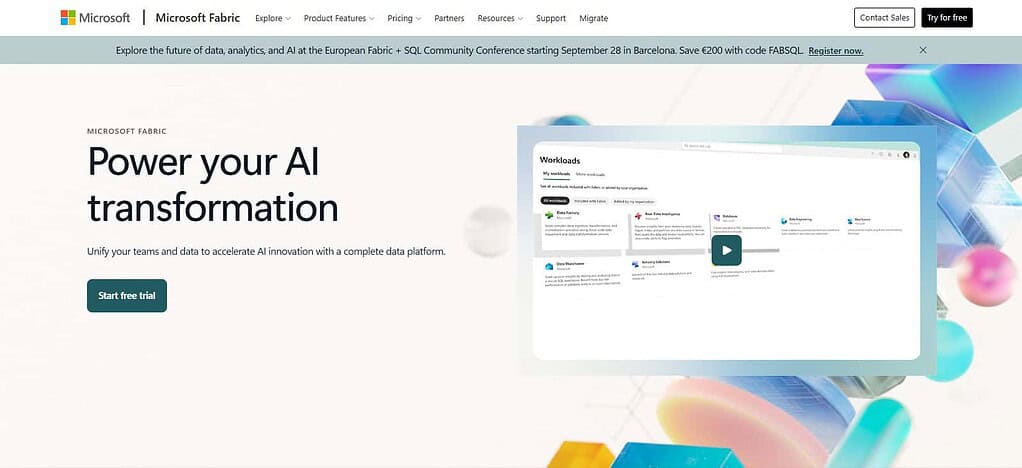
Costs depend on the Fabric capacity you select and your usage. Scalability is the ability of an organization to grow capacity to handle larger workloads. Deployment is cloud based via Microsoft Azure. Integrations are particularly strong with Microsoft services, Power BI, Azure, OneLake and external data sources.
Observability involves monitoring capacity and workloads. Microsoft’s larger governance ecosystem can be used for data governance and data quality is achieved by data integration, transformation, validation, and centralized data-management workflows.
Microsoft Fabric Features
- Unified Analytics Platform – Brings together data engineering, integration, warehousing, data science, and BI.
- OneLake Storage – OneLake is a single data lake for the entire enterprise.
- Data Factory Integration – Enables automated ingestion, transformation, and pipeline orchestration.
- Power BI Integration – Integrates enterprise analytics and visualization directly with data pipelines.
- Microsoft Ecosystem Integration – Works in concert with Azure, Microsoft 365, Power BI, and other Microsoft offerings.
| Pros | Cons |
|---|---|
| Combines multiple analytics workloads in one platform | Broad feature set can take time to learn |
| OneLake provides centralized data storage | Capacity pricing requires careful planning |
| Strong Power BI integration | Primarily centered on the Microsoft cloud ecosystem |
| Good integration with Azure services | Some advanced workloads require additional configuration |
| Useful for unified enterprise analytics | Resource management can become complex at scale |
3. Snowflake Snowflake
Snowflake was founded in 2012 as a cloud-native data platform for data engineering, data analytics, AI, machine learning, data sharing and application workloads. It has an architecture that separates storage and compute so that enterprises can scale resources to meet workload needs.
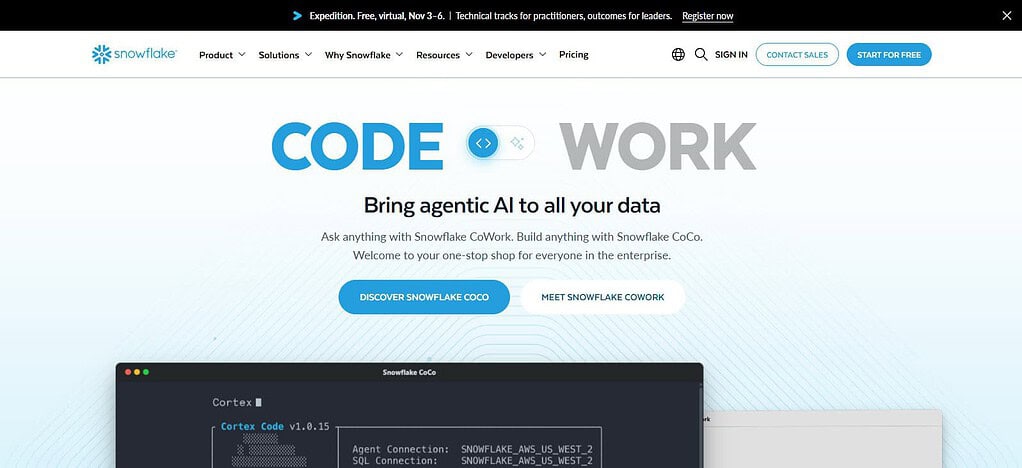
Pricing is consumption-based, and is correlated with platform resources and usage. Scalability with elastic compute and multi-cluster for larger workloads. Deployment is available on all major cloud environments. Integrations link Snowflake to databases, BI tools, applications, cloud storage, and artificial intelligence (AI) technologies.
Observability allows you to monitor data and operational workloads. Data governance includes encryption, privacy, control of access, and granular governance capabilities. Data quality can be managed with transformation, validation, monitoring, and controlled data-sharing workflows.
Snowflake Snowflake Features
- Cloud Data Platform** – Supports data engineering, analytics, AI, data sharing and application workloads.
- Separate Storage and Compute – Enables compute resources to scale independently of stored data.
- Snowpark – Allows developers to process and transform data in supported programming languages.
- Data Sharing – Enables governed data sharing between organizations without traditional data movement.
- Enterprise Governance – Provides security, access control, monitoring, privacy and data management
| Pros | Cons |
|---|---|
| Separates compute and storage for flexible scaling | Consumption costs require monitoring |
| Strong cloud data warehousing capabilities | Complex workloads can become expensive |
| Supports data sharing across organizations | Advanced features may require specialist knowledge |
| Broad ecosystem of integrations | Less focused on end-to-end ML than dedicated ML platforms |
| Strong security and governance capabilities | Architecture can require careful cost optimization |
4. Amazon SageMaker
Amazon SageMaker, a managed machine learning and AI platform for data preparation, model development, training, deployment and monitoring, was released in 2017. Pricing is mostly usage based . Costs are based on the AWS resources and services that are used .
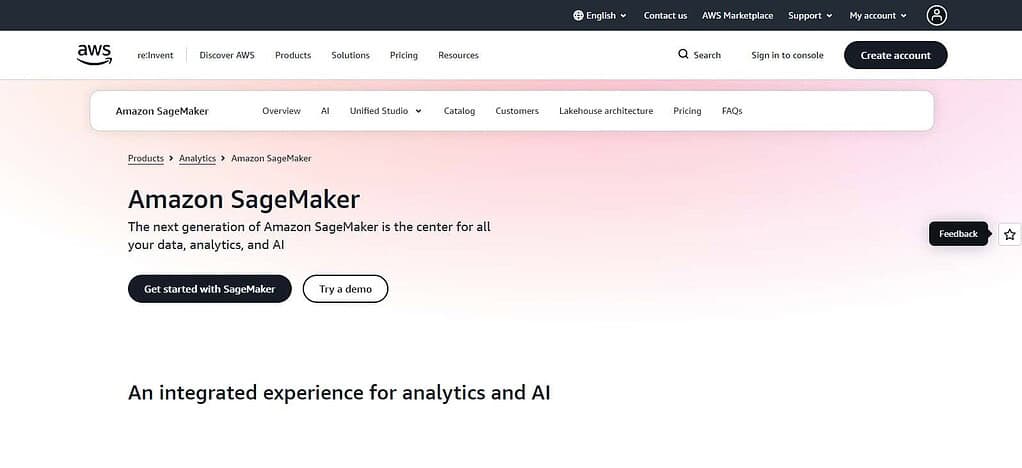
AWS compute infrastructure can scale for larger training and inference workloads enabling Scalability. Implementation is on AWS cloud. Integrations include Amazon S3, IAM, CloudWatch, databases, analytics services and other AWS infrastructure. Observability may utilize AWS monitoring services for model and infrastructure operations.
Data governance is enabled through AWS security and access-control mechanisms and data quality can be addressed with preparation, validation, feature engineering, and managed ML workflows before data reaches production models.
Sagemaker Features
- Machine Learning Platform – Offers end-to-end ML lifecycle capabilities from data preparation to deployment.
- Model Training – Offers a scalable infrastructure for training machine-learning models.
- Real-Time Inference – Provides deployed models with managed endpoints to generate predictions.
- AWS Integrations – Integrates with S3, CloudWatch, IAM, databases and other AWS services.
- ML Monitoring – Offers monitoring functionality for deployed models, infrastructure, and production workloads.
| Pros | Cons |
|---|---|
| Covers the complete machine-learning lifecycle | AWS services can have a steep learning curve |
| Highly scalable ML infrastructure | Pricing can be difficult to estimate |
| Strong integration with AWS services | Best results may require several AWS services |
| Supports model training and deployment | Requires cloud and ML expertise |
| Provides production monitoring capabilities | Configuration can become complex for large environments |
5. Google Vertex-AI
Google Vertex AI is Google Cloud’s managed machine learning and AI platform** for data preparation, model training, deployment, generative AI and MLOps, launched in 2021. Pricing is usage-based, based on the particular Google Cloud services, compute resources, and AI workloads used. Scalability Scales on Google Cloud infrastructure for growing training, inference and data workloads.
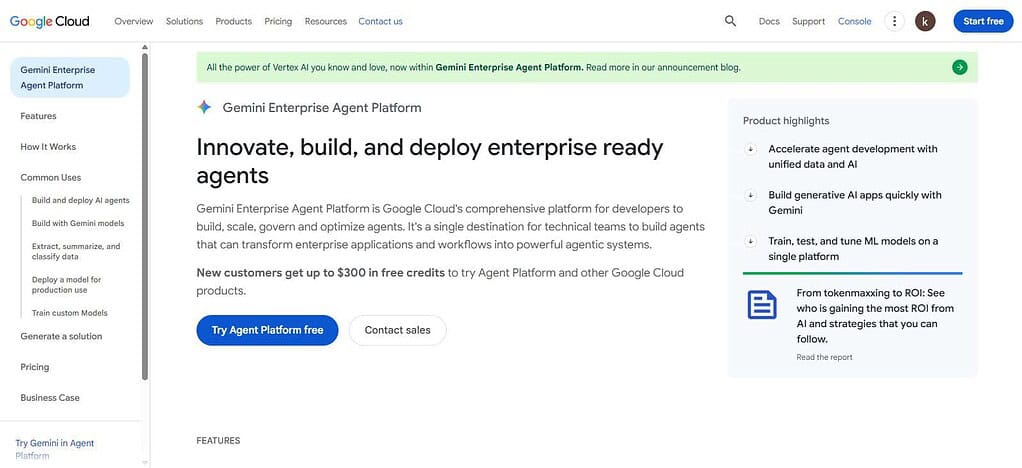
Deployment is cloud based on Google Cloud. Integrations include BigQuery, Cloud Storage, Dataflow, databases, and other Google Cloud services.
Observability provides monitoring for models, applications, and AI workloads. Data governance leverages Google Cloud security, identity, and policy controls and data quality can be achieved by data preparation, validation, feature workflows, and managed machine-learning processes.
Google Vertex AI Features
- Unified AI Platform – Machine Learning for Generative AI, model development and deployment.
- Foundation Model Application Building – Infrastructure and tools for building applications with foundation models.
- BigQuery Integration – Links AI workflows to Google Cloud’s data warehouse environment.
- MLOps Capabilities – Support for model lifecycle management, monitoring, evaluation, deployment and training.
Scalable Cloud Infrastructure – Leverages Google Cloud resources for enterprise-scale AI workloads.
| Pros | Cons |
|---|---|
| Strong machine-learning and generative AI capabilities | Large feature set can be difficult to navigate |
| Deep integration with Google Cloud | Usage-based pricing requires monitoring |
| Supports managed model training and deployment | Google Cloud expertise may be required |
| Strong MLOps functionality | Some workflows involve multiple cloud services |
| Works well with BigQuery data workflows | Advanced configurations can increase complexity |
6. Azure Machine Learning studio
Microsoft announced Azure Machine Learning, a managed machine-learning and MLOps platform for data preparation, model development, training, deployment and lifecycle management. Pricing is based on consumption of Azure Resources.

Compute and other connected services are billed as they are used. Scalability is achieved by scaling Azure compute resources up or down to meet workload requirements. Deployment in the Azure cloud. Integrations include Azure Blob Storage, Key Vault, Container Registry, Application Insights, Event Hub and more Azure services.
Observability is the capability of observing and managing costs. Azure security, identity, and responsible-AI controls help with Data governance Preparation, validation, feature engineering, and repeatable MLOps workflows help with Data quality.
Azure Machine Learning Features
- End-to-End ML Platform – Provides capabilities for data preparation, experimentation, training, deployment and monitoring.
- Automated Machine Learning – Aids automation of portions of model development and selection.
- MLOps Workflows – Enables repeatable model deployment, lifecycle management, and production operations.
Azure Integrations – Integrate with Azure Storage, Key Vault, Container Registry and other Azure services. - Enterprise Security – Identity, access management, security, monitoring and governance capabilities.
| Pros | Cons |
|---|---|
| Comprehensive machine-learning lifecycle management | Azure services can be complex |
| Strong MLOps capabilities | Costs depend on multiple Azure resources |
| Integrates well with Azure infrastructure | Requires technical ML knowledge |
| Supports automated machine learning | Advanced workflows can require additional services |
| Strong enterprise security ecosystem | Resource configuration can take time |
7. Dataiku –
Dataiku, founded in 2013, is an enterprise AI and data science platform for data prep, analytics, machine learning, generative AI, agents, and governed AI workflows. The pricing is often aimed at enterprises and can vary based on the features needed and the deployment setup.
Scalability supports multiple teams, projects, models and AI initiatives. Deployment can work with existing infrastructure and data environments in the enterprise. Integrations: Snowflake, Databricks, Redshift, Amazon S3, APIs, SQL, Spark, Kubernetes, GPUs and more.
Observability Pipelines, models, agents, and AI performance. Data governance includes centralized inventories, policies, approvals, lineage and risk controls. Data quality involves validation checks, certification, documentation, lineage, and quality rules in data workflows.
Dataiku Features
- Collaborative AI Platform – Enables data scientists, engineers, analysts, and business teams to collaborate on common workflows.
- Visual Data Preparation – Allows users to cleanse, transform and prepare data using visual tools.
Code-Based Workflows – Support for SQL, Python, R, and other methods for advanced data processing.
AI Governance – Gives you controls to govern models, projects, users, policies, and AI assets. - Enterprise Integrations – Connect with databases, cloud storage, data warehouses, APIs, and ML infrastructure.
| Pros | Cons |
|---|---|
| Combines visual and code-based data workflows | Enterprise pricing may require a custom quote |
| Accessible to technical and non-technical teams | Large feature set can require training |
| Strong AI and data governance capabilities | Advanced deployments may need specialist expertise |
| Supports data preparation and machine learning | Can be more extensive than smaller teams need |
| Broad enterprise integration options | Complex projects can require careful administration |
8. Data Robot
DataRobot (founded in 2012) is an enterprise machine learning and artificial intelligence platform** that helps to develop, deploy, monitor and govern predictive and generative AI models. Pricing is generally enterprise-centric, priced according to platform capabilities and deployment needs.
Scalability allows for production AI deployments across organizational environments. Deployment can encompass cloud, on-premises, edge and other controlled environments. Integrations include enterprise data systems, cloud services, monitoring platforms, and observability integrations such as Splunk and Prometheus.
Observability supports logs, metrics, traces, and model observability. Data governance is access control, testing, validation, change logs, traceability and compliance. Validation, monitoring, lineage, and controlled model-development workflows support data quality.
DataRobot Features
- AI Model Deployment – Helps deploy models into production for operational use.
- Automated Machine Learning – Automates the crucial steps of model development and evaluation.
- Model Monitoring – Monitors model performance, data drift and production behavior.
AI Governance – Offers controls for approvals, documentation, compliance, and model lifecycle management. - Enterprise AI Support – Support for predictive AI and generative AI workflows for enterprises.
| Pros | Cons |
|---|---|
| Strong automated machine-learning capabilities | Enterprise pricing can be substantial |
| Simplifies model development and deployment | Advanced customization may require expertise |
| Provides model monitoring tools | Automation may not suit every specialized workflow |
| Strong AI governance capabilities | Large deployments can require careful administration |
| Supports enterprise AI lifecycle management | Full platform capabilities can take time to master |
9. Palantir Foundry
Palantir Foundry is the enterprise data operations and AI platform from Palantir Technologies that connects data integration, transformation, analytics, ontology-based modeling, AI and operational applications. Pricing is generally enterprise based, and is based on the needs of the organization and the capabilities that are contracted.
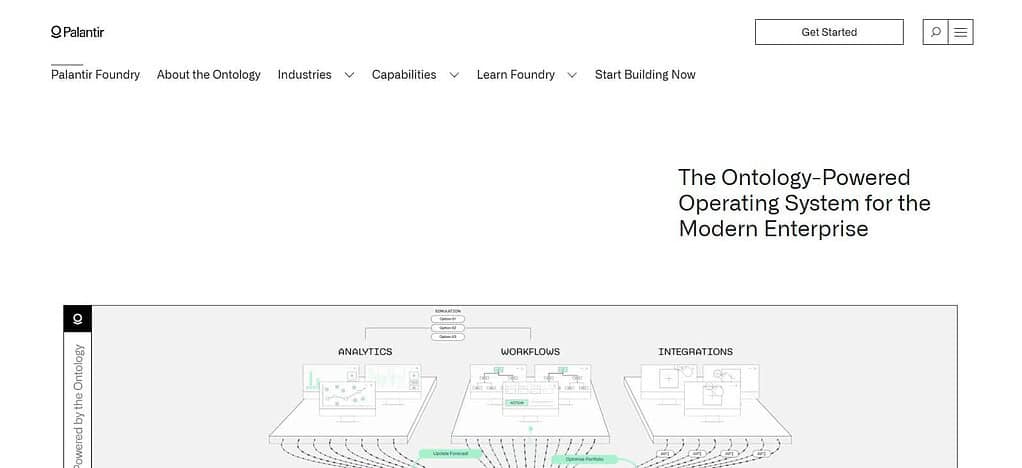
Scalability is built for complex enterprise data environments and large operational workflows. Deployment supports cloud and controlled enterprise environments Integrations link databases, files, applications, APIs, and operational data sources. Observability brings visibility into data pipelines, transformations and operational workflows.
Data governance is about permissions, lineage, access policies and the controlled use of data. Data quality is assured by pipeline validation, lineage, data management and operational controls that enable organizations to maintain governed data across enterprise AI workflows.
Palantir Foundry Features
- Ontology based Data Modeling – Translates complex data into business-centric objects, relationships and processes.
- Enterprise Data Integration – Connects and integrates data across a wide range of operational and enterprise sources.
- Data Transformation – Enables the creation of pipelines and transformation across enterprise datasets.
- AI and Analytics – Integrates enterprise data with analytics, machine learning and AI applications.
- Security and Governance – Delivers fine-grained permissions, lineage, control of access, and controlled data actions.
| Pros | Cons |
|---|---|
| Strong enterprise data integration | Implementation can be complex |
| Ontology connects data with business operations | Pricing is generally customized |
| Supports operational AI applications | Requires specialized platform knowledge |
| Granular permissions and governance | Enterprise deployment can require significant planning |
| Designed for complex organizational data | May be excessive for simpler data pipelines |
10. Cloudera Data Platform (CDP)
Cloudera Data Platform (CDP) is an enterprise hybrid and multi-cloud data platform that enables data engineering, analytics, machine learning, streaming and data management. Pricing differs according to deployment and service.
CDP Public Cloud uses consumption-based pricing, whereas on-premises offerings may use annual subscriptions. Scalability Enables enterprise application workloads for large data and streaming processing. Deployment includes public cloud, private cloud and on premise infrastructure. Integrations: Cloud infrastructure, databases, streaming systems, enterprise data services.
Observability Monitoring and optimization for CDP deployments. Data governance and security are core platform capabilities and data quality is supported through data engineering workflows, validation, monitoring and pipeline management.
Cloudera Data Platform (CDP) Features
- Hybrid and Multi-Cloud Platform – Supports data workloads on public cloud, private cloud and on-premise.
- Data Engineering – Tools to build, schedule and manage enterprise data pipelines
Streaming Analytics – Allows continuous data processing for real-time and event-driven workloads. - Machine Learning – Infrastructure to develop and operate enterprise ML workflows.
- Data Governance and Security – Enables centralized governance, control of access, compliance, lineage, and secure data management.
| Pros | Cons |
|---|---|
| Strong hybrid and multi-cloud architecture | Requires considerable technical expertise |
| Supports on-premises and cloud environments | Administration can be complex |
| Strong data engineering capabilities | Enterprise deployment can require significant planning |
| Supports streaming and machine learning workloads | Costs depend on deployment and services |
| Strong security and governance features | Optimization may require specialized Cloudera skills |
Conclusion
For enterprises building reliable, scalable, and AI-ready data workflows, AI data pipeline platforms are a must-have by 2026. Databricks, Microsoft Fabric, Snowflake, AWS SageMaker, Google Vertex AI, Azure Machine Learning, Dataiku, DataRobot, Palantir Foundry, and Cloudera CDP each offer different approaches to data integration, transformation, machine learning, governance, observability, and deployment.
Enterprises should evaluate these platforms based on scalability, pricing, deployment flexibility, integrations, data quality, and security and monitoring requirements. The right platform depends on existing infrastructure, data volume, AI workloads, technical expertise and long-term business goals. This comparison in a structured way allows organizations to choose a good baseline for production AI pipelines.
FAQ
What is an AI data pipeline platform?
An AI data pipeline platform helps enterprises collect, process, transform, validate, govern, and deliver data for analytics, machine learning, and generative AI applications.
Why do enterprises need AI data pipelines?
They help organizations automate data movement, improve data quality, support real-time processing, maintain governance, and provide reliable data for production AI and machine-learning workloads.
What features should enterprises look for in an AI data pipeline platform?
Important features include scalability, data integration, transformation, real-time processing, data quality, governance, security, observability, orchestration, and AI/ML compatibility.
Can AI data pipeline platforms handle real-time data?
Yes. Several enterprise platforms support streaming or near-real-time pipelines, allowing organizations to process continuously generated data for analytics, operational applications, and AI systems.