

In this article, I will talk about the Best AI Games With Play to Earn Crypto Rewards. The games that combine artificial intelligence, blockchain technology, NFTs, and crypto-based rewards. I’ll review their AI features, gameplay, native tokens, earning mechanisms, entry costs, and overall potential to help players find the most interesting AI-powered Web3 games available today.
Why Choose AI Games With Play-to-Earn Crypto Rewards
AI-Enhanced Gaming: AI enables smarter NPCs, dynamic challenges, personalized interactions, and more immersive gaming worlds.
Earn Money Playing: Players can earn crypto tokens, NFTs, or other digital rewards for completing quests, winning battles, joining events, or helping to grow the ecosystem.
Digital Ownership: Blockchain technology can give players verifiable ownership of characters, land, items and other in-game assets.
More Personalized Experiences: Typical artificial intelligence systems can adapt characters, difficulty levels, missions or interactions to the way the player behaves.
Multiple ways to earn rewards: Depending on the game, players can earn through gameplay, tournaments, trading, staking, crafting, resource gathering and much more.
Tradable Assets: NFTs and tokens based on blockchain can potentially be transferred or traded through supported marketplaces and ecosystems.
AI Agents Innovation: Some games allow players to train, customize or interact with AI agents that can affect game play.
Player Driven Economies: Tokens and NFTs can be used to link gameplay with marketplaces, governance, crafting, and other community driven systems.
More Game Variety: AI + Web3 can power a range of genres including RPGs, strategy games, simulations, social worlds, and competitive games.
Long-Term Value Potential: Games that have useful tokens, active communities, meaningful AI integration, and sustainable economies may be more valuable than games that are focused only on rewards.
Transparent Blockchain Activity: On-chain transactions can provide publicly verifiable information on certain assets, transfers and economic activity.
Early Adopter of New Gaming Models: AI Web3 games are experimenting with new ways to integrate AI companions, autonomous agents, dynamic content, and player-owned digital economies that differ greatly from traditional gaming.
Key Points
| Game | Key Point |
|---|---|
| Parallel | Combines AI-powered agents with blockchain card ownership and token-based reward opportunities. |
| AI Arena | Players train AI fighters and earn blockchain rewards through competitive matches and tournaments. |
| Sleepless AI | AI companion gaming platform that integrates token incentives with virtual character interactions. |
| Altered State Machine (ASM) | Uses trainable NFT-owned AI brains that can participate in blockchain-based gaming ecosystems. |
| Axie Infinity | Enables players to earn crypto rewards through NFT creature battles, breeding, and ecosystem participation. |
| Illuvium | Open-world blockchain RPG offering token rewards, NFT asset ownership, and AI-enhanced gameplay systems. |
| Pixels | Web3 farming and social game where players can earn crypto rewards through gameplay activities. |
| Star Atlas | Space metaverse featuring AI-assisted systems, player-owned assets, and tokenized in-game economies. |
| World of Dypians | MMORPG combining AI-driven features, blockchain ownership, and crypto reward mechanisms. |
1. Parallel/Colony
Parallel: Colony is a sci-fi colony-building game that uses AI. Available on iOS and Android. Gameplay includes building settlements, gathering resources, recruiting colonists, PvE/PvP activity, and interacting with AI-powered characters.
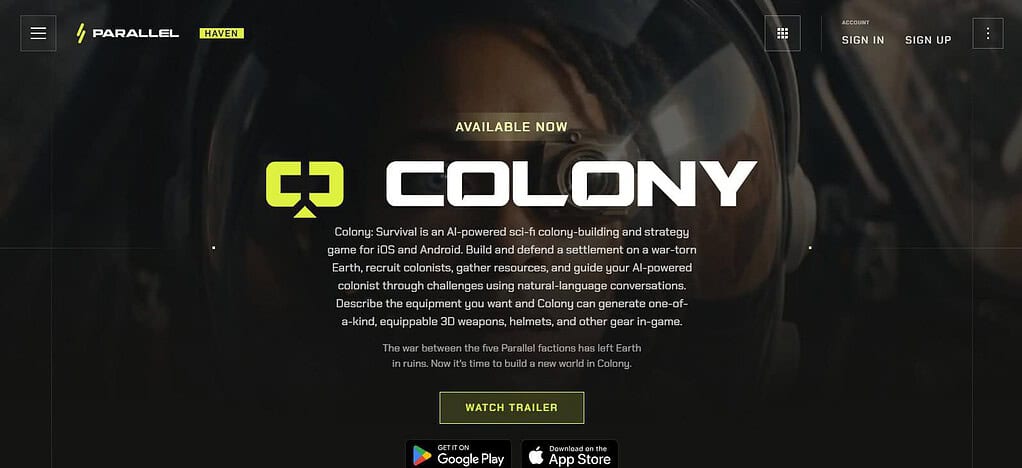
The best AI feature is the conversational colonist system where the personality affects the responses and the decisions. Colony is a member of the Parallel/Echelon ecosystem, and PRIME is embedded in its Web3 reward system.
Reward-eligible functionality has additional requirements, but a free-to-play version is available. Native Token: PRIME. AI Score: 9/10. Reward Mechanism: Gameplay, qualifying activities. Market/Transaction Data: Varies with activity in the PRIME market; no fixed amount of earnings should be assumed.
Parallel/Colony Features
- Sci-Fi Colony Building: Players build colonies, manage resources and expand settlements.
- AI-Driven Colonists: Incorporates AI characters who can interact and make decisions.
- Web3 Integration: Integrates gameplay with blockchain based digital resources.
- Gameplay Strategy: Planning, resource management, and colony progression.
Crypto Ecosystem: Works with the larger Parallel ecosystem and its PRIME token.
| Advantages | Disadvantages |
|---|---|
| AI-driven colonists create more dynamic interactions | Gameplay can be complex for new players |
| Combines strategy with AI mechanics | Web3 features may require wallet knowledge |
| Connected to the broader Parallel ecosystem | Crypto-market volatility can affect asset values |
| Offers resource-management gameplay | Some features may still be evolving |
| AI is meaningfully connected to gameplay | Not ideal for players seeking simple arcade gameplay |
2. The AI Arena
AI Arena is a competitive gaming project about AI, which is about training intelligent fighters instead of just controlling conventional characters. The experience is built around the integration of AI, as players develop and train AI-controlled characters for competitive battles.
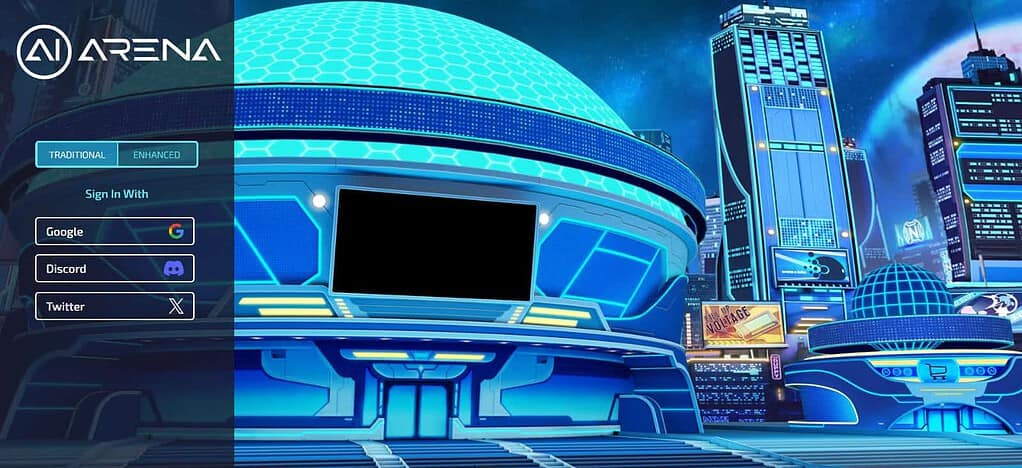
Blockchain: Ethereum / Arbitrum ecosystem. Native Token: NRN, or Neuron, the project’s utility token powering its AI-gaming ecosystem. Total supply: 1 billion NRN. Entry Cost: Depends on current access to the game and any NFT requirements. **Reward Mechanism: ** ecosystem & competitive gaming participation.
AI Score: 9/10 (since AI is at the core of the gameplay concept. Please be aware that the current market and transaction figures are constantly changing and should be verified upon publication.
The AI Arena Features
- AI-Fighters: Players train intelligent characters that fight in battles.
- Machine Learning Angle: AI performs based on training and player strategies.
- Competitive Play: Created for player vs. player competition.
- NFT Characters: Fighters can be digital resources on the blockchain.
- NRN Token: Leverages NRN as the native ecosystem token driving its Web3 economy.
| Advantages | Disadvantages |
|---|---|
| AI is central to the combat experience | Requires understanding of AI training mechanics |
| Unique approach to competitive gaming | Competitive gameplay can have a steep learning curve |
| Players influence fighter behavior through training | Rewards and asset values can fluctuate |
| Combines gaming with machine-learning concepts | Smaller audience than established Web3 games |
| Strong differentiation from conventional P2E games | Long-term ecosystem growth remains important |
3. Sleepless AI
Sleepless AI will combine blockchain gaming with digital companions based on AI, where interaction with AI is part of the ecosystem and not just an option. Players engage with AI characters and take part in its wider Web3 gaming economy. Blockchain: Ecosystem BNB Chain. Native Token: AI. ** Max Supply: 1 billion AI tokens with a long-term vesting schedule for supply release.
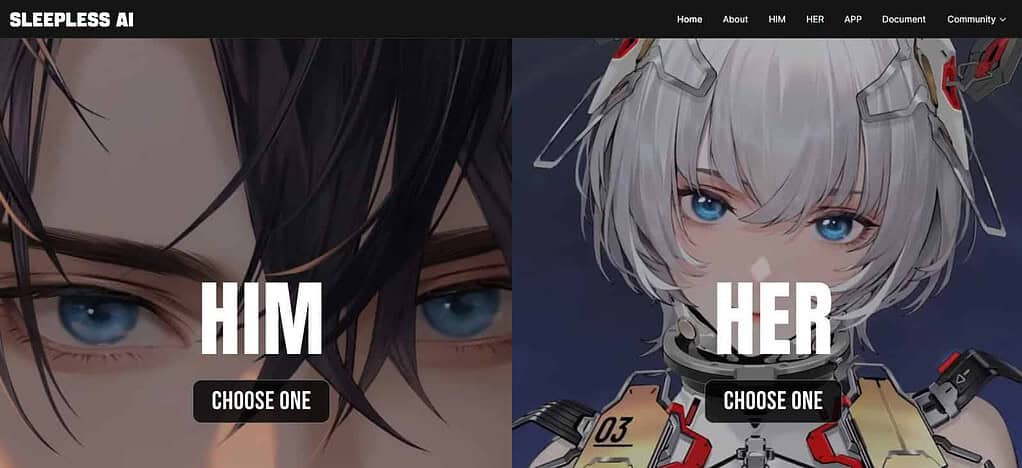
Entry Cost: Varies based on the specific Sleepless AI experience and digital resources involved. Reward Mechanism: engagement in ecosystem, token-based features and game activities. AI Score: ** 9/10. The AI is central to the companion experience and thus has higher AI relevance than games that only use AI for secondary systems.
Sleepless AI Features
- AI Virtual Companions: Focuses on AI characters with unique personalities that users can interact with.
- Interactive Gameplay: Players can chat and engage with AI companions.
- Blockchain Ownership: Ownership of digital characters and assets can be recorded on the blockchain.
Different Gaming Experiences: The ecosystem is not just one gaming format. - AI Token Economy: The AI token is used in its larger Web3 ecosystem.
| Advantages | Disadvantages |
|---|---|
| AI companions provide interactive experiences | AI interactions may not appeal to every gamer |
| AI is a core part of the ecosystem | Token prices can be volatile |
| Blockchain enables digital character ownership | Some assets/features may require spending |
| Distinctive combination of AI and Web3 | Ecosystem complexity can confuse beginners |
| Offers an alternative to traditional game formats | Long-term engagement depends on continued development |
4. Altered State Machine (ASM)
Altered State Machine (ASM) is a Web3 gaming ecosystem built around intelligent characters, branded Brains, that focuses on NFT and AI-agent. Its core AI feature is the idea of trainable AI personalities that can partake in gaming experiences which is a different model than traditional fixed NFTs. Native Token : ASTO.
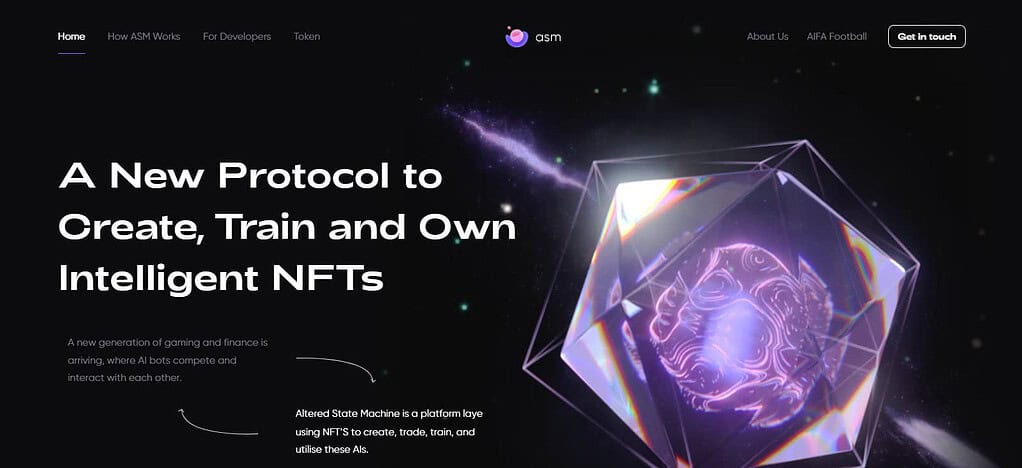
Blockchain : Ethereum ecosystem, Web3 assets and infrastructure attached to ASM platform. Cost to Enter: varies by game and by digital resources required. Reward System: gaming, contests, ecosystem engagement, and online resources utility. AI Score: 9/10 (As the project is AI agent based, it is great) Kindly ensure that the current token supply, market cap, and transaction figures are verified against live network data prior to publication.
Altered State Machine (ASM) Features
- AI Characters: Players can obtain and train AI characters.
- AI Brains: ASM uses “Brains” as intelligent digital resources that can learn and compete.
- NFTs: AI Characters and their assets can be represented as NFTs;
- Cross-Game Potential: ASM technology is designed to work with AI characters across different experiences.
- ASTO Token: Powered by ASTO for its ecosystem and Web3 utility.
| Advantages | Disadvantages |
|---|---|
| Strong focus on trainable AI agents | AI-agent concepts can be difficult for beginners |
| AI “Brains” provide distinctive digital assets | Entry requirements may vary by experience |
| Combines AI, NFTs, and gaming | NFT values can fluctuate significantly |
| Potential for AI characters across experiences | Ecosystem adoption is still important |
| Creates deeper utility for AI-based assets | Not every player will enjoy AI-training mechanics |
5. Axie Infinity
Axie Infinity is a mature blockchain gaming ecosystem where players collect, breed and use Axies across multiple experiences. Its blockchain infrastructure is mostly based on Ronin, AXS is the governance token of the ecosystem and SLP is used in some game economies.
Max supply of AXS: 270 million. Cost to Entry: Some experiences are available without buying Axies, but blockchain features may require assets. Incentive System: gameplay, competitive rewards, crafting and ecosystem activities AI Score: 4/10 as AI is not the main defining technology of the project. Current transaction activity and token market data are variable, so they should be noted with a specific date.
Axie Infinity Features
- Battle Gameplay: Axies are able to participate in competitive battles and game modes.
- Ronin Blockchain: Utilizes Ronin network for its Web3 gaming ecosystem.
- Ownership of NFTs: Axies and other assets are digital collectibles on the blockchain.
- Dual Token Economy: Has AXS and SLP for different purposes in the ecosystem and gameplay.
| Advantages | Disadvantages |
|---|---|
| One of the most established blockchain gaming ecosystems | Token values can be highly volatile |
| Large ecosystem of digital assets and game modes | Economy can be complicated for newcomers |
| Ronin provides gaming-focused blockchain infrastructure | Some activities may require significant time |
| Multiple ways to use and develop Axies | NFT and asset prices can change rapidly |
| Strong brand recognition in Web3 gaming | AI is not a major part of its core gameplay |
6. Illuvium
Illuvium is an open-world blockchain RPG about capturing and fighting creatures called Illuvials. Its ecosystem uses Ethereum-based infrastructure and Immutable X zkEVM for NFT activity. Native Token: ILV Max Supply: 10 million ILV Entry Cost: Entry costs may vary based on the particular Illuvium experience, current game requirements, and it may require additional costs for NFTs and ecosystem assets.
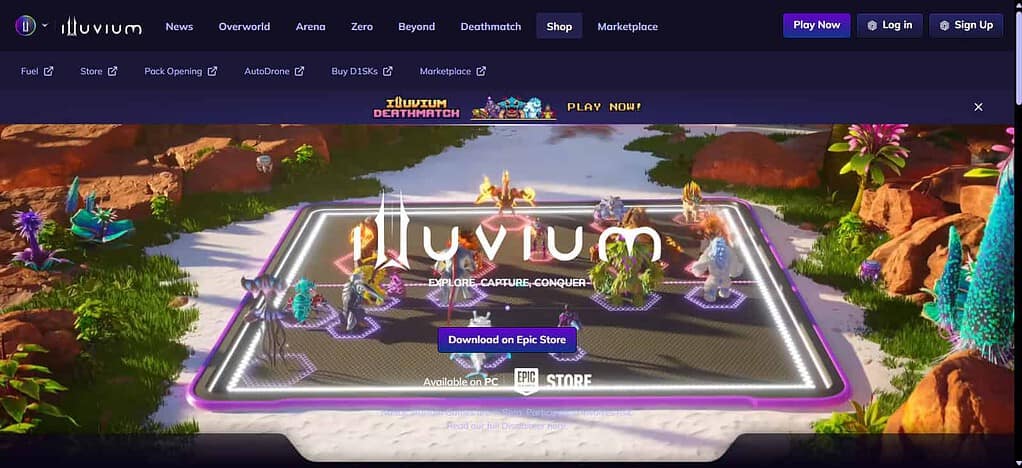
Rewards System: gameplay activities, digital resources, and ILV-related ecosystem mechanisms. AI Score: 5/10 since its core identity is more about RPG, strategy, NFTs and blockchain ownership than AI-native gameplay. For market data and transaction volume, the date of measurement should always be reported.
Illuvium Features
- Open World RPG: Players explore a big sci-fi fantasy world and meet creatures.
- Creature Collection: Collect Illuvials, grow them and use them in gameplay.
- Tactical Battles: Mix creature collection with strategy-based combat mechanics.
- Blockchain Assets: Things and creatures in the game can be owned on the blockchain.
- ILV Token: The main token of the ecosystem, ILV.
| Advantages | Disadvantages |
|---|---|
| High-quality RPG and creature-collection concept | Some blockchain assets can be expensive |
| Strong visual presentation and world design | Complex systems may overwhelm beginners |
| Strategic gameplay adds depth | Crypto and NFT markets introduce financial risk |
| Uses blockchain ownership for game assets | Requires suitable hardware for some experiences |
| Broad ecosystem with multiple gaming experiences | AI is not its primary gameplay feature |
7. Pixel
Pixels is a social MMO and farming/life-simulation game running on Ronin that combines farming, resource gathering, professions, quests, land ownership and a player driven economy. Native Token: PIXEL Max Supply: 5,000,000,000 PIXEL The game also features in-game economic systems and limited land NFTs. Cost to Join:
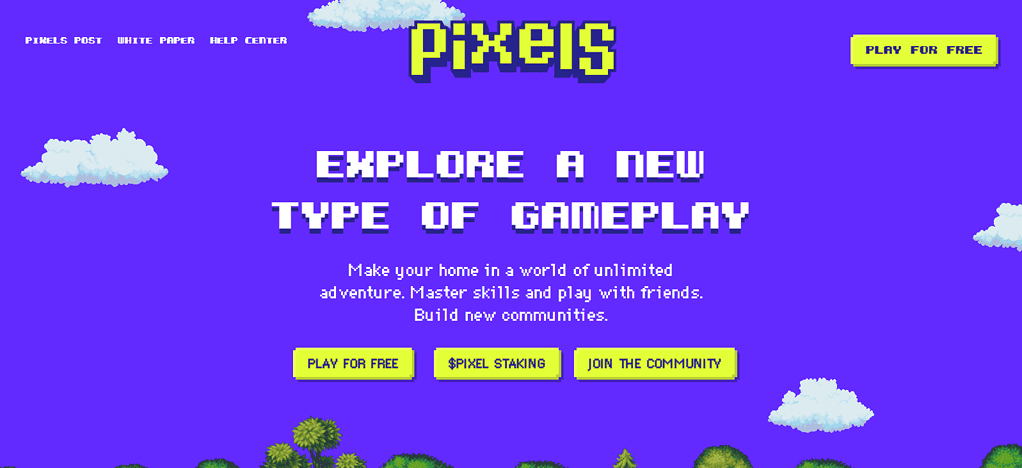
The core of the experience is built around accessible gameplay, with optional blockchain assets that may involve spending. How to Make Money: quests, events, resource activities, land opportunities, and ecosystem involvement. AI Score: 3/10 as AI is not the core gameplay technology. That is why Pixels is more akin to the wider Web3 gaming genre rather than an AI-native game.
Pixels Features
- Social MMO Gameplay: Combines social interaction with farming, exploration, and progression.
- Farming Mechanics: Players can grow resources, complete activities, and develop their characters.
- Player-Owned Assets: Blockchain technology supports ownership of selected in-game assets.
- Ronin Ecosystem: Operates within the Ronin blockchain gaming ecosystem.
- PIXEL Token: Uses PIXEL for various game and ecosystem utilities.
| Advantages | Disadvantages |
|---|---|
| Easy-to-understand farming and social gameplay | Gameplay may feel repetitive to some players |
| Accessible Web3 gaming approach | Token value can fluctuate |
| Built within the Ronin ecosystem | Economy depends on continued player activity |
| Combines social features with blockchain assets | Some blockchain features require additional knowledge |
| Strong casual-gaming appeal | AI integration is relatively limited |
8. Star Atlas
Star Atlas is a sci-fi gaming metaverse built on the Solana blockchain, with a dual-token economy of ATLAS and POLIS. ATLAS is the main in-game utility and payment token . POLIS provides governance functionality. Blockchain: Solana Entry Cost: Some blockchain games such as SAGE Labs need a Solana wallet, SOL for transactions, and starting assets.
Reward System: Players can earn ATLAS through activities like resource gathering, crafting, marketplace participation, and SAGE gameplay systems. AI Score: 3/10 (AI isn’t the main differentiator of Star Atlas) ATLAS has an inflationary setup designed to grow with the ecosystem, whereas POLIS has a fixed supply unless governance votes to change it.
Star Atlas Features
- Sci-Fi Metaverse: In a futuristic space-based universe.
Space Exploration: Explore, gather resources, trade, and engage in a variety of activities.
Solana Blockchain: Built on Solana-based Web3 infrastructure. - Digital Asset Ownership: Digital property such as ships, resources, land and other assets can be owned via blockchain.
- ATLAS & POLIS: POLIS is governance. ATLAS is economic utility.
| Advantages | Disadvantages |
|---|---|
| Ambitious sci-fi gaming universe | Large ecosystem can be difficult for beginners |
| Built on the Solana blockchain | Asset prices can be volatile |
| Extensive digital-asset economy | Some assets and activities require upfront spending |
| Multiple activities including exploration and resource gathering | Full ecosystem development is ongoing |
| ATLAS and POLIS provide different utilities | AI is not the central gameplay focus |
9. World of Dypians
World of Dypians is a mix of gaming, NFTs, DeFi, AI related features, and a token driven virtual world. Native Token: WOD. Blockchain ecosystem: the project is multi-chain and mentions BNB Chain, Base, MultiversX, and other networks.
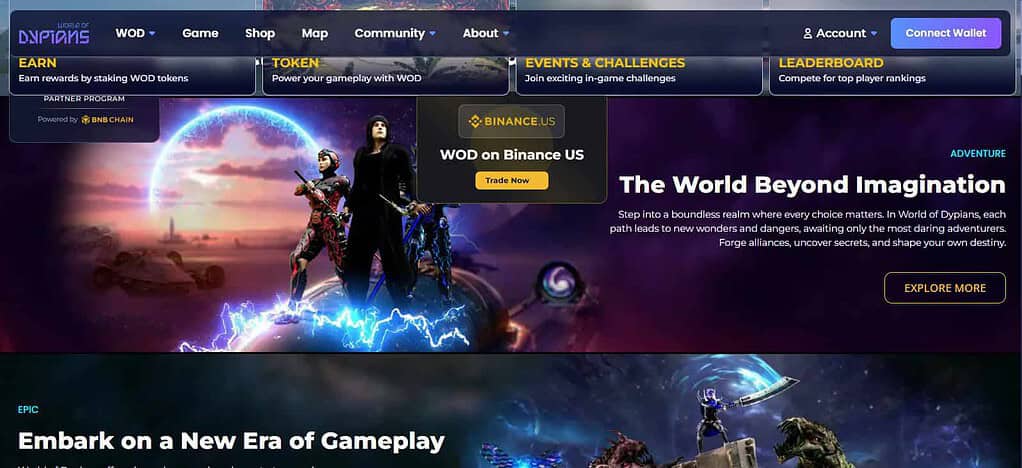
Max Supply: 1 billion WOD. The token can be used for in-game purchases, upgrades, staking, NFT transactions, governance and platform fees. Reward System achievements engagement staking challenges leaderboard activities. Currently, the website has over 3.8 million monthly on-chain players and over 1.19 billion total on-chain transactions. AI Score: 7 / 10.
Dypians’ World Features
- Virtual Open World: Offers a vast digital world to explore and interact within.
- AI integration: Integrates AI features into the larger gaming ecosystem.
Web3 Economy: Integrates gaming with NFTs, tokens, and blockchain-based ownership. - Different Activities: Players can take part in challenges, achievements, exploration and more.
- WOD Token: WOD for purchase, upgrade, staking, governance and other utilities of the ecosystem.
| Advantages | Disadvantages |
|---|---|
| Combines gaming, AI, NFTs, and Web3 features | Large ecosystem may have a learning curve |
| Open-world environment offers varied activities | Crypto assets carry market volatility |
| Multiple blockchain integrations | Wallet and blockchain knowledge may be required |
| WOD has several ecosystem utilities | Long-term token sustainability remains important |
| Offers achievements, challenges, and exploration | Experience can be more complex than traditional games |
Conclusion
AI-powered blockchain gaming is evolving past the simple play-to-earn paradigm, combining smart characters, AI agents, digital ownership and crypto-based reward systems. This guide highlights 10 games that offer a variety of approaches, from AI companions and trainable agents to virtual worlds, RPGs, and competitive gameplay.
However, players should consider more than just token rewards and also look at the quality of gameplay, real AI integration, entry cost, token utility, transaction activity, and long-term sustainability. AI Arena , Sleepless AI and Altered State Machine are notable for deeper AI deployment .
Broader Web3 gaming experiences are provided by Axie Infinity , Illuvium , Pixels , Star Atlas and World of Dypians . Do your research on current game conditions and risks in the crypto-market before spending money.
FAQ
What are AI games with play-to-earn crypto rewards?
AI play-to-earn games combine artificial intelligence with blockchain gaming and crypto-based economies. Depending on the game, AI may control characters, create dynamic interactions, train agents, or personalize gameplay, while blockchain enables tokens, NFTs, ownership, and rewards.
Which AI game is best for AI integration?
AI Arena, Sleepless AI, and Altered State Machine (ASM) are strong choices for AI-focused gameplay because AI is more central to their core concepts. The best option ultimately depends on whether you prefer competitive battles, AI companions, or trainable AI agents.
Can I play AI crypto games for free?
Some games offer free or low-cost entry, while others may require NFTs, cryptocurrency, or specific digital assets for certain features. Always check the current entry requirements before purchasing anything because game economies and access models can change.
How do players earn crypto from AI games?
Reward mechanisms vary by game. Players may earn through quests, competitions, tournaments, resource gathering, staking, marketplace activity, achievements, or other ecosystem activities. Rewards can include tokens, NFTs, or in-game assets.
Which tokens are used in these AI games?
The games covered in this guide use different native tokens, including PRIME, NRN, AI, ASTO, AXS, ILV, PIXEL, ATLAS, and WOD. Each token has different utilities, supply structures, and roles within its respective gaming ecosystem.