

In this article, I’ll be talking about the Top Mem.ai Alternatives For AI Knowledge Bases in 2026. I will compare their AI capabilities, knowledge organization, data sources, integrations, pricing, deployment options, search features and use cases. This comparison will help you to understand how each platform is different and choose an AI knowledge solution that fits your specific needs.
What Is Mem.ai Alternatives?
Mem.ai alternatives are AI-powered knowledge management platforms that offer similar or different ways to capture, organize, search, and retrieve information. These tools can merge notes, documents, databases, research, meetings and workplace data with AI-powered search and help.
Depending on the platform they may be aimed at personal knowledge management, team documentation, enterprise search, structured information or source-grounded research. Notion AI, Obsidian, Google NotebookLM, Tana, Reflect, Capacities, ClickUp Docs + AI, Slite, Roam Research and Glean are all popular options, each with a different approach to building and accessing an AI knowledge base.
Why Choose Mem.ai Alternatives for AI Knowledge Bases
Organizing Varied Knowledge: Alternatives are different ways to structure information . Databases , backlinks , objects , folders , graphs , structured nodes , collaborative documentation .
Improved Team Collaboration: Tools like Notion AI, Slite, and ClickUp Docs + AI offer teams shared workspaces, comments, permissions, and collaborative knowledge management.
Additional sources of data: Others tie in knowledge from documents, cloud storage, meetings, emails, messaging apps, project-management tools and other workplace apps.
Advanced AI Search : Enterprise platforms can offer semantic search and contextual answers across a variety of applications, helping users find information without having to manually search different systems.
Flexible Knowledge Models: There are many different options to do this, such as local markdown files, interconnected blocks, objects, databases, notebooks, knowledge graphs, and structured nodes.
Varying Pricing Options: By comparing alternatives, users can spot platforms with free plans, simpler pricing, enterprise packages, or feature sets that fit their budget and team size better.
Niche Use Cases: The platforms cater to different workflows ranging from personal second-brain systems, research to team wikis, project documentation, meeting knowledge and enterprise-wide AI search.
Key Points
| Alternative | Best For | Key Advantage Over Mem.ai |
|---|---|---|
| Notion AI | Team knowledge management | Combines AI-powered search, documents, databases, wikis, and project management in a single workspace. |
| Obsidian | Personal knowledge bases | Stores notes locally in Markdown files with extensive plugins, backlinking, and full data ownership. |
| Google NotebookLM | Research and document analysis | Uses uploaded sources to generate AI summaries, insights, and grounded answers from your documents. |
| Tana | Structured knowledge management | SuperTags transform notes into searchable databases while maintaining AI-powered organization. |
| Reflect | AI-assisted note-taking | Offers networked notes, calendar integration, AI recall, and end-to-end encryption for privacy-focused users. |
| Capacities | Object-based knowledge systems | Organizes information as interconnected objects instead of folders, creating a dynamic second-brain experience. |
| ClickUp Docs + AI | Knowledge and project workflows | Connects AI-powered documentation directly with tasks, goals, and team collaboration tools. |
| Slite | Team documentation | Delivers collaborative knowledge-base features with AI search designed for distributed teams. |
| Roam Research | Connected thinking | Pioneer of bidirectional linking and graph-based note organization for researchers and knowledge workers. |
| Glean | Enterprise knowledge discovery | Searches across workplace apps, documents, and systems to surface organizational knowledge instantly. |
1. Notion AI
Notion AI is a work environment and knowledge management platform that was launched in 2016 and combines documents, databases, wikis, projects and AI in one environment. Category: Collaborative workspace and AI knowledge management Knowledge Model: Based on workspace content and connected-app information to support search, answers, writing and task Data Sources are Notion pages, databases and connected apps.
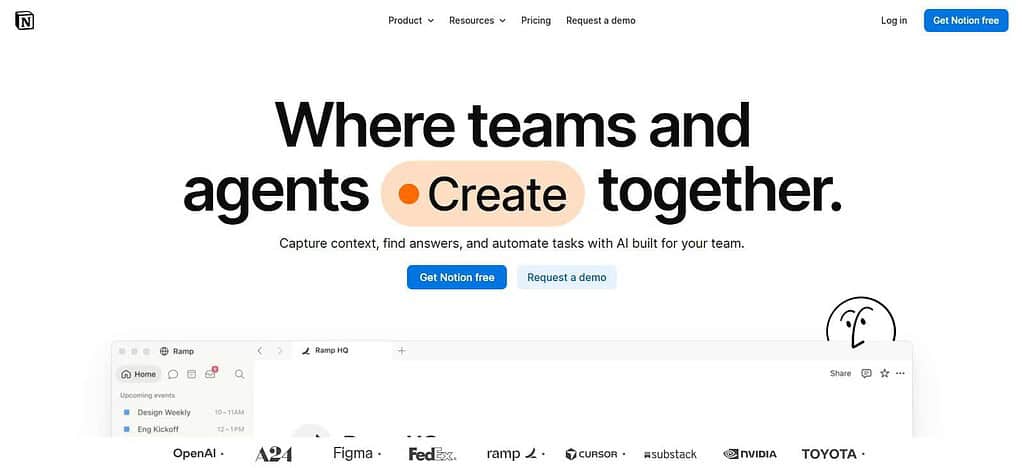
Pricing Free, Plus, Business, Enterprise (AI is mostly in Business and Enterprise. Deployment is cloud based on the web and apps. Notion AI is a good fit when your team wants to collaborate on knowledge, documentation and productivity.
| Feature | Details |
|---|---|
| Category | AI workspace, knowledge management, documentation |
| Core Model | Workspace-based pages, databases, wikis, and connected knowledge |
| AI Capabilities | AI search, writing, summaries, Q&A, research and task assistance |
| Knowledge Retrieval | Searches Notion workspace and connected applications |
| Data Sources | Pages, databases, documents, workspace content and connected apps |
| Organization | Pages, databases, properties, tags and linked content |
| Collaboration | Real-time team collaboration, comments and shared workspaces |
| Integrations | Connects with external workplace applications |
| AI Grounding | Uses workspace and connected information to provide contextual answers |
| Deployment | Cloud-based web, desktop and mobile applications |
| Pricing | Free/Plus/Business/Enterprise; AI is primarily included with Business and Enterprise |
| Best For | Teams combining knowledge management, documentation and productivity |
| Key Advantage | AI operates directly inside the workspace rather than requiring a separate knowledge tool |
2. Obsidian
Obsidian is a local-first knowledge-management and note-taking app developed in 2020. Category: personal knowledge management Knowledge Model: interconnected Markdown notes, backlinks, tags and graph relationships, not a centralized cloud database. Data Sources: primarily locally stored files, with users able to add functionality through plugins and integrations.
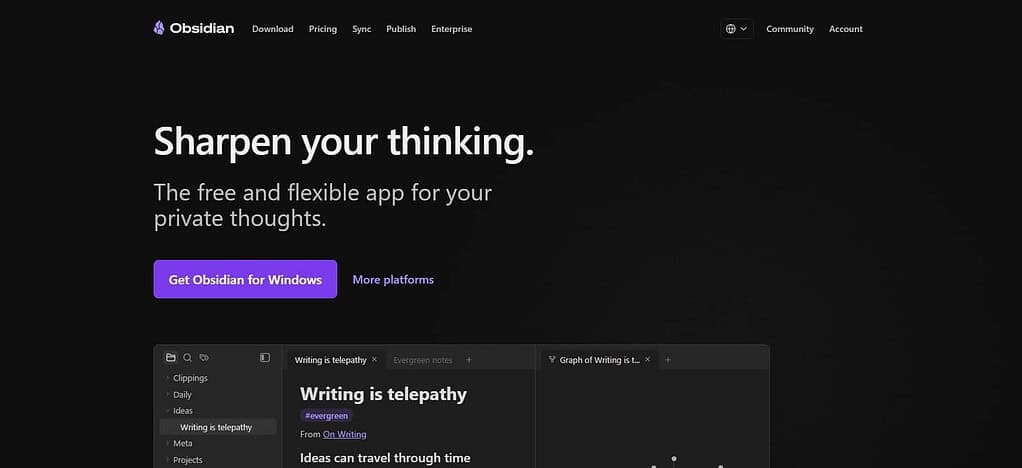
Pricing The core application is free. Sync is $4 per user/month annually and Publish is $8 per site/month annually. Deployment Desktop and mobile, with optional encrypted sync. Obsidian is suited to privacy-conscious individual knowledge workflows.
| Feature | Details |
|---|---|
| Category | Personal knowledge management and connected note-taking |
| Core Model | Local Markdown files with backlinks and graph relationships |
| AI Capabilities | AI functionality can be added through community plugins and external integrations |
| Knowledge Retrieval | Full-text search, backlinks, tags and graph navigation |
| Data Sources | Local Markdown notes, attachments and imported files |
| Organization | Folders, tags, links, backlinks, properties and graph view |
| Collaboration | Shared vault collaboration available through Sync |
| Privacy | Local-first architecture gives users direct control over their files |
| Sync | End-to-end encrypted Obsidian Sync |
| Deployment | Windows, macOS, Linux, iOS and Android |
| Pricing | Core application is free; Sync is $4/user/month annually; Publish is $8/site/month annually |
| Best For | Researchers, writers and personal knowledge builders |
| Key Advantage | Highly flexible local knowledge graph with extensive customization |
3. Google NotebookLM
Google NotebookLM (renamed Gemini Notebook in July 2026) is an AI-powered research and knowledge workspace, launched in 2023. Its Category is AI research and source-grounded knowledge management, and its Knowledge Model answers questions from user-selected sources, rather than just general model knowledge.
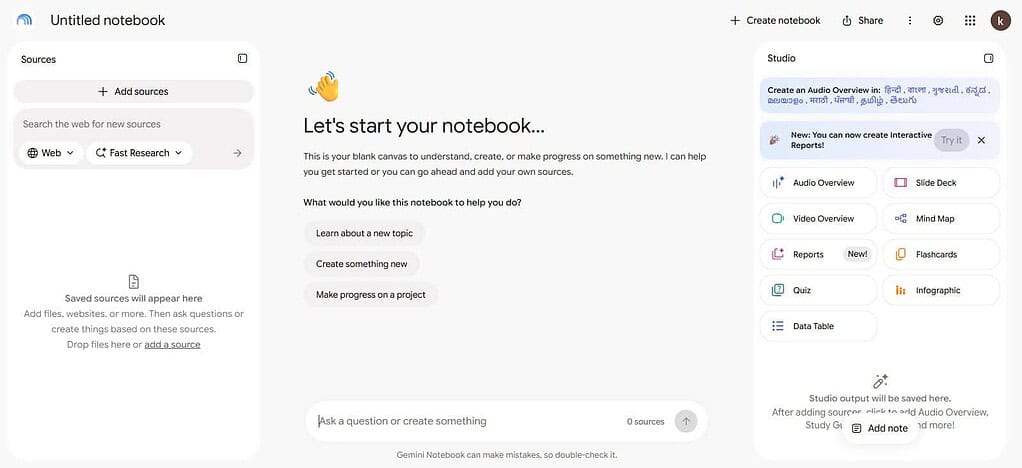
Data Sources are PDFs, Google Docs, Slides, web sites, YouTube URLs, audio, and other supported files. Pricing Free, with premium features available through Google AI plans. Cloud deployment is web and mobile accessible. Its best use case is research, document analysis, summaries, citations and source grounded AI answers.
| Feature | Details |
|---|---|
| Category | AI research and source-grounded knowledge management |
| Core Model | Notebook-based collections of user-provided sources |
| AI Capabilities | Q&A, summaries, research assistance, source analysis and generated study materials |
| Knowledge Retrieval | Retrieves information from selected notebook sources |
| Data Sources | Supported documents, Google files, websites, YouTube and other supported sources |
| Source Grounding | Answers are grounded in the sources added to the notebook |
| Citations | Provides source references for verification |
| Organization | Separate notebooks for different research topics |
| Collaboration | Designed primarily around research and information sharing |
| Deployment | Cloud-based with web and mobile access |
| Pricing | Free access with expanded capabilities available through Google AI plans |
| Best For | Research, document analysis, studying and source-based knowledge |
| Key Advantage | Strong source-grounded workflow rather than relying only on general AI knowledge |
4. Tana
Tana is a structured knowledge-management and productivity platform that makes information into connected, actionable data. Its Category is a combination of personal knowledge management, outliner-based productivity, AI and meeting intelligence. The Knowledge Model organizes information into structured nodes, fields, supertags, relationships, and AI-generated context.

Data Sources: Notes, structured records, meetings, transcripts, integrations and connected workflows. Pricing There are Free, Pro and Max tiers listed, with Pro at an early-bird $20 per user/month and Max at $80 per user/month. Deployment is app-based with integrations and MCP support for advanced workflows.
| Feature | Details |
|---|---|
| Category | Structured personal knowledge management and productivity |
| Core Model | Nodes, fields, supertags, relationships and structured data |
| AI Capabilities | AI queries, meeting transcription, summaries, agents and structured workflows |
| Knowledge Retrieval | Searches connected structured knowledge and meeting information |
| Data Sources | Notes, meetings, transcripts, calendar information and integrations |
| Meeting Intelligence | AI transcripts, summaries and meeting agents |
| Organization | Supertags, nodes, fields and relationships |
| Integrations | Calendar, Zoom, Teams, Google Meet, MCP and other integrations |
| Automation | Agents and structured workflows |
| Deployment | Desktop/web application with connected services |
| Pricing | Free; Pro early-bird $20/user/month; Max early-bird $80/user/month |
| Best For | Structured knowledge, meeting intelligence and AI workflows |
| Key Advantage | Converts unstructured information into structured, connected knowledge |
5. Reflektieren
Reflect is a networked note-taking and personal knowledge-management application focused on rapid capture, backlinks, and AI-assisted organization. Its Category is personal knowledge management and AI notes, and its Knowledge Model links notes via backlinks to help users build a networked second brain.
Data Sources include notes, web clips, Kindle highlights, Readwise, Google and Outlook calendars and contacts, and apps connected with Zapier. Pricing is a straightforward model of $10 per month when billed annually. Deployment Web based, desktop workflows, iOS app. End to end encryption. Reflect is for people who care about connected notes and privacy.
| Feature | Details |
|---|---|
| Category | AI note-taking and personal knowledge management |
| Core Model | Networked notes connected through backlinks |
| AI Capabilities | AI-assisted writing, summarization and knowledge interaction |
| Knowledge Retrieval | Backlinks, connected notes and search |
| Data Sources | Notes, web clips, Kindle highlights, calendar/contact information and integrations |
| Organization | Backlinks, tags and linked notes |
| Integrations | Readwise, Kindle, Google/Outlook calendars and contacts, Zapier and other tools |
| Privacy | End-to-end encryption |
| Collaboration | Primarily designed for individual knowledge workflows |
| Deployment | Web, desktop and iOS |
| Pricing | Subscription-based paid plan |
| Best For | Personal second-brain workflows and connected note-taking |
| Key Advantage | Combines networked notes, AI and privacy-focused storage |
6. Capacities
Capacities is a personal knowledge-management app that was started in 2020 and has been in public beta since 2022. Its Category is object-based personal knowledge management and its Knowledge Model stores information as connected objects, such as people, books, meetings, and projects, instead of traditional folders.
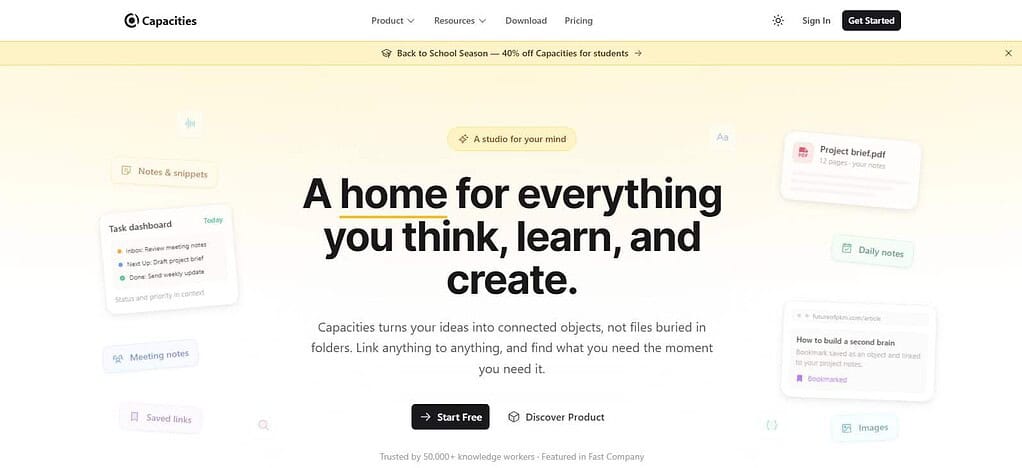
Sources of Data Notes, media, weblinks, messages, email captures, imported content. Pricing comes with a free Basic plan, and Pro is currently listed at $11.99/month, with Believer starting at $14.99/month. Deployment supports web, Windows, MacOS, Linux, iOS and Android. It is primarily aimed at individual knowledge work.
| Feature | Details |
|---|---|
| Category | Object-based personal knowledge management |
| Core Model | Connected objects instead of traditional files and folders |
| AI Capabilities | AI assistant, AI chat, autofill and media analysis |
| Knowledge Retrieval | Full-text search, smart search, related content and object relationships |
| Data Sources | Notes, web links, media, messages, imported content and supported captures |
| Organization | Objects, custom object types, properties, tags, templates and backlinks |
| Automation | Smart queries, task actions and AI workflows |
| Developer Access | REST API, OpenAPI, TypeScript SDK and remote MCP |
| Deployment | Web, Windows, macOS, Linux, iOS and Android |
| Pricing | Basic free; Pro $9.99/month currently; Believer from $12.49/month |
| AI Limits | Paid plans include monthly AI budgets, with optional Plus AI power-up |
| Best For | Individuals building structured personal knowledge systems |
| Key Advantage | Object-based architecture creates a highly connected knowledge graph |
7. ClickUp Docs and AI
ClickUp Docs + AI combines collaborative docs, project management, and AI-powered workplace productivity. ClickUp was founded in 2017 and is in the Category of productivity, project management, documentation, and AI knowledge management. Its Knowledge Model links Docs to tasks, projects, teams, and workspace information.
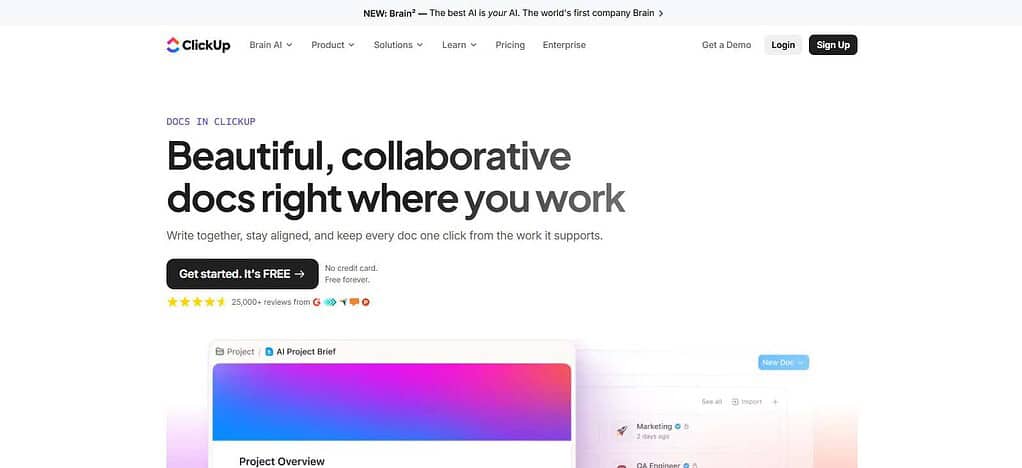
Data Sources: ClickUp Docs, tasks, comments, project info, connected workplace systems. Pricing varies by workspace plan, and newer plans include AI credits and features like ClickUp Brain, AI agents and AI Notetaker. Deployment is cloud-based for desktop, web and mobile. It is for teams who want knowledge directly tied to execution.
| Feature | Details |
|---|---|
| Category | Project management, documentation and workplace AI |
| Core Model | Docs connected with tasks, projects, people and workspace data |
| AI Capabilities | ClickUp Brain, AI writing, summaries, AI fields, agents and AI Notetaker |
| Knowledge Retrieval | Searches workspace information and connected knowledge |
| Data Sources | Docs, tasks, comments, projects and connected applications |
| Organization | Docs, folders, spaces, lists, tasks and custom structures |
| Collaboration | Real-time editing, comments, assignments and team workflows |
| Automation | AI agents, automations and task actions |
| Meeting Intelligence | AI Notetaker and AI meeting features |
| Deployment | Web, desktop and mobile |
| Pricing | Free and paid plans; newer plans include different AI credit allowances |
| Best For | Teams connecting documentation directly to project execution |
| Key Advantage | Knowledge, documents, tasks and AI workflows operate within one platform |
8. Slite
Slite is a team knowledge base platform created in 2017. Its Category is collaborative documentation and AI knowledge management. Its Knowledge Model is company documents plus connected workplace information and verification workflows. Data Sources can be: Slite docs, Slack, Notion, Google Drive, Jira, tickets, and other connected tools.
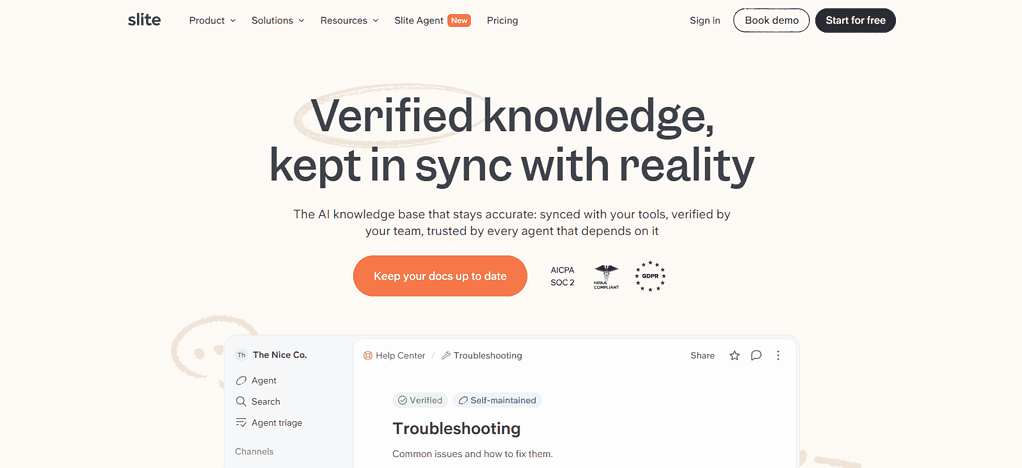
Pricing starts at $10/user/month (billed annually) for Basic and $20/user/month (billed annually) for Pro. Enterprise custom pricing. Deployment to the cloud with API, MCP, integration, and public documentation options. It’s able to provide cited, permission-aware answers to questions across connected company knowledge.
| Feature | Details |
|---|---|
| Category | Team wiki and AI knowledge base |
| Core Model | Collaborative company documentation and verified knowledge |
| AI Capabilities | AI search, answers, writing assistant, fact-checking and agents |
| Knowledge Retrieval | Searches Slite documents and connected tools |
| Data Sources | Slite docs plus connected workplace applications |
| Knowledge Verification | Doc verification and fact-checking workflows |
| Organization | Docs, collections, templates and knowledge-management controls |
| Collaboration | Real-time editing, comments, mentions and notifications |
| Integrations | Connected tools through Slite Agent and search |
| Deployment | Cloud-based platform with API and MCP access |
| Pricing | Basic $10/user/month; Pro $20/user/month annually; Enterprise custom |
| Best For | Internal company knowledge and team documentation |
| Key Advantage | Combines AI answers with document verification and knowledge maintenance |
9. Roam Research
Roam Research is a networked-thinking platform and personal knowledge-management system built around connected ideas rather than traditional folders. Its Category is networked note-taking and knowledge management Its Knowledge Model is daily notes, block level references, backlinks, interconnected graphs to form an associative knowledge network Data Sources Mainly notes, references, and user-generated knowledge, imported.
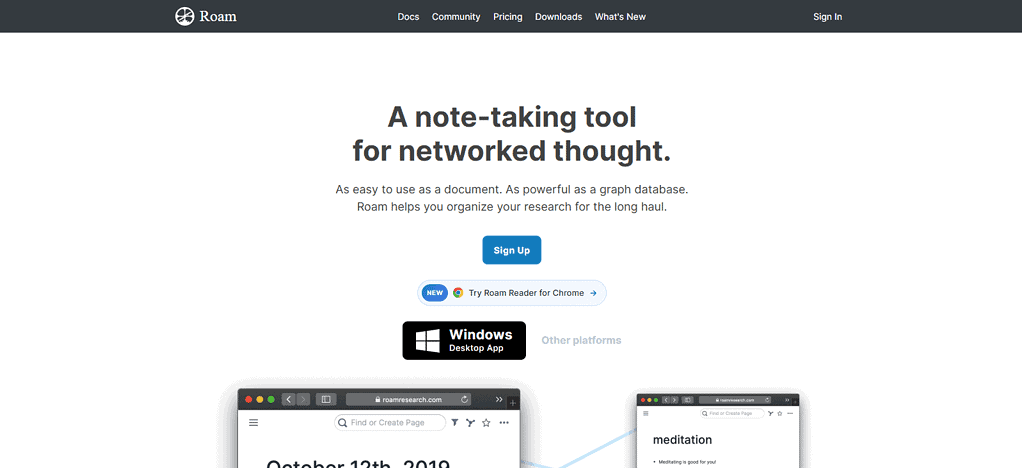
Pricing Pro is available for $15/month, $180/year, or $165/year promotional pricing. The Believer plan is $500 for five years. Deployment access includes web, desktop, mobile, and browser-extension. Roam is for researchers and writers building interconnected knowledge systems.
| Feature | Details |
|---|---|
| Category | Networked note-taking and personal knowledge management |
| Core Model | Block-based notes connected through bidirectional references |
| AI Capabilities | AI capabilities and extensions can complement the core knowledge graph |
| Knowledge Retrieval | Search, backlinks, block references and graph relationships |
| Data Sources | User-created notes, daily notes, references and imported knowledge |
| Organization | Daily notes, pages, blocks, tags and linked references |
| Knowledge Graph | Builds relationships between ideas through bidirectional linking |
| Collaboration | Shared graph and collaborative knowledge workflows |
| Deployment | Web, desktop and mobile |
| Pricing | Pro $15/month or $180/year; longer-term Believer plan available |
| Best For | Researchers, writers and users developing interconnected knowledge |
| Key Advantage | Block-level references make relationships between ideas highly granular |
10. Glean
Glean, an enterprise search and knowledge-management platform, launched in 2019. Its Category is enterprise AI search and workplace intelligence, and its Knowledge Model combines semantic search, retrieval-augmented generation, company context, and an enterprise knowledge graph. Data Sources link to 100+ workplace tools for searching across documents, messages, tickets, and business apps.
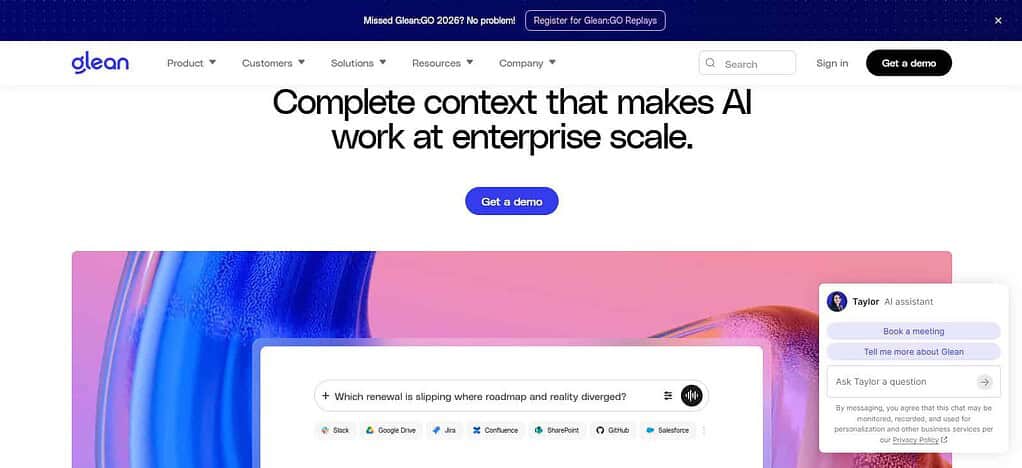
Pricing is enterprise focused and usually requires a sales call instead of picking a public self service plan. Deployment is cloud-based and built for organizations with security, governance and permissions. Glean offers on-demand, permission-aware answers from company knowledge and connected systems.
| Feature | Details |
|---|---|
| Category | Enterprise AI search and workplace knowledge platform |
| Core Model | Enterprise knowledge graph, semantic search and AI retrieval |
| AI Capabilities | AI search, grounded answers, summaries, recommendations and workplace agents |
| Knowledge Retrieval | Semantic and natural-language search across enterprise applications |
| Data Sources | Documents, emails, conversations, tickets, Google Workspace, Microsoft 365, Slack, Salesforce, Jira and more |
| Knowledge Graph | Connects people, content, projects and organizational relationships |
| Permissions | Real-time permission-aware retrieval |
| Search | Real-time indexing and contextual personalized search |
| Integrations | 100+ enterprise applications; Glean currently advertises 275+ connectors |
| Deployment | Enterprise cloud platform |
| Pricing | Enterprise/custom pricing |
| Security | Enterprise security, governance and compliance controls |
| Best For | Large organizations with knowledge spread across many applications |
| Key Advantage | Connects enterprise-wide knowledge while preserving existing access permissions |
Mem.ai Alternatives Comparison Table
| Platform | Category | Knowledge Model | AI Features | Main Data Sources | Integrations | Deployment | Pricing | Best For |
|---|---|---|---|---|---|---|---|---|
| Notion AI | AI Workspace & Knowledge Base | Pages, databases, wikis, connected workspace knowledge | AI Search, Q&A, writing, summaries, research | Notion pages, databases, connected apps | Multiple workplace integrations | Web, Desktop, Mobile | Free; paid Plus, Business & Enterprise | Team knowledge & documentation |
| Obsidian | Personal Knowledge Management | Local Markdown, backlinks, graph | Search, plugins and AI extensions | Local notes, Markdown files, attachments | Plugins, APIs and external tools | Windows, macOS, Linux, iOS, Android | Free; Sync & Publish paid | Personal knowledge & research |
| Google NotebookLM | AI Research & Knowledge | Source-grounded notebooks | Q&A, summaries, research, study tools | PDFs, Google files, websites, YouTube and supported sources | Google ecosystem | Web & Mobile | Free; expanded capabilities via Google AI plans | Research & document analysis |
| Tana | Structured Knowledge Management | Nodes, fields, supertags & relationships | AI search, meeting AI, summaries, agents | Notes, meetings, transcripts, calendars | Google Meet, Zoom, Teams, MCP and others | Web/Desktop | Free; Pro & Max paid | Structured knowledge & meetings |
| Reflect | Personal Knowledge Management | Networked notes & backlinks | AI writing, summaries, knowledge assistance | Notes, web clips, Kindle, calendars, contacts | Readwise, Kindle, Zapier, Google/Outlook | Web, Desktop, iOS | Paid subscription | Personal second brain |
| Capacities | Object-Based PKM | Connected objects, properties & relationships | AI assistant, AI chat, smart search | Notes, media, web links, messages | API, MCP and integrations | Web, Windows, macOS, Linux, iOS, Android | Free Basic; paid Pro/Believer | Structured personal knowledge |
| ClickUp Docs + AI | Productivity & Knowledge | Docs connected to tasks/projects | ClickUp Brain, AI writing, summaries, agents, Notetaker | Docs, tasks, comments, projects | Workplace integrations | Web, Desktop, Mobile | Free + paid plans with AI credits | Team productivity & documentation |
| Slite | Team Wiki & AI Knowledge Base | Collaborative docs & verified knowledge | AI Search, Q&A, writing, fact-checking, agents | Slite docs and connected workplace tools | Slack, Notion, Google Drive, Jira and others | Cloud/Web | Basic $10; Pro $20/user/month annually; Enterprise custom | Internal company knowledge |
| Roam Research | Networked Note-Taking | Block references, backlinks & graph | Search and AI extensions | Daily notes, pages, blocks, references | Extensions and integrations | Web, Desktop, Mobile | Pro $15/month or $180/year | Research & connected thinking |
| Glean | Enterprise AI Search | Enterprise knowledge graph + semantic retrieval | AI Search, grounded answers, summaries, agents | Documents, email, chats, tickets and business apps | 275+ connectors | Enterprise Cloud | Custom enterprise pricing | Enterprise-wide knowledge search |
Key Comparison Takeaways
| Requirement | Suitable Platforms |
|---|---|
| Personal Knowledge Base | Obsidian, Reflect, Capacities, Roam Research |
| AI Research | Google NotebookLM, Notion AI |
| Structured Knowledge | Tana, Capacities |
| Team Documentation | Notion AI, Slite, ClickUp Docs + AI |
| Enterprise Search | Glean |
| Local/Privacy-Focused Notes | Obsidian |
| Meeting Knowledge | Tana, ClickUp Docs + AI |
| Connected Knowledge Graph | Obsidian, Tana, Capacities, Roam Research |
| Cross-App Enterprise Search | Glean |
| All-in-One Work Management | ClickUp Docs + AI |
Conclusion
The right Mem.ai alternative for you depends on how you collect, organize, retrieve and use knowledge. Notion AI and ClickUp Docs + AI are about knowledge management and productivity in general. Obsidian, Reflect, Capacities, Tana and Roam Research are more about personal knowledge, interlinked.
Google NotebookLM is good for source-grounded research, Slite is focused on team documentation and collaboration, and Glean is for enterprise-wide knowledge search. Compare AI retrieval, data sources, integrations, privacy, deployment, collaboration, pricing, and knowledge freshness before you decide.
In the end, it really depends on whether you value personal knowledge, team documentation, research, or enterprise AI search.
FAQ
What are the best Mem.ai alternatives in 2026?
Popular Mem.ai alternatives include Notion AI, Obsidian, Google NotebookLM, Tana, Reflect, Capacities, ClickUp Docs + AI, Slite, Roam Research, and Glean. Each focuses on different knowledge-management needs.
Which Mem.ai alternative is best for personal knowledge management?
Obsidian, Tana, Reflect, Capacities, and Roam Research are designed around personal knowledge management. They differ in how they handle backlinks, structured data, AI assistance, privacy, and organization.
Which Mem.ai alternative is best for AI-powered research?
Google NotebookLM is particularly focused on source-based research. It allows users to provide documents and other supported sources and then interact with that information using AI.
Which Mem.ai alternative is best for enterprise knowledge?
Glean is designed specifically for enterprise search and workplace knowledge. It connects information from multiple business applications while incorporating organizational permissions and access controls.
Is Obsidian better than Mem.ai for privacy?
Obsidian uses a local-first approach, storing notes as local Markdown files. This gives users more direct control over their files, while Mem.ai uses a cloud-based workspace model.