




In this article I am going to talk about the Best E-Commerce Platforms for Beginners, to help you to choose the right solution to start your online store. Popular platforms will be compared based on price, ease of use, payment support, SEO features, customization, and scalability. This guide will assist you to make an informed decision on this subject, whether you are looking to sell physical products or digital downloads.
What Are E-Commerce Platforms?
E-commerce platforms are software applications that help individuals and businesses to create, manage and run online stores to sell products or services over the internet. They are a must-have for creating websites, showing off product catalogs, controlling inventory, collecting payments, following orders, and managing customer information.
Many platforms also have SEO tools, marketing integrations, shipping options, and sales analytics that can help you run your online business more efficiently. Some well-known examples include Shopify, Wix eCommerce, Squarespace Commerce, WooCommerce and BigCommerce.
These platforms provide a low-barrier entry point into online selling for newcomers who may lack technical knowledge and include features that help grow businesses, engage customers and expand into new markets.
Benefits Of E-Commerce Platforms for Beginners
Online selling around the clock: In an online store, customers can view products and place orders at any time of day or nite, even outside of normal business hours.
Multiple Payment Options: New users can receive payment via supported credit cards, debit cards, digital wallets and other payment gateways.
Easy Product Management: Store owners can add product descriptions, upload images, manage inventory, update prices and organize product categories from one dashboard.
Built-in SEO Tools: Many platforms feature tools to optimize page titles, meta descriptions, product pages, and URLs for better search engine visibility.
Marketing and Promotion: In an effort to attract customers, e-commerce platforms often cooperate with email marketing, social media, discount codes and advertising tools.
Mobile-Friendly Shopping: Responsive themes allow customers to browse products and make purchases on smartphones, tablets and desktop computers.
Order and Inventory Tracking: Newbies can monitor sales, process orders, update stock levels, and handle shipping using integrated or compatible tools.
Business Scalability: As sales increase, store owners can increase their product selections, add new services, upgrade plans, and venture into other sales channels.
Broader Customer Base: An online store allows businesses to reach customers outside of their immediate geographical location, subject to shipping, payment and regional restrictions.
Performance and Sales Insights : Analytics instruments can help beginners understand customer behavior, popular products, traffic sources, and sales trends, thus enabling better business decisions.
Key Points
| E-Commerce Platform | Key Point |
|---|---|
| Shopify | Best overall for beginners, offering an easy-to-use interface, hosted infrastructure, extensive app ecosystem, and built-in commerce tools. |
| Wix eCommerce | Beginner-friendly website and store builder with visual editing, templates, and integrated e-commerce features. |
| Squarespace Commerce | Ideal for creators and small brands that want professional design with straightforward online selling tools. |
| WooCommerce | Popular choice for WordPress users seeking full customization and ownership of their online store. |
| BigCommerce | Strong platform for growing businesses needing extensive built-in commerce and catalog management features. |
| Square Online | Well-suited for retailers that sell both online and in-person, with native integration to Square POS. |
| Ecwid by Lightspeed | Lets beginners add an online store to an existing website without migrating platforms. |
| GoDaddy | Simple website and store builder designed for fast setup and easy management. |
| Shift4Shop | Includes built-in e-commerce features and supports businesses looking for an all-in-one store solution. |
| Adobe Commerce (Magento) | Highly customizable platform for larger or more complex stores, though it requires more technical expertise. |
1. Shopify
Founded in 2006, Shopify is for beginners looking for an all-in-one online store. India’s Basic plan costs ₹1,499 per month with annual billing, and the overall estimated budget could be between ₹2,000 and ₹5,000 per month, excluding advertising and variable transaction fees.

It supports product management, inventory, multiple sales channels and international selling. Payment options depend on the seller’s country and on the gateway’s availability. Shopify is an excellent option for growing businesses with built-in SEO, analytics, email marketing integrations, and scalable plans.
Shopify — Highlights
| Feature | Highlights |
|---|---|
| Founded | 2006 |
| Best For | Beginners, startups, and growing online stores |
| Store Builder | Hosted store builder with customizable themes |
| Product Management | Product listings, variants, inventory, and order tracking |
| Payment Support | Shopify Payments in supported countries and third-party gateways |
| SEO Features | Editable page titles, meta descriptions, URLs, and redirects |
| Marketing | Discount codes, email integrations, and social selling |
| Scalability | Multiple plans, apps, and sales channels |
| Main Advantage | All-in-one e-commerce management |
| Main Limitation | Paid plans, apps, and payment-processing fees can increase costs |
2. Wix eCommerce
Founded in 2006, Wix offers a drag-and-drop site builder and integrated e-commerce features. On the referenced US pricing display, its Core plan is listed at around $29.77/month, with annual billing. A practical budget of $35-100/month can cover a basic store and some extras.
Wix has settings for product catalogs, order management, marketing tools, and SEO. Wix Payments is available only in supported countries, so sellers outside these countries need compatible third-party providers. It’s great for beginners who love visual design and easy store management.
Wix eCommerce — Highlights
| Feature | Highlights |
|---|---|
| Founded | 2006 |
| Best For | Beginners and design-focused small businesses |
| Store Builder | Drag-and-drop editor and customizable templates |
| Product Management | Product variants, collections, and inventory tools |
| Payment Support | Wix Payments and third-party providers where available |
| SEO Features | Meta tags, customizable URLs, and SEO setup tools |
| Marketing | Email campaigns, promotions, and social integrations |
| Scalability | Product management and integrations for expanding stores |
| Main Advantage | Flexible visual design without extensive coding |
| Main Limitation | Advanced requirements may need paid apps or higher-tier plans |
3. Squarespace Commerce
Squarespace, established in 2003, is best for beginners who want to build design-focused stores for fashion, art, services, and lifestyle products. Monthly pricing varies by plan, domain, and integrations. General budgeting estimate: $25-$80+ per month.

Commerce features include product management, customer accounts, analytics, promotional tools, and social selling integrations. You can pay with Squarespace Payments, Stripe, and PayPal where available. Businesses can build their online presence and grow their product lines with SEO settings, mobile-friendly templates, and marketing integrations.
Squarespace Commerce — Highlights
| Feature | Highlights |
|---|---|
| Founded | 2003 |
| Best For | Artists, designers, fashion brands, and creative businesses |
| Store Builder | Professionally designed templates and visual editing |
| Product Management | Product catalogs, variants, and order management |
| Payment Support | Supported payment providers, including Stripe and PayPal where available |
| SEO Features | Page titles, meta descriptions, and URL customization |
| Marketing | Promotional tools, email marketing, and social integrations |
| Scalability | Commerce plans and integrations for growing businesses |
| Main Advantage | Design-focused storefronts |
| Main Limitation | Complex commerce needs may require additional integrations |
4. WooCommerce (learn more)
In 2011, WooCommerce was developed as an open-source e-commerce plugin for WordPress. The core plugin is free but beginners should budget for hosting, a domain, security, backups and optional extensions, with about $20–$100 a month a reasonable starting estimate for many small stores.
It supports product catalogs, inventory, coupons, and lots of payment gateway integrations. Availability is subject to your provider and country. WordPress provides a lot of flexibility for SEO and content marketing, and you can add even more functionality with plugins. WooCommerce is ideal for businesses that want to grow and need customization and control of their stores.
WooCommerce — Highlights
| Feature | Highlights |
|---|---|
| Launched | 2011 |
| Best For | WordPress users and businesses seeking customization |
| Store Builder | WordPress themes, blocks, and extensions |
| Product Management | Physical products, digital products, variations, and inventory |
| Payment Support | Multiple gateways through built-in options and extensions |
| SEO Features | WordPress SEO plugins, customizable URLs, and metadata |
| Marketing | Coupons, email integrations, content marketing, and extensions |
| Scalability | Depends on hosting, optimization, and technical configuration |
| Main Advantage | Open-source flexibility and control |
| Main Limitation | Hosting, updates, security, and maintenance require management |
5. BigCommerce
BigCommerce, founded in 2009, provides hosted e-commerce tools for businesses looking to grow their online presence. The Core plan begins at $29 per month if you pay annually. A sensible starting budget of $40-$100 or more should cover the subscription and selected extras.
Key features include responsive storefronts, inventory management, integrations and multiple sales channels Supported payment providers depend on the country, and plan-based sales thresholds could impact future costs. SEO controls, analytics and marketing integrations give businesses the ability to manage larger catalogs and reach.
BigCommerce — Highlights
| Feature | Highlights |
|---|---|
| Founded | 2009 |
| Best For | Growing businesses and larger product catalogs |
| Store Builder | Hosted storefront builder and customizable themes |
| Product Management | Catalog, inventory, product variations, and order management |
| Payment Support | Multiple supported payment providers |
| SEO Features | Customizable URLs, metadata, and redirects |
| Marketing | Promotions, integrations, and multichannel selling |
| Scalability | Plans and capabilities for expanding operations |
| Main Advantage | Extensive built-in commerce functionality |
| Main Limitation | Advanced configuration can feel complex for first-time sellers |
6. Square Online
Square Online was founded in 2009, bridging online selling with Square’s point of sale ecosystem. Free-entry options are available in some markets, but paid plans, payment processing, and other services affect the monthly budget, with an initial estimate of $0–$50 or more, excluding processing fees.

It has features such as online product listings, order management and integration with in-person sales. Currently, card processing is available in select countries including the US, Canada, Australia, Japan, and parts of Europe. Good for businesses that have both physical and online stores, with integrated website tools and sales reports.
Square Online — Highlights
| Feature | Highlights |
|---|---|
| Launched | Square was founded in 2009 |
| Best For | Local retailers, restaurants, and businesses selling in person and online |
| Store Builder | Website builder integrated with Square services |
| Product Management | Product listings, inventory, and order management |
| Payment Support | Square payment processing in supported countries |
| SEO Features | Basic website SEO settings and page customization |
| Marketing | Promotions, sales reporting, and compatible marketing tools |
| Scalability | Online and in-person selling through the Square ecosystem |
| Main Advantage | Integration with point-of-sale operations |
| Main Limitation | Geographic availability and payment eligibility can restrict use |
7. Ecwid
Ecwid, launched in 2009, makes it simple for beginners to either add an online store to an existing website or create a storefront using its own tools. Prices vary by plan, by product limits, and by billing period. As a rough guide plan to spend $5-$50 (or more) per month, not including the cost of the domain and other third party services.
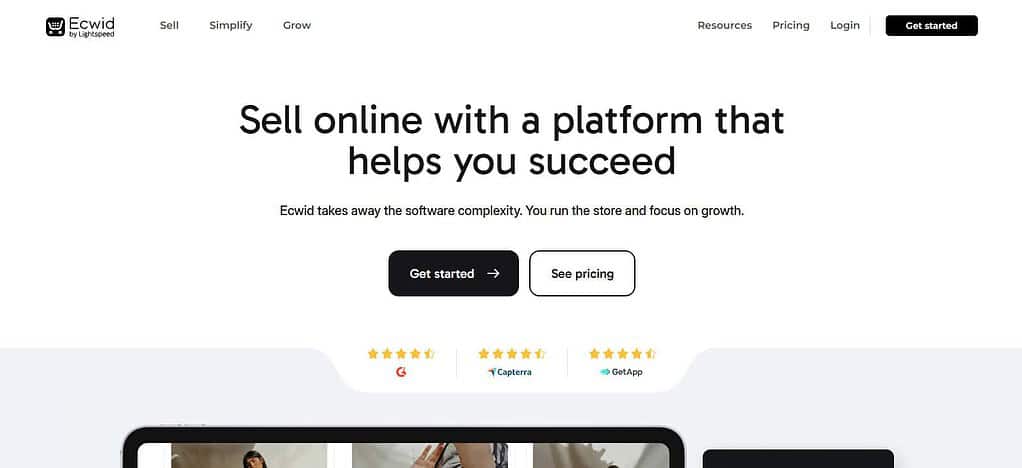
Features include product management, social selling, discount coupons, analytics and integrations with marketplaces on eligible plans. Payment gateways are dependent on availability of provider and location. Pricing information for Ecwid says that it does not charge any platform transaction fee, but payment processors still charge their fees.
Ecwid by Lightspeed — Highlights
| Feature | Highlights |
|---|---|
| Origin | Founded in 2009 |
| Best For | Small businesses adding online selling to an existing website |
| Store Builder | Standalone storefront and embeddable shopping tools |
| Product Management | Product catalogs, variants, and inventory management |
| Payment Support | Compatible payment gateways based on region |
| SEO Features | Product-page optimization and customizable store settings |
| Marketing | Social selling, discount codes, and marketing integrations |
| Scalability | Higher-tier plans and integrations support additional requirements |
| Main Advantage | Adds e-commerce functionality to existing websites |
| Main Limitation | Some advanced features depend on the selected plan |
8. GoDaddy
GoDaddy was founded in 1997 and offers a user-friendly website builder that can be used to create an online store. Its India online-store plan is listed at ₹899 per month, making roughly ₹900–₹2,500 a preliminary budget before payment processing, marketing, and optional extras.
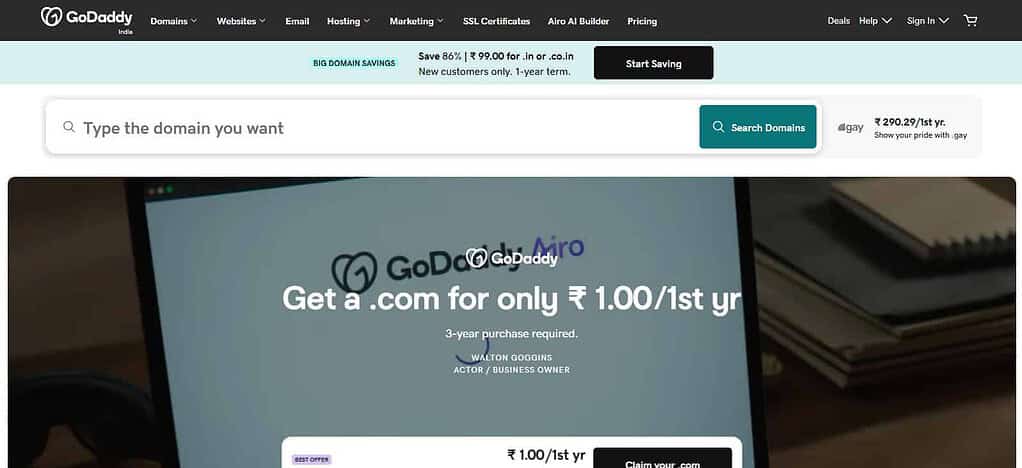
The platform supports up to 5,000 products, product images, shipping settings, and major payment methods (where available). Geographic suitability is determined by supported payment providers and local selling requirements. Built-in SEO tools, website analytics and integrations mean beginners can promote their stores without having to manage a complex technical setup.
GoDaddy — Highlights
| Feature | Highlights |
|---|---|
| Founded | 1997 |
| Best For | Beginners wanting a simple website and online store |
| Store Builder | Visual website builder with store functionality |
| Product Management | Product listings, order handling, and shipping settings |
| Payment Support | Available payment methods depend on country and plan |
| SEO Features | Basic SEO settings and page optimization |
| Marketing | Social integrations, email marketing options, and analytics |
| Scalability | Suitable for simpler stores and small-business operations |
| Main Advantage | Simple website and store setup |
| Main Limitation | Less flexibility for complex commerce requirements |
9. Shift4Shop
Founded in 1997, Shift4Shop offers hosted e-commerce solutions that include product management, SEO, promotions and order processing. It has a no-monthly-platform-fee plan for eligible merchants that use shift4 payments in its advertized end-to-end plan (or other arrangements may have a monthly fee). Budget about $0-$50 or more depending on eligibility and other services.

Availability of payment is the key consideration here as the offer is dependent on supported processing arrangements. Growing catalogs benefit from built-in marketing features, unlimited product options, and integrations. Beginners should check regional eligibility before committing.“We’re trying to see if we can get them to stay longer, and if we can give them some other kind of support to make their stay here more viable,” he said.
Shift4Shop — Highlights
| Feature | Highlights |
|---|---|
| Origin | Founded as 3dcart in 1997; later became Shift4Shop |
| Best For | Eligible merchants seeking integrated commerce features |
| Store Builder | Hosted storefront tools and customizable templates |
| Product Management | Product catalogs, inventory, and order management |
| Payment Support | Shift4 payment processing and eligible payment arrangements |
| SEO Features | Built-in SEO settings and URL controls |
| Marketing | Discounts, promotions, and customer marketing features |
| Scalability | Commerce features for expanding product catalogs |
| Main Advantage | Multiple commerce tools built into the platform |
| Main Limitation | Pricing offers and eligibility depend on payment-processing arrangements |
10. Adobe Commerce (Magento)
Magento was founded in 2008 and purchased by Adobe in 2018, and has developed into what we now know as Adobe Commerce. Magento Open Source is free to download, but hosting, development, security, and maintenance can add up to an estimated monthly cost of $100–$1,000 or more. Adobe Commerce offers customized enterprise pricing, so the total cost will vary based on your business needs and implementation.

Payment gateways, currencies and regional integrations require technical configuration, availability checks. Better for technically sophisticated businesses with complex growth needs due to sophisticated catalog controls, SEO customization, integrations, and flexible architecture.
Adobe Commerce (Magento) — Highlights
| Feature | Highlights |
|---|---|
| Origin | Magento launched in 2008; Adobe acquired Magento in 2018 |
| Best For | Enterprise businesses with complex commerce requirements |
| Store Builder | Highly customizable storefront and development tools |
| Product Management | Advanced catalogs, configurable products, and B2B features |
| Payment Support | Configurable payment integrations depending on implementation |
| SEO Features | Extensive customization of URLs, metadata, and technical SEO |
| Marketing | Integrations with analytics, customer management, and marketing systems |
| Scalability | Supports complex business requirements with suitable infrastructure |
| Main Advantage | Extensive customization and advanced commerce capabilities |
| Main Limitation | Higher implementation, hosting, development, and maintenance requirements |
Comparison Table of the Best E-Commerce Platforms for Beginners
| Platform | Best For | Ease of Use | Pricing Model | SEO Features | Main Advantage |
|---|---|---|---|---|---|
| Shopify | Beginners and growing online stores | Easy | Paid subscription | Built-in SEO tools | All-in-one e-commerce solution |
| Wix eCommerce | Small businesses and creative stores | Very Easy | Paid e-commerce plans | Built-in SEO settings | Drag-and-drop website builder |
| Squarespace Commerce | Design-focused online stores | Easy | Paid subscription | Built-in SEO tools | Professional templates |
| WooCommerce | WordPress users | Moderate | Free core plugin; hosting and extras cost extra | Flexible SEO plugins | Customization and control |
| BigCommerce | Growing businesses | Moderate | Paid subscription | Built-in SEO features | Extensive commerce functionality |
| Square Online | Local retailers and restaurants | Easy | Free and paid options, depending on market | Basic SEO tools | Online and in-person selling integration |
| Ecwid by Lightspeed | Existing websites adding online stores | Easy | Free or paid options, depending on current plans | Product SEO features | Easy store integration |
| GoDaddy | Beginners and small businesses | Very Easy | Paid plans | Basic SEO tools | Simple setup and management |
| Shift4Shop | Eligible merchants seeking built-in commerce tools | Moderate | Payment-processing-dependent options | Built-in SEO features | Integrated selling tools |
| Adobe Commerce (Magento) | Large businesses and complex stores | Advanced | Open-source or custom enterprise pricing | Advanced SEO customization | Extensive flexibility and scalability |
Conclusion
The best e-commerce platform for beginners in 2026 will depend on your budget, technical skills, business goals and future growth plans. Shopify is an excellent choice for an all-in-one online store, Wix and Squarespace are great for design-focused businesses, and WooCommerce provides flexibility for WordPress users.
BigCommerce is designed for growing catalogs, while Square Online and Ecwid are good for linking up multiple places you sell. You can also set up your shop on GoDaddy and Shift4Shop . For companies with complex requirements, Adobe Commerce is ideal. Before you choose a platform, compare pricing, payment support, SEO features, additional costs and scalability to find the best fit for your needs.
FAQ
What is the best e-commerce platform for beginners in 2026?
Shopify is a popular choice for beginners because it offers an all-in-one solution for building and managing an online store. Wix and Squarespace are suitable for design-focused stores, while WooCommerce is ideal for users who prefer WordPress flexibility.
Which e-commerce platform is the cheapest for beginners?
WooCommerce offers a free core plugin, while Square Online provides a free entry option in supported markets. However, hosting, payment processing, premium features, and other expenses can affect the total cost.
Can I start an online store without coding?
Yes, platforms such as Shopify, Wix, Squarespace, GoDaddy, and BigCommerce provide visual editors and store management tools that allow beginners to create an online store without extensive coding knowledge.
Which e-commerce platform is best for small businesses?
Shopify, Wix, WooCommerce, and Square Online can all suit small businesses. The best choice depends on product type, budget, preferred payment methods, technical skills, and whether the business also sells in person.