

In this article, I will discuss the Best AI Security Platforms for Enterprises, including solutions that enable organizations to secure AI models, applications, agents, data, and infrastructure. I will compare their security capabilities, AI-SPM features, runtime protection, deployment options, integrations, pricing and enterprise use cases to help businesses understand the differences among leading AI security platforms.
What Are AI Security Platforms for Enterprises?
AI security platforms for enterprises are specialized cybersecurity solutions that protect AI models, applications, agents, data and supporting infrastructure across the AI lifecycle. They assist organizations with locating AI assets, finding vulnerabilities, tracking AI activity, preventing prompt injection and data leakage, protecting AI supply chains, and implementing governance policies.
These platforms are different from traditional security tools as they address risks that are unique to LLMs, generative AI, autonomous agents and AI-enabled applications. Other enterprise AI security platforms can include AI security posture management, runtime protection, red teaming, compliance monitoring and integration with existing cloud, identity, SIEM and security operations environments.
Why Do Enterprises Need AI Security Platforms in 2026?
As enterprises adopt generative AI, LLMs, AI agents and AI-powered applications, traditional cybersecurity controls may not address all AI-specific risk. AI security platforms offer specialized visibility, protection, monitoring and governance for the AI environment.
Shadow AI Detection: Assists organizations in identifying rogue AI tools, apps, and services used by employees.
Prompt Injection Defense: Identifies malicious commands that can trick AI models or applications into executing undesirable actions.
Sensitive Data Protection: Helps prevent exposure of confidential business information, customer data, credentials and other sensitive content via standard artificial intelligence systems.
AI Agent Security: Secures autonomous agents that access APIs, databases, applications, tools and enterprise resources.
AI Asset Discovery: Provides visibility into AI models, apps, agents, datasets, APIs & supporting infrastructure in enterprise environments.
AI Supply-Chain Security: Identifies risks in third-party models, datasets, libraries, plugins, APIs and other AI components.
Runtime Threat Detection: Identifies suspicious behavior and emerging threats in AI applications and interactions while in execution.
AI Governance and Compliance: Helps organizations define policies, audit visibility, and security requirements for enterprise AI adoption.
AI-SPM: Identifies security weaknesses in AI environments, such as misconfigurations, vulnerabilities, exposed AI services, overly permissive permissions, and more.
Secure AI Adoption: Allows enterprises to scale AI consumption without sacrificing security controls, visibility and governance across their existing technology environment.
Key Points
| Platform | Key Strength |
|---|---|
| Protect AI (Palo Alto Networks Prisma AIRS) | Comprehensive MLSecOps and AI lifecycle security |
| HiddenLayer AISec Platform | Model protection, runtime defense, and threat detection |
| Cisco AI Defense | Enterprise AI application security and policy enforcement |
| Lakera (Check Point) | Prompt injection and LLM guardrail protection |
| Microsoft Defender for Cloud AI Security | AI posture management and cloud-native AI protection |
| Wiz AI-SPM | AI Security Posture Management across cloud environments |
| CrowdStrike Falcon AI Security | AI workload visibility and threat protection |
| Prompt Security | GenAI governance, monitoring, and data loss prevention |
| Cyera AI Guardian | AI data security and compliance controls |
| Cranium AI | AI supply chain security and governance platform |
1. Protect AI (Palo Alto Networks Prisma AIRS)
Founded in 2022, Protect AI joined Palo Alto Networks in 2025. Today, its technology powers Prisma AIRS, an AI security platform designed to protect AI applications, models, agents, and the entire AI lifecycle.
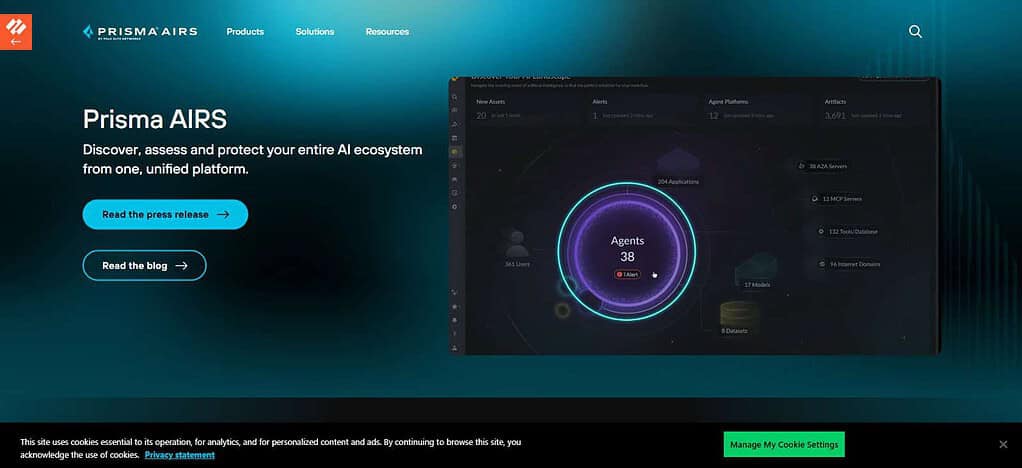
Features include AI discovery, security assessment, runtime protection, model security and AI supply-chain risks. Prisma AIRS helps detect shadow AI, vetting AI apps and agents, and help prevent prompt injection and data leaks. It is offered as an enterprise cloud security platform . Pricing is typically ** custom and sales driven ** for organizations .
Key AI Security Capabilities Protect AI (Palo Alto Networks Prisma AIRS)
- AI Runtime Safety
- AI Security Position Management
- MCP Security and AI Agent
- Security of AI Models and Supply Chains
- AI Red Teaming and Attack Simulation ([Palo Alto Networks
| Feature | Details |
|---|---|
| AI Security Posture Management | Discovers AI assets, applications, agents, models, and associated risks. |
| AI Runtime Security | Detects and blocks prompt injection, data exposure, malicious content, and other runtime threats. |
| AI Agent Security | Provides agent identity, permission controls, monitoring, and protection against unsafe agent actions. |
| AI Model Security | Scans AI models and artifacts for vulnerabilities, malicious code, tampering, and supply-chain risks. |
| AI Red Teaming | Simulates adversarial attacks against AI applications and agents to identify weaknesses before deployment. |
2. HiddenLayer AISec Platform
Founded in 2022, HiddenLayer is headquartered in Leander, Texas. The AI Security Platform is dedicated to protecting AI models, applications, agents and AI supply chains from security threats. The platform provides features such as AI discovery, supply-chain security, runtime protection, security posture management and attack simulation.
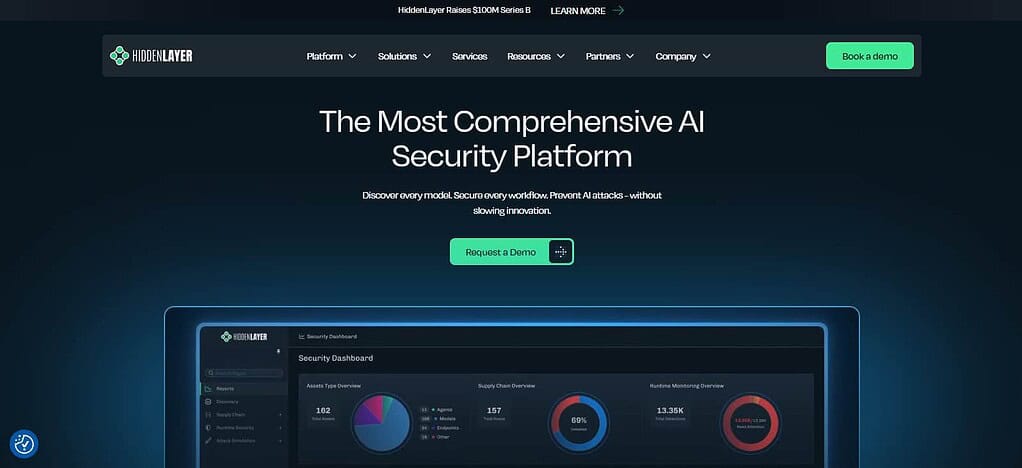
HiddenLayer is a agentless, model-agnostic solution and is delivered as a SaaS deployment, including via AWS Marketplace. It provides a platform for enterprises to protect across AI models and environments. The pricing is contract-based rather than a standard public subscription. Usage and cost are governed by enterprise agreements.
Key AI Security Capabilities HiddenLayer AISec Platform
- AI Model Discovery and Cataloging
- AI Model Vulnerability Scan
- Protecting AI Supply Chains
AI Runtime Threat Detection
AI Application and Agent Security
| Feature | Details |
|---|---|
| AI Model Security | Identifies vulnerabilities and malicious components within AI models and model artifacts. |
| AI Discovery | Provides visibility into AI models, applications, and AI assets across enterprise environments. |
| AI Supply-Chain Security | Helps identify risks introduced through third-party models, datasets, and AI components. |
| Runtime AI Protection | Monitors AI behavior and interactions for suspicious or malicious activity. |
| AI Red Teaming | Helps security teams test AI systems against adversarial threats and weaknesses. |
3. Cisco AI Defense
Cisco AI Defense is developed by Cisco, headquartered in San Jose, California, and founded in 1984. It is mainly concerned with enterprise AI security for AI applications, models, agents, data and cloud environments. The platform provides AI asset discovery, AI supply-chain risk management, model and application validation, algorithmic red teaming and runtime protection.
It fixes prompt injection, data leaks, model vulnerabilities, malicious tools, agent risks. Cisco provides network-level security controls so organizations can secure AI traffic without application changes. Deployment is enterprise-oriented for distributed environments, with pricing generally custom and quote-based.
Key AI Security Capabilities Cisco AI Defense
- AI Asset Discovery & Visibility
- Using AI and Checking the Model
*AI Red Teaming - AI Threat Protection at Runtime
- AI Supply-Chain and Data-Security #Lakera (Check Point)
| Feature | Details |
|---|---|
| AI Discovery | Helps enterprises identify AI applications and understand their security exposure. |
| AI Application Validation | Tests AI applications for vulnerabilities and security weaknesses before production. |
| AI Red Teaming | Simulates attacks to evaluate the resilience of AI applications and models. |
| Runtime Protection | Monitors AI interactions and helps detect AI-specific threats during operation. |
| AI Governance | Provides security controls and visibility for managing enterprise AI usage and risk. |
4. Lakera (Check Point)
Founded in 2021, Lakera has developed AI security technology, with primary focus to secure generative AI applications, LLM interactions, prompts and sensitive data. Features include prompt injection detection, jailbreak protection, malicious content detection, and AI application security. Check Point has acquired Lakera, adding its AI security technology to a broader cybersecurity portfolio.
It is a platform built for organizations that are deploying generative AI and has the need for controls that work around model interactions and application workflows. # Deployment Deployment can support API-based and enterprise environments. Pricing is typically custom and sales-led based on organizational requirements, AI workloads, and protection scope.
Key AI Security Capabilities Lakera (Check Point)
- Jailbreak & Malware Detection
- Data privacy
- Application Security for LLM
AI Guardrails and Runtime Protection
| Feature | Details |
|---|---|
| Prompt Injection Detection | Identifies malicious instructions attempting to manipulate LLM applications. |
| Jailbreak Protection | Detects attempts to bypass AI safety policies and application restrictions. |
| Data Leakage Prevention | Helps prevent sensitive enterprise information from being exposed through AI interactions. |
| AI Guardrails | Applies security policies to prompts, responses, and AI application interactions. |
| LLM Application Security | Provides security controls designed for generative AI applications and LLM workflows. |
5. Microsoft Defender for Cloud AI Security
Part of Microsoft’s cloud security offering, Microsoft Defender for Cloud is designed to protect hybrid, multicloud, application, and AI environments. It offers threat protection for supported AI services such as Azure OpenAI and Azure AI Model Inference, with activity monitoring and prompt evidence accessible via security alerts.
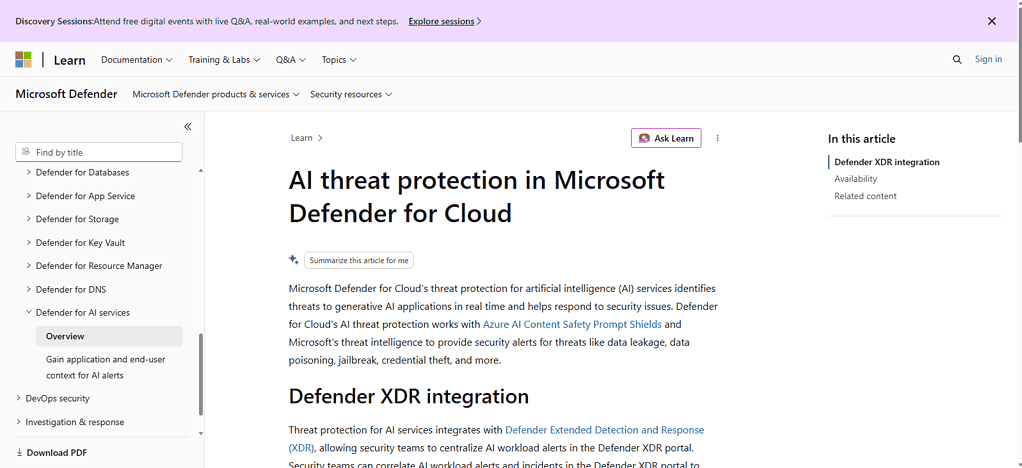
Defender for Cloud is cloud-native and integrates with the wider Microsoft security ecosystem. pay-as-you-go model is how pricing is structured, and Defender for AI Services includes a 30-day free trial with token scanning limits. Enterprise planning tools are also provided by Microsoft to calculate costs.
Key AI Security Capabilities Microsoft Defender for Cloud AI Security
- AI Workload Identification
- Recognize AI Threat
- Prompt & Response Monitoring
- Security of Application AI
- Cloud-Native AI Security & Governance
| Feature | Details |
|---|---|
| AI Threat Detection | Identifies security threats associated with supported AI and cloud workloads. |
| AI Activity Monitoring | Provides visibility into AI-related activities and security events. |
| Prompt Monitoring | Helps security teams investigate suspicious prompts and AI interactions. |
| Cloud Security Integration | Connects AI protection with Microsoft’s broader cloud security capabilities. |
| Security Alerts | Generates security findings that can help organizations investigate potential AI threats. |
6. Wiz AI-SPM
Founded in 2020, Wiz is based in New York and offers cloud security with AI Security Posture Management as a standalone capability. Wiz AI-SPM is designed to discover AI models, agents, services, pipelines and technologies anywhere in the cloud. It provides AI-BOM visibility, configuration assessment, exposed endpoint detection, sensitive data discovery, attack path analysis,
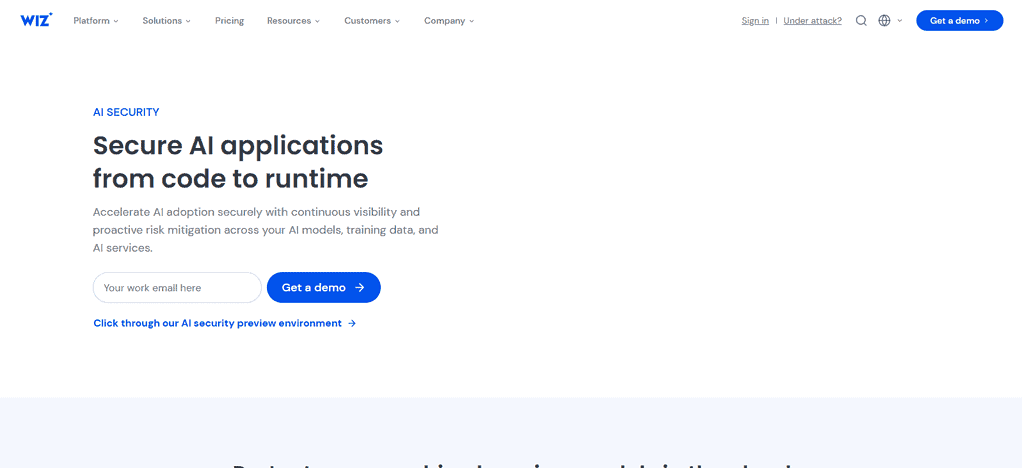
AI runtime protection, and more. Its agentless architecture enables organizations to connect to cloud environments without having to deploy traditional security agents to each workload. Wiz is primarily provided as a cloud platform and enterprise pricing is custom and sales based. Its AI security capabilities are part of the broader Wiz cloud security platform.
Key AI Security Capabilities Wiz AI-SPM
- Discover AI Assets
- AI Security Posture Management
AI Bill of Materials - AI Attack-Path Analysis
- AI Runtime & Data Exposure Detection
| Feature | Details |
|---|---|
| AI Asset Discovery | Discovers AI models, applications, agents, services, and related cloud resources. |
| AI-BOM | Provides an inventory of AI components and dependencies to improve visibility. |
| AI Risk Assessment | Identifies misconfigurations, vulnerabilities, exposures, and other AI security risks. |
| Attack-Path Analysis | Connects AI risks with cloud exposures to show potential attack paths. |
| Agentless Architecture | Uses Wiz’s cloud-native agentless approach for discovering and assessing AI environments. |
7. CrowdStrike Falcon AI Security
Founded in 2011 and based in Austin, Texas, CrowdStrike adds AI security to its Falcon platform and cloud security offerings. It is on AI-SPM, AI model scanning, protection of cloud workloads, identity security, threat detection and runtime security.
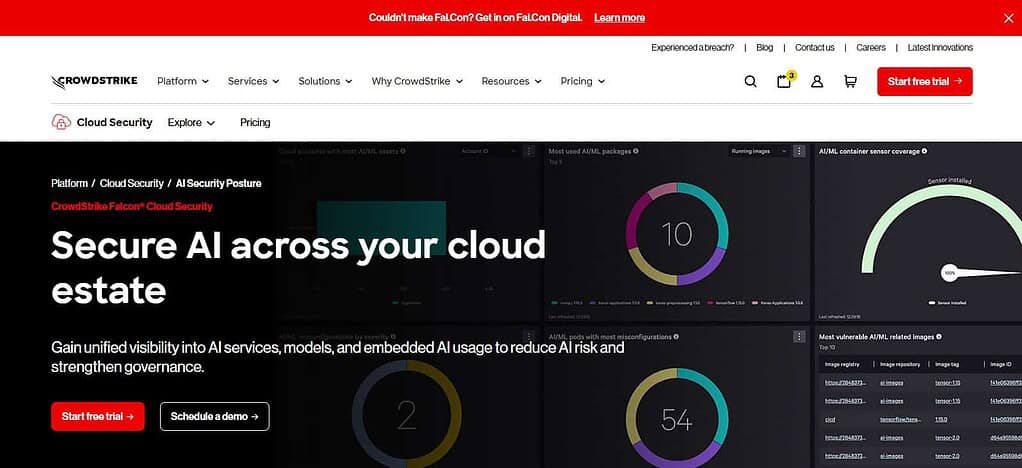
Falcon Cloud Security can protect AI workloads across on-premises, hybrid and multicloud environments, while CrowdStrike’s broader platform connects endpoint, identity, cloud and threat intelligence capabilities. Deployed in a cloud native way with platform integrations. The entry-level Falcon Go offering is priced at $7.99 per device per month. For advanced cloud and AI security capabilities, pricing is usually custom-quoted based on specific needs.
Key AI Security Capabilities CrowdStrike Falcon AI Security
- AI Security Posture Management
- Understanding AI Models and Use Cases
AI Workload Protection - AI Runtime Threat Detection
- Cloud Security for Identity and AI
| Feature | Details |
|---|---|
| AI Security Posture Management | Helps identify AI assets, configurations, vulnerabilities, and security exposures. |
| AI Workload Protection | Protects AI workloads across cloud and enterprise environments. |
| Model Security | Helps assess AI models and associated workloads for security risks. |
| Runtime Threat Detection | Uses security telemetry and threat detection capabilities to identify suspicious AI activity. |
| Cloud and Identity Security | Connects AI security with cloud workload and identity protection capabilities. |
8. Prompt Security
Founded in 2023, Prompt Security is an enterprise-only generative-AI security company. Its platform provides visibility and governance of employee AI use, while protecting enterprise AI applications and sensitive data. Capabilities include shadow-AI discovery, prompt injection protection, protection of sensitive data, policy enforcement, security of AI applications, and security controls for AI coding assistants.
The platform monitors AI interactions and helps security teams build organizational policies for generative AI. It is sold primarily as an enterprise security service and pricing is generally custom and sales driven and not standardized for public view. SentinelOne acquired Prompt Security in 2025.
Key AI Security Capabilities Prompt Injection
- Shadow AI Detection
Protection Against Prompt Injection - Prevention of sensitive data leaks
- Monitoring the Use of Generative AI
- Controls for AI Policy and Governance
| Feature | Details |
|---|---|
| Shadow AI Discovery | Identifies unauthorized or unmanaged AI tools being used within an organization. |
| GenAI Usage Monitoring | Provides visibility into employee interactions with generative AI services. |
| Prompt Injection Protection | Detects malicious prompts and attempts to manipulate AI applications. |
| Sensitive Data Protection | Helps prevent confidential information from being entered into external AI services. |
| AI Policy Enforcement | Allows organizations to establish security policies governing enterprise AI usage. |
9. Cyera AI Guardian
Cyera, founded in 2021 and based in New York, is laser focused on securing enterprise data as organizations embrace generative AI with its AI security offering. AI Guardian focuses on finding AI usage, understanding sensitive data exposure, and applying security controls to AI interactions.
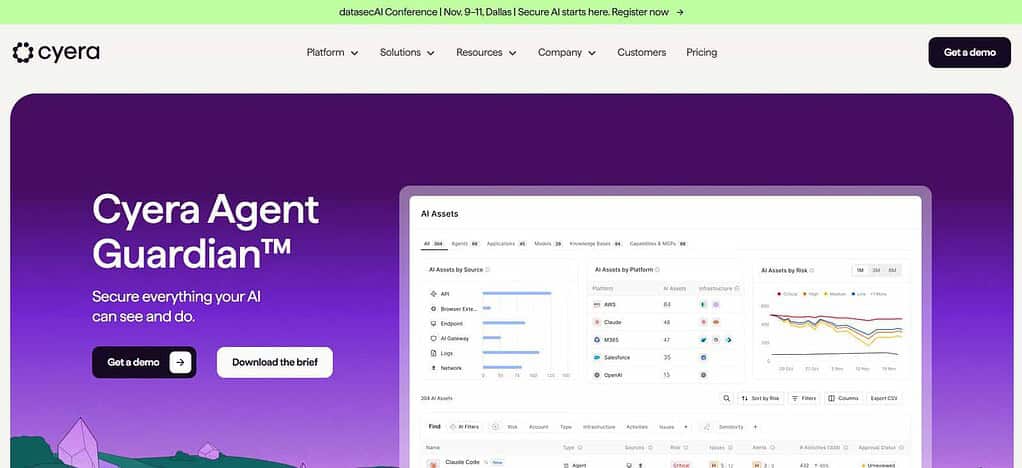
It links data security to the use of AI, allowing organizations to see what data is being accessed or shared by AI tools and apps. Deployment in cloud for enterprises. Prices are usually custom and depend on the data environment, users, integrations and the needed security coverage.
Key AI Security Capabilities Cyera AI Guard
- Explore AI Usage
- Identifying Sensitive Data
- Watching for exposure of AI data
- Shadow AI Knowledge
AI Data Protection and Policy Enforcement
| Feature | Details |
|---|---|
| AI Usage Discovery | Provides visibility into how employees and applications use AI services. |
| Sensitive Data Detection | Identifies sensitive information that may be exposed through AI interactions. |
| AI Data Protection | Applies data-security controls to information moving through AI applications. |
| Shadow AI Visibility | Helps security teams identify unmanaged AI services and associated data risks. |
| AI Policy Controls | Supports security policies for controlling how sensitive enterprise data is used with AI. |
10. Cranium AI
Cranium AI, founded in 2021, offers an end-to-end AI security and governance platform for enterprises. Its primary mission is the discovery, security, monitoring, and governance of AI models, agents, applications and AI supply chains.
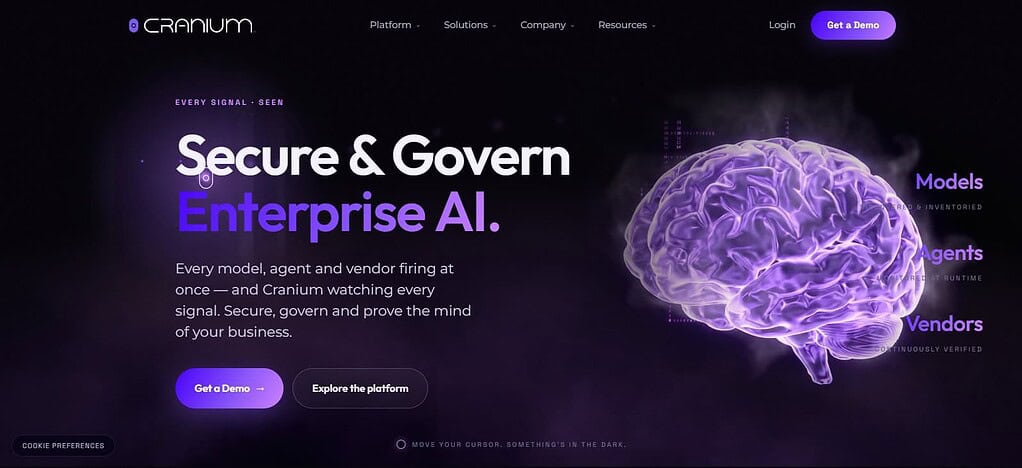
The platform is built to offer visibility across an organization’s AI estate, and to help security teams manage AI-specific risks and governance requirements. Cranium supports enterprise deployment across AI environments and builds security and governance into AI operations. Pricing is typically custom and sales led, based on enterprise deployment needs, AI assets, integrations and security scope. Its registered office is located at Short Hills, New Jersey.
Key AI Security Capabilities Cranium AI
- AI Asset Discovery
- AI Risk and Security Assessment
- AI Model and Application Monitoring
- AI Governance and Compliance
- AI Supply-Chain Security
| Feature | Details |
|---|---|
| AI Asset Discovery | Provides visibility into AI models, applications, systems, and related assets. |
| AI Risk Management | Helps organizations identify and manage security risks across their AI environment. |
| AI Governance | Supports policies and governance controls for responsible enterprise AI adoption. |
| AI Supply-Chain Security | Helps assess risks associated with AI models, components, and dependencies. |
| Compliance Monitoring | Provides visibility and controls to help organizations align AI deployments with governance and compliance requirements. |
Conclusion
As organizations adopt LLMs, AI applications, and autonomous agents, AI security platforms are emerging as a critical component of enterprise cybersecurity. The platforms discussed in this article cover different areas, including AI-SPM, model security, prompt security, runtime monitoring, data security, governance, and AI supply-chain risks.
Enterprises should evaluate each platform against their AI environment, deployment requirements, security architecture, integrations and compliance needs and pricing model. Some solutions are very AI applications and models focused while others are broader cloud, data, identity or threat protection. The right platform will depend on the specific needs of each enterprise’s AI workloads and security requirements.
FAQ
What are AI security platforms for enterprises?
AI security platforms help enterprises discover, monitor, protect, and govern AI models, applications, agents, data, and AI infrastructure. They can address risks such as prompt injection, data leakage, unauthorized AI usage, model vulnerabilities, and AI supply-chain threats.
Why do enterprises need AI security platforms in 2026?
Enterprises are increasingly using generative AI, LLMs, AI agents, and AI-powered applications. AI security platforms provide visibility and security controls designed specifically for these technologies while helping organizations manage security and governance requirements.
What is AI-SPM?
AI Security Posture Management, or AI-SPM, helps organizations discover AI assets and identify security risks across models, applications, agents, data, configurations, and AI infrastructure. It can provide visibility into an enterprise’s overall AI security posture.
Can AI security platforms protect against prompt injection?
Many AI security platforms provide controls for detecting or mitigating prompt injection and related attacks. Capabilities vary between vendors, so enterprises should verify whether protection covers direct, indirect, and application-specific prompt injection scenarios.