


This article outlines the Best AI Knowledge Base APIs for Customer Support. You can learn about the features and use cases for the available offerings.
In addition, you can find options best for your business, as I address pricing and integrations, as well as the advantages and disadvantages of each. These APIs can help your company, regardless of size, provide advanced support through AI knowledge management.
What Is an AI Knowledge Base API?
AI Knowledge Base APIs are a special type of API that integrate AI functionalities, particularly related to knowledge bases and NLP. Usually, they are incorporated into customer support software.
They also connect virtual assistants and AI chatbots. They can cut down on the time people have to spend answering support tickets by giving users self-service support.
They help create modules that are useful to users like FAQs and help articles. These articles can be easily searched for using different AI technologies like semantic search. They can also help troubleshoot user problems. The integration of AI answers customer queries and serves as an automation feature for customer support.
Why Use AI Knowledge Base APIs for Customer Support?
24/7 Customer Self-Service – With AI Knowledge Base APIs, customers can find answers without an agent even being there. This gives customers more options and makes the service more convenient.
Faster Response Times – With the power of AI, search functions, and smart content retrieval, the time required to answer customer inquiries is greatly reduced.
Reduced Support Ticket Volume – If quality self-service is made available, repetitive support inquiries will be reduced, and support staff will have time to deal with inquiries of a greater complexity.
Improved Customer Satisfaction – The ability to find relevant help and troubleshooting articles instantly improves the customer experience and fosters customer loyalty and trust.
AI Chatbot Integration – These APIs work in tandem with AI chatbots and virtual assistants to carry out automated conversations with a realtime knowledge base.
Centralized Knowledge Management – All FAQs, documentation, policies, guides, etc., can be kept in one place and accessed from many different locations.
Consistent Customer Support – Because every customer is issued the same answer, support staff cannot give different answers to the same question.
Easy CRM and Help Desk Integration – The majority of the AI Knowledge Base APIs are easily integrated with various CRM systems, ticketing software, live chats, and customer support tools.
Scalable Support Operations – AI Knowledge Base APIs allow you to scale the volume of inquiries without needing to scale the support staff proportionally.
Actionable Analytics and Insights – Embedded reporting and analytics assist in identifying not only common articles and search patterns and behaviors and content gaps, but also trends in your customer base which could assist the ongoing enhancement of your knowledge base.
How We Selected the Best AI Knowledge Base APIs
Capability of AI Search – We looked at how well AI and NLP and other search techniques are used in an API to generate knowledge articles that are accurate and relevant.
Integration – APIs were judged based on how easily they plugged into customer support applications, CRMs, AI chatbots, help desk applications, and other software and third party tools.
KM Features – We reviewed APIs based on the features that are offered.
Ease of Use for Developers – APIs that scored high on the other criteria also had detailed documentation and SDKs related to the APIs and implementation guides.
KPIs – API uptime, responsiveness, and the ability to process large volumes of customer requests were also considered.
Safety and Standards – APIs were examined based on safety of authentication, data encryption, role based access, and other safety and data protection standards.
Language Facilities – APIs that offered more than English were ranked higher.
Automation and AI – APIs that offered workflow automation and AI based recommendations and suggestions were ranked higher.
APIs and Reporting – APIs that offered suggestions and reporting on customer article usage, search and engagement, and content scored the highest.
Flexibility – APIs that allowed customization of the knowledge bases, user permissions, APIs, and workflows and branding scored higher.
Flexibility for Growth of Company/Business – APIs were selected that can accommodate single person startups, small and mid-sized businesses and large corporations.
Assessment of Value and Pricing – Finally, we looked at the pricing structures and available features and evaluated overall value to make sure that each API was cost-ef0ective and provided a favorable return on investment through all business tiers.
Benefits of Using AI Knowledge Base APIs
Instantaneous Customer Support – By supplying relevant articles and documentation, AI Knowledge Base APIs can furnish real-time answers to customer questions.
Decreased Customer Support Expenses – The automation of previously repetitive inquiries minimizes the volume of support tickets, thereby reducing costs and eliminating the need for expanded support staff.
Increased Customer Satisfaction – Positive responses that are both rapid and accurate engender a positive customer experience and a subsequently increased customer loyalty.
Enables 24/7 Self-Service – Self-service support is available to customers at any hour.
Enhanced AI Chatbot Functionality – Knowledge Base APIs allow for contextually accurate responses, rather than the standard finite responses, to be delivered by AI chatbots.
Increased Support Agent Efficiency – The rapid retrieval of supporting knowledge articles allows for the optimization of the resolution of complex support issues.
Provides Consistent Data – The most current, accurate, and consistent informational updates are available to both customers and the support staff.
Integration Friendly – The majority of AI Knowledge Base APIs have flexible integration options with most of the available CRM systems, help desk systems, live chat systems, automation and workflow systems.
Localized Support – Many APIs can provide multiple languages, thereby simplifying the delivery of more localized customer support for a global audience.
Operational Metrics – The performance of the Knowledge Base can be improved with built-in analytics by utilizing user feedback and monitoring searches and article views.
Grows with Business Development – AI Knowledge Base APIs can manage the influx of customer queries and increasing documentation without any performance limitations.
Fosters Rapid Digital Transformation – Integrating AI and automation with centralized knowledge management, companies can enhance their customer support systems and provide more efficient and data-oriented service experiences.
Best AI Knowledge Base APIs for Customer Support List
- Zendesk Knowledge API
- Freshdesk Knowledge Base API
- Zoho Desk API
- Salesforce Knowledge API
- ServiceNow Knowledge API
- HubSpot Service Hub API
- Intercom Articles API
- Kustomer Knowledge API
- Helpjuice API
- Document360 API
10 Best AI Knowledge Base APIs for Customer Support
1. Zendesk Knowledge API
The Zendesk Knowledge API earns a spot on the list of the top knowledge base API solutions, thanks to its wide-ranging support for building and maintaining help center articles. It offers APIs to build, maintain, and retrieve center articles, making integration and support for a multilingual knowledge base quick and straightforward.
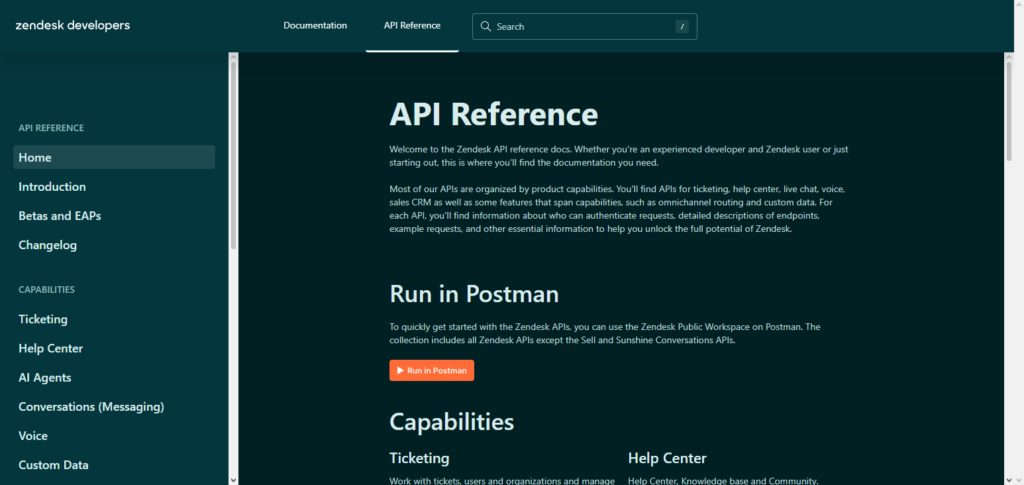
Global organizations will appreciate the support for segmentation of articles into categories and sections as well as labeling. Updating functional user permissions further streamlines content management. AI chatbots can reduce support tickets and improve the self-service experience by automatically retrieving and displaying customer-relevant articles.
Being an API, it integrates easily with CRM, analytics, and automation. Its superb documentation and enterprise-class security and seamless integration with the Zendesk ecosystem addresses the support needs of all companies.
Zendesk Knowledge API Details
| Feature | Details |
|---|---|
| REST API Access | Manage articles, categories, sections, and attachments programmatically. |
| AI-Powered Search | Supports intelligent article recommendations through AI-driven search. |
| Multilingual Support | Publish and manage knowledge bases in multiple languages. |
| Content Organization | Organize articles using categories, sections, labels, and tags. |
| Role-Based Permissions | Control who can create, edit, publish, or view content. |
| Article Versioning | Track revisions and restore previous article versions. |
| Help Center Integration | Connects directly with Zendesk Help Center and Support. |
| Chatbot Compatibility | Enables AI bots to retrieve relevant knowledge articles. |
| Analytics & Reporting | Monitor article performance, views, and customer engagement. |
| Secure Authentication | Supports OAuth and API token authentication. |
2. Freshdesk Knowledge Base API
The Freshdesk Knowledge Base API automates knowledge article management and AI self-service. This API shows why Freshdesk is one of the Best AI Knowledge Base APIs for Customer Support. Freshdesk supports organizations by providing different features like article creation, article editing, article categorization, folder organization, and multilingual documentation, along with the ability to automate publication.
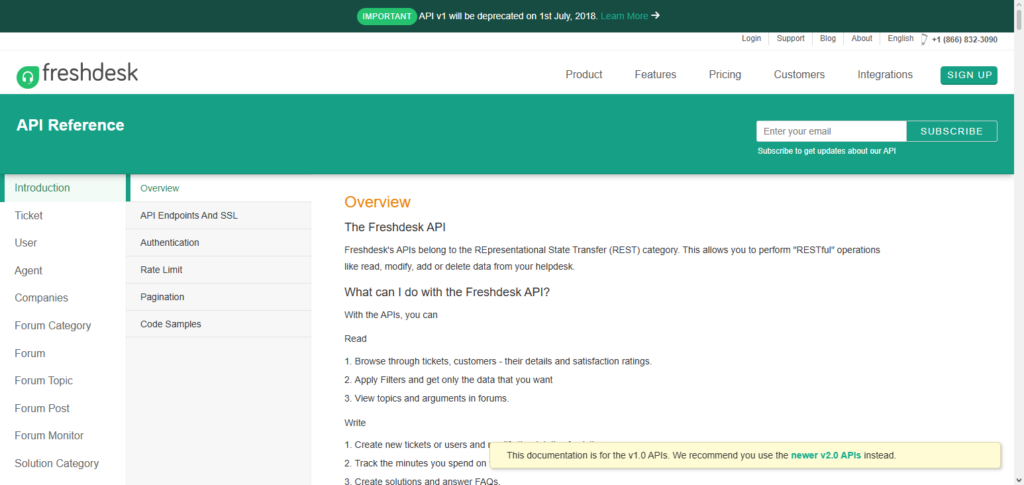
This API helps organizations connect AI chatbots to pull relevant support content, allowing customers to troubleshoot problems without needing to engage a support agent. The API works seamlessly with Freshworks and third-party business apps to smoothen support workflows.
Enhanced search, authentication, and role-based permissions, along with an extensive documentation library, provide the framework needed to develop a robust and scalable support portal. AI-enhanced support portals result in a more satisfied customer base, while simultaneously reducing support costs.
Freshdesk Knowledge Base API Details
| Feature | Details |
|---|---|
| Knowledge Base Automation | Create, edit, delete, and publish articles through APIs. |
| Folder Management | Organize articles into folders and categories. |
| AI Article Suggestions | Recommend relevant articles during customer interactions. |
| Multi-Language Articles | Support customers in multiple languages. |
| Article Status Management | Manage draft, review, and published articles. |
| Search API | Fast search across documentation and FAQs. |
| Workflow Integration | Connect with Freshworks automation tools. |
| Permission Controls | Restrict content access by user roles. |
| Customer Feedback | Collect article ratings and feedback. |
| RESTful API | Easy integration with third-party applications. |
3. Zoho Desk API
The Zoho Desk API offers secure REST endpoints to fully access articles and categories from your knowledge base and access customer support resources.
As one of the Best AI Knowledge Base APIs for Customer Support, it provides businesses the ability to automate the publishing of articles and the synchronization of documents and AI assistants for the intelligent retrieval of knowledge.
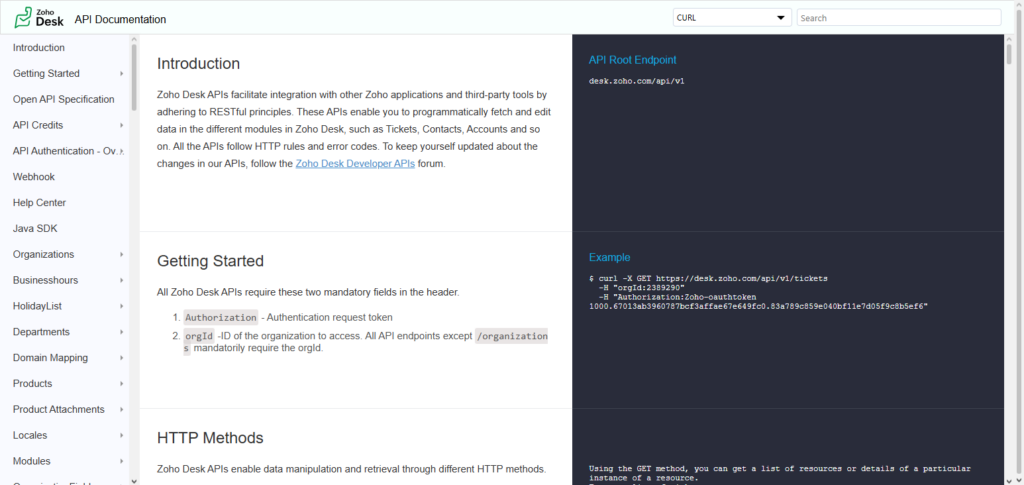
The API enables support teams to work seamlessly using its built-in features such as multilingual support, custom workflows, article ratings and attachments, and access controls.
The API can be integrated into many other tools and applications to provide more custom solutions. This API offers great features for its low price which can cater to businesses from the startup to the enterprise level.
Zoho Desk API Details
| Feature | Details |
|---|---|
| Article Management | Create, edit, publish, and archive knowledge articles. |
| Department-Based Knowledge | Separate documentation for different departments. |
| Custom Categories | Organize articles using customized categories. |
| Multilingual Knowledge Base | Publish articles in various languages. |
| AI Assistant Support | Works with Zia AI for intelligent recommendations. |
| Workflow Automation | Automate article approval and publishing. |
| CRM Integration | Connect seamlessly with Zoho CRM. |
| User Permission Management | Control author and reader access. |
| Search Optimization | Quickly retrieve articles using advanced search. |
| API Security | Uses OAuth authentication and encrypted API requests. |
4. Salesforce Knowledge API
Salesforce Knowledge API allows organizations to create customer support systems based on AI by giving programmatic access to knowledge articles, data categories, versions, and workflows for publishing. Salesforce Knowledge API is also recognized as one of the best AI Knowledge Base APIs for Customer Support & it also empowers the developers to automate article management when integrating knowledge into customer service applications and AI chatbots.
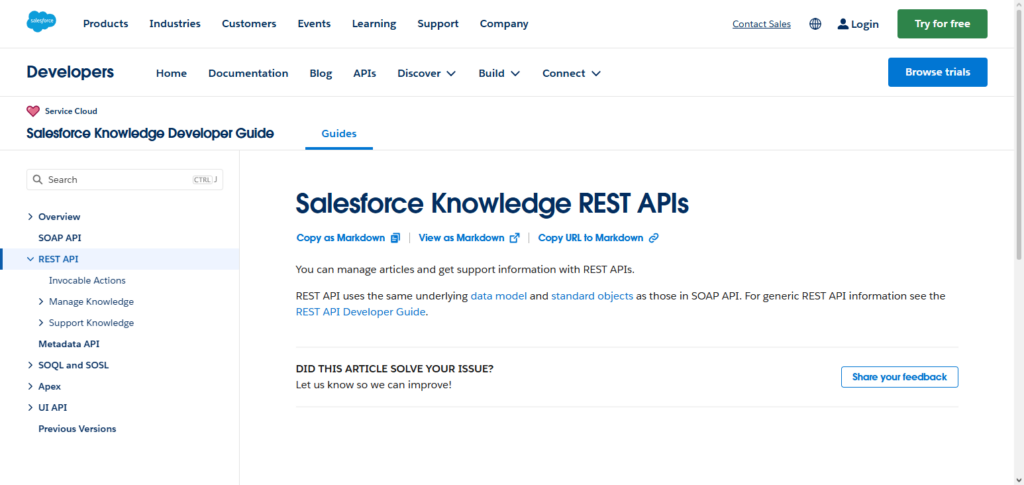
The API offers multilingual documentation, advanced searching, approval workflows, and versioning and access controls for security. Salesforce’s CRM, AI, and reporting tools, in addition to its enterprise-level offerings, ensure that organizations get the best use case. These allow the customers to get the best experience and support agents to get the best out of their time.
Salesforce Knowledge API Details
| Feature | Details |
|---|---|
| Knowledge Article API | Access and manage articles programmatically. |
| Version Control | Maintain multiple versions of documentation. |
| Data Categories | Organize content using category groups. |
| Approval Workflows | Support review and approval before publishing. |
| AI Integration | Integrates with Salesforce Einstein AI. |
| Multilingual Content | Publish articles for global audiences. |
| CRM Connectivity | Share knowledge directly within Salesforce CRM. |
| Secure Access | Enterprise-grade authentication and permissions. |
| Search API | Intelligent article retrieval for support agents. |
| Enterprise Scalability | Handles large knowledge bases efficiently. |
5. ServiceNow Knowledge API
ServiceNow Knowledge API helps companies automate enterprise knowledge management by providing secure APIs to access articles, categories, workflows, approvals, and documentation.
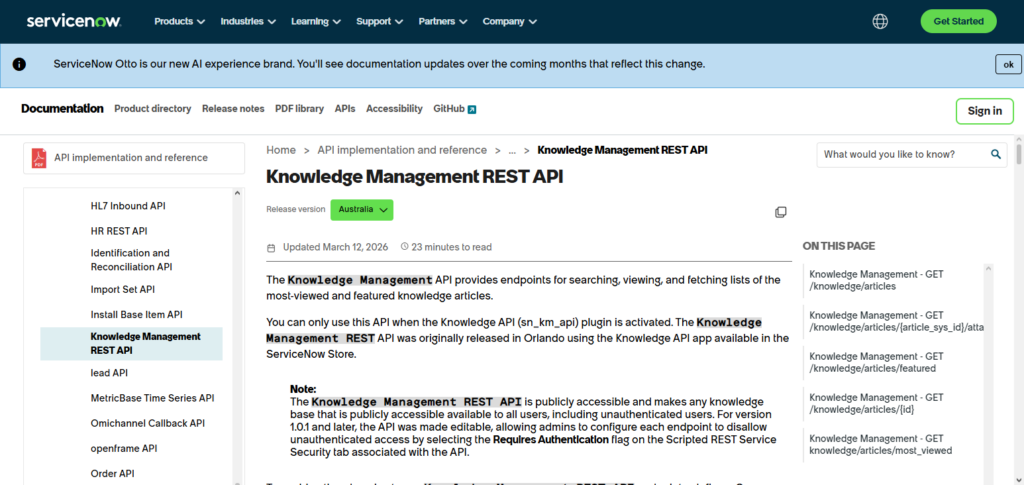
As one of the Best AI Knowledge Base APIs for Customer Support, it helps AI virtual agents to provide the best answers with the most current knowledge articles. Companies can automate the publishing of content, updates to articles, collection of feedback, and the approval process while keeping governance and compliance.
This API integrates easily with IT service management, HR services, customer service management, and enterprise automation. Workflow automation, advanced analytics, and strong security with a scalable architecture are some of the reasons why it is a great option for big enterprises.
ServiceNow Knowledge API Details
| Feature | Details |
|---|---|
| Knowledge Article Management | Create, edit, and publish knowledge content. |
| Workflow Automation | Automate approvals and publishing processes. |
| Virtual Agent Support | AI virtual agents retrieve knowledge articles. |
| Role-Based Security | Manage user permissions and content visibility. |
| Enterprise Search | Powerful search across all knowledge resources. |
| Version History | Track document changes and updates. |
| Service Catalog Integration | Link articles to IT and HR services. |
| Analytics Dashboard | Measure article usage and effectiveness. |
| REST API Support | Easy integration with enterprise systems. |
| Compliance Controls | Supports governance and compliance policies. |
6. HubSpot Service Hub API
The HubSpot Service Hub API first classifies categorizations of customer support articles, along with knowledge base content, and search capabilities using a REST API, and allows developers to manage them through their API.
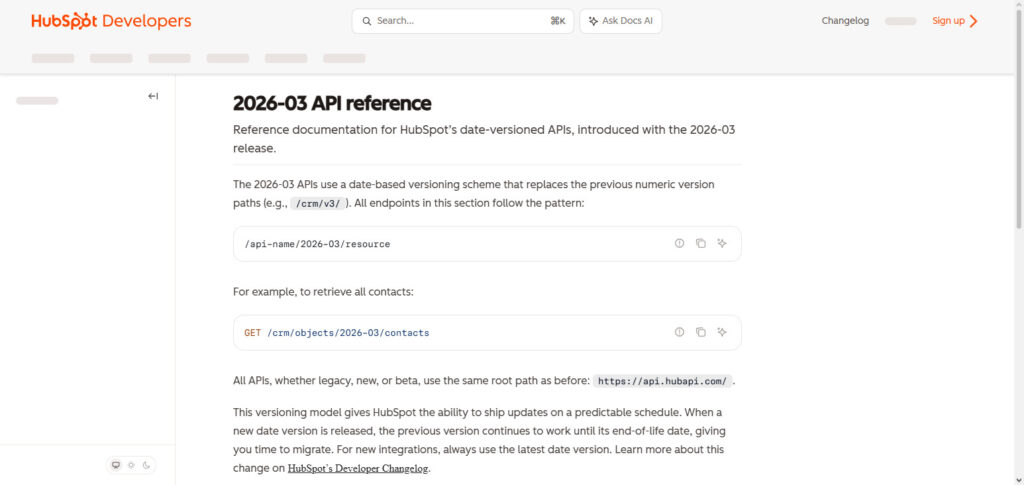
This API is ranked highly among AI customer support knowledge base APIs for its ability to integrate AI chatbots, and customer support portals, to call up related articles in real time to support customer inquiries. It allows companies to integrate their content automation, article publishing, and multilingual user document management, along with user participation, using tools in the HubSpot CRM and marketing suite.
It also provides thorough statistical reporting on the performance of articles and the engagement of customers. Its design is user-friendly, and combined with its automation, documentation, and the ability to use the API with other systems, it provides an excellent customer support solution for small to medium-sized businesses.
HubSpot Service Hub API Details
| Feature | Details |
|---|---|
| Knowledge Base API | Programmatically manage support articles. |
| CRM Integration | Connect knowledge content with HubSpot CRM. |
| AI Search | Deliver intelligent article recommendations. |
| Customer Portal Integration | Display articles within customer portals. |
| Multilingual Support | Publish documentation in multiple languages. |
| Automation Tools | Automate content updates and publishing. |
| Article Analytics | Track views, searches, and customer engagement. |
| User Access Control | Manage permissions for editors and viewers. |
| RESTful API | Easy developer integration. |
| Webhook Support | Receive real-time updates for content changes. |
7. Intercom Articles API
The Intercom Articles API provides businesses with the flexibility to programmatically manage help center articles from the Intercom platform. The Intercom Articles API is easy to integrate, has a modern architecture that developers love, and helps to centralize information to help digitally focused companies scale. The API allows programmatic control over the creation, updating, categorization, localization, publication, and permissioning for articles.
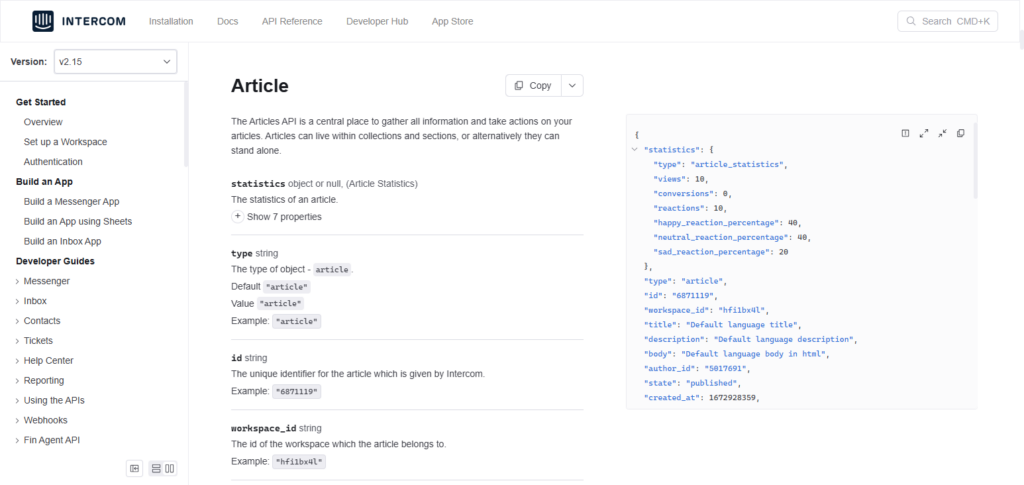
This API is great to use in conjunction with automation and live chat. As an integration for the Intercom platform, it is one of the leading AI Knowledge Base APIs for Customer Support. It allows AI chatbots and messaging platforms to pull and even display articles in real time.
Intercom Articles API Details
| Feature | Details |
|---|---|
| Article Management | Create, update, delete, and organize help articles. |
| Messenger Integration | Display articles directly inside Intercom Messenger. |
| AI Chatbot Support | Works with AI bots for instant customer assistance. |
| Collection Management | Organize articles into collections. |
| Localization | Support multiple languages for global customers. |
| Search Functionality | Quickly retrieve relevant documentation. |
| User Permissions | Restrict editing and publishing rights. |
| Automation Integration | Connect with automated customer support workflows. |
| REST API | Standard API for developers. |
| Analytics | Measure article performance and customer usage. |
8. Kustomer Knowledge API
The Kustomer Knowledge API allows developers to manage customer support articles and access knowledge intelligence and content retrieval via secure APIs. It is recognized as one of the Best AI Knowledge Base APIs for Customer Support as it aids AI assistants in rapidly delivering timely, relevant, and documented answers.
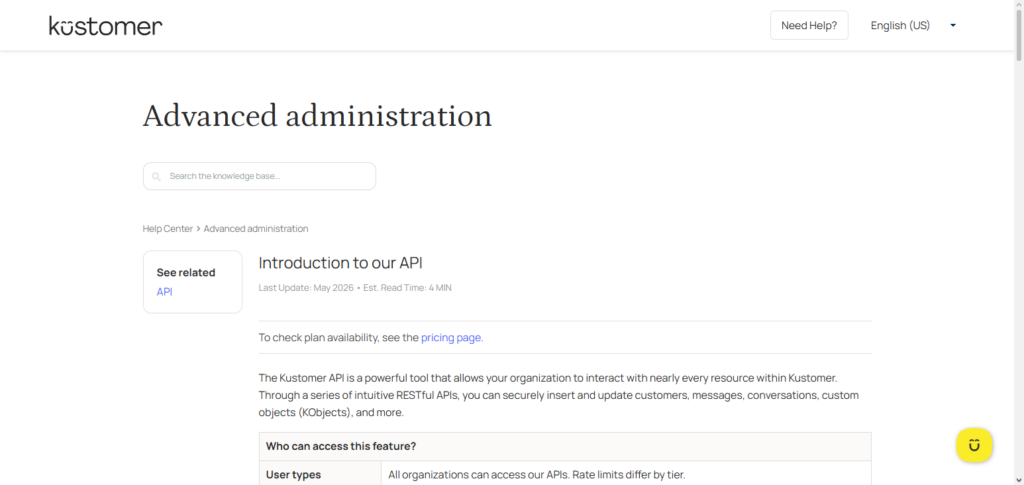
Companies can automate the updating of articles, the categorizing of knowledge, and the managing of access and can control the knowledge provided across the support channels. The API is designed to work with CRM systems, message systems, and tools for managing the automation of workflows to enhance the efficiency of customer support.
The combination of security for an enterprise, customizable workflows, analytics, and omnichannel support makes the API a good fit for companies with a large volume of customer interactions.
Kustomer Knowledge API Details
| Feature | Details |
|---|---|
| Knowledge Content API | Manage FAQs, articles, and documentation. |
| Omnichannel Integration | Share knowledge across chat, email, and messaging. |
| AI Recommendations | Suggest relevant articles using AI. |
| CRM Integration | Connect knowledge with customer profiles. |
| Search Optimization | Intelligent article search capabilities. |
| Permission Management | Secure access for teams and customers. |
| Workflow Automation | Automate article updates and publishing. |
| REST API | Easy integration with external applications. |
| Analytics Reports | Track knowledge usage and effectiveness. |
| Enterprise Security | Supports secure authentication and encryption. |
9. Helpjuice API
Helpjuice API streamlines knowledge management by allowing developers to use RESTful APIs to automate the creation, editing, organization, and retrieval of articles. It is one of the Best AI Knowledge Base APIs for Customer Support because it provides advanced searching, content categorization, user permissions, and version control, as well as support for multilingual documentation.
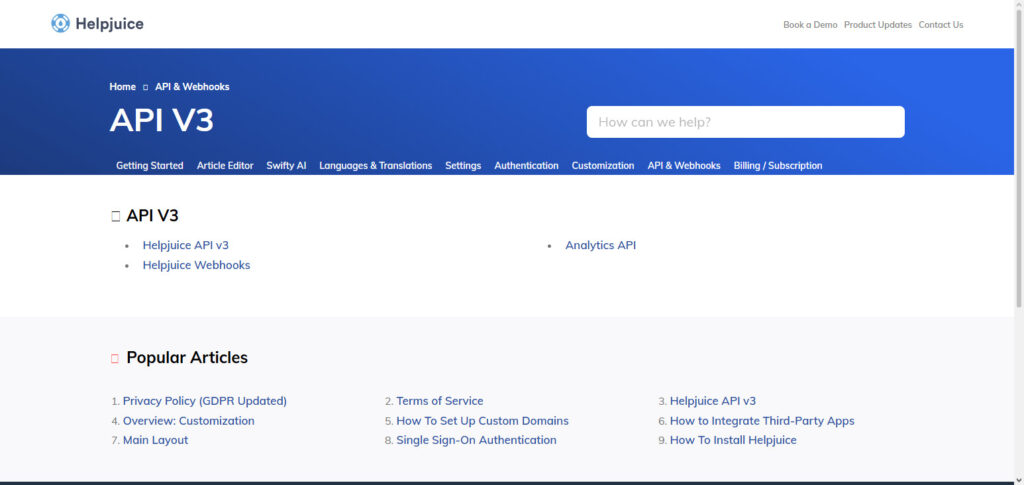
Companies can link AI chatbots and customer portals to provide automatic and relevant answers and decrease the number of support requests. The robust analytics help knowledge base creators understand the engagement with articles and customers. With easy implementation, customizable knowledge bases, secure authentication, and collaboration features, Helpjuice is a great choice for growing support teams.
Helpjuice API Details
| Feature | Details |
|---|---|
| Knowledge Base Management | Create and organize documentation efficiently. |
| Advanced Search | AI-powered search for quick information retrieval. |
| Custom Branding | Fully customize the appearance of the knowledge base. |
| Version Control | Maintain complete article revision history. |
| User Roles | Assign editing and viewing permissions. |
| Team Collaboration | Multiple authors can collaborate on articles. |
| Multilingual Documentation | Support global audiences with multiple languages. |
| API Integration | Connect with business software and automation tools. |
| Analytics Dashboard | Monitor search trends and article performance. |
| Secure Authentication | Protect API access using secure credentials. |
10. Document360 API
The Document360 API includes secure REST APIs for content, documentation, category, user, and publishing workflow management for your knowledge base and documentation. It has the tools for the AI and customer support developers, and is among the Best AI Knowledge Base APIs for Customer Support.
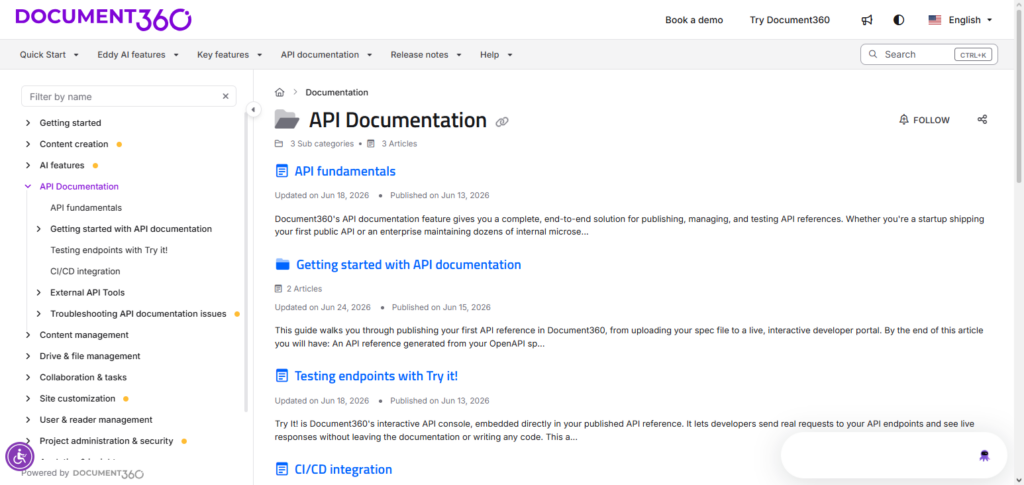
Because it helps your AI chatbots, virtual assistants and self-service portal access the right documentation instantly. The API has version history support, markdown editing, multilingual support, advanced searching, and analytics, as well as workflow automation and role-based access control.
Companies can integrate it with ticketing, CRM, and automation apps to bring better customer support while ensuring their documentation is consistent and clear across every team.
Document360 API Details
| Feature | Details |
|---|---|
| Content Management API | Manage articles, categories, users, and documentation. |
| Markdown Editor Support | Create rich technical documentation using Markdown. |
| AI Search | Intelligent search for faster article discovery. |
| Version History | Track every content modification. |
| Category Management | Organize documentation into structured categories. |
| Workflow Automation | Automate review and publishing processes. |
| Multilingual Knowledge Base | Publish documentation in various languages. |
| Role-Based Access | Manage permissions for writers and readers. |
| Analytics & Insights | Track user engagement and documentation performance. |
| Third-Party Integrations | Connect with CRM, help desk, and collaboration tools. |
Challenges and Limitations of AI Knowledge Base APIs
Complicated Initial Setup – Employing AI Knowledge Base APIs to enhance customer support systems, CRMs, and chatbots can be time-consuming and require a great deal of expertise.
Content Quality Dependence – Knowledge bases must provide content of a high, structured, and chronological quality if they are to provide correct responses and avoid providing outdated incorrect responses.
Continuous Upkeep – Regular updates, reviews, and re-writes are necessary to maintain the relevance of the knowledge base.
Hurdles to Integration – Many APIs require custom coding to provide the needed integration with older systems and other specialized business systems.
Cost of Subscriptions and API Calls – Modern, high-end AI Knowledge Base APIs usually involve a subscription fee and rate limiting on API calls.
Team Training Requirements – Customer support personnel, content managers, and developers must be trained to aid in the API’s management.
Data Protection Challenges – To safeguard client and corporate data, appropriate encryption, authentication, and access controls must be instituted.
Search and Recommendation Limitations – AI systems that provide searches and recommendations often provide irrelevant and incomplete solutions.
Limited System Modifications – Custom workflows, search methods, and UI systems require a great deal of advanced coding and are rarely supported by most systems.
Scalability Issues – Most contemporary APIs are designed for scalability. However, organizations experiencing very high traffic are likely to need higher-tier plans or additional infrastructure.
Vendor Lock-In – APIs create dependencies as organizations become reliant on a provider’s ecosystem. Future migration to another provider will become more expensive and more challenging.
Compliance and Other Considerations – APIs must have the ability to satisfy the data protection requirements for the industry in which the organization that will be adopting the API operates. Examples of such requirements would be the GDPR, HIPAA, SOC 2, and similar requirements.
Common Use Cases
AI Customer Support Chatbot: Knowledge Base APIs allow AI-powered customer service chatbots to locate and reference help articles and FAQ and troubleshooting guides to respond to inquiries without human aid.
Customer Self-Service Portals: Knowledge Base APIs provide the foundation for Customer Self-Service Portals to help customers locate the documentation and support needed to resolve issues and learn about the product or service.
Help Desk and Ticketing Systems: Help Desk software applications include knowledge articles to help support staff resolve customer support ticket issues.
Internal Employee Knowledge Bases: Many companies create repositories of knowledge articles for employees to learn about and access company policies, HR documents and procedures, IT documents and procedures, and training materials.
Virtual AI Assistants: AI-based virtual assistants provide context-aware answers using Knowledge Base APIs across a myriad of web, mobile, messaging, and voice platforms.
IT Service Management (ITSM): IT Management teams build automated troubleshooting guides and resolution to incidents and integrate technical documentation and Knowledge Base APIs to IT Service Management platforms.
SaaS Product Documentation: Knowledge Base APIs assist software firms publish user guides and API documentation and onboarding and feature-focused documentation.
Ecommerce Customer Support: Knowledge Base APIs respond to an online store’s customer inquiries pertaining to orders, shipment, returns, refunds, warranties, and product usage.
Healthcare and Patient Support: Knowledge Base APIs help healthcare companies support patients with pertinent questions regarding services, making appointments, insurance, and general medical FAQs.
Banking and Financial Services – We see the implementation of AI Knowledge Base APIs in banking and financial services in applications that allow customers to safely manage their accounts and digital banking, as well as loans and banking-related questions through self-service options.
Enterprise Knowledge Management – These APIs streamline the automation of document centralization across divisions for large enterprises, providing customers and employees with access to current information.
Developer Portals and API Documentation – AI Knowledge Base APIs are helpful for companies providing technology to other companies in building searchable developer portals that contain SDKs, tutorials, code snippets, release notes, and more.
Conclusion
Selecting the ideal AI Knowledge Base APIs for Customer Support involves considering your business size, customer support needs, and software already in use. For larger support operations, APIs such as Zendesk, Freshdesk, Salesforce, and ServiceNow are appropriate.
HubSpot, Intercom, Helpjuice, and Document360 are flexible options for smaller businesses. Organizations can integrate AI Knowledge Base APIs to automate customer support, enhance self-service options, lower support costs, and boost employee productivity. Integrating the appropriate API provides the advantage of rapid, precise, and reliable customer support and creates a foundation for iterative service support using AI.
FAQ
What is an AI Knowledge Base API
An AI Knowledge Base API allows developers to access, manage, and retrieve knowledge base content programmatically. It enables AI chatbots, virtual assistants, and customer support applications to provide accurate answers using stored documentation.
Why should businesses use AI Knowledge Base APIs?
Businesses use AI Knowledge Base APIs to automate customer support, improve self-service options, reduce support ticket volume, deliver faster responses, and ensure consistent information across multiple support channels.
Which is the best AI Knowledge Base API for customer support?
The best API depends on your needs. Zendesk, Salesforce Knowledge, Freshdesk, ServiceNow, HubSpot Service Hub, Intercom, Zoho Desk, Helpjuice, Kustomer, and Document360 are among the top choices.
Can AI chatbots integrate with Knowledge Base APIs?
Yes. Most AI Knowledge Base APIs integrate seamlessly with AI chatbots, virtual assistants, and conversational AI platforms, allowing bots to retrieve relevant articles and answer customer questions automatically.
Do AI Knowledge Base APIs support multilingual content?
Yes. Many leading APIs, including Zendesk, Salesforce Knowledge, Freshdesk, and Document360, support multilingual knowledge bases for serving customers in different languages.