



This article discusses the innovations in digital defense systems brought about by the Best AI Agents for Cybersecurity Threat Monitoring. In this article. AI-focused Cybersecurity Threat Monitoring helps organizations identify, analyze, and counteract cyber threats in real time.
Machine learning and automation are rapidly developing. Learn more about how these leading solutions improve security, decrease potential risks, and reinforce enterprise threat monitoring and mitigation frameworks.
Key Point & Best AI Agents for Cybersecurity Threat Monitoring
| AI Agent | Key Points |
|---|---|
| Darktrace AI Agent | Uses self-learning AI to detect unknown threats, real-time anomaly detection, autonomous response actions, behavioral analysis of users/devices, minimal human input required |
| CrowdStrike Falcon AI | Cloud-native endpoint protection, AI-driven threat intelligence, fast malware detection, behavioral analytics, lightweight agent for endpoints |
| Palo Alto Cortex XDR AI | Correlates data across network, endpoint & cloud, advanced threat hunting, AI-based incident prioritization, automated investigation workflows |
| SentinelOne Singularity AI | Autonomous endpoint protection, real-time threat detection & rollback, AI behavioral analysis, offline protection capability, automated remediation |
| Microsoft Defender AI Agent | Integrated with Microsoft ecosystem, AI-powered threat detection, identity & endpoint protection, automated investigation & response, cloud-scale security analytics |
| IBM QRadar AI | AI-driven SIEM platform, log analysis & threat correlation, predictive threat intelligence, automated alert prioritization, strong enterprise compliance support |
| Splunk Enterprise Security AI | Big data security analytics, AI-based anomaly detection, real-time monitoring dashboards, threat correlation engine, customizable security insights |
| Elastic Security AI Agent | Open-source SIEM + endpoint protection, ML-based anomaly detection, scalable log analytics, threat hunting tools, real-time alerting system |
| Fortinet FortiAI | AI-powered SOC automation, deep learning threat detection, reduces false positives, incident response automation, integrated with Fortinet Security Fabric |
| Check Point Horizon AI | Cloud-native AI security platform, predictive threat prevention, automated SOC workflows, advanced threat intelligence sharing, unified security management |
1. Darktrace AI Agent
Darktrace AI Agent is an AI-based cybersecurity system that uses self-learning capabilities to monitor threats and provide responses in real time. It monitors each user and device to build a dynamic pattern of life, enabling Darktrace to monitor and detect abusive behaviors without relying on predefined rules.
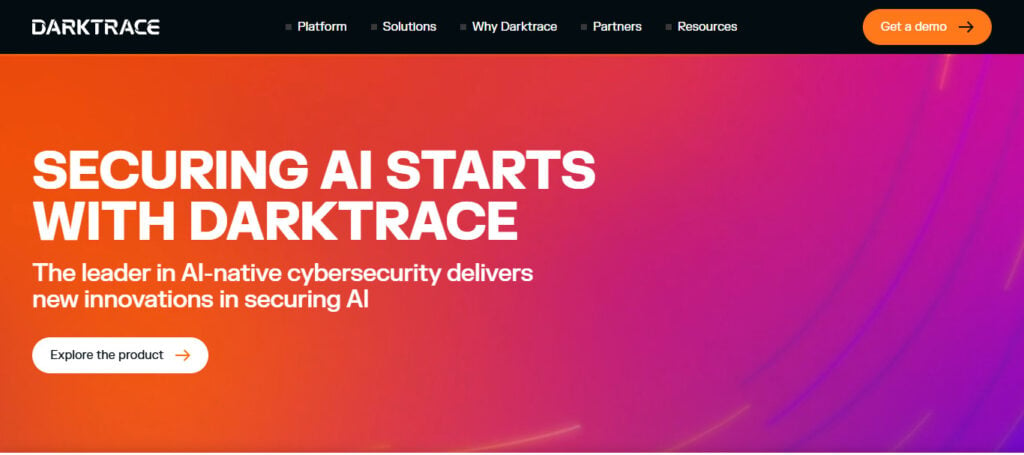
This self-learning capability equips Darktrace to be protective against zero-day attacks and threats coming from within. Darktrace is among the Best AI Agents for Cybersecurity Threat Monitoring, because it adapts to attacks and threat responses autonomously and therefore reduces the need for security personnel. It is mainly built for use in enterprise environments for threat prediction and protective measures.
Darktrace AI Agent Features
- AI auto learns various “patterns of life” for users and devices
- Zero-day anomaly detection
- Zero-day threat detector with an incident-response automation feature
- AI auto learns various “patterns of life” for users and devices
- Auto monitors networks with
Darktrace AI Agent
| Pros | Cons |
|---|---|
| Strong self-learning AI for unknown threats | High cost for enterprise deployment |
| Real-time anomaly detection | Requires tuning for best accuracy |
| Autonomous response reduces workload | Can generate occasional false positives |
| Works well in zero-day attack detection | Complex setup for beginners |
| No reliance on signature-based detection | Limited transparency in AI decision-making |
2. CrowdStrike Falcon AI
CrowdStrike Falcon AI is a framework for protection that is based in the cloud and uses AI and behavioral analytics to prevent endpoint-related breaches. It employs a mechanism of protection that is built on real-time detection of threats and a self-scaling mechanism across global enterprise environments.
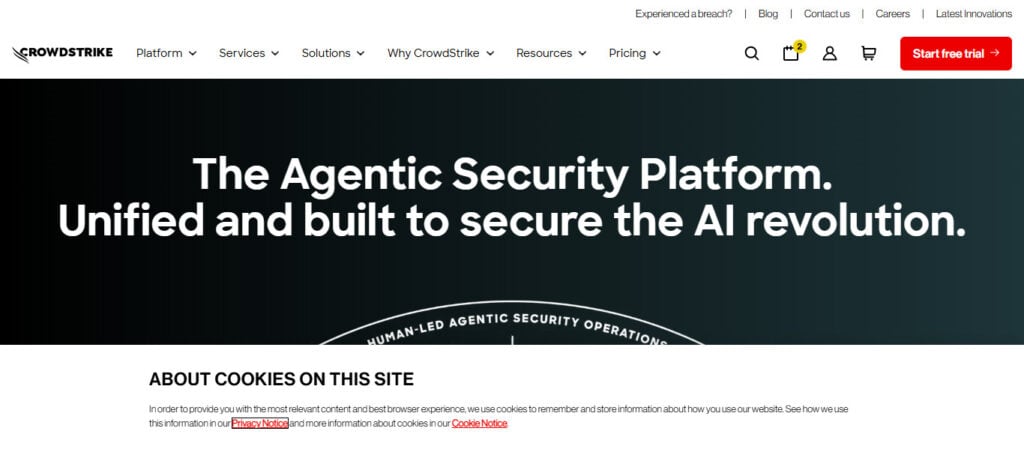
Falcon AI is among the Best AI Agents for Cybersecurity Threat Monitoring because of its efficient detection and response capability. Additionally, the product has a limited impact on the performance of the system and provides threat visibility along with forensic insights. Further, it is equipped with hunting tools.
CrowdStrike Falcon AI Features
- A lightweight agent for cloud-native endpoint protection
- AI and behavioral-based protection
- Malware and ransomware detection
- Real-time threat detection and incident-response automation
- Endpoint protection and threat-response automation at scale
CrowdStrike Falcon AI
| Pros | Cons |
|---|---|
| Excellent cloud-native endpoint protection | Pricing can be expensive for small businesses |
| Fast threat detection and response | Requires stable internet connectivity |
| Strong global threat intelligence network | Some advanced features need higher-tier plans |
| Lightweight agent with low system impact | Can be complex for non-technical users |
| Highly scalable for enterprises | Limited offline protection |
3. Palo Alto Cortex XDR AI
Cortex XDR AI by Palo Alto combines network, endpoint, and cloud data to provide an integrated threat detection and response solution. It employs machine learning to connect disparate cybersecurity events and recognize attack patterns beyond the capabilities of conventional security systems.
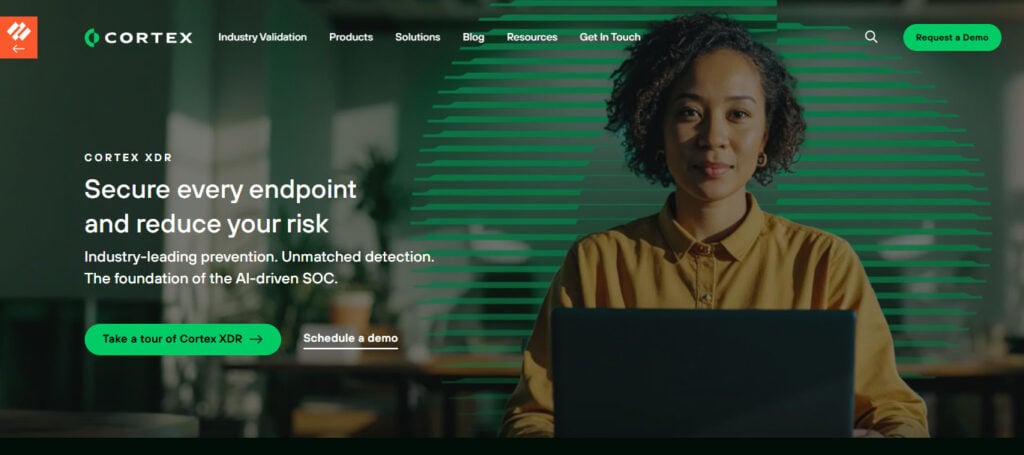
With the help of AI and security automation, Cortex XDR prioritizes and addresses security events with the highest risk. Cortex XDR is the most effective solution for hunting threats, streamlining investigations, and automating the security response process, which improves lateral movement detection of cyber threats, insider threats, and multi-stage cyber intrusions, thereby improving the security environment of the organization.
Palo Alto Cortex XDR AI Features
- Data correlation across endpoints and networks and cloud
- Pattern-based attack detection with AI to identify threats
- AI auto prioritizes alerts and conducts incident investigations
- Enhanced threat hunting
- AI auto prioritizes alerts and conducts incident investigations
Palo Alto Cortex XDR AI
| Pros | Cons |
|---|---|
| Strong cross-platform threat correlation | Expensive licensing model |
| Advanced threat hunting capabilities | Requires skilled security team |
| Reduces alert fatigue with AI prioritization | Complex deployment process |
| Automated investigation workflows | Resource-heavy for smaller systems |
| Strong integration with Palo Alto ecosystem | Learning curve for new users |
4. SentinelOne Singularity AI
SentinelOne Singularity AI provides endpoint security that uses artificial intelligence to autonomously detect, block, and remediate threats in real time, without the need for human interaction. It uses behavioral AI to identify malicious activity, even when the host computer is offline.
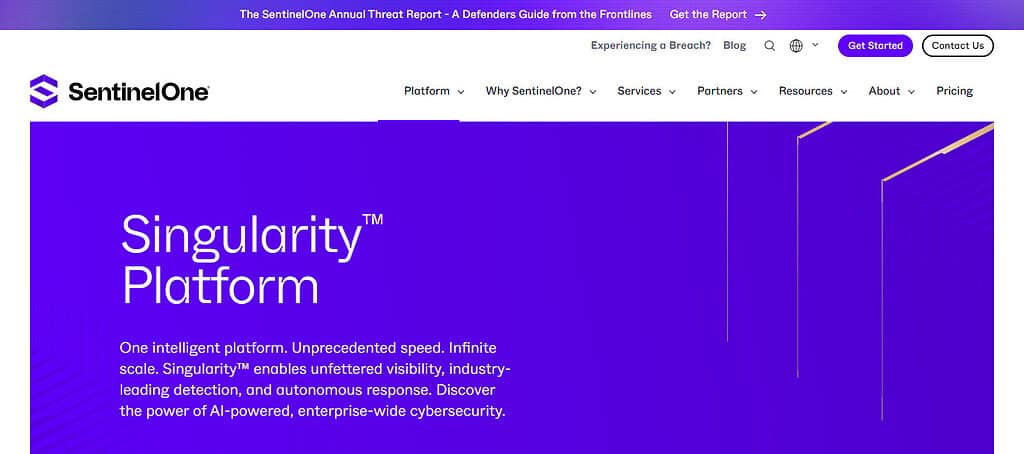
Singularity is one of the Best AI Agents for Cybersecurity Threat Monitoring because its automated threat response capability includes the restoration of systems after a ransomware attack or infection with malware.
Additionally, the product offers a unified security console that allows organizations to protect endpoint computers, cloud workloads, and all the IoT devices in their enterprise environment. This has positioning SentinelOne as a leading option for a security solution.
SentinelOne Singularity AI Features
- AI automation of EDR and endpoint protection
- Protection, detection, and threat remediation in real time
- AI advanced attacks behavioral analysis
- Protection of an endpoint in isolation
- Auto rollback to an uninfected state
SentinelOne Singularity AI
| Pros | Cons |
|---|---|
| Fully autonomous endpoint protection | Higher pricing compared to competitors |
| Real-time detection and remediation | Requires system resources |
| Offline threat protection | Advanced features require premium plans |
| Automated rollback for ransomware recovery | Complex configuration for beginners |
| Strong behavioral AI engine | Limited third-party integrations |
5. Microsoft Defender AI Agent
The Microsoft Defender AI Agent is an advanced built-in security solution in the Microsoft ecosystem that protects against sophisticated threats. AI-driven analytics coupled with Microsoft Defender continuously monitor Email, Endpoints, Identity, and Cloud Applications for threats.
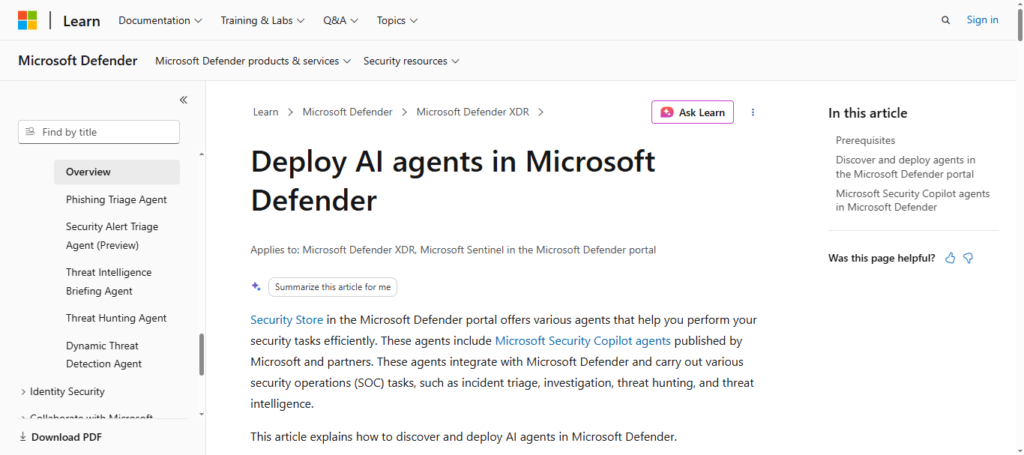
The Microsoft Defender AI Agent seamlessly integrates with Azure Security Center and Microsoft 365. Defender is one of the Best AI Agents for Cybersecurity Threat Monitoring, due to its capabilities of automated investigation and remediation, which diminishes response times. Its ease of deployment, scalability, and solid integration with the existing Microsoft infrastructure, makes it the most sought after solution for enterprises.
Microsoft Defender AI Agent Features
- Threats to Ir e-mail, identity, and endpoints in real time with AI
- AI-based endpoint protection across 365 and Azure environments
- AI auto conducts investigations and mitigates threats
- Security analytics with protection and AI
Microsoft Defender AI Agent
| Pros | Cons |
|---|---|
| Deep integration with Microsoft ecosystem | Best features limited to Microsoft environment |
| Easy deployment for enterprises | Can generate high alert volume |
| Strong identity and endpoint protection | Requires Azure ecosystem for full power |
| Automated investigation and response | Less effective outside Windows systems |
| Cost-effective for Microsoft users | Limited customization compared to rivals |
6. IBM QRadar AI
At the cornerstone of the AI-enabled Cybersecurity is IBM QRadar AI that is a builder of the Security Information and Event Management (SIEM) platform. QRadar AI collects and integrates data from disparate systems to see and interpret the threats for intelligent and automated prioritization of alerts.
Being one of the Best AI Agents for Cybersecurity Threat Monitoring, QRadar AI provides predictive threat intelligence that assists the Security Operations Team to focus on the critical threats while eliminating the possibility of false positive alerts. Its solid analytics and reporting capabilities, makes it a good solution for larger enterprises with complex regulatory requirements.
IBM QRadar AI Features
- Log and event analysis via AI-based SIEM
- Threat correlation across enterprise systems
- Analytics and forecasting of potential future risks
- Pre-filtered alerts by relevance and priority
- Robust compliance and regulatory reporting capabilities
IBM QRadar AI
| Pros | Cons |
|---|---|
| Powerful SIEM with advanced analytics | High complexity for setup |
| Strong compliance and reporting tools | Expensive for small businesses |
| AI-driven threat correlation | Requires skilled analysts |
| Scales well for large enterprises | UI is less modern |
| Reliable enterprise-grade security | Heavy infrastructure requirements |
7. Splunk Enterprise Security AI
Splunk Enterprise Security AI provides a platform designed to enhance cybersecurity operations through advanced data analytics. Its machine learning capabilities promote automated, real-time detection, correlation, and investigation of security threats and incidents across hybrid environments.
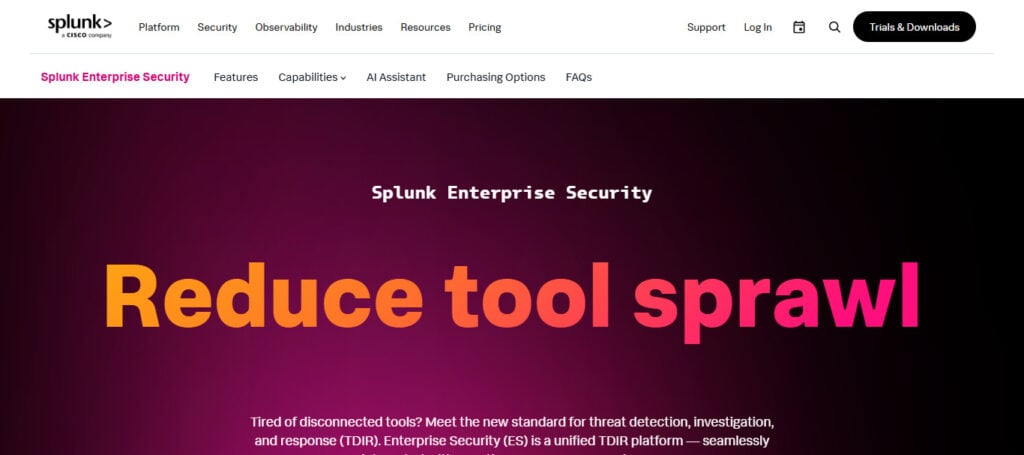
Splunk’s AI engine assists in identifying security anomalies and threats before they intensify. In the context of Best AI Agents for Cybersecurity Threat Monitoring,
Splunk augments its analytic capabilities with customizable dashboards bolstered by automated alerts. Splunk is ideal for security operations centers (SOCs) where it can optimize real-time incident response, reduce investigative workload, and facilitate proactive threat hunting.
Splunk Enterprise Security AI Features
- Security analytics platform powered by Big Data
- Anomaly detection with machine learning
- Security monitoring with real-time dashboards
- Threats correlation and investigation capabilities
- Flexible rule creation for your tailored alerts
Splunk Enterprise Security AI
| Pros | Cons |
|---|---|
| Excellent big data security analytics | Very expensive licensing |
| Real-time monitoring dashboards | High resource consumption |
| Strong threat correlation engine | Requires expert configuration |
| Highly customizable alerts and rules | Complex for beginners |
| Great SOC integration tools | Steep learning curve |
8. Elastic Security AI Agent
Elastic Security AI Agent provides an open-source platform that unifies Security Information and Event Management (SIEM) capabilities, endpoint protection, and threat hunting. Elastic’s architecture is designed to easily scale, enabling machine learning throughout your logs and endpoints and facilitating the detection of anomalous and suspicious behavior.
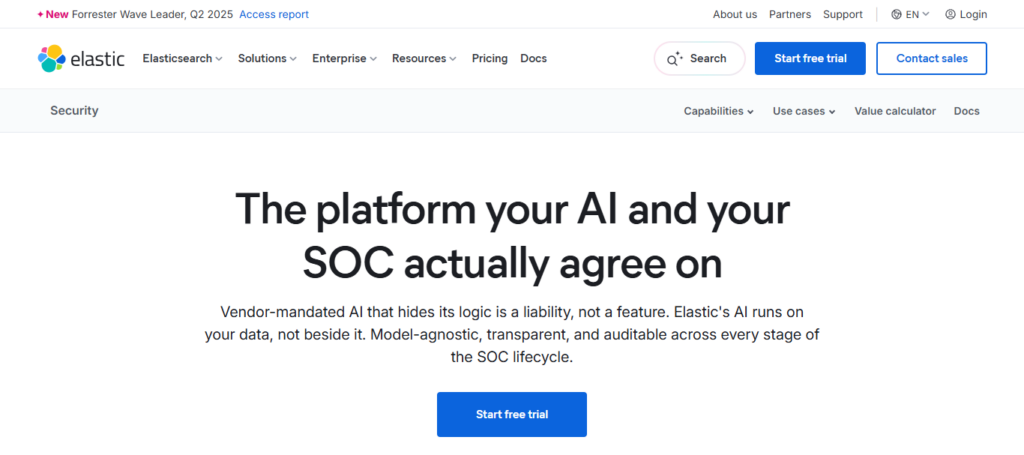
Elastic Security constitutes one of the Best AI Agents for Cybersecurity Threat Monitoring as it offers a highly flexible platform that is developer-friendly and cost-effective. This highly scalable, open-source security solution provides behavioral analytics, real-time alerts, and detection rules that can be customized for your organization. Many companies choose Elastic Security due to their strong integration capabilities and transparency.
Elastic Security AI Agent Features
- SIEM and endpoint security offering with open source
- Advanced log analysis powered by machine learning
- Threat detection and alerts in real-time
- Security automation and dashboards with differentiated capabilities
- Advanced integration capabilities with Elastic Stack
Elastic Security AI Agent
| Pros | Cons |
|---|---|
| Open-source flexibility | Requires technical expertise |
| Scalable and cost-efficient | Less enterprise support than competitors |
| Strong ML-based detection | Setup can be complex |
| Real-time threat detection | Limited out-of-box enterprise features |
| Good integration with Elastic Stack | Needs manual tuning for best results |
9. Fortinet FortiAI
Fortinet AI FortiAI is a powerful AI tool and a unique product that provides an opportunity to automate security and take measures to reduce negative security alerts. It uses deep learning to evaluate streams and network data with high performance and great precision.
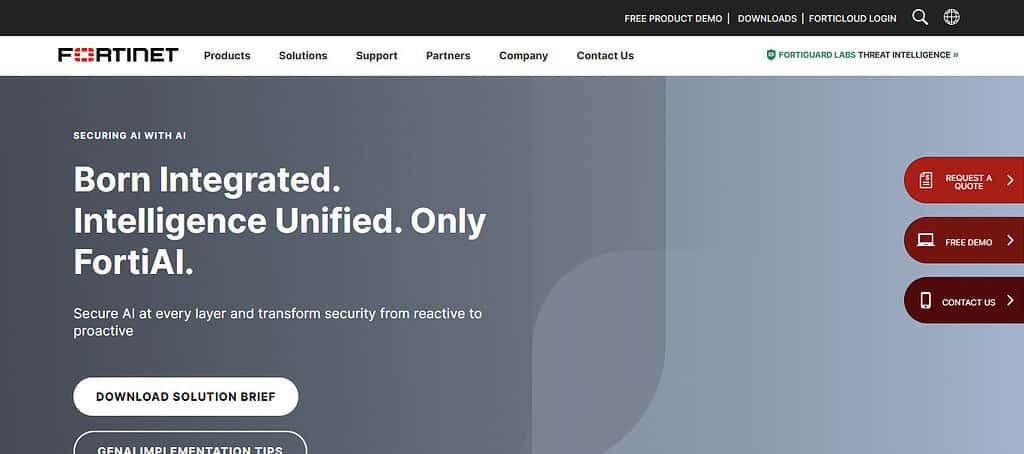
FortiAI is an automated tool that provides an analysis of incidents and offers recommendations for automated responses. FortiAI increases visibility and improves efficiency of security operations. FortiAI is a member of the family of products for the category of Best AI Agents for Cybersecurity Threat Monitoring.
It further supports Security Fabric of Fortinet and increases the visibility of threats in all sections of the network. FortiAI increases the performance of security operations by reducing manual effort and improving the time required to resolve incidents.
Fortinet FortiAI Features
- Advanced deep learning systems for threat detection
- Incident classification with automated SOC operations
- AI filtering with reduced false positive outcomes
- Advanced integration capabilities with Fortinet Security Fabric
- Recommendations for SOC analysts with real-time evidence
Fortinet FortiAI
| Pros | Cons |
|---|---|
| Strong SOC automation capabilities | Works best within Fortinet ecosystem |
| Reduces false positives significantly | Limited flexibility outside Fortinet tools |
| Deep learning-based threat detection | Enterprise-focused pricing |
| Fast incident classification | Requires Fortinet infrastructure |
| Strong network security integration | Not ideal for small businesses |
10. Check Point Horizon AI
Check Point Horizon AI is a product that is cloud based and provides protection against cyber threats using foreseeing protection against threats. The main features offered by Check Point Horizon AI are based on prediction of threats and the analysis of security incidents that allow central management of defenses and security incidents.
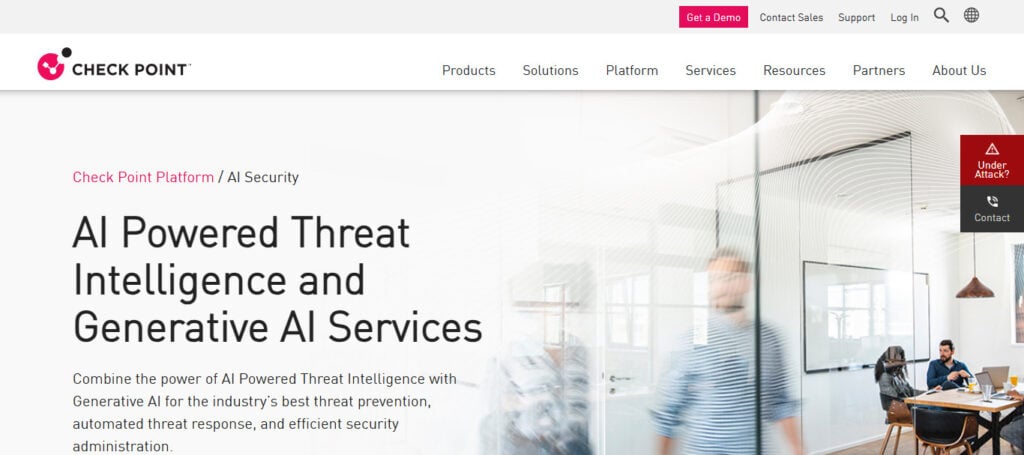
This AI engine constantly provides help to analysts in combating an attack in a timely manner against incidents that are based on modern attacks. Horizon AI is one of the Best AI Agents for Cybersecurity Threat Monitoring. It is an ideal solution that offers integration of protection for networks, endpoints, and the cloud with a unified threat management system that is optimal.
Check Point Horizon AI Features
- AI cybersecurity platform in the cloud
- Advanced threat prevention with global intelligence
- Automated SOC operations with advanced threat response
- Unified management capabilities for cloud, SOC, and endpoint
- Threats detection with real-time evidence collection
Check Point Horizon AI
| Pros | Cons |
|---|---|
| Strong cloud-native security platform | Can be expensive for full deployment |
| Predictive threat intelligence | Requires learning curve |
| Automated SOC workflows | Best features locked in enterprise plans |
| Unified security management | Complex configuration |
| Strong global threat database | Limited customization for advanced users |
Conclusion
Organizations today face growing threats that require a new kind of defense. AI Agents for Cybersecurity threat monitoring like Darktrace, CrowdStrike Falcon, Palo Alto Cortex XDR, SentinelOne Singularity, Microsoft Defender, IBM QRadar, Splunk Enterprise Security, Elastic Security, Fortinet FortiAI, and Check Point Horizon AI all provide advanced protection using machine learning, automated processes, and real-time analytics.
These tools diminish response times and human error while providing greater visibility across endpoints, networks, and cloud environments. Each has its own strengths, be it autonomous response, deep analytics, or SIEM integration, but they are united in the goal of threat prevention. Because of how complex and frequent cyberattacks are today, it is vital that organizations adopt AI-powered security agents in order to foster a strong and resilient security posture.
FAQ
What are AI agents for cybersecurity threat monitoring?
AI agents for cybersecurity are intelligent software systems that use machine learning, behavioral analytics, and automation to detect, analyze, and respond to cyber threats in real time. The Best AI Agents for Cybersecurity Threat Monitoring help organizations identify anomalies, prevent attacks, and improve overall security posture with minimal human intervention.
Why are AI agents important in cybersecurity?
AI agents are important because modern cyber threats are fast, complex, and constantly evolving. Traditional security systems often fail to detect unknown attacks. The Best AI Agents for Cybersecurity Threat Monitoring provide proactive defense, faster response times, reduced false alerts, and continuous monitoring across networks, endpoints, and cloud environments.
Which are the best AI agents for cybersecurity threat monitoring?
Some of the leading solutions include Darktrace AI, CrowdStrike Falcon AI, Palo Alto Cortex XDR AI, SentinelOne Singularity AI, Microsoft Defender AI, IBM QRadar AI, Splunk Enterprise Security AI, Elastic Security AI Agent, Fortinet FortiAI, and Check Point Horizon AI. These are widely recognized as the Best AI Agents for Cybersecurity Threat Monitoring.
How do AI cybersecurity agents detect threats?
AI cybersecurity agents use behavioral analysis, anomaly detection, machine learning models, and real-time data correlation. The Best AI Agents for Cybersecurity Threat Monitoring continuously learn from network activity and detect unusual patterns that may indicate malware, ransomware, or insider threats.