




This article focuses on patient-matching platforms driven by medical AI that allow researchers to locate qualified candidates with a higher degree of accuracy and convenience.
These platforms utilize AI, ML, and clinical data analytics to optimize recruiting, mitigate lags in enrollment, enhance the overall efficacy of the trial, and provide tailored clinical research solutions to myriad organizations in pharma, biotech and health care.
What Are Clinical Trial Patient Matching Platforms?
A patient matching platform for clinical trials is a sophisticated software program that finds eligible patients and matches them to a specific clinical trial.
AI, Machine Learning, Natural Language Processing, and advanced healthcare analytics drive the platforms’ capabilities to interpret and analyze a patient’s Electronic Health Record, as well as their clinical test histories, lab test results, and other clinical documentation.
These platforms streamline the process of patient enrollment by automating the labor-intensive manual tasks of patient recruitment and considering clinical trial eligibility.
As a result, clinical trial matching platforms optimize clinical trial patient enrollment and assist clinical trial sponsors to ensure an optimal patient population and maximize the practical benefits of clinical trials.
How Medical AI Models Improve Clinical Trial Recruitment
Expedited Patient Identification: Patient data from the EHR is searched by Medical AI models to identify patients eligible for clinical trials faster.
Greater Matching Precision: Medical AI models reduce participation mismatches through accurate evaluation of eligibility.
Reduced Manual Efforts in Recruitment: Medical AI models evaluate patient histories and diagnostics to automate recruitment efforts.
Optimized Recruitment Timeline: Time lost on recruiting is reduced for clinical trial sponsors through quicker patient discovery.
Enhanced Interpretation of Unstructured Data: Medical AI’s NLP capabilities aid in the analysis of unstructured data.
Improved Scientific Validity Pre-Assessment for Clinical Trials: Medical AI can assist in determining the patient population to decide on the feasibility of a clinical trial.
Improved Recruitment of Underrepresented Populations: Medical AI contributes to the recruitment of patients through a broader range of demographics and geographic populations.
Predictive Analytics for Recruitment: Medical AI uses advanced analytics to dynamically retrieve data for patient recruitment.
Cost Optimization for Clinical Trials: Medical AI reduces the administrative burden of screening and recruiting patients, lowering the cost of clinical trials.
Greater Confidence in Clinical Trial Outcomes: Medical AI increases the efficiency of recruiting trial participants, which improves the outcomes of clinical trials.
Benefits of Using Clinical Trial Patient Matching Platforms
Faster Patient Recruitment – Patient Matching Platforms assist research teams in reaching trial enrollment goals and shortening delays associated with conducting trials.
Greater Matching Precision – Patient Matching Platforms that utilize advanced AI provide research teams with candidates whose profiles are likely to be eligible.
Less Manual Screening Time – Patient Matching Platforms that utilize EHRs and automated data analysis substantially reduce the need for research teams to manually review candidate profiles.
Efficiency of Clinical Trials – Reduced time to recruit and evaluate trial volunteers increases the efficiency of trial operations and reduces the time required to complete the development of the trial.
Reduced Costs – Less time and effort required to recruit trial volunteers lowers the cost of conducting clinical trials.
Increased Patient Range – Patient Matching Platforms have the potential to broaden the range of patients and volunteers by relying on multiple healthcare databases.
Greater Patient Inclusion – Patient Matching Platforms improve the participant inclusion profile by recruiting candidates from varying demographics and geographies.
Better Patient Data Utilization – Systems that utilize AI have the capability of analyzing both structured and unstructured patient data to identify participants who would remain hidden in traditional clinical data.
More Accurate Trial Planning – Patient Matching Platforms improve the ability to accurately forecast trial recruitment and improve the likelihood of successful clinical trial completion.
Greater Probability of Successful Clinical Trials – The ability to recruit suitable clinical trial candidates enhances the reliability of the research and improves the probability of successful clinical trials.
Key Point & Best Clinical Trial Patient Matching Platforms Powered by Medical AI Models
| Platform | Key Points |
|---|---|
| Deep 6 AI | • Uses AI to scan EHR data for eligible trial participants.• Identifies patients in real time across healthcare systems.• Reduces manual chart review efforts.• Accelerates patient recruitment timelines.• Supports complex inclusion and exclusion criteria.• Improves enrollment efficiency for sponsors and sites. |
| TriNetX AI Match | • Accesses large global healthcare datasets.• Uses AI-driven cohort discovery tools.• Helps assess trial feasibility before launch.• Enables patient matching across multiple institutions.• Provides real-world evidence insights.• Supports faster recruitment planning and execution. |
| Clinerion Patient Network Explorer AI | • Searches anonymized patient records worldwide.• Delivers near real-time patient availability insights.• Helps identify suitable trial locations.• Uses AI-enhanced eligibility screening.• Improves site selection decisions.• Supports multinational clinical studies. |
| IBM Watson Health Clinical Trials AI | • Leverages natural language processing for trial matching.• Analyzes structured and unstructured clinical data.• Assists clinicians in identifying eligible participants.• Improves accuracy of patient selection.• Reduces recruitment bottlenecks.• Supports data-driven trial management. |
| Antidote Match AI | • Focuses on patient-friendly trial matching.• Uses AI to simplify eligibility assessment.• Connects patients directly with relevant studies.• Increases participant engagement and awareness.• Supports diverse patient populations.• Helps improve enrollment rates. |
| Phesi AI Trial Optimization | • Uses predictive analytics for trial planning.• Analyzes historical clinical trial data.• Forecasts recruitment performance and risks.• Optimizes protocol design and site selection.• Improves patient matching efficiency.• Reduces delays in clinical development. |
| ConcertAI Trial Match | • Combines AI with oncology-focused datasets.• Matches patients using real-world clinical evidence.• Supports precision medicine initiatives.• Enhances recruitment for complex trials.• Provides actionable insights to researchers.• Improves trial enrollment accuracy. |
| Flatiron Health AI Trials | • Specializes in oncology clinical trial recruitment.• Uses EHR-derived real-world data.• Identifies eligible patients at care sites.• Streamlines trial screening workflows.• Supports data-driven enrollment strategies.• Improves patient access to cancer studies. |
| Verily Clinical Trial Platform AI | • Integrates AI with digital health technologies.• Supports decentralized and hybrid trials.• Uses advanced analytics for participant identification.• Enhances patient monitoring and engagement.• Improves operational efficiency.• Facilitates broader trial accessibility. |
| Elligo Health Research AI | • Connects clinical research with community healthcare providers.• Uses AI to identify eligible participants.• Expands access to underrepresented populations.• Simplifies patient recruitment processes.• Supports faster study enrollment.• Enhances diversity in clinical trials. |
1. Deep 6 AI
Deep 6 AI is an innovative patient recruitment platform that leverages AI to mine electronic health records (EHRs) and find potential participants for clinical trials.
Deep 6 AI works with both structured and unstructured medical data. Automated patient screening saves significant time for research teams and the Best Clinical Trial Patient Matching Platforms Powered by Medical AI Models.
Deep 6 AI helps healthcare organizations fast track participant recruitment by optimizing trial feasibility and finding candidates with complex inclusion and exclusion criteria. Deep 6 AI, with its powerful analytics, enables research sponsors and sites to better target recruitment efforts to the right patient populations.
Deep 6 AI Features, Pros & Cons
Features
- AI driven Electronic Health Record (EHR) assessments
- Real time patient identification and matching
- Clinical notes natural language processing
- Automated screenings for eligibility
- Hospital systems integration
Pros
- Rapid patient recruitment
- Decreased time spent reviewing patient charts
- Handles complicated eligibility criteria
- Increased efficiency in enrollment
- Real time insights into recruitment
Cons
- May take a long time to EHR integration
- Enterprise wide pricing could be very high
- New users may have a learning period
- Poor data = poor results
- Large enough patient data to be worthwhile
2. TriNetX AI Match
TriNetX AI Match is an advanced clinical research platform that uses an AI-augmented analytics framework to build a global network of patient data for healthcare organizations.
TriNetX AI Match assists study sponsors with the feasibility of a clinical trial by using AI analytics to find research participants. With a robust analytics platform,
TriNetX gives researchers the ability to analyze the demographics and clinical data of a population to determine the feasibility of a study. TriNetX is one of the Best Clinical Trial Patient Matching Platforms Powered by Medical AI Models and helps improve patient recruitment and trial success.
TriNetX AI Match Features, Pros & Cons
Features
- Worldwide healthcare data network
- AI based cohort identification
- Assessment of trial feasibility
- Real world data evaluation
- Patient matching across multiple institutions
Pros
- Large patient data access
- Excellent research and data analysis
- Optimizes study design
- Worldwide trial support
- Better recruitment for trials
Cons
- Implementation costs can be high
- Participation of institutions is a must
- Data gaps exist in some geographical areas
- Steep learning curve for beginners
- Many advanced features require specific training
3. Clinerion Patient Network Explorer AI
Clinerion Patient Network Explorer AI is another patient recruitment solution that builds a global network to find participants through a collection of healthcare organizations and offers researchers many advanced tools and analytics capabilities.
The platform uses near real time anonymized patient data to show researchers the geographical distribution of participants. An AI search engine swiftly assesses eligibility requirements and identifies matched patient populations.
Clinerion ranks among the Best Clinical Trial Patient Matching Platforms Powered by Medical AI Models. It optimizes site selection and recruitment strategies. The system is designed to support multi-national studies, reduces enrollment periods, and provides insights that positively impact the strategy and execution of a clinical trial.
Clinerion Patient Network Explorer AI Features, Pros & Cons
Features
- Immediate patient search functionality
- Global network of hospitals
- AI driven eligibility matching
- Supports site selection
- Analysis using anonymized patient data
Pros
- Supports planning for recruitment
- Aids in selection of ideal trial locations
- Supports studies in multiple countries
- Near real time data
- Enrollment time lag is shortened
Cons
- Only connected health networks
- Data gaps in participating sites
- Can be costly for smaller companies
- Needs connection to hospital systems
- May not be found in all countries
4. IBM Watson Health Clinical Trials AI
IBM Watson Health Clinical Trials AI employs sophisticated natural language processing (NLP) and machine learning techniques to enhance patient recruitment and trial matching.
The platform can interpret both structured healthcare data and unstructured clinical notes, enabling accurate identification of candidate subjects. Watson further streamlines the eligibility reviewing process, resulting in a lower recruitment bottleneck and less administrative burden. It is also stands out in the category of Best Clinical Trial Patient Matching Platforms Powered by Medical AI Models.
It is designed to facilitate rapid patient identification and evidence-based clinical interventional decisions. Healthcare organizations using the platform realize enhanced recruitment, increased accuracy of candidate patient subject selection, and improved use of available clinical data.
IBM Watson Health Clinical Trials AI Features, Pros & Cons
Features
- Handles Natural Language Processing
- Can Analyze Clinical Data
- Automated Patient Eligibility Determination
- AI-powered Analysis
- Handles both Structured and Unstructured Data
Pros
- Highly developed AI
- Lessens Administrative Load
- Better Patient Match
- Designed for large-scale healthcare systems
- Aids Clinical Decisions
Cons
- Lengthy Integration
- Large System Demands
- High Upkeep Costs
- Needs healthcare data of high standards
- May need specialized healthcare IT staff
5. Antidote Match AI
Antidote Match AI is designed to facilitate participation in clinical trials for patients, while simultaneously increasing enrollment for clinical trial sponsors.
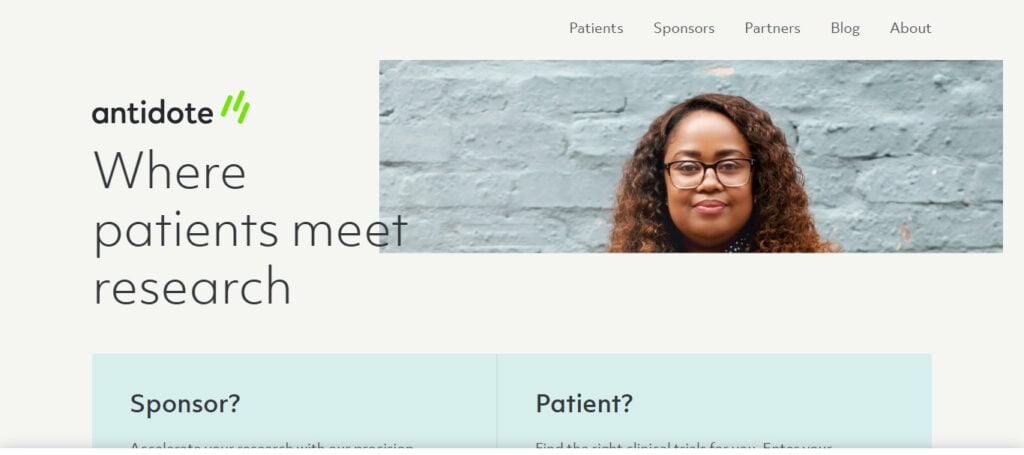
The platform employs artificial intelligence to make screening for trial eligibility less cumbersome and to better connect individuals with medical research studies. Users answer simple questions, and the platform determines medically aligned studies.
Antidote is ranked as one of the leading clinical trial patient matching platforms powered by medical AI models. It significantly boosts patient engagement and awareness. By matching participants to trials in a timely manner, the platform makes it easier for clinical researchers to recruit participants and increases patient engagement by allowing them access to ground-breaking therapies.
Antidote Match AI Features, Pros & Cons
Features
- Focused Patient Trial Match
- AI-Based Eligibility Questionnaires
- Trial Discovery with Participant Tools
- Engagement and Workflow Tools
Pros
- Patient Friendly
- Better Awareness of Trials
- Greater Engagement
- Broader Recruitment
- Better Screening
Cons
- Patient Reliance
- Control of Healthcare Data Limited
- May not meet Specialized Trials
- Recruitment Dependent on Patient
- Less Enterprise Focus
6. Phesi AI Trial Optimization
Phesi AI Trial Optimization uses advanced analytics and predictive capabilities to transform patient recruitment and improve trial execution. It provides an analysis of past trial outcomes and patient populations to offer insights and recommendations on the best approaches to participant recruitment.
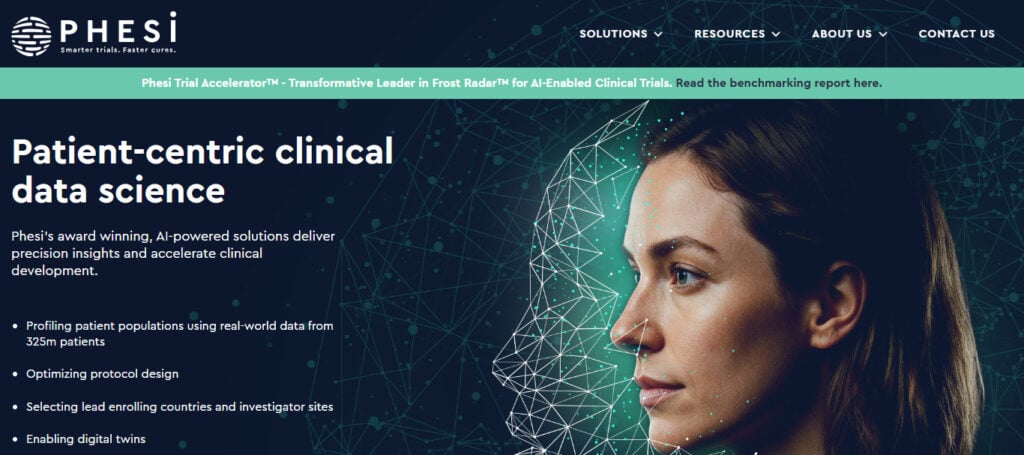
Phesi is one of the leading clinical trial patient matching platforms powered by medical AI models. Phesi reduces the recruitment challenges and barriers to access and enhances the overall productivity of the trial process by providing sponsors with the tools to undertake timely, efficient, and beneficial improvements to the trial process.
Phesi AI Trial Optimization Features, Pros & Cons
Features
- Predictive Recruitment Analytics
- Analyzes Previous Trials
- Forecasts Site Performance
- Protocol Assist with Optimization
- AI Risk Assessment
Pros
- Better Trial Design
- Recruitment Risk Decrease
- Study Design Optimization
- Insight Generation
- Faster Drug Development
Cons
- Previous Trial Data Needed
- Complex Analytics
- More expensive for smaller companies
- Accuracy of predictions relies on data
- May need specialized training to interpret results
7. ConcertAI Trial Match
ConcertAI Trial Match is a dedicated patient matching platform that uses AI and real-world clinical data to facilitate patient matching for precision medicine and oncology trials. The platform pulls data from clinical care, research, and other treatment networks to provide patient matches.
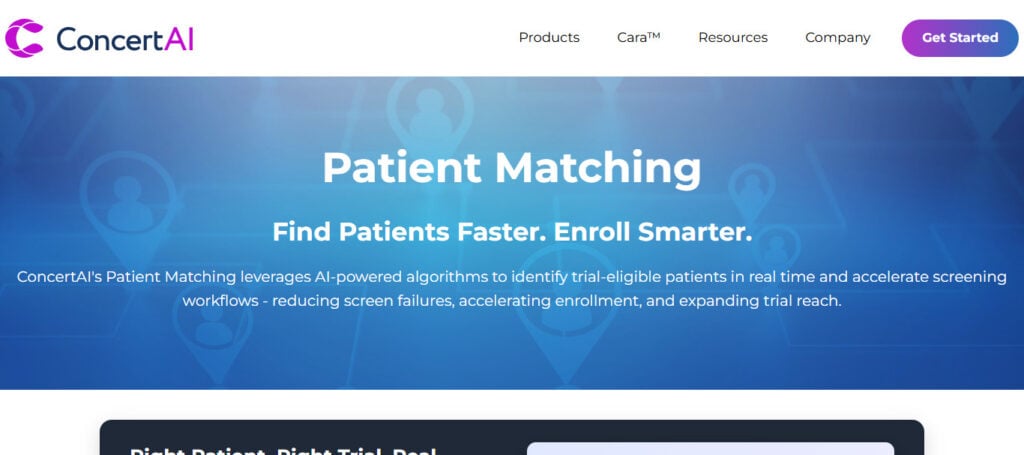
The advanced analysis helps researchers identify and target participants who meet certain disease criteria and treatment and biomarker histories. ConcertAI is one of the leading clinical trial patient matching platforms powered by medical AI tools. ConcertAI’s emphasis on oncology research is impressive, as it helps researchers with difficult studies that require narrow participant inclusion.
ConcertAI Trial Match Features, Pros & Cons
Features
- Patient matching feature focused on oncology
- AI analytics for optimizing recruitment
- Integration of real world clinical data
- Recruit based on precision medicine
- Recruit based on biomarkers
Pros
- Designed for oncology research
- Supports precision medicine
- Increased accuracy of recruitment
- Useful real world evidence
- Improved selection of patients
Cons
- Oncology focused
- Enterprise pricing
- May be complex to integrate data
- Needs specialized healthcare data
- Too large for smaller research teams
8. Flatiron Health AI Trials
Owing to its use of real-world evidence and ethnographic research, Flatiron Health’s Trials has become a popular oncology research platform to assist with the challenge of clinical trial recruitment. Flatiron identifies potential patients by placement in cancer care delivery networks and expedites the screening process for research teams.
Flatiron’s AI capabilities also reduce the burden of the manual review process on research teams by guiding the review of studies and outlining the participation criteria.
Flatiron is one of the Best Clinical Trial Patient Matching Platforms Powered by Medical AI Models for its ability to increase the speed of participant recruitment and streamline clinical trial operations. Additional benefits of Flatiron improving oncology research and clinical trial recruitment is the advancement and accessibility thereof to patients and research clinicians.
Flatiron Health AI Trials Features, Pros & Cons
Features
- Oncology data from EHRs
- Automated screening for recruitment
- Enrolment in clinical trials
- Tools for recruitment in oncology
Pros
- Extensive expertise in oncology
- High quality data in oncology
- Increased speed of recruitment
- Improved workflows for recruitment
- Increased patient access to trials
Cons
- Focus is on oncology
- Research in other cancer areas is limited
- High cost
- Integrating into healthcare systems is required
- Limited to supported networks
9. Verily Clinical Trial Platform AI
Verily Clinical Trial Platform AI has a focus on the amalgamation of AI, digital therapeutics, and analytics to further develop frameworks for the recruitment and management of clinical trials.
Verifying CT AI also incorporates technologies to facilitate decentralized and hybrid clinical trials through the allowance of remote and virtual participant engagement. With a focus on enhancing recruitment, Verily is one of the Best Clinical Trial Patient Matching Platforms Powered by Medical AI Models.
This also increases opportunities for clinical research. Due to Verily’s focus on technology, clinical research can evolve faster by reducing the complexity and improving the experience and engagement of participants.
Verily Clinical Trial Platform AI Features, Pros & Cons
Features
- Support for decentralized trials
- AI participant matching
- Remote patient observation
- Tools for digital engagement
- Sophisticated analytics for clinical trials
Pros
- Supports hybrid and remote trials
- Enhances the participant experience
- Lowers operational burdens
- Refines data collection
- Greater recruitment
Cons
- Digital adoption barriers for some patients
- Needs tech infrastructure
- May have increased initial costs
- Study team may need training
- Requires reliable internet for full participation
10. Elligo Health Research AI
Elligo Health Research AI focuses on connecting clinical research with community healthcare providers to improve patient recruitment and trial accessibility.
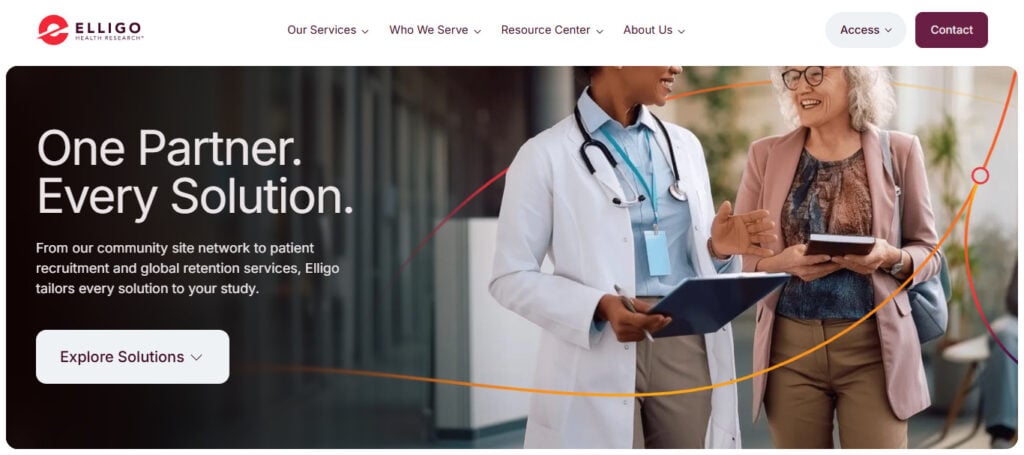
Using AI algorithms to analyze participants within healthcare practices improves the ability for researchers to contact a broader participant population. Elligo expands research efforts within a normal healthcare practice and improves participation.
As a Best Clinical Trial Patient Matching Platform Using Medical AI Models, the service diversifies clinical trials. The platform speeds up participant enrollment for studies and assists clinical trial sponsors for improved participant engagement and research reliability.
Elligo Health Research AI Features, Pros & Cons
Features
- Patient recruitment through community networks
- AI for participant finding
- Links healthcare providers
- Enrollment assistance for diverse populations
- Automation of research tasks
Pros
- Enrollment of a wider demographic
- Enrollment of populations that are usually difficult to recruit
- Recruitment is faster
- Research becomes part of normal healthcare
- Higher patient recruitment
Cons
- Needs collaboration of the healthcare providers
- Networks are different based on area
- Can become complex to integrate
- Not all healthcare specialties are available
- Could need more coordination of the research site
Conclusion
AI-driven patient matching systems are reshaping the process of participant selection and recruitment for clinical studies.
Systems such as Deep 6 AI, TriNetX AI Match, and Clinerion Patient Network Explorer AI, IBM Watson Health Clinical Trials AI, Antidote Match AI, Phesi AI Trial Optimization, and ConcertAI Trial Match, Flatiron Health AI Trials, Verily Clinical Trial Platform AI, and Elligo Health Research AI have all made significant advancements in streamlining the clinical trial process and developing new treatments.
Phesi believe that as clinical research continues to grow around real world data and proven clinical use, AI patient matching systems will become crucial to enabling innovations in healthcare.
FAQ
What are clinical trial patient matching platforms?
Clinical trial patient matching platforms are software solutions that use artificial intelligence, machine learning, and healthcare data to identify patients who meet the eligibility criteria for clinical studies. These platforms help researchers recruit participants faster and more accurately.
How do AI-powered patient matching platforms work?
AI-powered platforms analyze electronic health records (EHRs), medical histories, lab results, physician notes, and other clinical data to match patients with suitable clinical trials. They automate the screening process and reduce manual effort.
What are the benefits of using AI for clinical trial recruitment?
AI improves recruitment speed, increases matching accuracy, reduces enrollment delays, lowers operational costs, and helps researchers identify eligible participants who might otherwise be overlooked.
Which industries use clinical trial patient matching platforms?
These platforms are primarily used by pharmaceutical companies, biotechnology firms, contract research organizations (CROs), hospitals, academic research centers, and healthcare providers conducting clinical studies.