



This article covers the top AI Context Management Tools. These tools assist developers and businesses in enhancing the memory and data retrieval skills of AI.
These tools also help the systems understand context, explain user queries, and provide more accurate responses. Leading tools in the space will be covered, along with their benefits, features, and how they enable AI applications.
Key Points
| AI Context Management Tool | Key Points |
|---|---|
| LangChain | • Framework for building AI applications with memory and context handling capabilities.• Supports LLM orchestration, agents, retrieval-augmented generation (RAG), and vector databases.• Provides tools for managing conversation history and maintaining long-term AI context.• Integrates with multiple models, APIs, and data sources.• Suitable for developing custom AI agents and enterprise applications. |
| LlamaIndex | • Data framework designed for connecting LLMs with private and external data sources.• Helps AI systems retrieve, organize, and maintain relevant context efficiently.• Supports document indexing, knowledge bases, and RAG workflows.• Provides advanced data retrieval and context enrichment features.• Ideal for building AI assistants with domain-specific knowledge. |
| Pinecone | • Cloud-based vector database focused on fast AI similarity search.• Enables AI applications to store and retrieve contextual information using embeddings.• Supports scalable memory storage for AI agents and chatbots.• Provides low-latency vector search for real-time applications.• Commonly used for RAG, recommendation systems, and semantic search. |
| Weaviate | • Open-source vector database designed for AI-powered search and knowledge retrieval.• Supports hybrid search combining keyword and vector-based retrieval.• Helps AI systems maintain contextual memory from large datasets.• Offers built-in modules for embeddings and generative AI applications.• Suitable for enterprise AI assistants and knowledge management. |
| Milvus | • Open-source vector database optimized for large-scale AI applications.• Provides high-performance similarity search across billions of vectors.• Supports AI memory management through efficient embedding storage.• Works with multiple machine learning frameworks and cloud environments.• Used for RAG, image search, and recommendation engines. |
| Chroma | • Lightweight open-source vector database for AI and LLM applications.• Simplifies storing and retrieving embeddings for contextual AI responses.• Designed for developers building RAG applications quickly.• Supports document-based memory and semantic search workflows.• Integrates easily with LangChain and other AI frameworks. |
| Redis Vector | • Adds vector search capabilities to the Redis data platform.• Enables fast retrieval of contextual data for AI applications.• Supports semantic search, recommendation engines, and AI memory systems.• Provides real-time data processing with low latency.• Useful for production AI applications requiring speed and scalability. |
| Vespa | • AI search and serving platform designed for large-scale data processing.• Combines vector search, machine learning models, and ranking algorithms.• Helps AI systems retrieve highly relevant contextual information.• Supports real-time indexing and personalized search experiences.• Used for advanced AI search and recommendation solutions. |
| Kinetica | • Real-time database platform with vector search and AI analytics capabilities.• Enables fast processing of large-scale contextual data.• Combines geospatial analytics, machine learning, and vector retrieval.• Supports real-time AI decision-making workflows.• Suitable for enterprise applications requiring instant data insights. |
| Oracle AI Vector DB | • Enterprise vector database technology integrated with Oracle Database.• Enables organizations to store and search AI embeddings securely.• Supports RAG applications using enterprise business data.• Provides database-level security, scalability, and governance.• Ideal for businesses building AI solutions with existing Oracle systems. |
1. LangChain
LangChain is a framework that allows developers to construct complex applications using large language AI models. LangChain links large language AI models with external data, databases, tools, and memory systems.
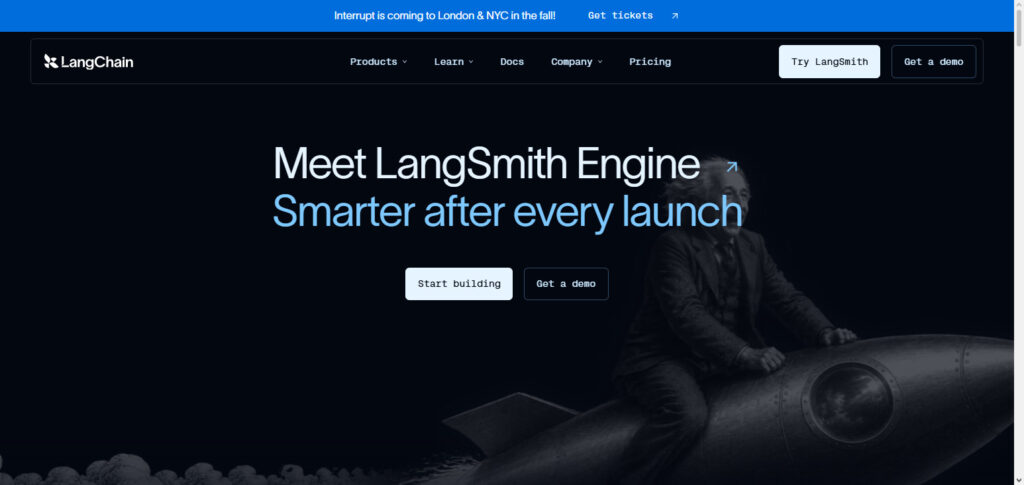
With LangChain, AI agents can keep track of conversations, manage context, and retrieve relevant information by using workflows like Retrieval-Augmented Generation (RAG). This is why LangChain is one of the best AI context management tools. LangChain supports multiple LLM and vector database providers and APIs, many data sources including custom data.
It has components used in construction of complex AI applications, including agents, memory, prompts, and documents. Because of these components, businesses are able to develop intelligent chatbots and knowledge automation applications with a high degree of context.
Features
- LLM Application Framework: Tools for constructing AI agents, chatbots, and applications based on retrieval-augmented generation (RAG).
- Memory Management: Short and long-term memory management for maintaining context in AI conversations.
- Multiple Integrations: Integrates with a variety of LLMs, APIs, vector databases, and external data sources.
- Agent Development: Development of AI agents that can execute tasks through the use of tools and goal-oriented reasoning workflows.
- Prompt Management: Framework of templates and chains for managing and optimizing interactions with AI.
Pros
- Customizable and versatile AI application development framework.
- Rich ecosystem with a plethora of integrations.
- Capable of supporting varying AI models and databases.
- Active community with robust documentation.
- Well-suited for intricate AI workflows and agent-based applications.
Cons
- Initial hurdles of learning the framework may be significant.
- Complex applications may prohibitively demand advanced coding.
- Updating the framework may lead to disallowed changes in software.
- For simple applications, the framework may be unnecessarily complicated.
- Dependent on the performance of the models and infrastructure it connects to.
2. LlamaIndex
LlamaIndex is a data-focused AI framework for integrating LLMs with private, structured and unstructured data. It improves AI context management by providing models with structured and searchable indexes. LlamaIndex is one of the best AI context management tools.
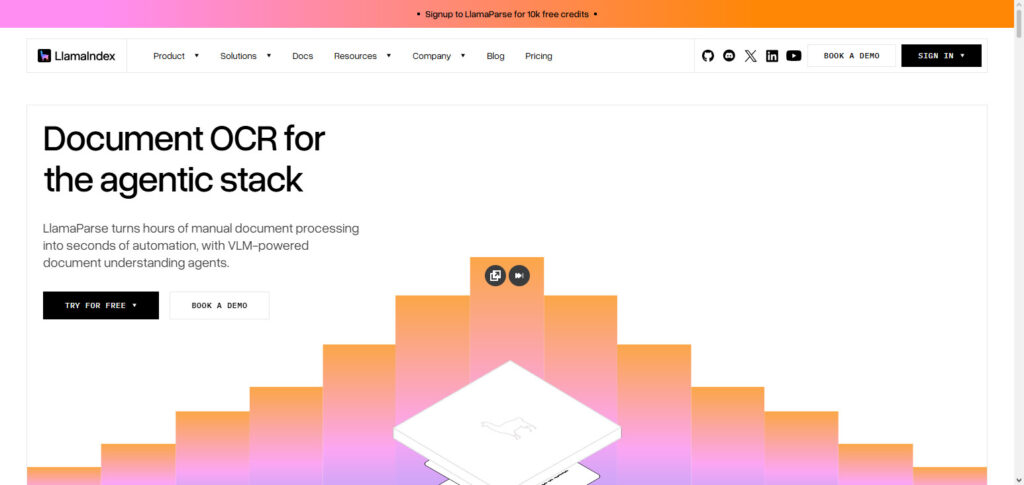
With its advanced features of document ingestion and data retrieval, and query optimization, and RAG-based services, LlamaIndex is a great framework for constructing enterprise-level AI Assistants. Companies use LlamaIndex to give models the ability to access documents and databases within the company, improving AI responses.
Features
- Data Connection Framework: LLM connection with proprietary and corporate datasets.
- Advanced Indexing: Enables effective and efficient retrieval of documented information.
- RAG Support: Enhances responses generated by the AI using retrieval-augmented generation based on external knowledge.
- Data Query Engine: Intelligent query capability for disparate data within a unified framework.
- AI Knowledge Management: Supports the development of specialized AI systems.
Pros
- Exceptional for data-intensive applications of AI.
- Facilitates the connection of proprietary datasets to LLMs.
- Strong capabilities in document processing.
- Supports a variety of storage and vector databases.
- Enhances the AI’s capability of context retention through retrieval.
Cons
- Requires fundamental knowledge of data indexing.
- Large datasets may necessitate further optimization.
- Can be cumbersome to configure.
- Applications outside of data-related purposes are minimal.
- Complexities and difficulties may arise with the advanced features.
3. Pinecone
Pinecone is a vector database that enables speedy storage and retrieval of AI-generated embeddings. It becomes crucial in AI context management by allowing applications to store long term memory and helping retrieve relevant information during AI interactions.
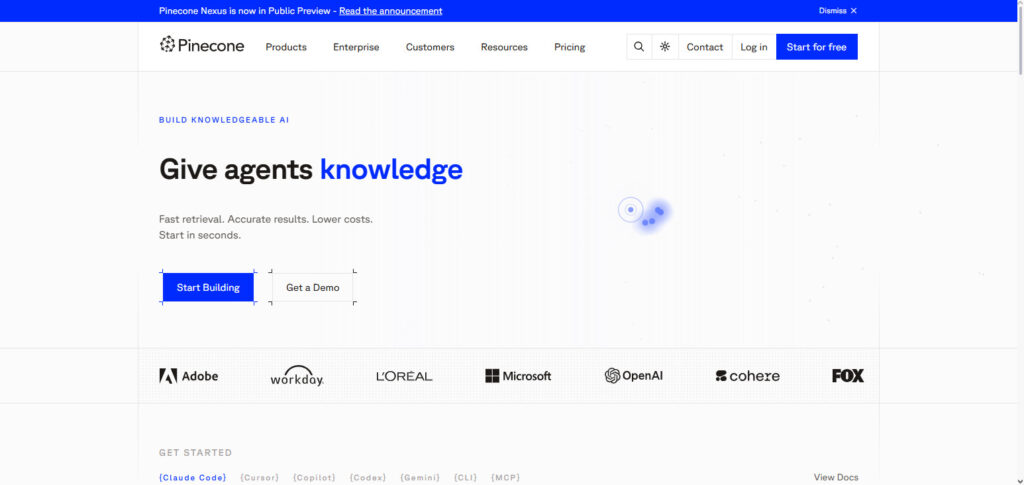
With the help of Pinecone, developers can create scalable RAG systems, recommendation engines and build intelligent search systems. Pinecone has fast and scalable similarity searches with metadata and enterprise level scalability. Pinecone helps integrate AI frameworks to building applications that generate AI solutions with personalized, context-aware responses.
Features
- Cloud Vector Database: Flexible and scalable storage for AI embeddings.
- Fast Similarity Search: Quick access to relevant contextual data.
- Metadata Filtering: Enables search refinement with additional data characteristics.
- RAG Integration: Useful for AI applications with knowledge retrieval needs.
- RAG Integration: Efficiently manages enterprise AI applications of varied scale.
Pros
- Completely managed and simple to deploy.
- Exceptional vector search performance.
- Excellent scalability for enterprise applications.
- Robust AI framework integrations.
- Minimal infrastructure management burden.
Cons
- Primarily a cloud solution with few self-hosting options.
- Costs may become significant for large environments.
- Less adaptable than open-source counterparts.
- Requires external systems for some AI tasks.
- May be a disadvantage for some.
4. Weaviate
Weaviate is an open source vector database that helps AI systems store and retrieve contextual information using vector embeddings. It is suitable for modern AI applications that require semantic search and knowledge retrieval.
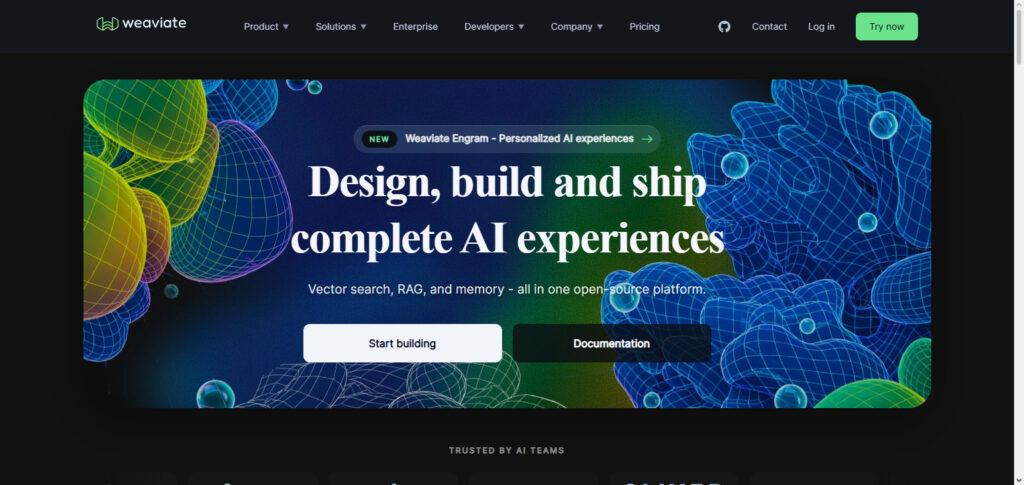
Weaviate provides hybrid search that combines keyword based search with vector similarity search for improved results. It has generative AI modules and multiple embedding models and is a great option for RAG workflows. Weaviate helps AI assistants, recommendation systems, and enterprise search platforms that understand user intent and provide contextual information.
Features
- Open-Source Vector Database: Flexible storage solutions for AI data.
- Hybrid Search: Merges keyword and vector search.
- Generative AI: Compatible with many AI models and APIs.
- Semantic Search: Comprehension of user intention beyond simple keyword matching.
- Architectural Scalability: Suited for enterprise AI needs.
Pros
- Open-source and very configurable.
- Many AI integrations.
- Excellent hybrid search.
- Features geared toward developers.
- Well suited for RAG and knowledge applications.
Cons
- Needs some technical knowledge.
- Self-hosted will be a time investment.
- Adjusting settings for ideal performance may be difficult.
- Smaller user base than other similar products.
- Higher demand for resources when handling larger operations.
5. Milvus
Milvus is an open-source vector database that enables the retrieval and storage of billions of embeddings at high speed from different sources. This improves AI applications by enhancing context. Milvus is one of the best AI context management tools. It is useful when developers build large-scale AI systems like RAG applications, image recognition systems, and recommendation systems.
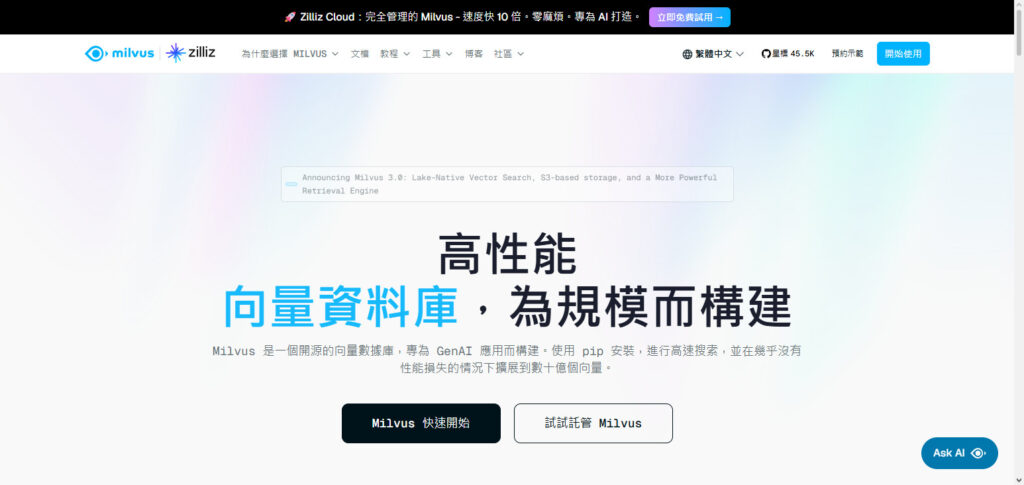
Milvus has the capability to support multiple indexing methods, cloud applications, and machine learning methods. It is strong in performance and scalability, which enables organizations to build complex AI applications.
Features
- Big Vector Database: Good at processing billions of AI embeddings.
- Fast Searches: Good at similarity searches for many AI applications.
- Index Options: Flexible indexing for varying performance trade-offs.
- Cloud Optimized: Built for use in modern cloud infrastructures.
- AI Friendly: Useful for retrieval-Augmented Generation (RAG), recommendation, and other search applications.
Pros
- RAG systems using massive datasets benefit from its excellent performance and scalability.
- Open-source means you can adjust it to your needs.
- Vector search performance is excellent.
- Flexible systems can be deployed in various locations.
- Community driven development is strong.
Cons
- Beginners may find it har to deploy.
- You will need to manage your own systems.
- Hard to configure.
- Needs technically experienced users to find the best performance.
- May be too much for some small AI applications.
6. Chroma
Chroma is an open-source, lightweight vector database tailored to AI and large language model applications. It facilitates the storage of embeddings and the retrieval of context to improve AI responses.

Chroma is one of the best AI context management tools. Developers of RAG applications, AI assistants, and prototype AI solutions use Chroma because of its easy setup and developer-friendly features.
Document storage, semantic search, and integration with LangChain and LlamaIndex are facilitated by Chroma. Because of its ability to maintain conversation memory and retain important information, Chroma extends the capability of AI applications to improve context and accuracy of interactions.
Features
- Small Vector Database: Optimized for fast AI applications.
- Vector Memory: Efficient memory for AI vectors.
- RAG Friendly: Retrieves RAG embeddings.
- Easy to Use: Integrate fast with AI frameworks.
- Local Ready: fast prototypes or tests.
Pros
- Small memory and easy to use.
- Open-source and free.
- Small AI applications are easy to make and use.
- Pairs great with LangChain and LlamaIndex.
- Low requirements.
Cons
- Large memory and use is limited.
- Fewer features geared for larger companies.
- Large memory and use can be inefficient.
- Low security options.
- Large production systems are not capable.
7. Redis Vector
Redis Vector enhances Redis data services with vector search. Developers can now build AI applications with embedding storage, indexing, and search with sub-millisecond latency. Redis Vector Utility Wheel Context Management helps AI systems manage contextual information for chatbots, recommendation systems, and enterprise searches.
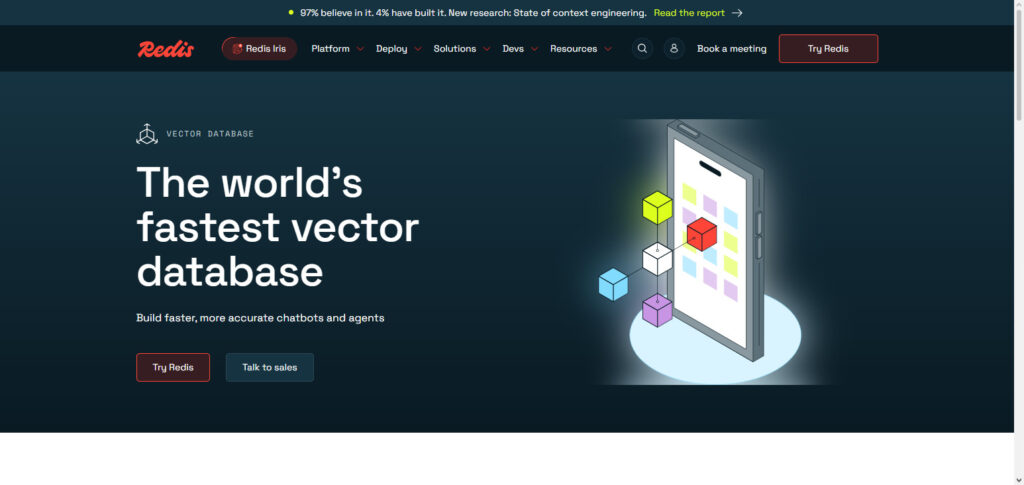
Its architecture of low-latency and high availability allows instantaneous data request and dynamic data manipulation. Redis Vector performs similarity searches and integrates with numerous AI development frameworks. Fast and scalable AI applications require systems to efficiently manage memory and continually understand context in real-time.
Features
- Real-Time Vector Search: Fast AI context retrieval.
- Memory-Based Performance: Low-latency data retrieval.
- AI Application Support: Chatbots and recommendation systems.
- Metadata Filtering: Enhanced search features.
- Database Integration: Vector search and traditional data merging.
Pros
- Fastest data retrieval.
- Real time AI application support.
- Seamless integration into preexisting Redis applications.
- High-performance and flexible data management.
Cons
- High memory usage.
- Vector based storage at large scales becomes difficult.
- Requires deep knowledge of Redis.
- Not focused on AI usage.
- May require configuration for advanced features.
8. Vespa
Vespa is an AI Serving and Search Platform with vector search, API, and ML operations for large-scale data processing. Relevance is achieved by blending vector search, traditional search methods, and AI models.

The Best AI Context Management Tools – Vespa provides real-time indexing and intelligent data retrieval, helping organizations manage complex AI contexts. It offers personalization, semantic search, and scalability across large-scale AI use cases.
Vespa is the solution for companies that need swift processing of large datasets with an emphasis on precision. Its value stems from integrating ML with search technology and data processing for enterprise applications and advanced AI Assistants.
Features
- AI Search Platform: Search, ranking, and machine learning integrated.
- Vector Search: Semantic retrieval for AI.
- Real-Time Processing: Data can be updated and indexed instantly.
- Personalization: Custom search result experiences.
- Large Data Handling: Enterprise scale applications.
Pros
- Strong search and ranking features.
- Complex AI workloads can be handled.
- Real time data processing.
- Can be focused on personalized AI Systems.
- Good for enterprises.
Cons
- Can be difficult to learn.
- Requires deep knowledge and skills.
- Lengthy setup process.
- Less focus on smaller organizations.
9. Kinetica
Kinetica is a real-time database platform that integrates vector search, analytics, and machine learning. It empowers users to manage contextual data by enabling them to process and retrieve large datasets quickly. Kinetica is one of the best AI context management tools because it offers real-time analytics powered by AI.
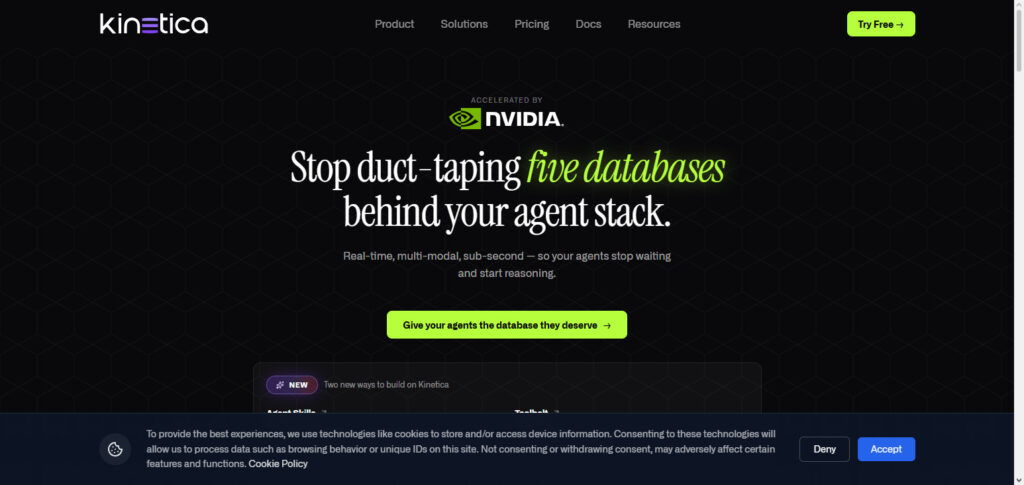
It is geared towards the industries that require instant and precise decision-making, such as the finance, logistics, and telecoms, industries. Kinetica backs businesses in accelerating digital transformation through designing intelligent applications, optimizing AI interactions, and providing context-aware experiences with absolute real-time data.
Features
- Real-Time AI Database: Vector search and analytics combined.
- High-Speed Processing: Large data sets can be processed instantly.
- Machine Learning Integration: AI driven insights can be provided.
- Geospatial Analytics: Location data can be processed.
- Enterprise Data Management: Empowers AI-driven business applications.
Pros
- Superior performance for real-time analytics.
- Handles complex enterprise workloads.
- Merges various data functionalities.
- Excellent for applications that require decisions.
- Optimally manages large-scale data.
Cons
- Higher price tag for enterprise use.
- Requires higher technical know-how.
- Less developer friendly.
- Overkill for smaller workloads.
- Less available open-source concessions.
10. Oracle AI Vector DB
Oracle AI Vector Database is an enterprise-ready vector database built upon the Oracle Database technology. It empowers organizations to safely control and manage AI embeddings while retaining high levels of security, governance, and scalability.

Best AI Context Management Tools – Oracle AI Vector DB uses large language models (LLMs) and connects them to the enterprise data sources.
It enables businesses to utilize their enterprise databases in a variety of AI-accelerated search and automation related applications, such as knowledge management systems. It is particularly suited for businesses with a strong focus on security and protection of their business information while requiring reliable and accurate AI context management.
Features
- Enterprise Vector Database: Incorporates AI Search within Oracle Database.
- Safe Data Management: Supports enterprise-grade data security.
- RAG Application Enablement: Bridges LLMs to enterprise data.
- Database Compatibility: Integrates with current Oracle systems.
- AI Infrastructure: Business-ready scalable AI.
Pros
- Excellent enterprise security and good data governance.
- Integrates with current Oracle databases.
- Scalability and performance are solid.
- Good for regulated sectors.
- Excellent for business imperative AI applications.
Cons
- Costly, especially compared to open-source.
- Optimal for Oracle environments.
- Requires good Oracle know-how.
- Detailed and complex setup.
- Less suitable for small developers.
Conclusion
The best AI context management tools enable businesses to build smart AI applications that remember, fetch and analyze data better and give more precise responses. Companies that offer tools like LangChain, LlamaIndex, Pinecone, Weaviate, Milvus, Chroma, Redis Vector, Vespa, Kinetica, and Oracle AI Vector DB, help solution developers create enterprise solutions with AI assistants, chatbots, knowledge systems, RAG applications and other products to manage contextual data.
The capabilities of these tools offer a choice for a developer based on where an application needs to scale and how it should be integrated. The security and AI understanding goals also impact the choice of tools. As more organizations invest in AI, managing AI contexts will become important for creating adaptive, smart, and safe AI experiences.
FAQ
What are AI Context Management Tools?
AI Context Management Tools are platforms that help artificial intelligence systems store, organize, retrieve, and manage information required to generate accurate responses. These tools improve AI memory, enable better understanding of user queries, and support applications like AI agents, chatbots, and Retrieval-Augmented Generation (RAG) systems.
Why are AI Context Management Tools important?
AI Context Management Tools help improve the performance of AI applications by providing relevant information at the right time. They allow AI models to maintain conversation history, access external knowledge sources, reduce incorrect responses, and deliver more personalized and accurate results.
Which are the Best AI Context Management Tools in 2026?
Some of the leading AI Context Management Tools in 2026 include LangChain, LlamaIndex, Pinecone, Weaviate, Milvus, Chroma, Redis Vector, Vespa, Kinetica, and Oracle AI Vector DB. These platforms offer features such as vector search, AI memory management, data retrieval, and RAG support.
How does LangChain help with AI context management?
LangChain helps developers create AI applications by managing prompts, memory, workflows, and external data connections. It allows AI agents to maintain context across conversations and integrate with various LLMs, APIs, and vector databases.
What is the role of vector databases in AI context management?
Vector databases store AI-generated embeddings that represent the meaning of text, images, or other data. They allow AI systems to quickly search and retrieve relevant information, helping models provide more accurate and context-aware responses.