



This article will go over the Best AI Knowledge Graph Platforms. Knowledge Graph Platforms help connect data and understand AI better. Having these platforms make it easier to navigate complex data and gain insights that aid in decision making.
These platforms help construct networks of data and semantic analysis with the use of graph databases and machine learning. In this article, I will explore the best AI Knowledge Graph platforms available, and the features and capabilities of each.
What is AI Knowledge Graph Platforms?
AI Knowledge Graph Platforms are tools that connect and process data in a smart way through networks of things, ideas, and how they relate to each other. Building AI systems on these platforms lets machines process the context of ideas rather than simply the data. AI Knowledge Graph Platforms are a combination of technologies that link data in new ways, optimize searches, and uncover insights.
AI Knowledge Graph Platforms help companies design intelligent processes and systems for search, recommendations, fraud detection, data unification, and various intelligent automations. Companies leverage these technologies to optimize the quality of their systems with intelligent automations.
Why Use AI Knowledge Graph Platforms for Smarter Data Insights
Integrate Isolated Data Sources
- Knowledge Graph Platforms help users integrate disparate data modules, applications, and systems into a cohesive connected data network.
- They eliminate data silos by establishing valuable connections between diverse data elements.
- Organizations obtain integrated data that is both cohesive and well-structured for optimal analysis and expedient decision-making.
Enrich AI Context and Precision
- These platforms illustrate associations between various elements, concepts, and events, thereby providing context to AI systems.
- Knowledge Graphs enable AI models to parse and interpret complex data more easily.
- Advanced Knowledge Graphs provide AI systems with greater contextual acuity for more precise output.
Reveal Data Connections
- AI Knowledge Graph Platforms reveal data connections and relationships that are not easily discernible within voluminous data sets.
- They help organizations glean important insights that are typically overlooked by conventional data systems.
- Organizations can identify threats, realize new business opportunities, and optimize the overall effectiveness of their business operations.
Improve Data Search and Discovery
- Knowledge Graphs enhance searches within an organization by deciphering the intent of queries.
- They provide optimal and pertinent answers to queries by understanding the relationships among sources of information.
- Knowledge Graphs improve the data discovery process.
Enable Continuous Connected Data Relationship Analysis
- AI Knowledge Graph Platforms facilitate instantaneous analysis of associated data.
- Organizations can identify outliers/discover new insights and improve the responsiveness to real-time data.
- This is especially important for customer insights, operational intelligence, and the detection of fraudulent activity and data breaches.
Upgrade Your Data Governance and Management
- Graph-based knowledge management helps with structuring and governing enterprise data.
- They help organizations track who owns data and helps to visualize how data is related.
- Better governance of enterprise data helps organizations achieve higher data quality, compliance, and trust in the outcome of the decisions made by AI.
Develop More Advanced AI Applications
- AI Knowledge Graph Platforms help AI systems and related applications by providing more organized and structured knowledge.
- They focus on advanced automation, assistive technologies, recommendation systems, and more.
- Companies can lift the limits of the AI solutions that they have developed by providing better contextual knowledge.
Provide Custom-Tailored Customer Experiences
- Knowledge graphs provide insights on customer actions and help organizations understand the preferences of their customers.
- Organizations can provide services and products to customers that are tailored to their needs.
- Customers become more loyal and value the organization more.
Eliminate Unnecessary Data
- These platforms eliminate redundant enterprise data by arranging information in reasonable relationships
- These platforms help organizations understand large volumes of data without detailed frameworks.
- Organizations can achieve rapid progress with more organized data.
Achieve Enhanced Business Outcomes
- AI Knowledge Graph Platforms help with integrated insights that are used for value-generating business processes.
- They help organizations see and understand new opportunities and enterprise customer value.
- By converting information into knowledge, organizations can adopt a culture of innovative business processes and solutions.
Key Point & Best AI Knowledge Graph Platforms
| Platform | Key Features |
|---|---|
| Neo4j | • Leading native graph database using property graph technology• Supports real-time relationship analysis and graph queries with Cypher language• Provides AI-powered graph data science and machine learning tools• Offers knowledge graph creation for enterprise data integration• Used in fraud detection, recommendation systems, and intelligent search applications |
| Stardog | • Enterprise knowledge graph platform with semantic data virtualization• Combines graph databases with AI reasoning and ontology management• Supports SPARQL queries and knowledge graph analytics• Enables data integration from multiple enterprise sources• Provides tools for building connected data ecosystems |
| TigerGraph | • High-performance distributed graph database for large-scale analytics• Supports real-time deep link analysis and complex relationship queries• Includes built-in graph algorithms and machine learning capabilities• Handles massive enterprise knowledge graphs efficiently• Used for fraud prevention, cybersecurity, and customer intelligence |
| Ontotext GraphDB | • Semantic knowledge graph database supporting RDF and SPARQL standards• Provides ontology management and linked data capabilities• Supports AI-driven search and semantic reasoning• Integrates structured and unstructured enterprise data• Popular for research, publishing, healthcare, and government applications |
| Cambridge Semantics Anzo | • Enterprise knowledge graph platform for data discovery and integration• Connects siloed data sources into a unified semantic layer• Supports visual analytics and business intelligence workflows• Enables data governance and metadata management• Helps organizations improve data accessibility and decision-making |
| Amazon Neptune | • Fully managed graph database service from AWS• Supports property graph and RDF graph models• Provides scalable infrastructure for knowledge graph applications• Integrates with AWS AI, analytics, and data services• Used for recommendation engines, identity graphs, and fraud detection |
| IBM Watson Knowledge Catalog | • AI-powered data catalog and governance platform• Helps discover, classify, and manage enterprise data assets• Uses machine learning for metadata enrichment• Supports data quality, compliance, and governance workflows• Enables trusted AI and analytics operations |
| SAP HANA Graph | • Graph processing capability integrated with SAP HANA database• Enables relationship analysis across enterprise business data• Supports graph algorithms for connected insights• Combines transactional data with graph analytics• Useful for supply chain, finance, and customer relationship analysis |
| Yewno Edge | • AI-powered knowledge graph platform for research and discovery• Extracts insights from large volumes of information• Uses semantic connections to improve information exploration• Supports academic, financial, and enterprise research workflows• Provides intelligent content discovery and analysis |
| PoolParty Semantic Suite | • Enterprise semantic AI platform for knowledge graph development• Supports taxonomy management, ontology modeling, and linked data• Enables semantic search and content intelligence• Provides tools for data governance and knowledge management• Used in industries like healthcare, finance, and publishing |
1. Neo4j
One of the best AI Knowledge Graph Platforms, Neo4j, enables businesses to connect and analyze complicated data patterns. Its native graph database is designed on the fundamental principles of nodes, connections, and properties, making it a suitable choice for AI driven applications.
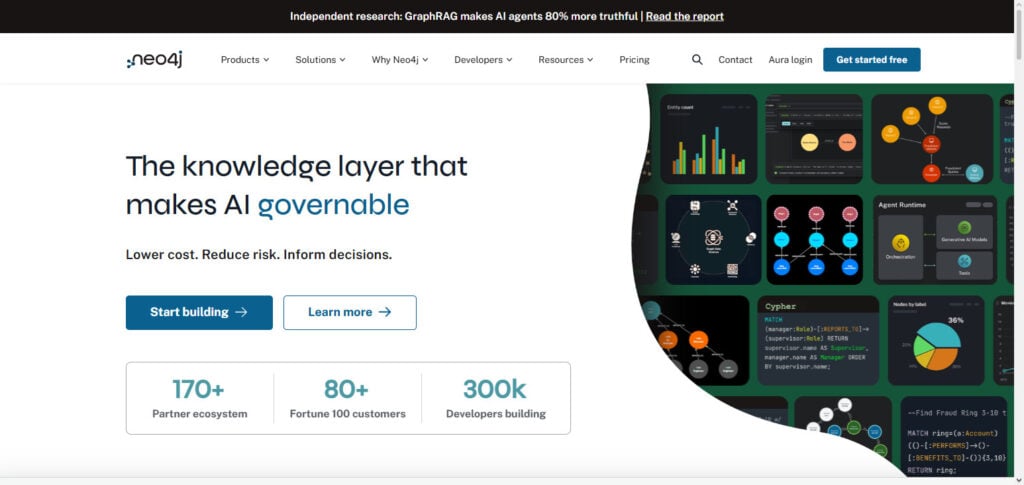
Neo4j has capabilities to perform advanced graph analytics, ML models, and explore data in real time with the Cypher query language.
It is used for fraud detection, recommendation systems, customer intelligence, cyber security analysis, and enterprise knowledge management, among many other use cases. Its AI integration and an extensive partner ecosystem make Neo4j a primary choice for customers when it comes to building intelligent data networks.
Features
- Specific graph database for storing and analyzing connected data.
- Includes Cypher query language for easy exploration and analysis of graph data.
- Offers graph data science and ML capabilities.
- Offers real-time analytics for fraud detection, recommendations, and network analysis.
- Cloud deployment available with enterprise security.
Pros
- Scalable for data with many complex relationships.
- Vibrant developer community and extensive documentation.
- Swift graphs queries and data connections.
- Offers a range of ML and AI integrations.
- More customizable data modeling than traditional databases.
Cons
- Expensive enterprise deployments.
- Some novice users may find a learning curve due to graph database concepts.
- Relationship to traditional relational databases is limited.
- Some features may require an upgrade.
- Requires an experienced DBA for implementation.
2. Stardog
Stardog is recognized as one of the Best AI Knowledge Graph Platforms, for good reason. It allows businesses to connect and consolidate disparate data sources to build intelligent data infrastructures. Stardog leverages knowledge graphs, semantic AI, and knowledge in order to give businesses insight into complex information.
RDF data modeling along with SPARQL queries, and ontology management with data virtualization enable organizations to keep their data in its original source while still being able to access it.
Stardog connects structured and unstructured data to assist in the optimization of data governance and driving informed business decisions. It is utilized across various segments such as the finance, healthcare, manufacturing, and government industries.
Features
- Knowledge graph platform for enterprise use that offers semantic reasoning.
- Supports RDF and SPARQL and data modeling with ontologies.
- Provides data virtualization for multiple enterprise sources.
- Uses AI with data analytics and knowledge discovery.
- Has data governance and metadata tools.
Pros
- Strong semantic reasoning and technology.
- Connects data from multiple sources without duplication.
- Enhances data in the enterprise and data accessibility.
- Suited for the advanced knowledge graph use cases.
- Creates a data environment prepared for AI in the enterprise.
Cons
- Requires knowledge of semantic technology.
- Somewhat high price for small businesses.
- May require some work for configuration and initial installation.
- Limited intermediate and advanced level tutorials.
3. TigerGraph
TigerGraph is an AI knowledge graph platform designed for fast graph analytics. Suited for systems requiring near real time insights, TigerGraph provides companies the ability to analyze billions of interconnected data points.
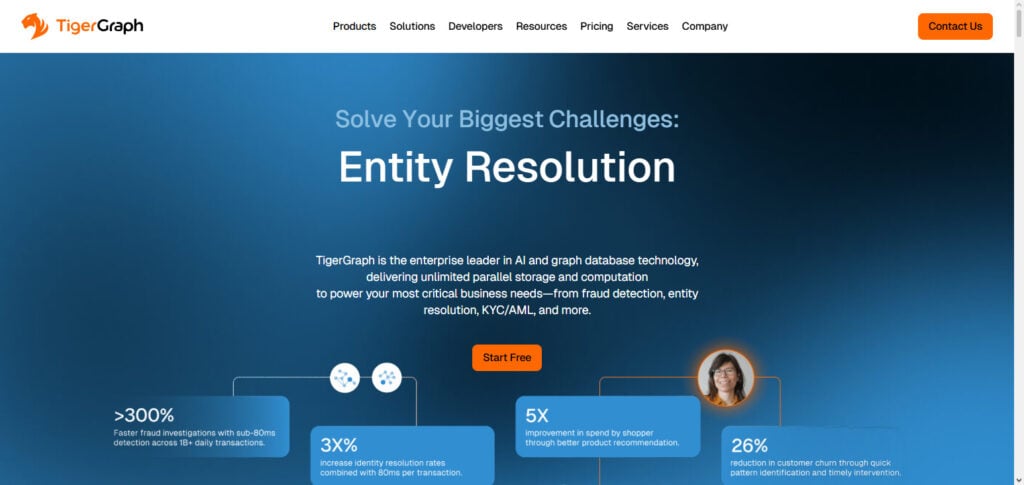
It provides a number of advanced graph analytics and machine learning services. TigerGraph is used across multiple industries for detection and prevention of fraud, analysis of customer data for improving customer satisfaction and providing personalized recommendations, supply chain optimization,
cybersecurity, and many others. Its architecture makes it suitable for companies that require real time processing of large knowledge graphs and for making complex business decisions requiring AI.
Features
- A graph database for large-scale data processing.
- Supports deep analysis of links and graph algorithms in real time.
- Integrates AI and ML technology.
- Offers efficient processing of billions of connected data elements.
- Has advanced features for enterprise analytics.
Pros
- Outperforms most products for large graph datasets.
- Promotes real-time analytics.
- Ideal for more complicated ML and AI applications.
- Has the framework to support the breadth of enterprise-level systems.
- Has robust visualization tools.
Cons
- Steeper learning curve.
- Requires an intermediate level of experience in usage and optimization.
- May be out of reach for most small companies.
- Smaller ecosystem than other DBMS products.
- Complex deployment may require professional help.
4. Ontotext GraphDB
Ontotext GraphDB is one of the platforms for efficient semantic data management, linked data, and intelligent information mining. It is an RDF graph database that provides SPARQL query support along with ontology modeling and semantic reasoning.
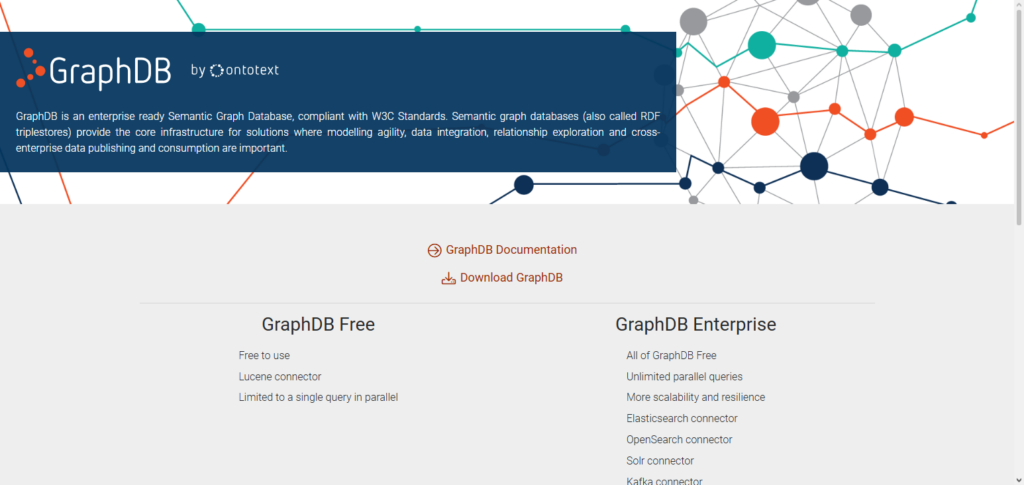
With Ontotext GraphDB, enterprises can convert diffused information into useful knowledge that can be understood by AI systems. It serves numerous commercial and public sectors from research and academia to healthcare, finance, and publishing.
With Ontotext GraphDB, knowledge discovery becomes easier with automated insights, and connected enterprise data can be used to develop applications with advanced and intelligent features.
Features
- An RDF and SPARQL compliant semantic graph database.
- Includes the management of ontologies and semantic reasoning.
- Supports the creation of linked data from multiple sources.
- Has AI-powered search and knowledge discovery.
- Includes enterprise security and scalability.
Pros
- Superior support and integration for the semantic web and linked data.
- Excellent support for knowledge graph applications.
- Enhances search and question answering accuracy.
- Can easily be adapted for business integration.
- Designed for research and data-centric domains.
Cons
- Knowledge of semantic modeling and RDF is needed.
- Not ideal for simple graph database applications.
- Needs enterprise license for most advanced features.
- Query performance is impacted by optimization.
- May be difficult to learn.
5. Cambridge Semantics Anzo
Cambridge Semantics Anzo is arguably one of the best AI Knowledge Graph Platforms. It helps companies to join and analyze data across their business applications.
Anzo provides a Unified Semantic Layer, allowing companies to easily access data from different applications and avoid the need for difficult data movements across systems. Anzo provides knowledge graphs, data virtualization, metadata, and advanced analytics.
It helps companies enhance their data governance and increase the performance of their AI models with seamless data connections. It is utilized in many data intensive industries, especially financial, healthcare, and government.
Features
- Enterprise knowledge graph platform for data integration
- Creates a unified semantic layer across data sources
- Enables data virtualization and related analytics
- Offers tools for managing and governing metadata
- Empowers enterprises to create connected data ecosystems
Pros
- Simplifies the challenge of accessing distributed enterprise data
- Robust data integration
- Enhances data governance and clarity
- AI-analytics and related workflows are supported
- Lessens the need for physical data transfers
Cons
- Less accessible for small companies
- Implementation requires some technical skills
- Less community support compared to open-source tools
- Complicated enterprise deployments are included
- May require some training for business users
6. Amazon Neptune
Amazon Neptune, another one of the Best AI Knowledge Graph Platforms, is offered by Amazon Web Services (AWS). It is a fully managed graph database service. Neptune gives companies the capability to build flexible Knowledge Networks for their AI and Analytics applications.
There are a variety of reasons why companies choose Amazon Neptune for their business needs, including recommendation systems, identity management, fraud detection, network analysis, and customer relationship intelligence.
Neptune is a cloud-based solution for many companies, and because of that, it simplifies the Database Management burden for companies, and it enhances the processing of data in real-time.
Features
- Fully managed graph database service at AWS
- Supports property graphs and graph models based on RDF
- AWS AI services and analytics are integrated
- High availability and automatic scaling
- Supports recommenders and fraud detection applications
Pros
- Fully managed service — low operational overhead
- Strong integration within the AWS environment
- High performance with a scalable service
- Supports multiple graph models
- Strong security and compliance features for enterprises
Cons
- Primarily optimized for the AWS environments
- Can become costly at large scale
- Limited options for customization when compared to managed services
- Requires knowledge of AWS
- Can be challenging to move data from existing solutions
7. IBM Watson Knowledge Catalog
IBM Watson Knowledge Catalog is an AI-powered knowledge graph platform. It assists organizations to manage, govern and catalog their data assets. It uses AI and ML to classify, enhance metadata and ultimately create a trusted data environment for the development of analytics, AI, and BI applications.
IBM Watson Knowledge Catalog helps businesses maintain compliance, improve data governance, and provide high quality data to their employees. It is widely used by organizations that demand secure data management across multiple departments and business units.
Features
- AI-powered data catalog and governance platform.
- Uses machine learning for data classification.
- Provides metadata enrichment and data discovery.
- Supports enterprise data quality management.
- Helps create trusted AI-ready datasets.
Pros
- Strong AI and machine learning capabilities.
- Improves enterprise data governance.
- Supports regulatory compliance requirements.
- Integrates with IBM analytics solutions.
- Helps organizations manage large data environments.
Cons
- High cost for enterprise usage.
- IBM ecosystem knowledge may be required.
- Complex setup and configuration.
- Can be overwhelming for small teams.
- Requires skilled administrators.
8. SAP Hana Graph
SAP HANA Graph is a powerful knowledge graph solution built on top of the SAP HANA database. It provides businesses with the tools they need to track and analyze the relationships within their enterprise data by using graph processing technology.
With the help of SAP HANA Graph, businesses can identify hidden relationships in financial records, supply chains, customer data, and other business operations systems. A combination of traditional database capabilities and graph analytics make SAP HANA Graph a technology that enables extremely fast data analysis and provides insights powered by Artificial Intelligence.
HANA Graph allows companies that use SAP products to increase the intelligence of their business systems by providing higher levels of process automation and building intelligent applications that require connected data analysis and relationship-based reasoning.
Features
- Has the capability to perform graph processing on SAP HANA.
- Examines business data and identifies relationships.
- Supports graph algorithms and connected analytics.
- Blends transactional data and graph data.
- Aids in the optimization of business processes and operations.
Pros
- Powerful integration with SAP enterprise solutions.
- Rapid analysis of business relationships.
- Beneficial for supply chain and financial data analytics.
- Offers real-time business intelligence.
- Leverages the SAP data layer.
Cons
- Focuses on the needs of SAP users.
- Needs SAP technical skills.
- Has high enterprise-level costs.
- Provides little flexibility outside the SAP realm.
- Offers a complicated implementation.
9. Yewno Edge
Yewno Edge is an AI-powered platform for knowledge graphs that is built for intelligent knowledge discovery and advanced information analysis. The platform uses both artificial intelligence and semantic technology to discern relationships between various concepts and entities over vast datasets.
Using Yewno Edge, organizations are able to discover valuable insights hidden within research documents, financial information, academic databases, and other organizational information.
The platform helps build a better and dynamic knowledge graphs that aids search, exploration, and improved decision-making. It is a great platform for research institutions, investment firms, and other organizations that need tools to interpret and understand large and complex information structures.
Features
- Platform for knowledge discovery empowered by AI.
- Constructs knowledge maps using large amounts of data.
- Analysis of knowledge using semantic AI.
- Supports the research and intelligence framework.
- Aids in the discovery of latent relationships.
Pros
- Excellent AI for knowledge discovery.
- Deep research and knowledge discovery.
- Large amounts of unstructured data are processed easily.
- Enables customized visual KM (knowledge mapping) diagrams.
- Beneficial for finance-related and academic research.
Cons
- General-purpose databases have some limitations.
- Consistently research-oriented.
- Cost structure is uncertain.
- Adaptation is needed for corporate workflows.
- Smaller user base.
10. PoolParty Semantic Suite
PoolParty Semantic Suite is among the best AI knowledge graph platform offerings that helps organizations build semantic knowledge graphs, and offers taxonomy management and improved enterprise search.
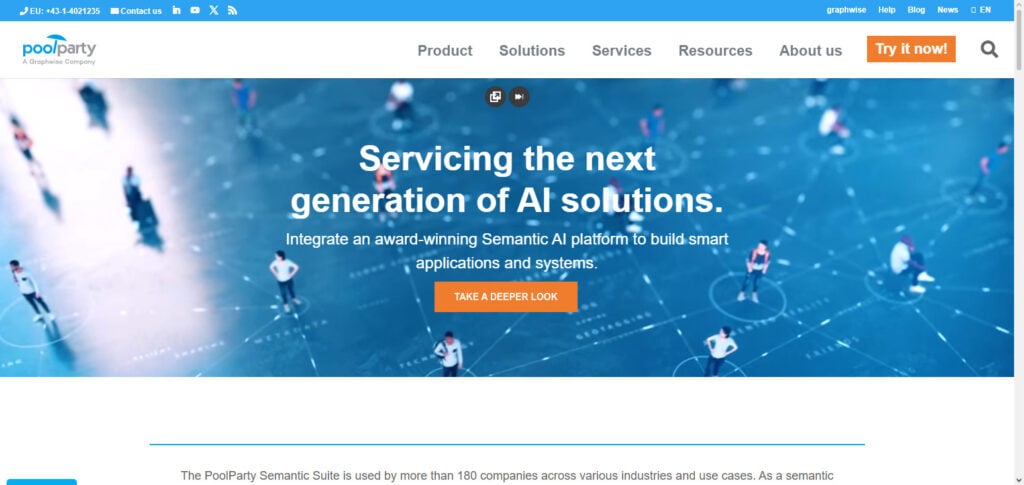
The suite allows firms to model and build information and structures using the principles of linked data, semantics, and ontologies. Using PoolParty, organizations are able to differentiate themselves from the competition, enhance their content and data structures, and build meaningful connections across different data ecosystems.
The suite covers the needs of the healthcare, publishing, government, and financial sectors. PoolParty’s platform supports and helps organizations build contextual systems that have the ability to provide superior and accurate insights.
Features
- Combines semantic technologies and AI for building knowledge graphs.
- Can manage and control taxonomies and ontologies.
- Offers semantic search.
- Provides tools for the creation and management of linked data.
- Offers solutions for enterprise content intelligence.
Pros
- Can greatly assist in semantic modeling.
- Enhances search capabilities and content discoverability.
- Can assist in the workflows of knowledge management.
- Flexible options for integration.
- Can serve industries with strict regulations.
Cons
- Users need to have at least some familiarity with semantic technologies.
- Implementation may be challenging for the uninitiated.
- Can be pricey for enterprises.
- Lesser-known solutions when compared to other services.
- Customization is limited without the proper knowledge and skills.
Conclusion
Using an AI Knowledge Graph Platform allows organizations to manage and analyze data effectively. They have transformed Relational Graph Databases. Neo4j, Stardog, TigerGraph, Ontotext GraphDB, Amazon Neptune, and other similar platforms have allowed organizations to enhance AI, search and information extraction, decision making, and the discovery of data.
These platforms have a variety of offerings, whether it be semantic reasoning or data governance, real-time graph analytics, or integration of machine learning.
There are many factors that contribute to the best AI Knowledge Graph Platform choice; data size, data complexity, AI’s ability to scale, and the company’s goals when implementing the AI. The implementation of AI will be the foundation for transforming the company and increasing the company’s global market presence.
FAQ
What are AI Knowledge Graph Platforms?
AI Knowledge Graph Platforms are technologies that organize data by connecting entities, relationships, and concepts into intelligent networks. These platforms help AI systems understand context, discover patterns, improve search accuracy, and generate better insights from complex information.
Why are AI Knowledge Graph Platforms important for businesses?
AI Knowledge Graph Platforms help businesses unify disconnected data, improve decision-making, enhance customer experiences, and support advanced AI applications. They enable organizations to discover hidden relationships, automate analysis, and create more intelligent data-driven solutions.
Which are the Best AI Knowledge Graph Platforms?
Some of the Best AI Knowledge Graph Platforms include Neo4j, Stardog, TigerGraph, Ontotext GraphDB, Cambridge Semantics Anzo, Amazon Neptune, IBM Watson Knowledge Catalog, SAP HANA Graph, Yewno Edge, and PoolParty Semantic Suite.
How does Neo4j support AI Knowledge Graph applications?
Neo4j supports AI Knowledge Graph applications through its native graph database technology, graph analytics, and machine learning capabilities. It helps organizations analyze relationships between data points for applications such as fraud detection, recommendations, cybersecurity, and intelligent search.