


In this article, we’ll cover the top synthetic data companies that are changing the secure ways companies generate, manage, and use data.
These companies offer AI-driven synthetic data that help simulation, analysis, operation testing, and privacy. From healthcare to automotive to finance, synthetic data platforms help companies to innovate in a rapid manner without the risk of using sensitive real data.
What is Synthetic Data Companies?
Synthetic data firms leverage machine learning and cutting-edge data creation technologies to produce data that mimic real-world data. Businesses can utilize the data to train AI models and analyze the data and run research without concern for exposing real data.
These firms are able to produce data, which is compliant with data privacy legislation and is safe to use. These firms work with a variety of industries from healthcare to finance. Synthetic data firms cater to the data privacy concerns of their clients to enable the rapid, safe use of data and the development of artificial intelligence.
Is synthetic data safe to use?
Generally, synthetic data is safer to use because it is generated through means that do not lead to real people or their data. Companies that provide synthetic data use techniques that preserve privacy and artificial intelligence to generate datasets that mimic the structure, patterns, and functionalities of the original data and keep the sensitive data hidden.
Within organizations, synthetic data can be used to meet data protection laws, and, due to its safety, can be used to transfer data and improve the training of artificial intelligence models.
The enclosure of sensitive data is critical, but so is the safety of the generation methods and privacy controls. Organizations that offer artificial synthetic data rely on techniques and are the safest means of synthetic data generation.
Key Point & Best Synthetic Data Companies
| Synthetic Data Company | Key Points / Features |
|---|---|
| Mostly AI | • Specializes in high-quality synthetic data generation for enterprises.• Uses advanced AI models to create privacy-safe datasets.• Helps organizations comply with data protection regulations like GDPR.• Supports structured data, customer data, and analytics use cases.• Improves AI model training without exposing sensitive information. |
| Gretel.ai | • Provides developer-friendly synthetic data APIs and platforms.• Uses machine learning models to generate realistic datasets.• Supports data privacy, anonymization, and data augmentation.• Enables faster AI development and testing workflows.• Offers tools for generating synthetic text, tabular, and event data. |
| Hazy | • Focuses on privacy-preserving synthetic data solutions.• Creates realistic datasets for financial and enterprise applications.• Helps businesses overcome data-sharing limitations.• Uses AI models to maintain statistical accuracy.• Supports secure data collaboration and compliance requirements. |
| MDClone | • Provides synthetic data solutions mainly for healthcare organizations.• Enables secure medical research without exposing patient identities.• Creates realistic healthcare datasets for analysis and innovation.• Supports clinical trials and healthcare AI development.• Improves collaboration between hospitals and researchers. |
| Tonic.ai | • Offers synthetic data generation for software development and testing.• Helps engineering teams access realistic datasets safely.• Supports databases, APIs, and application testing workflows.• Reduces dependency on sensitive production data.• Provides data privacy and compliance-focused solutions. |
| Anonos | • Provides data privacy and protection technologies.• Uses advanced anonymization and synthetic data techniques.• Helps enterprises securely use sensitive information.• Supports regulatory compliance across global markets.• Enables safe data sharing for analytics and AI projects. |
| Kinetica | • Provides real-time analytics and AI data processing solutions.• Supports high-performance data management for enterprises.• Helps organizations analyze large-scale synthetic datasets.• Enables faster machine learning and operational insights.• Combines analytics, AI, and real-time database capabilities. |
| Cvedia | • Specializes in synthetic data generation for computer vision AI.• Creates realistic 3D environments and training datasets.• Supports autonomous systems, robotics, and industrial AI.• Helps improve computer vision model accuracy.• Reduces the need for expensive real-world data collection. |
| Datagen | • Creates synthetic visual data for AI and machine learning models.• Focuses on computer vision and image recognition applications.• Generates realistic 3D images and environments.• Supports robotics, automotive, and smart device industries.• Helps improve AI training speed and accuracy. |
| Parallel Domain | • Provides synthetic data solutions for autonomous vehicle development.• Generates realistic driving environments and simulation data.• Supports computer vision and machine learning training.• Helps automotive companies test AI systems safely.• Reduces costs associated with real-world data collection. |
1. Mostly AI
Mostly AI is among the best in producing high quality synthetic data. They utilize artificial intelligence and machine learning to develop data that is both realistic and maintains the attributes of original datasets. They do this without revealing vulnerable information.
This is a prime solution for those who face data privacy issues. This application is critical when developing artificial intelligence, analysis, and testing for software. Mostly AI primarily operate in the banking and insurance sectors, as well as healthcare and telecommunications.
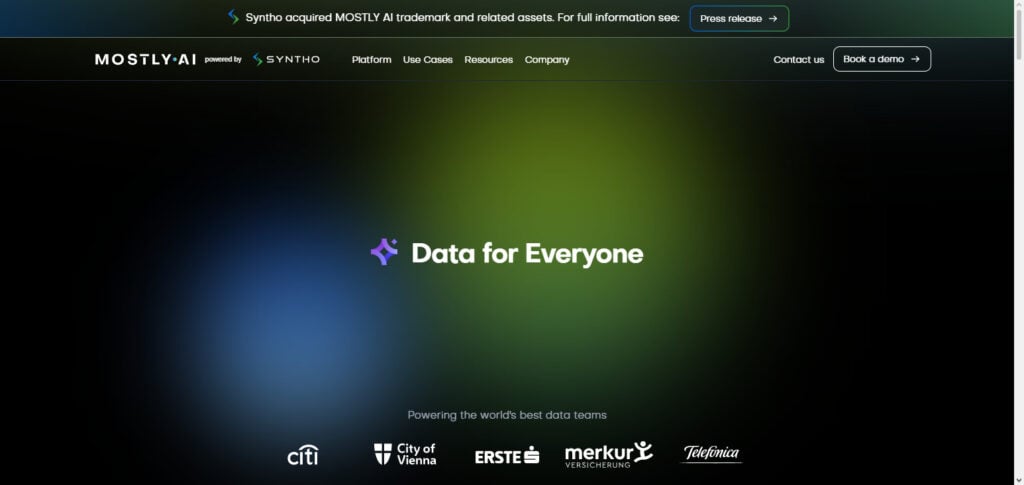
This is because of the severity of the data security in the mentioned fields. Mostly AI is further able to help companies remain compliant with GDPR as they analyze and train their models using synthetic data.
Mostly AI Characteristics, Advantages & Disadvantages
Characteristics:
- Leverages state-of-the-art AI models for realistic synthetic data generation.
- Specializes in privacy-focused data generation for businesses.
- Works with structured data, customer data, and data analytics pipelines.
- Keeps original data sets’ statistical correspondence.
- Assists businesses with GDPR and other data compliance.
Advantages:
- Synthetic data is generated without the need for any real data.
- Increases the speed and efficiency of AI model training and testing.
- Allows for safe and secure data sharing across teams.
- Lowers reliance on actual customer data.
- Designed for use on big data across the enterprise.
Disadvantages:
- Advanced usage may require high levels of technical know-how.
- High enterprise pricing, meaning small businesses may be priced out.
- Mostly AI relies on good quality original data sets.
- Complex relationships in data may require extra fine-tuning.
- May not be appropriate for specific data-intensive use cases.
2. Gretel.ai
Gretel.ai is a synthetic data platform for software developers looking to create secure data sets for artificial intelligence with relative ease. Gretel.ai provides APIs that synthesize a variety of data in seconds. They also design their frameworks using generative AI models.
These sophisticated models are able to keep data useful while protecting sensitive information. They are widely used and are a great solution for the training of machine learning models as well as application testing and data sharing. Gretel.ai enables companies to rapidly improve artificial intelligence implementations while fortifying data privacy.
Gretel.ai Characteristics, Advantages & Disadvantages
Characteristics:
- Offers APIs for developer-centered synthetic data generation.
- Provides text, tabular, and event-based synthetic data.
- Employs privacy-preserving generative AI models.
- Includes automation features for data generation processes.
- Targets testing and development of AI applications.
Advantages:
- Provides APIs and other developer tools for seamless integration.
- Enables protection of sensitive information of enterprises.
- Advances development of machine learning.
- Offers a range of data.
- Addresses the concerns of using real data.
Disadvantages:
- Customization requires technical knowledge.
- Data generated may not be validated for production.
- Advanced features may lead to higher operational costs.
- Not all industries may find off-the-shelf products useful.
- Highly intricate sets of data may require additional setup.
3. Hazy
Hazy is a synthetic data generation company centered on the creation of realistic data sets without the risk of exposing personal data. Their platform utilizes machine learning and artificial intelligence to create synthetic versions of sensitive data that still maintain the structures and relationships of the original data.

Hazy is mainly utilized by financial institutions and healthcare companies that require safe data to conduct analytics and to build out artificial intelligence. Using Hazy’s technology, teams are able to safely collaborate, build and test applications, and even build machine learning models.
Hazy minimizes privacy concerns by optimizing data availability. By doing this, Hazy helps companies quickly and safely comply with data privacy regulations, and provides a competitive advantage to its users by providing access to their data.
Hazy Characteristics, Advantages & Disadvantages
Characteristics:
- Synthetic data solution provider with a focus on privacy.
- Data generated through ML algorithms.
- Offers financial and enterprise data.
- Organizations can share private data with less risk.
- Data structures and relationships are preserved and protected.
Advantages:
- Data privacy and compliance are improved.
- Organizations can work with other data and institutions.
- Usable datasets are available sooner.
- Personal data exposure is less likely.
- Data can be used for AI and analytics.
Disadvantages:
- Offers enterprise solutions primarily.
- May require an IT staff member to set up.
- Synthetic data could be generated at a low quality.
- Solutions may be priced outside the budget of smaller enterprises.
- Less information available in the public domain compared to larger competitors.
4. MDClone
MDClone is a synthetic data generation company with a focus on the healthcare industry. Their technology allows healthcare companies safe access to data for research and analytics. MDClone’s platform generates synthetic healthcare data that retains the statistical structure and integrity of real data, while ensuring the privacy of individual data.
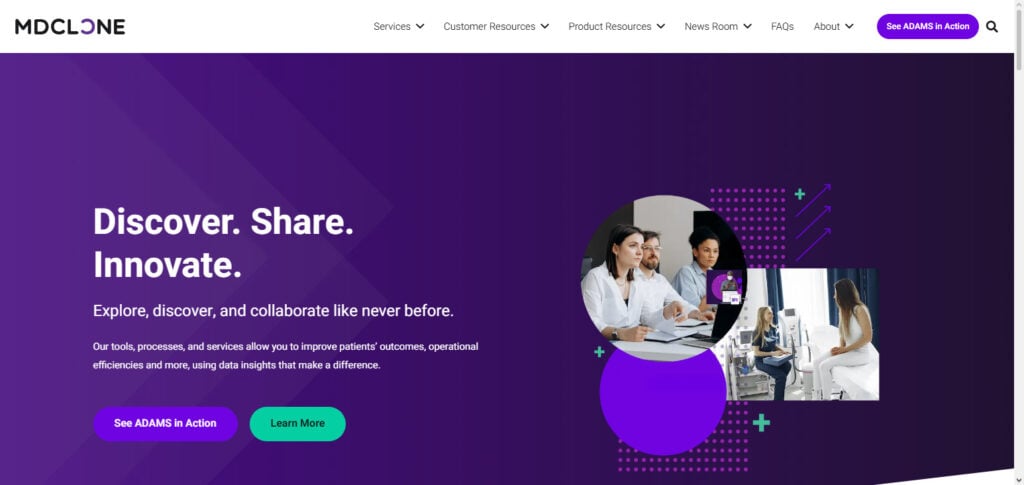
MDClone is used by hospitals, healthcare systems and companies, and researchers to enhance the care of patients, perform healthcare research, and build artificial intelligence based healthcare solutions.
Their technology allows healthcare systems to safely collaborate in research without privacy infringements. MDClone helps healthcare research and analytics keep pace with healthcare decision making by ensuring safe data transformations.
MDClone Characteristics, Advantages & Disadvantages
Characteristics:
- Synthetic data platform focused on healthcare.
- Provides synthetic data to create patient data for research.
- Supports healthcare analytics and AI.
- Safe to share and work with data from multiple healthcare organizations.
Advantages:
- Research and innovation in healthcare are improved.
- Patient privacy is protected.
- Safe to share data for clinical research and healthcare related AI.
- Healthcare analytics are improved.
Disadvantages:
- Designed with the needs of healthcare in mind.
- May not meet other business needs.
- Can be costly for smaller healthcare organizations.
- Can require healthcare specific knowledge to implement.
- Can be challenging to integrate into other healthcare systems.
5. Tonic.ai
Synthetic data and privacy concern tools for software development, testing, and AI workflows are offered by Tonic.ai. The platform helps build engineering frameworks where teams can create realistic data models without worrying about the sensitivity of the production data.
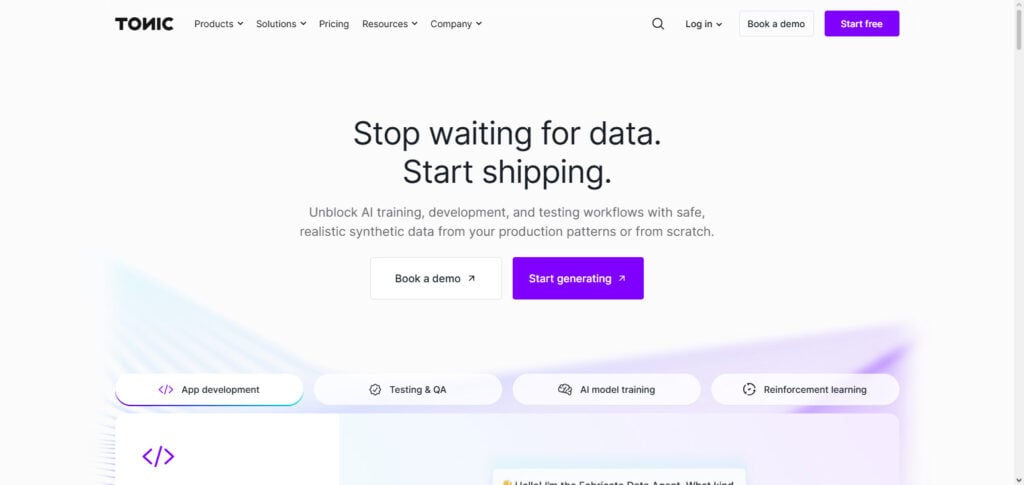
Tonic.ai builds privacy-safe models of the real-world data for different databases, APIs, and enterprise applications. The platform builds safe data models by implementing sophisticated data generation and anonymization frameworks.
Technology, finance, and healthcare companies whose concerns for validating and triggering the development of data and models in the safest, fastest, and most regulatory-compliant way are addressed with Tonic.ai are its most important users.
Tonic.ai Characteristics, Advantages & Disadvantages
Characteristics:
- Provides synthetic data for software development and testing.
- Supports database and application testing workflows.
- Focuses on privacy-safe developer environments.
- Generates realistic production-like datasets.
- Helps engineering teams avoid using sensitive data.
Advantages:
- Improves software testing security.
- Reduces dependency on production databases.
- Provides realistic testing environments.
- Helps developers work faster.
- Supports compliance with privacy regulations.
Disadvantages:
- Mainly focused on development and testing needs.
- Complex databases may require customization.
- Can involve learning time for new users.
- Advanced capabilities may increase costs.
- Not primarily designed for all AI applications.
6. Anonos
Anonos is a layer of privacy focus data technology who synthesizes data in a more secure framework. With their data generation model, the users of Anonos are able to unlock trade data while remaining compliant and secure. Anonos helps companies in finance, healthcare, and government retain a competitive edge by using their data in a secure framework.
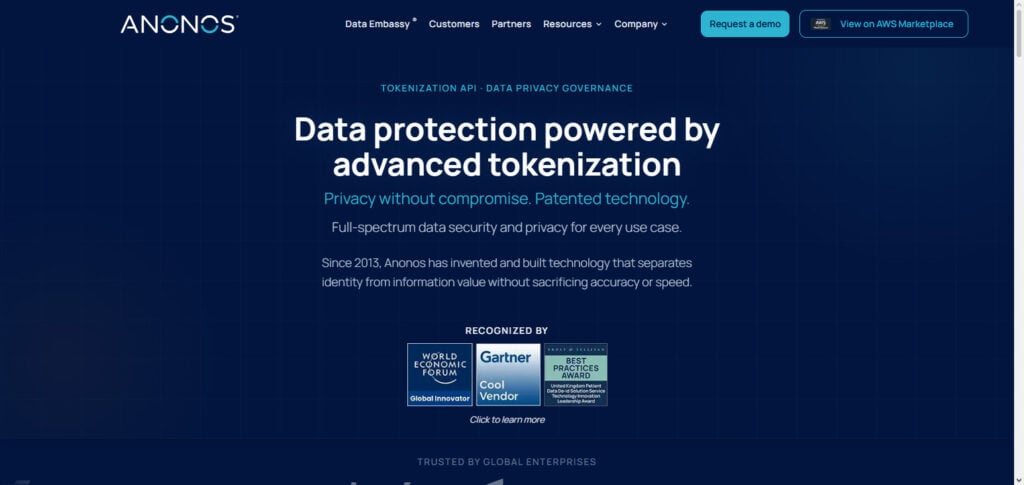
Anonos’ focus on combining secure data with a privacy framework enhances the AI and analytic capabilities for their customers while enabling them to compete. Anonos builds a secure environment for their users to promote innovation.
Anonos Characteristics, Advantages & Disadvantages
Characteristics:
- Provides privacy-enhancing data technologies.
- Uses anonymization and synthetic data methods.
- Helps enterprises securely use sensitive information.
- Supports global compliance requirements.
- Focuses on trusted data collaboration.
Advantages:
- Strong privacy and security capabilities.
- Helps organizations comply with regulations.
- Enables safe data sharing.
- Supports enterprise-level data governance.
- Protects valuable business information.
Disadvantages:
- Solutions may be complex for beginners.
- Requires technical implementation knowledge.
- Higher costs for smaller businesses.
- May require consulting support.
- Not focused only on synthetic data generation.
7. Kinetica
Kinetica offers powerful analytics data and the ability to quickly process data in real-time. Kinetica supports synthetic data workflows by letting its users process the data generated for machine learning, simulations, and analytics. Kinetica’s real-time database can assist the finance, transportation, and telecom sectors, as well as government agencies.
Combining AI, analytics, and real-time computing gives Kinetica an edge in taking fast and reliable decisions. Kinetica is focused on providing a scalable, high-performance, and real-time analytics platform.
Kinetica Characteristics, Advantages & Disadvantages
Characteristics:
- Provides real-time data analytics and processing solutions.
- Supports AI-driven data operations.
- Handles large-scale datasets efficiently.
- Combines database technology with analytics capabilities.
- Used in industries requiring fast data insights.
Advantages:
- Provides high-speed data processing.
- Supports large-scale analytics workloads.
- Helps organizations make real-time decisions.
- Useful for AI and machine learning applications.
- Handles complex data environments effectively.
Disadvantages:
- Requires technical expertise for deployment.
- May be expensive for smaller organizations.
- More focused on analytics than pure synthetic data.
- Requires infrastructure planning.
- Not suitable for simple data generation needs.
8. Cvedia
Cvedia is a provider of synthetic data for computer vision. They help companies develop and improve their AI-enabled autonomous systems by providing a means to create and use realistic virtual environments to train and test autonomous systems. Cvedia provides its users with customizable synthetic datasets, thereby minimizing the need for costly real-world data collection.
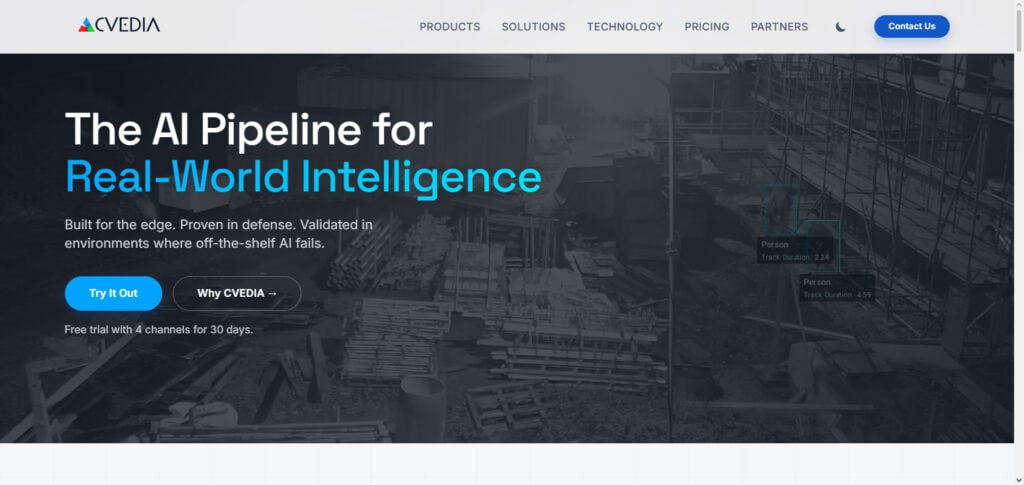
Cvedia’s synthetic data is used to train computer vision systems to recognize objects, environments, and scenarios. By creating a greater diversity of data during the computer vision system development process, Cvedia helps to shorten the time of the AI development and testing process. Cvedia is a very useful tool for almost any company that is developing intelligent machines and automated systems.
Cvedia Characteristics, Advantages & Disadvantages
Characteristics:
- Focuses on synthetic data for computer vision.
- Constructs lifelike virtual settings.
- Supports industrial AI efforts and robotics.
- Constructs computer vision training datasets.
- Assists in lessening the load of data collection.
Advantages:
- Beneficial for training computer vision models.
- Lessens expense for data collection.
- Encourages use of custom simulation.
- Assists in the safe testing of AI.
- Offers many training options.
Disadvantages:
- Primarily centers on computer vision.
- Requires sophisticated knowledge of AI.
- High-end simulations might need alterations.
- Can’t supplant all physical data.
- Costly for smaller groups.
9. Datagen
Datagen focuses on the creation of visual datasets where realism is key. Generating 3D environments, images, and videos, Datagen provides businesses with the perfect inputs for training their machine learning models. Datagen is heavily utilized throughout multiple verticals, including robotics, automotive, and retail tech.
These industries are better able to address the problems of expensive data collection and the scarcity of real-world data with the solutions that Datagen provides. Datagen’s flexible synthetic visual data aids the development of advanced computer vision models. Furthermore, Datagen’s solution enables companies to build their smart AI systems and scale their data generation.
Datagen Characteristics, Advantages & Disadvantages
Characteristics:
- Concerned with making synthetic visual data.
- Able to produce lifelike images and 3D spaces.
- Constructs datasets for training AI and computer vision.
- Recently became popular in robotics, automotive, and smart devices.
- Offers customizable synthetic datasets.
Advantages:
- Datasets are effective for training and fast for development.
- Constructing computer vision models is easy.
- Works across many domains.
- Data generation is in large quantities.
Disadvantages:
- Focused mainly on visual data.
- Requires AI knowledge for customization.
- Can be costly.
- May need outside data to validate.
- Limited usage for projects outside computer vision.
10. Parallel Domain
Dedicated to training artificial intelligence for the computer vision and automotive industries, Parallel Domain specializes in synthetic data generation through simulation. With the creation of virtual environments and driving scenarios,
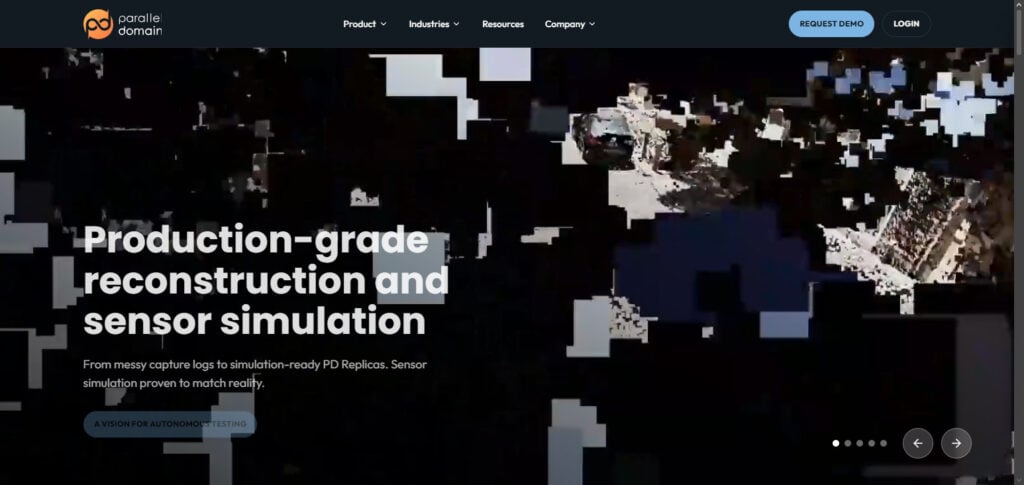
Parallel Domain assembles datasets and aids the training of AI models. Parallel Domain enables companies in the automotive and robotic industries to safely simulate the functionalities of autonomous systems prior to the data collection in the real world.
The company’s solutions create diverse data with varying weather patterns, places, and driving scenarios. In addition to the rapidly growing AI market, Parallel Domain is advancing technology in autonomous driving, machine learning, and intelligent transportation.
Parallel Domain Characteristics, Advantages & Disadvantages
Characteristics:
- Specializes in synthetic data for AI and autonomous systems.
- Builds realistic driving simulations.
- Offers labeled computer vision datasets.
- Operates in the automotive and robotics domains.
- Trains AI in Virtual environments.
Advantages:
- Lowers the costs associated with testing autonomous vehicles.
- Offers various simulation situations.
- Increases the Safety of AI testing.
- Creates Simplicity for large-scale computer vision.
- Accelerated Innovation for Autonomous systems.
Disadvantages:
- Primarily covers automotive and simulation use cases.
- Involves niche, technical skill sets.
- Good simulations are expensive.
- Virtual environments can provide many, but not all, real world scenarios.
- Not the best fit for general business data.
Conclusion
Top Synthetic Data Companies offer organizations privacy-preserving and realistic data sets to aid companies with the development, analysis, and testing of AI and software, respectively. “Realistic data sets” contains the word “realistic.”
Hazy, Gretel.ai, MDClone, and Mostly AI are only a few of the synthetic data providers dominating the healthcare, finance, automotive, technology, and remaining sectors.
Datagen, Kinetica, Cvedia, Anonos, and Parallel Domain are emerging, industry-disrupting companies in the AI and synthetic data sector, and are designed for rapid ML and AI development. Synthetic data platforms render a data privacy framework and a scalable/secure AI framework and enable companies to remain compliant and decrease business disruptions.
FAQ
What are synthetic data companies?
Synthetic data companies are organizations that use artificial intelligence, machine learning, and data generation techniques to create artificial datasets that look and behave like real-world data. These companies help businesses train AI models, test software, and perform analytics while protecting sensitive information.
Why do companies use synthetic data?
Companies use synthetic data to overcome privacy concerns, limited data availability, and regulatory restrictions. It allows organizations to develop AI models, conduct testing, and share data securely without exposing real customer or business information.
Which are the best synthetic data companies?
Some of the best synthetic data companies include Mostly AI, Gretel.ai, Hazy, MDClone, Tonic.ai, Anonos, Kinetica, Cvedia, Datagen, and Parallel Domain. These companies provide solutions for privacy protection, AI training, healthcare research, computer vision, and enterprise analytics.
. Is synthetic data safe to use?
Yes, synthetic data is generally safer than real data because it does not contain direct personal information from actual users. Leading synthetic data platforms apply privacy-preserving techniques to reduce the risk of exposing confidential information.
How does Mostly AI generate synthetic data?
Mostly AI uses advanced machine learning models to analyze real datasets and create synthetic versions that maintain important patterns and relationships. Its platform helps enterprises generate privacy-safe data for analytics, AI development, and testing.