

This article will cover the top AI Monitoring software that allow businesses to oversee the performance of AI, tracking the models, spotting errors, and enhancing the reliability of the applications.
These AI Monitoring software systems provide advanced utilities such as analytics, evaluation, and debugging with ease of real-time access. This will enable the organizations to select among the best systems the most appropriate software for managing, optimizing, and scaling AI systems.
What is Monitoring Software?
Monitoring Software is a tool that allows companies to understand how digital processes are functioning and how users are interacting. Developers utilize the tool to manage the performance of applications and systems. This software captures real-time, actionable data.
It will identify and alert issues before the software or application fails due to performance difficulties. Monitoring software addresses additional concerns while tracking the performance of AI systems. It will track model accuracy, data quality, performance of the responses and the system, as well as usage patterns. Monitoring software will suggest when and if a system may fail.
For organizations, monitoring software becomes critical when trying to operate and utilize resources with maximum reliability. Monitoring Software is an important for ensuring the efficient of a system in operating in real-time.
Why Choose AI Monitoring Software for Smarter AI Management
Continuous AI Performance Monitoring
AI Monitoring Software helps to keep a constant watch on all AI Models, Applications and Workflows. It helps teams track various performance metrics, the quality of AI responses, system latency and behavior and ensures AI solutions work optimally.
Detecting Errors and Issues Proactively
AI Monitoring tools automatically capture issues such as wrong outputs, Model failures, poor Data quality and performance issues. Early detection enables businesses to address issues before they affect the end user.
Refining AI Models
AI Monitoring tools provide an in-depth analysis of models and suggest areas for improving the quality of predictions, responses and decisions. This ensures that organizations keep their AI systems reliable and refined.
Managing LLM Applications
AI Monitoring Software helps developers manage prompts, responses, tokens and AI Workflows. It also helps in managing large language models (LLMs) effectively by providing various behavioral insights of Applications.
Cost Reduction
AI Monitoring tools help organizations improve the cost efficiency of AI operations by monitoring the consumption and usage of resources.
Improved Data Quality Monitoring
AI Monitoring tools detect Data Drifts and provide alerts on the Data quality status. Continuous monitoring of Data helps AI Systems serve better.
Improved Debugging and Troubleshooting
AI Monitoring tools provide advanced debug and troubleshooting capabilities by providing traces and detailed logs.
Key Point & Best AI Monitoring Software
| AI Monitoring Software | Key Points / Overview |
|---|---|
| Klu.ai | • AI observability platform for monitoring LLM applications and workflows.• Provides prompt tracking, evaluation, and performance analytics.• Helps teams optimize AI applications with real-time insights.• Supports debugging and improving AI model outputs.• Useful for enterprises building scalable AI systems. |
| Instabug | • Mobile application monitoring platform with AI-powered error tracking.• Detects crashes, bugs, and performance issues automatically.• Provides real-time user feedback and diagnostic reports.• Helps developers improve app reliability and user experience.• Supports monitoring of mobile AI-powered applications. |
| Groundcover | • Cloud-native observability platform designed for modern applications.• Uses AI-driven monitoring to detect system issues quickly.• Provides Kubernetes and infrastructure performance insights.• Helps identify application errors and operational bottlenecks.• Offers lightweight monitoring with high scalability. |
| Maxim AI | • AI testing and evaluation platform for LLM applications.• Enables automated quality checks for AI responses.• Provides simulation, debugging, and performance tracking tools.• Helps improve accuracy and reliability of AI models.• Supports enterprise AI development and deployment workflows. |
| WhyLabs | • AI observability platform focused on machine learning monitoring.• Detects data drift, model issues, and performance changes.• Provides automated alerts for AI system problems.• Helps maintain reliable and compliant ML operations.• Supports monitoring across production AI environments. |
| Langfuse | • Open-source LLM observability and analytics platform.• Tracks prompts, responses, costs, and model performance.• Helps developers debug and optimize AI applications.• Provides detailed traces for LLM workflows.• Supports collaboration between AI engineering teams. |
| Helicone | • LLM monitoring platform for tracking AI application usage.• Provides analytics on latency, costs, and user behavior.• Enables prompt management and performance optimization.• Supports multiple AI model providers and APIs.• Helps developers improve LLM reliability. |
| Arize AI | • Enterprise AI observability platform for machine learning models.• Monitors model performance, data quality, and drift.• Provides explainability tools for AI decisions.• Helps detect production model failures quickly.• Supports responsible and scalable AI deployment. |
| LangSmith | • AI application monitoring platform developed for LangChain workflows.• Provides tracing, debugging, and evaluation capabilities.• Helps developers analyze LLM application performance.• Supports testing and improving AI agent behavior.• Enables better management of complex AI pipelines. |
| Braintrust | • AI evaluation platform for testing and monitoring LLM applications.• Provides automated evaluation and experiment tracking.• Helps compare model performance and output quality.• Supports continuous improvement of AI systems.• Useful for teams building production-ready AI products. |
1. Klu.ai
Klu.ai is a cutting-edge AI monitoring and optimization platform for teams developing AI applications using large language models. Klu.ai has tools for tracking AI performance, performing prompt management, assessing model responses, and refining AI applications.
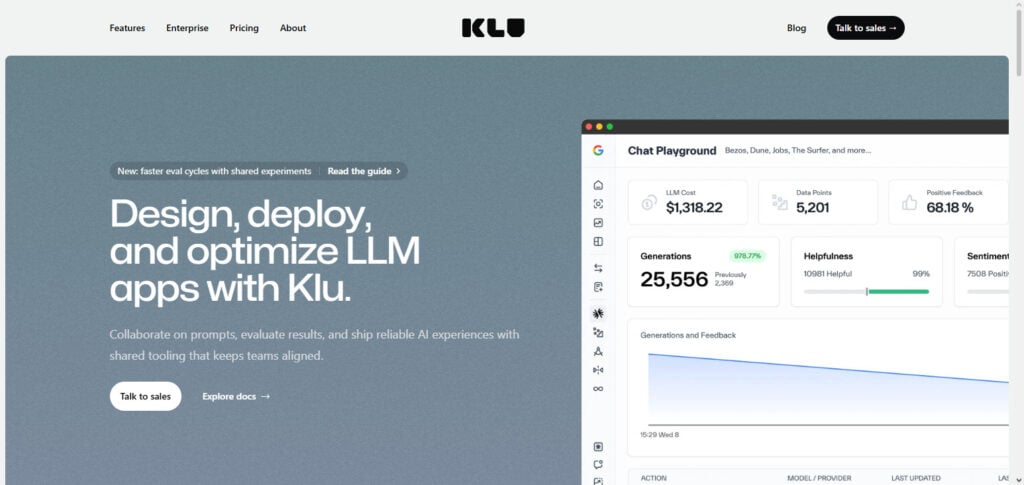
Rated among the Best AI Monitoring Software tools, Klu.ai assists developers in monitoring AI workflows, pinpointing AI performance issues, and behavior optimization of models through extensive analytics.
The platform accommodates advancement, prompt versioning, and teamwork of AI-enabled staff. Klu.ai helps the business achieve reliability, optimizes the AI expenditure, and guarantees output consistency in the company’s AI applications.
Characteristics:
- Designed to optimize the interaction between users and AI.
- Great for tracking AI performance, managing prompts, and evaluating AI.
- Monitors the performance of AI workflows.
- Analyzes AI responses and enables teams to improve AI.
- Promotes project-related discussions.
Advantages:
- Provides insight into AI application performance.
- Offers tools to better manage and edit AI outputs.
- AI workflow debugging is quicker.
- Minimizes the time taken to develop and test AI.
- Great for managing AI applications within a company.
Disadvantages:
- Advanced features rely on a certain level of expertise.
- Focuses mainly on AI and LLMs.
- Small teams may find the cost restrictive.
- New users spend time getting used to the system.
- Not great for monitoring traditional applications.
2. Instabug
Instabug is a monitoring solution that helps enhance the performance and robustness of mobile applications and the experience of mobile app users. Instabug has automated bug identification and crash reporting, performance monitoring, and user feedback collection features.
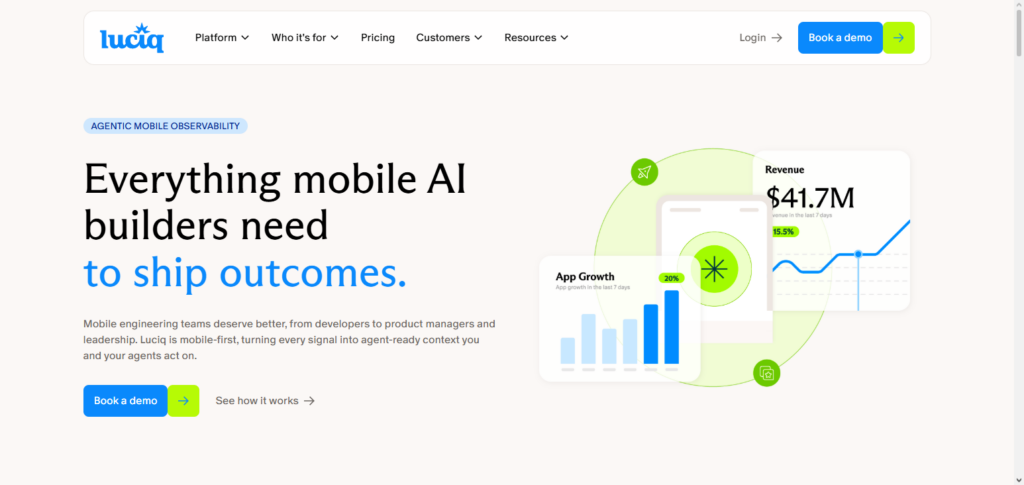
Rated among the Best AI Monitoring Software tools, Instabug enables application development teams to detect application issues and fix them before users are impacted. The platform uses intelligent diagnostics for error analysis and behavior tracking of the application and provides actionable insights.
AI-based mobile application development companies can use Instabug for reliability monitoring and better customer satisfaction and seamless digital experiences.
Characteristics:
- Comprehensive monitoring of mobile applications focused on error tracking.
- Monitors app crashes and performance.
- Offers real-time feedback.
- Diagnoses issues.
- Supports AI mobile app monitoring.
Advantages:
- Monitors and improves the stability of mobile apps.
- Provides in-depth crash and bug analysis.
- Analyzes feedback to enhance user experience.
- Decreases debugging time.
- Seamless integration.
Disadvantages:
- Focus is solely on mobile.
- Very few monitoring features for LLMs.
- High cost for large teams.
- Higher cost for advanced features.
- Not great for monitoring AI models.
3. Groundcover
Groundcover is a cloud-focused monitoring platform that provides businesses with the ability to track the performance and health of applications and the infrastructure that supports them. It targets Kubernetes and cloud applications that need instantaneous monitoring.
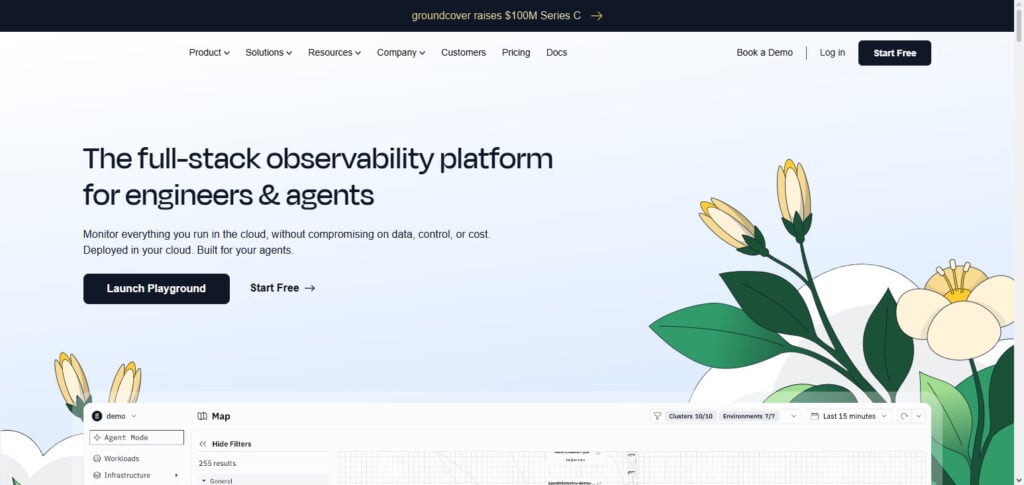
Groundcover is one of the Best AI Monitoring Software solutions. With sophisticated monitoring tools, Groundcover finds atypical behavior, diagnoses and resolves operational problems, and enhances the reliability of the system.
With Groundcover, businesses receive the insights needed to track the performance of an application, how resources are consumed, and what failures are likely to occur. Groundcover makes cloud monitoring easy and helps eliminate downtime with AI applications that perform optimally in the most complex of technology environments.
Characteristics
- Observability platform that is Cloud-native
- Kubernetes and infrastructure monitoring
- Systems issues are detected through advanced analytics
- Application performance insights are provided in real-time
- Elasticity designed for cloud scalability
Advantages
- Fast and lightweight monitoring
- Deep visibility of cloud infrastructure
- Detects performance issues faster
- Environments of large-scale applications are supported
Disadvantages
- Knowledge of cloud infrastructure required
- Engineering teams are the primary users
- AI model evaluation is limited
- Complexity for novice users
- Costly for enterprise features
4. Maxim AI
Maxim AI is an AI evaluation and monitoring platform that services the needs of businesses that are developing applications based on generative AI and large language models. Maxim AI is an exceptional AI monitoring tool that helps teams test AI models, assess responses, and track performance, while also assisting teams with the modification of their applications to be of a higher quality.
As one of the Best AI Monitoring Software tools, Maxim AI helps teams perform prompt authoring and testing, and also supports the simulation and debugging of AI tools and the automation of these tasks. With Maxim AI, businesses can develop AI tools that are of a higher quality, and that minimize errors and contribute to an overall higher satisfaction rating for the end user.
Characteristics
- An AI testing and evaluation for LLMs
- Simulation and testing with the analysis of AI and application performance
- AI and application behavior is tracked
- Evaluation of AI and optimization of prompts
- Assist in the creation of AI-based products
Advantages
- AI model assessment and testing is improved
- Evaluation provides insights and is detailed
- AI-related issues are identified
- Improvement of AI is continuous
- Generative AI developers find this useful
Disadvantages
- AI-focused design
- LLMs and AI infrastructure is required
- Small scope for small AI projects
- Highly detailed analysis and evaluation may require a tech background
- Cost and budget discrepancy may occur
5. WhyLabs
WhyLabs is an AI observability platform that enables enterprise-level monitoring of ML models, data quality, and AI systems. WhyLabs focuses on spotting issues like data drift, model decay, and anomalous AI behaviors. WhyLabs is one of the Best AI Monitoring Software solutions, featuring automated monitoring, alerts, and business analytics for dependable AI operations.
WhyLabs also assists data science teams in understanding the post-deployment model and the prevention of post-deployment model framework failure. Enterprises leverage WhyLabs to enhance the precision of AI, ensure continual governance, and engineer enterprise-grade ML systems.
Characteristics
- AI observability platform for ML systems
- Monitors and detects data drift and model performance issues
- Automated monitoring and alerts
- Support for ML lifecycle management
- AI operations monitoring and observability
Advantages:
- Strong machine learning monitoring capabilities.
- Early detection of AI model degradation.
- Supports enterprise-level AI deployment.
- Enhances model reliability and accuracy.
- Offers in-depth data quality assessments.
Disadvantages:
- Must have some ML knowledge to utilize fully.
- Can be complicated to use with little experience.
- Focused on ML over general applications.
- A decent amount of technical resources required to set up.
- Potentially high enterprise pricing.
6. Langfuse
Langfuse is an open-source LLM monitoring and analytics platform tailored to developers designing AI apps. Langfuse provides comprehensive insight into the tracking of prompts, model output, latency, tokens, and the performance of the application.
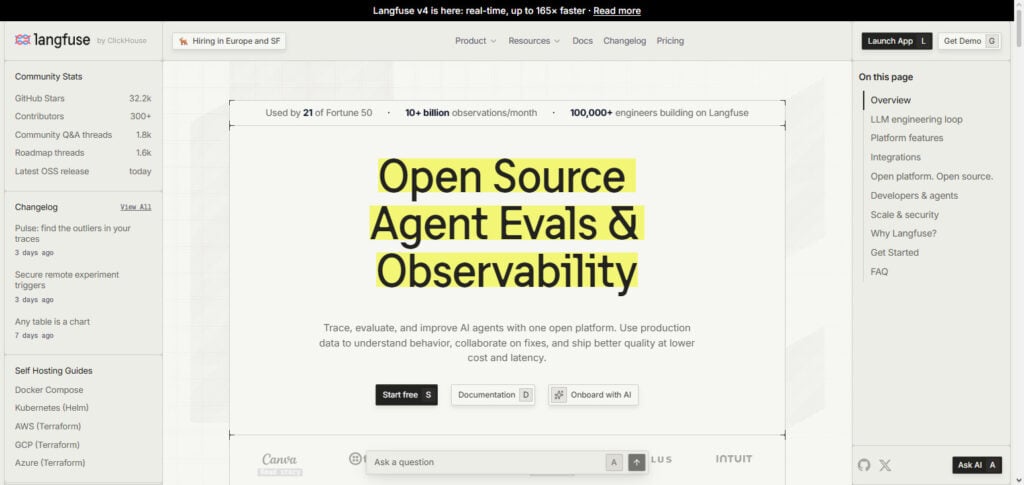
Langfuse is one of the Best AI Monitoring Software solutions that enables teams to debug AI workflows, examine user behaviors, and fine-tune LLM applications. Langfuse captures the finest details of AI processes, step-by-step. Companies aim to create high-caliber, and low-cost, efficient generative AI solutions and LLMs using Langfuse.
Characteristics:
- Open-source observability and analytics platform for LLMs.
- Monitors prompts, responses, latency, and token counts.
- Excellent AI workflow tracing.
- Debugs intricate LLM applications.
- Aids evaluation and collaboration of developers.
Advantages:
- Open-source and easily customizable.
- Excellent LLM monitoring.
- Lessens amount of time spent on AI debugging.
- Supports numerous AI application workflows.
- Great for developer teams.
Disadvantages:
- Needs knowledge of technology to set up
- Self-hosting can be tedious.
- Limited monitoring for traditional applications.
- Requires careful setup for most advanced features.
- Can be difficult for inexperienced developers.
7. Helicone
Helicone is an AI monitoring tool that allows developers to track and optimize their applications that use large language models. It offers analytics related to the cost of running AI, API usage, latency, and the quality of API responses.
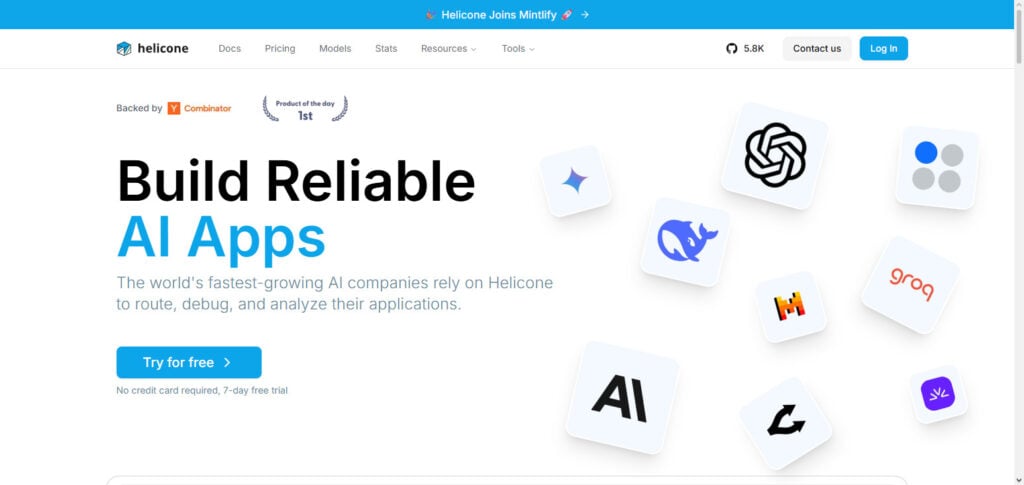
Helicone is one of the Best AI Monitoring Software tools because it allows organizations to analyze model performance, compare AI frameworks, and look for opportunities to enhance AI Models.
Helicone takes prompt and request analysis to the next level by offering the capability to track and analyze AI applications in real time. Organizations can utilize Helicone to increase trust and transparency, decrease costs, and understand user behavior toward AI systems.
Characteristics:
- A monitoring platform for LLMs that focuses on AI application analytics.
- Monitors API requests, costs, latency, and performance.
- Supports many AI model providers.
- Offers prompt monitoring and performance optimization.
- Aids LLM application performance.
Advantages:
- Easy to use with AI APIs.
- Offers real-time analytics for AI.
- Assists in LLM cost management.
- Performance tracking of prompts is simple.
- Excellent for AI development and start-ups.
Disadvantages:
- Limited monitoring for traditional AI infrastructure.
- Focused on LLM applications.
- Requres paid plans for advanced analytics.
- Less optimal for intricate ML models.
- API-based AI workflow is a necessity.
8. Arize AI
Arize AI is an enterprise level AI monitoring tool that helps organizations to control and manage machine learning and generative AI systems. It offers monitoring of models and data, analysis and tracking of performance and explainability of AI.
Arize AI is one of the Best AI Monitoring Software tools because it helps organizations to identify the failures of models, detect data drift, and strengthen AI-enabled solutions.
Arize AI supports the production of AI by offering the capability to understand the real-time behavior of models. Arize AI is used by organizations to build trust, safe, scalable, and high-performance AI systems and solutions.
Characteristics:
- Enterprise AI observability platform ML and LLM systems.
- Monitors models and provides explainability.
- Identifies data drift and issues with performance.
- Monitors production AIs.
- Enables enterprises to run AI responsibly.
Advantages:
- Enterprise AI monitoring is strong.
- Model explainability is strong.
- Large scale AI is safe to deploy.
- AI performance issues are mitigated.
- AI performance is improved.
Disadvantages:
- Enterprise users only.
- Small businesses may find this expensive.
- AI skills are needed.
- Complexity is an issue for beginners.
- Might require technical assistance for setup.
9. LangSmith
LangSmith is an AI monitoring and development application that helps users build, develop, and test applications using LLM. It offers several services to build AI workflows. It offers tracing, evaluation, and performance analysis of AI workflows.
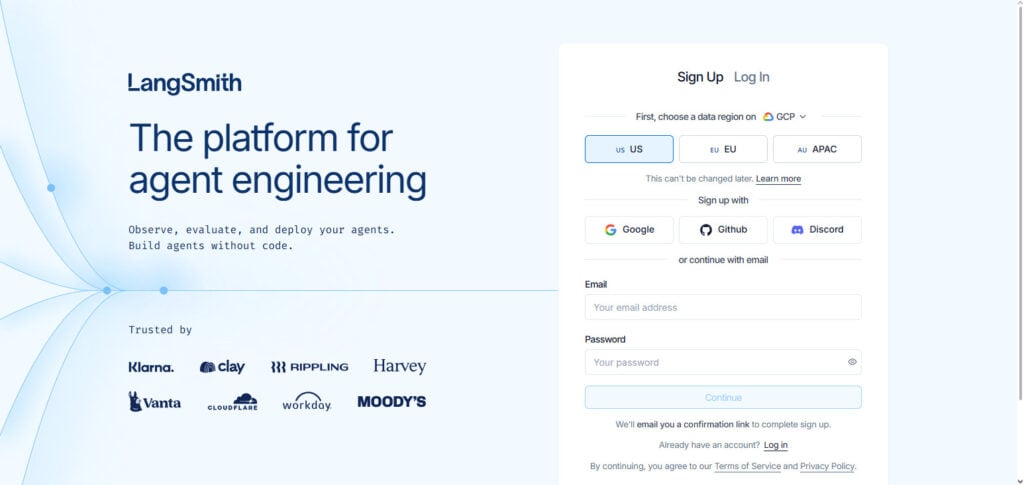
LangSmith is one of the Best AI Monitoring Software applications that helps teams understand the behavior of AI applications and manage complex systems. It builds features that help you track prompts, outputs, and interactions with models during the lifecycle of the application. LangSmith helps businesses build faster and better applications by helping them pinpoint errors and track the application’s AI behavior.
Characteristics:
- Monitoring system for LangChain and AI.
- Provides tracing, debugging, and evaluation.
- LLM workflows and agents evaluation.
- Development and testing support for AI applications.
- Supports AI application development lifecycle.
Advantages:
- LangChain integration is excellent.
- Monitoring AI workflow is easy.
- Debugging and testing is easier.
- LLM application and AI agent development is improved.
Disadvantages:
- Development skills are needed.
- Cannot be used for anything other than LLMs.
- LangChain is a must.
- Costs may be higher for advanced features.
- Evaluating AI applications is not its purpose.
10. Braintrust
Braintrust is an AI monitoring and evaluation application designed for teams that build production-level AI applications. It offers several services to help businesses build and test AI models, track experiments, and assess the quality of the AI models.
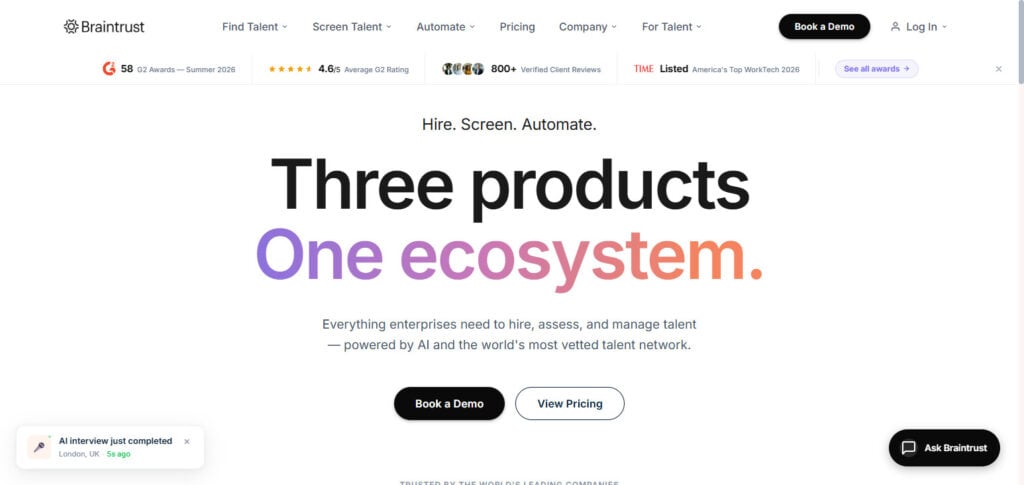
Braintrust is one of the Best AI Monitoring Software applications that offers automated evaluation services to help users understand the behavior of AI models and to help improve the quality of AI models. It offers several services to help businesses build and manage AI products. Companies can use Braintrust to manage the risks of AI and build robust models that offer stable and accurate results.
Characteristics:
- AI evaluation platform for testing AI applications.
- Provides experiment tracking and quality measurement.
- Helps compare different AI models.
- Supports automated AI performance evaluation.
- Designed for production AI development teams.
Advantages:
- Strong AI testing capabilities.
- Helps improve model output quality.
- Supports continuous evaluation workflows.
- Provides useful performance insights.
- Suitable for enterprise AI teams.
Disadvantages:
- Mainly focused on AI evaluation.
- Requires technical understanding.
- May be expensive for smaller teams.
- Limited infrastructure monitoring features.
- Setup can require development resources.
Comparison Table: Best AI Monitoring Software
| AI Monitoring Software | Best For | Key Monitoring Features | AI Support | Main Advantage | Limitation |
|---|---|---|---|---|---|
| Klu.ai | LLM application monitoring | Prompt tracking, AI evaluation, workflow analytics, performance monitoring | LLMs & Generative AI | Helps optimize AI workflows and improve model performance | Requires technical knowledge for advanced usage |
| Instabug | Mobile app monitoring | Crash reporting, bug tracking, performance analytics, user feedback | AI-powered mobile apps | Excellent mobile application stability monitoring | Limited LLM-specific monitoring features |
| Groundcover | Cloud-native monitoring | Infrastructure tracking, Kubernetes monitoring, real-time observability | Cloud AI applications | Provides fast and lightweight cloud monitoring | Requires cloud expertise |
| Maxim AI | AI testing and evaluation | AI testing, simulation, response analysis, prompt evaluation | LLM applications | Improves AI quality through automated testing | Mainly focused on AI workflows |
| WhyLabs | Machine learning monitoring | Data drift detection, model monitoring, AI alerts, data quality analysis | ML Models & AI Systems | Strong machine learning observability capabilities | Can be complex for beginners |
| Langfuse | Open-source LLM monitoring | Prompt tracking, tracing, analytics, token usage monitoring | LLM applications | Flexible open-source AI observability solution | Requires technical setup |
| Helicone | LLM analytics | API monitoring, cost tracking, latency analysis, prompt insights | LLM APIs | Easy AI usage monitoring and cost optimization | Limited traditional application monitoring |
| Arize AI | Enterprise AI monitoring | Model tracking, explainability, drift detection, AI performance analysis | ML & Generative AI | Powerful enterprise AI observability features | Higher cost for small teams |
| LangSmith | LangChain applications | AI tracing, debugging, evaluation, workflow monitoring | LLM & AI Agents | Excellent for LangChain-based AI development | Best suited for LangChain users |
| Braintrust | AI evaluation | Model testing, experiments, quality measurement, performance tracking | LLM applications | Strong AI testing and evaluation capabilities | Requires technical expertise |
Quick Comparison Summary
| Category | Best Choice |
|---|---|
| Best Overall AI Monitoring | Arize AI |
| Best Open-Source Option | Langfuse |
| Best for LLM Applications | LangSmith |
| Best AI Testing Platform | Braintrust / Maxim AI |
| Best for Machine Learning Models | WhyLabs |
| Best for AI Cost Tracking | Helicone |
| Best for Mobile AI Apps | Instabug |
| Best Cloud Monitoring | Groundcover |
| Best Prompt Optimization | Klu.ai |
Conclusion
The Top AI Monitoring Software suites assist firms with overseeing, assessing, and fine-tuning their AI software to increase accuracy, performance, and reliability. Klu.ai, WhyLabs, Langfuse, Arize AI, LangSmith, and Braintrust are platforms with robust tool sets for the assessment of AI.
These assist in identifying problems and fine-tuning model quality. As the use of AI increases, firms need sophisticated monitoring tools to efficiently coordinate AI’s intricate systems, reduce costly errors, and ensure the sustained reliability of their AI systems.
The correct selection of AI monitoring software depends on the particular use cases each firm has, the need to scale, how well it integrates with other tools, and how much AI the firm is willing to completely automate.
FAQ
What is AI Monitoring Software?
AI Monitoring Software is a technology solution that helps businesses track, analyze, and improve the performance of artificial intelligence systems. It monitors AI models, data quality, accuracy, response times, errors, and overall system reliability.
Why is AI Monitoring Software important?
AI Monitoring Software helps organizations detect problems early, improve model performance, reduce operational risks, and maintain consistent AI output quality. It ensures AI applications remain accurate, reliable, and efficient after deployment.
What features should the Best AI Monitoring Software have?
The Best AI Monitoring Software should include features such as real-time monitoring, AI model tracking, error detection, performance analytics, data drift detection, prompt monitoring, evaluation tools, and automated alerts.
Which are the Best AI Monitoring Software platforms?
Some of the Best AI Monitoring Software platforms include Klu.ai, Instabug, Groundcover, Maxim AI, WhyLabs, Langfuse, Helicone, Arize AI, LangSmith, and Braintrust. These tools offer different monitoring and evaluation capabilities for AI applications.
Can AI Monitoring Software track LLM applications?
Yes, many AI monitoring platforms are designed specifically for large language models (LLMs). They can track prompts, responses, token usage, latency, costs, and model performance to improve generative AI applications.