



On this page I will be going over the Best Synthetic Data Generation Platforms for AI, and compare their features, the types of synthetic data, pricing, deployment options, integrations, privacy, security and data quality. These platforms help companies create realistic datasets to train, test, fine-tune and evaluate AI, removing the need for sensitive, limited or costly real-world data.
What Is Synthetic Data Generation Platforms?
Synthetic data generation platforms are software tools that leverage artificial intelligence, machine learning, statistical techniques, or simulation to generate artificial datasets that are similar to real-world data. These platforms can generate tabular records, text, images, time-series information, sensor data and other formats for machine learning and artificial intelligence applications.
Where real data is scarce, costly, sensitive, or difficult to acquire, synthetic data is used by companies to train, fine-tune, test, evaluate, and create edge cases for their models. Users can control data characteristics, maintain important statistical relationships, improve dataset diversity and reduce exposure to sensitive information when developing and validating standard artificial intelligence depending on the platform.
Key Points
| Platform | Best For | Key Generation Capability |
|---|---|---|
| NVIDIA NeMo Data Designer | Generative AI, LLMs & AI agents | Generates datasets from scratch or seed examples with configurable models and schemas |
| MOSTLY AI | Enterprise tabular and relational data | Generative models preserve relationships, correlations and referential integrity |
| Tonic.ai | AI development, testing & enterprise data | Agentic generation, rule-based generation and database-aware synthesis |
| YData | Data science & AI training workflows | Synthetic datasets generated through SDK and platform workflows |
| K2view | Enterprise synthetic data management | AI-powered generation, masking, rules-based generation and data cloning |
| Hazy | Privacy-focused enterprise synthetic data | Synthetic data generation with statistical modeling and privacy mechanisms |
| Synthesized | Enterprise testing & AI-agent validation | Generates production-realistic scenarios while preserving relationships |
| Rendered.ai | Computer vision & sensor AI | Physics/simulation-based customizable synthetic imagery with accurate labels |
| Synthesis AI | Automotive & computer vision | Simulation-based generation of controllable visual training data and edge cases |
| Syntho | Enterprise privacy-safe data | AI-based synthesis designed to reproduce statistical patterns without reproducing individual records |
1. NVIDIA NeMo Data Designer
NVIDIA NeMo Data Designer is NVIDIA’s programmatic synthetic-data solution for AI developers. NVIDIA itself was founded in 1993. It creates domain-specific datasets from scratch or seed examples for model training, fine-tuning and evaluation, including structured data and AI/LLM-oriented datasets.
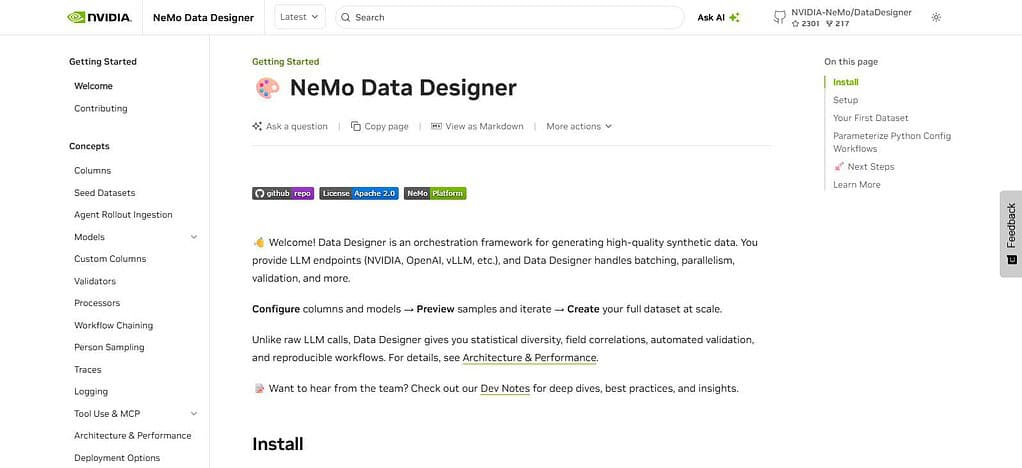
Deployment is available as an open-source Python library or NeMo Microservice and integration supports OpenAI compatible endpoints, NVIDIA models, Azure OpenAI, Anthropic, vLLM and enterprise gateways.
Privacy & security include secure execution options, and related NeMo anonymization and safe-synthesis tools. There is a free trial and the cost of enterprise infrastructure depends on the deployment.
Features
- Dependency aware field generation and configurable schemas.
- Generates synthetic structured, text, image, code, embedding and multimodal datasets.
- *Supports data generation from scratch and from seeds.
- Supports dataset validation, scoring, preview and iterative workflows.
- LLM endpoints, MCP servers, plugins, and Python customizations supported
Pros
- Great fit for LLM, agentic AI, and multimodal workloads.
- Open source and highly customizable.
- Supports reproducible and programmatic generation workflows
- Scalable from experiments to generation of large datasets.
- Integration with the strong NVIDIA AI ecosystem.
Cons
- Needs technical knowledge for advanced workflows.
- Model / API usage may incur further costs.
- Some features require configuration of external model endpoints
- The NVIDIA Build is not recommended for production use with confidential data.
More developer focused than no-code synthetic data platforms.
2. Mostly AI
MOSTLY AI was founded in 2017 in Vienna by Michael Platzer, Klaudius Kalcher and Roland Boubela and focuses on privacy-preserving synthetic data for enterprise AI and analytics. Structured and relational synthetic data is its core strength. It handles datasets where statistical patterns, correlations and relationships must remain useful in machine learning workflows.
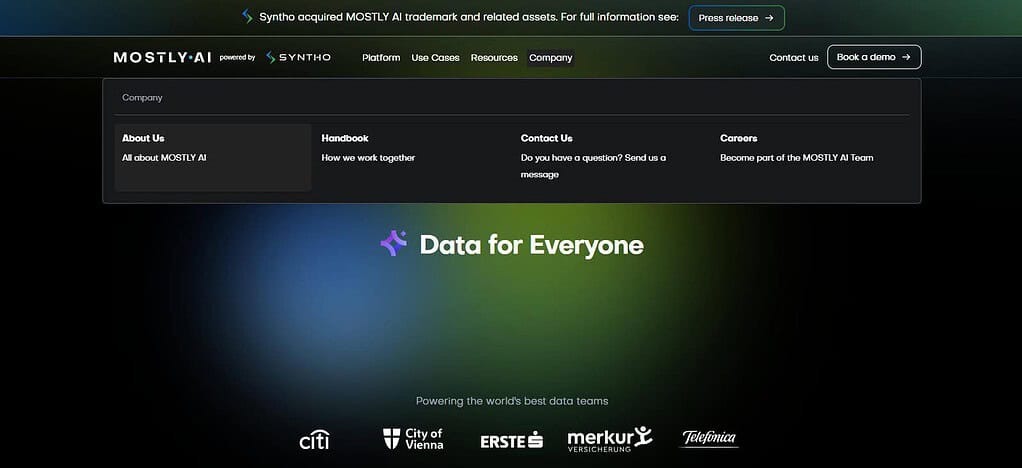
Deployment and integration are built for modern data environments, so organizations can use synthetic data in existing data stacks. Data quality and privacy are core to the platform, especially for regulated or sensitive datasets. Pricing is typically more aligned with the needs of the organization as opposed to a simple public consumer plan.
Features
- Focuses on generation of privacy-preserving synthetic data.
- Wide support for tabular and relational enterprise data.
*Constructed to preserve statistical relationships and correlations. - Data sharing, analytics, testing, and AI development.
- Enables synthetic-data workflows for the enterprise.
Pros
- Good privacy and data utility.
- Suitable for sensitive enterprise data.
- Good standard development and analytics.
- Designed for realistic statistical behavior.
- An enterprise-focused approach.
Cons
- Primarily targeting companies with structured-data requirements.
- Some advanced enterprise features might require a commercial plan.
- More complex than basic synthetic-data tools
- Pricing may be less clear for larger deployments.
- Not as simulation-focused with computer vision as specialized platforms.
3. Tonic.ai
Tonic.ai (founded 2018) – synthetic data for software development, AI training, testing and edge case generation. Its current Fabricate product uses agentic AI to generate relational databases and unstructured datasets from descriptions, schemas or existing sources, and its wider platform supports structured and textual data.
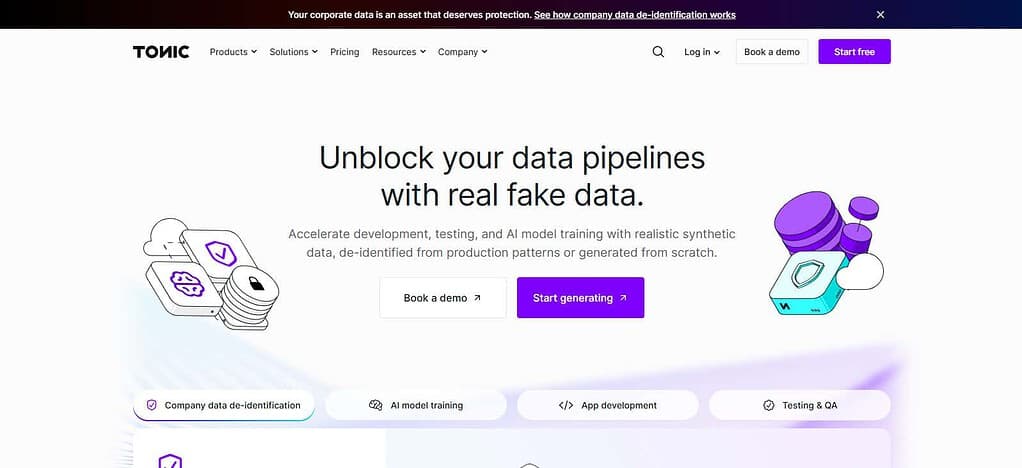
Pricing Free, $29/month (Plus, with $25 credits), and Enterprise custom pricing at $5/month (with $5 credits). Deployment Tonic Cloud and on-premise enterprise options. Integration: Databases, API’s & Processes. Privacy capabilities include de-identification, masking, privacy scanning, referential integrity and compliance-oriented controls.
Features
- Creates synthetic relational databases and unstructured datasets.
- AI-Powered Data Agent for Dataset Creation.
- PDF, DOCX, free text, JSON and database data support.
- Provides validation, rule based generation and mock API’s.
- Provides cloud and self-hosted enterprise deployment.
Advantages
- Very broad support of synthetic-data formats.
Free plan includes $5 monthly usage credits. - Plus plan is $29/month and up.
Enterprise version with SSO, RBAC and self-hosting. - Useful for AI training, development and edge case testing.
Cons
- Complex generation tasks may increase usage-based costs.
- Custom pricing for advanced enterprise functionality.
- AI generated datasets should be verified before being used in production.
- More configuration may be required for large relational datasets.
- Certain export options for enterprises are plan-dependent.
4. YData
YData Launched in 2019, YData offers synthetic-data capabilities via its SDK and Fabric platform for data scientists and AI engineers. It supports tabular, time-series, databases, synthetic documents and synthetic text including Q&A generation and text-to-dataset workflows for LLM training, evaluation and RAG applications.
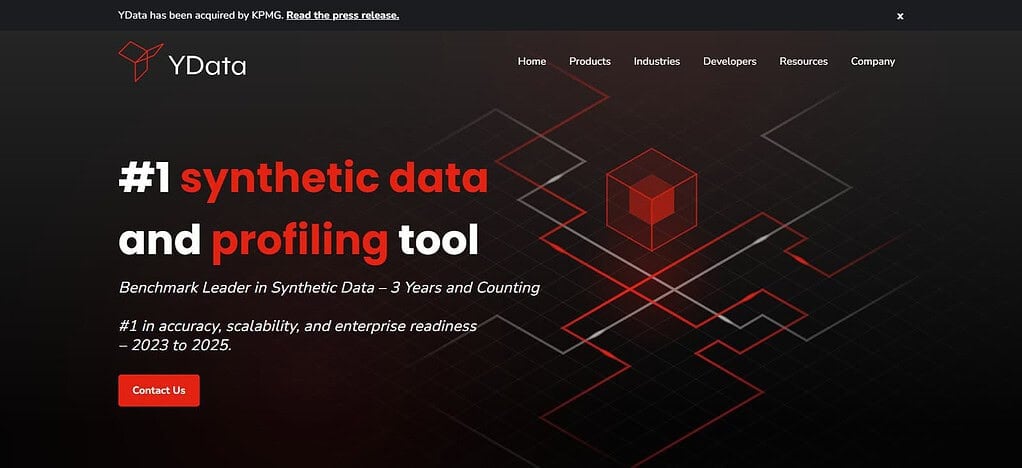
Generation methods include GANs, VAEs, Bayesian networks, bootstrapping and LLM-based generation. Pricing Free with monthly credits, pay-as-you-go $1/credit, and enterprise pricing; Fabric also supports self-hosted AWS/Azure, and private-cloud or on-premise enterprise deployment. Quality is assessed through statistical, utility and privacy checks.
Features
- Offers synthetic-data tools for data-science and AI workflows.
- Supports tabular and structured data output.
- Provides document-generation and synthetic text features.
- Supports datasets for LLM, RAG and machine-learning workflows.
- Delivers Python-based tools for developers and data scientists.
Pros
- Strong data-science and developer orientation.
- Useful for many AI dataset workflows.
- Python support works with current M/L pipelines.
- May aid limited or sensitive training data.
- For teams looking for programmatic control.
Cons
- More technical than basic no-code platforms.
- Advanced features might require data science expertise.
Quality of synthetic data is heavily dependent on source data and configuration. - Commercial terms may be customized to meet enterprise requirements.
- Users need to validate the generated datasets before production training.
5. K2view
K2view (founded 2009) is an enterprise data-management company. It offers a synthetic-data solution that generates realistic business-entity data, while maintaining relationships across connected systems. It supports structured and semi-structured synthetic data and combines generative AI, rules, entity cloning and masking instead of relying on a single generation method.
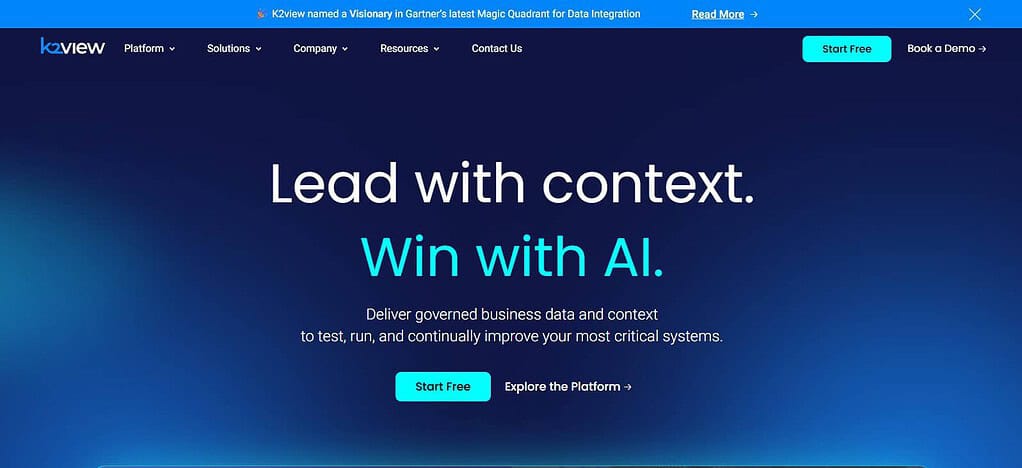
Its entity-centric architecture assists in preserving referential integrity and data quality across customers, accounts, orders, and associated systems. Deployment and integration are designed for enterprise data environments, with provisioning and data services integrated into the larger platform. Pricing is enterprise/custom and not a public self-service rate.
Features
- Delivers enterprise synthetic-data generation and management.
- Supports business data in tabular and structured form.
- Maintains relationships among related business entities.
Combines generation, masking, rules and data management capabilities. - Created for complex enterprise data environments.
Pros
- Good fit for large enterprise data environments
Entity-based approach helps to preserve relations in data. - Good for testing, analytics and AI development.
- Enables enterprise workflows with privacy.
- Can work with complex, interlinked data sets.
Cons
- Primarily aimed at enterprise users.
• Can involve a lot of effort to implement. - Pricing is typically customized, not simple self-service pricing.
- Advanced features may require technical knowledge.
Overkill for small teams that want simple synthetic datasets.
6. Hazy
Founded in London in 2017 as Anon AI, Hazy is focused on privacy-centric synthetic data for enterprise and financial data use cases. It’s technology is focused on structured/tabular business data and produces artificial datasets that maintain useful statistical properties, while limiting exposure to sensitive information.

Data quality is important, as generated records need to be analytically useful, not just realistic. It is a platform for organizations needing more secure access to data for analytics, AI development and sharing. Pricing and detailed deployment options are generally enterprise/custom so a fixed public monthly price should not be claimed. Important to point out that Hazy is currently owned by SAS, as they acquired it.
Features
- Synthetic data with privacy preservation.
- Designed primarily for structured and tabular enterprise data sets.
- Preserving useful statistical characteristics.
- Enables AI, analytics, testing, and data sharing use cases.
- especially critical for organizations processing sensitive data.
Pros
- Strong, privacy-first positioning.
- Safe to use with regulated and sensitive information.
- Synthetic data may be less exposed to actual records.
- Preserves analytical utility by design.
- Applicable to enterprise data sharing scenarios.
Cons.
- Less emphasis on image and computer vision generation
- Custom engagement may be required for advanced enterprise capabilities.
- Not the best fit for multimodal AI workflows.
- Synthetic data quality needs to be carefully validated.
- Platform capabilities may be more specialized than generic tools.
7. Synthesized
Synthesized is a London-based company launched in 2018, which specializes in automated test-data generation and software-quality workflows. Its platform generates production-like synthetic test data, offers data masking and subsetting, and designed to preserve relationships and referential integrity for continuous testing.
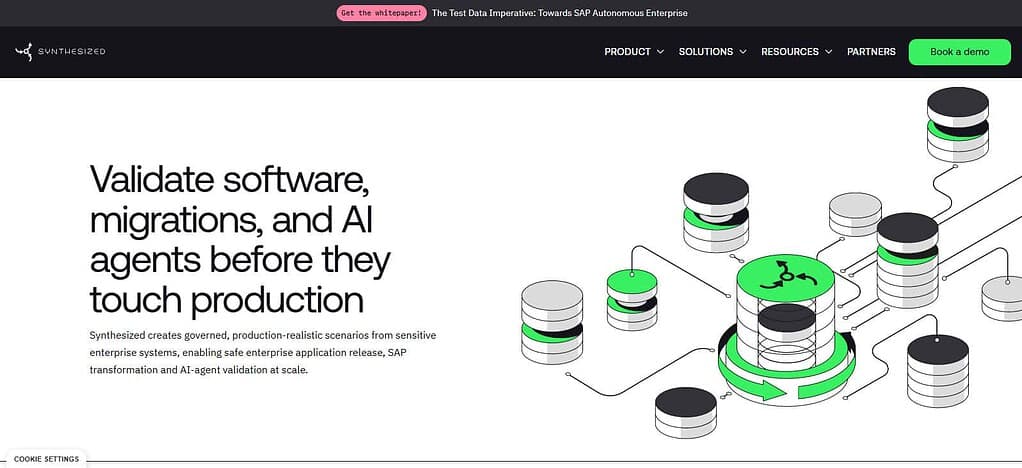
Integration is especially applicable to engineering teams as the platform integrates synthetic test-data workflows with CI/CD and development workflows.
Deployment Supports cloud, on-premise and hybrid environments Privacy is addressed via compliant data generation and masking and data quality is targeted at realistic usable test environments. Pricing is geared toward enterprises and is generally provided via a customized sales process rather than a public fixed plan.
Features
- Expert in generating synthetic test data.
- Generates realistic data sets for testing software.
- Support for Data Masking & Data Subsetting.
- Built for referential integrity and relationships.
- Integrates synthetic data workflows into the development and CI/CD pipelines.
Pros
- Great choice for software-testing teams.
- Useful for a continuous test environment.
- Reduces dependence on production data.
- Supports cloud, on-premises and hybrid environments *
- Strong emphasis on realistic test-data scenarios
Cons
- More toward testing than general purpose AI data generation.
- Possibly not suitable for training multimodal AI.
- Enterprise features may require implementation effort.
Pricing isn’t as straightforward as consumer SaaS tools. - Teams looking for LLM-specific generation may want to try AI-oriented alternatives.
8. Rendered.ai
Rendered.ai, founded in 2019, is a Platform-as-a-Service for computer-vision synthetic data. It allows teams to build custom synthetic-data applications and produce physically realistic imagery and other simulated datasets for AI/ML training, tuning, bias detection and validation.
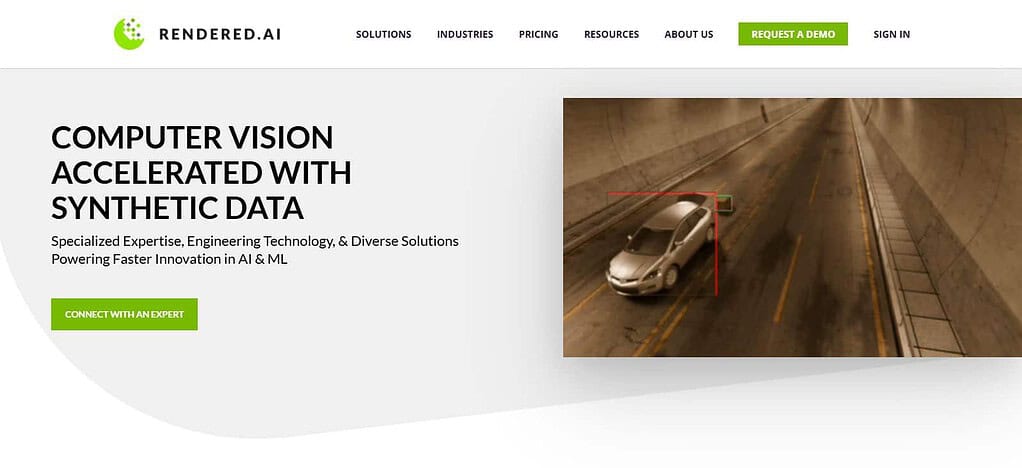
Deployment Cloud-based via its PaaS SDK and infrastructure support for custom data-generation pipelines. ** Integration ** APIs, SDKs, simulation workflows and AI pipelines Subscription pricing starts at $5,000/month for Teams and $15,000/month for Organizations. Managed services are custom project priced. Ordinary tabular synthesis doesn’t drive data quality, controllable simulation, labeling and scenario generation does.
Features
- Creates simulated sensor imagery and datasets.
- focus on synthetic data for computer vision.
- Enables the creation of controlled scenarios and environments.
- Machine-learning workflows need fine-grained annotation.
- Purpose-built for training, validation, testing and edge case generation.
Pros
- Ideal for computer-vision applications.
High controllability synthetic environments - Useful when collecting images from the real world is costly.
- Creates rare or difficult visual scenarios.
- Compatible with high-end perception and sensor-AI pipelines.
Cons
- More specialized than general synthetic data platforms.
- Best suited for visual and sensor workloads.
- May need simulation and computer-vision expertise.
- Enterprise pricing can be a little steep.
- Not as good for simple table or text only generation.
9. Synthesis AI
Synthesis AI, founded in 2019 in San Francisco by Yashar Behzadi, specialized in computer-vision synthetic data, especially photorealistic images and accurate labels for training artificial intelligence (AI) systems. Its technology enabled applications involving people, faces, bodies and vision relevant for autonomous systems, robotics and other vision workloads.
Data quality was built on controllable synthetic scenes and highly detailed labels, helping overcome the limitations of manually collected and annotated imagery. However, this platform has an important 2026 qualification: Synthesis AI was acquired by Globant in 2025, so it should be presented as an acquired technology/business rather than an unchanged, stand-alone vendor.
Features
- Has synthetic computer-vision data as its focus.
- Creates photorealistic visual training datasets.
- Supports human, face, body and perception scenarios.
- Provides visual settings that can be controlled and fine-grained labels.
Targets applications like automotive and advanced vision AI.
Pros
- Deep knowledge of computer vision.
- Useful when visual training data is hard to collect.
- Allows controlled scenario generation.
- Can generate fine-grained training labels.
Useful for human-centered AI and perception applications.
Cons
- Focused mainly on computer-vision workloads.
- less applicable to synthetic tabular or text data.
Technical expertise might be needed for specialized workflows.
Not a general purpose synthetic data platform.
Since it has been acquired by Globant, the current product positioning must be verified before publication.
10. Syntho
Syntho Founded in 2020 and based in Amsterdam, Syntho offers privacy-centric synthetic data for enterprise testing, analytics and AI development. It supports structured/tabular data, time-series, multi-table databases, geographic data and open text, and combines AI-generated, rule-based and masking approaches.
Deployment can run in the customer’s own environment, helping to keep source data within its trusted infrastructure. Integration with Docker and 20+ database and file system connectors Pricing is based on features, not consumption, and comes in three tiers—Basic, Standard and Ultimate—that are available by quote. The licensing model includes unlimited synthetic-data generation. Data quality is evaluated via QA capabilities in terms of accuracy and privacy.
Features
- Creates privacy-preserving synthetic enterprise data.
- Supports tabular, time-series, multi-table, geographic and text data.
The system offers both rule-based and AI-powered data generation. - Support for database and file system links.
- For analytics, testing and sharing data for AI development.
Pros
- Broad enterprise structured data support .
- Strong focus on privacy.
- Can work on complex multi-table datasets.
- Recommended for organizations with sensitive data.
Enables deployment in controlled enterprise environments.
Cons
- Primarily for enterprise data teams.
- Some technical knowledge may be required for advanced workflows.
- Business needs drive pricing.
- Less specialized for computer-vision data than Rendered.ai.
- Synthetic data still needs to be validated for your specific AI use-case by users.
Conclusion
Synthetic data generation platforms are evolving into a critical component of modern AI development by empowering organizations to generate realistic datasets without being entirely dependent on sensitive or difficult-to-acquire real-world data.
The platforms in this list have strengths that span from generating tabular and relational data to computer vision, LLM training, testing, and AI evaluation. Businesses should consider synthetic data quality, supported data types, privacy controls, deployment options, integrations, scalability, and pricing when choosing a platform.
NVIDIA NeMo Data Designer, MOSTLY AI, Tonic.ai, YData, K2view, Hazy, Synthesized, Rendered.ai, Synthesis AI and Syntho cater to different AI data needs.
FAQ
What is a synthetic data generation platform?
A synthetic data generation platform uses AI, machine learning, statistical methods, or simulation to create artificial datasets that reproduce useful characteristics of real-world data. These datasets can support AI training, testing, evaluation, and development.
Why do businesses use synthetic data for AI?
Businesses use synthetic data to expand training datasets, create rare or difficult scenarios, reduce dependence on sensitive information, improve testing, and accelerate AI development. It can be particularly useful when collecting or labeling real-world data is expensive or restricted.
What types of synthetic data can AI platforms generate?
Depending on the platform, synthetic data can include tabular records, time-series data, text, documents, images, video, sensor data, relational databases, and datasets designed for LLM or AI-agent training.
Is synthetic data safe for privacy?
Synthetic data can reduce privacy risks, but it is not automatically risk-free. Organizations should evaluate whether a platform provides privacy controls, anonymization, de-identification, privacy testing, and safeguards against reproducing sensitive information from source datasets.