

In this article, I will discuss the Best AI Data Platforms for Machine Learning, covering leading solutions for data preparation, model development, feature engineering, deployment, integrations, governance, and scalability. You will learn how platforms such as Databricks, Snowflake, Google Vertex AI, Amazon SageMaker, Dataiku, and H2O.ai support modern machine learning workflows and help organizations build reliable, production-ready AI systems.
What Are AI Data Platforms for Machine Learning?
AI data platforms for artificial intelligence are software environments that help organizations collect, prepare, manage, analyze and transform data into usable inputs for machine-learning workflows. Assist with data ingestion, cleaning, transformation, feature engineering, dataset management, model training, deployment, monitoring and governance.
Modern platforms may also include generative AI, vector search, automated machine learning, model evaluation and MLOps capabilities. They tie together data sources with ML frameworks and cloud infrastructure, enabling teams to get from raw data to production models faster. These platforms are useful for data scientists, ML engineers, developers, and enterprises that develop scalable AI applications.
Key Points
| Platform | Key Strength |
|---|---|
| Databricks Mosaic AI | Unified lakehouse platform for data engineering, ML, and AI |
| Snowflake Cortex AI | AI and machine learning directly within the Snowflake Data Cloud |
| Microsoft Fabric | End-to-end data, analytics, and AI platform integrated with Microsoft services |
| Google Vertex AI | Managed machine learning and generative AI platform on Google Cloud |
| Amazon SageMaker | Comprehensive ML development, training, and deployment platform |
| Azure Machine Learning | Enterprise MLOps and AI lifecycle management on Azure |
| Dataiku | Collaborative AI and machine learning platform for technical and business teams |
| DataRobot | Automated machine learning and AI application development |
| Domino Data Lab | Reproducible, governed, and compliant enterprise data science workflows |
| H2O.ai | Open-source and enterprise AI platform with AutoML capabilities |
1. Databricks Mosaic AI
Databricks Mosaic AI builds on Databricks, founded in 2013, and brings data engineering, machine learning, generative AI, and model operations into the lakehouse. Supports Python, MLflow, model training, fine-tuning, evaluation, feature engineering, vector search and AI application development. Pricing: Predominantly consumption-based, not a simple fixed license, it covers compute, storage, and AI workloads.

Deployment: cloud-based on AWS, Azure and Google Cloud. Integrations: MLflow, Spark, Delta Lake, major cloud storage, databases, BI tools and ML frameworks. Data Governance: Access control, lineage, discovery, auditing, and centralized governance are provided by Unity Catalog.
Databricks Mosaic AI – Limitations
- Can be difficult for new users to learn.
- Pricing can be hard to estimate for different workloads.
- Sophisticated workflows may require seasoned data engineers.
Complexity is a result of a heavy dependence on the larger Databricks ecosystem. - Large clusters and workloads need to be optimized carefully to manage.
| Pros | Cons |
|---|---|
| Unified lakehouse environment for data and AI workflows | Can be complex for smaller teams |
| Strong MLflow and experiment-management support | Pricing can be difficult to estimate |
| Supports generative AI and model development | Requires skilled data and ML engineers |
| Unity Catalog provides centralized governance and lineage | Advanced capabilities can increase platform costs |
| Strong cloud and data ecosystem integrations | Some features depend on the broader Databricks ecosystem |
2. Snowflake Cortex AI
Snowflake: Founded in 2012, Snowflake is expanding its cloud data platform with Cortex AI to support machine learning, generative AI, analytics and data applications. Supports SQL and Python workflows, machine-learning development, embeddings, classification, forecasting, document processing, and LLM-powered applications close to enterprise data.

Pricing: Consumption-based with Snowflake credits and AI Credits; AI services billed per use. Deployment: Fully managed cloud service across supported AWS, Azure and Google Cloud environments. Integrations: Big data tools, Python, SQL, BI platforms, cloud storage, ML ecosystems. Data Governance RBAC, controls on access, usage monitoring, budgets and regional controls provide for governed AI workloads.
Snowflake Cortex AI—Limitations
- Usage-based pricing can be difficult to forecast.
- Advanced ML workflows might require extra tools.
The AI capabilities of Cortex are built right into the Snowflake environment. - Complex workloads might need warehousing and resource management.
- Certain advanced AI features may not be available in some regions.
| Pros | Cons |
|---|---|
| AI capabilities operate close to enterprise data | Usage-based costs can become complex |
| Strong SQL and Python support | More specialized ML workflows may require additional tools |
| No separate data-movement layer for many workloads | Best experience is closely tied to Snowflake |
| Supports LLM and generative AI workloads | Advanced AI capabilities can require careful cost management |
| Strong enterprise security and data-management foundation | Less infrastructure flexibility than self-managed platforms |
3. Microsoft Fabric
Microsoft Fabric (released in 2023) is an end-to-end analytics platform that brings together data engineering, data science, real-time analytics, warehousing, and business intelligence. ML capabilities include support for notebooks, Python, Spark, experiment tracking, model development, and integration with Azure Machine Learning for more complex workflows.

Pricing: Primarily capacity-based through Fabric capacity, with some consumption based on connected Azure services. Deployment: Microsoft cloud environment with good integration across the Azure ecosystem. Integrations: Power BI, Azure services,
Microsoft Purview, Git, Spark, enterprise data sources, OneLake Data Governance: Purview, permissions, lineage, cataloging and Microsoft identity controls enable enterprise governance across data and AI workflows.
Microsoft Fabric Limitations
- Teams may take time to learn the broad platform.
- Capacity-based pricing can be hard to calculate.
Azure ML may be needed for advanced ML workflows.
*Performance may be dependent on proper capacity planning. - Organizations that are not in the Microsoft ecosystem may have additional integration considerations.
| Pros | Cons |
|---|---|
| Combines data engineering, analytics, and data science | Broad platform can take time to learn |
| Strong Power BI integration | Advanced ML workflows may require Azure Machine Learning |
| OneLake provides unified data storage | Pricing can be complex across capacities and services |
| Built-in MLflow-based model registry | Some ML endpoint capabilities have limitations |
| Strong Microsoft ecosystem connectivity | Best suited to organizations already using Microsoft services |
4. Google Vertex AI
Google Vertex AI, introduced in 2021, is a managed environment that supports machine learning, generative AI, model development, training, evaluation and deployment. Supports TensorFlow, PyTorch, scikit-learn, XGBoost, custom containers, foundation models, notebooks, pipelines, feature management and model monitoring.

Pricing: usage-based, with costs based on the compute, storage, training, prediction and AI services consumed. Deployment: Scalable endpoints and batch prediction on managed infrastructure in Google Cloud.
Integrations: BigQuery, Cloud Storage, Dataflow, Dataproc, Kubernetes, TensorFlow, PyTorch and Google Cloud services. Data Governance: IAM, encryption, audit logging, Model Registry, lineage, monitoring, and enterprise security controls enable governed ML operations.
Google Vertex AI – Limitations
- Large feature set may cause a steep learning curve.
It can be tough to forecast usage-based pricing.
More advanced workflows may require more knowledge of Google Cloud. - Running multiple connected Google Cloud services can increase complexity.
- Some capabilities may require separate configuration for data and AI services.
| Pros | Cons |
|---|---|
| Comprehensive managed ML and AI environment | Large feature set can increase learning requirements |
| Strong support for Google Cloud data services | Costs vary significantly by workload |
| Supports popular ML frameworks | Advanced workflows may require Google Cloud expertise |
| Strong generative AI capabilities | Primarily optimized for Google Cloud |
| Scalable training and model-serving infrastructure | Configuration across multiple services can become complex |
5. Amazon SageMaker
Amazon SageMaker: Launched in 2017 by AWS, this managed machine-learning platform includes data preparation, notebooks, training, feature engineering, model development, deployment, monitoring, and MLOps. It includes support for popular frameworks like PyTorch, TensorFlow, XGBoost, and scikit-learn, as well as custom containers.

Pricing: Mostly pay-as-you-go based on compute, storage, processing, training and inference resources consumed. Deployment: Endpoints, serverless inference, batch transformation, and infrastructure options for different workloads in the AWS cloud.
Integrations Amazon S3, Redshift, Glue, EMR, Lambda, ECR, Kubernetes, AWS analytics services. Data Governance: Enterprise ML governance is made possible by IAM, encryption, CloudTrail, VPC controls, monitoring, lineage, and security services.
Amazon SageMaker — Limitations
- AWS terminology and services can be difficult for beginners.
- Pricing can become complex across compute, storage, training, and inference.
- Advanced implementations often require knowledge of several AWS services.
- Infrastructure configuration can require significant technical expertise.
- Managing end-to-end ML workflows may involve multiple AWS components.
| Pros | Cons |
|---|---|
| Extensive end-to-end ML capabilities | AWS ecosystem can have a steep learning curve |
| Strong support for production ML workloads | Pricing can be difficult to forecast |
| Excellent AWS service integration | Requires understanding of multiple AWS services |
| Flexible training and deployment options | Configuration can become complex for smaller teams |
| Strong ML governance and monitoring capabilities | Some advanced capabilities involve additional AWS services |
6. Azure ML
Azure Machine Learning (launched in 2015) is Microsoft’s cloud service to build, train, deploy and manage machine learning models that are standardized. It supports Python, notebooks, automated ML, distributed training, model registries, pipelines, responsible AI capabilities and MLOps workflows.

Pricing: In many configurations, Azure Machine Learning has no additional service fee and customers pay primarily for the underlying compute and connected Azure resources. Deployment: online endpoints, batch endpoints, Kubernetes and Azure infrastructure.
Integrations: Azure Storage, Azure Container Registry, Key Vault, Azure DevOps, Git, Microsoft Fabric and additional Azure services. Data Governance: Microsoft Entra ID, RBAC, private networking, encryption, monitoring, audit controls, and responsible-AI capabilities to support enterprise deployments.
Azure Machine Learning — Limitations
- Can require substantial Azure expertise for advanced deployments.
- Compute and connected-service costs can be difficult to forecast.
- Some workflows require additional Azure services.
- The platform can be complex for smaller ML teams.
- Organizations using multiple cloud providers may need additional integration work.
| Pros | Cons |
|---|---|
| Strong end-to-end MLOps capabilities | Azure ecosystem knowledge is helpful |
| Excellent integration with Microsoft services | Pricing depends heavily on underlying compute |
| Supports automated ML and multiple frameworks | Can be complex for new users |
| Strong model registry and lifecycle tracking | Some capabilities require additional Azure services |
| Robust enterprise security and governance | Primarily designed around Azure infrastructure |
7. Dataiku
Dataiku: Founded in 2013, Dataiku is an enterprise AI and data science platform connecting data preparation, analytics, machine learning, generative AI and MLOps. It supports visual workflows, as well as Python, R, SQL, notebooks, automated machine learning, feature engineering, model evaluation and deployment.

Pricing: Custom for organizations; based on licensing of capabilities and deployment. • Deployment: cloud, hybrid and enterprise infrastructure deployments Integrations: Databricks, Snowflake, AWS Sagemaker, Azure ML, Google Vertex AI, Databases, Cloud storage and ML ecosystem.
Data Governance: Dataiku Govern provides the tools for approvals, documentation, control of access, model oversight, versioning, monitoring, and governance processes.
Dataiku — Limitations
- Enterprise licensing can be expensive for smaller organizations.
- The large feature set may require user training.
- Advanced governance capabilities can add implementation complexity.
- Highly customized workflows may require technical development.
- Smaller teams may not need its full enterprise functionality.
| Pros | Cons |
|---|---|
| Combines visual and code-based data science | Enterprise pricing may be significant |
| Strong collaboration between technical and business users | Advanced governance requires appropriate licensing |
| Supports Python, R, SQL, and notebooks | Large platform can require training |
| Strong governance and AI lifecycle management | Some advanced capabilities are add-ons |
| Works across multiple data and cloud environments | Configuration can become complex at enterprise scale |
8. DataRobot
DataRobot, founded in 2012, is all about automated machine learning, predictive AI, generative AI, model development, deployment, monitoring and enterprise MLOps. It supports automated feature engineering, model selection, evaluation, explainability, time-series workflows and production monitoring, and enables organizations to bring models built with external frameworks.
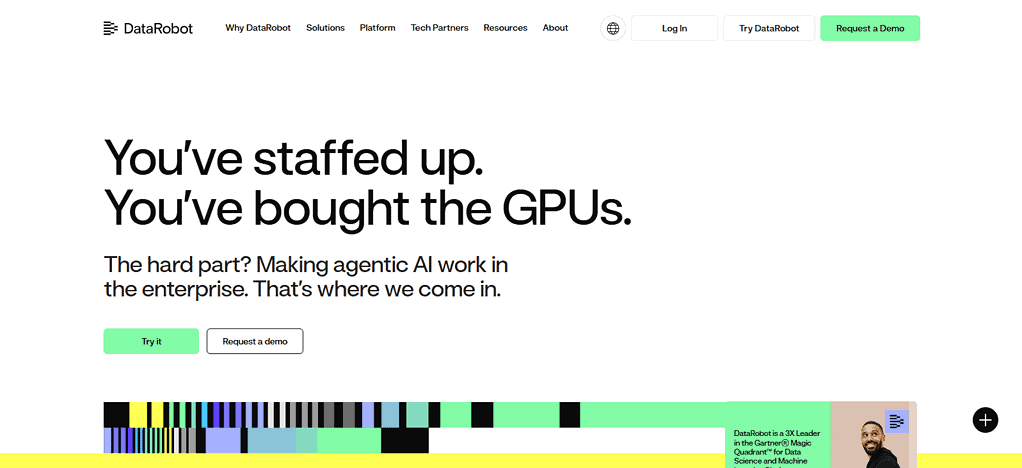
Pricing: more enterprise and usage/custom pricing than a simple public fixed plan. Deployment: production APIs and MLOps capabilities for cloud, hybrid and enterprise environments.
Integrations: Python, R, leading data platforms, cloud environments, databases, ML frameworks, and enterprise apps. Data Governance: helps manage production AI risk with access control, validation, deployment approvals, logging, traceability, monitoring and model governance.
DataRobot Limitations
- Pricing may be difficult for smaller organizations to enter into enterprise pricing.
- Less low-level control than custom ML development with automated workflows.
Need platform knowledge for advanced implementations. - Large deployments might require careful governance configuration.
- Organizations may still need to use external data infrastructure for special workflows.
| Pros | Cons |
|---|---|
| Strong automated machine-learning capabilities | Enterprise pricing is generally customized |
| Reduces manual model-development work | Advanced users may want more low-level control |
| Supports model governance and monitoring | Large platform requires configuration |
| Provides deployment and lifecycle management | Costs can increase with broad usage |
| Supports predictive and generative AI governance | Some capabilities are oriented toward enterprise deployments |
9. Domino Data Lab
Domino Data Lab, founded in 2013, is an enterprise AI platform for collaborative data science, machine learning, MLOps, model deployment, governance and infrastructure management. It supports Python, R, Jupyter, RStudio, VS Code, distributed computing, GPUs, model training, experiment management and generative AI workflows.

Pricing: subscription-based with customized plans for enterprise requirements, including Cloud, Premium, and Enterprise options. Deployment: single-tenant SaaS, self-managed VPC or on-premises, hybrid and multicloud Integrations: AWS, Azure, GCP, Kubernetes, ML frameworks, Feast, CI/CD tools, enterprise data sources. Data Governance: Policies, approvals, lineage, auditability, model registries, control of access, monitoring, and cost governance for regulated ML environments.
Domino Data Lab- Limitations
- Designed for enterprise data science needs.
- Pricing is generally customized, not simple fixed pricing.
- Can require specialized technical know-how to implement.
In big environments, the administration of the platform can get quite large. - Its governance and collaboration options may be more than smaller teams require
| Pros | Cons |
|---|---|
| Strong enterprise data-science collaboration | Primarily aimed at enterprise organizations |
| Supports multiple clouds and infrastructure environments | Pricing is generally customized |
| Strong model management and MLOps | Implementation can require specialist skills |
| Supports governance across the AI lifecycle | Platform administration can be extensive |
| Provides policy management and enforcement | May be more than smaller teams need |
10. H2O.ai
H2O.ai is a 2012 founded company that provides machine learning and artificial intelligence technologies for automated machine learning, forecasting, explainable AI and generative AI. Its ecosystem includes H2O-3 and enterprise AI capabilities that support Python, R, Java, notebooks, automated feature engineering, model training, model interpretation and production deployment.

Pricing: Enterprise offerings are typically quoted, while the open-source H2O-3 provides a free ML framework. Deployment: Cloud, private cloud, on-premises, containerized, depending on the product. Integrations: Python, R, Java, Spark, Kubernetes, major clouds, databases, and common ML workflows Data Governance: Supported by enterprise security, model explainability, monitoring, access management and controlled deployment for governed AI operations.
H2O.ai — Limitations
- Other platform components may be required for advanced H2O.ai products.
- Enterprise capabilities may include custom pricing.
- Big deployments might require specialized ML expertise.
- Some workflows may be reliant on external data engineering infrastructure.
- The broader product ecosystem may need careful assessment before implementation.
| Pros | Cons |
|---|---|
| Strong automated machine-learning capabilities | Enterprise products can require custom pricing |
| H2O-3 provides an open-source ML framework | Advanced enterprise features require additional products |
| Supports multiple programming languages and environments | Broader platform can require technical expertise |
| Strong model explainability capabilities | Some workflows may require external data infrastructure |
| Supports cloud, hybrid, and enterprise deployments | Product ecosystem can be complex to evaluate |
Conclusion
AI data platforms are a critical technology backbone for modern machine learning, bringing together data preparation, feature engineering, model development, deployment, monitoring and governance within a single workflow. Databricks Mosaic AI, Snowflake Cortex AI, Microsoft Fabric, Google Vertex AI, Amazon SageMaker, Azure Machine Learning,
Dataiku, DataRobot, Domino Data Lab and H2O.ai all have different approaches to building and managing ML workloads. Choose a platform based on your data environment, ML framework support, deployment requirements, integrations, scalability, pricing model, and security and governance requirements. The right platform needs to integrate with your existing architecture and support reliable, scalable, and production-ready machine learning workflows.
FAQ
What are AI data platforms for machine learning?
AI data platforms help organizations collect, prepare, transform, manage, and analyze data for machine learning. Many also support feature engineering, model training, deployment, monitoring, and governance.
Which capabilities should an AI data platform have?
Important capabilities include data ingestion, data preparation, feature engineering, ML support, model deployment, monitoring, integrations, scalability, security, governance, and support for modern AI workloads.
Do AI data platforms support generative AI?
Yes. Many modern platforms support generative AI through foundation models, embeddings, vector search, RAG workflows, model customization, evaluation, and AI application development.
How are AI data platforms priced?
Pricing varies by provider. Common models include consumption-based pricing, cloud compute charges, capacity-based pricing, subscriptions, and customized enterprise licensing.