




In this article, I’ll be discussing the Best Vector Databases for AI Applications, their architecture, vector search capabilities, performance, scalability, pricing, security, integrations, hybrid search, and filtering features.
This comparison will help developers and businesses understand how Pinecone, Weaviate, Milvus, Qdrant, Chroma, LanceDB, pgvector, Redis, MongoDB and Elasticsearch support modern AI workloads.
What Is Vector Databases for AI Applications?
A vector database is a database that is optimized for storing, indexing, and querying high-dimensional numerical vectors, also known as embeddings. These are used by AI applications to understand the semantic relationships between text, images, audio, documents and other data. Vector databases don’t just search for exact keyword matches.
They do similarity searches to find information that’s related contextually. They have a wide range of applications in retrieval-augmented generation, semantic search, recommender systems, AI agents, personalization, and long-term AI memory. Vector databases are an important infrastructure layer for modern AI applications with features like metadata filtering, hybrid search, scalable indexing and fast retrieval.
How To Choose Vector Databases for AI Applications
Test vector search performance: Don’t just look at general performance claims. Look at retrieval latency, query throughput, indexing speed, recall, and search accuracy against your expected workload.
Scalability Evaluation: Take into account the number of vectors, the embedding dimension, the data growth, the concurrent queries, the ingestion volume and whether the platform can scale horizontally as your AI application grows.
Mix Search: If your use case requires both semantic understanding and exact-term matching, choose a platform that combines vector similarity with keyword or full-text search.
Test Metadata Filtering: Ensure that the database can filter the results by fields such as user ID, document type, category, date, language, permissions, or any other metadata specific to the application.
Compare Deployment Options: Choose between managed cloud, self-hosted, embedded, Kubernetes or on-premise deployment based on your infrastructure, operational expertise, data needs and application architecture.
Audit AI Integrations: Make sure it can integrate with LangChain, LlamaIndex, Haystack, embedding providers, LLM platforms, programming languages, APIs, SDKs, and the AI frameworks your dev team is already using.
Check the price and total cost: Compare storage, compute, queries, indexing, data transfer, minimum commitments, scaling costs and self hosting costs, not just advertized starting prices.
Determine security requirements: For enterprise or sensitive AI data, look at authentication, authorization, RBAC, encryption, multi-tenancy, private networking, auditing, compliance capabilities, and data-isolation features.
Examine Your Current Database Stack: If you already have an application using PostgreSQL, MongoDB, Redis or Elasticsearch, consider if their native vector capabilities are sufficient for your use case, before adding a dedicated vector database.
Key Points
| Vector Database | Key Point |
|---|---|
| Pinecone | Fully managed vector database built for AI applications, offering automatic indexing, real-time retrieval, and scalable similarity search without infrastructure management. |
| Weaviate | Open-source AI database that combines vector search, hybrid search, RAG support, and built-in integrations with popular embedding models. |
| Milvus | High-performance open-source vector database designed for GenAI workloads, capable of scaling to billions of vectors with distributed architecture. |
| Qdrant | Production-focused vector database featuring advanced metadata filtering, hybrid search, multivector support, and flexible deployment options. |
| Chroma | Open-source AI retrieval platform providing vector, sparse, full-text, regex, and metadata search within a single system. |
| LanceDB | Open-source vector database optimized for AI applications with local-first deployment, efficient storage, and multimodal search capabilities. |
| pgvector | Popular PostgreSQL extension that adds vector similarity search to existing PostgreSQL databases without requiring a separate vector store. |
| Redis Vector Search | Extends Redis with low-latency vector search, filtering, and semantic retrieval for real-time AI applications. |
| MongoDB Atlas Vector Search | Integrates vector search directly into MongoDB Atlas, enabling semantic retrieval alongside traditional document queries. |
| Elasticsearch Vector Search | Combines vector similarity search with powerful keyword search, filtering, and analytics for AI-powered search applications. |
1. Pinecone vector database
Pinecone launched in 2019 as a vector database purpose-built for AI workloads. The cloud-native architecture provides managed vector storage, indexing, and retrieval without requiring users to run database infrastructure.
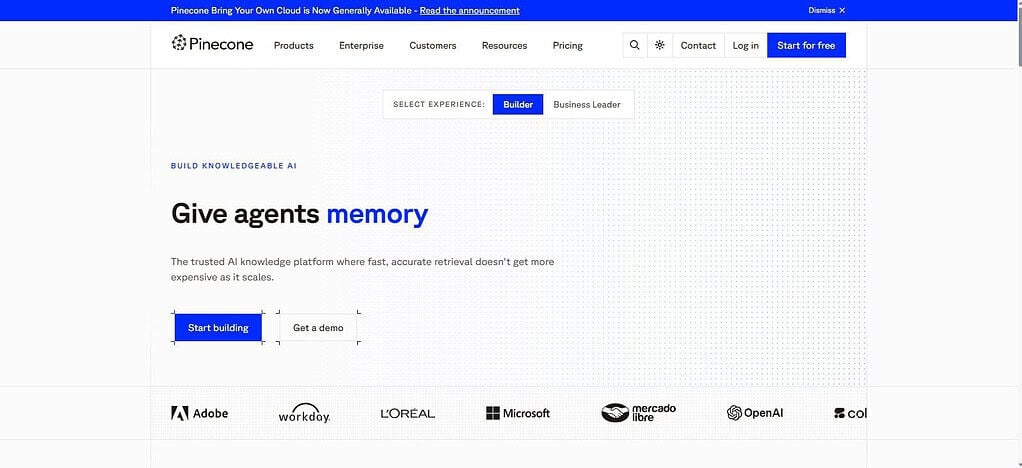
Designed for scalable semantic search, RAG, recommendation systems & AI-agent workloads. Pinecone provides dense and sparse vector search, metadata filtering, namespaces and hybrid retrieval. Pricing is usage-based and depends on storage, compute and the selected services.
Security comprises encryption, authentication, control of access and enterprise isolation features. Integrations with LLM platforms, embedding providers, LangChain, LlamaIndex, Python, JavaScript and REST APIs.
| Feature | Details |
|---|---|
| Vector Search | Dense and sparse vector search for semantic retrieval |
| Indexing | Optimized vector indexing for fast similarity search |
| Metadata Filtering | Supports filtering results using structured metadata |
| Hybrid Search | Combines semantic and keyword-oriented retrieval |
| Namespaces | Separates vectors and data for application or tenant use cases |
| RAG | Suitable for retrieval-augmented generation pipelines |
| AI Agents | Can provide persistent retrieval and memory layers |
| Scalability | Designed for large-scale managed vector workloads |
| Deployment | Cloud-managed architecture |
| APIs & SDKs | APIs and SDKs for application integration |
| AI Integrations | Works with popular LLM, embedding, and AI frameworks |
| Security | Authentication, encryption, access controls, and enterprise security options |
| Pricing | Usage and infrastructure-based pricing depending on service configuration |
| Main Use Cases | RAG, semantic search, recommendations, AI agents, personalization |
2. Weaviate
Weaviate is an open-source vector database for AI-powered search and retrieval, launched in 2019. It combines object storage with vector indexes in its architecture and is available as a self-hosted & managed cloud offering. It scales with distributed deployment, replication, sharding and optimized vector index. Weaviate supports vector search, keyword search, hybrid search, metadata filtering, reranking, multi-modal vectors, and multiple vector configurations.

For self-hosting it is mostly infrastructure cost. Pricing depends on cloud resources and deployment needs. Security. Authentication, Authorization, RBAC, Encryption, Multi-Tenancy, Enterprise Controls. Integrations: LangChain, LlamaIndex, Haystack, embedding models, and major AI platforms.
| Feature | Details |
|---|---|
| Vector Search | Semantic similarity search using vector embeddings |
| Hybrid Search | Combines vector search with BM25 keyword retrieval |
| Filtering | Metadata and property-based filtering |
| Reranking | Supports reranking within retrieval workflows |
| Multimodal Search | Supports vector-based retrieval across multiple data modalities |
| Multiple Vectors | Supports multiple vector representations for objects |
| RAG | Designed for retrieval and generative AI applications |
| Scalability | Distributed architecture with sharding and replication |
| Deployment | Cloud-managed and self-hosted options |
| Open Source | Open-source database with managed service options |
| Integrations | LangChain, LlamaIndex, Haystack, embedding providers, and AI tools |
| Security | Authentication, authorization, RBAC, encryption, and multi-tenancy |
| Pricing | Cloud pricing varies according to resources and deployment |
| Main Use Cases | RAG, semantic search, recommendations, multimodal AI, enterprise retrieval |
3. Milvus
Milvus is an open-source vector database that was launched in 2019 for large-scale AI and similarity-search workloads. Its distributed architecture decouples storage, compute, indexing and query processing, so each component can scale independently according to workload requirements.
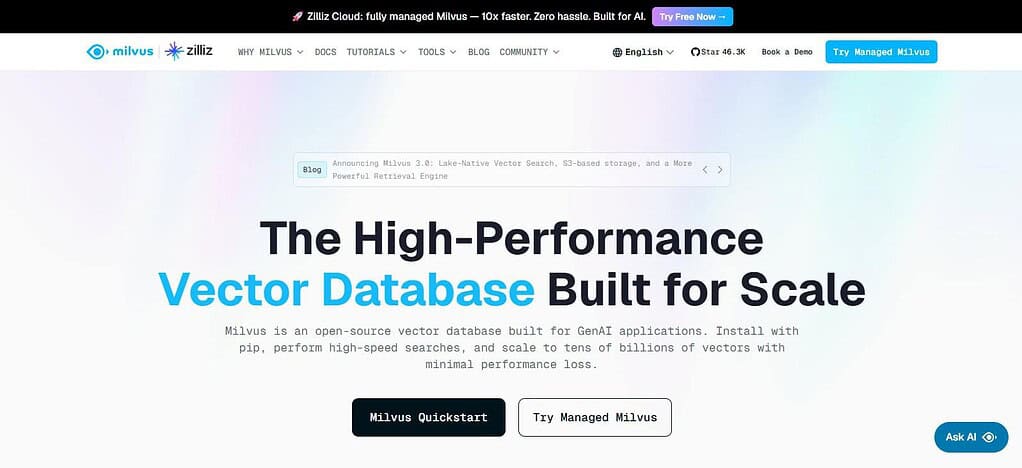
Performance: high-volume vector ingestion, approximate nearest-neighbor search, and distributed retrieval in large collections. Milvus supports multiple vector types, indexing methods, meta-data filtering, hybrid search, reranking-oriented retrieval workflows.
The pricing of the open-source version is mostly based on infrastructure, and the pricing of managed deployments also includes cloud usage costs. Security can include authentication, authorization, encryption and deployment level controls. Integrations. LangChain, LlamaIndex, Kubernetes, SDKs, AI applications.
| Feature | Details |
|---|---|
| Vector Search | High-scale similarity search for embedding-based applications |
| Indexing | Multiple indexing strategies for different vector workloads |
| Distributed Architecture | Separates storage, compute, query, and indexing components |
| Scalability | Designed for large vector collections and distributed workloads |
| Hybrid Search | Supports combined vector and structured retrieval workflows |
| Filtering | Scalar and metadata filtering alongside vector queries |
| Vector Types | Supports different vector data types and representations |
| RAG | Suitable for large-scale RAG pipelines |
| AI Applications | Search, recommendations, image retrieval, and AI assistants |
| Deployment | Self-hosted, Kubernetes, and managed cloud options |
| Integrations | LangChain, LlamaIndex, SDKs, APIs, and ML infrastructure |
| Security | Authentication, authorization, encryption, and deployment controls |
| Pricing | Open-source deployment mainly incurs infrastructure costs; managed options vary |
| Main Use Cases | Enterprise AI, RAG, recommendation engines, semantic search, large-scale retrieval |
4. Qdrant
Qdrant is an open-source vector database released in 2021, for similarity search and structured payload filtering. Its architecture stores vectors and payload data and lets applications retrieve semantically similar records with structured conditions. The performance is further enhanced by efficient vector indexes, quantization, payload indexes and distributed deployment options for larger workloads.
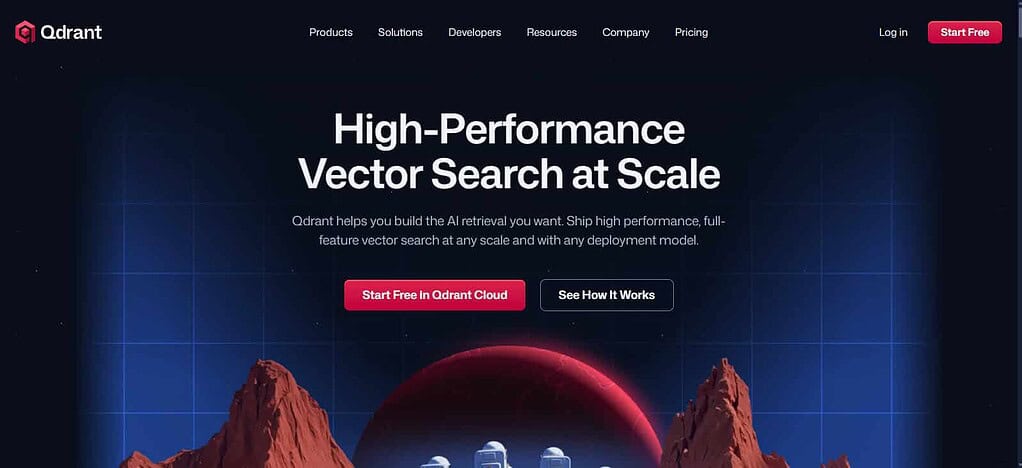
Qdrant supports dense and sparse vectors, hybrid retrieval, metadata filtering, recommendations and similarity search. The price reflects the cost of self-hosted infrastructure and managed cloud usage, tailored to your deployment needs.
Security features: Authentication, Authorization, Encryption, Controls of access. Integrations include LangChain, LlamaIndex, Python, REST, gRPC and other AI development frameworks.
| Feature | Details |
|---|---|
| Vector Search | Fast similarity search using vector embeddings |
| Payload Storage | Stores vectors together with structured payload information |
| Filtering | Advanced payload and metadata filtering |
| Hybrid Search | Supports dense and sparse retrieval combinations |
| Sparse Vectors | Supports sparse representations for retrieval workflows |
| Quantization | Reduces storage requirements and can improve retrieval efficiency |
| Scalability | Supports distributed and horizontally scalable deployments |
| RAG | Suitable for document retrieval and RAG applications |
| AI Memory | Useful for persistent retrieval and AI-agent memory |
| APIs | REST and gRPC interfaces |
| SDKs | SDK support for multiple programming environments |
| Integrations | LangChain, LlamaIndex, embedding systems, and AI frameworks |
| Security | Authentication, authorization, encryption, and access controls |
| Deployment | Self-hosted and managed cloud options |
| Main Use Cases | RAG, AI agents, recommendations, semantic search, filtered retrieval |
5. Chroma
Chroma is an open-source vector database for developers building RAG systems, semantic search, and AI memory applications. It has a simple architecture and can be used for both local development and server-based deployments. It is optimized for performance over basic embedding storage, similarity retrieval, document collections and metadata filtering. Larger production workloads require appropriate infrastructure planning.

Chroma supports vector search, metadata filtering, document retrieval, embeddings and AI-oriented collection management with hybrid capabilities based on the surrounding retrieval architecture. The open source version can be self-hosted, but hosted usage follows its service pricing. Integrations: Python, JavaScript, LangChain, LlamaIndex, AI applications.
| Feature | Details |
|---|---|
| AI Focus | Designed specifically for AI developers and embedding-based applications |
| Vector Search | Similarity search over stored embeddings |
| Collections | Organizes embeddings and associated documents into collections |
| Metadata | Stores metadata alongside vectors |
| Filtering | Metadata-based filtering during retrieval |
| Embeddings | Supports storing and retrieving embedding representations |
| RAG | Suitable for document retrieval and RAG workflows |
| AI Memory | Can be used as a retrieval layer for AI memory |
| Developer Experience | Simple architecture aimed at rapid AI application development |
| Deployment | Local, self-hosted, and hosted deployment approaches |
| Programming | Python and JavaScript/TypeScript support |
| Integrations | LangChain, LlamaIndex, and other AI development tools |
| Pricing | Open-source deployment has infrastructure costs; hosted services use applicable usage pricing |
| Security | Security depends on deployment architecture and configured access controls |
| Main Use Cases | RAG prototypes, semantic search, AI memory, document retrieval |
6. LanceDB
LanceDB is an open-source vector database built on top of the Lance data format, and optimized for AI and multimodal data workloads. Its architecture allows it to run embedded directly in an application, making a separate database server unnecessary, while a cloud-oriented deployment can accommodate larger shared workloads.
Columnar data organization, vector indexing, and efficient processing of machine-learning datasets improve performance. LanceDB offers vector search, metadata filtering, full-text retrieval, multimodal data, and RAG workflows.
Pricing varies according to whether users run the open-source system themselves or use managed infrastructure. Security depends on the deployment environment and the available cloud controls. Supports integrations with Python, TypeScript, AI frameworks and data-processing pipelines.
| Feature | Details |
|---|---|
| Architecture | Embedded vector database built around the Lance data format |
| Vector Search | Similarity search for AI and machine-learning datasets |
| Indexing | Vector indexes designed for efficient retrieval |
| Filtering | Metadata and structured filtering |
| Full-Text Search | Supports text retrieval alongside vector search |
| Multimodal Data | Suitable for text, image, and other AI-related data |
| RAG | Supports retrieval workflows for generative AI |
| Storage | Columnar data format designed for efficient AI data access |
| Deployment | Embedded/local and cloud-oriented deployment models |
| Programming | Python and TypeScript support |
| Scalability | Suitable for application-level and larger AI data workloads |
| Integrations | AI frameworks, data pipelines, and machine-learning workflows |
| Pricing | Open-source usage primarily involves infrastructure costs; managed options vary |
| Security | Depends on deployment architecture and cloud infrastructure |
| Main Use Cases | RAG, multimodal AI, local AI applications, semantic search, ML datasets |
7. pgvector
pgvector is a PostgreSQL extension that adds vector similarity search to an existing PostgreSQL database. It combines embeddings and relational records, SQL queries, transactions, indexes, and application metadata into a single system. Performance can be exact nearest-neighbor search, or approximate HNSW and IVFFlat indexes.
PostgreSQL capabilities help manage filtering and structured queries. pgvector supports vector, half-precision, binary and sparse representations. PostgreSQL full-text search can be used to aid hybrid retrieval.
There is no separate pgvector database license cost, although the operational expense is generated by PostgreSQL infrastructure. Security is based on PostgreSQL authentication, roles, permissions, encryption and access control. Integrations go from Python, ORMs, LangChain, LlamaIndex and regular PostgreSQL applications.
| Feature | Details |
|---|---|
| Architecture | PostgreSQL extension for storing and searching vectors |
| Vector Search | Exact and approximate nearest-neighbor search |
| Indexing | HNSW and IVFFlat indexing |
| Vector Types | Supports vector, half-precision, binary, and sparse representations |
| SQL | Uses PostgreSQL SQL queries and database functionality |
| Filtering | Combines vector queries with PostgreSQL filtering |
| Hybrid Search | Can combine vector retrieval with PostgreSQL full-text search |
| Transactions | Uses PostgreSQL transaction capabilities |
| Scalability | Can use PostgreSQL scaling, replication, partitioning, and infrastructure |
| Deployment | Works wherever PostgreSQL can be deployed |
| Integrations | PostgreSQL drivers, ORMs, LangChain, LlamaIndex, and application frameworks |
| Security | PostgreSQL roles, permissions, authentication, encryption, and access controls |
| Pricing | No separate pgvector license cost; infrastructure remains the main expense |
| Main Use Cases | RAG, semantic search, AI applications already using PostgreSQL |
8. Redis Vector Search
Redis Vector Search brings vector similarity to Redis, integrating real-time application data with AI retrieval workloads. Its architecture stores vectors in Redis hashes or JSON documents and provides indexes for fast lookups.
Optimized for low-latency search, high-throughput applications, recommendations, semantic search, RAG, and AI-agent memory. Redis supports HNSW and FLAT indexes, vector-range searches, and structured filtering with tags, numbers, text, and other metadata.
The pricing depends on the deployment of Redis, cloud resources, storage and selected services. Security includes authentication, authorization, encryption, TLS, control of access and enterprise governance. It supports integrations such as LangChain, LlamaIndex, Python, JavaScript, REST, and Redis application ecosystems.
| Feature | Details |
|---|---|
| Architecture | Vector search integrated directly into Redis |
| Vector Storage | Stores vectors within Redis hashes or JSON documents |
| Search | Similarity and nearest-neighbor vector search |
| Indexing | HNSW and FLAT indexing options |
| Filtering | Supports metadata, numeric, tag, text, and other filters |
| Range Search | Supports vector-range search for distance-based retrieval |
| Hybrid Search | Combines vector retrieval with Redis text and structured search |
| Performance | Designed for low-latency and real-time workloads |
| AI Memory | Suitable for real-time AI-agent memory systems |
| Scalability | Redis infrastructure can scale for high-throughput applications |
| Integrations | LangChain, LlamaIndex, Python, JavaScript, APIs, and Redis ecosystem |
| Deployment | Self-managed and managed cloud options |
| Security | Authentication, TLS, encryption, authorization, and enterprise controls |
| Pricing | Depends on Redis deployment, resources, storage, and selected services |
| Main Use Cases | Real-time recommendations, RAG, semantic search, AI agents, personalization |
9. MongoDB Atlas Vector Search
Natively built on MongoDB’s document database architecture, MongoDB Atlas Vector Search is for vector retrieval. This keeps embeddings, application records, and metadata together. It supports approximate and exact nearest neighbor retrieval for its search infrastructure and indexed fields can be used to filter vector queries.
Performance scales with Atlas infrastructure and dedicated search resources for demanding workloads. It supports semantic search, RAG, recommendations, AI agents, metadata filtering and hybrid search (vector + traditional text).
We price based on the Atlas cluster you select and your search resources, storage and usage. Security includes encryption, authentication, RBAC, network controls, auditing and enterprise governance. Supported integrations include MongoDB drivers, LangChain, LlamaIndex, Python, JavaScript, and AI services
| Feature | Details |
|---|---|
| Architecture | Vector search integrated with MongoDB document database |
| Vector Search | Approximate and exact nearest-neighbor search |
| Indexing | HNSW-based vector indexing |
| Filtering | Metadata pre-filtering during vector retrieval |
| Hybrid Search | Combines semantic and traditional text retrieval |
| Document Storage | Keeps embeddings, documents, and metadata together |
| RAG | Supports retrieval-augmented generation applications |
| AI Agents | Provides retrieval for agent and memory workflows |
| Scalability | Atlas infrastructure and dedicated search resources support scaling |
| Deployment | Fully managed MongoDB Atlas cloud platform |
| Integrations | MongoDB drivers, LangChain, LlamaIndex, Python, JavaScript, and AI services |
| Security | Encryption, RBAC, authentication, networking controls, and auditing |
| Pricing | Based on Atlas cluster, search resources, storage, and usage |
| Main Use Cases | RAG, enterprise search, recommendations, AI agents, document retrieval |
10. Elasticsearch Vector Search
With Elasticsearch Vector Search you can now use vector search in the distributed search and analytics architecture of Elasticsearch. It combines traditional inverted index search with vector indexes so that applications can use both semantic and keyword retrieval on the same platform.
Elasticsearch’s distributed nodes, sharding, replication and configurable indexing infrastructure increases performance and scalability. It offers approximate nearest neighbor search, dense vectors, metadata filtering, keyword search, and hybrid retrieval for RAG, enterprise search, recommendations and AI discovery.
The cost varies between Elastic Cloud and self-managed deployments, depending on the compute, storage and services you choose. Security capabilities include authentication, RBAC, encryption, network controls and auditing. The integrations include Elastic APIs, clients, LangChain, LlamaIndex and AI development platforms.
| Feature | Details |
|---|---|
| Architecture | Vector retrieval integrated into Elasticsearch search infrastructure |
| Vector Search | Approximate nearest-neighbor and similarity search |
| Dense Vectors | Supports dense vector representations for semantic retrieval |
| Hybrid Search | Combines vector search with traditional keyword search |
| Filtering | Metadata and structured filtering during retrieval |
| Full-Text Search | Powerful keyword and text-search capabilities |
| Analytics | Combines AI retrieval with search analytics |
| RAG | Supports enterprise RAG and knowledge retrieval |
| Scalability | Distributed architecture with sharding and replication |
| Deployment | Elastic Cloud and self-managed deployment options |
| Integrations | Elastic APIs, clients, LangChain, LlamaIndex, and AI platforms |
| Security | Authentication, RBAC, encryption, auditing, and network controls |
| Pricing | Depends on cloud or self-managed deployment, compute, storage, and services |
| Main Use Cases | Enterprise search, RAG, recommendations, semantic search, AI discovery |
Comparison Table: 10 Best Vector Databases for AI Applications
| Vector Database | Launch | Architecture | Performance & Scalability | Hybrid Search | Filtering | Deployment | Integrations | Security | Pricing Model | Best Suited For |
|---|---|---|---|---|---|---|---|---|---|---|
| Pinecone | 2019 | Fully managed, cloud-native vector database | Designed for scalable, low-latency vector retrieval | Yes | Metadata filtering | Cloud-managed | LangChain, LlamaIndex, AI/LLM tools, APIs, SDKs | Authentication, encryption, access controls, enterprise options | Usage-based | RAG, semantic search, AI agents, recommendations |
| Weaviate | 2019 | Open-source, object-based vector database | Distributed architecture with sharding and replication | Yes, including BM25 | Metadata/property filtering | Cloud + self-hosted | LangChain, LlamaIndex, Haystack, embedding providers | RBAC, authentication, encryption, multi-tenancy | Cloud/resource-based + self-hosted infrastructure | RAG, multimodal AI, semantic search |
| Milvus | 2019 | Distributed architecture separating storage, compute, and query processing | Built for very large vector collections and distributed workloads | Yes | Scalar and metadata filtering | Self-hosted, Kubernetes, managed cloud | LangChain, LlamaIndex, SDKs, ML infrastructure | Authentication, authorization, encryption | Infrastructure-based + managed usage | Large-scale AI, RAG, recommendations |
| Qdrant | 2021 | Vector database using collections, points, and payloads | Efficient indexing, quantization, and distributed scaling | Yes, dense + sparse | Advanced payload filtering | Cloud + self-hosted | LangChain, LlamaIndex, REST, gRPC, SDKs | Authentication, authorization, encryption | Cloud usage + self-hosted infrastructure | RAG, AI memory, recommendations |
| Chroma | 2022 | AI-focused, lightweight vector database | Optimized for developer workflows and application-level retrieval | Retrieval capabilities depend on implementation | Metadata filtering | Local, self-hosted, hosted | Python, JavaScript/TypeScript, LangChain, LlamaIndex | Deployment-dependent security controls | Open-source infrastructure + hosted usage | RAG, prototypes, AI memory |
| LanceDB | 2023 | Embedded database based on Lance columnar storage | Efficient for AI datasets and application-level workloads | Vector + full-text retrieval | Metadata filtering | Embedded, local, cloud-oriented | Python, TypeScript, AI/data workflows | Depends on deployment environment | Open-source infrastructure + managed options | Multimodal AI, RAG, local AI |
| pgvector | 2021 | PostgreSQL extension for vector search | Uses PostgreSQL infrastructure with HNSW and IVFFlat indexes | Vector + PostgreSQL full-text search | SQL and metadata filtering | Any PostgreSQL environment | PostgreSQL drivers, ORMs, LangChain, LlamaIndex | PostgreSQL roles, permissions, encryption, authentication | No separate license; infrastructure cost | RAG, applications already using PostgreSQL |
| Redis Vector Search | — | Vector search integrated into Redis | Designed for low-latency, high-throughput workloads | Yes | Tags, numeric, text, metadata and other filters | Self-managed + cloud | LangChain, LlamaIndex, Python, JavaScript, Redis APIs | TLS, authentication, authorization, encryption | Resource and service-based | Real-time AI, recommendations, AI memory |
| MongoDB Atlas Vector Search | 2023 | Vector search integrated with MongoDB documents | Scales through Atlas infrastructure and search resources | Yes | Indexed metadata pre-filtering | Managed Atlas cloud | MongoDB drivers, LangChain, LlamaIndex, Python, JavaScript | Encryption, RBAC, authentication, network controls, auditing | Atlas cluster + search resource usage | RAG, enterprise search, AI agents |
| Elasticsearch Vector Search | 2019* | Distributed search and analytics architecture with vector capabilities | Sharding, replication, and distributed search support large workloads | Yes | Structured and metadata filtering | Elastic Cloud + self-managed | Elastic APIs, clients, LangChain, LlamaIndex, AI platforms | RBAC, encryption, authentication, auditing | Cloud/self-managed resource-based | Enterprise search, RAG, semantic search |
Conclusion
The best vector database for you will depend on your AI use case, data scale, retrieval needs, deployment model, and budget. Pinecone and Weaviate are purpose built for modern AI retrieval, and Milvus and Qdrant are flexible choices for scalable vector workloads.
Chroma and LanceDB are most suitable for developers designing light-weight or application-centric artificial intelligence systems. pgvector is good for vector search that needs to stay inside PostgreSQL, while Redis, MongoDB Atlas, and Elasticsearch combine vector features with more general data and search features.
Select a platform by comparing performance, scalability, security, integrations, hybrid search, metadata filtering, operational requirements, and pricing for the specific AI workload.
FAQ
What is a vector database used for in AI applications?
A vector database stores and retrieves numerical embeddings that represent text, images, audio, documents, and other data. It helps AI applications perform semantic search, RAG, recommendations, personalization, and AI-agent memory retrieval.
Which vector databases support RAG applications?
Pinecone, Weaviate, Milvus, Qdrant, Chroma, LanceDB, pgvector, Redis Vector Search, MongoDB Atlas Vector Search, and Elasticsearch Vector Search can all be used as retrieval layers for RAG applications.
What is the difference between a vector database and PostgreSQL with pgvector?
A dedicated vector database is designed primarily around vector retrieval and AI search workloads. pgvector adds vector capabilities directly to PostgreSQL, allowing developers to keep relational data, metadata, transactions, and embeddings within the same database.
Do vector databases support hybrid search?
Several vector databases support hybrid retrieval that combines semantic vector search with keyword or traditional text search. This approach can improve retrieval when both meaning and exact terms are important.
Can vector databases handle metadata filtering?
Yes. Vector databases commonly provide metadata or attribute filtering so applications can restrict results based on fields such as user, document type, category, date, language, permissions, or other application-specific attributes.