




In this article, we’ll take a look at the Best AI Governance Platforms to help manage enterprise AI responsibly and efficiently. We will assess leading platforms for AI risk management, compliance and framework support, model monitoring, governance workflows, deployment options, integrations, pricing, enterprise AI coverage and key governance capabilities to help organizations understand their options for managing modern artificial intelligence systems.
What Is AI Governance Platforms?
AI governance platforms are software solutions that enable organizations to manage, monitor and control standard artificial intelligence systems across their entire lifecycle. They offer a single point of reference for management of AI inventories, risk assessments, policies, compliance tracking, model documentation, performance monitoring and audit evidence.
Modern platforms can govern traditional machine-learning models, generative AI applications, large language models, AI agents, data sets, and third-party AI tools. They might endorse frameworks like NIST AI RMF, ISO/IEC 42001, and the EU AI Act. AI governance platforms combine risk management, compliance, transparency, accountability and automated workflows to help enterprises deploy AI more responsibly and consistently.
How To Choose AI Governance Platforms
When evaluating an AI governance platform, keep these key considerations in mind:
AI Inventory & Discovery – Select a platform that can discover and catalog models, GenAI apps, AI agents, datasets, APIs and third-party AI tools in your organization.
Risk Management – Verify it enables AI risk identification, classification, scoring, mitigation, assessments and continuous risk monitoring.
Compliance & Framework Support – Support for relevant requirements including EU AI Act, NIST AI RMF and ISO/IEC 42001 and customizable internal policies.
Generative AI Governance – Make sure the platform can govern LLMs, prompts, outputs, RAG applications, foundation models, and other generative AI use cases.
AI Agent Governance – Assess controls around agent identity, permissions, tool access, actions, approvals, monitoring, and agent-to-agent workflows in modern AI environments.
Policy Management – Look for central policy creation, automated controls, approval workflows, exception handling, and policy enforcement.
Monitoring & Evaluation – Make sure the platform constantly monitors AI performance, drift, fairness, safety, hallucinations, security risks and policy violations.
Auditability & Evidence – Choose a platform that stores documentation, approval records, risk assessments, monitoring results, policy history, and audit trails.
Integrations – Evaluate if the tool can connect with your existing cloud providers, MLOps platforms, data warehouses, GRC tools, security solutions, ticketing software, and AI development environments.
Deployment Options – Align SaaS, private cloud, hybrid and on-premise deployment with your organization’s security, privacy and regulatory needs.
Data privacy & security – Check access control, encryption, sensitive data protection, identity management, data residency and security certifications.
Pricing & Scalability – Assess subscription, usage-based, per-user, asset-based, and enterprise pricing and how costs increase as your AI inventory expands.
Customization – Offer configurable risk frameworks, policies, controls, workflows, reporting and compliance requirements to fit your organization’s governance program.
Reporting & Transparency – Choose a platform that provides dashboards and reports for technical teams, compliance, risk, executives, auditors and regulators.
Key Points
| Platform | Key Strength |
|---|---|
| IBM watsonx.governance | Enterprise AI governance, lifecycle controls, risk workflows, and monitoring |
| Credo AI | AI policy management, risk assessment, and regulatory compliance workflows |
| Microsoft Purview AI Hub | AI inventory, governance, compliance, and oversight across Microsoft environments |
| OneTrust AI Governance | Risk assessments, compliance management, and AI accountability controls |
| Holistic AI | AI risk management, model evaluations, monitoring, and governance support |
| ModelOp | Enterprise-wide AI lifecycle governance and model oversight |
| Fairly AI | Responsible AI assessments, compliance evidence, and governance workflows |
| Fiddler AI | AI observability, monitoring, explainability, and governance capabilities |
| Monitaur | AI risk management, auditability, and regulatory documentation |
| Saidot | Governance, risk assessment, and compliance management for enterprise AI systems |
1. IBM watsonx.governance
IBM watsonx.governance is an enterprise AI governance solution to manage AI risk, compliance, documentation, evaluation, monitoring and accountability throughout the AI lifecycle. IBM has introduced watsonx governance as part of its broader watsonx platform.
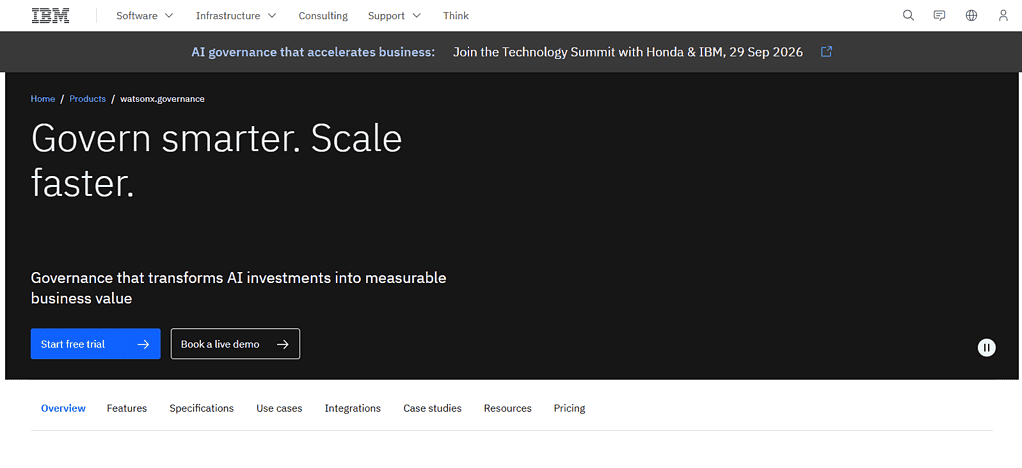
Public pricing includes a 14-day trial, Model Management from $0.64, Risk & Compliance Basic from $3,500/month and Advanced from $6,450/month, with other software priced per VPCs.
It supports SaaS, software deployment and integrates with IBM and broader enterprise environments. Governance capabilities include AI inventory, risk assessment, model evaluation, monitoring, documentation, compliance assessment and audit evidence.
| Feature | Details |
|---|---|
| AI Inventory | Tracks machine-learning models, foundation models, prompt templates, and AI use cases across the lifecycle. |
| Model Governance | Provides governance workflows for models from request and development through production and retirement. |
| Risk Management | Supports model risk, operational risk, risk thresholds, alerts, and governance activities. |
| Generative AI Governance | Monitors foundation models, prompt templates, and GenAI-specific metrics. |
| AI Factsheets | Captures model and prompt metadata, versions, lifecycle information, and governance evidence. |
| Monitoring | Supports monitoring for quality, fairness, drift, performance, and GenAI risks. |
| Compliance | Provides regulatory compliance management and connects AI use cases with applicable regulatory requirements. |
| Workflow Automation | Provides approval processes, task lists, governance workflows, and compliance activities. |
| Explainability & Fairness | Supports responsible AI monitoring around fairness, quality, explainability, and model behavior. |
| Enterprise Integration | Works across IBM environments and can incorporate third-party models and AI assets. |
2. Credo AI
Founded in 2020, Credo AI is an AI governance platform for governing models, applications, agents, workflows, and third-party AI vendors throughout their lifecycle. Enterprise pricing is largely quote-based, not publicly listed.
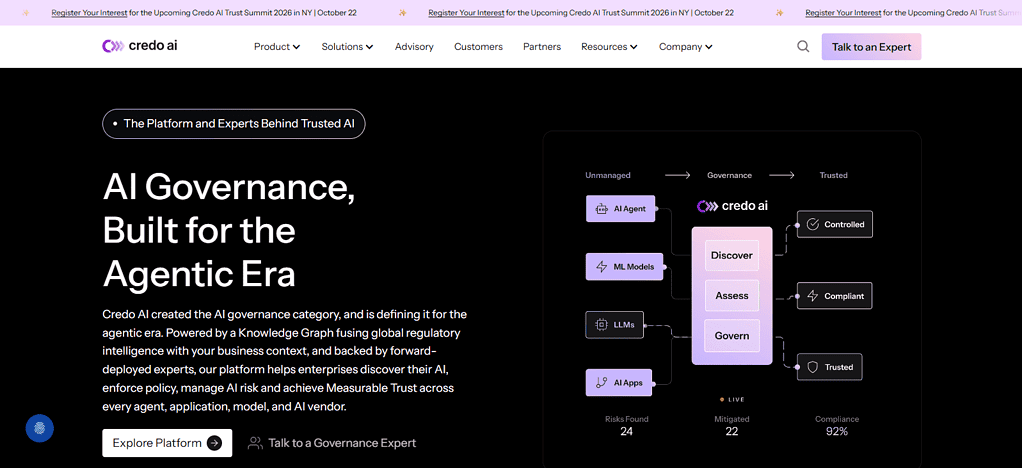
The platform is offered as an enterprise governance service and integrates with Snowflake, Databricks, AWS, Azure, ServiceNow, Jira, Confluence, Slack, Github and MLflow.
Governance capabilities include AI discovery, inventory, risk classification, policy management, compliance mapping, ongoing monitoring, evidence collection and agent governance. Credo AI advocates for standards such as the EU AI Act, NIST AI RMF, ISO 42001, OMB M-25 and industry-specific standards.
| Feature | Details |
|---|---|
| AI Discovery | Discovers AI systems and shadow AI across enterprise environments. |
| AI Registry | Centralizes models, applications, agents, vendors, and AI use cases. |
| Risk Management | Provides contextual AI risk assessment, risk scoring, controls, and continuous risk management. |
| Agent Governance | Provides agent inventories, agent-specific risk assessment, controls, and governance workflows. |
| Compliance Engine | Provides policy packs and governance workflows for major AI regulations and standards. |
| Policy Management | Connects regulations, organizational policies, controls, and AI system configurations. |
| Monitoring | Supports continuous monitoring, drift detection, red-teaming, and production governance. |
| Audit Evidence | Generates governance evidence and audit trails for compliance activities. |
| Governance Knowledge Graph | Connects regulatory intelligence, business context, AI configurations, risks, and controls. |
| Integrations | Connects with AWS, Azure, GCP, Databricks, Snowflake, ServiceNow, OneTrust, GitHub, MLflow, Jira, and other enterprise tools. |
3. Microsoft Purview AI Hub
Microsoft Purview AI Hub offers AI-related governance for the ecosystem of Microsoft Purview’s data security, compliance, risk, and information-governance. Purview is not a standalone AI governance product with a fixed price. It is available in Microsoft licensing and consumption models. Purview Suite is priced at ₹1,000/user/month in India.
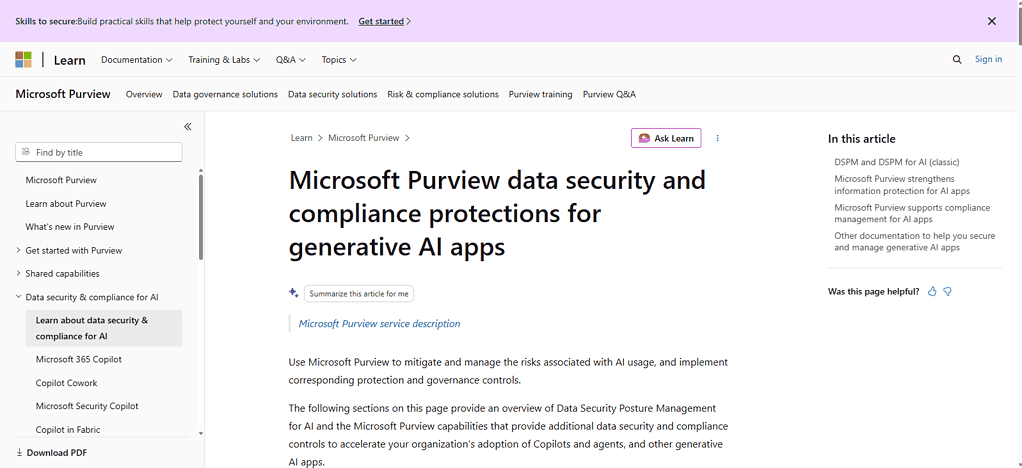
Other capabilities can be priced using Microsoft 365 licensing or Azure pay-as-you-go billing. This includes Microsoft 365, Copilot, AI apps, agents, sensitive data, and non-Microsoft data environments. Key capabilities include visibility into AI risks, data discovery, classification, DLP, audit, insider-risk controls, eDiscovery, compliance management, and protection for AI interactions.
| Feature | Details |
|---|---|
| AI Discovery | Helps organizations identify AI use and understand AI-related data and activity across Microsoft environments. |
| AI Governance | Provides governance capabilities around Microsoft Copilot, AI applications, data, and organizational AI usage. |
| Data Classification | Classifies sensitive information so organizations can apply appropriate protection policies. |
| Data Loss Prevention | Helps prevent sensitive information from being exposed through AI interactions and enterprise workflows. |
| Compliance Management | Connects AI usage with broader Microsoft compliance and information-governance capabilities. |
| Audit | Provides visibility into relevant user, data, and AI-related activities for investigation and compliance. |
| Insider Risk | Helps identify potentially risky AI-related activities involving users and sensitive information. |
| eDiscovery | Supports investigation and discovery workflows across governed Microsoft data. |
| Information Protection | Applies sensitivity labels, policies, and protection controls to enterprise information used with AI. |
| Microsoft Ecosystem | Integrates closely with Microsoft 365, Copilot, Azure, Purview, and other Microsoft security and compliance services. |
4. AI Governance by OneTrust
Founded in 2016, OneTrust expands its privacy and GRC ecosystem into AI governance with enterprise inventory, risk assessment, policy management, approvals, monitoring, runtime controls and audit evidence. AI Governance is quote-based and based on the number of administrator users and the size of your AI inventory.
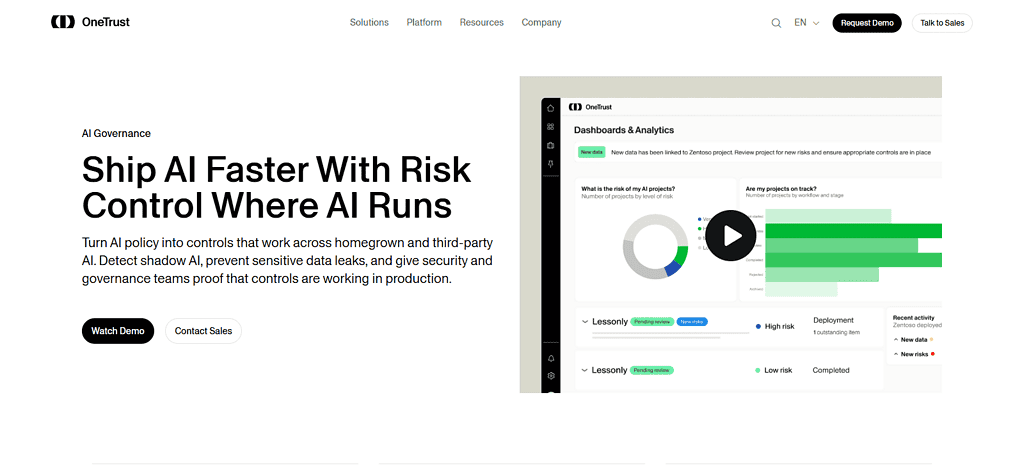
The platform is cloud-native and integrates with technologies like Amazon Bedrock, Microsoft Foundry, Databricks, Jira and other enterprise systems. Enterprise AI coverage includes models, agents, datasets, applications, vendors, use cases. EU AI Act, NIST AI RMF, ISO 42001 Framework support Automated risk tiering Guardrails Policy enforcement Attestations Monitoring Evidence generation Governance capabilities.
| Feature | Details |
|---|---|
| AI Discovery | Continuously discovers AI systems, models, agents, datasets, vendors, and shadow AI. |
| AI Registry | Provides a centralized system of record with ownership, metadata, lifecycle status, and version history. |
| Risk Assessment | Supports automated risk tiering based on use case, system, data sensitivity, deployment context, and other factors. |
| Compliance | Provides templates for EU AI Act, NIST AI RMF, and ISO 42001. |
| Governance Workflows | Automates intake, assessment, approval, attestation, sign-off, exceptions, and remediation. |
| Runtime Monitoring | Monitors AI model and agent behavior in production environments. |
| AI Guardrails | Supports policy-based controls including allowing, blocking, redacting, escalating, and routing AI activity. |
| Sensitive Data Protection | Detects sensitive information in AI prompts and responses and can block or redact content. |
| Agent Governance | Supports agent purpose, permissions, allowed actions, MCP policies, multi-agent handoffs, and delegated actions. |
| Audit Evidence | Tracks policy violations, enforcement actions, attestations, remediation, and governance evidence. |
5. Holistic AI
Founded in 2020, Holistic AI offers an end-to-end governance platform including AI discovery, risk evaluation, testing, compliance, monitoring and enforcement. Enterprise pricing is customarily not published as a standard self-service price.
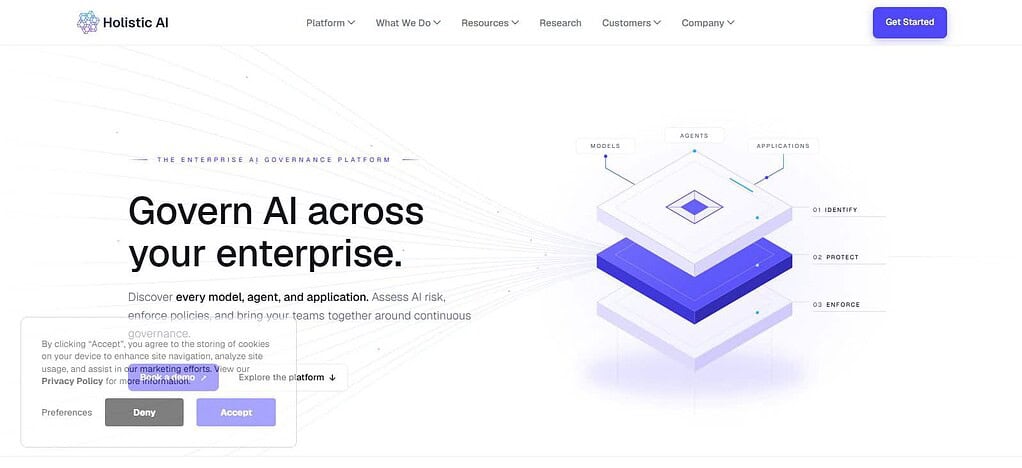
The deployment works with existing enterprise infrastructure via read-only connectors, APIs, SDKs and integrations with AWS, Azure, Google Cloud, GitHub, Databricks, MLflow, OpenAI, Anthropic, ServiceNow, Jira and more. Models, agents, APIs, applications and pipelines, shadow AI.
Its core capabilities include bias and robustness testing, red teaming, risk classification, policy enforcement, agent governance, audit evidence and framework mapping for the EU AI Act, NIST AI RMF and ISO 42001.
| Feature | Details |
|---|---|
| AI Discovery | Discovers AI models, agents, APIs, pipelines, and shadow AI across cloud, code, and vendor environments. |
| Central AI Inventory | Creates a centralized inventory of AI systems, models, agents, datasets, and endpoints. |
| AI Classification | Classifies AI assets and maps them to owners and lifecycle stages. |
| Risk Assessment | Provides qualitative and quantitative risk assessment capabilities across AI systems. |
| Automated Testing | Tests AI systems for risk, safety, bias, and compliance issues. |
| Agentic Red Teaming | Tests agentic systems and workflows for security, safety, and governance risks. |
| Compliance | Supports EU AI Act, NIST AI RMF, ISO 42001, NYC Local Law 144, and custom frameworks. |
| Policy Enforcement | Applies governance controls, remediation tasks, approvals, and compliance workflows. |
| Audit Evidence | Provides documentation and evidence for demonstrating governance and compliance. |
| Agent Governance | Provides visibility into agent identity, tool calling, access control, and agentic workflows. |
6. ModelOp
ModelOp, launched in 2016, is an enterprise AI lifecycle and governance platform that delivers a unified control layer over traditional ML, GenAI, agentic AI and third-party AI. There is no public pricing listed, so typically enterprise customers will request a custom quote.
ModelOp can be deployed on-premises, in private cloud or hybrid environments with data remaining in the customer environment. It works with 50+ technologies including MLflow, Amazon Bedrock, SageMaker, Azure ML, Vertex AI, GRC, ITSM, security and data platforms.
Governance capabilities such as AI inventory, automated risk scoring, policy enforcement, lifecycle workflows, testing, approvals, monitoring, documentation, audit evidence and compliance mapping.
| Feature | Details |
|---|---|
| AI System of Record | Centralizes visibility across internal, third-party, ML, GenAI, and agentic AI systems. |
| AI Intake | Standardizes AI use-case submission and creates lifecycle records. |
| Risk Assessment | Codifies risk assessments and automatically generates risk tiers based on organizational policies. |
| Lifecycle Governance | Manages AI from registration and development through approval, deployment, monitoring, and retirement. |
| Policy Automation | Automates governance policies across existing enterprise processes and systems. |
| Approval Workflows | Coordinates business, technical, risk, compliance, and portfolio reviews. |
| Monitoring | Connects AI performance, risk, cost, usage, and governance information. |
| Third-Party AI | Provides governance visibility across vendor AI as well as internally developed systems. |
| Interoperability | Connects with enterprise technology through 50+ integrations. |
| Governance Reporting | Provides centralized reporting around AI risk, compliance, cost, usage, and enterprise value. |
7. Fairly AI
Fairly AI was founded in 2020 to provide a compliance and risk management layer for organizations that are adopting AI on their existing infrastructure. The commercial pricing is mostly enterprise targeted and not widely published as a standardized public rate.
The platform is meant to blend with existing AI environments, rather than requiring organizations to toss out their current development stack. It centers on governance: AI risk identification, compliance management, assessment workflows, explainability, documentation and monitoring.
Fairly AI is particularly relevant for organizations that desire structured oversight of their artificial intelligence (AI) systems, integrating governance processes with existing technical infrastructure and responsible-AI requirements.
| Feature | Details |
|---|---|
| AI Risk Management | Helps organizations identify and manage risks associated with AI systems. |
| AI Compliance | Supports structured compliance processes for organizations deploying AI. |
| Model Governance | Provides governance and oversight capabilities for AI and machine-learning models. |
| Risk Assessment | Helps evaluate AI systems against organizational risk requirements. |
| Documentation | Supports documentation required for responsible AI and governance programs. |
| Explainability | Provides capabilities designed to improve transparency around AI decision-making. |
| Monitoring | Supports oversight of AI systems after deployment. |
| Responsible AI | Addresses areas such as fairness, transparency, accountability, and responsible AI practices. |
| Enterprise Integration | Designed to work alongside existing enterprise AI and technology environments. |
| Regulated Industries | Particularly relevant to organizations requiring structured AI risk and compliance oversight. |
8. Fiddler.AI
Founded to create transparency and accountability in machine learning, Fiddler AI has since expanded into AI observability, security, governance and agent control. Pricing: It currently has a free plan, Developer plan ($0.002 per trace) and Enterprise plan (custom pricing). SaaS, VPC and on-premise are available for enterprise customers.
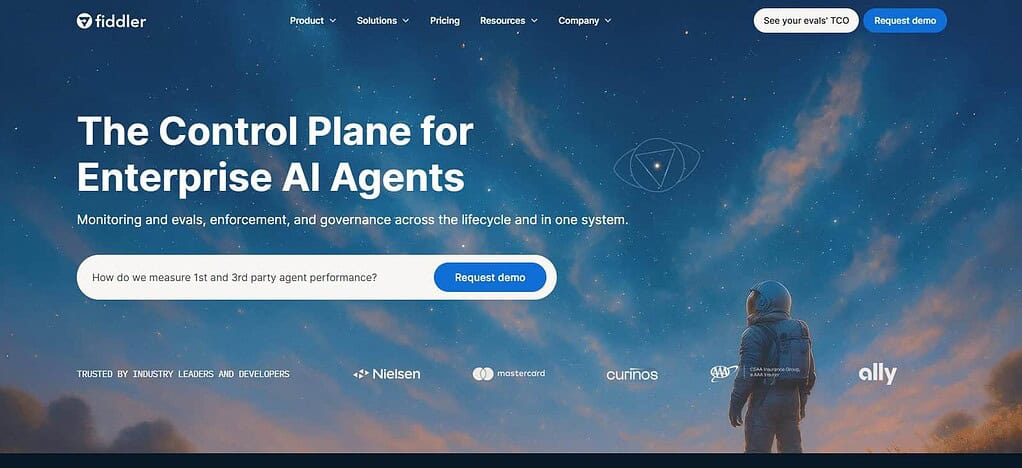
Fiddler supports Azure OpenAI, Amazon Bedrock, LangGraph and other AI environments. The coverage of enterprise AI includes predictive models, LLM applications and agents. Features include monitoring, evaluation, hallucination and toxicity detection, PII/PHI protection, prompt-injection detection, guardrails, policy enforcement and auditable governance.
| Feature | Details |
|---|---|
| AI Observability | Provides monitoring and visibility into model, LLM, and agent behavior. |
| LLM Monitoring | Tracks GenAI quality, safety, performance, and application behavior. |
| AI Evaluation | Supports evaluation of AI outputs and production behavior. |
| Hallucination Detection | Helps identify problematic or unreliable generated responses. |
| Toxicity Detection | Monitors generated content for harmful or inappropriate behavior. |
| PII/PHI Protection | Detects sensitive personal and healthcare information in AI interactions. |
| Prompt Injection Detection | Helps identify prompt-injection and related AI security risks. |
| Guardrails | Provides controls for managing risky AI inputs and outputs. |
| Agent Governance | Extends observability and controls to AI agents and agentic workflows. |
| Deployment | Supports SaaS, VPC, and on-premises enterprise deployment options. |
9. Monitaur
Monitaur was founded in 2019 and is focused on AI governance and model assurance for highly regulated industries including insurance, financial services, healthcare, life sciences, and HR. In general, it tailors its pricing for enterprise deployments, rather than publishing a standard subscription.
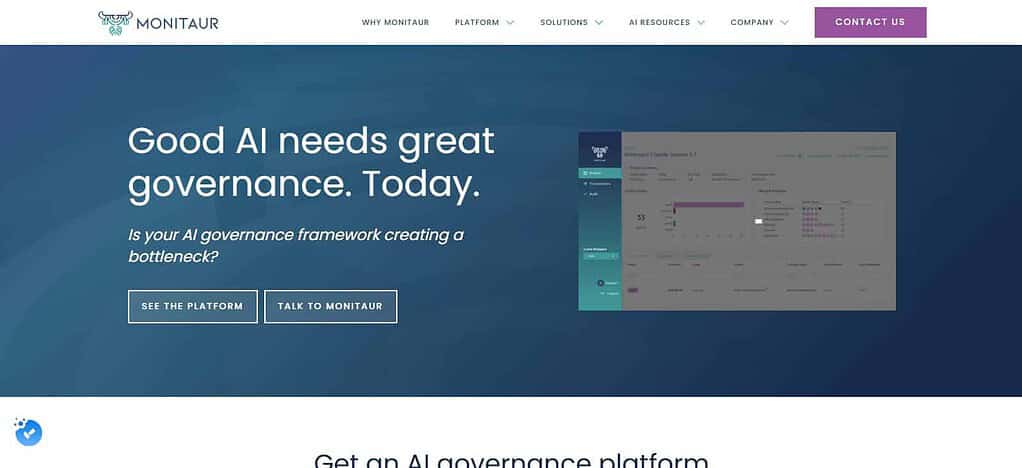
The platform is connected to existing systems via APIs, client libraries and integrations with Jira, Confluence, Databricks and GitHub. Enterprise AI coverage: predictive models, automated decision systems, GenAI and third-party AI.
Its key capabilities include AI inventory, risk management, model validation, fairness testing, ongoing monitoring, decision logging, evidence capture and governance controls. Its Common Controls approach maps requirements to frameworks including NIST AI RMF, ISO 42001 and EU AI Act.
| Feature | Details |
|---|---|
| AI Inventory | Provides centralized visibility into governed AI and automated decision systems. |
| Model Governance | Supports governance and oversight of models throughout their lifecycle. |
| Risk Management | Helps organizations identify, assess, document, and manage AI risks. |
| Model Validation | Supports structured validation and assurance processes for models. |
| Fairness Testing | Helps evaluate AI systems for potential fairness and bias issues. |
| Monitoring | Supports ongoing monitoring of model behavior and governance requirements. |
| Documentation | Maintains governance records and documentation for regulated environments. |
| Decision Governance | Provides controls around automated decisions and their business impact. |
| Auditability | Helps organizations maintain evidence supporting governance and compliance activities. |
| Regulated Industries | Designed particularly for sectors such as insurance, financial services, healthcare, life sciences, and HR. |
10. Saidot
Saidot, an AI governance platform founded in 2018, is based on a connected knowledge graph that links artificial intelligence systems, models, agents, datasets, risks, policies, controls and evidence. Its pricing is publicly reported to start at €1,000/month for the SME Platform, €1,400/month for Saidot Library and €3,100/month for the Enterprise platform.
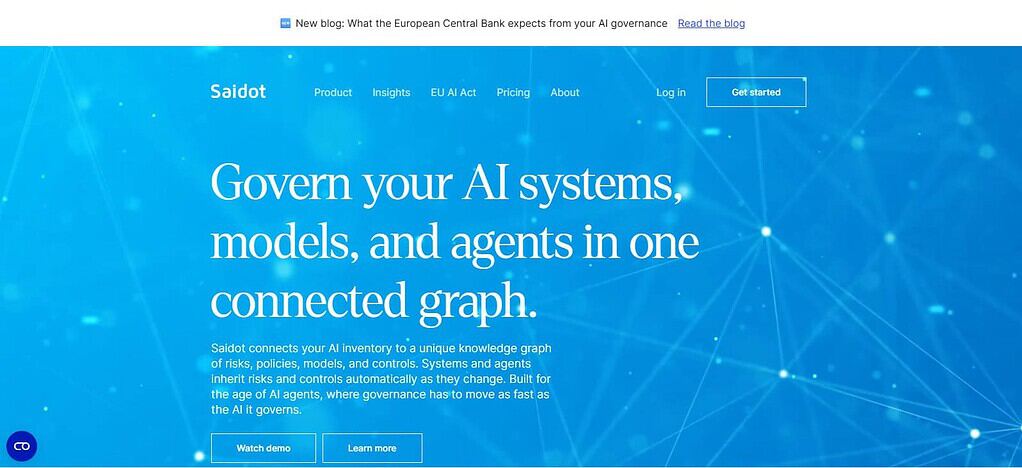
Deployment leverages its platform, APIs, webhooks and MCP servers, with integrations including Azure AI Foundry and Amazon Bedrock. It covers enterprise artificial intelligence systems, models, agents, data sets and products. Governance capabilities include inventory, risk inheritance, policy management, automated workflows, compliance evidence, audit trails, and support for the EU AI Act, ISO/IEC 42001, and NIST RMF.
| Feature | Details |
|---|---|
| AI Inventory | Centralizes AI systems, models, agents, datasets, and products in one governance environment. |
| Saidot Graph | Connects systems, models, agents, datasets, risks, policies, controls, and evidence. |
| AI Agent Governance | Provides agent ownership, risk levels, approvals, tool-level risk classification, and linked controls. |
| Risk Management | Supports risk identification, scoring, treatment, mitigation, and residual-risk assessment. |
| Risk Inheritance | Automatically carries relevant risks from models, datasets, and tools into connected AI systems. |
| Policy Management | Connects AI assets with applicable policies, requirements, and controls. |
| Compliance | Supports governance aligned with EU AI Act, ISO standards, NIST standards, and other policies. |
| Audit Evidence | Generates compliance evidence, governance records, and audit trails. |
| AI Transparency | Supports transparency reporting for boards, regulators, and other stakeholders. |
| Integrations & APIs | Supports integrations with Azure AI, Azure OpenAI, Amazon Bedrock, Microsoft Foundry Agent Service, REST APIs, and MCP-based workflows. |
Best AI Governance Platforms Comparison
| Platform | Best For | AI Inventory | Risk Management | Compliance & Frameworks | GenAI / LLM | AI Agents | Monitoring | Deployment | Pricing |
|---|---|---|---|---|---|---|---|---|---|
| IBM watsonx.governance | Enterprise AI lifecycle governance | ✓ | ✓ | NIST, ISO, regulatory controls | ✓ | ✓ | ✓ | SaaS / Software | Subscription / Enterprise |
| Credo AI | AI governance & compliance | ✓ | ✓ | EU AI Act, NIST, ISO 42001 | ✓ | ✓ | ✓ | Enterprise Cloud | Quote-based |
| Microsoft Purview AI Hub | Microsoft ecosystem governance | ✓ | ✓ | Microsoft compliance ecosystem | ✓ | ✓ | ✓ | Cloud | Microsoft licensing |
| OneTrust AI Governance | AI risk, privacy & compliance | ✓ | ✓ | EU AI Act, NIST, ISO 42001 | ✓ | ✓ | ✓ | Cloud | Quote-based |
| Holistic AI | AI risk assessment & testing | ✓ | ✓ | EU AI Act, NIST, ISO 42001 | ✓ | ✓ | ✓ | Cloud / Enterprise | Quote-based |
| ModelOp | AI lifecycle & model governance | ✓ | ✓ | Enterprise frameworks | ✓ | ✓ | ✓ | Cloud / Hybrid / On-prem | Quote-based |
| Fairly AI | Responsible AI & risk governance | ✓ | ✓ | AI compliance frameworks | ✓ | Limited | ✓ | Enterprise | Quote-based |
| Fiddler AI | AI observability & governance | ✓ | ✓ | Responsible AI controls | ✓ | ✓ | ✓ | SaaS / VPC / On-prem | Free / Usage / Enterprise |
| Monitaur | Regulated-industry AI governance | ✓ | ✓ | NIST, ISO 42001, EU AI Act | ✓ | Limited | ✓ | Enterprise | Quote-based |
| Saidot | AI inventory, risk & agent governance | ✓ | ✓ | EU AI Act, ISO, NIST | ✓ | ✓ | ✓ | Cloud / API | Subscription / Enterprise |
Conclusion
AI governance platforms have become critical for enterprises that are grappling with the growing use of traditional AI, generative AI and autonomous agents. The platforms highlighted in this guide offer a range of combinations of AI inventory, risk assessment, compliance management, monitoring, policy enforcement, and documentation and audit capabilities.
Pricing and deployment models also differ, from cloud-based subscriptions to custom enterprise and hybrid deployments. When choosing a platform, organizations should factor in their AI environment, regulatory needs, existing technology stack, maturity of governance and level of monitoring needed. A strong AI governance approach can enable more visibility, accountability, compliance, and control across the AI lifecycle.
FAQ
What is an AI governance platform?
An AI governance platform helps organizations manage AI systems throughout their lifecycle. It can provide AI inventory, risk assessment, policy management, compliance tracking, monitoring, documentation, approvals, and audit evidence.
Why do enterprises need AI governance platforms?
Enterprises use AI governance platforms to improve visibility and control over AI models, applications, data, and agents while managing risks, internal policies, regulatory requirements, and accountability.
What should an AI governance platform include?
Important capabilities include AI inventory, risk classification, compliance mapping, policy controls, model monitoring, documentation, human oversight, audit trails, workflow automation, and continuous risk assessment.
Do AI governance platforms support generative AI?
Yes. Many modern platforms support generative AI applications, LLMs, prompts, outputs, evaluations, and related risks such as hallucinations, privacy issues, bias, and unauthorized AI usage.
Can AI governance platforms manage AI agents?
Some platforms increasingly support agent governance, including agent inventories, permissions, tool access, workflows, monitoring, approvals, and policy enforcement. The depth of agent capabilities varies by platform.