


In this article, we will explore top AI data pipeline tools that help businesses optimize their workflows and leverage smart data processing within advanced AI applications.
Enhanced data integration, real-time data processing, and workflow automation is possible through these tools. We will discover the benefits, key features of these tools, and the advantages they introduce in data processing workflows.
What Are AI Data Pipeline Tools?
AI Data Pipeline tools are automation tools for ETL processes that AI applications need for data science and analytics. AI Data Pipeline Tools integrate multiple data sources for AI, clean and preprocess data, control and manage data workflows for reliable AI model workflows, and help with other process automations like data monitoring and real-time data processing.
AI Data Pipeline Tools also help with the automation and integration of AI-based workflows and help with data science tasks. Reduced cost, quality data and reduced manual efforts lead to faster, smarter, and scalable data solutions that the business needs.
Why AI Data Pipeline Tools Matter for Smarter Data Workflows
Automates Data Processing Tasks: Tools include AI data pipeline automation for data collection, transformation, and data integration processes to help data professionals streamline disparate workflows.
Improves Data Quality and Accuracy: Organizing and validating data through AI data pipelines alleviates the burden of cleaning data and improves the quality of data for analytics and AI.
Enables Faster AI Model Development: Data scientists can easily build and iterate upon AI models using AI data pipelines.
Supports Real-Time Data Processing: Modern tools allow businesses to process streaming data on demand for insights to drive instant, real-time decisions.
Enhances Workflow Automation: Sophisticated AI data pipelines manage workflow dependencies, execution schedules, and overall pipeline health, enabling users to step away from managed services and concentrate on core activities.
Improves Scalability for Growing Data Needs: AI Data Pipeline Services can serve workloads cut across multiple data sources and services of any volume, thereby indicating enterprise-level readiness.
Provides Better Data Monitoring and Management: Pipelines coupled with automation increase visibility to data flow and pipeline health to improve reliability for workflows.
Supports Cloud and Multi-Platform Integration: AI pipelines link cloud and data services with enterprise systems, further strengthening connected data ecosystems.
Key Features of AI Data Pipeline Tools
| Feature | Description |
|---|---|
| Workflow Automation | Automates data collection, processing, transformation, and delivery tasks to reduce manual operations and improve efficiency. |
| Data Integration Support | Connects multiple data sources such as databases, cloud platforms, applications, and enterprise systems for seamless data movement. |
| Real-Time Data Processing | Enables instant processing and analysis of streaming data for faster insights and real-time AI applications. |
| Machine Learning Integration | Supports AI model training, deployment, and monitoring by providing optimized data workflows for machine learning systems. |
| Data Transformation & Cleaning | Cleans, validates, and transforms raw data into high-quality datasets suitable for analytics and AI models. |
| Pipeline Monitoring & Management | Provides dashboards, alerts, and tracking features to monitor workflow performance and identify issues quickly. |
| Scalability | Handles growing data volumes and complex workloads by supporting distributed processing and cloud-based infrastructure. |
| Cloud Compatibility | Integrates with major cloud platforms such as AWS, Microsoft Azure, and Google Cloud for flexible data management. |
| Error Handling & Recovery | Automatically detects failures, retries tasks, and maintains reliable pipeline execution. |
| Security & Data Governance | Provides access control, encryption, compliance features, and data governance capabilities to protect sensitive information. |
| API & Tool Integration | Supports connections with third-party tools, databases, analytics platforms, and AI services through APIs and connectors. |
| Data Quality Management | Ensures accurate, consistent, and reliable data through validation rules and quality monitoring processes. |
Key Point & Best AI Data Pipeline Tools
- Apache Airflow – Open-source workflow orchestration tool for scheduling, monitoring, and managing complex data pipelines with DAG-based automation.
- Prefect – Modern data workflow orchestration platform focused on automation, reliability, and dynamic pipeline management.
- Dagster – Data orchestration framework designed for building, testing, and maintaining scalable data pipelines with strong observability.
- Luigi – Python-based pipeline management tool for handling batch jobs, dependency tracking, and large-scale data processing tasks.
- Kubeflow Pipelines – Kubernetes-native platform for building, deploying, and managing machine learning and AI data workflows.
- AWS Data Pipeline – Cloud-based service for automating data movement, transformation, and processing across AWS resources.
- Azure Data Factory – Microsoft cloud ETL and data integration service for creating automated data pipelines across multiple sources.
- Databricks Delta Live Tables – Data engineering framework for building reliable, automated, and high-quality data pipelines on Databricks.
- Snowflake Snowpark Pipelines – Snowflake-based data processing solution for developing scalable data workflows using Snowpark technology.
- Confluent Kafka Streams – Real-time stream processing platform for building event-driven data pipelines with Apache Kafka.
10 Best AI Data Pipeline Tools for Smarter Data Workflows
1. Apache Airflow
Apache Airflow is a platform used to design, schedule, automate, and manage complex data pipelines. This system implements Directed Acyclic Graphs (DAGs) to represent the structure of the pipeline and its dependencies, automate tasks, and provide visibility into a data pipeline.
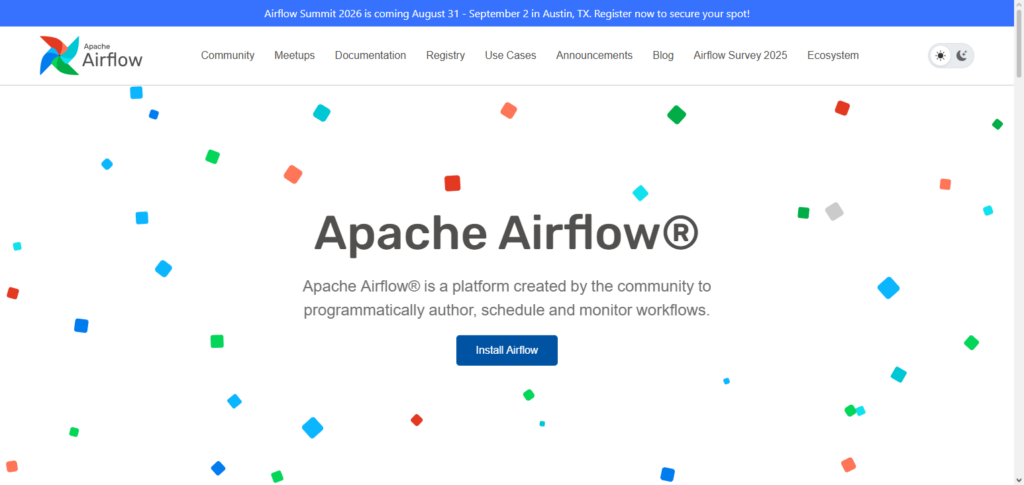
As one of the Best AI Data Pipeline Tools, Apache Airflow supports integrations with cloud platforms, databases, ML systems, and big data frameworks.
This system provides scheduling, dashboards, a framework for task management, and a plugin framework for large scale data engineering projects. Companies use Airflow to automate ETL processes, manage AI workflows, and maintain data pipelines.
Why is Apache Airflow Important?
- Brings complex data workflows under control with less management of manual pipelines.
- Helps with scheduling, monitoring and automation of ETL, AI, and ML workflows.
- Offers a DAG-based architecture to manage task dependencies.
- Offers integration with databases, cloud platforms, and analytics tools.
- Enhances pipeline reliability with error-handling and monitoring features.
- Advances data engineering operations with enterprise scalability.
- Has a flexible, configurable and user-friendly open source option.
| Pros | Cons |
|---|---|
| Open-source platform with strong community support. | Requires technical knowledge for setup and management. |
| Excellent workflow scheduling and automation capabilities. | Complex DAG management for beginners. |
| Supports many integrations with databases and cloud services. | Can require additional configuration for scaling. |
| Provides detailed monitoring and pipeline tracking. | Maintenance can become difficult for large workflows. |
| Flexible plugin system for customization. | UI is less intuitive compared to some modern tools. |
2. Prefect
Prefect is a workflow orchestration platform used to build, execute, and monitor data pipelines flexibly and at scale. This system implements a dynamic workflow to manage errors, automate tasks and provide real time monitoring.

As one of the Best AI Data Pipeline Tools, Prefect helps data teams construct intelligent pipelines for ML and analytics, and cloud-based apps. Prefect improves upon standard workflow systems by allowing pipelines to change during execution and by providing automatic failure recovery.
It is based upon Python, provides integrations with cloud based development and various data services, and is popular in AI and modern data engineering.
Why is Prefect Important?
- Offers modern data and AI workflow automation flexiblility.
- Delivers intelligent workflow management to execute dynamic pipelines.
- Handles failures with automatic retries and failure recovery.
- Provides ease of use with Python based workflows.
- Offers real time visibility and control of workflows.
- Is compatible with scalable cloud data processing.
- Allows teams to develop reliable and agile data pipelines with manageable velocity.
| Pros | Cons |
|---|---|
| Easy-to-use Python-based workflow development. | Some advanced features require paid cloud services. |
| Provides automatic retries and error handling. | Smaller ecosystem compared to Apache Airflow. |
| Supports dynamic and flexible workflows. | Requires learning Prefect-specific concepts. |
| Offers strong monitoring and observability features. | Large-scale deployments may need additional configuration. |
| Good support for modern cloud environments. | Limited enterprise adoption compared to older tools. |
3. Dagster
Dagster and Luigi are popular data orchestration tools: Dagster helps with data quality and provides stronger workflow management with data pipelines, while enabling teams to build AI pipelines for analytics with significant project management features for assets and dependencies.
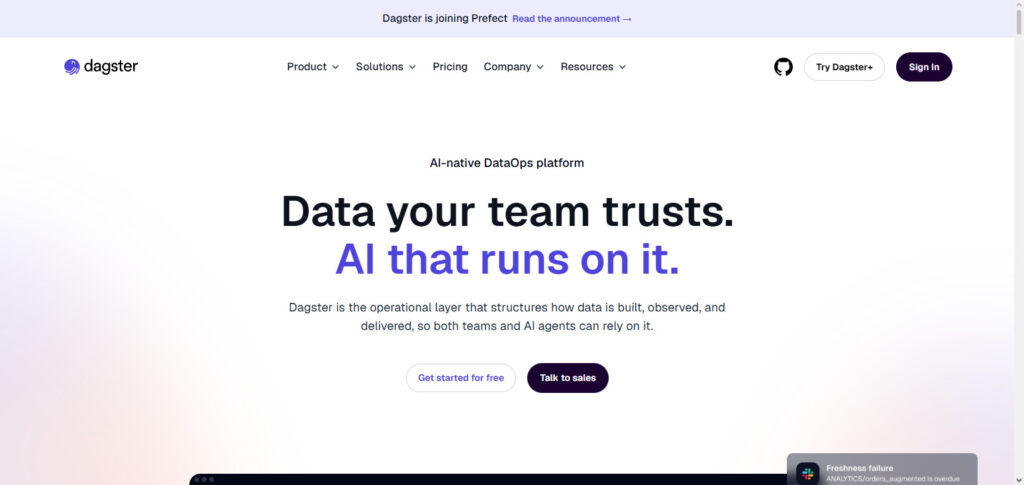
It incorporates pipelines to almost every major cloud provider and the AI/ML toolset. Dagster helps work pipelines remain reliable with insight into the status of pipeline execution and errors committed during data operations. It allows for strong, transparent data pipelines.
Why Dagster is Important?
- Offers strong observability and reliability features for data pipelines.
- Offers robust management of data assets, dependencies, and workflow relationships.
- Helps with testing and validating data to maintain a high level of trust for the data.
- Enables scalable AI, Analytics and ML workflows.
- Offers valuable insights on the performance and status of pipelines.
- Minimizes friction when working with complex data environments.
- Enables the building of trusted and production ready data systems.
| Pros | Cons |
|---|---|
| Strong data quality monitoring and observability. | Requires learning new concepts and architecture. |
| Excellent asset-based data pipeline management. | Smaller community compared to Airflow. |
| Supports testing and reliable workflow development. | May be complex for simple workflows. |
| Provides clear pipeline visualization. | Needs proper setup for enterprise environments. |
| Good support for AI and analytics workflows. | Limited third-party integrations compared with mature platforms. |
4. Luigi
Luigi is also an open source Python module that helps with building batch processes in complex pipelines along with dependency management. It helps data engineers do many, if not all, of the processing tasks needed in a large scale data operation and helps with task automation and process management. It is also used with ML and analytics pipelines and data related tasks.
Like Dagster, it has a lot of features to aid management of pipelines, including scheduling and dependency resolution,though it is less flexible in comparison. It also helps with reliable automation, but is more limited in its batch workflows.
Why Luigi is Important?
- Simplifies the management of complex data batch processing.
- Helps with managing dependencies between various data processing tasks.
- Offers automated scheduling of data processing jobs and decreases the need for manual work.
- Meets the needs of large scale ML and Analytics workflows.
- Delivers a Python framework for tailored pipelines.
- Establishes uniformity and dependability in data transformation.
- Presents a light design for automated workflow structures.
| Pros | Cons |
|---|---|
| Simple Python framework for batch workflows. | Older technology compared to modern orchestration tools. |
| Good dependency management capabilities. | Limited user interface and monitoring features. |
| Lightweight and easy to customize. | Requires more manual workflow management. |
| Suitable for large-scale batch processing. | Less suitable for real-time data pipelines. |
| Open-source with proven reliability. | Smaller active development community. |
5. Kubeflow Pipelines
Kubeflow Pipelines is a tool for constructing automated AI workflows on Kubernetes. It enables machine learning engineers and developers to include tools for auto model training, data preprocessing and deploying the model. Being one of the Top AI Data Pipeline Tools, Kubeflow Pipelines feature ready-to-use components and an experiment tracker. It provides scalable execution environments to developers.
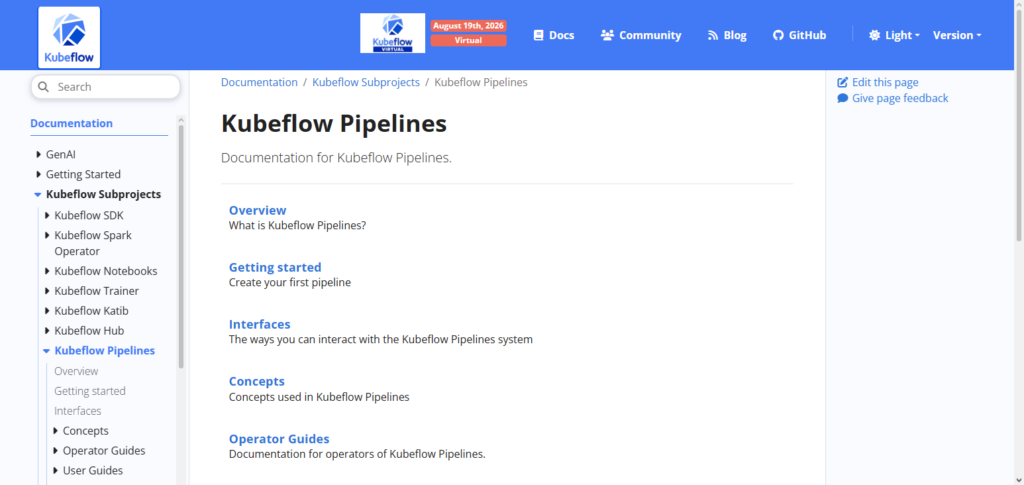
Kubeflow integrates well into a Kubernetes infrastructure for cloud native AI applications and distributed computing. Kubeflow Pipelines helps organizations automate and improve their machine learning activities by simplifying the building of production ready AI workflows.
Why Kubeflow Pipelines is Important
- Automates ML workflow from the preparation of data to deployment.
- Facilitates the creation of repeated AI experiments by data scientists.
- Offers scalable ML operations on top of a Kubernetes infrastructure.
- Contains pipeline sections which can be reused for pipeline construction.
- Promotes collaboration between data science and engineering teams.
- Manages ML workflow, from the training and evaluating of models to their deployment.
- Supports the construction of high-level AI offerings based on automated workflows.
| Pros | Cons |
|---|---|
| Designed specifically for machine learning workflows. | Requires Kubernetes knowledge for deployment. |
| Supports scalable AI model training and deployment. | Complex setup and infrastructure requirements. |
| Provides reusable ML pipeline components. | Higher operational complexity. |
| Enables MLOps automation and experiment tracking. | Can be expensive to manage at scale. |
| Integrates well with cloud-native AI environments. | Not ideal for simple data processing tasks. |
6. AWS Data Pipeline
AWS Data Pipeline targets organizations who struggle to orchestrate the highly repetitive workflows involved in data transfer and data transformation on various AWS components. AWS Data Pipeline makes ETL a breeze by integrating with AWS S3 and other AWS services.
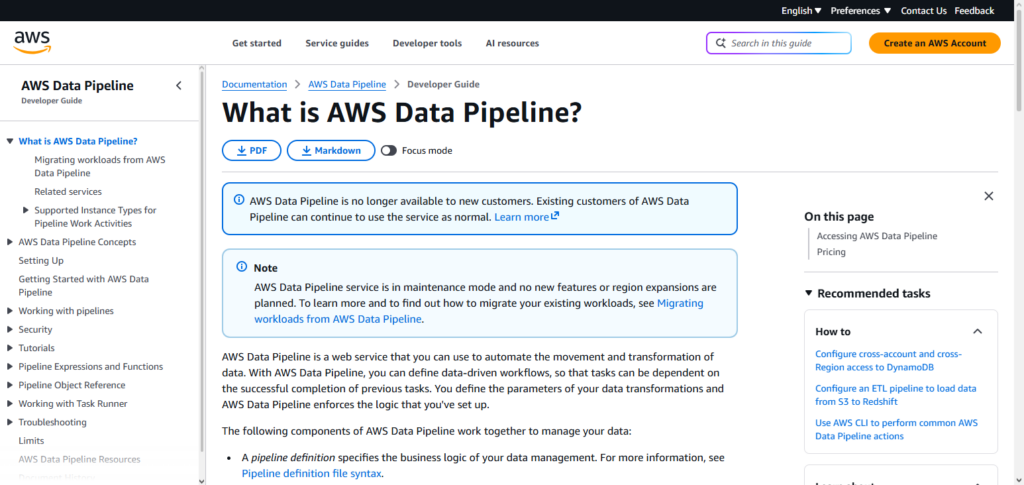
fault tolerance, monitoring, and automated execution of data operations provide confidence when implementing mission critical data management services at scale. Organizations seeking to implement computing architectures for AI and machine learning on the cloud benefit greatly from the scalability and performance that AWS Data Pipeline brings.
Why AWS Data Pipeline is Important
- Automates the moving and the transforming of data throughout the AWS services.
- Provides cloud-based ETL automation workflows.
- Supports scheduled data processing to perform recurring workflow operations.
- Integrates with Amazon S3, EC2, RDS, and AWS analytics services.
- enhances data availability for AI workflows and ML applications.
- Contains fault tolerance and monitors workflows.
- Provides services for the construction of scalable cloud data architectures.
| Pros | Cons |
|---|---|
| Strong integration with AWS cloud services. | Limited support outside AWS ecosystem. |
| Automates data movement and transformation tasks. | Requires AWS expertise for configuration. |
| Provides reliable scheduling and monitoring features. | Older service compared with newer AWS solutions. |
| Supports scalable cloud-based workflows. | Workflow design can be complex. |
| Provides enterprise-level security features. | Less flexible for advanced custom pipelines. |
7. Azure Data Factory
Azure Data Factory is an automated cloud-based ETL and data integration service developed by Microsoft that helps companies build cross-platform automated data pipelines. Azure Data Factory helps users to collect, transform, and move data from many heterogeneous sources (cloud and non-cloud applications, databases, and enterprise systems).
Some of the uses of Azure Data Factory are AI analytics, machine learning, and big data. Features like visual tools for constructing pipelines, customizable dashboards, and integration with Azure services make Azure Data Factory attractive to users. Azure Data Factory allows companies to build efficient, secure, and scalable data pipelines.
Why Azure Data Factory is Important
- Integrates data from multiple sources.
- Provides ETL automation for clouds and enterprise environments.
- Supports data workflows for AI, analytics, and machine learning.
- Offers Pipeline construction and management with visual tools.
- Integrates with Azure services and enterprise applications.
- Improves data security, governance, and scalability.
- Supports the construction of modern cloud-based data platforms.
| Pros | Cons |
|---|---|
| Strong integration with Microsoft Azure services. | Can become expensive with large-scale usage. |
| Provides visual pipeline development tools. | Advanced customization requires coding knowledge. |
| Supports many data sources and connectors. | Debugging complex pipelines can be challenging. |
| Suitable for enterprise data integration. | Strong dependency on Azure ecosystem. |
| Offers security and governance features. | Learning curve for beginners. |
8. Databricks Delta Live Tables
Delta Live Tables is a data engineering framework that helps automate reliable data pipelines in the Databricks Lakehouse Platform. It has capabilities for automatic data processing and quality checks, including pipeline optimization. As one of the Best AI Data Pipeline Tools, Delta Live Tables helps organizations build both real-time and batch data pipelines for analytics and AI.
To ensure operational health, Delta Live Tables has the capability of automatically managing data processing orders and performing data integrity checks. Databricks Delta Live Tables help organizations to improve the reliability of data, decrease the burden of pipeline management, and create scalable data architectures for advanced analytics.
Why Databricks Delta Live Tables is Important
- Provides options for both batch and real-time data processing.
- Simplifies construction of dependable pipelines.
- Automates data quality checks and pipeline monitoring.
- Provides tools to create high-quality data sets for building AI systems.
- Lessens the need for manual maintenance of data pipelines due to automation.
- Improves the reliability of data pipelines with its dependency management tools.
- Has features for data analysis on the Databricks Lakehouse platform.
| Pros | Cons |
|---|---|
| Simplifies creation of reliable data pipelines. | Requires Databricks platform knowledge. |
| Provides automated data quality monitoring. | Can have higher cloud infrastructure costs. |
| Supports batch and real-time processing. | Limited outside Databricks environment. |
| Integrates well with AI and analytics workloads. | Complex workflows may require advanced skills. |
| Reduces pipeline maintenance efforts. | Vendor dependency on Databricks ecosystem. |
9. Snowflake Snowpark Pipelines
Snowflake’s Snowpark Pipelines provide developers with an environment to develop data workflows in a cloud service. Developers can apply programming languages such as Java, Python, and Scala to Snowflake’s infrastructure. Snowpark Pipelines can be used for many of the workloads of AI and analytics, as well as data transformations.
Snowpark Pipelines can facilitate secure data processing and integration with the systems of enterprise data. Companies employ Snowpark Pipelines for building sophisticated data processing applications with tight control of data governance, maintaining scalable cloud analytics services.
Why Snowflake Snowpark Pipelines is Important
- Allow diverse data processing within Snowflake.
- Assist users in building AI/ML applications.
- Reduces the movement of data for increased security and performance.
- Offers developers the ability to use data processing tools in Python, Java, and Scala.
- Empowers businesses to create enterprise data solutions.
- Enhances cloud computing for analytics and data control.
- Provides a reliable system for complex data applications.
| Pros | Cons |
|---|---|
| Enables data processing directly inside Snowflake. | Requires Snowflake expertise. |
| Supports Python, Java, and Scala development. | Costs can increase with heavy workloads. |
| Improves data security by reducing movement. | Limited functionality outside Snowflake platform. |
| Supports AI and machine learning applications. | Complex applications may need additional tools. |
| Provides scalable cloud data processing. | Learning curve for developers new to Snowpark. |
10. Confluent Kafka Streams
Confluent Kafka Streams is built on Apache Kafka and is used by companies to construct event/data flow pipelines in real time. Streams captures, analyzes, and transforms data from several sources in a streaming fashion. Kafka Streams supports the AI pipeline, real time fraud detection and recommender systems, and a wide array of operational analytics.
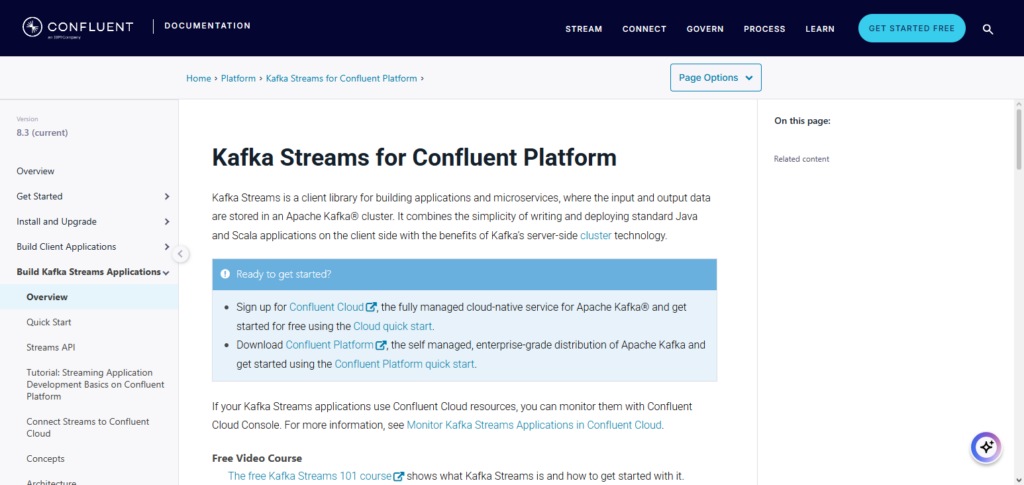
Kafka Streams offers modern enterprises flexibility and fault tolerance within data processing. Confluent Kafka Streams is employed by companies to construct data processing architectures that are responsive and capable of quickly processing huge volumes of data to support real time business operations.
Why Confluent Kafka Streams is Important
- Supports the real-time processing of vast quantities of streaming data.
- Aids the construction of event-based data architectures.
- Allows instant analytics and AI-based decisions.
- Offers huge scalability for millions of data events.
- Improves the speed of responses for real-time applications.
- Minimizes the time needed for fraud detection and recommendation generators.
- Helps businesses develop modern data pipelines.
| Pros | Cons |
|---|---|
| Excellent for real-time data processing. | Requires expertise in Kafka architecture. |
| Handles large volumes of streaming data efficiently. | Setup and maintenance can be complex. |
| Supports event-driven application development. | Infrastructure costs can increase at scale. |
| Provides high scalability and fault tolerance. | Debugging streaming workflows can be challenging. |
| Useful for AI, analytics, and real-time applications. | Not suitable for simple batch processing tasks. |
Conclusion
The correct AI Data Pipeline Tools enable companies to establish scalable data pipelines and improve the quality of their data to make better AI-enabled services to their customers. Tools such as Apache Airflow and Prefect, among others, provide excellent automation, monitoring, and integration infrastructure.
There are tools that offer real-time data processing like Confluent Kafka Streams and platforms like Databricks Delta Live Tables and Snowflake Snowpark pipelines. When picking the best AI data pipeline tools, consider factors like scalability, complexity of workflows, cloud options, machine learning considerations, and the goals of your data management.
The tools solve core challenges of building infrastructure to establish intelligent and reliable data systems.
FAQ
What are the Best AI Data Pipeline Tools?
The Best AI Data Pipeline Tools are platforms that help automate data collection, processing, transformation, and movement for artificial intelligence and analytics workflows. Popular tools include Apache Airflow, Prefect, Dagster, Kubeflow Pipelines, AWS Data Pipeline, Azure Data Factory, Databricks Delta Live Tables, Snowflake Snowpark Pipelines, and Confluent Kafka Streams.
Why are AI Data Pipeline Tools important for businesses?
AI Data Pipeline Tools help businesses manage large volumes of data efficiently by automating repetitive tasks, improving data accuracy, reducing manual work, and ensuring reliable data flow for machine learning models, analytics systems, and AI applications.
Which AI Data Pipeline Tool is best for workflow automation?
Apache Airflow and Prefect are among the best choices for workflow automation. They provide scheduling, task management, monitoring, and dependency handling features that help teams create and manage complex data workflows.
Which AI Data Pipeline Tool is best for machine learning workflows?
Kubeflow Pipelines is one of the best tools for machine learning workflows because it is designed for AI model training, experimentation, deployment, and management on Kubernetes-based environments.
Are AI Data Pipeline Tools suitable for real-time data processing?
Yes, tools like Confluent Kafka Streams and Databricks Delta Live Tables support real-time data processing. They help organizations analyze streaming data instantly for applications such as fraud detection, recommendations, and operational analytics.