




In this article I will tell you about the Best Secrets Management Platforms for Developers, and how teams use them to securely manage API keys, passwords, tokens, certificates and other sensitive credentials. We’ll compare the leading platforms on security capabilities, pricing, integrations, deployment options, developer experience, automation, control of access, and support for modern cloud-native development workflows.
What Is Secrets Management?
Secrets management is the process of securely storing, controlling, distributing, monitoring and rotating sensitive information used by applications, developers and infrastructure. Examples of such secrets include API keys, passwords, database credentials, access tokens, encryption keys, certificates and private keys. Secrets management platforms address insecure practices such as hardcoding credentials in source code or storing them in plain-text configuration files.
They provide centralized storage, encryption, role-based control of access, authentication, auditing and automated rotation. Secrets management also lets developers securely pass credentials from local development, through CI/CD pipelines, to Kubernetes environments, cloud applications, and production systems without leaking sensitive values in the clear.
Why Developers Need Secrets Management in 2026
No Hardcoded Credentials Secrets management enables developers to store API keys, passwords, tokens and database credentials outside of source code and reduces the risk of accidental exposure through repositories.
Reduces Secret Sprawl: Today’s applications are built on a multitude of credentials for dev, test, staging, and production. Centralized management can make it easier to organize, control and monitor these secrets.
Automated Rotation: Platforms can automate credential rotations and expirations, decreasing dependence on manually changing passwords and reducing the window of exposure of compromised or expired secrets.
Secures the CI/CD pipeline: This allows developers to inject secrets into the build and deployment process without hardcoding sensitive credentials directly in pipeline files, scripts, or publicly accessible repositories.
Enables least-privilege access: Granular permissions enable teams to control which developers, applications, services or workloads can access which secrets, enabling more granular control over access.
Secure Cloud-Native Apps: Kubernetes, containers, serverless functions and multi-cloud apps need secure delivery of credentials. In secret management, controls are centrally located across all of these distributed environments.
Enhances Security Visibility: Audit logs and access monitoring provide security teams with insight into who or what accessed a secret, when it was accessed, and how credentials are being used.
Allows for Ephemeral Credentials: Dynamic and ephemeral secrets can be used to provide applications with on-demand credentials, reducing the need for long-lived credentials and improving overall security.
Key Points
| Platform | Key Point |
|---|---|
| HashiCorp Vault | Dynamic secrets, fine-grained access policies, PKI, encryption, multi-cloud support, Kubernetes integration, extensive APIs and CLI, and self-hosted or managed deployment. |
| AWS Secrets Manager | Fully managed AWS-native secrets storage with automatic rotation, AWS KMS encryption, IAM controls, CloudTrail auditing, and integrations with RDS, Lambda, ECS, EKS, and CI/CD workflows. |
| Google Cloud Secret Manager | Versioned secrets, IAM-based access control, encryption, audit logging, regional replication, and integrations with Cloud Run, GKE, Compute Engine, Cloud Functions, and other Google Cloud services. |
| Azure Key Vault | Centralized management of secrets, encryption keys, and certificates with Microsoft Entra ID, Azure RBAC, logging, network controls, HSM-backed protection, and broad Azure integration. |
| Akeyless | Cloud-native secrets management with dynamic credentials, zero-knowledge architecture, granular policies, certificate management, multi-cloud support, Kubernetes integrations, and SaaS-based deployment. |
| CyberArk Secrets Manager | Enterprise-focused protection for privileged credentials, application secrets, and machine identities with automated rotation, access policies, auditing, and cloud, DevOps, and CI/CD integrations. |
| Doppler | Developer-centric centralized secrets and configuration management with environment separation, CLI and API access, CI/CD integrations, role-based controls, activity monitoring, and simple secret injection. |
| Infisical | Open-source-oriented secrets platform offering centralized environments, secret versioning, rotation, dynamic secrets, SSO, MFA, audit logs, Kubernetes and CI/CD integrations, plus cloud or self-hosted deployment. |
| 1Password Developer Secrets | Developer-focused secret management with strong encryption, access controls, CLI workflows, automation, CI/CD support, and integration into development and infrastructure workflows without exposing credentials in code. |
| Pulumi ESC | Environment and configuration management with secrets support, external secret-store integrations, OIDC-based short-lived credentials, RBAC, versioning, audit capabilities, CLI/API access, and Infrastructure-as-Code integration. |
1. HashiCorp Vault
HashiCorp Vault is a cloud-agnostic secrets and identity platform that was developed by HashiCorp in 2012 to help developers and security teams manage credentials in hybrid and multi-cloud environments. It supports static and dynamic secrets, credential leasing, automated workflows, auth methods, encryption, PKI and fine-grained policies.
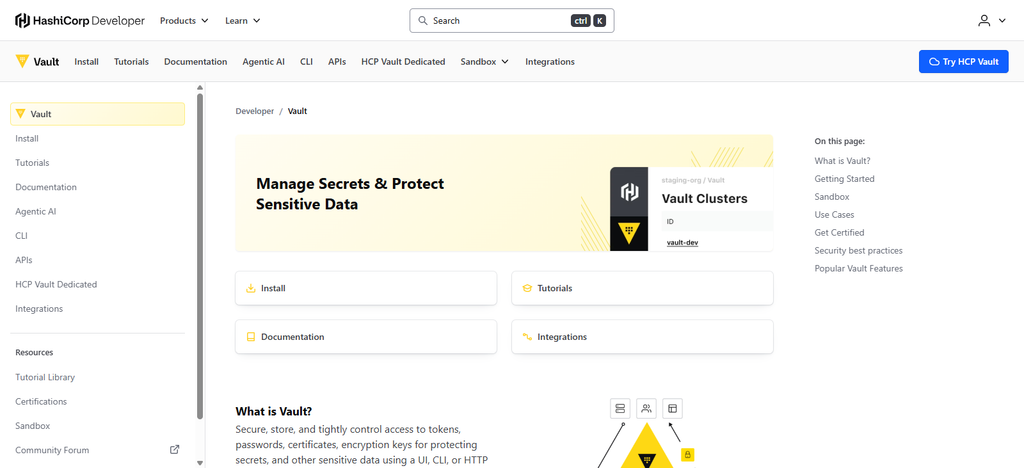
Pricing: Community edition is free, while enterprise versions are priced on a commercial basis. HCP Vault Dedicated uses managed-service pricing. Integrations: AWS, Azure, Google Cloud, Kubernetes, Databases, CI/CD tools, Identity providers. Deployment: Self-hosted or cloud-hosted. Developer Experience: good CLI, API, SDKs, authentication methods and automation support.
HashiCorp Vault Characteristics
- Encryption and central secret storage
- Dynamic secrets and ephemeral credentials
- *Fine-grained policy-based access control
- PKI and certificate management
Multi-cloud and hybrid environments support
Integration with Kubernetes and containers - CLI, API and SDK support
- Deployment options: self-hosted and managed
2. AWS Secrets Manager
AWS Secrets Manager, Amazon’s managed secrets platform, was introduced in 2018 and is a way to securely store, access, and rotate application credentials. It supports database passwords, API keys, tokens and other sensitive configuration and tight integration with AWS workloads.
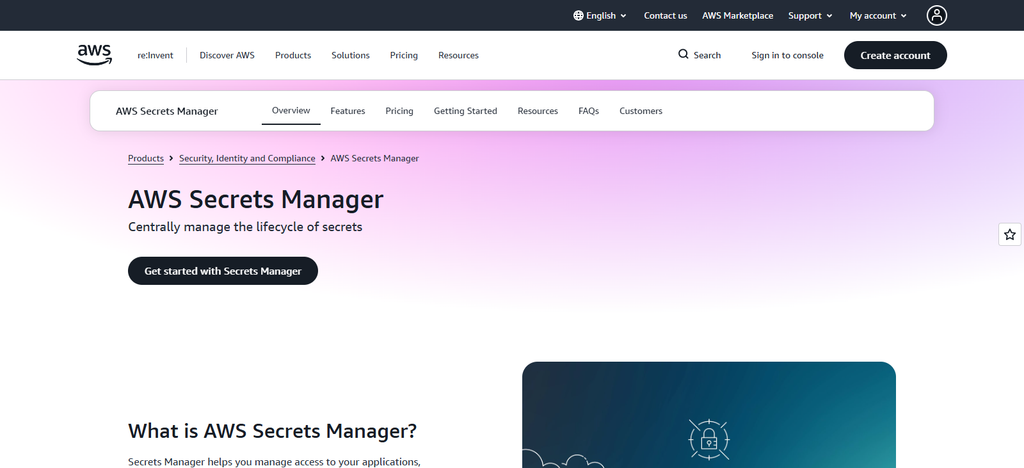
Pricing: AWS charges based on usage and it is $0.40 per secret per month and $0.05 per 10,000 API calls, with AWS Free Tier credits applicable. ** Integrations:** IAM, AWS Lambda, Amazon RDS, ECS, EKS, CloudFormation and other AWS services.
Security Capabilities: Encryption with AWS KMS, IAM based access control, auditing and rotation. Deployment: fully managed AWS service. Developer Experience: console, CLI, SDKs & APIs.
AWS Secrets Manager Characteristics
- shared storage for application secrets
- Automatic secret rotation features
- Encryption using AWS KMS
- Access control based on IAM
- Integration with AWS native services
Auditability with CloudTrail in AWS - Support for API, CLI and SDK
- Cloud deployment management
3. Google Cloud Secret Manager
Google Cloud Secret Manager is a Google Cloud managed service to store and manage sensitive information such as API keys, passwords, certificates, and application credentials. It offers versioned secrets, control of access, replication options, auditing, and integration with Google Cloud workloads.
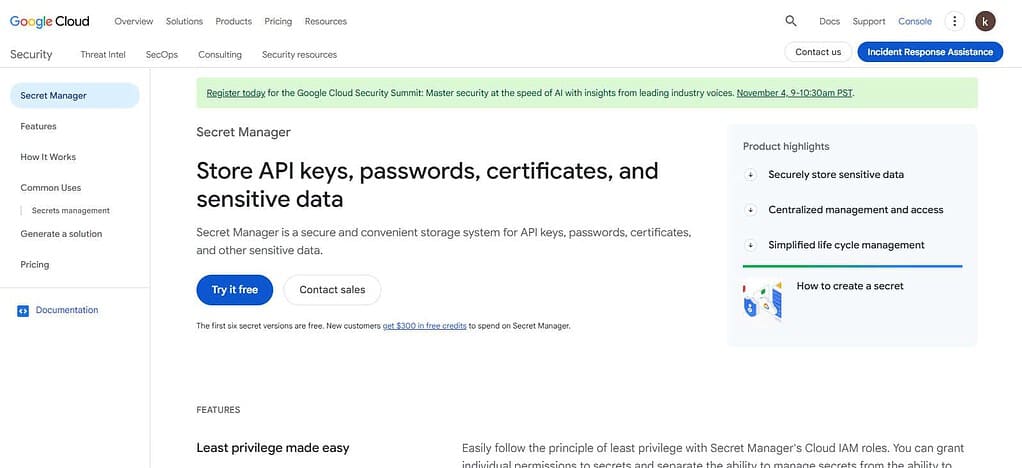
Pricing: Pricing for active secret versions and access operations is based on usage with free monthly quotas including six active versions and 10,000 access operations.
Integrations: Google Kubernetes Engine, Cloud Run, Compute Engine, Cloud Functions, IAM and Google Cloud Services Security features include encryption, IAM-based authorization, version control, audit logging and restricted access. Deployment: Managed in the cloud. Developer Experience: console, CLI, APIs and client libraries.
Google Cloud Secret Manager. Characteristics
- Secret storage with versions
- granular access control based on IAM
- Secrets encrypted at rest
- Replication of secrets across locations
- Integration with Google Cloud workloads*
- Logging audit logs for Google Cloud services
- Client-library, API and CLI support
- Complete cloud deployment management
4. Azure Key Vault.
Azure Key Vault is a Microsoft managed platform for securely managing application secrets, encryption keys, and certificates. Microsoft Azure was first released in October 2010. Pricing: Standard and Premium Key Vault pricing is per transaction with a monthly fee for some hardware-backed keys for Premium. ** Integrations:** Azure App Service, Azure Storage, Azure SQL, Event Grid, Azure Monitor, Private Link and Microsoft Entra ID.
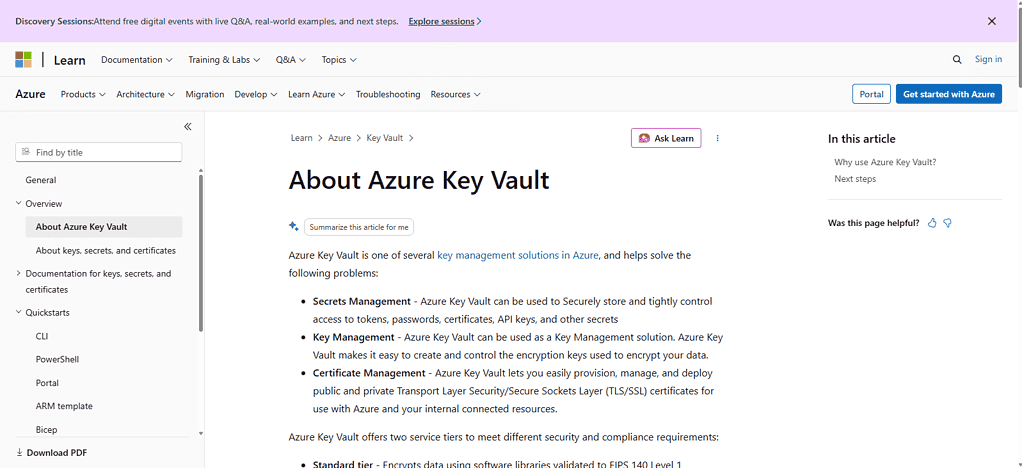
** Security Capabilities Encryption at rest, Azure RBAC, access policies, logging, network restrictions, HSM-protected keys in Premium. Deployment: Fully managed Azure service available in regions Developer Experience: Azure Portal, REST APIs, Azure CLI, PowerShell and SDKs provide easy integration with cloud apps.
Azure Key Vault Characteristics
- Storing secrets, keys and certificates securely
- Integration with Microsoft Entra ID
- Access policies and Azure RBAC
- Options for hardware-backed key protection
- Automated certificate lifecycle capabilities
Azure ecosystem integration - Audit and monitoring logs
- fully managed Azure deployment
5. Akeyless _
Akeyless (founded in 2018) is a cloud-native secrets management platform that provides centralized access across multi-cloud, hybrid and distributed environments. It provides static secrets, dynamic credentials, passwordless authentication, SSH certificates, certificate lifecycle management and automated secret workflows.
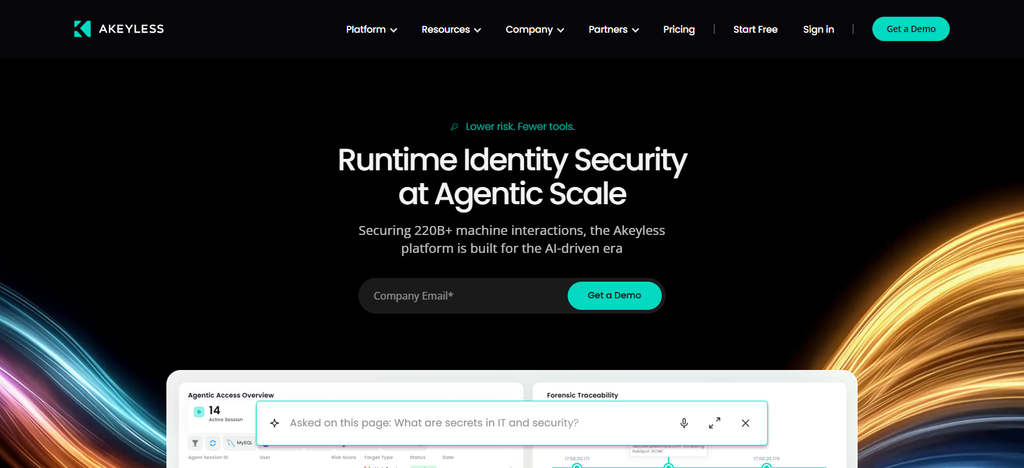
Pricing: Akeyless has a commercial subscription pricing model that is usage-based and takes into account the number of connectors and managed capabilities rather than just the number of secrets. Integrations: AWS, Azure, Google Cloud, Kubernetes, HashiCorp Vault, CI/CD systems and DevOps tools.
Security Features: zero-knowledge encryption architecture, distributed keys fragments, granular control of access and short-lived credentials. Deployment: Mostly SaaS with hybrid connectivity. Developer Experience: APIs, CLIs, integrations, and developer resources enable automated workflows.
Akeyless Characteristics
- Cloud native secrets management (centralized)
*Dynamic generation of secrets and credentials - Zero knowledge security architecture
Access policies, fine-grained - Support for hybrid and multi-cloud environments
- Kubernetes and DevOps integration
- SSH keys and certificate management
- SaaS Deployments with flexible connectivity
6. CyberArk Secrets Manager
CyberArk Secrets Manager is part of CyberArk’s identity security portfolio and focuses on protecting privileged credentials, application secrets, machine identities and non-human access. Founded: CyberArk was founded in 1999.
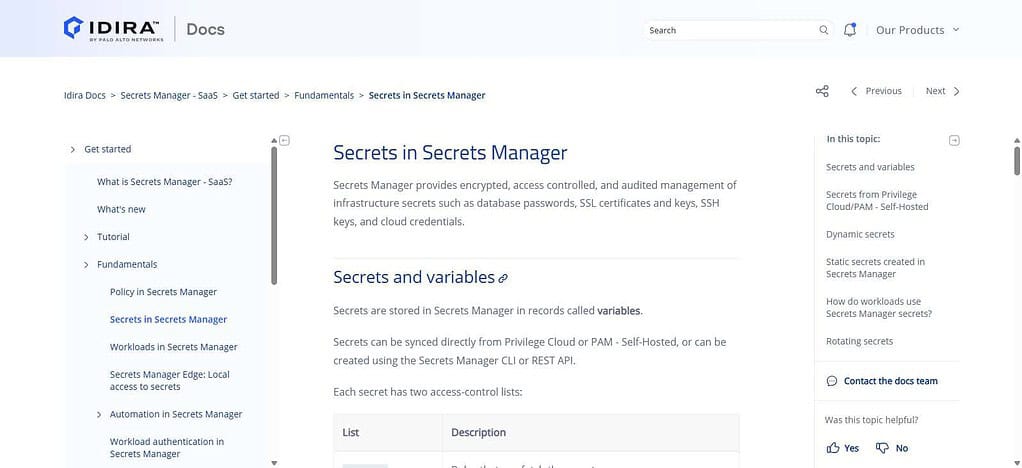
Pricing: Enterprise pricing is typically tailored to deployment, capabilities, identities and organizational needs. Integrations: cloud platforms, Kubernetes, CI/CD pipelines, databases, DevOps tools, enterprise identity environments Security Capabilities Centralized credential protection, privileged control of access, policy enforcement, credential rotation, auditing, machine-identity protection.
Deployment CyberArk offers cloud, self-hosted, and hybrid approaches. Developer Experience: APIs, automation interfaces, SDKs and DevOps integrations enable developers to securely retrieve credentials without hardcoding them into application code.
CyberArk Secrets Manager Characteristics
- Protection of privileged credentials
- Application and machine identity security
- Automatic rotating credentials
- Fine-grained access control policies
- Protect secrets in any cloud environment
- DevOps and CI/CD integrations
- Complete auditing and surveillance
- Cloud, hybrid and enterprise deployment options
7. Doppler
Doppler is a developer-first secrets management platform launched in 2018 to centralize application configuration and secrets across dev, staging, and production. Pricing: free Developer plan for up to three users, with additional users costing $8/month; Team is $21 per user/month, and Enterprise has custom pricing.
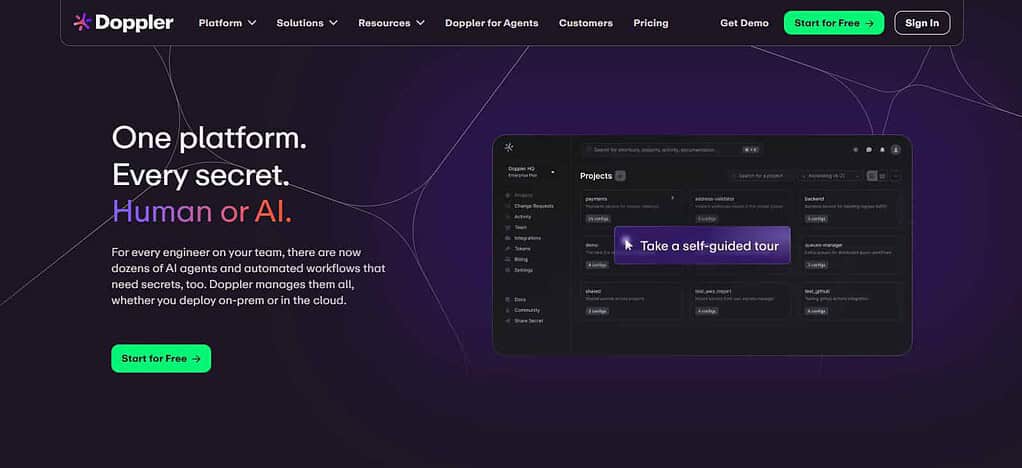
** Integrations: GitHub, GitLab, AWS, Kubernetes, Vercel, Terraform, CI/CD platforms, and many developer tools. Security Features: RBAC, SSO, identity-based authentication, trusted IPs, activity logs, secret rotation, service accounts. Deployment: Cloud-based, enterprise options. Developer Experience: Secret injection is easy with Doppler CLI, dashboard, API, webhooks, SDKs, and local-development workflows.
Doppler- Characteristics
- Centralized environment & secrets management
- Developer friendly secret injection
- Environment-specific configuration
CLI and API automation - Integrations of CI/CD pipelines
- Role based control of access
- Activity monitoring, audit capabilities
- Deployment in the cloud
8. Infisical
Infisical is an open-source-centric secrets and identity security platform founded in 2022 and built for developers who manage secrets across applications, environments, and infrastructure. Pricing: Free plan is $0 and supports up to five identities, Pro starts at $20 per identity monthly when billed annually, Advanced starts at $40 per identity monthly, and Enterprise pricing is custom.
Integrations: 100+ integrations , Kubernetes, cloud platforms, CI/CD tools & infrastructure tools. Security Capabilities: control of access, secret rotation, SSO, MFA, audit logs, secret versioning, dynamic secrets, temporary access, external KMS/HSM support.
Deployment options: cloud, self-hosted or dedicated infrastructure. Developer Experience: Great developer flexibility is provided by CLI, API, SDKs, secret imports, references, automation workflows.
Infisical Infisical Characteristics
- Rotation and secret versioning
- Open source secrets management strategy
- Centralized environment and project management
- Fine-grained control of access
- Dynamic secrets support
- SSO, MFA and audit logging
- Integration with Kubernetes and CI/CD
- Cloud & self-hosted deployment options
9. 1Password Developer Secrets
1Password Developer Secrets is by 1Password, founded in 2005, extends its well-established credential-management platform into developer workflows for securely managing application secrets and machine credentials. Pricing: pricing and availability are based on the 1Password business or developer offering you qualify for, and is not a universal standalone per-secret price.
Integrations: developer workflows can integrate to CLI-based environments, CI/CD systems infrastructure tooling and development platforms. Security features: encryption, control of access, centralized administration, secure secret sharing and controlled access to machines Deployment: mostly cloud-based, with enterprise capabilities.
Developer Experience: 1Password CLI, APIs, developer-friendly workflows, and automation enable teams to retrieve secrets without hardcoding sensitive values right into source code, configuration files, or repositories.
1Password Developers Secrets Characteristics
- Secrets management for developers
- Storage and retrieval of application secrets in a secure manner
- Architecture de chiffrement puissant
- Access and authorization controls
- Developer workflows using CLI
- Supports CI/CD automation
- Integration with infrastructure and development tools
- Cloud management of the enterprise-class
10. Pulumi ESC
Pulumi ESC (Environments, Secrets & Configuration) is a configuration and secrets management service from Pulumi, founded in 2017, that centralizes environment configuration and connects to existing secret stores. Pricing: Pulumi ESC is included with Pulumi’s commercial service model and is available and limited based on plan and organization needs.
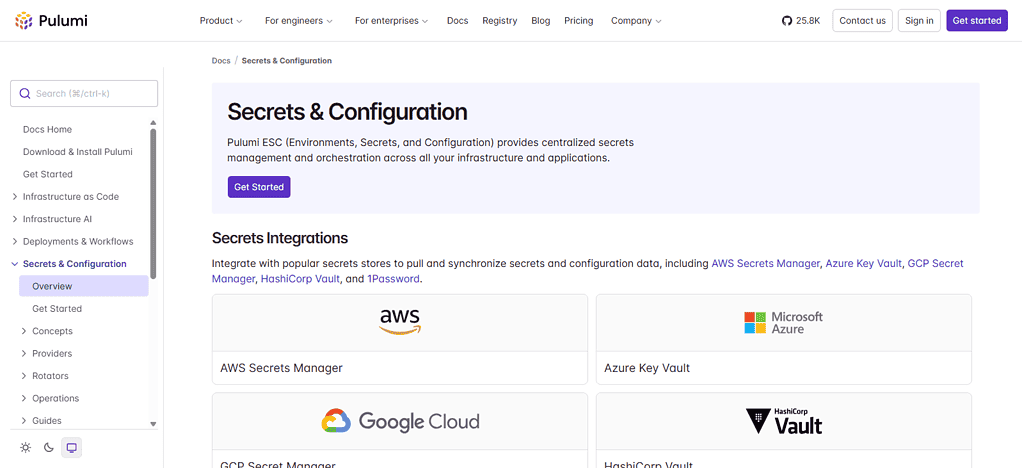
Integrations: AWS Secrets Manager, Azure Key Vault, Google Cloud Secret Manager, HashiCorp Vault, 1Password, Doppler, Infisical, Custom Providers. Security features: RBAC, versioning, audit logging, OIDC-based short lived credentials, no plaintext secret storage.
Deployment: Managed cloud control plane with external store integrations. Developer Experience: CLI, API, SDKs, Kubernetes operators, and native Pulumi IaC integration are particularly helpful for developer teams that are infrastructure focused.
Pulumi ESC (Environments, Secrets and Configuration) Characteristics
- Centralized control of environment configurations
- Integrate with multiple external secret stores
Secret and configuration versioning - OIDC based short lived credentials
- Role Based Access Control (RBAC)
- Audit and environmental management features
- CLI, API, SDK and Kubernetes support
Smooth integration to Infrastructure as Code workflows
Secrets Management Platforms Comparison Table
| Platform | Founded | Best For | Pricing Model | Key Integrations | Security Capabilities | Deployment | Developer Experience |
|---|---|---|---|---|---|---|---|
| HashiCorp Vault | 2012 | Enterprise & multi-cloud | Free Community; paid enterprise/managed | AWS, Azure, GCP, Kubernetes, databases, CI/CD | Dynamic secrets, encryption, RBAC/policies, PKI, audit logs | Self-hosted & managed | CLI, API, SDKs, automation |
| AWS Secrets Manager | 2018 | AWS workloads | Usage-based | AWS IAM, RDS, Lambda, ECS, EKS, CloudFormation | KMS encryption, IAM, rotation, CloudTrail | Fully managed AWS | CLI, SDKs, API, console |
| Google Cloud Secret Manager | 2018 | Google Cloud applications | Usage-based | GKE, Cloud Run, Compute Engine, Cloud Functions, IAM | Encryption, IAM, versioning, audit logging | Fully managed cloud | CLI, API, client libraries |
| Azure Key Vault | 2010 | Microsoft Azure environments | Transaction/tier-based | Azure App Service, SQL, Storage, Entra ID, Private Link | Encryption, RBAC, HSM, access policies, logging | Fully managed Azure | Azure CLI, PowerShell, SDKs, API |
| Akeyless | 2018 | Multi-cloud & distributed teams | Commercial subscription | AWS, Azure, GCP, Kubernetes, CI/CD, DevOps tools | Zero-knowledge architecture, dynamic secrets, granular policies | SaaS & hybrid connectivity | CLI, API, integrations, automation |
| CyberArk Secrets Manager | 1999 | Enterprise & privileged access | Custom enterprise pricing | Cloud, Kubernetes, CI/CD, databases, DevOps | Credential rotation, privileged access, policies, auditing | Cloud, hybrid & self-managed options | APIs, automation, DevOps integrations |
| Doppler | 2018 | Developer teams & DevOps | Free & paid plans | GitHub, GitLab, AWS, Kubernetes, Vercel, Terraform | RBAC, SSO, activity logs, secret rotation | Cloud-based | CLI, API, dashboard, webhooks |
| Infisical | 2022 | Open-source & self-hosted teams | Free, paid & enterprise | Kubernetes, CI/CD, cloud platforms, DevOps tools | Encryption, RBAC, SSO, MFA, rotation, audit logs | Cloud & self-hosted | CLI, API, SDKs, automation |
| 1Password Developer Secrets | 2005 | Developer & machine secrets | Plan-based | CLI, CI/CD, development & infrastructure tools | Encryption, access controls, secure sharing | Cloud-based | CLI, APIs, automation |
| Pulumi ESC | 2017 | IaC & cloud-native teams | Plan-based | AWS, Azure, GCP, Vault, 1Password, Doppler, Infisical | RBAC, versioning, auditing, OIDC short-lived credentials | Managed cloud | CLI, API, SDKs, Kubernetes, IaC |
Conclusion
Which is the best secrets management platform for developers in 2026 depends on the team’s infrastructure, security needs, deployment model and development workflow. HashiCorp Vault and CyberArk are solid options for advanced enterprise security. AWS Secrets Manager, Google Cloud Secret Manager and Azure Key Vault are particularly well suited to their respective clouds.
Akeyless, Doppler, Infisical, 1Password Developer Secrets, and Pulumi ESC provide developer-first approaches for modern DevOps and cloud-native environments. Teams should look for secure secret storage, automated rotation, granular control of access, integrations, deployment options, developer experience and predictable pricing when evaluating a platform.
FAQ
What is a secrets management platform?
A secrets management platform securely stores, controls, distributes, and monitors sensitive information such as API keys, passwords, tokens, certificates, and database credentials without exposing them in application code.
Why do developers need secrets management?
Developers use secrets management to prevent credentials from being hardcoded or accidentally committed to repositories. These platforms also provide access controls, secret rotation, auditing, and secure delivery to applications.
Which is the best secrets management platform for developers in 2026?
There is no single best option for every team. HashiCorp Vault is strong for flexible enterprise environments, while AWS Secrets Manager, Google Cloud Secret Manager, and Azure Key Vault are suitable for teams deeply using their respective cloud platforms.
Is secrets management better than using .env files?
Yes, especially for production environments. .env files can be useful during local development, but dedicated secrets management platforms provide centralized access control, encryption, auditing, rotation, and safer secret distribution.
What are dynamic secrets?
Dynamic secrets are temporary credentials generated when an application or user needs access. They can automatically expire, reducing the risk associated with permanently stored passwords and long-lived credentials.