
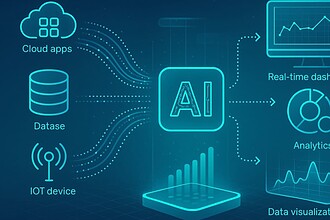


This article describes the Best AI Voice Infrastructure Platforms changing real-time communications in 2026. With speech-to-text, text-to-speech, orchestration, and telephony integration, these platforms provide low latency, scalable, and enterprise-ready solutions. Whether it’s developer focused APIs or compliance driven enterprise stacks, unique roles of these platforms provide building blocks of next generation voice AI ecosystems, allowing companies to deploy intelligent and reliable natural sounding conversational agents globally.
What is AI Voice Infrastructure Platforms?
AI Voice Infrastructure Platforms provide core pieces for the construction of real-time voice applications. These systems integrate various components, including speech-to-text (STT), text-to-speech (TTS), large language models, and calls. AI Voice Infrastructure Platforms provide the tools necessary for the construction of intelligent, natural, and Active interactive voice assistants.
APIs and hands-on deployment capabilities provide an easy way for users to interact and integrate with enterprise systems while also offering audio processing, messaging, compliance, and integrations. Reliable communication is crucial in several industries such as customer service, healthcare, finance, and media, and AI infrastructure Voice Platforms provide the foundation for Easily integrating communication across all these industries.
Key Points
| Platform | Strengths | Best Use Case | Pricing (2026) |
|---|---|---|---|
| Vapi | Full-stack orchestration, modular STT/LLM/TTS, sub-500ms latency | Managed voice agents with flexibility | $0.05/min + provider costs |
| Retell AI | Built-in telephony, low-latency orchestration | Fast deployment of phone agents | $0.07/min |
| Deepgram Nova-3 | High STT accuracy, <300ms latency | Real-time transcription at scale | $0.0048/min |
| AssemblyAI Universal-3 Pro | Multilingual STT + audio intelligence (sentiment, PII) | Post-call analytics | $0.21/hr |
| ElevenLabs | Ultra-realistic TTS, voice cloning, multilingual | Customer-facing agents needing trust | $6/month starter |
| Cartesia Sonic 3.5 | Sub-100ms latency, streaming-first | Real-time agents with strict latency | $4/month |
| OpenAI Realtime API | Unified speech-to-speech loop | Developers wanting single-model audio | $32/1M tokens |
| Twilio | Global telephony coverage, mature SIP trunking | Enterprise-grade telephony integration | $0.014/min inbound |
| Telnyx | Cost-efficient telephony, programmable voice | Budget-conscious enterprises | Competitive per-minute |
| PolyAI | Layer-4 complete platform, enterprise governance | Regulated industries & large-scale ops | Enterprise pricing |
1. Vapi
Vapi is a developer orientated voice agent orchestration toolkit. Vapi provides a complete STT, LLM, and TTS stack over a unified communications API. Sub 500ms latency means real-time communication between agents and human users.
Deploying Vapi means never having to manage aimless infrastructure again, as your agent hosting can be done over the cloud with a single click. The main function of Vapi is orchestration and abstracting away multi-cloud infrastructures and providers. Vapi simplifies provider infrastructure and pricing, charged at $0.05 per minute for communication with LLMs, and at a slight vendor premium.
Developers can avoid integrating new code for new service integrations with Deepgram, OpenAI, ElevenLabs, and Twilio. Vapi reflects the ease of highly advanced service integrations with agent design as the primary focus for development teams.
Voice Stack Coverage: STT, LLM, and TTS.
Key Infrastructure Strength: API with sub-500ms latency.
Main Limitation: STT/TTS quality requires external APIs.
Best For: API development for orchestration and automation.
Vapi Pros & Cons
| Pros | Cons |
|---|---|
| Unified orchestration for STT, LLM, TTS | Relies on external providers for STT/TTS |
| Sub-500ms latency | Requires provider costs on top of base pricing |
| Modular API design | Less analytics compared to AssemblyAI |
| Flexible integrations (Deepgram, OpenAI, ElevenLabs, Twilio) | Limited enterprise compliance features |
| Transparent pricing ($0.05/min) | No built-in telephony |
| Developer-friendly | Needs external monitoring tools |
| Scalable cloud-native deployment | Higher engineering setup for compliance |
| Reduces infrastructure complexity | Not ideal for regulated industries |
| Fast iteration for startups | Less governance compared to PolyAI |
2. Retell AI
Retell AI is specialized for low-latency orchestration for phone-based AI agents. Optimized for real-time interaction, its voice stack latency is under 400ms. A managed hosting deployment streamlines the setup for AI agents. Unlike other telephony-based stacks,
Retell AI orchestration minimizes the engineering burden by including telephony in its pricing of $0.07/min, more than Vapi, but justifiable due to the telephony bundle. Supporting integrations include Twilio, Telnyx, and other AI providers, ensuring enterprise compatibility.
Retell works well for startups and businesses needing rapid deployment of phone agents. Building complex pipelines is no longer a necessity. Retell balances speed, reliability and ease of use.
Voice Stack Coverage: STT, LLM, and TTS with on-device telephony.
Key Infrastructure Strength: Phone agent-focused low-latency orchestration.
Main Limitation: Slightly higher per-minute cost compared to competitors.
Best For: Quick deployment of phone-based AI agents.
Retell AI Pros & Cons
| Pros | Cons |
|---|---|
| Built-in telephony support | Higher per-minute cost ($0.07/min) |
| Low-latency orchestration (~400ms) | Less modular than Vapi |
| Easy deployment for phone agents | Limited analytics features |
| Seamless integrations with Twilio/Telnyx | Focused mainly on telephony |
| Managed hosting reduces engineering | Less flexibility for custom pipelines |
| Enterprise-ready telephony compliance | Not ideal for non-telephony use cases |
| Rapid deployment for startups | Limited customization compared to Vapi |
| Strong reliability | Higher cost for scale |
| Simplifies phone agent infrastructure | Less suited for advanced AI workflows |
3. Deepgram Nova-3
Deepgram Nova-3 empowers applications with speech-to-text capabilities with the advantage of having a 300ms response time and almost perfect accuracy. Deepgram Nova-3 has a voice stack with several models built for multilingual and domain-specific speech-to-text transcription. Nova-3 is best suited for applications with large transcription workloads.
Having an API-first infrastructure makes Deepgram easy to integrate for real-time or post-processing transcription. Deepgram also offers the ability to integrate several other transcription frameworks built on top of Deepgram.
Competitive pricing of $0.0048/min for large transcription workloads makes Deepgram a clear winner in the transcription market. Deepgram is excellent for large enterprises requiring reliable and scalable real-time or near-real-time transcription for a multitude of use cases including call centers and compliance where accurate speech-to-text is required.
Voice Stack Coverage: Enhanced STT with Multilingual support.
Key Infrastructure Strength: Accurate STT with <300 ms latency.
Main Limitation: Only STT. No orchestration or TTS.
Best For: STT for AWS-based enterprise-scale transcription.
Deepgram Nova-3 Pros & Cons
| Pros | Cons |
|---|---|
| High STT accuracy | Focused only on STT |
| Latency under 300ms | No orchestration or TTS |
| Multilingual support | Requires external orchestration |
| Cost-efficient ($0.0048/min) | Limited compliance features |
| Scalable API-first deployment | No built-in telephony |
| Strong enterprise adoption | Less flexibility for full-stack agents |
| Seamless integration with Vapi/Retell | Needs external monitoring |
| Optimized for transcription-heavy workloads | Not ideal for real-time agents |
| Reliable for compliance-heavy industries | Limited analytics compared to AssemblyAI |
4. AssemblyAI Universal-3 Pro
AssemblyAI Universal-3 Pro is an advanced speech-to-text application providing greater context through built-in analytics. Some of the analytics provided include real-time sentiment scoring, topic detection, and personally identifiable information (PII) suppression.
Universal-3 Pro has a sub 400ms response time, making it perfect for near-real-time analytics. Universal-3 Pro is excellent for compliance and customer intelligence applications. AssemblyAI Universal-3 Pro has a competitive pricing of $0.21/hr.
AssemblyAI is perfect for large enterprises needing not just speech-to-text capabilities but also valuable analytics including compliance in regulated industries. AssemblyAI Universal-3 Pro is an excellent fit for industries like healthcare and finance.
Voice Stack Coverage: STT and audio intelligence (e.g. sentiment analysis, PII detection).
Key Infrastructure Strength: Advanced analytics for transcription beyond compliance.
Main Limitation: More than 400 ms latency for ultra-real-time agents.
Best For: Ultra-real-time agents for regulated industries.
AssemblyAI Universal-3 Pro Pros & Cons
| Pros | Cons |
|---|---|
| Advanced STT with audio intelligence | Latency ~400ms |
| Sentiment, topic, and PII detection | Not optimized for ultra-real-time |
| Compliance-ready analytics | Higher cost than Deepgram |
| Affordable pricing ($0.21/hr) | Focused mainly on analytics |
| API-driven deployment | Less suited for gaming/interactive agents |
| Strong enterprise integrations | Requires orchestration for telephony |
| Ideal for regulated industries | Limited TTS capabilities |
| Seamless CRM integration | Less modular flexibility |
| Actionable insights beyond transcription | Not ideal for latency-critical use cases |
5. ElevenLabs
ElevenLabs specializes in TTS technologies that integrate naturally in customer-facing applications, where trust in a voice enhances the user experience and engagement. Its voice stack prioritizes the rendering of naturalistic speech, with a latency of 500ms.
It deploys via an API which allows for the integration of tools for media, customer support, and accessibility. Its infrastructure role is the TTS specialization, and the pricing ranges from $6/month to more, depending upon usage.
Retell and Vapi are some of the tools which aid in the embedding of voice across applications in multiple industries. It is the ideal choice for organizations where voice quality tremendously impacts the user experience and engagement.
Voice Stack Coverage: TTS and voice cloning with multilingual support.
Key Infrastructure Strength: Highly realistic, natural voices.
Main Limitation: More than 500 ms. Latency is higher than low latency.
Best For: Multilingual voice support for trustworthy customer interactions.
ElevenLabs Pros & Cons
| Pros | Cons |
|---|---|
| Ultra-realistic TTS voices | Latency ~500ms |
| Voice cloning capabilities | No STT or orchestration |
| Multilingual support | Requires external orchestration |
| Affordable entry ($6/month) | Limited compliance features |
| API-based deployment | Not ideal for latency-sensitive agents |
| Strong customer trust | Higher cost at scale |
| Seamless integration with Vapi/Retell | Focused only on TTS |
| Ideal for customer-facing apps | No analytics |
| Improves accessibility and media | Limited enterprise governance |
6. Cartesia Sonic 3.5
Cartesia Sonic 3.5 delivers ultra-low latency response at under 100ms. Building on streaming-first architecture, it supports real-time conversational agents without lag. It is deployed using cloud-native technologies and is optimized for high concurrency. For infrastructure, it performs low latency critical instant orchestration. For pricing, it is priced at $4 per month.
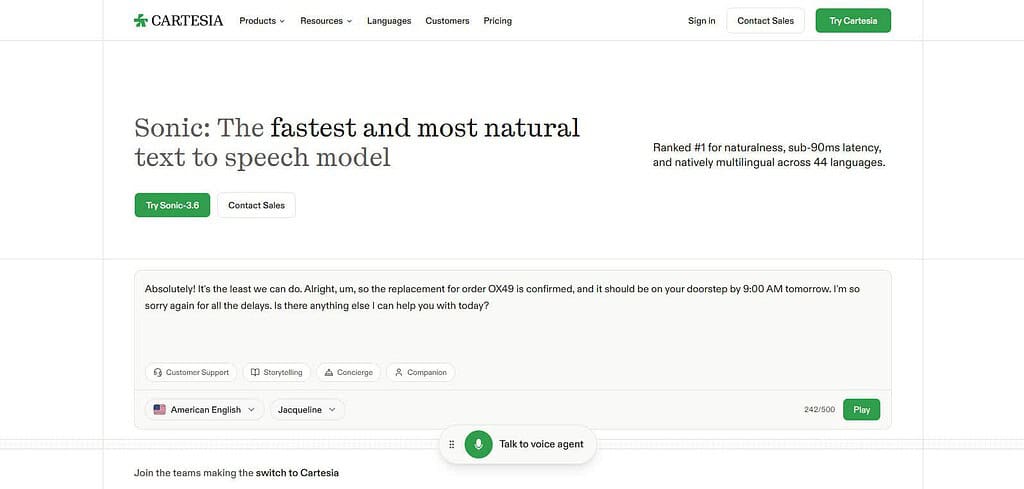
It offers integrations for Vapi, Retell, and direct pipelines. It allows for flexible orchestration. Cartesia Sonic 3.5 excels at building real-time agents for gaming, customer service, and other applications where latency and user experience are closely tied. When talking about technology in sensitive time environments, it has a strong balance between performing at high speeds and scalability.
Voice Stack Coverage: Includes a full stack with STT, TTS, and LLM for real-time and streaming applications.
Key Infrastructure Strength: Out-of-the-box STT and TTS capabilities with sub-100ms latency.
Main Limitations: No orchestration is designed for STT only.
Best For: Agents and UIs that require highly sophisticated real-time or streaming interactions.
Cartesia Sonic 3.5 Pros & Cons
| Pros | Cons |
|---|---|
| Sub-100ms latency | Less analytics features |
| Streaming-first architecture | Limited compliance certifications |
| Cloud-native deployment | Focused mainly on latency |
| Affordable pricing ($4/month) | Not ideal for regulated industries |
| Scalable for real-time agents | Less enterprise governance |
| Seamless integration with orchestration | Requires external monitoring |
| Optimized for gaming/support | Limited multilingual support |
| Strong concurrency handling | No advanced audio intelligence |
| Best for latency-critical workloads | Less suited for post-call analytics |
7. OpenAI Realtime API
The OpenAI Realtime API incorporates STT, LLM, and TTS in a unified speech-to-speech loop, and has a profile of ~300 ms latency, which optimizes for natural, conversational flow. API-first deployment makes it easy for developers to use a single provider for the entire voice stack. The infrastructure role is fully automated end-to-end alignment, which means there is a need for fewer providers.
Pricing is $32 per 1M tokens, which corresponds to OpenAI’s pricing plan. Custom pipelines and Vapi are some of the integrations that allow for hybrid deployments. OpenAI Realtime API is particularly useful for developers who favor simplicity and are looking for a one-stop shop for building voice agents, despite the limitations in customization compared to other platforms.
Stack Unification: Unified STT, LLM, and TTS.
Ease of Deployment: End-to-end coverage that simplifies deployment.
Key Constraint: Relatively less flexibility offered compared to modular platforms.
Ideal Scenario: APIs covering all aspects of a complete voice loop.
OpenAI Realtime API Pros & Cons
| Pros | Cons |
|---|---|
| Unified STT, LLM, TTS | Limited flexibility |
| Latency ~300ms | Higher pricing ($32/1M tokens) |
| Simplifies deployment | Less modular than Vapi |
| End-to-end coverage | Limited telephony support |
| API-first integration | Not ideal for compliance-heavy industries |
| Strong developer adoption | Requires external monitoring |
| Seamless integration with orchestration | Higher cost at scale |
| Ideal for startups | Less customization |
| Reduces provider complexity | Limited enterprise governance |
8. Twilio
Twilio continues to be the primary option for global telephony, offering SIP trunking, programmable voice, and call routing. Its voice stack is focused on telephony infrastructure rather than on AI, but can integrate with AI orchestration systems. Latency is variable based on routing, but is roughly ~500 ms worldwide. Deployment is enterprise ready, with strong APIs and compliance. Its infrastructure role is telephony backbone, providing worldwide connectivity for AI agents.
Pricing is $0.014/min inbound, with outbound pricing varying by location. Integrations include Vapi, Retell, and enterprise-level CRMs, making it essential for deploying AI agents globally. Twilio is the best option for enterprises requiring telephony infrastructure that is reliable and compliant in order to support AI customer interactions.
Stack Unification: Provides programmable SIP trunking with a base of telephony.
Infrastructure Strength: Global coverage at an enterprise level.
Key Constraint: Costs are higher compared to other telephony options.
Ideal Scenario: Global telephony requiring reliability and compliance.
Twilio Pros & Cons
| Pros | Cons |
|---|---|
| Global telephony coverage | Higher costs than Telnyx |
| SIP trunking and programmable voice | Focused only on telephony |
| Enterprise-grade compliance | No STT/TTS |
| Robust APIs | Requires orchestration for AI |
| Reliable infrastructure | Latency ~500ms |
| Seamless integration with Vapi/Retell | Higher engineering overhead |
| Strong enterprise adoption | Not ideal for startups |
| Compliance certifications | Expensive for large-scale use |
| Backbone for AI agents | Limited analytics |
9. Telnyx
Telnyx prices its services to compete with Twilio’s pricing. It offers a fully programmable voice and telephony stack to the market at a lower price than Twilio. This stack includes global routing, programmable voice APIs, and SIP Trunking.
For cost-optimized deployments, average latency is around 400 ms. Telnyx offers API-first deployments designed to be flexible. These deployments can either be enterprise-scale or more geared toward startups. As a telephony backbone, Telnyx has prioritized affordability and programmability.
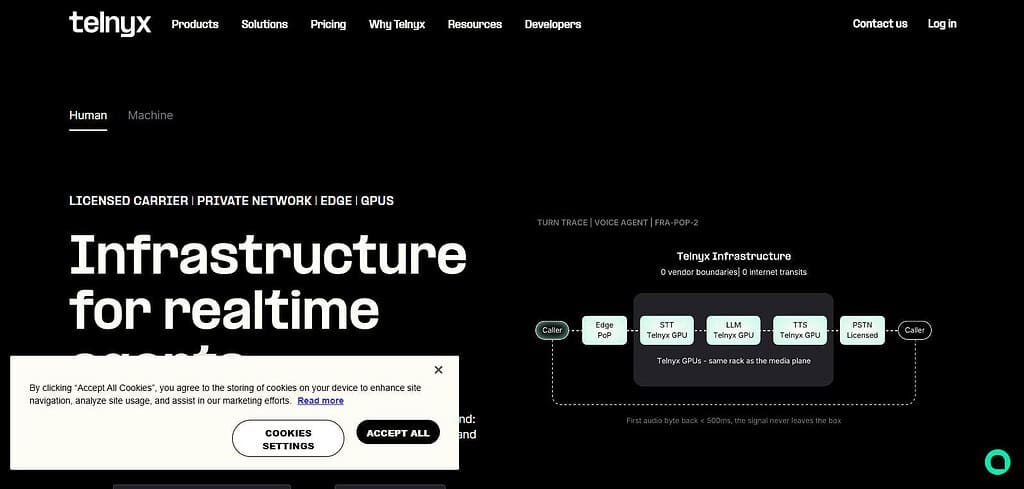
Its focus as a telephony backbone means that it provides solutions with low price points and is highly programmable. These factors combined make it an excellent price-competitive solution with Twilio.
Additionally, Telnyx has a number of integrations that allow for AI orchestration through Vapi, Retell, and direct pipelines. This makes Telnyx best suited for companies looking for affordability and reliability while providing global coverage.
Stack Unification: Programmable telephony and SIP trunking.
Infrastructure Strength: Cost and API flexibility.
Key Constraint: Modulations of Twilio’s offerings are more limited.
Ideal Scenario: Affordable overall telephony solutions.
Telnyx Pros & Cons
| Pros | Cons |
|---|---|
| Cost-efficient telephony | Smaller ecosystem than Twilio |
| Programmable APIs | Focused only on telephony |
| Competitive per-minute pricing | No STT/TTS |
| Latency ~400ms | Requires orchestration for AI |
| Flexible deployment | Limited compliance certifications |
| Seamless integration with Vapi/Retell | Less enterprise adoption |
| Budget-friendly for startups | Not ideal for regulated industries |
| Reliable routing | Less analytics |
| Strong developer community | Limited governance features |
10. PolyAI
PolyAI has an enterprise ready voice AI platform with full stack orchestration for governance and compliance. Their voice stack includes STT, LLM and TTS. The technology balances speed and reliability by averaging ~500ms. Enterprise focused deployments include managed hosting and compliance certifications.
Governance and compliance means that their product ensures that companies comply with regulations. Enterprise level custom pricing is utilized. PolyAI integrates CRMs, telephony providers and Vapi. PolyAI offers voice AI products in regulated industries and to large enterprises that need governance, monitoring, and compliance. The voice AI products are trusted in healthcare, finance and government.
Stack Unification: Full-stack orchestration and governance.
Infrastructure Strength: Enterprise compliance, monitoring, and scalability.
Key Constraint: Enterprise-level pricing.
Ideal Scenario: Large enterprises within regulated industries.
PolyAI Pros & Cons
| Pros | Cons |
|---|---|
| Full-stack orchestration | Higher enterprise-tier pricing |
| Governance and compliance features | Latency ~500ms |
| Enterprise-ready deployment | Less suited for startups |
| Managed hosting | Limited flexibility compared to Vapi |
| Strong monitoring tools | Focused mainly on compliance |
| Ideal for regulated industries | Not optimized for gaming/interactive |
| Seamless CRM integrations | Requires enterprise contracts |
| Reliable scalability | Less cost-efficient |
| Trusted by healthcare/finance | Limited modularity |
Conclusion
Finally, in 2026 what differentiates voice infrastructure is a balance between latency, scalability, and enterprise readiness. For now, Vapi and Retell AI take a lead in orchestration and modular-flex and telephony integration, while Deepgram Nova-3 and AssemblyAI Universal-3 Pro own transcendence accuracy and analytics.
For natural voice, ElevenLabs leads and as for ultra-low latency, Cartesia Sonic 3.5 does it best. For end-to-end deployment of voice AI, Openai Realtime API does it best. In addition, for governance and compliance within voice AI, PolyAI owns it. Lastly, Twilio and Telnyx own the telephony backbone. Therefore, they all own the next-gen voice AI infrastructure.
FAQ
What is AI voice infrastructure?
AI voice infrastructure refers to the platforms and APIs that power speech-to-text (STT), text-to-speech (TTS), orchestration, and telephony integration for real-time voice agents.
Which platform offers the lowest latency?
Cartesia Sonic 3.5 achieves sub-100ms latency, making it the fastest option for real-time conversational agents.
Which platform is best for orchestration?
Vapi and Retell AI lead orchestration, offering modular STT/LLM/TTS pipelines with built-in telephony support.
Which platform is best for transcription accuracy?
Deepgram Nova-3 and AssemblyAI Universal-3 Pro dominate transcription with high accuracy and advanced analytics.
Which platform provides the most natural voices?
ElevenLabs is the leader in ultra-realistic TTS, offering voice cloning and multilingual support.