

In this article, I will examine the leading AI Data Governance Platforms. These platforms empower companies to use AI to manage, protect, and refine their data.
Many of these platforms help to fine tune data, automate governance functions, improve compliance, and enhance visibility in complex data contexts. I will identify the core features, advantages, and abilities of these platforms for helping modern companies with data management in the year 2026.
What is AI Data Governance Platforms?
AI Data Governance Platforms are a modern approach to data management. These platforms are especially good at using their data systems to find, organize, sort, and protect data. They also help to monitor data and even analyze data governance and assist with management.
These platforms can monitor the quality of data, identify its lineage, and help with compliance. They also have features to protect the privacy of data.
These platforms lessen the amount of governance data employees have to do. They also help make data more accurate. From 2023 to 2026, these types of platforms will help businesses to create environments where data governance is prioritized and enforced.
Why Use AI Data Governance Platforms
Augmented Data Accuracy: With error detection, duplicate elimination, and incomplete record identification, AI Data Governance Platforms can detect inconsistencies within datasets. Organizations are able to maintain high data quality with the aid of these solutions, which, in turn, helps analytics, reporting, and the performance of AI models.
Facilitated Data Discovery and Governance Automation: Through AI algorithms, the discovery of data assets, information classification, and detection of sensitive data (personal, financial, confidential, etc.) is automated. This helps lower the manual governance burden.
Improved Data Security and Privacy: AI governance solutions construct and sustain access controls, data protection policies, and privacy monitoring and compliance management tools in defense of critical business information from unauthorized use.
Simplified Compliance with Data Protection Regulations: These platforms help organizations comply with data protection regulations and industry standards with their governance automation solutions that aid in maintaining data usage transparency, managing policies, and constructing and sustaining audit trails.
Improved Data Lineage: With AI Data Governance Platforms, the origin of data, where the data exists in movement across systems, and the changes it has undergone is documented. This elucidates data and inter-data dependency.
Augmented Responsible AI: AI systems can be managed to mitigate the effects of unreliable and insecure data. These solutions help organizations mitigate bias, improve model reliability, and grace the systems with ethics.
Improved Efficiency: Automation removes the manual burden of data governance activities (monitoring, cataloging, compliance checks, etc.) and enables data teams to focus on more fulfilling activities.
Foster Enhanced Business Decisions: AI governance platforms assist organizations in gaining insights, optimizing predictions, and expediting decisions with data by facilitating the generation of such data at a higher accuracy by ensuring that the data generated is both trustworthy and easily accessible.
Oversee Governace Across Multi-Cloud & Hybrid Data Platforms: The latest AI governance platforms enable sophisticated centralized governance across complex multi-cloud platforms, hybrid data governance, and on-premises data governance.
Help Enterprises Evolve with the Subsequent Growth of AI: The integration and development of both generative AI and machine learning require that organizations have the appropriate governance structures surrounding the frameworks of such data. AI Data Governance Platforms fulfill such structures.
Key Points
| AI Data Governance Platform | Key Points |
|---|---|
| Informatica CLAIRE AI | AI-powered data governance platform that uses machine learning to automate data discovery, classification, quality monitoring, metadata management, and data lineage tracking. It helps enterprises create trusted data ecosystems for analytics, cloud migration, and AI applications. |
| Talend Data Fabric | Unified data governance solution that combines data quality, integration, cataloging, and compliance management. It enables organizations to monitor data accuracy, manage metadata, improve transparency, and maintain regulatory compliance across hybrid and multi-cloud environments. |
| Alation Data Governance | AI-enhanced data intelligence platform focused on data cataloging, collaboration, stewardship, and governance workflows. It helps businesses discover trusted data sources, improve data literacy, and support responsible data usage across teams. |
| Collibra Data Intelligence | Enterprise data governance platform that provides data cataloging, lineage, privacy management, and governance automation. It helps organizations build a centralized data intelligence layer for compliance, AI readiness, and better decision-making. |
| SAP Data Intelligence | Data governance and orchestration platform designed for managing enterprise data across SAP and non-SAP systems. It supports data integration, metadata management, data quality improvement, and AI-driven data workflows. |
| Microsoft Purview | Cloud-based data governance platform that provides automated data discovery, classification, lineage, compliance monitoring, and risk management. It helps enterprises govern data across Microsoft services, databases, SaaS applications, and multi-cloud environments. |
| Oracle Enterprise Data Governance | Oracle’s governance solutions provide metadata management, data quality controls, security policies, and compliance capabilities. It helps large organizations manage enterprise data assets and improve trust in business intelligence and AI initiatives. |
| Google Cloud Dataplex | Intelligent data governance and management platform for Google Cloud that organizes distributed data across data lakes, warehouses, and analytics systems. It provides automated discovery, metadata management, quality checks, and policy enforcement. |
| AWS Glue Data Catalog | Serverless data catalog service from AWS that automatically discovers, stores, and manages metadata for data assets. It supports data governance by enabling searchable data discovery, schema management, and integration with analytics services. |
| Databricks Unity Catalog | Unified governance solution for data and AI assets that provides centralized access control, data lineage, auditing, and security management. It helps organizations safely manage data, machine learning models, and AI workloads at scale. |
1. Informatica CLAIRE AI
The Informatica CLAIRE AI system, as a top-rated option in AI Data Governance Platforms, leverages machine learning to augment a user’s ability to manage data through its discovery, lineage, classification, monitoring, and metadata functions.
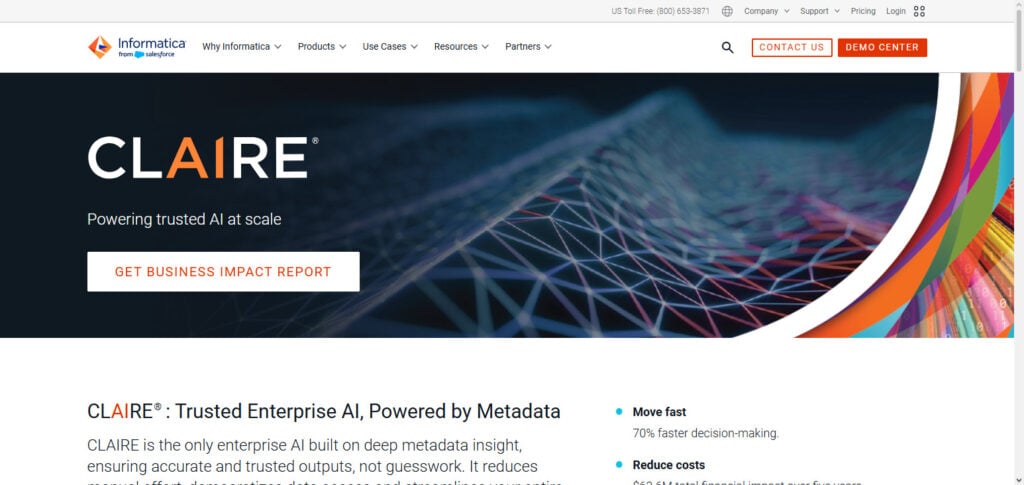
This system has governance capabilities to help enterprises build protected environments for analytic and AI systems, as well as assist in the identification and understanding of critical and sensitive data.
Furthermore, this governance system has the capability to operate in hybrid, multiple cloud, and on-premises environments, which can help enterprises comply to regulations concerning the use of data to enhance its quality and facilitate the use of enterprise data for the development of AI systems.
Features
- AI-driven metadata and data classification automation.
- ML-based data quality assessment and suggestions.
- Automatic data lineage mapping and tracking.
- Works on hybrid, multi-cloud, and on-prem data.
- Offers data privacy and protection assistance.
Pros
- Advanced AI automation boosts enterprise data governance.
- Adequate visibility for complex data structures.
- Increased trust for analytics data.
- Enterprise ready.
- Supports numerous databases and cloud solutions.
Cons
- High cost for small enterprises.
- Needs technical knowledge for setup.
- Complexity increases time to learn.
- High configurability for advanced features.
- Not suitable for enterprises with basic data requirements.
2. Talend Data Fabric
Talend’s Data Fabric system consolidates the ability to integrate, govern, and manage quality data within a single system. This system incorporates a cataloging feature and a unique ability to leverage AI for the automation of data health monitoring, profiling, metadata management, and compliance tasks.
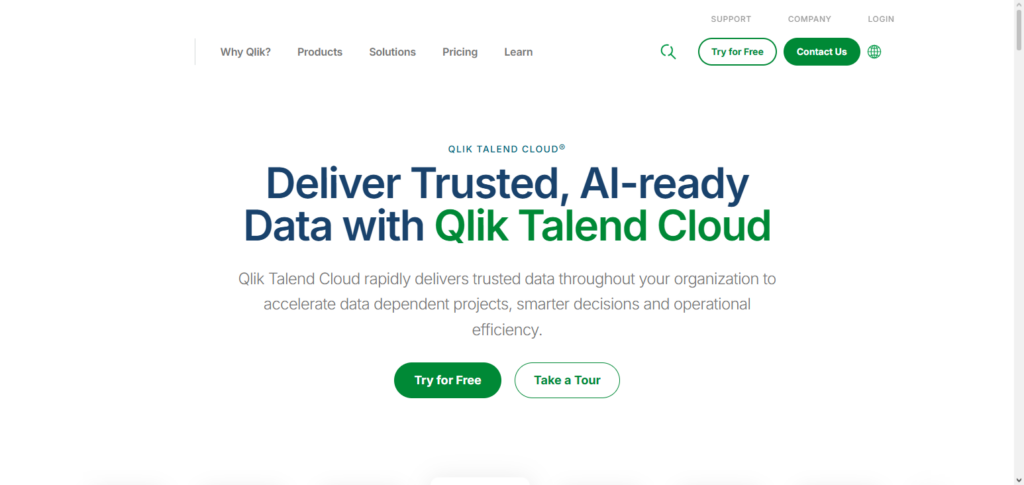
As a result, this system can be deployed to any environment and help enterprises build high quality, secure, and agile data pipelines for sound decision-making. This system is also one of the top-rated options in AI Data Governance Platforms, as it assists its users in the management of high quality data automated for the analytic and AI systems.
Features
- Data integration, quality, and governance bundled.
- Automated data profiling and monitoring.
- Supports management of metadata and data catalogs.
- Supports data governance and compliance workflows.
- Cloud, hybrid, and on-prem infrastructure support.
Pros
- Excellent data quality management.
- Intuitive for data teams.
- Supports many data inputs and integrations.
- Lowers effort to manage data.
- Flexible in how it can be deployed.
Cons
- Advanced governance can be complicated.
- Large data structures can be difficult to manage.
- Many automation features need custom work.
- Depends on how infrastructure is set up.
- High cost to license for enterprises.
3. Alation Data Governance
The Alation Data Governance platform enhances data discovery, stewardship, and collaboration, as well as data literacy within an organization.
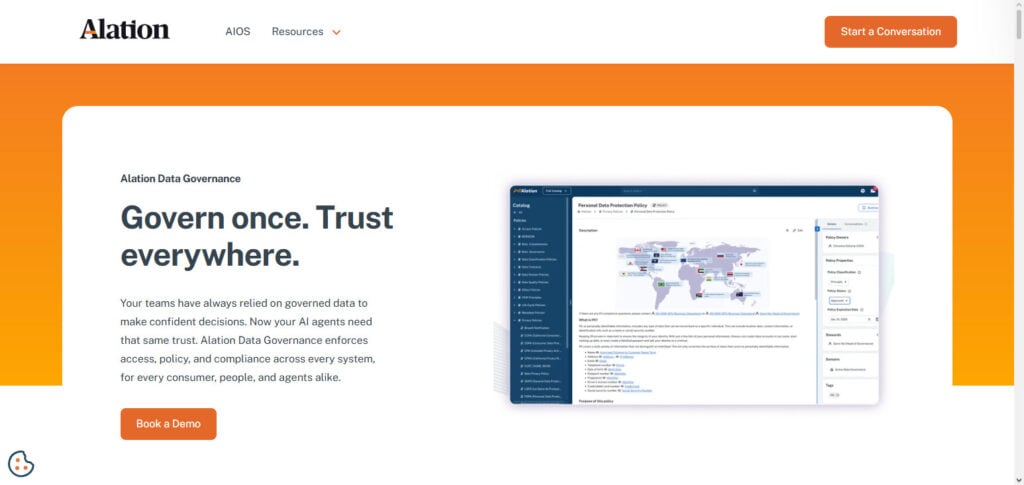
Alation has made the list of Best AI Data Governance Platforms due to its application of AI and ML to systemize metadata, suggest pertinent data sets, and provide users with the means to locate verified data faster. Data catalogs, governance workflows, policy mgmt., and data quality insights are part of Alation’s offering, and they all assist in the responsible use of data.
Alation’s goal is to connect business units with data engineers and analysts in order to build a data-centric culture. It allows organizations to maximize the potential of their data, all while improving compliance and mitigation of data-related issues.
Features
- Enterprise data catalog powered by AI.
- Automated metadata and data management.
- Data governance and stewardship management.
- Collaboration tools for data governance.
- Data literacy tools.
Pros
- Great for data cataloging.
- Enhances collaboration between business and IT.
- Data set searching and discovery is straightforward.
- Data adoption is enhanced across business units.
- Data governance is supported.
Cons
- Smaller companies may find costs prohibitive.
- Governance planning is a must.
- Advanced data processing is lacking.
- Significant data prep is needed for setup.
- Full governance may require other tools.
4. Collibra Data Intelligence
Collibra Data Intelligence provides a sophisticated, enterprise-level governance framework to facilitate the centralization of control over organizational data assets. Acknowledged as one of the Best AI Data Governance Platforms,
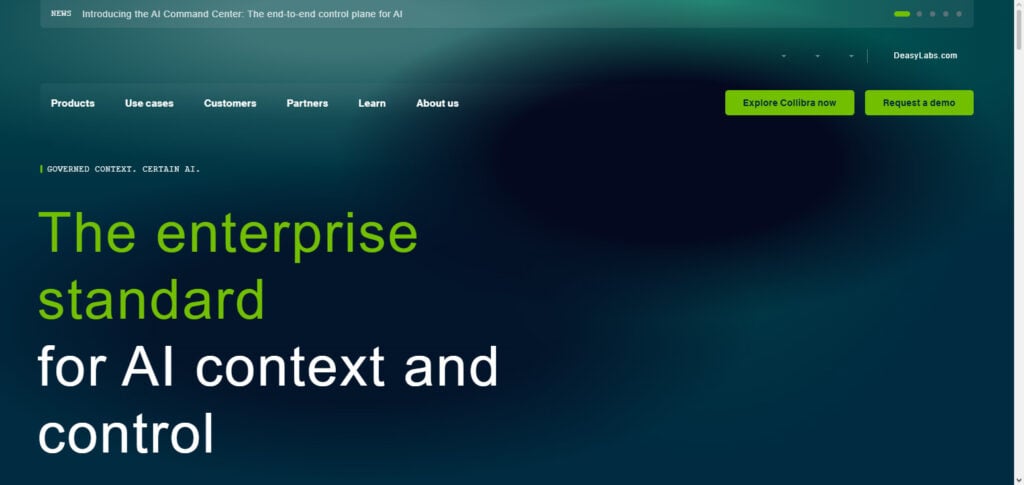
Collibra assists companies in the management of data catalogs, business glossaries, data lineage, privacy, and governance workflow automation. Collibra’s intelligent automation enhances metadata management and assists organizations to understand the origin, use, and access of data.
Collibra fulfills regulatory compliance of data privacy and enhances the collaboration of technical and business staff. The platform empowers organizations to develop dependable data environments for analytics and reporting, as well as for the stimulation of AI innovations and enterprise creativity.
Features
- Data catalog and governance in one place.
- Data lineage and business glossary.
- Privacy and compliance governance.
- Governance workflows are automated.
- Data collaboration across the enterprise.
Pros
- Excellent enterprise governance.
- Compliance and governance is supported.
- Data assets are transparent.
- Global enterprises are supported.
- Workflows are automated.
Cons
- Pricing is above basic tools.
- Time investment for implementation.
- Governance teams are a must.
- May be too complex for some.
- Customization is beyond basic.
5. SAP Data Intelligence
SAP Data Intelligence builds enterprise data management and governance by linking and managing data from various sources. As one of the Best AI Data Governance Platforms, its features include metadata management and data integration, data pipeline automation, and data quality monitoring.
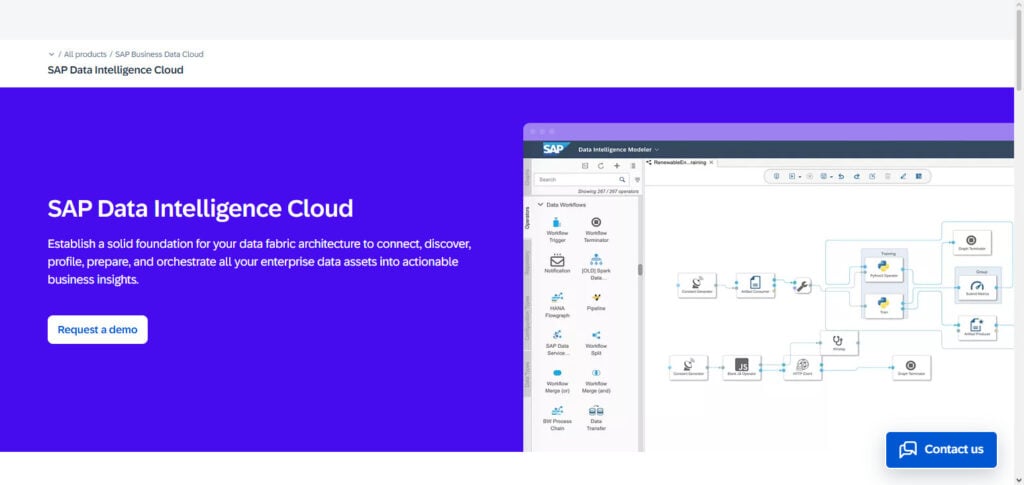
It helps firms consolidate data from SAP and non-SAP business systems. With its data governance and analytics readiness, it helps AI and ML initiatives. For large enterprises, SAP Data Intelligence builds operational efficiency, validates data for digital transformation, and strengthens regulatory compliance.
Features
- Integration and governance of enterprise data.
- Data management and pipeline governance.
- Governance of data quality.
- Data sources of both SAP and non-SAP.
- Facilitates AI and ML workflows.
Pros
- Excellent integration with SAP systems.
- Designed with large enterprises in mind.
- Enhances efficiency of data management.
- Supports sophisticated business processes.
- Provides flexible governance.
Cons
- Limited to SAP-centered companies.
- Managing system requires SAP knowledge.
- Complex to implement.
- Greater total cost of ownership.
- Difficult to learn with substantial upskilling.
6. Microsoft Purview
Microsoft Purview is a data governance and compliance solution available on the cloud and built for managing enterprise data in a protective and organized manner. As one of the Best AI Data Governance Platforms, it uses automation and intelligence for data discovery and classification, sensitive data detection, and data governance and protection lineage tracking.

It is built for Microsoft services and supports other cloud services, platforms, and applications. Purview provides security, compliance, and protection of enterprise data, along with clarity and transparency for governance. It helps firms create a trusted data environment for the safe practice of AI.
Features
- Automated discovery and classification of data.
- Offers data lineage and governance controls.
- Supports Microsoft and multi-cloud.
- Compliant with governance and privacy.
- Utilizes AI to reveal sensitive data.
Pros
- Integrates well with Microsoft.
- Fast and easy connection to cloud data.
- Solid compliance and security.
- Enterprise-scale.
- AI automation in classification.
Cons
- Best used in Microsoft environments.
- Complex configurations with cost increase.
- Mastery of Azure needed for optimal usage.
- Some third-party integrations require setup.
7. Oracle Enterprise Data Governance
With Oracle Enterprise Data Governance solutions, organizations can control and protect important business data in the middle of complicated IT systems.
As one of the Best AI Data Governance Platforms, Oracle offers metadata management, data quality, control access, compliance, and data stewardship. Oracle enterprise data governance solutions are ideal for enterprises that deal with financial, operational, and customer data.
Based on artificial intelligence, Oracle enterprise data governance solutions recognize trends, govern data reliability, automate the governance process, and improve data reliability. The security and compliance of data empower organizations to confidently build the foundation for data in analytics, cloud-based, and AI solutions.
Features
- Enterprise governance over metadata and data.
- Data governance with quality and security control.
- Supports compliance and data stewardship.
- Integrates with Oracle DB environments.
Pros
- Excellent security for enterprises.
- Very dependable for large companies.
- Great integration with Oracle.
- Supports large enterprise needs.
- Stays compliant.
Cons
- Smaller organizations cannot afford it.
- Oracle knowledge needed to use it.
- Significant time to implement.
- Looking for major improvements outside of Oracle environments.
- Difficult to Manage.
8. Google Cloud Dataplex
Google Cloud Dataplex is an intelligent data management and governance tool designed for large-scale cloud data environments. As one of the Best AI Data Governance Platforms, Google Cloud Dataplex helps organizations automatically discover, organize, and manage data in data lakes, warehouses, and analytics systems.
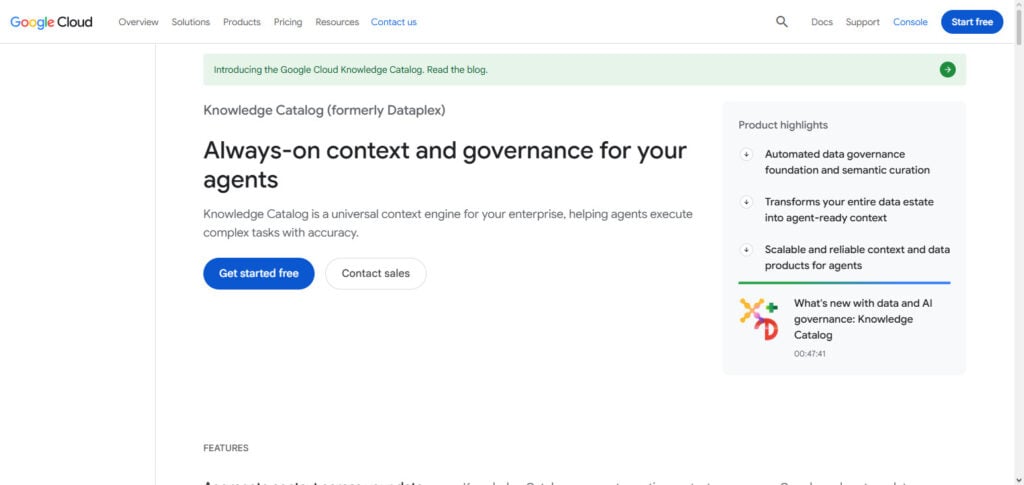
With its governance policies, Dataplex includes security and data quality control. Organizations can trust the data they govern with Dataplex, while AI and machine learning workloads can run on advanced analytics.
Features
- Intelligent Data Management Google Cloud
- Data Discovery and Organization (Automatic)
- Metadata and Governance (Controls)
- Data Quality Monitoring (Supports)
- Analytics and Data Lake (Managed)
Pros
- Data Management Google Cloud
- Scalable to Any Size
- AI Data Organization
- Data Governance Simplified
- Analytics (Modern) Supported
Cons
- Data Management Google Cloud
- Advanced Cloud Skills Required
- Scalable Costs (Increased Operational Costs)
- Difficult to Use
- Best for Google Cloud Users
9. AWS Glue Data Catalog
The Amazon Web Services Glue Data Catalog is a serverless repository of metadata that enables a business to discover, organize, and govern, their data assets in the cloud. As one of the Best AI Data Governance Platforms, the AWS Glue Data Catalog automatically gathers metadata, manages schemas, tracks data, and facilitates data discovery for analytics.
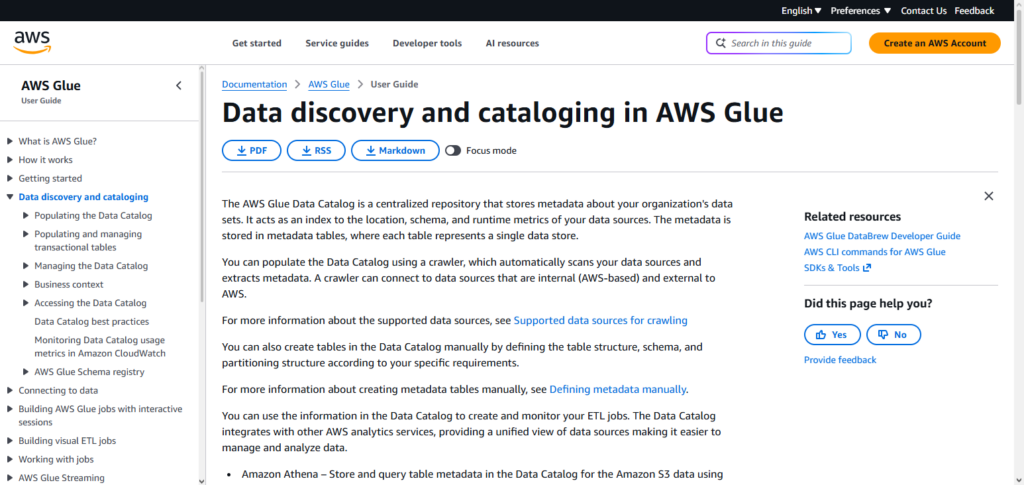
It is built to work with the AWS analytics services and helps businesses implement governance practices over large datasets. The platform enables businesses to improve the overall visibility and consistency of data, and aids the business in managing compliance.
The AWS Glue Data Catalog is built to be the foundational building block for enterprise data lakes, AI, and analytics at enterprise scale.
Features
- Metadata Repository (Data Assets/SERVERLESS) A
- Schema (Automatic) Management and Discovery
- Analytics Services (AWS) Integration
- Data Lake Governance
- Catalogs (Searchable Data)
Pros
- AWS Service (Fully Managed)
- AWS Usage Cost Efficient
- AWS Ecosystem (Simple Integration)
- Scalable (Increased Volume of Data) Automatic
- Metadata Automation (Less Manual Work)
Cons
- AWS Services Focused
- Less Governance (Compared to Enterprise Solutions)
- AWS Skills Required
- Complex Services Aided by Other Services
- Multi Cloud Governance Low Suitability
10. Databricks Unity Catalog
Databricks Unity Catalog is a data governance platform that manages a business’ data, analytics, and AI assets across the enterprise. As one of the Best AI Data Governance Platforms, Databricks Unity Catalog offers centralized access control, data lineage, audits, and governance to datasets and AI and ML models and applications.
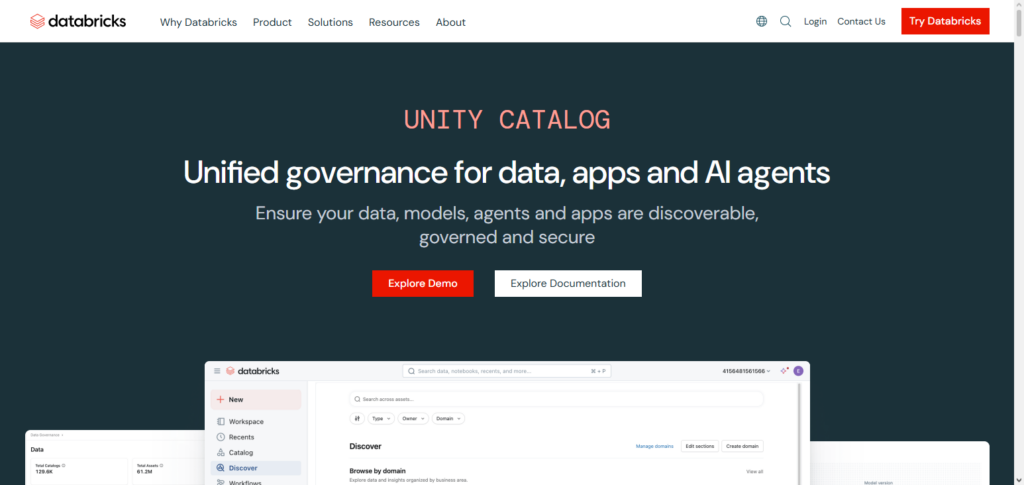
It offers businesses the ability to securely collaborate, while controlling and maintaining visibility over all their data. The platform was designed to enable cloud-scale analytics and AI. Databricks Unity Catalog is a solution for businesses looking to improve compliance and security of their data, and responsibly adopt AI.
Features
- Data and AI Assets Governance (Unified)
- Access Controls (Centralized)
- Data (Lineage) and Usage (History) Monitoring
- ML Model Governance (Assisted)
- Data Collaboration (Secure)
Pros
- Effective management for AI and analytics.
- Exceptional integration with Databricks.
- Detailed lineage tracking.
- Large-scale data operation support.
- Security and compliance enhancements.
Cons
- Optimal within Databricks.
- Requires knowledge of Databricks.
- Smaller teams may find it expensive.
- Migration needs technical planning.
- Advanced features require configuration.
Conclusion
Best AI Data Governance Platforms will likely be available to businesses that need to manage, protect and increase the value of their data in 2026’s AI-centric business ecosystem. Informatica CLAIRE AI, Collibra, Microsoft Purview, Databricks Unity Catalog, and Google Cloud Dataplex enable businesses to improve the overall quality of data, automate governance, enhance compliance, and construct dependable data ecosystems.
Artificial Intelligence and advanced analytics will shape the future of business, and of the data that the business relies on. Accurate, safe, and ethical data usage to foster innovation and improve decision-making will be enabled by effective AI data governance.
FAQ
What are AI Data Governance Platforms?
AI Data Governance Platforms are tools that use artificial intelligence to manage, secure, classify, monitor, and improve enterprise data quality, compliance, and accessibility.
Why are AI Data Governance Platforms important in 2026?
These platforms help organizations manage growing data volumes, improve AI model accuracy, maintain regulatory compliance, and ensure trusted data usage across business operations.
What are the key features of AI Data Governance Platforms?
Key features include data discovery, metadata management, data lineage tracking, automated classification, data quality monitoring, privacy protection, and access control management.
Which are the Best AI Data Governance Platforms for enterprises?
Leading platforms include Informatica CLAIRE AI, Collibra Data Intelligence, Microsoft Purview, Databricks Unity Catalog, Google Cloud Dataplex, and Alation Data Governance.
How does AI improve data governance?
AI automates data classification, detects data quality issues, identifies sensitive information, recommends governance actions, and reduces manual data management efforts.