




In this article, I will present the top AI dataset platform options for developers, data scientists, and businesses. High-quality dataset resource platforms contain essentially limitless, diverse, and valuable data resources including, but not limited to, text, images, audio, and all forms of data structures and model resources.
These data resource platform options foster the development of advanced AI models, enhance the capability and performance of AI models, and drive the deployment of intelligent AI model solutions across a range of industries.
What is AI Dataset Platforms?
AI dataset platforms offer online data management systems and repositories which provide high-quality datasets for training, testing, and improving Artificial Intelligence and Machine Learning models.
These platforms consolidate, categorize, and offer a variety of types data, such as text, images, videos, audios, and formatted data, which assist AI in acquiring data patterns and assisting AI in performing accurate forecasts and other forms of predictive analysis.
Reworking of data AI dataset platforms help significantly reduce AI development time and offer practicing datasets to reduce the time taken in data preparation.
Key Features Of AI Dataset Platforms for Machine Learning
| Key Feature | Description |
|---|---|
| High-Quality Datasets | AI Dataset Platforms provide reliable, accurate, and well-structured datasets that help machine learning models learn effectively and improve prediction accuracy. |
| Large Dataset Collection | These platforms offer extensive collections of datasets across industries such as healthcare, finance, technology, marketing, and scientific research for different AI applications. |
| Multiple Data Formats | AI Dataset Platforms support various formats, including CSV, JSON, images, audio, video, text, and tabular data, making them suitable for different machine learning projects. |
| Dataset Search & Filtering | Advanced search and filtering options allow users to quickly find relevant datasets based on categories, keywords, data types, size, and use cases. |
| Data Organization & Management | These platforms organize datasets with proper categorization, metadata, documentation, and version tracking, making it easier for users to discover, manage, and reuse data efficiently. |
| Data Annotation Tools | Many platforms provide labeling and annotation features for preparing datasets used in computer vision, natural language processing, and other AI model training tasks. |
| Dataset Version Control | Version management features help users track dataset updates, changes, and improvements while maintaining consistency during AI model development. |
| API Integration Support | AI Dataset Platforms often provide APIs that allow developers to access, download, and integrate datasets directly into machine learning workflows and applications. |
| Open-Source & Community Sharing | Many platforms enable researchers and developers to share datasets, collaborate on projects, and contribute improvements to the AI community. |
| Data Licensing & Compliance | Platforms provide licensing details and usage guidelines to help organizations understand data permissions, privacy requirements, and commercial usage restrictions. |
| Machine Learning Framework Compatibility | These platforms support popular AI frameworks such as TensorFlow, PyTorch, Scikit-learn, and Hugging Face, simplifying dataset integration into ML pipelines. |
| Cloud-Based Accessibility | Cloud-based dataset platforms allow users to access, store, and process large datasets without requiring extensive local storage or infrastructure. |
Best AI Dataset Platforms List
- Kaggle
- Google Dataset Search
- Microsoft Azure Open Datasets
- Hugging Face Datasets
- OpenML
- Data.gov
- Zenodo
- Figshare
- Dataverse (Harvard)
- Roboflow
10 Best AI Dataset Platforms for Machine Learning in 2026
1. Kaggle
Kaggle is a leading AI dataset hosting platform for ML developers, data scientists, researchers, and individuals interested in Artificial Intelligence.
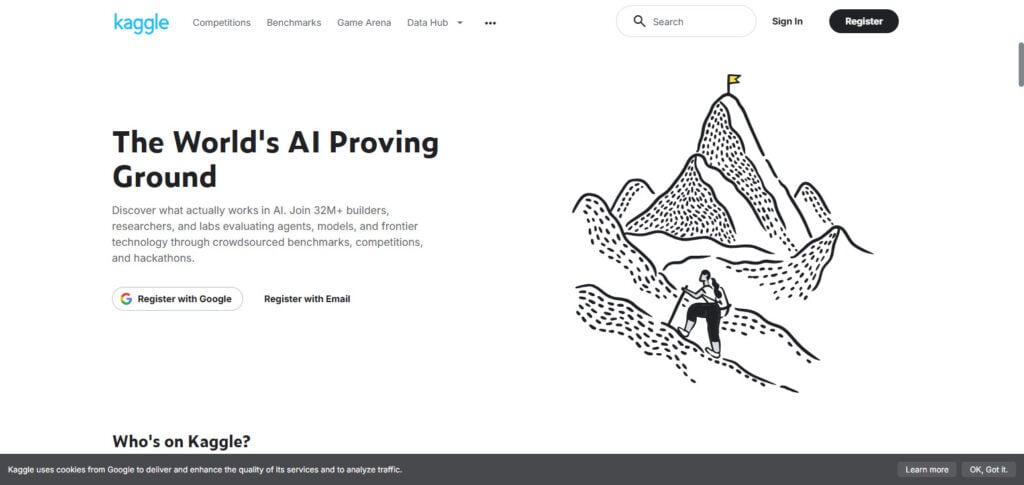
It has thousands of free datasets across various domains and industries including finance, healthcare, natural languages, social sciences, etc. The Kaggle datasets cover structured data, images, text files, audio datasets, as well as real-world business data that assist users in training and testing AI models.
The platform provides contests, notebooks, and a community channels where users can improve their machine learning skills. With Kaggle, users can easily explore and integrate datasets, versions, and datasets, as well as integrate them directly with some Python tools. Kaggle is widely utilized for AI experimentation and model generation.
Kaggle Characteristics, Pros & Cons
| Category | Details |
|---|---|
| Characteristics | • Kaggle is one of the most widely used AI dataset platforms for machine learning and data science communities. • Provides thousands of datasets covering healthcare, finance, marketing, NLP, computer vision, and predictive analytics. • Supports multiple data formats, including CSV, JSON, images, text, and audio. • Offers Kaggle Notebooks, competitions, and community discussions for AI experimentation. • Allows users to upload, share, analyze, and collaborate on datasets. |
| Pros | • Large collection of free AI and ML datasets. • Strong global data science community. • Provides ready-to-use datasets for beginners and professionals. • Integrated notebook environment for model testing. • Easy dataset search, download, and exploration. |
| Cons | • Dataset quality depends on individual contributors. • Some datasets may have limited documentation. • Licensing information must be checked before commercial use. • Duplicate or outdated datasets may exist. • Less focus on enterprise-level data governance. |
2. Google Dataset Search
Google Dataset Search is a multi-source dataset discovery platform that helps AI researchers and developers identify datasets available on the internet. As one of the Best AI Dataset Platforms, it does not host datasets directly, however, it indexes publicly-available datasets from multiple sources.
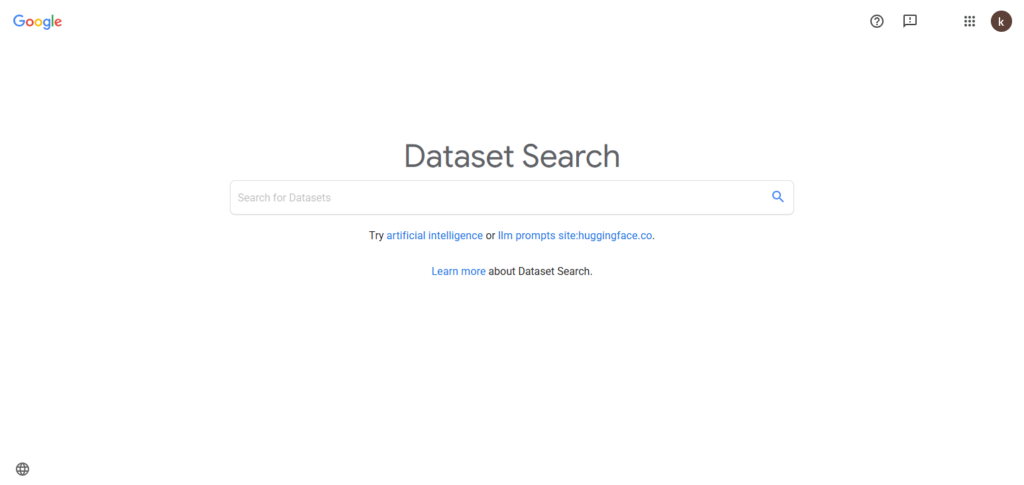
Users can search for datasets by various criteria including topic, format, location, and last update time to make it easier to find relevant data for training AI models.
Google Dataset Search supports a variety of fields, including health, finance, climate science, economics, and many more. With Google Dataset Search, users are able to easily access all types of datasets that are required and relevant for building AI models that will be accurate.
Google Dataset Search Characteristics, Pros & Cons
| Category | Details |
|---|---|
| Characteristics | • Google Dataset Search is a dataset discovery engine that helps users find datasets from different online sources. • It indexes datasets from research institutions, government organizations, universities, and companies. • Supports searching by keywords, topics, location, and data formats. • Covers datasets related to science, business, healthcare, environment, and technology. • Helps researchers quickly discover publicly available datasets. |
| Pros | • Provides access to millions of datasets from multiple sources. • Simple search interface similar to Google Search. • Helps find datasets from trusted organizations. • Covers multiple industries and research areas. • Saves time during dataset discovery. |
| Cons | • Does not store datasets directly. • Dataset availability depends on external websites. • Quality varies between different sources. • Limited dataset management features. • Users must verify licenses and data accuracy. |
3. Microsoft Azure Open Datasets
Microsoft Azure Open Datasets is a browser-based service for data management and integration for artificial intelligence (AI) and machine learning (ML) projects. Having one of the Best AI Dataset Platforms, it publishes ready-made datasets for direct use or integration with Azure ML and cloud services.
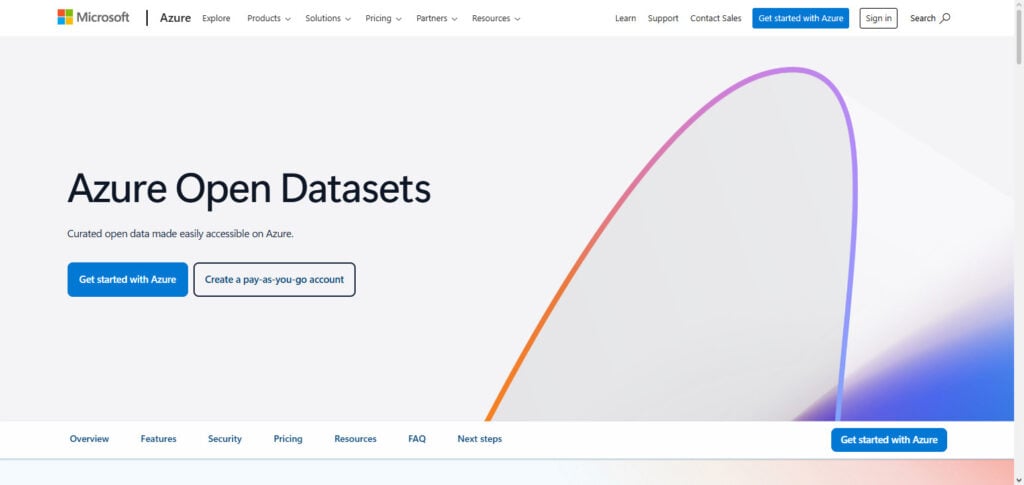
The platform contains data related to various areas such as weather, transportation, healthcare, population, economics and research on the environment. Developers can access clean and organized data sets without wasting time gathering and organizing the data themselves.
Azure Open Datasets helps organizations shorten the time required to implement AI by providing professionals with outstanding data resources that enhance the training of models and the automation of related tasks.
Microsoft Azure Open Datasets Characteristics, Pros & Cons
| Category | Details |
|---|---|
| Characteristics | • Microsoft Azure Open Datasets provides curated datasets designed for AI and machine learning workflows. • Integrates with Azure Machine Learning and cloud-based AI services. • Includes datasets related to weather, healthcare, transportation, economics, and population data. • Helps developers reduce time spent collecting and cleaning data. • Designed for scalable enterprise AI development. |
| Pros | • High-quality curated datasets. • Direct integration with Microsoft Azure AI tools. • Suitable for enterprise machine learning projects. • Supports large-scale data processing. • Reduces data preparation workload. |
| Cons | • Best suited for Azure users. • Cloud usage may increase costs. • Requires knowledge of Microsoft Azure services. • Smaller dataset variety compared with open platforms. • Limited community-driven datasets. |
4. Hugging Face Datasets
Hugging Face Datasets is a leading service for AI and natural language processing (NLP) datasets. Being one of the Best AI Dataset Platforms, it provides thousands of ready-to-use datasets for the training of large language models, computer vision systems, speech recognition models, and other AI applications. The platform enables text, image, audio, and multimodal datasets.
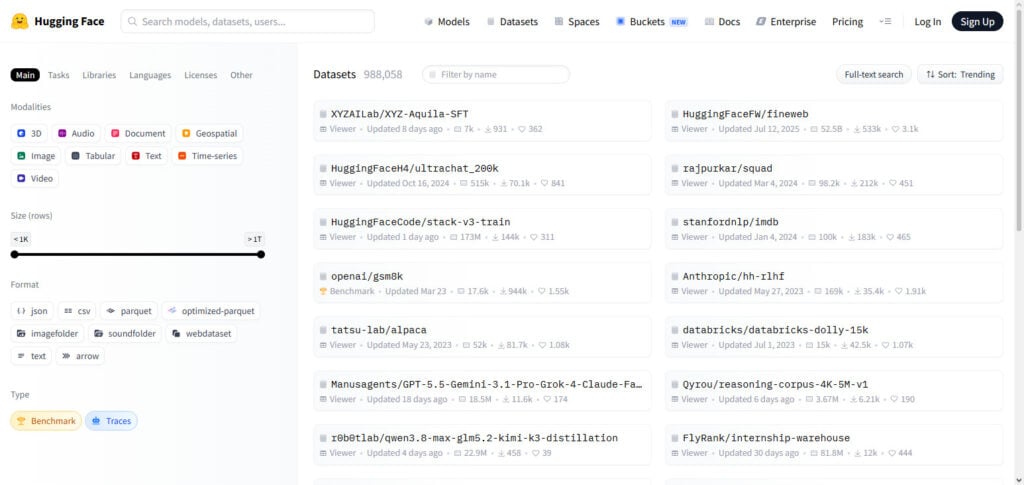
The datasets can be easily integrated into cloud-based compute services. Within Hugging Face, researchers and developers have the opportunity to publish, edit, and collaborate on datasets throughout the AI community. Because of its compatibility with transformer models and ML libraries, Hugging Face is the preferred platform for AI research and developing generative AI.
Hugging Face Datasets Characteristics, Pros & Cons
| Category | Details |
|---|---|
| Characteristics | • Hugging Face Datasets is a leading AI dataset platform for NLP, large language models, and generative AI applications. • Provides thousands of text, image, audio, and multimodal datasets. • Supports integration with Transformers, PyTorch, TensorFlow, and other AI frameworks. • Enables dataset sharing, versioning, and collaboration. • Widely used for training and evaluating modern AI models. |
| Pros | • Excellent resource for LLM and NLP projects. • Large open-source AI dataset library. • Easy integration with machine learning frameworks. • Strong developer and research community. • Supports advanced AI experimentation. |
| Cons | • Some datasets require high computing resources. • Dataset quality depends on contributors. • Large datasets require significant storage. • Licensing requirements vary by dataset. • May be complex for beginners. |
5. OpenML
OpenML is an open-source AI dataset platform for sharing datasets, machine learning experiments, and research workflows. We name one of the Best AI Dataset Platforms, it offers the collaborative environment among data scientists to perform (i) searching datasets, (ii) comparing machine learning algorithms, and (iii) reproducing experiments.
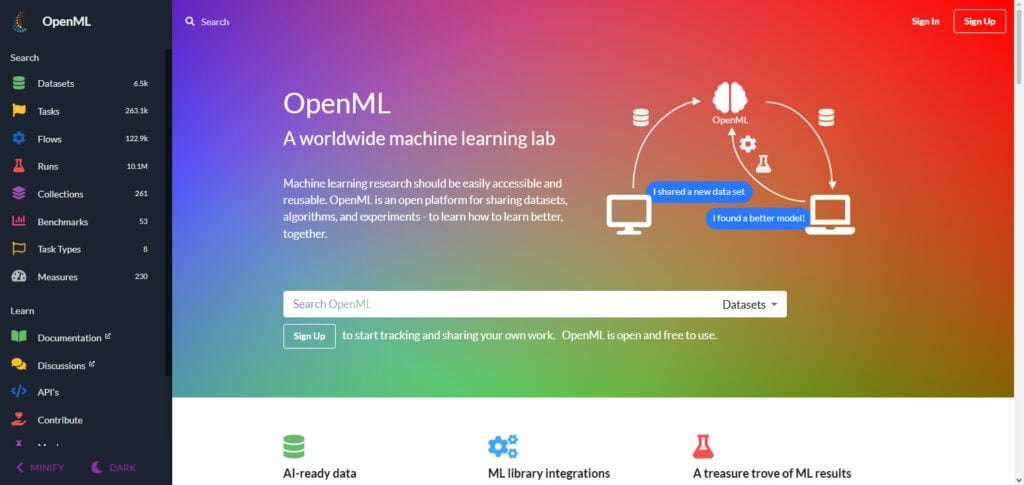
OpenML provides thousands of datasets, which cover a variety of topics, including classification, regression, image recognition, bioinformatics, and so on.
The platform supports popular programming languages and machine learning frameworks, which facilitate dataset access for researchers and developers. OpenML concentrates on transparency, collaboration, and reproducibility. Hence, the AI community can build more reliable models with the help of shared data and research knowledge.
OpenML Characteristics, Pros & Cons
| Category | Details |
|---|---|
| Characteristics | • OpenML is an open-source platform focused on machine learning datasets and experiments. • Provides datasets for classification, regression, clustering, and predictive modeling. • Enables researchers to share experiments and compare algorithms. • Supports automated machine learning workflows. • Integrates with popular ML libraries such as Scikit-learn. |
| Pros | • Supports reproducible machine learning research. • Provides structured datasets for experiments. • Encourages collaboration among researchers. • Useful for algorithm benchmarking. • Supports open-source AI development. |
| Cons | • Smaller dataset collection compared with Kaggle. • Mainly designed for researchers and developers. • Interface may be difficult for beginners. • Limited commercial AI features. • Requires technical knowledge to use effectively. |
6. Data.gov
Data.gov is the official open data platform of the United States government that offers access to thousands of public datasets. One of the Best AI Dataset Platforms, such an extensive dataset helps organizations to develop their own AI applications to contribute to numerous sectors of the economy including healthcare, agriculture, education, finance, climate, transportation, public policy, and many more.
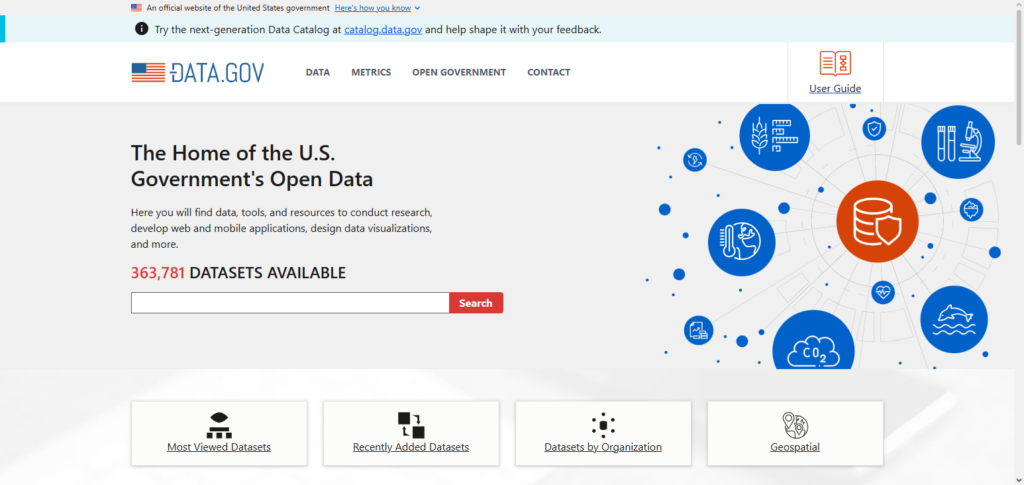
Researchers and organizations can use these extensive datasets to train their machine learning models, discover hidden relationships and trends, and create innovative data-driven solutions.
The Information offers datasets with various formats and a variety of government agencies from CSV to JSON to APIs. Data.gov focuses on improving government data accessibility, so developers can effectively build AI applications based on reliable government information.
Data.gov Characteristics, Pros & Cons
| Category | Details |
|---|---|
| Characteristics | • Data.gov is the official open government data platform of the United States. • Provides thousands of datasets from federal agencies. • Covers healthcare, education, climate, transportation, finance, and public services. • Offers datasets in formats such as CSV, JSON, and APIs. • Supports research, analytics, and AI model development. |
| Pros | • Provides reliable government datasets. • Free access to public information. • Covers many real-world datasets. • Useful for research and predictive analytics. • Supports open data innovation. |
| Cons | • Mainly focuses on US-related datasets. • Dataset quality varies between agencies. • Some datasets may not be frequently updated. • Requires data cleaning before AI usage. • Limited AI-specific dataset collections. |
7. Zenodo
Zenodo is a research data repository developed to support open science and academic collaboration. It is considered one of the Best AI Dataset Platforms because it provides access to millions of research datasets, scientific publications, software packages, and experimental resources.
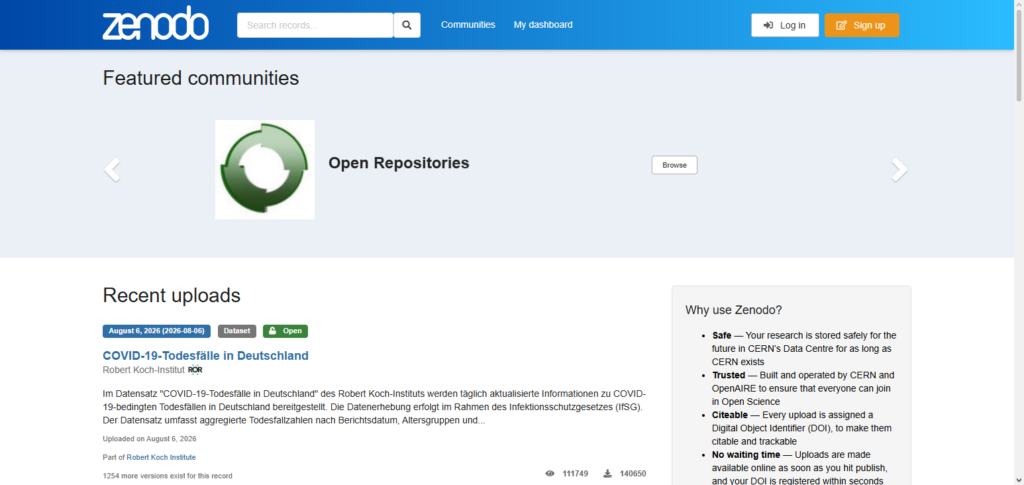
Researchers, universities, and organizations use Zenodo to publish and share datasets across multiple disciplines including artificial intelligence, medicine, physics, environmental science, and social studies.
The platform provides persistent identifiers such as DOI links, ensuring datasets can be easily cited and accessed. Zenodo helps AI researchers discover reliable research data for model training, validation, and academic machine learning projects.
Zenodo Characteristics, Pros & Cons
| Category | Details |
|---|---|
| Characteristics | • Zenodo is an open research repository for datasets, publications, software, and scientific resources. • Supports academic AI and machine learning research projects. • Provides datasets from universities and research organizations worldwide. • Uses DOI identifiers for permanent dataset references. • Supports open science and research collaboration. |
| Pros | • Reliable source for academic datasets. • Provides permanent citation through DOI. • Supports multiple research disciplines. • Free access to many datasets. • Encourages transparent research practices. |
| Cons | • Not specifically designed for AI developers. • Dataset quality depends on researchers. • Limited AI-specific tools. • Search functionality can be improved. • Some datasets require academic knowledge. |
8. Figshare
Figshare is an online research data publishing and sharing platform. It enables research workers to publish, share, and preserve datasets, documents, images, videos, and other research objects.

As one of the Best AI Dataset Platforms, Figshare offers many valuable resources to AI researchers working in various fields and disciplines including computer vision, health analytics and bio-technologies, physical sciences, engineering, environmental and social sciences.
The platform provides open access publishing which allows users to discover and re-use research data for academic machine learning. Figshare also offers secure storage, dataset tracking, and citation features to help researchers maintain visibility of their data. Its focus on research collaboration makes it ideal for developing AI models based on verified academic datasets.
Figshare Characteristics, Pros & Cons
| Category | Details |
|---|---|
| Characteristics | • Figshare is a research data-sharing platform for publishing and managing datasets. • Supports documents, images, videos, scientific data, and research materials. • Allows researchers to share datasets publicly. • Provides metadata, tracking, and citation features. • Used across science, healthcare, and technology research. |
| Pros | • Easy dataset publishing process. • Supports many file formats. • Provides citation and visibility options. • Useful for academic AI research. • Promotes open data sharing. |
| Cons | • Not focused specifically on machine learning. • Limited AI development tools. • Dataset quality varies. • May require manual preprocessing. • Smaller AI community compared with Kaggle or Hugging Face. |
9. Dataverse (Harvard)
Harvard Dataverse is an open access research data repository that allows researchers to publish, archive, share, and manage research data across different academic domains. Recognized among the Best AI Dataset Platforms, Harvard Dataverse provides high quality research data that can be used in various machine learning, statistical analysis, and AI experiments.
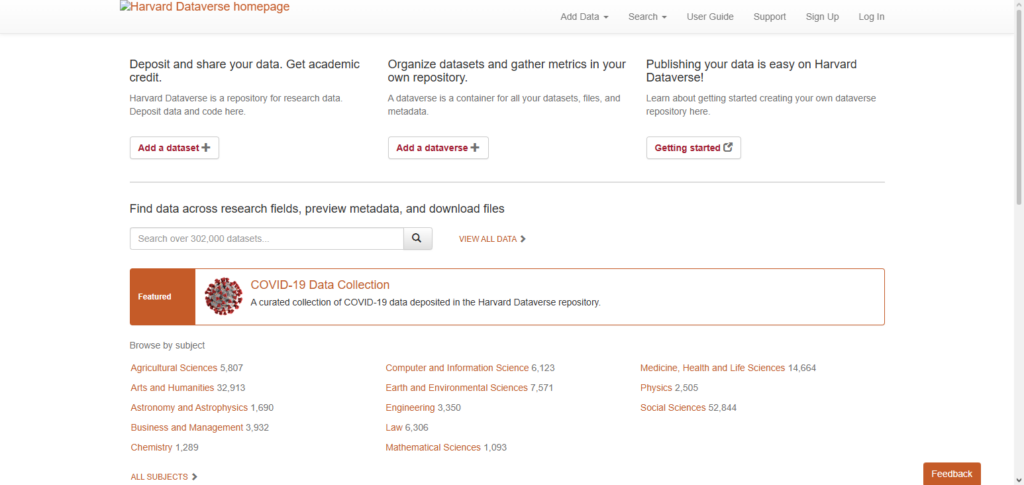
The platform hosts research data in the fields of social science, health & medicine, economics & finance, environmental studies & sciences, and scientific research.
Harvard Dataverse helps users publish research data with full metadata, data descriptions & licenses, supporting documentation, and annotations. Its strong focus on data transparency and reproducibility enables AI developers to access reliable datasets to build and train their AI models and to conduct advanced research..
Dataverse (Harvard) Characteristics, Pros & Cons
| Category | Details |
|---|---|
| Characteristics | • Harvard Dataverse is an academic data repository for storing and sharing research datasets. • Provides datasets from universities and research organizations. • Supports social science, healthcare, economics, and scientific research data. • Includes metadata, documentation, and data citation features. • Focuses on transparency and reproducibility. |
| Pros | • High-quality academic datasets. • Strong documentation and metadata support. • Reliable research data source. • Supports data sharing and collaboration. • Useful for scientific AI projects. |
| Cons | • Limited datasets for commercial AI applications. • Interface may be complex for beginners. • Some datasets require permission access. • Smaller AI-focused dataset collection. • Requires research-oriented understanding. |
10. Roboflow
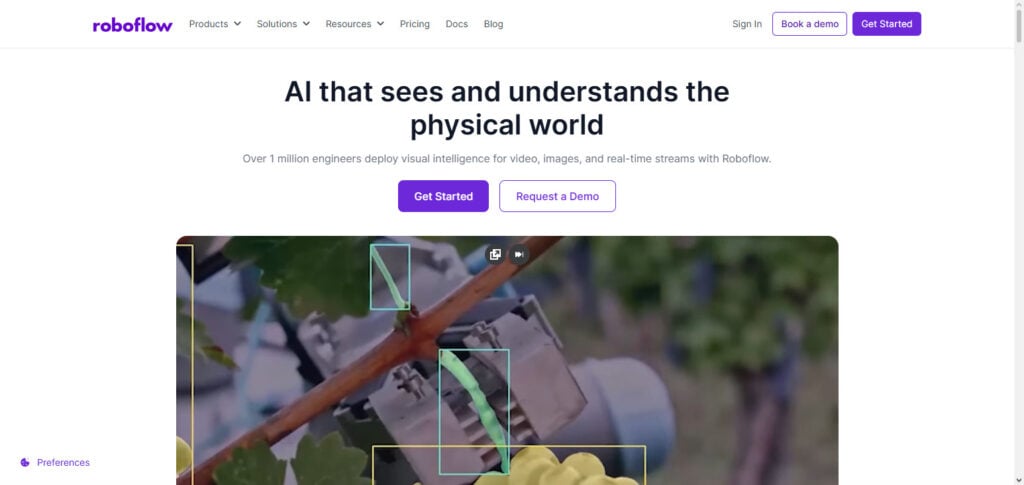
Roboflow is specialized computer vision data platform for creating, building, managing, and improving image datasets used for AI & ML models.
Recognized among the Best AI Dataset Platforms, Roboflow is data science and deep learning data annotation framework for high quality, accurate computer vision datasets that are essential for reliable, high quality AI, ML, and DL applications.
Roboflow offers datasets used in the fields of social sciences, health & medicine, economics & finance, environmental studies & sciences, and scientific research. Harvard Dataverse helps users publish research data with full metadata, data descriptions & licenses, supporting documentation, and annotations.
Its strong focus on data transparency and reproducibility enables AI developers to access reliable datasets to build and train their AI models and to conduct advanced research projects.
Roboflow Characteristics, Pros & Cons
| Category | Details |
|---|---|
| Characteristics | • Roboflow is an AI dataset platform focused on computer vision applications. • Provides tools for image collection, annotation, preprocessing, and dataset management. • Supports object detection, image classification, and segmentation projects. • Offers dataset version control and augmentation features. • Integrates with popular computer vision frameworks. |
| Pros | • Excellent platform for computer vision datasets. • Provides powerful annotation tools. • Simplifies image dataset preparation. • Supports AI model training workflows. • Allows creation of custom datasets. |
| Cons | • Mainly focused on image-based AI projects. • Advanced features may require paid plans. • Not suitable for text or tabular datasets. • Large datasets require significant storage. • Annotation workflows may require learning time. |
Conclusion
The Best AI Tool Dataset Platforms offer high-quality datasets that facilitate the development of artificial intelligence and machine learning. Kaggle, Hugging Face Datasets, Google Dataset Search, Microsoft Azure Open Datasets, OpenML, Zenodo, Figshare, Harvard Dataverse, and Roboflow are some of the examples of the best AI tool data platform.
Different requirements of applications determine the quality and accessibility of the datasets that a particular data platform has. On the other hand, to develop innovative solutions using artificial intelligence, even the best AI tool data platforms can become very supportive. Innovation in artificial intelligence is made easier through the effective use of high-quality datasets that the best AI tool data platforms provide.
FAQ
What Are AI Dataset Platforms?
AI dataset platforms are online repositories that provide access to structured and unstructured datasets used for training, testing, and improving artificial intelligence and machine learning models. These platforms offer datasets in different formats, including text, images, audio, video, and numerical data. Developers and researchers use them to build AI applications, improve model accuracy, and reduce the time required for data collection and preparation.
Why Are AI Dataset Platforms Important for Machine Learning?
AI dataset platforms are important because machine learning models require large amounts of high-quality data to learn patterns and make accurate predictions. These platforms provide ready-to-use datasets that help developers train, validate, and optimize AI models efficiently. They also improve accessibility by allowing researchers, businesses, and developers to access reliable datasets without creating data from scratch.
Which Are the Best AI Dataset Platforms in 2026?
Some of the Best AI Dataset Platforms in 2026 include Kaggle, Google Dataset Search, Microsoft Azure Open Datasets, Hugging Face Datasets, OpenML, Data.gov, Zenodo, Figshare, Harvard Dataverse, and Roboflow. Each platform offers different types of datasets suitable for machine learning, deep learning, natural language processing, computer vision, and AI research projects.
Is Kaggle the Best Platform for AI Datasets?
Kaggle is one of the most popular AI dataset platforms because it provides thousands of free datasets, machine learning notebooks, competitions, and a large data science community. It supports various AI fields, including predictive analytics, computer vision, and natural language processing. Kaggle is especially useful for beginners, researchers, and professionals looking for practical datasets.