


This article outlines best AI search infrastructure companies that lead in 2026. Each company provides a description of their key elements of search and their offerings. Information regarding deployment, pricing, and areas of emphasis for each company is analyzed in depth along with strengths and optimal use cases to help organizations and software developers decide which of these AI search infrastructures is most appropriate for their needs.
Key Points
| Company | What It Actually Provides | Core AI Search Capabilities | Best Fit |
|---|---|---|---|
| Pinecone | Managed vector database and retrieval infrastructure | Vector search, metadata filtering, semantic retrieval, RAG retrieval | Production RAG, AI applications, AI agents |
| Vespa.ai | Open-source AI search and serving platform | Vector search, lexical search, hybrid retrieval, ranking, ML inference | Large-scale AI search, recommendations, RAG |
| Elastic | Search and analytics platform with AI/vector search | Keyword search, vector search, hybrid search, filtering, ranking | Enterprise search and AI applications |
| Weaviate | Open-source vector database | Vector search, hybrid search, filtering, reranking | RAG and semantic/hybrid search |
| Qdrant | Open-source vector database | Vector similarity search, filtering, payload indexing | RAG, semantic search, recommendation |
| Zilliz | Vector database technology and managed vector database service | Vector search, similarity search, filtering, distributed retrieval | Large-scale vector workloads |
| OpenSearch | Open-source search and analytics suite | Lexical search, vector search, hybrid search, filtering | Self-managed and enterprise AI search |
| Algolia | Search and discovery platform | Keyword search, semantic/AI search, ranking, personalization | Ecommerce, websites and application search |
| MongoDB | Vector search integrated into MongoDB Atlas | Vector search, filtering, semantic retrieval, hybrid search capabilities | Applications already using MongoDB |
| Chroma | Open-source AI-native database | Embedding storage, vector search, metadata filtering, retrieval | Developers, prototypes and RAG applications |
1. Pinecone
Pinecone — AI Search Score: 94/100. Founded in 2019, Pinecone specializes solely in vector search and is now an AI knowledge platform with database search and retrieval, as well as other offerings. Pinecone’s strongest offering is its managed vector database, which provides semantic retrieval, RAG, and AI, with filtering capabilities and production-scale retrieval.
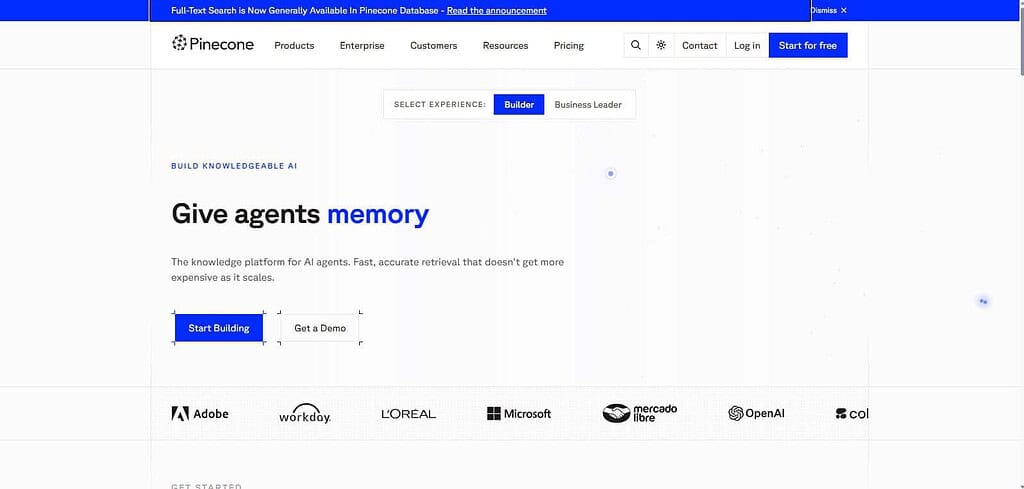
Cloud: Pinecone operates a managed cloud, although deployment options are available that connect the customer’s cloud to Pinecone’s. Pinecone charges usage-based pricing, and although they have fixed pricing plans, their individual quotations are based on varying workloads. For these reasons, a fixed price per month would not apply. Pinecone is designed for teams that want to implement dedicated AI retrieval, as it eliminates the need to manage the infrastructure for the database.
Features
- A managed vector database designed for AI applications.
- Supports vector and semantic search.
- Supports metadata filtering for precise search results.
- Designed for RAG and AI agent use cases.
- Uses cloud technology to eliminate the need for database management.
Pros
- Easily deployable and manageable.
- Optimized for AI retrieval.
- Scales without the need for managing database servers.
- Developer focused APIs and integrations.
- Optimized for production RAG use cases.
Cons
- Primarily focused on cloud technology.
- Prone to increase costs for large scale usage.
- Not ideal for use cases requiring full control infrastructure.
- May require careful cost management for advanced use cases.
- May not be necessary to have dedicated vector infrastructure for smaller use cases.
2. Vespa.ai
Vespa.ai — AI Search Score: 96/100. Starting with the search technology at Yahoo, Vespa grew into an AI search and serving platform, rather than just a vector database. Its framework allows users to perform lexical, vector, and ranking searches, as well as recommendations and ML inferencing.
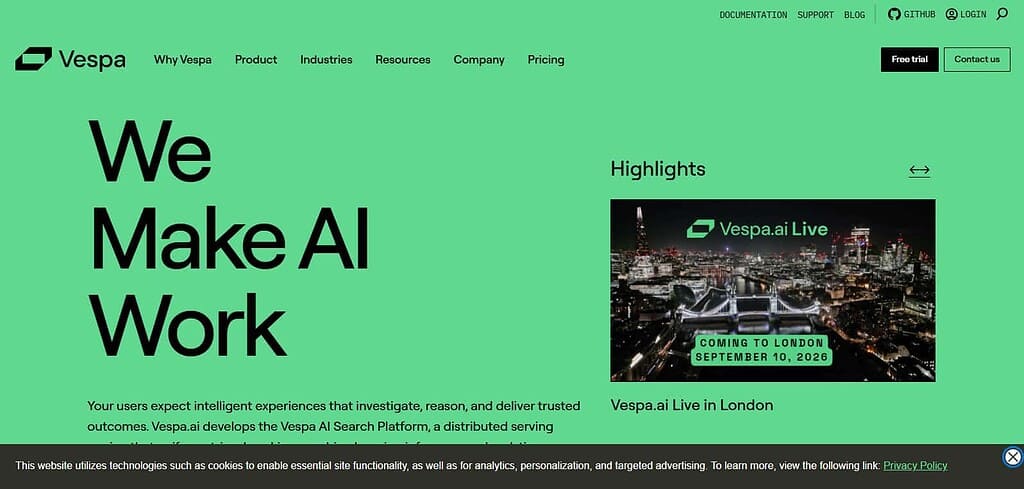
Its framework also supports multiple levels of search and ranking with a variety of complex AI search systems. Deployment: You can deploy Vespa via Vespa Cloud, its managed production service, or the Vespa Kubernetes Operator for Kubernetes.
Pricing: Unlike other services which offer a simple subscription pricing model, Vespa Cloud offers unit-based pricing for resources used (e.g. compute and storage resources). It is helpful to organizations which need ranking and search for their production searches in one unified platform.
Features
- Combines vector and lexical search.
- Advanced ranking and relevance.
- Machine learning inference control.
- Designed for large scale search and recommendation systems.
- Capable of real time data processing and serving.
Pros
- Powerful search and ranking.
- Designed to handle complex retrieval.
- Ideal for large scale search and recommendation systems.
- Open source Vespa and Vespa Cloud available.
- Search and serving combined in one platform.
Cons
- Requires a greater level of search engine expertise.
- More complex configuration compared to simpler vector databases.
- Maybe excessive for basic use RAG projects.
- Advanced deployments require careful architecture planning.
3. Elastic
Elastic — AI Search Score: 95/100. Siblings to Elasticsearch and Apache Lucene, founded Elastic in 2012. Evolution brought Elastic from traditional search to a modern search, observability, security and AI platform. In terms of AI search, Elastic offers capabilities with Lexical and Vector search and hybrid search, and with its existing search infrastructure and structured filtering, it supports RAG apps.
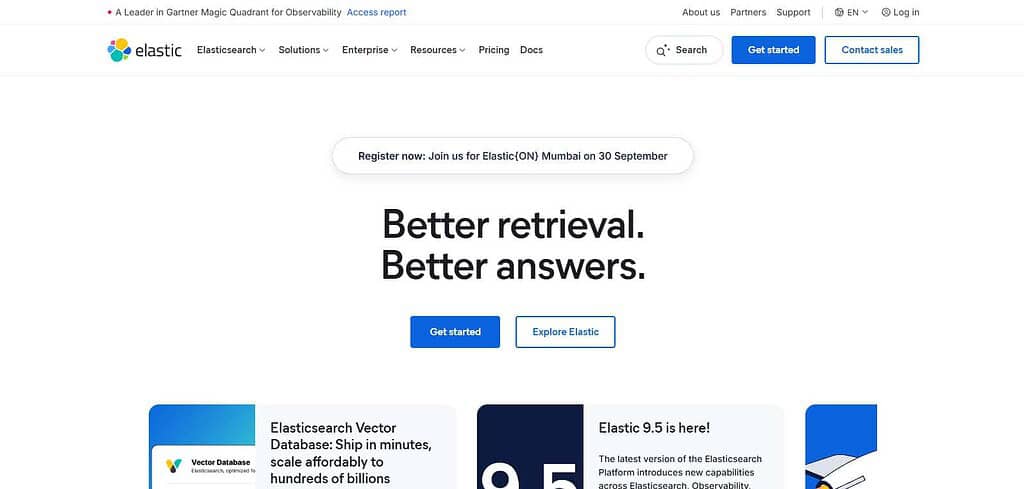
Elastic gives users the choice to deploy it themselves or use its cloud deployment called Elastic Cloud. Customers can deploy it from the cloud marketplaces. Pricing: Its pricing is dependent on workload and resources, among other factors. Elastic’s major value add is having sophisticated search infrastructure and AI retrieval.
Features
- Supports keyword search.
- Offers vector and hybrid search.
- Offers filtering and relevance ranking.
- AI and RAG use cases supported.
- Available for on-premise and cloud managed.
Pros
- Database structure designed for AI.
- Search has multiple approaches.
- Options for open source and cloud.
- Developer tools are good.
- Good for semantic and hybrid search.
Cons
- Requires learning the database.
- Expensive cloud.
- Needs infrastructure.
- Parametrich configurations are complex.
- More than what is needed for simple apps.
4. Weaviate
Weaviate – AI Search Score: 93/100. Weaviate is an open-source vector database designed for AI applications. It was created by Etienne and Bob van Luijt in 2019. Weaviate’s AI applications integrate vector similarity search, keyword search, hybrid search, filtering, RAG, and reranking. These systems allow multiple AI app retrieval operations to be performed separately.
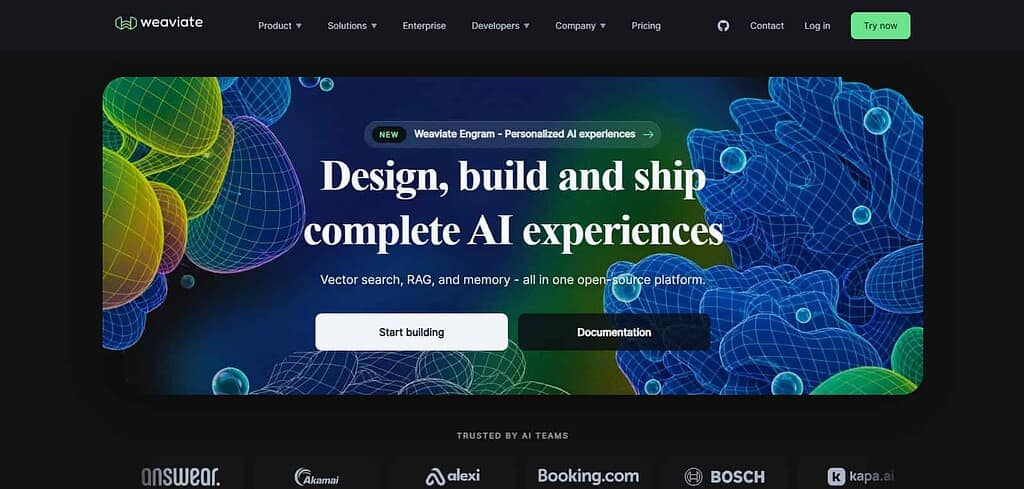
Developers may choose to use Weaviate cloud or deploy it themselves. Weaviate’s pricing for clouds is usage based and it has a free to try Query Agent and a paid plan for $30 per organization per month. This plan also includes certain limits for monthly requests. The price of deployments depends on the resources and scale.
Features
- Open-source vector database.
- Can do both vector and keyword search.
- Supports hybrid search.
- Can rerank based on filters.
- Built for RAG and AI.
Pros
- Built for AI.
- Multiple retrieval architectures.
- Can choose to deploy cloud or self-host.
- Built for search, both hybrid and semantic.
Cons
- Requires knowledge of their database model.
- Could be cost prohibitive to host.
- Requires self-host infrastructure.
- Can be tedious to set up.
- Can be more than what it’s built for.
5. Qdrant
Qdrant has an AI search score of 92/100. Qdrant was founded in 2021 by Andrey Vasnetsov and André Zayarni, and is the vector database for vector search similarity on unstructured data. Qdrant’s vector similarity search along with filtering and payload-based retrieval, helps it stand out among its competition.
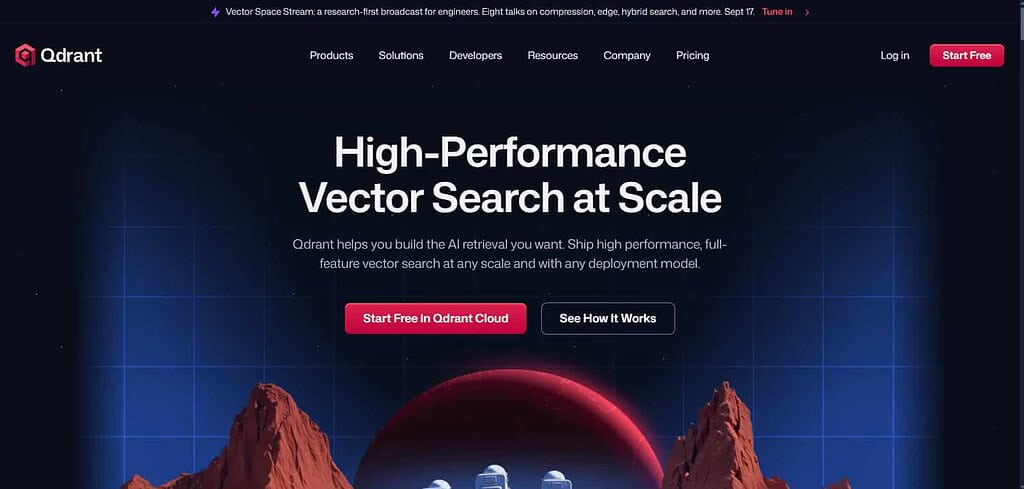
Qdrant’s framework has helped companies realize their full semantic and RAG search query capabilities and recommendations. Qdrant offers open source software for self-hosting and Qdrant Cloud. Qdrant Cloud uses resource pricing, with free plans that offer 1 GB RAM and 4 GB disk. Better and more dedicated resources cost more.
Features
- Vector similarity search.
- Filtering and ranking metadata.
- Handles metadata with high dimensional vectors.
- Available for free and open source.
- Has a managed Qdrant Cloud.
Pros
- Excellent vector oriented search.
- Good Filtering.
- Self hosting gives you control of the infrastructure.
- Cloud simplifies deployment.
- Excellent for RAG and semantic search.
Cons
- Focus on vector oriented workloads.
- May require more work for advanced search requirements.
- Needs Basic use operational skills.
- Large deployments need resources.
- Less broad than full enterprise search offerings.
6. Zilliz
Zilliz – 94/100 AI Search Score. Founded in 2017, Zilliz was started by Charles Xie. They have open sourced the Milvus vector database project. Milvus is built to be a performant vector database that can scan massive datasets that are unstructured and multimodal. AI Search features include vector similarity search, indexing, filtering, and large scale retrieval for AI applications.
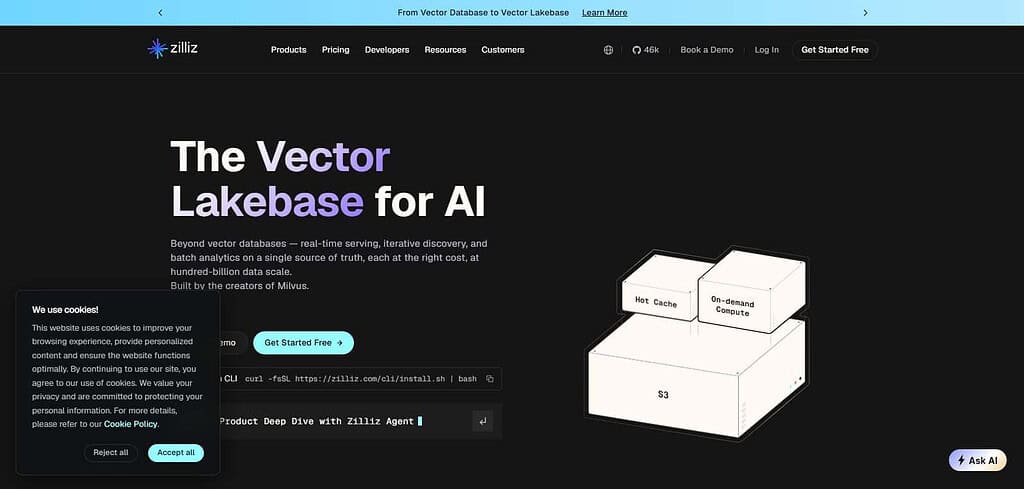
Users can choose to self-host Milvus or use the Zilliz Cloud, which is the fully-managed Milvus-compatible service. Zilliz Cloud has a pricing model that is usage based/resource based. Currently their service also runs on cloud marketplaces. For companies that need vector infrastructure that is not a lightweight embedded retrieval database, Zilliz Cloud is a great solution.
Features
- Commercialized version of Milvus.
- Distributed, vector database.
- Scalable similarity search.
- AI workload designed.
- Available via Zilliz Cloud and Milvus managed offerings.
Pros
- Large vector workload designed.
- Distributed architecture.
- Open source Milvus.
- Reduce operational costs with managed cloud.
- Enterprise AI retrieval suitable.
Cons
- Overkill for small projects.
- Large focus requires architecture.
- Operational costs for Milvus.
- May not need capabilities for vector workload.
- Costs based on infrastructure and usage.
7. OpenSearch
OpenSearch — AI Search Score: 91/100. The OpenSearch Project forked Elasticsearch and Kibana to create an open-source option and released OpenSearch 1.0 in July 2021. The project is more than a vector database. It combines search, data, dashboards and data preparation, An overview of search, analytical, observability, security, and machine learning extensions is provided.

OpenSearch can be self managed or offered as a service through Amazon OpenSearch Service. The software is available and managed as an AWS offering for an additional cost that is dependent on the resources, such as instance hours, storage, and data transfer.
Features
- Open source and analytic platform.
- Full text and vector search.
- Supports hybrid search.
- Self-managed and managed options available.
Pros
- Apache 2.0 based open source.
- Flexible deployment options.
- Enterprise search with traditional and vector.
- Strong infrastructure control for enterprises.
Cons
- Complex compared to lightweight vector database.
- Requires operational knowledge with self-hosting.
- High resource consumption.
- AI-search may require some additional expertise.
- Costs based on resources selected for managed option.
8. Algolia
Algolia – AI Search Score: 90/100. Nicolas Dessaigne and Julien Lemoine started Algolia in 2012 to offer search technology to developers. Over the years, it has moved to become a complete search and discovery service provider. Algolia is not a pure vector database.
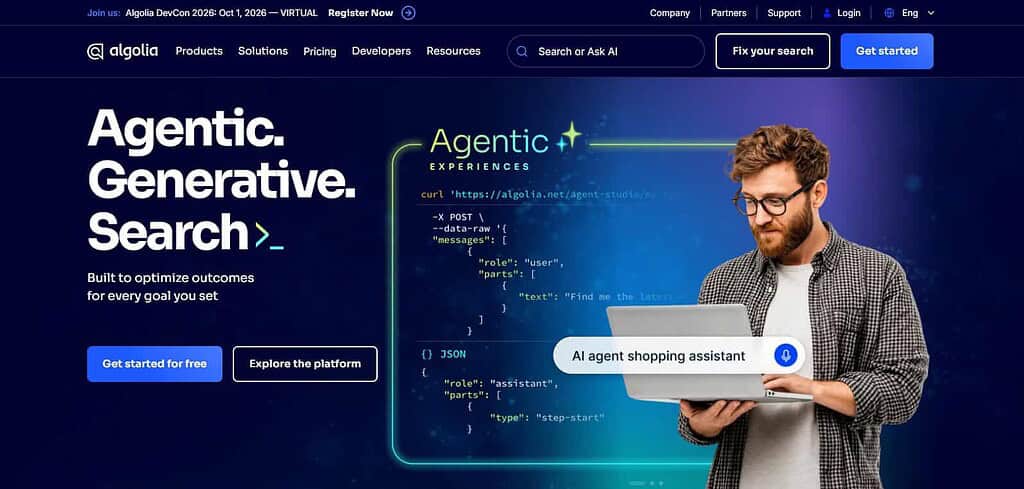
It offers a combination of features for application and e-commerce search as well as website search, along with keyword retrieval as well as AI ranking, personalization, and semantic features.
Deployment: Algolia offers its service primarily as a managed SaaS solution meaning customers don’t have to operate search clusters on their own. Pricing: Algolia offers usage-based plans, and its Grow Plus plan provides 10,000 search requests per month and 100,000 records. Add-on requests will cost extra, offering significant value for customer search experiences.
Features
- Hosted search platform.
- Fast application search.
- AI based search and application.
- Custom ranking and relevance.
- Strong support for Ecommerce.
Pros
- Simple integration into applications.
- Strong user facing search.
- Great application search and discovery.
- Lessens the workload related to managing infrastructure.
- Effective ranking and relevance features.
- Search is especially strong for ecommerce.
Cons
- Mostly a managed service.
- Costs are associated with searches and records.
- Less effort on a general-purpose vector database.
- Some effort is needed to plan costs for high volume use.
- Complex AI retrieval will likely require other services.
9. MongoDB
MongoDB — AI Search Score: 89/100. MongoDB was founded in 2007. Dwight Merriman, Eliot Horowitz, and Kevin Ryan all contributed to its founding. As a general-purpose database, it does not natively support vector databases.
Vector Search is a service that adds vector search to MongoDB’s Atlas’ document-centric data platform. An architecture that allows users to store app data, metadata, and vectors in one environment can be used. MongoDB Atlas offers cloud services deployment that are fully managed, and in addition, they offer the services of their database technology which can be self-managed deployed.
Atlas uses a resource-based pricing model, consumption based, on the deployment configuration. The cost of using the AI-search with MongoDB rests on which cluster is selected and the estimated workload.
Features
- Vector search integrated in document database.
- Vector search is enabled in MongoDB Atlas.
- Metadata can be integrated with the application data.
- Supports RAG and semantic search.
- Combines AI retrieval with other MongoDB data.
Pros
- Great for teams using MongoDB.
- Eliminates the need for additional vector database.
- Integrates application data with search data.
- Simplifies the operations with managed Atlas deployment.
- Strong developer community.
Cons
- Not a purpose-built vector database.
- Best savings are achieved with existing MongoDB setup.
- Vector search requires the right resources.
- Compromises on performance for large-scale search.
- Search platforms may offer more specialized capabilities.
10. Chroma
Chroma — AI Search Score: 88/100. Chroma is an embedding and retrieval centered AI-native database designed specifically for developers making LLM and RAG apps. Rather than as an enterprise search platform, it is more accurate to think of Chroma as developer-oriented AI infrastructure. AI Search Features: embedding, similarity and metadata-based retrieval APIs are some of the focus features. Deployment: Chroma supports developer/local usage as well as cloud deployments and enables teams to start locally before moving to a hosted infrastructure.

Pricing: Because Chroma’s product and cloud service may both change separately from the open-source software, the safest editorial approach is to refer to the current pricing page of Chroma rather than to publish an estimated monthly cost. For your article, Chroma should be described as a developer-centric AI retrieval and RAG service, not as a substitute for every enterprise search platform.
Features
- AI database built for developer workflows.
- Designed to support embeddings and retrieval.
- Supports vector similarity search.
- Metadata retrieval is supported.
- Supports LLM and RAG implementations.
Pros
- Supports developer workflows.
- Good for building AI prototypes.
- Supports RAG.
- Open source.
Cons
- Search capabilities are limited.
- Careful planning is needed for large production uses.
- Additional infrastructure may be required for enhanced professional search features.
- Pricing may vary according to the currently hosted offer and the volume of use.
- Probably not the optimal fit for complicated professional search needs.
Conclusion
AI search infrastructure is an essential part of modern applications of AI, RAG systems, enterprise search, and AI agents. The 10 companies covered in this guide (Pinecone, Vespa.ai, Elastic, Weaviate, Qdrant, Zilliz, OpenSearch, Algolia, MongoDB, and Chroma) have unique methods for retrieval and searching with vectors, hybrid viewing, ranking, and data infrastructure.
Every industry will have its own best search solution. The solution will depend on the search’s complexity, how much it needs to scale, the preferred deployment, cost, and the existing technology. As the use of AI applications for searching data rises in 2026, the companies that focus on delivering better search infrastructure that is fast, precise, can easily scale, and is flexible will play a big role in the full AI ecosystem.
FAQ
What is AI search infrastructure?
AI search infrastructure is the technology layer that helps AI applications find, retrieve, filter, and rank relevant information. It can include vector search, keyword search, hybrid retrieval, metadata filtering, reranking, and RAG infrastructure.
Which is the best AI search infrastructure company in 2026?
There is no single best option for every use case. Pinecone, Vespa.ai, Elastic, Weaviate, Qdrant, Zilliz, OpenSearch, Algolia, MongoDB, and Chroma serve different workloads, so the right choice depends on scale, search requirements, deployment model, and budget.
Is AI search infrastructure the same as a vector database?
No. A vector database is one component of AI search infrastructure. Modern AI search can combine vector retrieval with keyword search, hybrid search, filtering, ranking, reranking, and other technologies to improve results.
. Which AI search platforms are best for RAG?
Pinecone, Weaviate, Qdrant, Zilliz/Milvus, Chroma, Elastic, Vespa.ai, OpenSearch, and MongoDB Atlas Vector Search can all support RAG-related workloads, but their architectures and capabilities differ.
Is Pinecone a vector database?
Yes. Pinecone provides managed vector database and retrieval infrastructure designed for AI applications, including semantic search and RAG workloads.