


In this article, I cover the Best AI Recruiting Technology Platforms in 2026, and how they combine automation, recruiting intelligence, and candidate experience to revolutionize the hiring process. HireGen and Ashby, AI-first solutions, and SmartRecruiters and Eightfold, enterprise heavyweight solutions, all use automation to improve the recruitment process. Workable takes care of smaller business needs better, while HireVue / Paradox caters to more volume hiring needs, and both have their specific markets they address.
What Is an AI Recruiting Technology Platform?
An AI Recruiting Technology Platform is a piece of software that makes the process of hiring and keeping track of candidates easy. That is done through capabilities such as resume screening, matching candidates to roles, scheduling interviews, and finding candidates who have not been hired, but could fit. A recruiter can sort through a ton of data to find great potential employees.
These platforms ensure they are recruiting the best talent possible and help eliminate bias and engage candidates with chatbots and automated messages. AI Recruiting Technology Platforms are designed to boost overall effectiveness and bring recruiting efforts into the future. This plays a major role in recruiting in an ever evolving volatile hiring market.
What Can AI Recruiting Platforms Automate?
Resume Screening
AI parses resumes, extracts skills, and provides semantic matches to job descriptions instead of matching based on keyword stuffing.
Candidate Sourcing
Tools such as SeekOut and Eightfold compile millions of profiles and resurface past applicants and identify passive candidates.
Interview Scheduling
Conversational AI assistants (Olivia, for example) are capable of scheduling, sending reminders and confirmations, and even rescheduling interviews. All of this is done autonomously without required recruiter input.
Initial Screening
HireVue analyzes video interviews and provides scoring and feedback utilizing video analysis.
Outreach & Communication
AI handles automated outreach and communication with candidates in order to reduce the likelihood of candidates feeling neglected.
Diversity & Bias Reduction
Various tools provide resume anonymization and other mechanisms to improve hiring decisions.
Analytics & Predictions
Analytics provide insights related to candidate success, retention, and hiring funnel performance to help recruiters understand the hiring process.
How We Selected the 10 Best AI Recruiting Platforms
| Criteria | What to Evaluate | Weight (%) |
|---|---|---|
| AI Recruiting Capabilities | AI sourcing, candidate matching, resume screening, recommendations, and recruiter assistance | 20% |
| Recruiting Automation | Automated sourcing, outreach, scheduling, workflows, follow-ups, and repetitive tasks | 15% |
| Candidate Matching & Skills Intelligence | Skills-based matching, candidate ranking, job-to-candidate relevance, and talent discovery | 12% |
| ATS & HR Integrations | Integrations with ATS, HRIS, CRM, job boards, calendars, APIs, and other HR tools | 10% |
| Candidate Experience | Application experience, communication, chatbots, scheduling, personalization, and engagement | 10% |
| Analytics & Reporting | Hiring funnel analytics, recruiting KPIs, dashboards, source effectiveness, and workforce insights | 8% |
| Responsible AI & Data Security | Privacy, security, bias controls, human oversight, explainability, and compliance capabilities | 8% |
| Ease of Use | Recruiter interface, implementation complexity, workflow customization, and learning curve | 7% |
| Scalability | Ability to support SMB, mid-market, high-volume, and enterprise recruiting operations | 5% |
| Pricing & Overall Value | Pricing transparency, licensing model, implementation costs, and value relative to capabilities | 5% |
| Total | — | 100% |
1. HireGen
HireGen was established in 2021, and in a very short time has become one of the most advanced AI-first recruiting systems for 2026. HireGen provides features such as resume parsing, machine learning candidate matching, predictive analytics on hiring outcomes, and conversational AI hiring assistants.
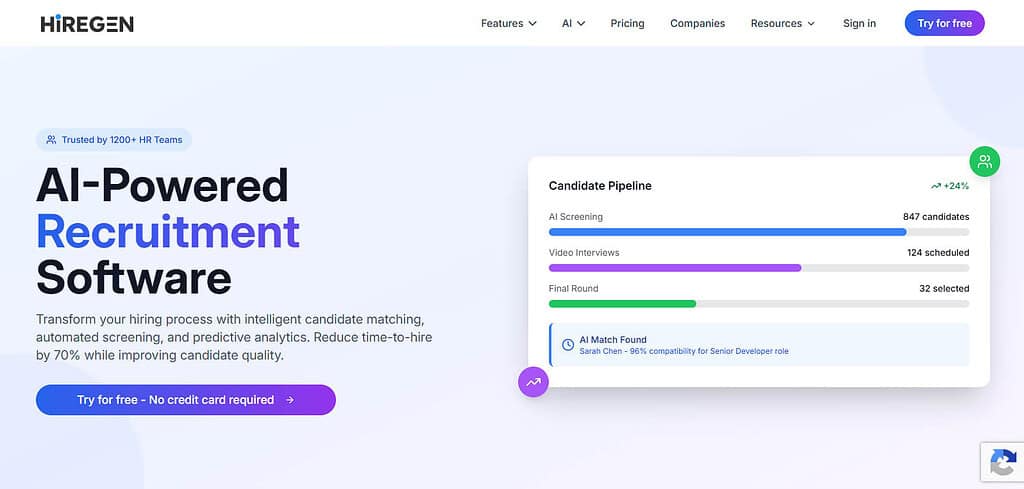
Pricing flexibility for HireGen includes a free plan for start-ups, as well as enterprise pricing at flat rates. HireGen’s strength is its AI-powered CRM that engages candidates and automates ease of use for recruiters.
Unlike legacy ATS systems, HireGen was purpose-built for AI and is therefore more rapid and precise at talent identification and execution. Further, HireGen has built-in compliance tools that offer protection for its clients and ease of adoption for enterprise clients, and affordable pricing for small-to-medium-sized businesses.
HireGen Features
- 2021 architecture built for A.I.
- Resume parsing, ML candidate matching
- Recruitment chatbot to engage candidates
- Predictive analytics for hiring outcomes
- Pricing starts at $0 with a free plan, flat-rate pricing
| Pros | Cons |
|---|---|
| AI-native architecture built in 2021 | Still expanding HRIS integrations |
| Affordable flat-rate pricing with free plan | Limited brand recognition compared to legacy ATS |
| Strong candidate matching & predictive analytics | May lack advanced compliance features of enterprise suites |
| Conversational chatbot improves candidate experience | Requires training for recruiters new to AI-native systems |
| Fast automation reduces recruiter workload | Less adoption in highly regulated industries |
2. SmartRecruiters
SmartRecruiters was founded in 2010, and in 2026 is a premier recruiting system for the enterprise. SmartRecruiters combines ATS, CRM, and AI sourcing systems in one format, therefore is very well suited for enterprise level clients. SmartRecruiters’ AI systems include candidate rediscovery, diversity analysis, and compliance tracking.
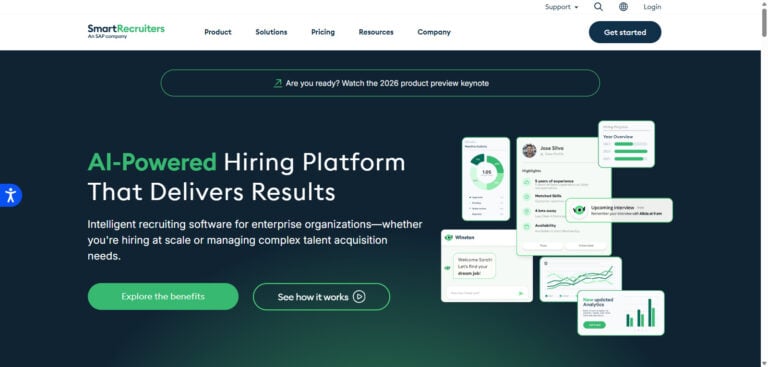
Pricing is customized, with an estimated starting cost of $25,000 per year for enterprise deployments. SmartRecruiters has an excellent reputation for integration with HRIS systems such as Workday, SAP, Oracle, and others that make it attractive to Fortune 500 firms. While not as AI-native as HireGen, SmartRecruiters uses machine learning for finding and engaging passive candidates across global talent pools.
SmartRecruiters Features
- Enterprise focused ATS + CRM built in 2010
- AI sourcing, candidate rediscovery
- Diversity analytics, compliance monitoring
- HRIS integrations (Workday, SAP, Oracle)
- Quote-based starting at ~$25K per year
| Pros | Cons |
|---|---|
| Enterprise-grade ATS + CRM integration | Quote-based pricing can be expensive |
| Strong HRIS integrations (Workday, SAP, Oracle) | Less AI-native compared to newer platforms |
| Diversity analytics & compliance monitoring | Complex setup for SMBs |
| Candidate rediscovery features | Higher cost barrier for startups |
| Widely adopted by Fortune 500 companies | Slower innovation compared to AI-first competitors |
3. Greenhouse
Greenhouse, founded in 2012, is one of the most frequently used ATS systems in 2026. As a structured hiring solution, Greenhouse includes automated interview scheduling and analytics dashboards. Its AI features include resume parsing and bias-reduction tools. Greenhouse offers custom pricing, with packages starting at $20K annually.
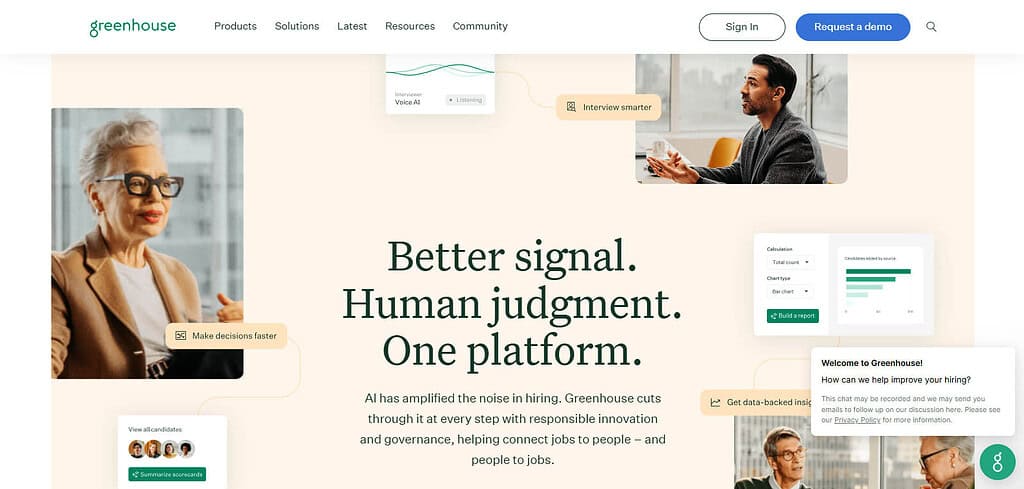
Greenhouse is highly regarded for its strong compliance and structured interview frameworks. As a result, Greenhouse is the preferred solution by regulated industries such as Finance and Healthcare. Greenhouse has integrated its offering with other AI sourcing solutions such as SeekOut and Eightfold, ensuring it offers flex to recruiters. Its offerings, strong reputation for dependability and Slack, Zoom and LinkedIn integrations, make it a top solution.
Greenhouse Features
- 2012 structured hiring workflows
- AI resume parsing, bias removal
- Interview scorecards, analytics dashboards
- Strong compliance for regulated industries
- Custom pricing, typically starting at $20K+ per year
| Pros | Cons |
|---|---|
| Structured hiring workflows & scorecards | Not fully AI-native |
| Strong compliance for regulated industries | Custom pricing often exceeds $20K annually |
| Reliable integrations with Slack, Zoom, LinkedIn | Limited AI sourcing compared to SeekOut |
| Widely adopted across industries | Less affordable for SMBs |
| Analytics dashboards for hiring insights | Requires add-ons for advanced AI features |
4. Lever
Lever, founded in 2012, is a CRM-style recruiting platform that combines ATS functionality with candidate management. In 2026, Lever is in high demand by mid-sized companies that need to manage passive candidate pipelines. Lever’s AI integrations include candidate pipeline automation and resume parsing.
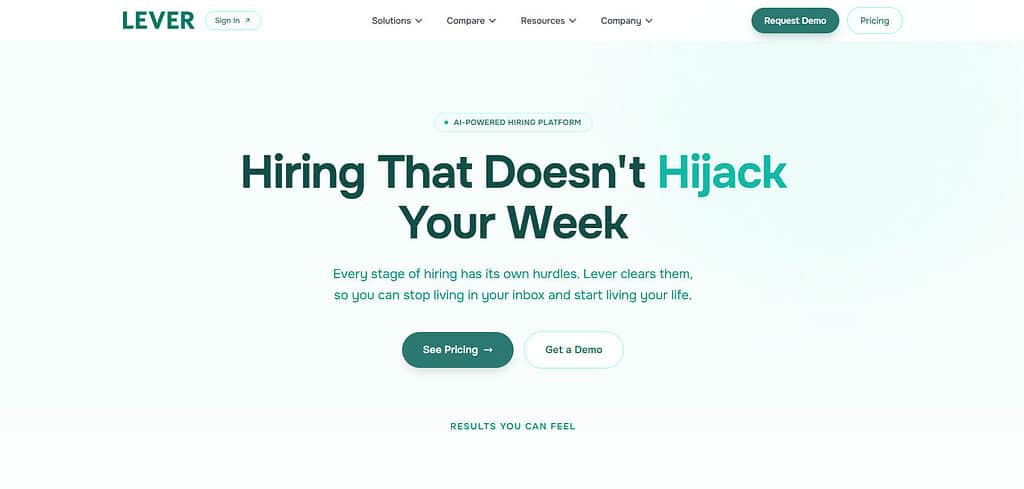
Pricing, starting at $6 per user per month, makes Lever an affordable solution as compared to enterprise designed systems. Lever’s strong candidate engagement tracking and automated follow-ups make it unique in the recruiting space. Although it lags behind similar AI-native competitors HireGen and Ashby, Lever’s CRM-first solution makes it an excellent choice for companies looking to modernize their recruiting practices.
Lever Features
- 2012 CRM style recruiting platform
- AI for automation, predictive analytics
- Candidate nurturing with automated follow-ups
- Resume parsing with engagement tracking
- Pricing starting at $6 per user, per month
| Pros | Cons |
|---|---|
| CRM-style candidate nurturing | Not AI-native |
| Affordable pricing from $6/user/month | Limited enterprise compliance features |
| Predictive analytics & pipeline automation | Less advanced sourcing compared to SeekOut |
| Strong candidate engagement tracking | May lack scalability for very large enterprises |
| Easy integrations with HR tools | Focused more on mid-market than SMBs |
5. Ashby
Ashby launched in 2018 with solutions to help growth-stage companies with recruiting. In 2026, Ashby gained recognition with its advanced analytics, advanced funnel optimization, and AI driven scheduling. Starting at $400/month, Ashby caters to startups and mid-market organizations. Features of Ashby’s AI include automated interview scheduling, candidate rediscovery, predictive hiring analytics, etc.
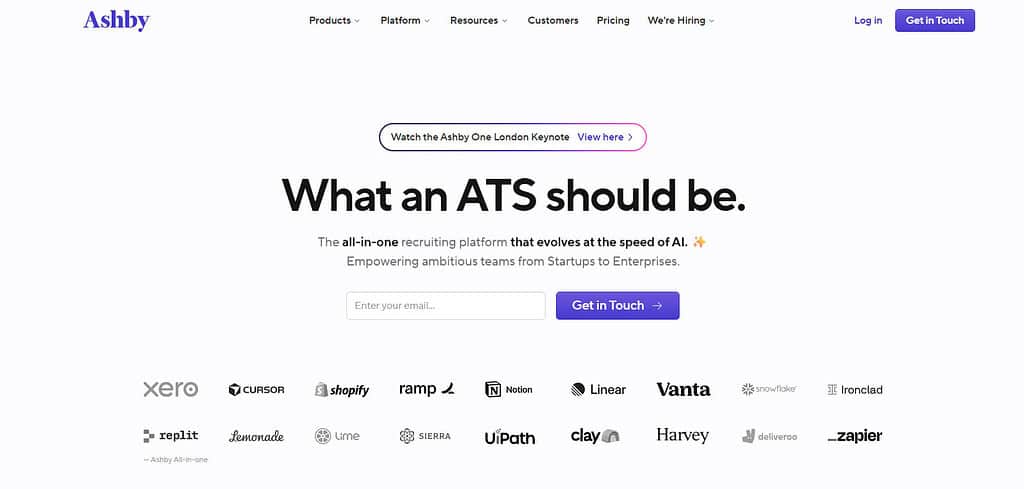
Compared to legacy ATS systems, Ashby uses AI-native architecture to create faster automation and improve candidate experience. Combined with its beautiful UI, integrations with Slack, Zoom, and HRIS systems make Ashby a go-to system for tech startups. Focused on data-centric recruiting, Ashby’s product helps recruiting functions cut through each stage of the funnel.
Ashby Features
- 2018 AI recruiting solution
- Advanced funnel analytics, optimization
- Automated interviews, hiring insights
- Candidate rediscovery
- Pricing starting at $400 per month for startups
| Pros | Cons |
|---|---|
| AI-native recruiting platform | Pricing starts at $400/month, higher than SMB tools |
| Advanced funnel analytics & optimization | Less adoption in traditional industries |
| Automated interview scheduling | Limited global compliance certifications |
| Sleek UI & modern integrations | Smaller ecosystem compared to Greenhouse |
| Strong candidate rediscovery | Best suited for startups & growth-stage firms |
6. Workable SMBs
Workable started in 2012 with SMB-centric Recruiting software. Today in 2026, they remain a top solution for small businesses due to their prices and user friendliness. Their lowest price starts at $299 per month and has different tiers of product offerings for growing teams.
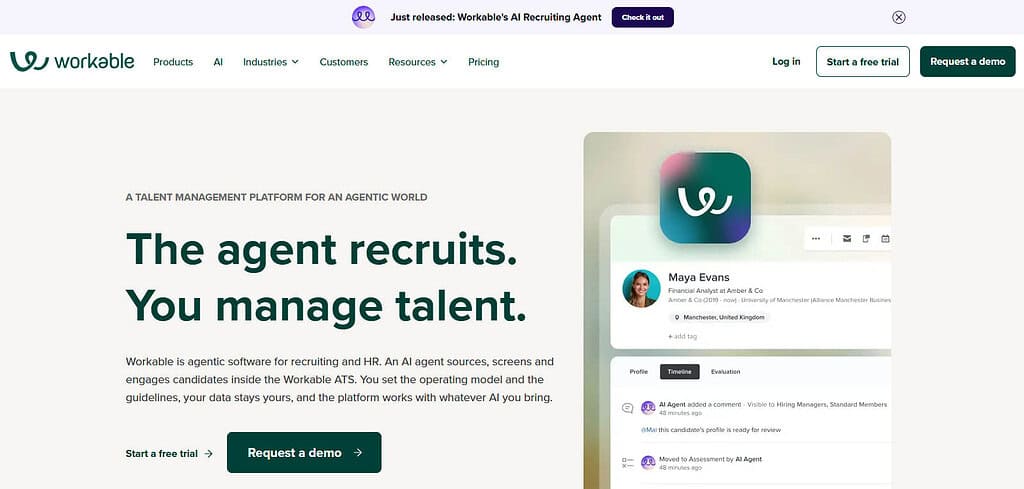
They have AI to parse resumes, post to 200+ job boards, and rediscover candidates, though their solutions are not as advanced as HireGen or Eightfold. Overall, Workable brings SMBs AI/automation tools at a fraction of enterprise costs.
Their integrations with Zoom, Slack, and Gmail allow small teams to have simple hiring processes without requiring complex IT integrations. Workable hits the right balance of being both user friendly and functional, making them a good solution for many SMBs.
Workable Features
- 2012 ATS designed for SMBs
- AI recruiting, resume parsing
- Automation for posting to 200+ boards
- Candidate rediscovery for small teams
- Pricing starting at $299 per month
| Pros | Cons |
|---|---|
| Affordable pricing from $299/month | Limited advanced AI features |
| Easy-to-use for SMBs | Not ideal for enterprise-scale hiring |
| Automated job posting across 200+ boards | Less predictive analytics compared to Ashby |
| Resume parsing & candidate rediscovery | Fewer compliance certifications |
| Simple integrations with Gmail, Slack, Zoom | Focused only on SMBs, not scalable |
7. JazzHR
JazzHR was founded in 2009 and is one of the more affordable ATS platform options in 2026. With features aimed at small companies and startups needing basic recruiting functionality, JazzHR’s pricing starts at $39/mo, making it one of the more affordable options. JazzHR has AI features such as resume parsing, automation of workflows, and candidate tracking.
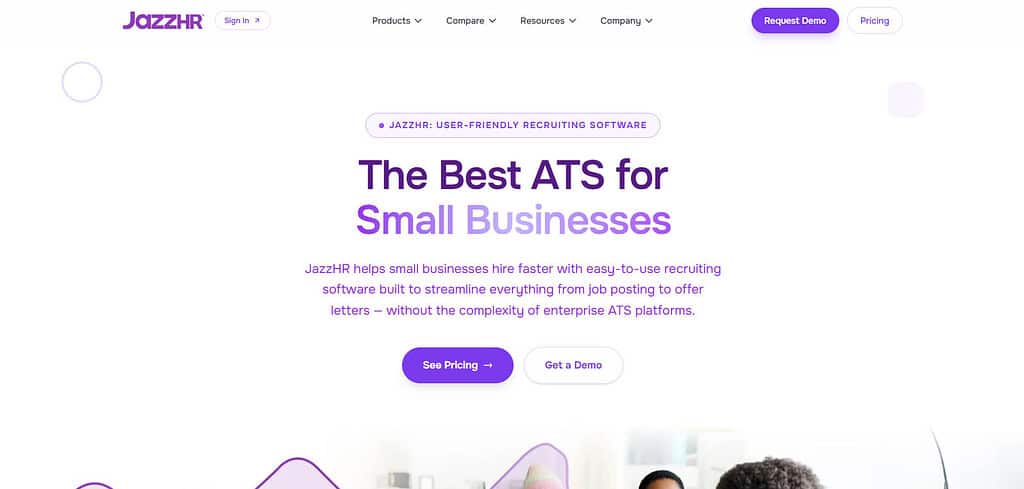
While JazzHR does not have as robust talent intelligence features as Eightfold or SeekOut, JazzHR still retains SMB customer interest with its budget and ease of use. JazzHR offers functionality with job boards, Gmail, and Slack which makes the software usable even without a high level of technical skill. JazzHR’s best fit is companies with hiring automation needs on a small budget.
JazzHR Features
- 2009, Budget focused ATS
- AI resume parsing
- Workflow automation
- Cost effective at $39 per month
| Pros | Cons |
|---|---|
| Very affordable at $39/month | Limited AI sophistication |
| Easy-to-use for startups | Not suitable for enterprise hiring |
| Resume parsing & workflow automation | Lacks advanced analytics |
| Integrations with job boards & Gmail | Minimal compliance features |
| Ideal for budget-conscious SMBs | Limited sourcing capabilities |
8. Eightfold
In 2026, Eightfold AI is one of the leading enterprise talent intelligence platforms. It uses deep learning to analyze millions of candidate profiles to help users discover prior applicants and assess diversity. Its enterprise level pricing is around $100K and above, per year. One key feature of Eightfold’s AI is semantic search. Predictive career pathing and workforce planning are also important functionalities of Eightfold’s AI.
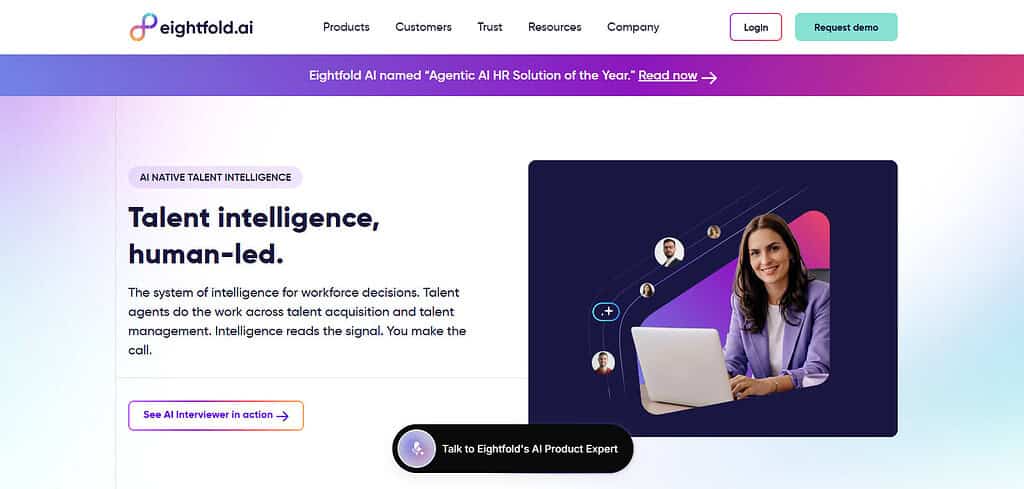
Due to key certifications for system compliance and the ability to scale, Eightfold AI has had a large clientele among Fortune 500 companies. Unlike other talent acquisition applicant tracking systems (ATS), Eightfold AI provides talent intelligence and uncovers applicant talent within client databases. Integrating Eightfold AI with HR systems Workday and SAP provides a strong enterprise solution.
Eightfold Features
- Founded in 2016, enterprise talent intelligence
- Deep learning for candidate rediscovery
- Diversity analytics & workforce planning
- Predictive career pathing & semantic search
- Pricing exceeds $100K annually
| Pros | Cons |
|---|---|
| Enterprise talent intelligence leader | Pricing exceeds $100K annually |
| Deep learning for candidate rediscovery | Cost barrier for SMBs |
| Diversity analytics & workforce planning | Complex implementation |
| Predictive career pathing | Requires large datasets for best results |
| Strong HRIS integrations | Focused mainly on enterprise clients |
9. SeekOut
SeekOut was founded in 2017. It uses AI to source candidates among the 800 million+ profiles. This solution was named one of the best tools for talent sourcing and diversity hiring in 2026. Prices start at $499 per month, with enterprise packages also available. SeekOut has AI features such as semantic search and diversity analytics, as well as a feature called candidate rediscovery.
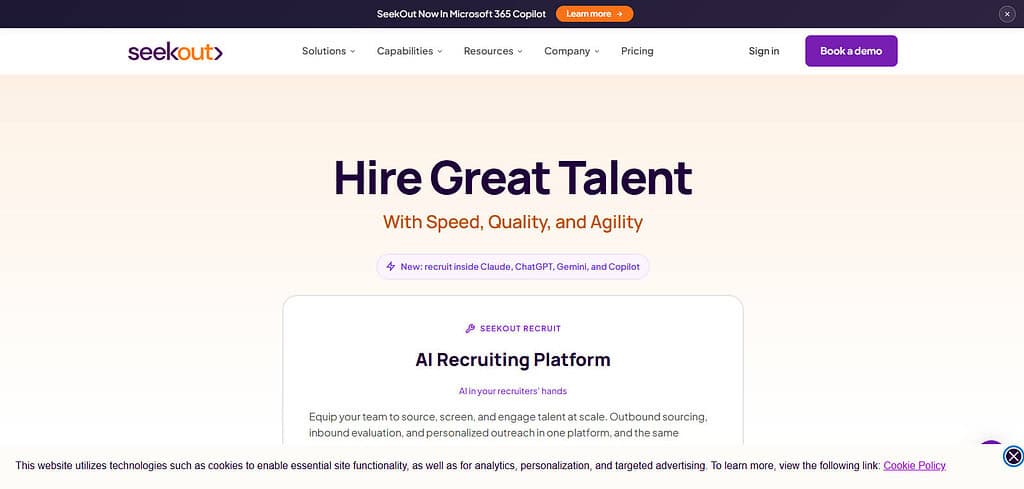
SeekOut is tailored to sourcing, which puts it against ATS systems like Greenhouse and Lever. As a complementary service to sourcing systems, SeekOut has integrations that improve recruiter workflow with LinkedIn Recruiter and Slack. SeekOut’s primary value comes from its features that help sourcing teams discover talent in high demand markets.
SeekOut Features
- Founded in 2017, AI-powered sourcing platform
- Semantic search across 800M+ profiles
- Diversity analytics for inclusive hiring
- Candidate rediscovery from past applicants
- Pricing starts at $499/month
| Pros | Cons |
|---|---|
| AI-powered sourcing across 800M+ profiles | Pricing starts at $499/month |
| Strong diversity analytics | Not a full ATS |
| Semantic search for hidden talent | Requires integration with ATS systems |
| Candidate rediscovery features | Higher cost for SMBs |
| Complements Greenhouse & Lever | Focused mainly on sourcing, not workflows |
10. HireVue / Paradox
In 2026, illustrative examples of AI-powered application includes HireVue (est. 2004) and Paradox (est. 2016). HireVue focuses on the analysis of video interviews using AI to assess candidate responses and reduce bias. Pricing begins at approximately $35K for enterprise clients.
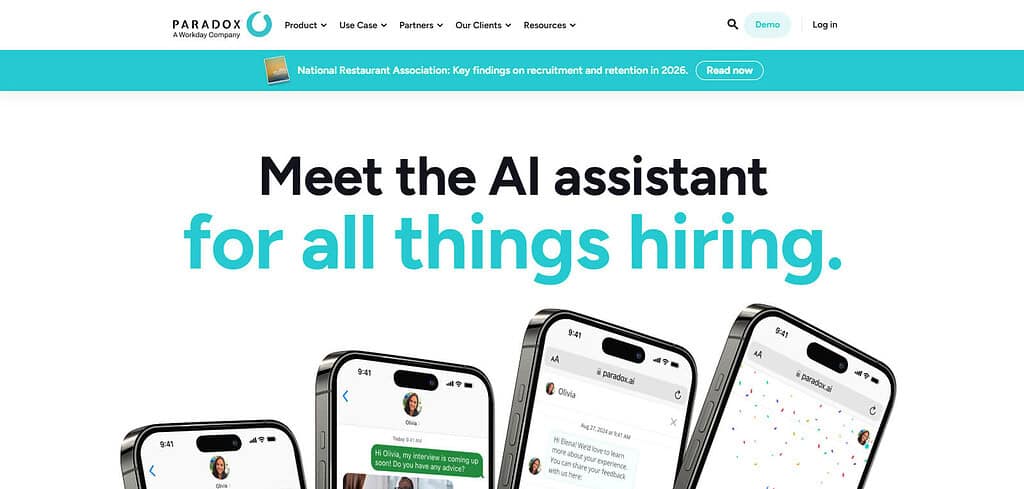
Paradox is known for its conversational AI assistant “Olivia” and uses automation in candidate communication, screening, and scheduling. Quote based pricing is used and is based on the size of the company.
HireVue and Paradox have a collective monopoly on high volume recruiting in the retail, hospitality and health care fields. The utilization of AI to automate the recruiting process reduces the workload of recruiters exponentially, and are therefore valuable assets to organizations that receive thousands of applicants every month.
HireVue / Paradox Features
- HireVue (2004) specializes in AI video interviews
- Paradox (2016) offers “Olivia” chatbot automation
- AI-driven scheduling & candidate communication
- Bias-reduction tools in interview analysis
- Pricing: HireVue ~$35K+, Paradox quote-based
| Pros | Cons |
|---|---|
| Leaders in interview automation | HireVue pricing ~$35K+, Paradox quote-based |
| AI-driven video analysis (HireVue) | Potential bias concerns in AI assessments |
| Conversational chatbot “Olivia” (Paradox) | High cost for SMBs |
| Automates scheduling & candidate communication | Focused mainly on high-volume hiring |
| Reduces recruiter workload significantly | Less suited for niche or specialized roles |
Conclusion
Automating the recruitment process to meet the needs of enterprises and SMBs at different price points while retaining intelligence and automation is key to AI recruiting technology in 2026. HireGen is the first AI native solution, while SmartRecruiters and Greenhouse have dominated workflows for enterprise automation.
The mid-market sector uses Lever and Ashby, and Workable and JazzHR automate for SMBs. SeekOut and Eightfold drive talent intelligence for enterprises, while interview process automation is led by HireVue / Paradox. These platforms define the recruitment process in terms of automating the hiring process with scalability, precision, and compliance while improving the candidate experience.
FAQ
What is HireGen?
HireGen, founded in 2021, is an AI-native recruiting platform offering resume parsing, candidate matching, and recruitment chatbots. It’s priced with free plans for startups and flat-rate enterprise packages.
How does SmartRecruiters differ from others?
Founded in 2010, SmartRecruiters is an enterprise suite integrating ATS, CRM, and AI sourcing. Pricing is quote-based, starting around $25K annually, with strong HRIS integrations.
Is Greenhouse AI-native?
Greenhouse, founded in 2012, is not fully AI-native but integrates AI features like resume parsing and bias reduction. Pricing is custom, often $20K+ annually.
Why choose Lever?
Lever, founded in 2012, blends ATS with CRM-style candidate nurturing. Pricing starts at $6 per user/month, making it affordable for mid-sized firms.
What makes Ashby unique?
Ashby, founded in 2018, is AI-native with advanced analytics and scheduling automation. Pricing starts at $400/month, ideal for growth-stage companies.