



In this article, I will analyze Best AI Integration Companies for Businesses in 2026, and how leading firms like IBM Consulting, Accenture, and Deloitte provide enterprise-level governance, while mid-market firms like Infosys, Hexaware, and Softlabs Group provide cost-effective solutions. These companies connect innovation in AI with the practicality of business implementation and ensure scale, compliance, and a competitive edge.
What Are AI Integration Companies for Businesses?
Businesses are able to bring artificial intelligence (AI) technologies into their operations by partnering with companies that specialize in AI integration. AI integration companies help with AI implementation as well as incorporating new technologies into their processes and strategies.
AI integration serves the purpose of bringing together the best AI technology and the functionality that businesses need. Trusted partners of companies help automate processes and convert data into beneficial knowledge that is needed to gain an advantage in the competitive world that is described as the digital economy. Some services that companies offer are providing an edge in customer relationship management, enterprise risk management and process automation.
Benefits Of AI Integration Companies for Businesses
Efficient Operation – AI service integrators provide solutions to automate and optimize key business functions such as processing and managing data in ERP and CRM, monitoring and managing the supply chain, and more.
Optimize Cost – Businesses utilizing mid-market service integrators like Infosys or Softlabs Group significant decrease operational costs. This is a result of optimized use of resources and elimination of redundant activities.
Globally Scalable AI Solutions – Firms like IBM Consulting and Accenture can provide enterprises with AI solutions capable of global scale. These solutions can grow without disrupting regular business activities.
Actionable Data – Firms like Fractal specialize in AI and automation combined with advanced data science techniques and predictive modeling to provide businesses with valuable data and insights necessary to make the best decisions.
Strong Governance and Ethical AI Framework – Firms like Deloitte and IBM Consulting provide the best frameworks for ensuring that AI is utilized within regulations and ethical boundaries.
Improved Customer Experience – AI optimizations provide the tools for improved personalization, predictive services, and chatbots to increase customer satisfaction and contribute to business loyalty.
Innovation Enabler – AI in conjunction with other modern technologies provides a competitive advantage to businesses that adopt it first. Niche firms like LeewayHertz push innovation by providing AI and cloud-native services in conjunction with blockchain, IoT, etc.
Competitive Advantage – First adoption of AI provides businesses the ability to offer innovative products and services in a timely manner and improve business performance and efficiency with optimized marketing strategies.
Flexible Solutions – Cloud-based AI adapts to a variety of budgets and business needs. Companies like Hexaware and Capgemini offer flexible AI solutions for various businesses.
Low-Cost AI Integration for SMBs – Softlabs Group and Infosys provide low-cost AI solutions for SMBs.
Key Points
| Company | Best For | Key Strengths |
|---|---|---|
| IBM Consulting | Regulated industries, large enterprises | watsonx lifecycle, responsible AI governance, legacy + cloud integration |
| Accenture | Multi-country enterprise programs | End-to-end AI governance, complex system integration |
| Deloitte | Strategy-led transformation | AI governance operating models, production-grade MLOps |
| TCS | Enterprise modernization | Strong governance, lifecycle monitoring, scalable AI workflows |
| Capgemini | Ease of use | MLOps + monitoring, lifecycle control |
| Infosys | Enterprise AI adoption | Integration across ERP/CRM stacks, cost-effective delivery |
| Fractal | Data-heavy industries | AI engineering, analytics-driven integration |
| LeewayHertz | Specialized engineering | Custom AI integrations, blockchain + AI convergence |
| Hexaware | Cloud-native AI | AI + automation integration, mid-market scalability |
| Softlabs Group | Mid-market buyers | Proven live integrations (SAP, Zoho, Tally), cost-effective rates |
1. IBM Consulting
Founded in 1911, IBM Consulting is a pioneer among AI integration companies. Their flagship product, watsonx, offers tools for lifecycle management of enterprise AI, as well as governance and compliance. They are particularly well-known for their specialization in AI for the banking, healthcare, and government sectors, ensuring ethical, monitored deployments in heavily regulated environments.
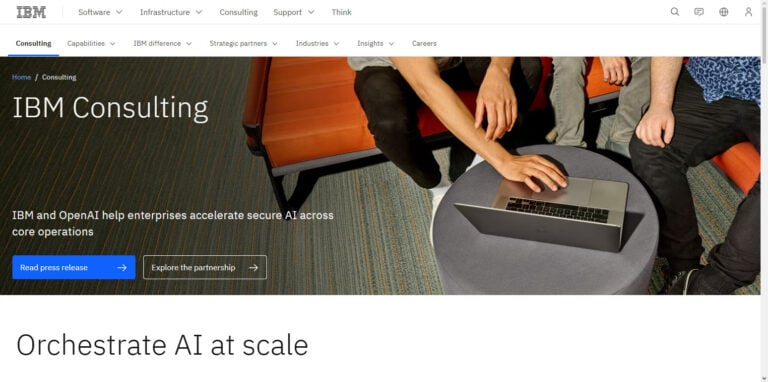
Their pricing model is based on the enterprise tier, where costs correspond to the size of the project. This model is reflective of IBM’s deep specialization and their unparalleled global reach. Their ability to transform legacy systems and embed AI across public and private cloud systems makes IBM a top AI integration company for the Fortune 500.
IBM Consulting Features, Pros & Cons
| Feature | Pros | Cons |
|---|---|---|
| Founded 1911 | Long legacy, trusted globally | Legacy systems may slow agility |
| watsonx platform | Strong governance & lifecycle | Premium cost |
| Regulated industry focus | Compliance expertise | Complex onboarding |
| Global coverage | Fortune 500 partnerships | Expensive contracts |
| AI + cloud integration | Hybrid flexibility | Vendor lock-in risk |
| Ethical AI frameworks | Strong governance | Slower innovation pace |
| Enterprise pricing | Tailored solutions | High budget required |
| Legacy modernization | Smooth transitions | Long project timelines |
| MLOps support | Production-grade AI | Complex management |
| Industry expertise | Healthcare, finance, govt. | Limited mid-market focus |
| Partnerships | Microsoft, AWS, Google | Proprietary ecosystem |
2. Accenture
Accenture was founded in 1989, and has since become a service titan in both consulting and technology integration. Their practice areas include AI systems for end-to-end deployment and governance, as well as systems for AI scaling across disparate industries. Accenture has embedded AI into enterprise resource planning, customer relationship management, and supply chain systems to provide enterprises with a measurable return on investment.
Their services are comprehensive from enterprise AI strategy and model deployment to lifecycle governance and monitoring. Their pricing model is based on the premium tier, given their ability to execute multicountry programs in addition to their global delivery network. Accenture is a favorite among enterprises for their seamless integration of complex AI systems across multiple industries.
Accenture Features, Pros & Cons
| Feature | Pros | Cons |
|---|---|---|
| Founded 1989 | Global consulting leader | Premium pricing |
| AI strategy & deployment | End-to-end delivery | Complex contracts |
| ERP/CRM integration | Strong enterprise focus | Limited SMB affordability |
| Governance frameworks | Ethical AI adoption | Slower for niche industries |
| Multi-country programs | Global scalability | Bureaucratic processes |
| Partnerships | Microsoft, AWS, Google | Vendor dependency |
| Premium pricing | High ROI for enterprises | Costly for mid-market |
| Supply chain AI | Efficiency gains | Long implementation cycles |
| Lifecycle monitoring | Strong compliance | Complexity in scaling |
| Industry coverage | Finance, retail, telecom | Less focus on startups |
| Global delivery | Consistent execution | High overhead costs |
3. Deloitte
Deloitte began in 1845 and pioneered professional services while being at the forefront of AI integration. Deloitte’s AI practice specializes in governance, compliance, and production-grade MLOps. Deloitte designs operating models for AI in organizations, facilitating the ethical use of AI with measurable outcomes.
Deloitte’s services include the formulation and integration of enterprise AI workflows. Deloitte employs an enterprise-level pricing strategy that is often project-based, illustrating its premium market placement. As one of the foremost AI integrators, Deloitte specializes in blending consulting and technical services. Deloitte’s industrial coverage within finance, healthcare, manufacturing, and beyond, paired with its extensive geographic coverage, solidifies its market position.
Deloitte Features, Pros & Cons
| Feature | Pros | Cons |
|---|---|---|
| Founded 1845 | Oldest consulting giant | Premium pricing |
| AI governance | Strong compliance | Slow adoption cycles |
| MLOps frameworks | Production-grade AI | High complexity |
| Operating models | Ethical AI use | Costly projects |
| Enterprise focus | Fortune 500 clients | Limited SMB reach |
| Risk management | Strong frameworks | Bureaucratic processes |
| Global coverage | Consistent delivery | Expensive contracts |
| Strategy-led | Combines consulting + tech | Long timelines |
| Industry expertise | Finance, healthcare | Limited niche focus |
| Premium pricing | Tailored solutions | Budget heavy |
| AI lifecycle | Strong monitoring | Vendor lock-in risk |
4. TCS Enterprise
Tata Consultancy Services (TCS) was founded in 1968 and has since built a reputation as a premier global services firm in information technology (IT) with a robust AI integration practice. Within its practice, TCS focuses on the embedding of AI in enterprise workflows and the modernization of legacy frameworks. Some of TCS’s services include the monitoring and governance of AI applications as well as the scalable deployment of AI solutions for diverse industries, including retail, banking, and telecom.
TCS’s pricing is attractive to large enterprises given that it is comparatively lower than that of its Western competitors. TCS is recognized for its governance and for its ability to deliver at scale in AI. TCS’s cloud-integrated AI products provide its enterprise customers with a great deal of combined value and flexible, scalable solutions.
TCS Enterprise Features, Pros & Cons
| Feature | Pros | Cons |
|---|---|---|
| Founded 1968 | Global IT giant | Less premium branding |
| Legacy modernization | Smooth transitions | Slower innovation pace |
| AI lifecycle monitoring | Strong governance | Complex scaling |
| ERP/CRM integration | Affordable solutions | Limited niche focus |
| Cloud integration | Flexible deployments | Vendor dependency |
| Competitive pricing | Cost-effective | Less prestige vs. Accenture |
| Global delivery centers | Consistent execution | Bureaucratic processes |
| Industry coverage | Retail, banking, telecom | Limited startup focus |
| Governance frameworks | Ethical AI | Slower adoption |
| Scalable deployment | Large enterprise focus | Mid-market less prioritized |
| Affordable contracts | Attractive pricing | Less innovation branding |
5. Capgemini
In 1967, France saw the birth of Capgemini, the consulting firm that today has a global presence in both the consulting and technology services industries, with a specialization in AI integration. Capgemini’s AI practice focuses on MLOps frameworks and offers lifecycle management and deployment services with a notable flexibility.

Services include AI strategy, integration with ERP/CRM systems, and automation. Pricing is average to high, relative to project scope, and is designed for use by larger and mid‑sized companies. Capgemini is noted for its simplification of the AI adoption process and is complemented by user friendly and low complexity operational frameworks. Their services are available globally in Europe, North America, and Asia, making them a suitable partner for businesses with large AI needs and a focus on scalable solutions with strong governance and compliance.
Capgemini Features, Pros & Cons
| Feature | Pros | Cons |
|---|---|---|
| Founded 1967 | European leader | Mid-premium pricing |
| AI strategy | Simplified adoption | Limited niche focus |
| ERP/CRM integration | Strong enterprise support | Slower innovation pace |
| MLOps frameworks | Lifecycle monitoring | Vendor dependency |
| Ease of deployment | User-friendly | Less advanced analytics |
| Global coverage | Europe, US, Asia | Limited startup focus |
| Mid-premium pricing | Accessible to mid-market | Costly for SMBs |
| Automation solutions | Efficiency gains | Complex scaling |
| Industry coverage | Finance, retail | Limited healthcare expertise |
| Governance frameworks | Ethical AI | Slower adoption cycles |
| Cloud integration | Flexible | Vendor lock-in risk |
6. Infosys
Infosys, founded in India in 1981, is a leading IT services company today and integrated AI systems is a major practice. Infosys focuses on AI integration in ERP, CRM, and supply chain systems. Their services offer cost savings and efficiency improvements.
Infosys focuses on AI strategy design, deployment, and monitoring and is significantly more affordable than competitors in the West. This price practice has earned Infosys the position of most sought after AI integration service among enterprises. Infosys is recognized for its scalable solutions in banking, retail, and telecommunications. Execution consistency worldwide is made possible by Infosys global delivery centers.
Infosys Features, Pros & Cons
| Feature | Pros | Cons |
|---|---|---|
| Founded 1981 | Indian IT giant | Less premium branding |
| ERP/CRM integration | Affordable solutions | Limited niche focus |
| AI strategy | Cost-effective | Less innovation branding |
| Global delivery centers | Consistent execution | Bureaucratic processes |
| Competitive pricing | Attractive for SMBs | Limited Fortune 500 reach |
| Industry coverage | Banking, retail, telecom | Limited healthcare expertise |
| Lifecycle monitoring | Strong governance | Slower adoption |
| Cloud integration | Flexible | Vendor dependency |
| Affordable contracts | Cost-effective | Less prestige vs. Accenture |
| Scalable deployment | Mid-market focus | Limited startup innovation |
| Governance frameworks | Ethical AI | Slower innovation pace |
7. Fractal
Fractal Analytics was founded in 2000. Analytics and AI is the core offerings of Fractal, and their niche is in data rich industries. Fractal offers AI engineering and integration services, analytics driven integration, and decision making support systems.
Their services include the development, deployment, and integration of AI models, and their pricing practice is mid tier due to the niche of analytics driven AI services. Fractal is recognized for its specialization in healthcare, retail, and financial services.
Its emphasis on data science and AI engineering makes it an ideal collaborator for companies requiring sophisticated analytics and AI. Fractal has a global reach with its operations in North America, Europe, and Asia.
Fractal Features, Pros & Cons
| Feature | Pros | Cons |
|---|---|---|
| Founded 2000 | Analytics specialist | Mid-tier pricing |
| Data-heavy focus | Strong analytics | Limited enterprise scale |
| AI engineering | Advanced expertise | Niche focus |
| Healthcare solutions | Strong adoption | Limited global coverage |
| Retail solutions | Efficiency gains | Smaller delivery network |
| Financial services | Analytics-driven | Limited SMB focus |
| Mid-tier pricing | Affordable | Less prestige |
| Custom solutions | Tailored delivery | Limited scalability |
| Global presence | US, Europe, Asia | Smaller footprint |
| Analytics-driven AI | Strong insights | Limited governance frameworks |
| Niche expertise | Specialized | Limited general AI adoption |
8. LeewayHertz
Established in the U.S. in 2007, LeewayHertz is an engineering firm synergizing AI with blockchain technologies. They deliver tailored AI solutions, embedding the technology within enterprise workflows and other emerging technologies. Their offerings comprise the development of AI models as well as integrations involving the intersection of blockchains and AI.
Their project-based pricing structure is more economical than the large consulting firms, appealing to the mid-market. LeewayHertz is recognized for its engineering solutions, especially within the domains of blockchain and AI. Its continuous offering of innovative solutions within its niche, and specializing in AI, makes it a suitable firm for enterprises wanting advanced AI integration.
LeewayHertz Features, Pros & Cons
| Feature | Pros | Cons |
|---|---|---|
| Founded 2007 | US-based | Smaller scale |
| AI + blockchain | Innovative | Niche focus |
| Custom solutions | Tailored delivery | Limited enterprise reach |
| Project-based pricing | Affordable | Limited scalability |
| Mid-market focus | Attractive pricing | Less prestige |
| Specialized engineering | Strong expertise | Limited global coverage |
| Emerging tech | Blockchain + AI | Niche adoption |
| Innovation focus | Cutting-edge | Limited compliance frameworks |
| Industry coverage | Startups, mid-market | Limited Fortune 500 reach |
| Affordable contracts | Cost-effective | Smaller delivery network |
| Custom integrations | Flexible | Limited governance |
9. Hexaware
Hexaware Technologies is an India-based, global IT services company founded in 1990, that specializes in the integration of cloud and AI. Hexaware offers AI and automation solutions, providing the embedding of AI within enterprise workflows. Their offerings span the spectrum of cloud-based AI, from strategy to its deployment and subsequent monitoring.
Their attractive and mid-market friendly pricing, paired with the ability to offer scalable AI solutions with a strong emphasis on automation, has resulted in Hexaware achieving a high market position. Hexaware’s presence in North America, Europe, and Asia makes it an ideal partner for enterprises wanting cost-effective and quality AI solutions. Their focus on cloud-based AI enables Hexaware to serve modern enterprises effectively.
Hexaware Features, Pros & Cons
| Feature | Pros | Cons |
|---|---|---|
| Founded 1990 | Indian IT firm | Smaller scale |
| Cloud-native AI | Modern focus | Limited enterprise reach |
| AI + automation | Efficiency gains | Limited niche expertise |
| Competitive pricing | Affordable | Less prestige |
| Mid-market focus | Attractive contracts | Limited Fortune 500 reach |
| Global presence | US, Europe, Asia | Smaller delivery network |
| Industry coverage | Retail, banking | Limited healthcare expertise |
| Project-based pricing | Cost-effective | Limited compliance frameworks |
| Automation solutions | Strong adoption | Limited innovation branding |
| Cloud integration | Flexible | Vendor dependency |
| Affordable contracts | Attractive | Smaller footprint |
10. Softlabs Group
Softlabs Group, founded in 2003 in India, is a mid-market IT services firm focused on AI integration. Softlabs offers cost effective AI solutions that incorporate AI with ERP, CRM, and accounting systems like SAP, Zoho, and Tally. Softlabs offers AI model development, deployment, and monitoring services.
Softlabs Group’s competitive pricing attracts mid-market buyers looking for more cost effective ways to integrate AI. Softlabs is known for creating AI solutions that are more practical and more production ready at a much lower cost when compared to larger global vendors. Softlabs commitment to affordability and delivery of ready to use AI solutions has earned them a good reputation among customers who are looking to implement AI at relatively lower costs.
Softlabs Group Features, Pros & Cons
| Feature | Pros | Cons |
|---|---|---|
| Founded 2003 | Indian IT firm | Smaller scale |
| ERP/CRM integration | SAP, Zoho, Tally | Limited enterprise reach |
| Mid-market focus | Affordable | Limited Fortune 500 reach |
| Project-based pricing | Cost-effective | Smaller delivery network |
| Custom solutions | Tailored delivery | Limited scalability |
| Proven integrations | Production-ready | Limited compliance frameworks |
| Competitive pricing | Attractive | Less prestige |
| Industry coverage | SMBs, mid-market | Limited global coverage |
| Affordable contracts | Cost-effective | Limited innovation branding |
| Custom AI models | Flexible | Limited governance frameworks |
| Practical adoption | Easy deployment | Limited advanced analytics |
Conclusion
Each of the ten companies has unique strengths, pricing models, and industries they serve. Accenture, Deloitte, and IBM Consulting are part of the ‘Big 3’ and serve most enterprise clients. They have robust AI governance models, compliant offerings, and large delivery networks.
They serve regulated businesses and Fortune 500 clients. The remainder of these companies offer business services at different price points. The cost balance of integration and scalability is addressed by Capgemini, Infosys, and TCS Enterprise. The niche areas are filled by LeewayHertz and Fractal. LeewayHertz excels in blockchain and AI. Fractal is an analytics company.
Hexaware and Softlabs Group help companies in the mid-market with practical AI implementations, and provide AI services that are cloud-native and cost efficient. The ten companies cover a variety of pricing and service models. Companies must decide if they want customized innovations at a lower cost, or if they want to implement a world-class AI offering.
FAQ
What industries does IBM Consulting serve?
IBM Consulting specializes in regulated industries like banking, healthcare, and government, offering watsonx AI lifecycle governance.
How does IBM price its services?
Pricing is enterprise‑tier, customized per project, often premium due to compliance and global scale.
Why choose Accenture for AI integration?
Accenture offers end‑to‑end AI deployment, governance, and global scalability across ERP, CRM, and supply chain systems.
What makes Deloitte unique in AI integration?
Deloitte emphasizes governance, compliance, and production‑grade MLOps, ideal for Fortune 500 firms.
How does Deloitte charge for AI projects?
Pricing is enterprise‑level, often project‑based, reflecting its premium consulting expertise.