



In this article I will write about Best AI Agents for Monitoring Failed Payments in Subscription Businesses. Here we’ll discuss platforms that help in detecting payment failures, automating smart retries, analyzing decline reasons and recovering recurring revenue. We will be comparing their key features, payment gateway integrations, analytics, pricing and subscription churn prevention capabilities to help businesses pick the right solution.
Why Choose AI Agents for Monitoring Failed Payments in Subscription Businesses
Early Payment Failure Detection: AI agents constantly track subscription transactions and pinpoint failed or declined payments, allowing businesses to address billing problems before they impact recurring revenue.
Automatic Payment Collection: These agents automatically initiate payment retries, reminders and walk customers through payment updates without manual intervention by billing teams.
Smart Retry Scheduling: AI analyzes transaction history, decline codes, and payment trends to identify optimal times to retry transactions, increasing the chances of successful payment capture.
Lower Subscription Churn: AI agents help prevent unwanted cancelations and maintain lasting subscriber relationships by tackling unsuccessful renewals and notifying customers of payment problems.
Failure Reason Analysis: AI-powered monitoring identifies common causes of payment failures, such as expired cards, insufficient funds, authentication issues, and bank declines, and helps businesses decide on appropriate recovery strategies.
Better Revenue Visibility: Built-in analytics can track failed transactions, recovered payments, outstanding invoices and revenue losses, so businesses can see how their subscription payment process is performing.
Personalized Customer Alerts: AI agents can automate customized email, SMS and in-app alerts that pertain to customer payment status, so recovery communications are more relevant and timely.
Managing Payments at Scale These solutions enable businesses to manage growing subscription volumes, varied payment methods, and recurring billing workflows without a proportional increase in manual payment management tasks.
Key Features Of AI Agents for Monitoring Failed Payments in Subscription Businesses
| Key Features | Description |
|---|---|
| Real-Time Payment Monitoring | Continuously tracks subscription transactions to identify failed, declined, pending, and unsuccessful payments. |
| Intelligent Retry Automation | Uses payment patterns and transaction signals to determine suitable retry timing and automate collection attempts. |
| Failure Reason Analysis | Identifies payment issues such as expired cards, insufficient funds, bank declines, and authentication failures. |
| Automated Dunning Management | Sends payment reminders through email, SMS, and other supported communication channels to encourage successful payments. |
| Predictive Payment Analysis | Analyzes historical payment behavior to identify transactions that may be at risk of failure. |
| Payment Gateway Integration | Connects with payment processors and billing platforms to monitor transactions and coordinate recovery activities. |
| Subscription Churn Prevention | Helps prevent involuntary cancellations by resolving failed renewals and encouraging customers to update payment information. |
| Revenue Recovery Analytics | Measures recovered revenue, successful retries, outstanding invoices, and failed payment trends. |
| Customer Payment Management | Provides payment update links and self-service options to help subscribers resolve billing problems. |
| Automated Recovery Workflows | Triggers predefined recovery actions based on transaction status, decline reasons, and customer payment history. |
Key Points
- Stripe Billing Smart Retries
- uses machine learning to monitor failed subscription payments, optimize retry timing, and automate payment recovery workflows for subscription businesses.
- Chargebee Revive
- provides AI-assisted dunning management, failed payment monitoring, smart retries, customer notifications, and subscription revenue recovery features.
- Recurly Revenue Recovery
- monitors recurring payment failures, automates retry schedules, and helps subscription companies reduce involuntary churn caused by declined payments.
- Butter Payments
- is a specialized payment recovery platform that uses data-driven retry optimization to recover failed subscription payments and improve revenue retention.
- Churnkey
- combines dunning automation, payment recovery workflows, account-status management, and customer communications to address failed subscription charges.
- Churn Buster
- focuses on monitoring failed payments, automating customer outreach, and providing payment-update experiences designed to recover lost subscription revenue.
- Baremetrics Recover
- helps subscription businesses track failed charges, automate dunning emails, monitor recovery performance, and reduce involuntary churn.
- Paddle Retain
- provides built-in failed-payment recovery capabilities, subscriber communication tools, and payment-retry management for subscription businesses using Paddle Billing.
- Zuora Billing
- offers subscription billing and dunning management features that synchronize retries, notifications, and account lifecycle actions after payment failures.
- FlyCode
- is a dedicated failed-payment recovery platform that monitors subscription payment failures and applies recovery models designed to improve recovery rates over standard billing-system retry logic.
1. Stripe Billing SmartRetry
Stripe was founded in 2010 and provides subscription billing and payment recovery through Smart Retries. The system uses machine learning to analyze payment patterns and determine the best time to retry failed transactions. It keeps track of failed payments, supports updates for expired cards and automates customer reminders.
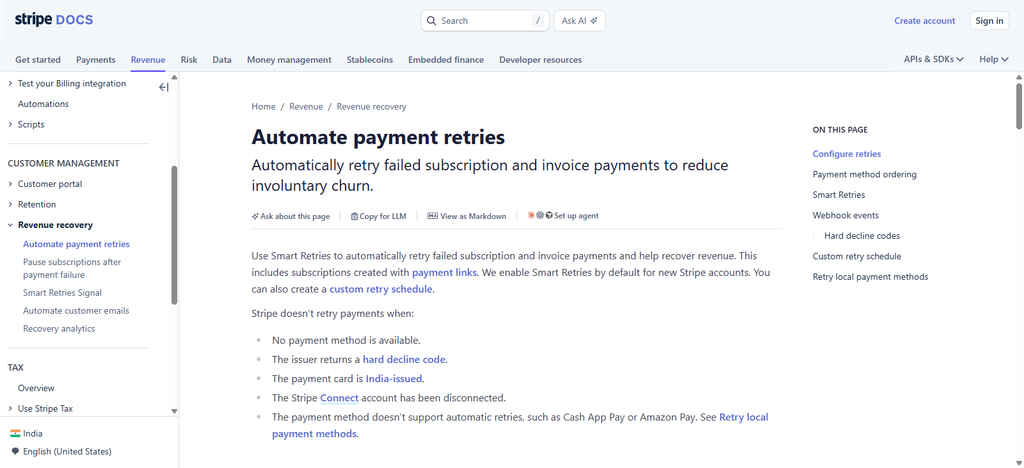
Its payment recovery analytics track failed transactions, recovery rates and recurring revenue performance. Stripe integrates with its payment ecosystem and supports more payment methods.
Subscription churn prevention features include customizable cancelation surveys and recovery workflows. Pricing starts at 0.7% of Billing volume on its pay-as-you-go billing plan with custom enterprise options.
Stripe Billing Smart Retries Features, Pros & Cons
Features
| Features |
|---|
| Machine-learning-based retry scheduling for failed subscription payments. |
| Automatic payment retry attempts based on transaction behavior. |
| Expired card updates through supported card network services. |
| Automated email reminders for unsuccessful payments. |
| Revenue recovery analytics for tracking failed and recovered payments. |
| Customizable dunning and subscription retention workflows. |
Pros & Cons
| Pros | Cons |
|---|---|
| Intelligent retry scheduling improves recovery opportunities. | Best suited to businesses already using Stripe Billing. |
| Built-in payment monitoring and recovery tools. | Advanced customization may require technical configuration. |
| Automatic expired-card updates reduce payment interruptions. | Recovery results depend on card issuer responses. |
| Integrated analytics simplify revenue tracking. | Not every payment failure can be recovered automatically. |
2. Chargebee Revive
ChargeFounded in 2011 , bee built Revive to help subscription businesses recover failed transactions using machine learning and intelligent retry automation. Its system examines 200+ signals including decline codes, payment history, issuer behavior, customer lifetime value and funding cycles.
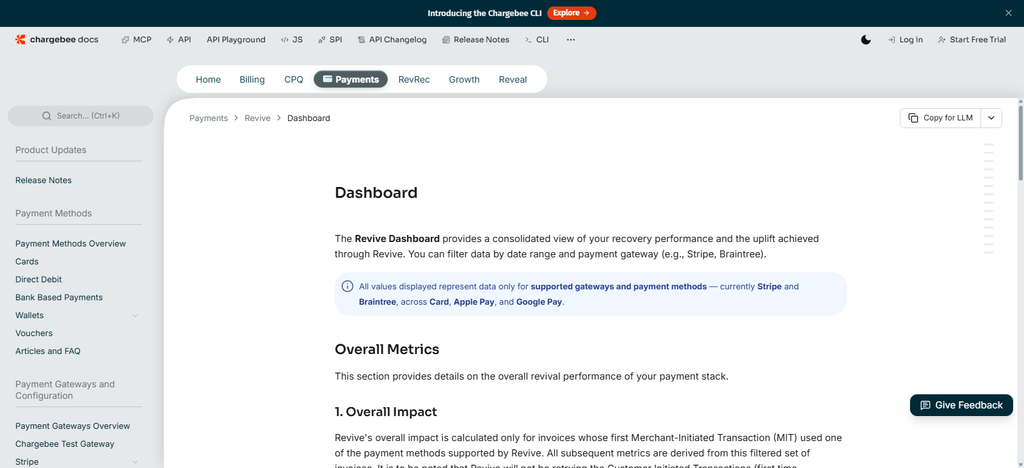
It manages payment failure analysis, automated retries, and smart dunning alerts. Chargebee has recovery analytics in order to monitor recovered invoices, transaction performance, and revenue growth.
Its platform supports Revive with Stripe and Braintree, and Chargebee Billing adds more gateway options. Pricing depends on the billing plan and business requirements, and Revive access is available to Chargebee Billing customers.
Chargebee Revive Features, Pros & Cons
Features
| Features |
|---|
| Machine-learning-based payment recovery and retry optimization. |
| Analysis of payment history and transaction decline signals. |
| Automated retry scheduling for unsuccessful subscription invoices. |
| Customer notifications and dunning workflow automation. |
| Recovery analytics for tracking collected invoices and revenue. |
| Integration with supported billing and payment gateways. |
Pros & Cons
| Pros | Cons |
|---|---|
| Advanced recovery intelligence analyzes multiple payment signals. | Requires Chargebee Billing infrastructure. |
| Automates repetitive payment recovery activities. | Pricing can be difficult to evaluate without a quotation. |
| Helps reduce involuntary subscription churn. | Configuration may require billing expertise. |
| Provides useful payment recovery insights. | Not every gateway supports identical recovery capabilities. |
3. Recurly Revenue Recovery
Recurly was founded in 2009 and offers Revenue Recovery to handle failed subscription payments via automated payment retries and dunning campaigns. It uses intelligent retry capabilities to analyze transaction errors to help businesses choose the right retry strategies.
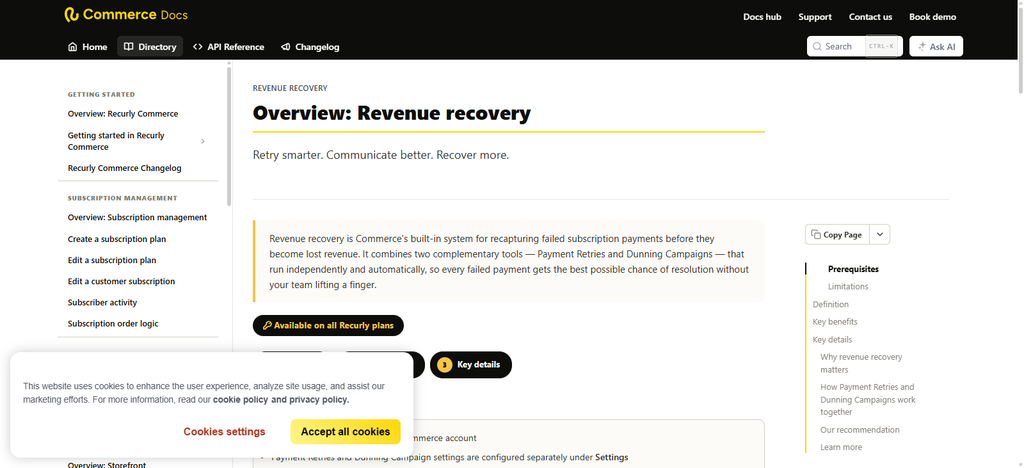
The platform detects payment failures, sends customer notifications and automatically stops recovery communications when payment is successful. Businesses can use its analytics and reporting features to gain insights into subscription performance and revenue recovery.
Recurly subscription platform has support for multiple payment gateways and payment methods. The Starter plan is $249 per month, plus 0.9% of the billing volume; higher-level plans include additional analytics and smart churn prevention features.
Recurly Revenue Recovery Features, Pros & Cons
Features
| Features |
|---|
| Automated payment retries for failed recurring transactions. |
| Configurable retry schedules and dunning management. |
| Declined payment monitoring and recovery workflows. |
| Automated customer communication for outstanding invoices. |
| Subscription analytics and revenue recovery reporting. |
| Payment gateway and recurring billing integrations. |
Pros & Cons
| Pros | Cons |
|---|---|
| Combines subscription billing with payment recovery. | Pricing may be expensive for smaller businesses. |
| Supports configurable dunning strategies. | Advanced functionality may require higher-tier plans. |
| Helps monitor recurring payment performance. | Setup can be complex for new users. |
| Provides subscription and revenue analytics. | Recovery depends on payment method and decline type. |
4. Butter Payments
Payment Recovery Butter Payments Glossary – Payment Recovery Founded in 2020 Payments specializes in recovering subscription revenue through machine learning-based payment optimization. Its Recover platform leverages hundreds of payment variables to identify the right retry opportunities and increase transaction authorization. It keeps tabs on failed payments, takes care of automated retries, and assists businesses in spotting recovery opportunities tied to declines.
Its ButterBoard dashboard shows real-time recovered revenue, recovery rates and recent transaction information. It can integrate with Stripe Billing, Braintree, Recharge, and custom subscription systems via APIs and webhooks. It uses a revenue share model for pricing, where companies pay an agreed upon percentage of the invoice revenue recovered, instead of a fixed public subscription fee.
Butter Payments Features, Pros & Cons
Features
| Features |
|---|
| Machine-learning-based payment recovery optimization. |
| Automated retry timing for unsuccessful transactions. |
| Payment behavior analysis to identify recovery opportunities. |
| Integration with existing subscription billing systems. |
| Real-time revenue recovery and transaction monitoring. |
| Recovery performance tracking through analytics dashboards. |
Pros & Cons
| Pros | Cons |
|---|---|
| Focuses specifically on subscription payment recovery. | Pricing details are not publicly standardized. |
| Uses machine learning for retry optimization. | May require integration assistance. |
| Supports existing billing infrastructure. | Recovery performance depends on transaction quality. |
| Provides revenue recovery visibility. | Less suitable for businesses seeking an all-in-one billing platform. |
5. Churnkey
Churn key, founded in 2020, offers subscription retention automation, failed payment recovery and cancelation prevention. With its platform, businesses can identify failed renewals and launch automated recovery campaigns with workflows that are specific to each customer.
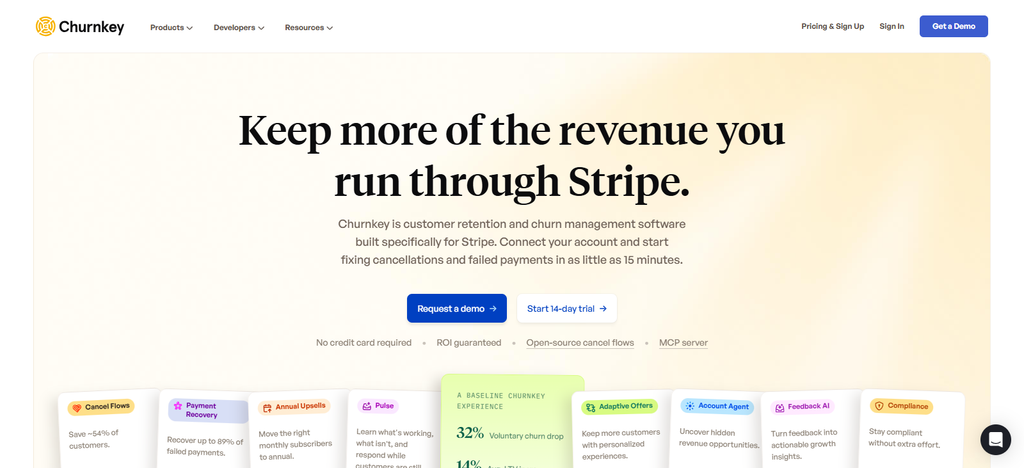
Payment recovery features include retry automation, customized reminders, and payment update experiences. Its retention tools also support cancelation flows, customized offers and subscriber reactivations. Analytics can help businesses track recovered payments, churn patterns and customer retention performance.
Churnkey integrates with Stripe, Chargebee, Braintree and Paddle. Prices are determined by business needs and chosen services. Businesses can request a custom quote to automate payment recovery & retention.
Churnkey Features, Pros & Cons
Features
| Features |
|---|
| Automated failed payment recovery workflows. |
| Customizable payment retry and dunning strategies. |
| Personalized customer payment reminders. |
| Subscription cancellation prevention and retention flows. |
| Recovery analytics and churn performance tracking. |
| Integrations with supported subscription billing platforms. |
Pros & Cons
| Pros | Cons |
|---|---|
| Combines payment recovery with customer retention. | Some advanced capabilities may require higher-tier plans. |
| Supports customizable recovery workflows. | Initial setup may require technical assistance. |
| Helps identify subscription cancellation patterns. | Pricing may be challenging for smaller businesses. |
| Provides useful retention and recovery insights. | Not every feature is available across all integrations. |
6. Churn Buster
Founded in 2013, Buster helps you get back failed subscription payments with automated dunning and customer communication. The platform monitors failed transactions, handles retry of payments and sends branded email and SMS reminders to customers to update payment information.
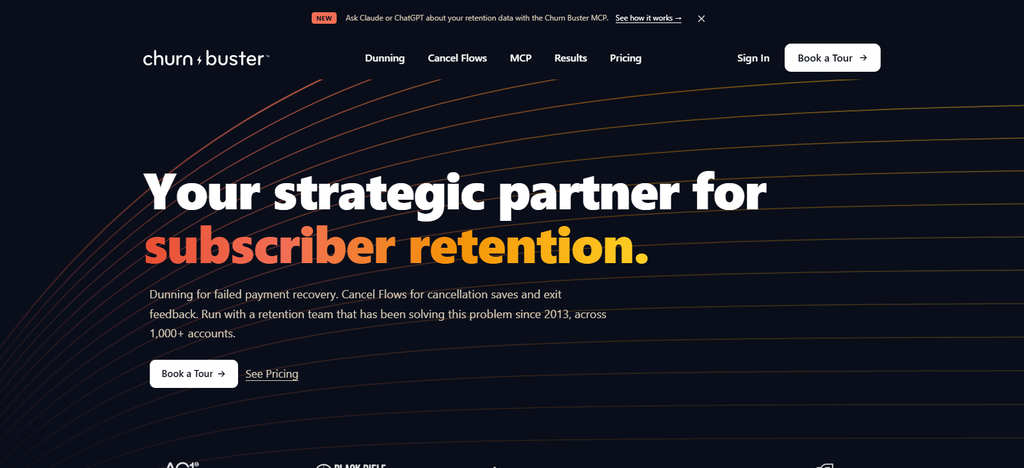
It researches payment issues that are related to decline and helps businesses to handle recovery campaigns without much manual follow-ups. The analytics provide insight into recovery performance, payment performance and campaign performance.
It supports Stripe, Braintree, Recharge, Shopify-related subscription platforms and other billing integrations. Pricing for Dunning or Cancel Flows starts at $269/month, and the combo package starts at $430/month, depending on MRR tiers.
Churn Buster Features, Pros & Cons
Features
| Features |
|---|
| Automated dunning campaigns for failed payments. |
| Email and SMS payment recovery notifications. |
| Customized payment update pages for subscribers. |
| Automated retry and recovery workflow management. |
| Recovery reporting and payment performance analytics. |
| Integration with Stripe, Braintree, and subscription platforms. |
Pros & Cons
| Pros | Cons |
|---|---|
| Strong focus on failed payment recovery. | Pricing can increase with subscription revenue. |
| Supports branded customer communication. | Requires integration with an existing billing system. |
| Provides automated email and SMS reminders. | Advanced customization may need additional setup. |
| Offers payment recovery reporting. | Primarily focused on subscription retention and dunning. |
7. Baremetrics Recover
Founded in 2013, Baremetrics provides Recover, which helps subscription businesses handle failed payments through automated communication with customers. The platform identifies failed subscription transactions and sends email, SMS and in-app reminders to prompt customers to update their payment details.
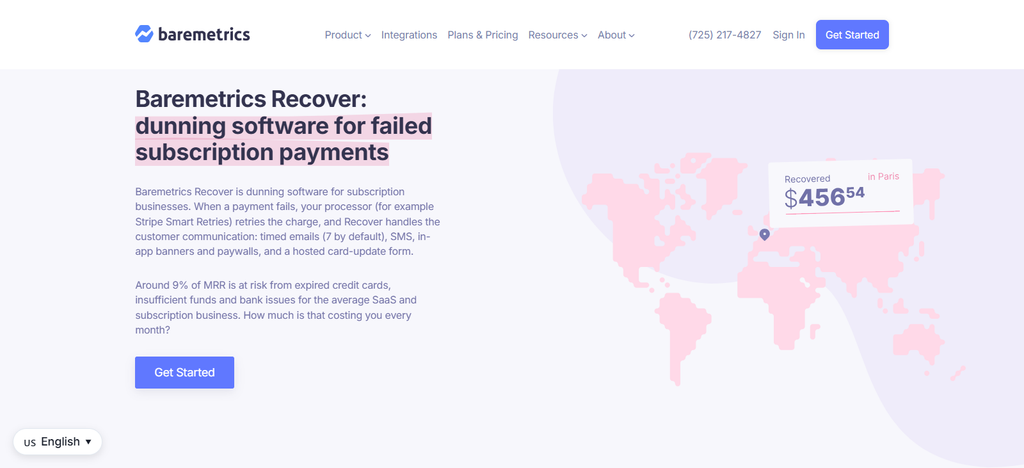
It’s recovery process helps businesses with expired cards, insufficient funds and other payment issues. Baremetrics also offers subscription analytics including monthly recurring revenue, churn, customer lifetime value and payment recovery performance. Recover works with Stripe, Braintree and Recurly. Its published pricing starts at $69/month for businesses up to $10,000 MRR, and scales with MRR.
Baremetrics Recover Features, Pros & Cons
Features
| Features |
|---|
| Automated failed payment recovery campaigns. |
| Email and SMS notifications for payment problems. |
| Customer payment information update workflows. |
| In-app payment recovery experiences. |
| Subscription revenue and churn analytics. |
| Payment recovery performance monitoring. |
Pros & Cons
| Pros | Cons |
|---|---|
| Combines payment recovery with subscription analytics. | Most useful within the supported billing ecosystem. |
| Supports multiple customer notification channels. | Requires a compatible payment platform. |
| Helps monitor recurring revenue and churn. | Additional costs may apply to recovery services. |
| Automates customer payment update reminders. | Less focused on advanced autonomous AI decisions. |
8. Paddle Retain
Founded in 2012, Paddle built Retain to help subscription businesses reduce involuntary churn and recover failed recurring payments. Its platform uses intelligent retry algorithms that consider decline reasons, card types, buyer locations and other transaction signals.
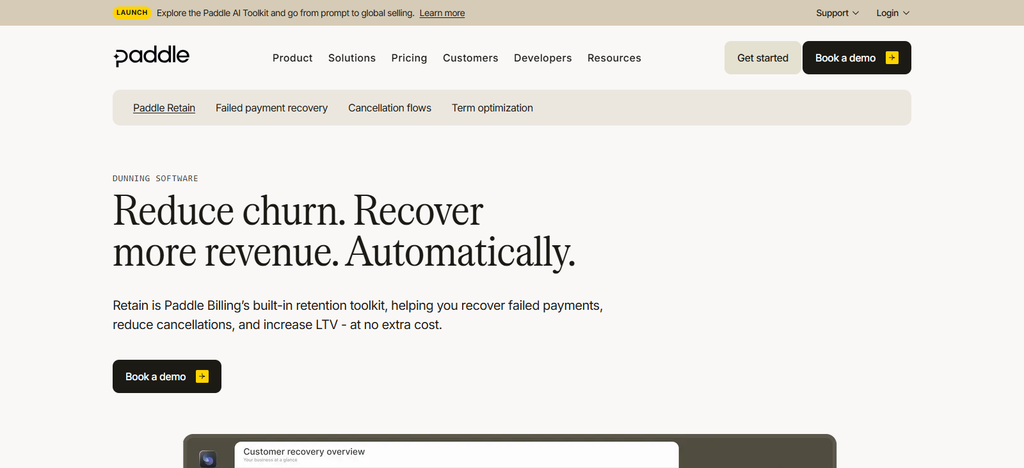
It automatically handles payment retries, dunning emails and in-app notifications to nudge users to update their payment method. Analytics helps businesses understand how well they are recovering and retaining subscribers.
Paddle Retain connects directly to Paddle Billing and interoperates with third-party platforms including Stripe Billing, Chargebee, Recurly, Braintree and Zuora. Retain does not have a separate published universal price, and prices vary based on the selected Paddle services and commercial arrangement.
Paddle Retain Features, Pros & Cons
Features
| Features |
|---|
| Intelligent retry scheduling for unsuccessful payments. |
| Automated dunning and customer communication. |
| Payment decline analysis and recovery optimization. |
| Customer payment update notifications. |
| Subscription retention and involuntary churn reduction. |
| Recovery performance and subscription analytics. |
Pros & Cons
| Pros | Cons |
|---|---|
| Integrates with Paddle’s subscription billing ecosystem. | Most convenient for businesses using Paddle Billing. |
| Supports automated payment recovery. | External billing integrations may require separate arrangements. |
| Helps reduce involuntary subscription cancellations. | Standalone pricing is not universally published. |
| Combines billing and retention capabilities. | Recovery options depend on supported payment integrations. |
9. Zuora Billing
2007 saw the launch of Zuora, a provider of enterprise subscription billing, payment collection and recurring revenue management. Its Payment Retry capabilities allow businesses to track declined transactions due to insufficient funds, expired cards and network errors.
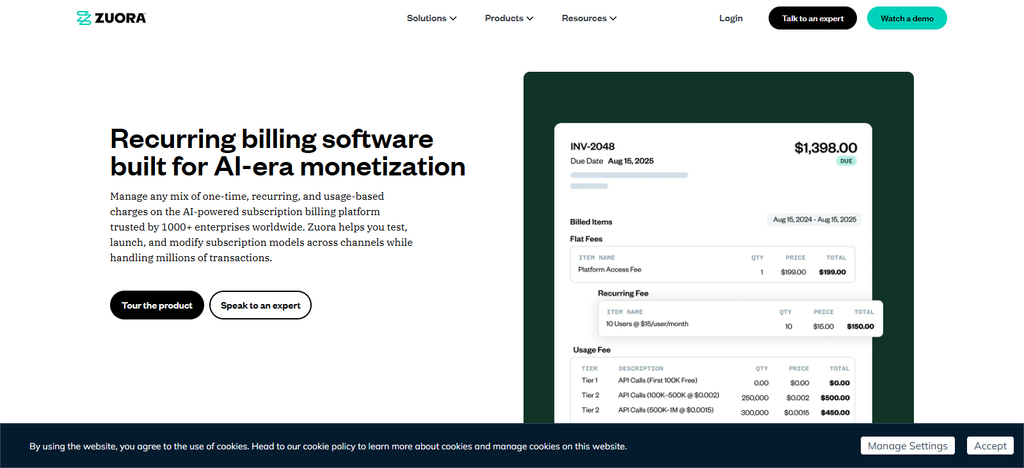
To improve payment collection, companies can implement retry schedules or use AI-based smart retry logic. It also has payment orchestration capabilities that support cascading payment methods if configured. Analytics and reporting help finance teams track billing performance, collections, and subscription revenue.
Zuora can connect with several payment gateways and enterprise systems. Pricing is custom and based on quotation considering complexity of billing, volume of transactions, modules selected and enterprise requirements.
Zuora Billing Features, Pros & Cons
Features
| Features |
|---|
| Automated recurring billing and subscription payment management. |
| Configurable payment retry and collection workflows. |
| Payment failure monitoring and transaction status tracking. |
| Payment orchestration across supported payment gateways. |
| Revenue analytics and financial reporting capabilities. |
| Enterprise subscription management and revenue recognition support. |
Pros & Cons
| Pros | Cons |
|---|---|
| Suitable for complex enterprise subscription operations. | Pricing is generally custom and quotation-based. |
| Supports multiple payment processing integrations. | Implementation can require significant technical resources. |
| Offers comprehensive billing and revenue management. | May be excessive for small subscription businesses. |
| Provides detailed financial and subscription reporting. | Advanced configuration can increase operational complexity. |
10. FlyCode
FlyCode is an AI-powered payment recovery platform founded in 2022 as per the company information. It helps subscription businesses recover failed transactions by using machine-learning models and payment optimization technology.
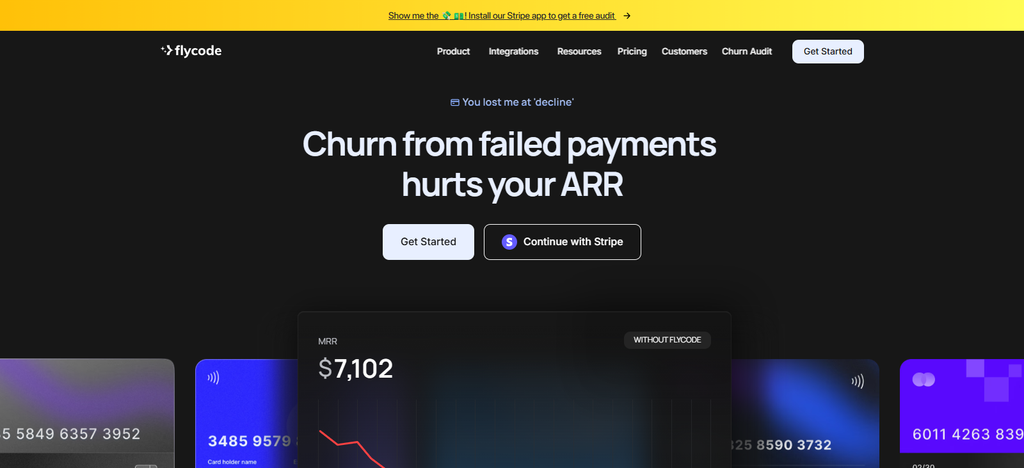
It uses a system that looks at payment behavior and card-network signals to figure out better retry timing and synchronize recovery attempts with customer outreach. This offers automated retry schedules, personalized recovery workflows, and payment performance monitoring. Its reporting dashboard monitors recovered revenue and recovery outcomes.
FlyCode integrates with existing billing systems such as Stripe integrations and offers custom integration options. It is based on a outcome-based model, which is based on incremental revenue recovered above an agreed baseline, rather than a standard fixed monthly subscription.
FlyCode Features, Pros & Cons
Features
| Features |
|---|
| Machine-learning-based payment recovery optimization. |
| Automated retry strategies for failed transactions. |
| Payment behavior analysis for recovery opportunities. |
| Integration with supported subscription billing systems. |
| Revenue recovery monitoring and performance tracking. |
| Outcome-based payment recovery pricing model. |
Pros & Cons
| Pros | Cons |
|---|---|
| Focuses on recovering failed subscription revenue. | Pricing requires direct commercial clarification. |
| Uses machine learning for payment optimization. | Integration compatibility should be verified. |
| Outcome-based pricing can align vendor incentives with recovery. | Recovery results are not guaranteed. |
| Can complement existing billing infrastructure. | Less suitable for businesses seeking a complete billing platform. |
Conclusion
AI Agents to monitor failed subscription payments help businesses detect failed transactions, automate retries of payments, recover recurring revenue and reduce involuntary customer churn. There are different methodologies for payment monitoring and recovery automation, with tools like Stripe Billing Smart Retries , Chargebee Revive , Recurly Revenue Recovery , Butter Payments , and Churnkey .
Some concentrate on timing smart retries while others provide customer notifications, billing analytics and subscription retention tools.
Businesses should compare everything from payment gateway integrations to AI capabilities, recovery performance, analytics and pricing before choosing a platform. Choosing the right solution can help increase payment success rates, protect recurring revenue and deliver a more seamless subscription experience.
FAQ
What Are AI Agents for Monitoring Failed Subscription Payments?
AI agents for monitoring failed subscription payments are software solutions that detect unsuccessful transactions, analyze decline reasons, automate payment retries, and help businesses recover recurring revenue.
How Do AI Agents Detect Failed Subscription Payments?
They monitor billing transactions, payment gateway responses, decline codes, expired cards, and unsuccessful renewals to identify payment failures and trigger appropriate recovery workflows.
Can AI Agents Automatically Retry Failed Payments?
Yes. Many platforms use intelligent retry scheduling to select suitable retry times based on transaction history, decline reasons, payment behavior, and other available signals.
How Do AI Agents Reduce Subscription Churn?
They reduce involuntary churn by automating payment reminders, retry attempts, card updates, and customer notifications, helping subscribers resolve billing issues before their subscriptions are cancelled.