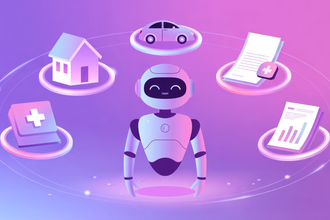


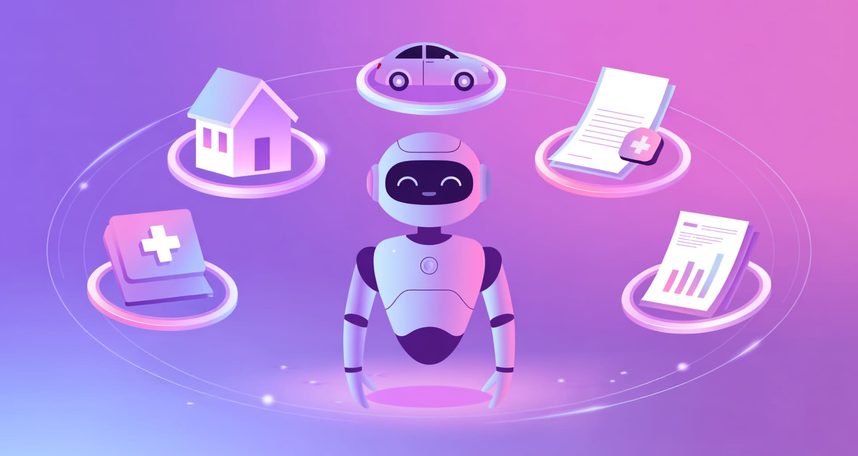
In this article, I will discuss the Best AI Agents for Insurance Inquiry Routing that helps insurance agencies to automate customer inquiries, qualify potential leads and connect customers with the right brokers. We will examine their key features, pricing, CRM integrations, omnichannel support, routing accuracy, and broker-matching capabilities to help insurance companies select the right AI solution.
Why Use AI Agents for Insurance Inquiry Routing
Faster Inquiry Handling: AI agents automatically receive, analyze and categorize incoming insurance inquiries, eliminating the need for manual processing and helping customers connect with appropriate brokers faster.
Better lead qualification: AI agents gather key customer information such as insurance needs, coverage preferences, location, and urgency, enabling brokers to prioritize more relevant leads.
Exact Broker Pairing: AI-powered routing determines broker expertise, insurance specialization, availability, and location requirements to direct inquiries to the right insurance professionals.
Continuous Customer Support: Automated agents can handle initial customer inquiries outside of business hours, collect lead information, and schedule follow-up appointments without constant human supervision.
Less Manual Work: AI automates repetitive tasks like inquiry classification, information gathering, lead assignment, and follow-up notices, freeing up insurance teams to focus on customer relationships.
Better Customer Experience: Customers get faster responses, relevant information, and better broker connections, avoiding unnecessary transfers and repetitive communication during the inquiry.
Efficient Lead Distribution: AI agents distribute incoming inquiries based on configurable assignment rules, broker availability, workload, and specialization, allowing insurance agencies to better manage lead volumes.
Better performance tracking: AI reporting allows agencies to monitor response times, lead qualification, broker assignments, unresolved inquiries, and conversion performance to find areas to improve operations.
Benefits Of AI Agents for Insurance Inquiry Routing
More Lead Conversions: AI-driven agents can determine customer intent, gather the required insurance information, and send qualified leads to the appropriate brokers, enabling agencies to boost their conversion rates from prospects to clients.
Quicker Response Times: Automation of inquiries enables insurance companies to respond to inquiries, ascertain customer needs, and allocate leads faster, without waiting for manual review or for a broker to be available.
Personalized Customer Interactions: AI agents analyze client preferences, coverage requirements, and previous interactions to provide relevant responses and connect individuals with brokers who understand their insurance needs.
Increased Broker Productivity: AI also helps by automating initial conversations, lead qualification and inquiry distribution, cutting down on administrative work and freeing brokers up to spend more time advising customers and discussing policies.
Better Lead Management: Typical artificial intelligence systems classify customer inquiries, track interactions, identify duplicate requests, and monitor assignment status, enabling insurance agencies to effectively manage their sales pipelines.
Scalable Insurance Operations AI-powered routing allows agencies to manage growing customer inquiries across insurance types, communication channels, and locations while preserving lead distribution and service workflows.
Key Points
| AI Agent | Key Strength for Insurance Inquiry Routing |
|---|---|
| Guidewire Insurance AI | Insurance-native triage, claims, and policy servicing workflows |
| Salesforce Agentforce Insurance Service Assistant | AI-powered insurance service routing and policyholder support |
| Microsoft Copilot Service Agent | Intelligent case routing and customer service assistance |
| ServiceNow AI Agents | Automated case triage, categorization, and workflow routing |
| Genesys Agentic Insurance Solution | AI-driven inquiry routing across claims and policy servicing |
| NICE CXone AI Routing | Predictive customer-to-agent matching and insurance inquiry routing |
| Cognigy AI Agents for Insurance | Insurance-specific conversational routing and self-service |
| Pega Customer Service AI | AI-powered service orchestration and work distribution |
| IBM watsonx Assistant & Orchestrate | Omnichannel inquiry handling and agent assistance |
| Zendesk AI Agents | Automated inquiry classification, routing, and resolution |
1. Guidewire Insurance AI
Founded: 2001 | Best for: Property & Casualty insurance operations
Guidewire offers software for insurance such as InsuranceSuite, InsuranceNow, and AI-based underwriting and digital engagement capabilities. The company, founded in 2001, supports policy administration, billing, claims, pricing and underwriting workflows.
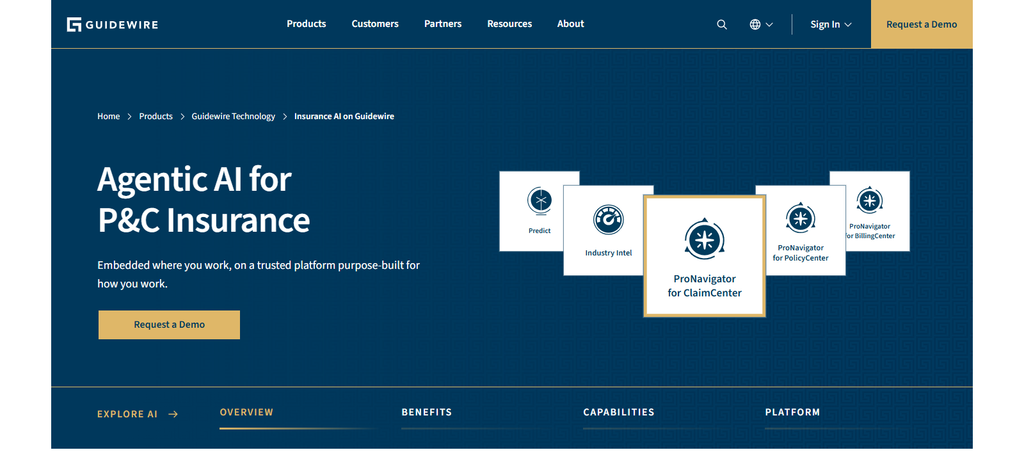
Insurers can use connected digital engagement and workflow capabilities to route inquiries by triaging customer requests, determining insurance needs and routing cases to the correct agency or service teams. Don’t assume broker matching is an automatic native feature.
It should be built around insurance products, customer information, and business rules. Enterprise implementation options, omnichannel engagement, and system integrations and CRM are a benefit to larger insurers. Prices are quoted per quote.
| Key Features | Explanation |
|---|---|
| Insurance-Specific AI | Uses insurance-focused data and workflows to support underwriting, claims, policy servicing, and customer service operations. |
| Intelligent Submission Processing | Extracts, summarizes, and organizes insurance submission information to help teams review incoming requests and assess risks. |
| AI-Powered Risk Assessment | Provides risk insights and predictive information that help underwriters evaluate applications and prioritize submissions. |
| Broker Workflow Support | Helps improve broker interactions through submission summaries, underwriting insights, and connected insurance workflows. |
| AI Agent Framework | Allows insurers to build, deploy, connect, and govern AI agents within a controlled insurance technology environment. |
2.Salesforce Agentforce Insurance Service Assistant
Founded: 1999 | Best for: Insurance agencies using Salesforce CRM
Salesforce Agentforce can help manage insurance inquiries with conversational AI, CRM data, automated workflows and service interactions. Founded in 1999, Salesforce offers a platform to gather customer information, identify insurance needs, qualify possible leads and assign inquiries through configurable automation.
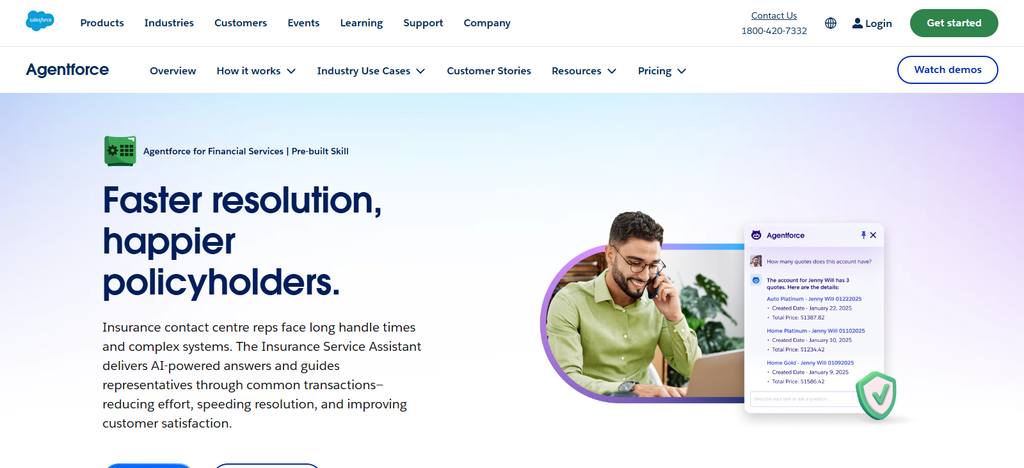
When these fields and workflows are properly configured, broker matching may utilize CRM records, product expertise, territory, availability and assignment rules. Its ecosystem supports sales, service, messaging and 3rd party integrations.
Omnichannel capabilities help you manage customer interactions across the channels you support. Prices depend on the Salesforce edition, the use of Agentforce and the implementation requirements, and you should test, rather than assume, routing accuracy for insurance-specific needs.
| Key Features | Explanation |
|---|---|
| Insurance Policy Summaries | Generates summaries of policyholder portfolios, associated policies, assets, and insurance coverage for service representatives. |
| Quote Information Analysis | Provides overviews of insurance quotes, including related details, line items, and policy relationships. |
| AI-Powered Customer Assistance | Helps insurance representatives access relevant customer information and respond to service inquiries more efficiently. |
| CRM-Based Lead Management | Uses Salesforce customer records and workflows to organize inquiries, maintain lead information, and support customer follow-ups. |
| Automated Service Workflows | Supports configurable AI-driven service processes, customer communications, and insurance-related task management. |
3. Microsoft Copilot Service Agent
Founded: 1975 | Best for: Microsoft-based insurance service operation
Microsoft provides Copilot Studio and customer service agent capabilities that organizations can configure for insurance inquiry handling. Founded in 1975, Microsoft offers AI tools to interpret customer questions, extract policy requirements, automate responses and connect workflows with business applications. An insurance agency could set up qualification questions concerning policy type, location, coverage needs, and urgency before routing an inquiry to the relevant broker or department.
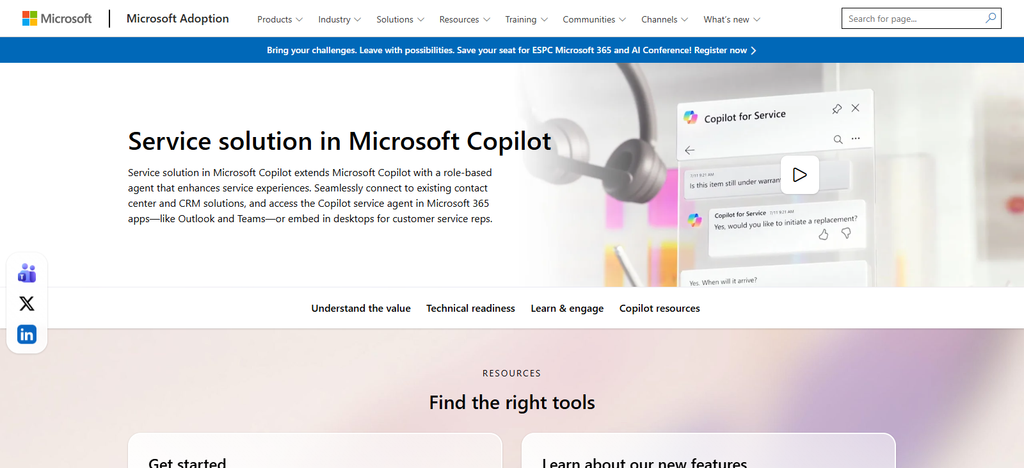
Integrations can be supported by Microsoft Dynamics 365, Power Platform, Teams, and external APIs. Multichannel deployment is configuration dependent. Prices vary depending on the Copilot product, license, and usage. The accuracy of broker matching depends on the quality of routing rules and connected data.
| Key Features | Explanation |
|---|---|
| Conversational AI Assistance | Understands customer questions and provides automated responses using connected business information and knowledge sources. |
| Custom AI Agent Creation | Allows insurance businesses to create agents tailored to specific inquiry types, customer requirements, and service workflows. |
| Automated Lead Qualification | Can collect customer information and ask configured questions about insurance products, coverage needs, and inquiry requirements. |
| Human Agent Handoff | Transfers conversations to human service representatives through supported customer engagement platforms when additional assistance is required. |
| Microsoft Ecosystem Integration | Connects with Microsoft business applications and external systems to support customer data access and workflow automation. |
4. ServiceNow AI Agents
Founded 2004 | Perfect for Enterprise workflow automation
ServiceNow employs its Now Platform and Now Assist ecosystem to provide AI agents and workflow automation capabilities. ServiceNow was founded in 2004 to help organizations manage service requests, automate repetitive tasks, coordinate workflows, and connect business departments.
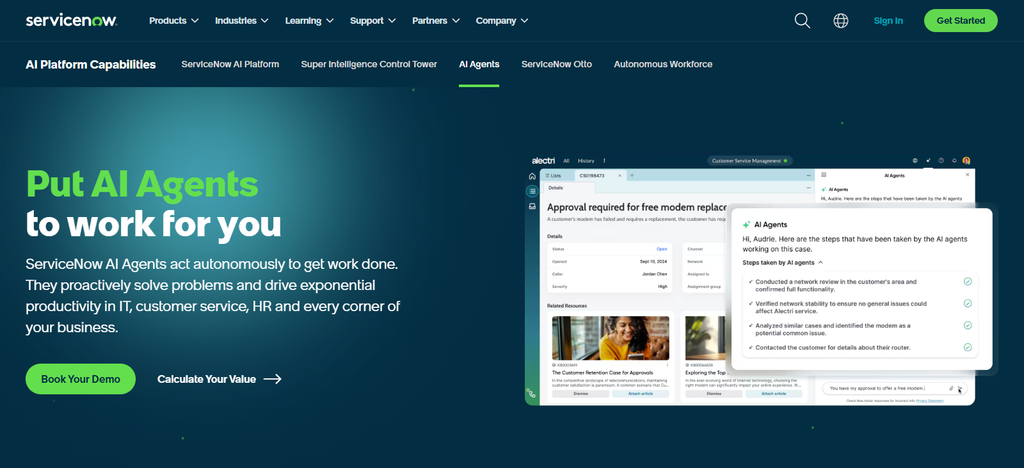
Insurance agencies can use AI agents to categorize incoming queries, gather customer information, prioritize leads and route requests to brokers based on insurance specialty, territory, and availability. CRM and enterprise application integration can help share information about customers.
Its workflow capabilities also assist with escalation and reassignment. Pricing is usually customized for enterprise needs and insurance-specific broker matching is configured and tested.
| Key Features | Explanation |
|---|---|
| AI Workflow Automation | Automates repetitive service tasks, customer requests, and business processes through configurable AI agents. |
| Intelligent Request Classification | Helps categorize incoming requests based on customer intent, request type, and predefined workflow rules. |
| Automated Case Management | Organizes service cases, tracks inquiry progress, and supports escalation when additional attention is required. |
| Enterprise System Connectivity | Connects business applications and workflows to improve information exchange between customer service and operational teams. |
| AI Agent Orchestration | Coordinates AI agents and automated workflows to support complex service operations and controlled task execution. |
5. Genesys Agentic Insurance Solution
Founded: 1990 | Best for: Insurance contact centers, and customer interaction
Genesys delivers AI-powered customer experience automation with Genesys Cloud and its agentic AI features. Established in 1990, the company specializes in contact center operations, conversational automation, workforce engagement, and intelligent interaction routing.
Insurance organizations can establish these capabilities to understand customer inquiries across voice and digital channels, capture policy requirements and route conversations to the appropriate licensed brokers or service representatives.
Skills-based routing, customer context and interaction history can improve assignment decisions. CRM integration for lead management and follow ups. Pricing varies based on the platform edition, the usage and deployment requirements. Real broker matching accuracy depends on the configured skills and business rules.
| Key Features | Explanation |
|---|---|
| Intelligent Interaction Routing | Directs customer conversations toward suitable service representatives based on skills, availability, and configured routing requirements. |
| AI-Powered Voice Assistance | Supports automated voice interactions that help customers communicate insurance questions and service requirements. |
| Omnichannel Customer Engagement | Coordinates customer interactions across supported voice and digital communication channels. |
| Agentic Workflow Automation | Uses AI-driven workflows to automate selected customer service activities and coordinate human assistance. |
| Customer Context Management | Helps representatives access interaction history and customer information for more informed conversations and smoother handoffs. |
6. NICE CXone AI Routing
Established: 1986 | Ideal for: Handling high volumes of insurance queries
NiCE provides CXone AI for customer interaction management, intelligent routing and contact center automation. Founded in 1986, NiCE supports organizations that handle a large volume of customer conversations across multiple communication channels.
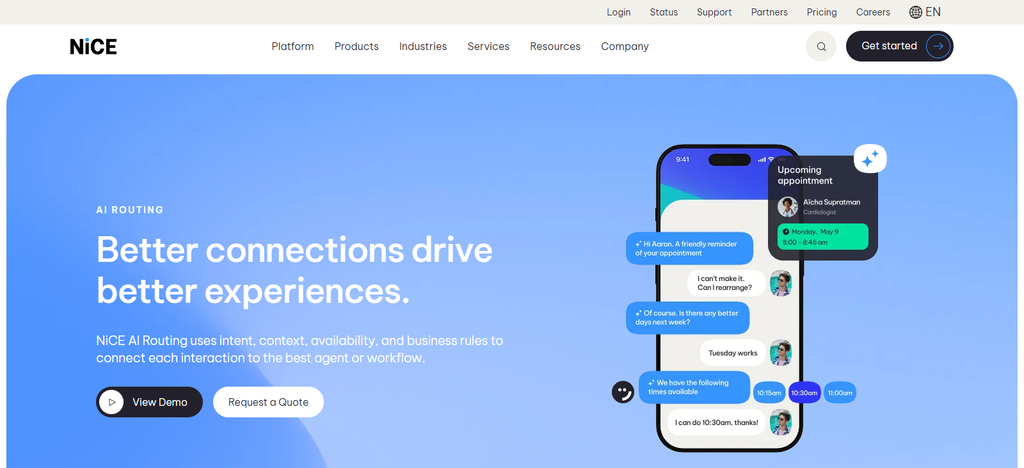
Insurance agencies can set routing up depending on the intent of the inquiry, broker skills, customer priority, availability, and interaction history. AI-powered automation can help with initial customer inquiries, lead qualification and escalation to human representatives.
CRM and contact center integrations keep the customer context throughout the conversation. Prices vary depending on the CXone products, licensing and usage. The routing performance should be evaluated in terms of the assignment accuracy, the response times and the broker acceptance data.
| Key Features | Explanation |
|---|---|
| Intelligent Call Routing | Routes customer calls according to configured skills, customer intent, priority, and agent availability. |
| AI-Powered Self-Service | Uses conversational AI capabilities to handle routine customer questions and reduce manual service workloads. |
| Real-Time Interaction Management | Coordinates customer interactions and agent workflows to support efficient contact center operations. |
| Workforce Optimization | Provides workforce management and performance tools to help organizations manage service capacity and agent productivity. |
| AI and Human Coordination | Supports coordination between automated AI experiences and human representatives when inquiries require additional attention. |
7. Cognigy AI Agents for Insurance
Founded: 2016 | Best for: Conversational AI and handling inquiries in multiple languages
Cognigy’s conversational AI agents automate customer interactions, using voice and chat experiences. Founded in 2016, the company provides tools for building automated conversations, understanding customer intent and connecting AI workflows to enterprise systems.
Insurance companies can build agents to identify whether a customer requires auto, health, life, home or commercial insurance, gather the right information, and route questions to the right brokers. Use API connectivity and back-end integrations to update your CRM, qualify leads and run appointment workflows.
Multilingual capabilities assist organizations to serve diverse customers. Pricing is quote-based and aimed at enterprises. It brokers matching based on custom routing logic, integrations and verified broker information.
| Key Features | Explanation |
|---|---|
| Insurance-Specific AI Agents | Provides insurance-focused agents for policy questions, first notice of loss, claims processing, and customer assistance. |
| Automated Document Collection | Collects and processes customer documents to support insurance inquiries and claims-related workflows. |
| First Notice of Loss Automation | Helps capture initial incident information and guide customers through the claims reporting process. |
| Multilingual Conversational AI | Supports automated customer conversations through voice and chat experiences in multiple languages. |
| Insurance Workflow Integration | Connects conversational AI with business systems to support information collection, task execution, and customer service automation. |
8. Pega Customer Service AI
Founded: 1983 | Best for: Complex insurance customer service processes
Powered by Pega Platform capabilities and customer service, Pega delivers AI-powered customer service and workflow automation. Founded in 1983, Pega helps organizations manage customer interactions, automate decisions and orchestrate complex service processes.
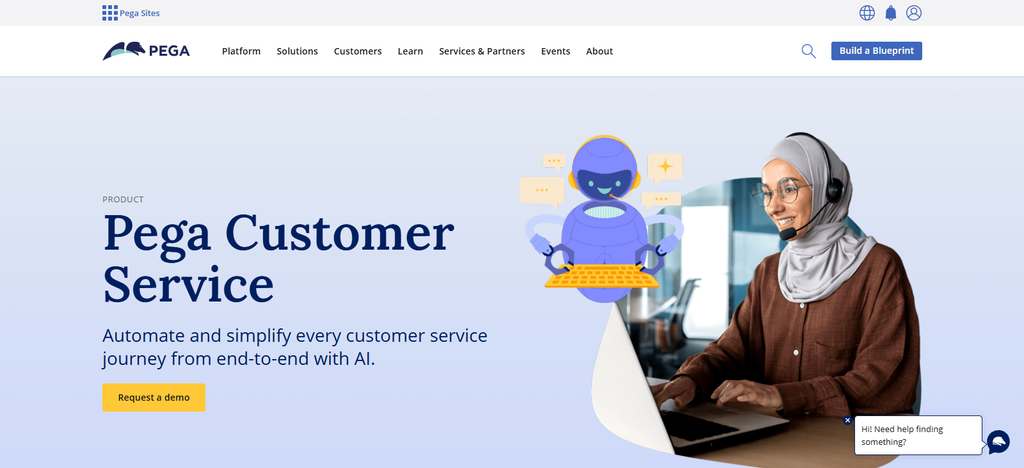
Insurance organizations can set up workflows to classify incoming inquiries, gather customer information, establish urgency, and route cases based on broker specialization and business rules. Its decisioning and case management capabilities can support lead prioritization, escalation and reassignment.
Enterprise integrations and CRM allow you to connect customer records across departments. Prices are based on enterprise licensing and deployment needs. The actual broker matching depends on the configured decision strategies and the available customer data.
| Key Features | Explanation |
|---|---|
| AI-Powered Case Management | Organizes customer inquiries into structured cases and helps service teams manage complex requests. |
| Intelligent Decisioning | Uses configurable decision strategies to determine appropriate next steps based on customer information and business rules. |
| Automated Customer Service | Supports conversational assistance, service automation, and responses to common customer questions. |
| Lead and Inquiry Prioritization | Can prioritize customer requests using configured business criteria, customer context, and workflow requirements. |
| Workflow and CRM Connectivity | Connects service processes with enterprise systems to support customer records, case updates, and automated handoffs. |
9. IBM watsonx Assistant & Orchestrate
Founded: 1911 (IBM) | Ideal for: Enterprise AI and workflow orchestration
IBM has watsonx Assistant for conversational automation and watsonx Orchestrate for enterprise workflow orchestration. IBM was founded in 1911 and has standard artificial intelligence (AI) technology that organizations can configure to answer insurance questions, understand customer intent, collect policy information and automate service tasks.
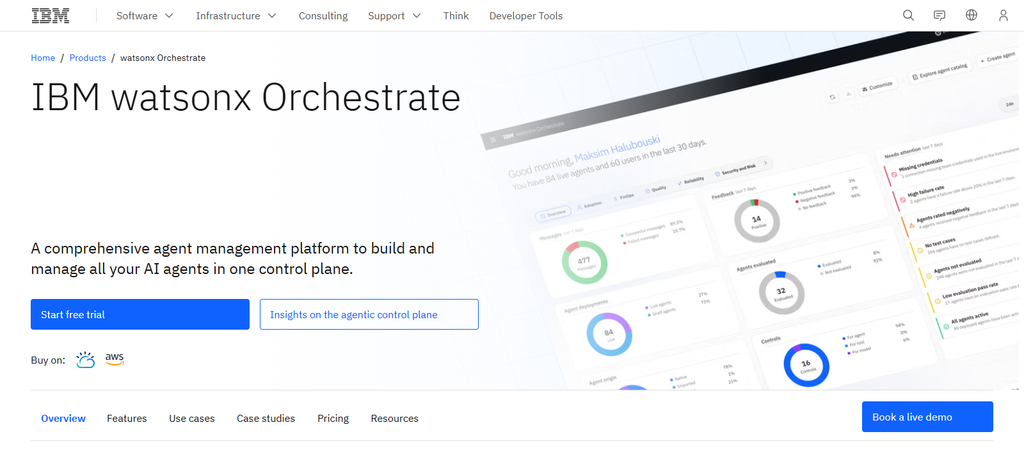
Insurance agencies can link these capabilities to CRM databases and internal systems to qualify leads and route requests based on broker expertise, location and availability. Integration capabilities enable automated workflows and customer information exchange.
The actual products and configuration you choose determine your omnichannel deployment. The price depends on the product, deployment and usage. Broker matching accuracy depends on having the right data and tested routing rules.
| Key Features | Explanation |
|---|---|
| Conversational AI Assistant | Helps customers interact with automated assistants to ask questions and receive relevant information from connected knowledge sources. |
| AI Agent Orchestration | Coordinates multiple AI agents and workflows through a centralized management environment. |
| Automated Business Workflows | Connects AI agents with business applications to automate selected customer service and operational activities. |
| Enterprise Integration | Supports connections with enterprise applications, APIs, and business systems for information exchange and task execution. |
| AI Governance and Monitoring | Provides capabilities for managing agent access, monitoring activity, evaluating performance, and applying governance controls. |
10. Zendesk AI Agents
Founded: 2007 | Best for: Small and midsized insurance agencies
Zendesk offers AI agents to automate customer conversations across messaging, email, web forms and voice. Founded in 2007, Zendesk helps insurance agencies manage incoming inquiries, sort customer requests, automate responses and organize support tickets.
Agencies can set up workflows that gather insurance requirements, qualify leads, and route tickets to brokers or reps based on skills, priority and availability rules. Its omnichannel routing,
APIs and third-party integrations enable connected customer service operations. The Suite Team is $55 per agent per month when billed annually with higher tiers available. Broker matching for insurance needs requires custom workflows and CRM integration.
| Key Features | Explanation |
|---|---|
| Automated Customer Conversations | Handles customer inquiries across supported messaging, email, web forms, and voice channels. |
| AI-Powered Ticket Classification | Helps categorize and organize incoming customer requests to support more efficient ticket management. |
| Automated Customer Responses | Uses trusted knowledge sources to answer common questions and resolve eligible customer service requests. |
| Workflow and API Integration | Connects AI agents with authorized business systems and APIs to perform configured actions and update customer information. |
| AI Performance Analytics | Tracks automated resolutions and provides reporting capabilities to help organizations evaluate customer service automation. |
Conclusion
AI agents are transforming how insurance agencies tackle incoming inquiries, qualify potential clients, and connect them with the right brokers. There are many other platforms like Guidewire, Salesforce Agentforce, Microsoft Copilot, ServiceNow, Genesys, NICE CXone, Cognigy, Pega, IBM watsonx, Zendesk, etc. that offer a wide range of functionalities that can automate customer interactions and improve inquiry management.
Agencies should consider broker matching, lead qualification, routing accuracy, CRM integrations, omnichannel support, pricing and data security when selecting an AI agent. The right solution can reduce manual effort, reduce response times, prevent missed inquiries, and provide a better insurance customer experience.
FAQ
What Are AI Agents for Insurance Inquiry Routing?
AI agents for insurance inquiry routing are automated systems that understand customer questions, identify insurance requirements, qualify potential leads, and direct inquiries to suitable brokers or insurance representatives.
How Do AI Agents Match Insurance Inquiries With the Right Broker?
AI agents analyze insurance type, customer location, coverage requirements, broker expertise, licensing eligibility, and availability to assign inquiries through configured matching and routing rules.
Which Are the Best AI Agents for Insurance Inquiry Routing in 2026?
Some notable platforms include Guidewire Insurance AI, Salesforce Agentforce, Microsoft Copilot, ServiceNow AI Agents, Genesys, NICE CXone, Cognigy, Pega, IBM watsonx, and Zendesk AI Agents.
Can AI Agents Automatically Qualify Insurance Leads?
Yes. Configured AI agents can collect customer details, identify insurance needs, ask qualification questions, assess lead priority, and prepare relevant information before transferring inquiries to brokers.