


In this article, I will to talk about the Best AI Cybersecurity Tools for preventing Deepfakes & Phishing as a result advanced artificial intelligence is changing digital security.
As cybercriminals leverage the power of A.I. to generate polished scams, organizations will need more sophisticated defense systems.
In this guide, we examine the powerful AI-driven cybersecurity solutions that detect threats earlier, prevent fraud, and protect businesses against ever-evolving attacks online.
Key Point & Best AI Cybersecurity Tools to Stop Deepfakes & Phishing
| AI Cybersecurity Solution | Key Points |
|---|---|
| Microsoft Defender for Endpoint AI | AI-driven threat detection, phishing protection, endpoint security monitoring, automated incident response, deep integration with Microsoft ecosystem |
| ZeroFox Deepfake Detection | Detects deepfake media, protects executives from impersonation attacks, social media monitoring, real-time brand protection |
| Darktrace PREVENT AI | Self-learning AI, predicts cyber risks before attacks, behavioral threat analysis, proactive vulnerability management |
| Proofpoint Threat Protection AI | Advanced phishing detection, email fraud prevention, AI-powered threat intelligence, employee risk analysis |
| Symantec Email Security AI | Malware and phishing filtering, email anomaly detection, cloud email protection, real-time threat blocking |
| IBM Watson for Cybersecurity AI | AI threat intelligence analysis, automated incident investigation, security data correlation, faster SOC response |
| SentinelOne Singularity Platform AI | Autonomous endpoint protection, ransomware detection, behavioral AI analysis, automated remediation |
| Fortinet FortiMail AI | AI-powered email filtering, anti-phishing protection, business email compromise prevention, threat sandboxing |
| Check Point Harmony Email & Collaboration AI | Prevents phishing and impersonation attacks, deepfake email detection, cloud collaboration security |
| Trend Micro Vision One AI | XDR threat detection, AI attack correlation, phishing and deepfake monitoring, centralized security visibility |
1. Microsoft Defender AI
Microsoft Defender AI delivers enterprise-grade protection using the synergy of endpoint security, behavioral analytics, and cloud-infused threat intelligence. It constantly monitors devices, identities, and applications for phishing attempts, credential theft, and AI-generated impersonation attacks.
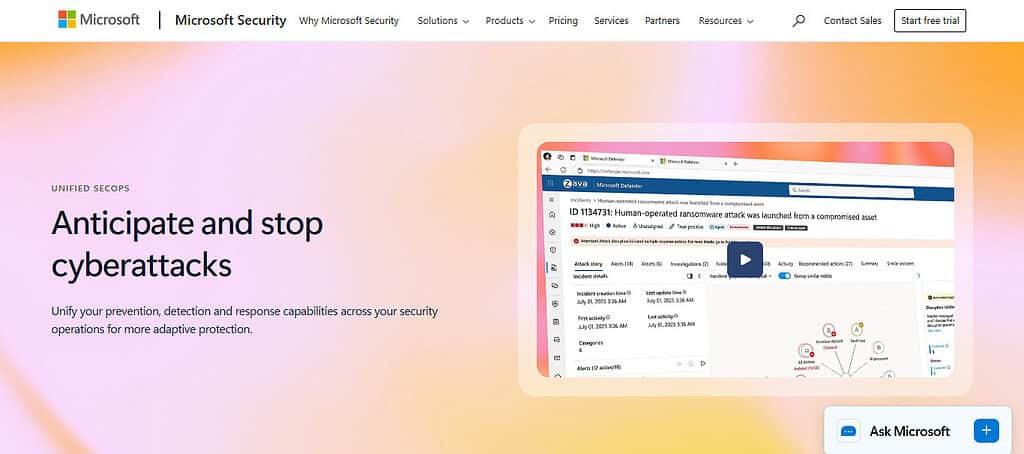
The platform uses machine learning models that have been trained on global attack data to automatically isolate threats and minimize response time. As organizations are looking for Best AI Cybersecurity Tools to Stop Deepfakes & Phishing, Defender rises about the noise because of its deep integration on Microsoft 365, Azure, and Windows. Ideal for modern hybrid workplaces with support for automated remediation, zero-trust architecture, and real-time attack visualization.
Microsoft Defender for Endpoint AI Features
- Artificial intelligence–based endpoint threat detection and response (EDR)
- Protection against phishing and malware in real time on all your devices
- Detection of deepfake-driven attacks with behavioral analytics
- Automated threat investigation and remediation
- Integration with Microsoft 365, cloud apps, and.identity security
Microsoft Defender AI
| Pros | Cons |
|---|---|
| Deep integration with Microsoft 365 ecosystem | Best performance mainly in Microsoft environments |
| AI-powered threat detection and response | Advanced features require premium licensing |
| Strong phishing and malware protection | Complex configuration for beginners |
| Real-time endpoint and identity protection | Limited customization outside Microsoft stack |
| Automated investigation and remediation | Can generate false positives initially |
2. ZeroFox Deepfake Detection
ZeroFox specializes in identifying deepfake content and digital impersonation threats against brands and executives. Its A.I. combs through social media, dark web forums and online platforms to detect manipulated videos, cloned voices and phony accounts before they inflict reputational harm. Sophisticated computer vision algorithms scrutinize facial discrepancies, voice inconsistencies and metadata signatures.
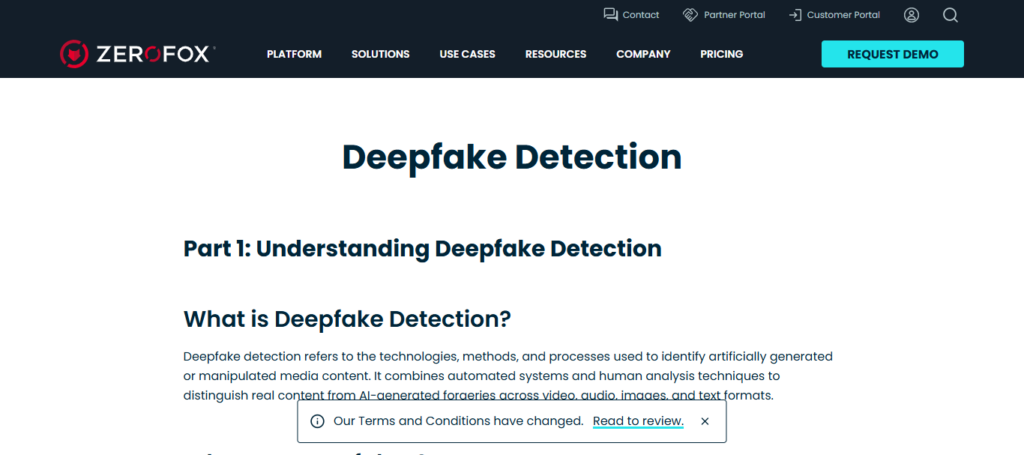
In Best AI Cybersecurity Tools to Stop Deepfakes & Phishing, ZeroFox is valuable when making cybersecurity tools for executive protection, creating the brands and risk monitoring. This includes alerts for security teams in real time, automated support for takedowns, and intelligence reports that enable organizations to protect themselves from social engineering attacks leveraged by generative AI technologies.
ZeroFox Deepfake Detection Features
- Social Media Impersonation Threats AI Monitoring
- Analysis of authenticity for deepfake audio and video
- Brand and executive impersonation protection
- Discovery and takedown of phishing domain in real-time
- Alerts of external threat intelligence and digital risks
ZeroFox Deepfake Detection
| Pros | Cons |
|---|---|
| Specialized deepfake and impersonation detection | Focused mainly on brand protection use cases |
| Social media threat intelligence monitoring | Higher cost for small businesses |
| Detects fake videos, accounts, and phishing pages | Requires continuous monitoring setup |
| Protects executives from impersonation attacks | Limited endpoint security features |
| AI analysis across open web and dark web | Not a full cybersecurity suite |
3. Darktrace PREVENT AI
The PREVENT AI from Darktrace shields proactively opposite to assaults by recognizing weaknesses before the enemies exploit them. It then leverages self-learning AI modeled on the human immune system to map patterns in organizational behavior and predict areas that are vulnerable to phishing, insider threats or deepfake-based social engineering.
The platform continuously monitors the cloud infrastructure, email systems as well as network configurations. Darktrace PREVENT leads the way in anticipating risk over reacting with its AI cybersecurity tools to stop deepfakes & phishing among the Best AI Cyber Security Tools It helps security teams simulate attacks, prioritize remediation strategies and bolster cyber resilience. Such a predictive method greatly minimizes the chances of successful AI-boosted cyberattacks.
Darktrace PREVENT AI Features
- Normal user behavior modeled by self-learning AI
- Before an attack, predictive cyber risk analysis
- Deepfake-enabled social engineering detection
- Autonomous response against phishing campaigns
- Continuous enterprise security posture assessment
Darktrace PREVENT AI
| Pros | Cons |
|---|---|
| Self-learning AI adapts to network behavior | Expensive enterprise solution |
| Predictive risk analysis before attacks occur | Requires skilled analysts for tuning |
| Identifies unknown threats and anomalies | Learning period needed for accuracy |
| Autonomous threat response capabilities | Can overwhelm teams with alerts |
| Strong network visibility and analytics | Complex deployment in large networks |
4. Proofpoint AI Threat Protection
Proofpoint Advanced Threat Protection for Email, powered by a combination of machine learning and human-centric risk analysis. It also assesses user behavior, communication patterns and sender veracity to screen out phishing emails, harmful attachments and impersonation scams.
The platform includes natural language processing that detects writing styles commonly associated with AI-generated phishing campaigns. According to the list of Best AI Cybersecurity Tools to Stop Deepfakes & Phishing, Proofpoint has been featured as it is widely known for its protection against the human layer of cyberattacks.
Enabling customers to be less susceptible to sophisticated business email compromise and social engineering attacks via features like real-time URL defense, account takeover prevention and employee risk scoring.
Proofpoint AI Threat Protection Features
- The only method for detecting phishing and spoofing attacks is AI email filtering
- URL and attachment sandboxing analysis
- Impersonation and business email compromise detection
- Machine learning threat intelligence updates
- Protection against human-targeted cyber threats
Proofpoint AI Threat Protection
| Pros | Cons |
|---|---|
| Industry-leading email phishing protection | Premium pricing tier |
| AI analyzes human behavior and email intent | Heavy focus on email security only |
| Blocks business email compromise attacks | Integration setup may be complex |
| Advanced URL and attachment scanning | Requires ongoing policy management |
| Strong compliance and data protection tools | Limited endpoint capabilities |
5. Symantec Email Security AI
Bombardier’s Ultimate Passenger Safety Through Secure Communication Enterprise Security Solution Leveraging Threat Intelligence And Automated Email Detection Engines It examines billions of email signals worldwide to identify trends in phishing, malware propagation and deepfake impersonation attempts aimed at corporate users.

Anomaly detection via AI determines oddities in sender behavior or patterns from chatting. When businesses are assessing the Best AI Cybersecurity Tools to Stop Deepfakes & Phishing, Symantec remains a stalwart in their enterprise solution suits using its layered defenses.
It bundles together content filtering (spam-scarab) together and intercepts the entries at cloud email traffic, preventing attacks from ever hitting inboxes while still upholding proper compliance and data protection standards.
Symantec Email Security AI Features
- Anomaly detection in communication patterns based on AI
- Deepfake voice phishing protection features
- Email encryption and data loss prevention
- Automatic threat blocking for cloud email security
Symantec Email Security AI
| Pros | Cons |
|---|---|
| Advanced spam and phishing filtering | Interface feels outdated to some users |
| AI threat intelligence from global network | Deployment can be complex |
| Strong ransomware and malware detection | High enterprise licensing cost |
| Cloud and on-premise deployment options | Requires experienced admin management |
| Data loss prevention integration | May generate occasional false alerts |
6. IBM Watson Cybersecurity AI
IBM Watson Cybersecurity AI: It automates threat analysis and investigation, making the security operations center more efficient. Watson, powered by cognitive computing, sifts through huge volumes of computer and unstructured data — research articles, threat reports and attack databases.
It correlates signals more quickly than traditional tools to uncover phishing campaigns, deepfake fraud attempts and advanced persistent threats. Slotted between the Top Hacks to Feed Your Cyberstarting Mind and at 138, Best AI Cybersecurity Tools to Stop Deepfakes & Phishing, Watson helps its analysts lessen alert fatigue and speed up decision-making.
Their AI-based recommendations, risk scoring models, and automated response workflows empower enterprises to build better defenses at higher levels of efficiency across complex IT environments.
IBM Watson Cybersecurity AI Features
- Cognitive analytics driven AI threat intelligence
- Automated incident investigation and response
- NLP for Threat Research
- Phishing campaign pattern recognition
- SIEM and enterprise integrated security system
IBM Watson Cybersecurity AI
| Pros | Cons |
|---|---|
| Cognitive AI analyzes massive threat datasets | Implementation requires expertise |
| Excellent threat intelligence correlation | Higher infrastructure requirements |
| Automates SOC investigation workflows | Expensive for small organizations |
| Natural language threat analysis | Setup time can be lengthy |
| Strong enterprise analytics capabilities | Needs integration with existing tools |
7. SentinelOne Singularity AI
SentinelOne Singularity AI autonomously protects endpoints leveraging behavioral AI models that identify malicious action without needing signatures. It actively monitors system processes, files and user actions to detect ransomware, phishing payloads and AI-assisted attacks in real time. After an event, the platform automatically isolate compromise devices and perform rollback recovery.
If you read the discussion about Best AI Cybersecurity Tools to Stop Deepfakes & Phishing, it mentions SentinelOne as a leader that offers completely automated threat response Its centralized dashboard provides visibility across endpoints, cloud workloads and identities, enabling security teams to protect themselves from advanced cyberattacks with minimal manual intervention.
SentinelOne Singularity AI Features
- Autonomous endpoint protection platform
- Ransomware and phishing detection using AI behavior
- Deep visibility across endpoints and cloud workloads
- Automated rollback and threat remediation
- Real-time attack storyline visualization
SentinelOne Singularity AI
| Pros | Cons |
|---|---|
| Autonomous endpoint protection using AI | Learning curve for new users |
| Fast ransomware rollback capability | Premium pricing model |
| Behavioral detection without signatures | Requires tuning for optimal alerts |
| Unified XDR visibility across endpoints | Resource usage may increase |
| Automated remediation and response | Advanced features locked in higher tiers |
8. Fortinet FortiMail AI
Fortinet FortiMail AI is a secure email gateway solution to defend against phishing, spoofing and business email compromise attacks. It employs machine learning algorithms to assess email reputation, scrutinize attachments and identify malicious URLs. Suspicious files can then be tested in an integrated sandbox environment prior to delivery.
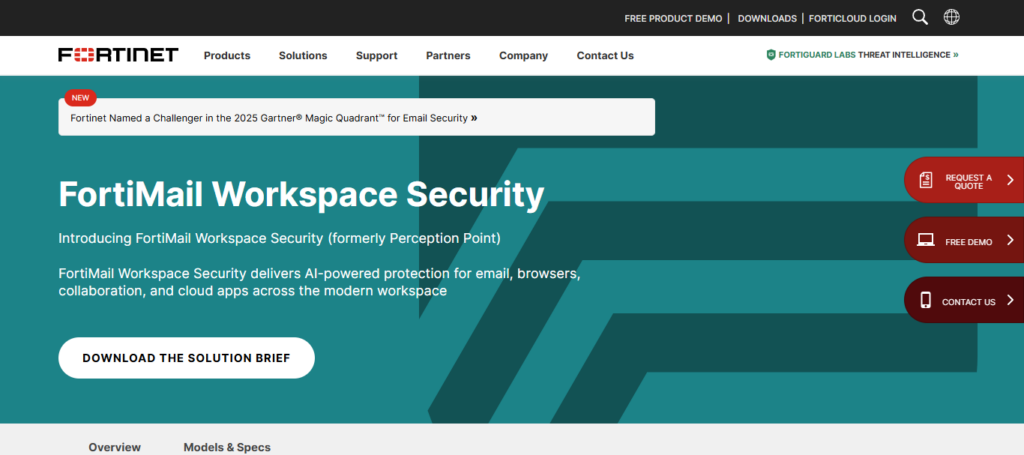
Best AI Cybersecurity Tools to Stop Deepfakes & Phishing : FortiMail is considered a great solution for utilizing the power of AI analytics and combining it with the ability to tap into Fortinet’s larger security fabric ecosystem. Advanced encryption, data loss prevention, and impersonation detection features benefit organizations. Its scalable architecture supports enterprises and service providers looking for stable email protection from faster-evolving AI-based attacks.
Fortinet FortiMail AI Features
- Anti Phishing Attacks and AI email security gateway
- Advanced malware and attachment inspection
- Anti-spoofing and impersonation detection
- Deep learning spam filtering engine
- Encryption and compliance controls for secure email
Fortinet FortiMail AI
| Pros | Cons |
|---|---|
| AI email gateway blocks phishing attacks | Best when used with Fortinet ecosystem |
| Advanced anti-spam and malware scanning | Initial configuration complexity |
| Sandboxing for suspicious attachments | Less flexible outside Fortinet tools |
| Strong email encryption features | Enterprise-focused pricing |
| High performance mail filtering | Limited endpoint security scope |
9. Check Point Harmony AI
Check Point Harmony AI secures cloud collaboration platforms like Microsoft 365, Google Workspace and messaging apps. The system reviews email tone, communication context, and attachments to detect phishing and (real) deepfake impersonation scams. AI systems identify unusual patterns of communication that indicate social engineering attacks.
Out of the Best AI Cybersecurity Tools to Stop Deepfakes & Phishing, Harmony helps secure modern collaboration workflows—not just email channels. Real-time threat prevention, automated policy enforcement and identity protection capabilities help organizations to protect their distributed teams that are working across various cloud platforms and collaboration environments.
Check Point Software Technologies Features
- AI-driven phishing prevention across devices
- Browser and email threat protection
- Zero-trust security architecture implementation
- Real-time URL reputation analysis
- Endpoint and mobile security integration
Check Point Harmony AI
| Pros | Cons |
|---|---|
| Prevents phishing across email, browser, and devices | Requires ecosystem integration |
| AI threat prevention across endpoints | Licensing structure can be confusing |
| Zero-trust security architecture | Advanced features need expertise |
| Protects remote workforce environments | Setup may take time |
| Strong cloud and SaaS protection | Smaller businesses may find it costly |
10. Trend Micro Vision One AI
Trend Micro Vision One AI provides extended detection and response (XDR) by connecting the dots with threat signals from endpoints, email, servers, networks, and cloud environments. Its AI engine detects attack behaviors that traditional tools can overlook like deepfake social engineering campaigns and targeted phishing operations.

Automated investigation workflows gratify security teams with unified visibility and actionable insights. Featured as one of the Best AI Cybersecurity Tools to Stop Deepfakes & Phishing, Vision One accelerates organizational response time with steps to remediate and prioritize risks. The platform’s cross-layer analytics allow for proactive defense against ever-evolving AI-driven cyberattacks.
Trend Micro Vision One AI Features
- Extended Detection and Response (XDR) Plattform
- (Malicious Phishing and Deepfake Threats correlate The 2AI)
- Cross-layer visibility (across email, cloud and endpoints)
- Automated threat hunting and investigation
- Attack surface management and risk scoring
Trend Micro Vision One AI
| Pros | Cons |
|---|---|
| Extended Detection and Response (XDR) platform | Requires training to maximize value |
| Correlates threats across multiple vectors | Enterprise pricing model |
| AI risk scoring prioritizes real threats | Can produce alert fatigue initially |
| Strong phishing and ransomware defense | Complex deployment in hybrid networks |
| Centralized security visibility dashboard | Best suited for mid-to-large organizations |
Conclusion
The advent of generative AI темные мины + the increasing sophistication of cyber threats means organizations need to move to intelligent security solutions with deception detection capabilities in real time.
AI Cybersecurity Tools The Best AI Cybersecurity Tools to Combat Deepfakes & Phishing use machine learning, behavioral analytics, and automated threat response to secure identities, communications, and digital assets. From email security platforms to advanced XDR systems and deepfake detection technologies, these tools enable businesses to shift from defensive posturing to proactive protection. “
By investing in AI-centric cybersecurity you are not only minimizing the risk but also improving trust, as organizations need to stay secure against evolving AI-driven attacks and social engineering threats.
FAQ
What are AI cybersecurity tools for deepfake and phishing protection?
AI cybersecurity tools use machine learning, behavioral analysis, and automation to detect fake videos, voice cloning, phishing emails, and impersonation attacks. The Best AI Cybersecurity Tools to Stop Deepfakes & Phishing analyze patterns, communication behavior, and digital signals to identify threats faster than traditional security systems.
How do AI tools detect deepfake content?
AI security platforms analyze facial movements, voice patterns, metadata inconsistencies, and visual artifacts to identify manipulated media. Advanced computer vision and audio analysis models help organizations detect synthetic videos or cloned voices used in fraud and social engineering attacks.
Can AI cybersecurity tools prevent phishing attacks completely?
No cybersecurity solution can guarantee 100% prevention, but AI tools significantly reduce risk. The Best AI Cybersecurity Tools to Stop Deepfakes & Phishing continuously learn from new attack patterns, block suspicious emails, detect malicious links, and alert security teams before damage occurs.
Why are deepfake attacks becoming a major cybersecurity concern?
Generative AI makes it easier for attackers to create realistic fake videos, audio messages, and executive impersonations. These attacks can bypass traditional security awareness methods, making AI-powered detection essential for modern cybersecurity strategies.
Who should use AI cybersecurity solutions?
Businesses of all sizes, government agencies, financial institutions, remote teams, and enterprises handling sensitive data benefit from AI cybersecurity tools. Any organization vulnerable to phishing scams, identity fraud, or digital impersonation should consider implementing AI-based protection.