



In this article, I’ll tell you the best AI agents to answer customer questions in 2026. Such AI-enabled platforms can help organizations automate customer support, pull accurate data from internal knowledge bases, and respond faster. We will look at their key features, knowledge integrations, pricing, human handoff abilities, automation tools and benefits to help you choose the right solution.
What Is AI Agents for Answering Customer Questions?
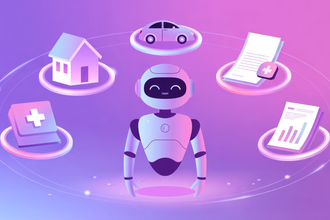
AI agents for answering customer questions are intelligent software solutions that apply artificial intelligence, natural language processing and knowledge retrieval technologies to understand customer questions and automatically deliver relevant answers.
They pull from internal knowledge bases, FAQs, product documentation, PDFs, websites, CRM systems and company databases to find the right information. Unlike traditional chatbots that operate on scripts, AI agents can understand conversational context, field follow-up questions, automate repetitive support tasks and escalate complex issues to human agents.
These solutions are utilized by companies to offer 24/7 customer support, minimize response time, enhance support efficiency, and provide a consistent customer experience across various communication channels.
Key Features Of AI Agents for Answering Customer Questions
| Key Feature | Description |
|---|---|
| Natural Language Processing | Understands customer questions, intent, context and conversational language to generate relevant responses. |
| Knowledge Base Integration | Connects with FAQs, PDFs, websites, internal documents, CRM systems and company databases to retrieve information. |
| Automated Query Resolution | Answers repetitive customer questions automatically without requiring human support for every interaction. |
| Contextual Understanding | Remembers previous conversation details and handles follow-up questions more effectively. |
| Human Handoff | Transfers complex, sensitive or unresolved customer inquiries to human support representatives. |
| Multilingual Support | Responds to customer questions in multiple languages to support international audiences. |
| Real-Time Knowledge Updates | Synchronizes updated information from connected sources to provide current answers. |
| Source-Based Responses | Uses relevant knowledge documents and references to generate more reliable and verifiable answers. |
| Workflow Automation | Performs configured actions such as order tracking, appointment scheduling, refunds and customer information collection. |
| Performance Analytics | Tracks resolution rates, response quality, customer satisfaction and support automation performance. |
Key Points
| AI Agent | Best For |
|---|---|
| Zendesk AI Agents | Omnichannel customer support |
| Salesforce Agentforce | CRM-powered customer service |
| Intercom Fin | Conversational customer support |
| HubSpot Customer Agent | CRM-integrated service automation |
| Freshworks Freddy AI | Support workflow automation |
| Genesys Cloud CX AI | Enterprise contact centers |
| Aisera | Enterprise service operations |
| Decagon | AI-powered issue resolution |
| Gorgias AI | Support ticket automation |
| Jotform AI Agents | No-code customer support agents |
1. Zendesk AI Agents
Founded: Zendesk – 2007
Zendesk AI Agents helps businesses automate responses to customer questions using trusted knowledge sources, help center articles and connected external content. The platform supports messaging, e-mail, web forms and voice interactions.
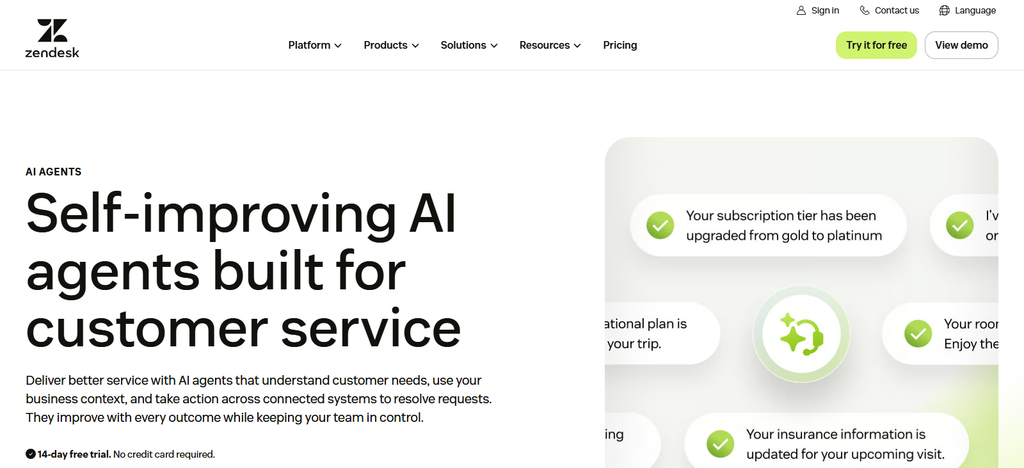
It can consume Zendesk Help Center content and external sources through web crawlers or knowledge connectors. External sources typically synchronize on a schedule, often about 24 hours. Help center content is searched as is.
Human handoff enables unresolved conversations to be escalated to support agents. The Suite Team plan starts at $55 per agent per month, billed annually, with extra automated-resolution fees depending on usage.
Zendesk AI Agents Characteristics
- Knowledge-Based Answers: Retrieves information from company help centers, FAQs, and connected knowledge sources to answer customer questions.
- Omnichannel Support: Supports customer conversations through messaging, email, voice, and other supported communication channels.
- Automated Resolution: Automatically resolves repetitive customer queries and helps to execute multi-step service processes without constant human intervention.
- Generative AI Replies: Generates replies according to the customer’s intent and the knowledge content available, contextualizing it.
- Human Handoff: Unresolved conversations are handed off to human support agents with relevant conversation context.
Knowledge Integration: Integrates with external business knowledge and supported applications for better knowledge access. - Workflow Automation: Supports ticket classification, routing, refunds and account-related service actions as part of workflows configured.
- AI Analytics: Delivers reporting, quality assurance and performance data to monitor automated customer interactions.
2. Salesforce Agentforce
Founded: 1999 – Salesforce
Salesforce Agentforce is an AI agent platform for the enterprise that responds to customer questions using knowledge articles from the company, uploaded files, web sources and associated business data. Agentforce Data Library’s Data 360 indexes information that grounds responses in organizational content. Businesses can connect CRM records, Salesforce Knowledge and other supported data sources to provide personalized answers.
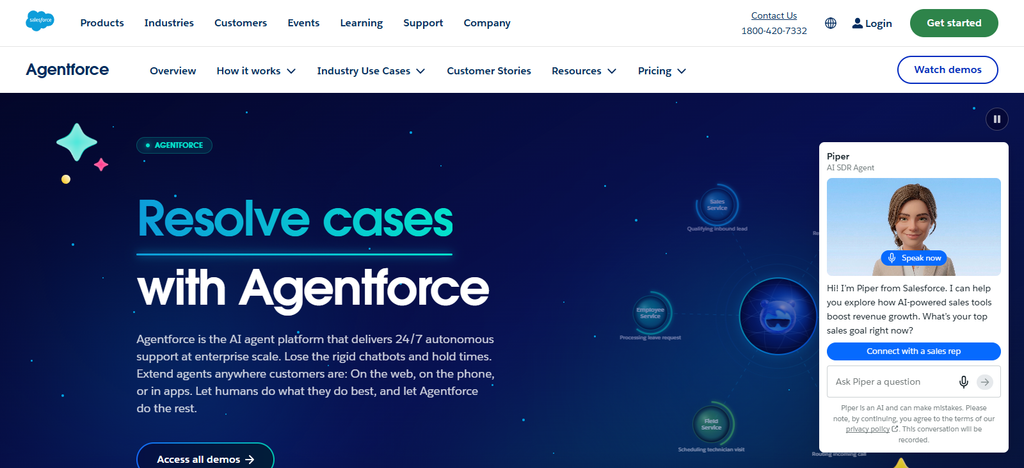
Updates on knowledge depend on the source and index configuration that is connected. Service Cloud supports human handoff via escalation workflows that you configure to route complex queries to support reps. It costs based on consumption with a starting price of $2 per conversation or $500 per 100,000 Flex Credits.
Salesforce Agentforce Characteristics
- CRM-Based Knowledge Retrieval: Provides relevant responses based on Salesforce Knowledge, customer records and integrated business data.
- Autonomous AI Agents: Acts as a customer service agent to answer questions based on programd agent instructions and actions.
- Data 360 Integration: Integrates organizational data to provide contextually relevant answers based on consolidated enterprise data.
- Multi-Step Workflows: Enables complex customer requests with multiple actions, business rules and connected systems.
- Human Escalation: Escalates complex customer cases to service representatives with relevant customer information.
- Custom Agent Builder: Allows businesses to configure agent instructions, topics, actions, and response behaviors.
- Omnichannel Communication: Engage customers in all supported digital channels and service environments.
Enterprise Automation: Connects customer support with CRM workflows, APIs, and business applications.
3. Intercom Fin
Founded: Intercom 2011
Intercom Fin is an AI customer service agent that answers questions using help center articles, PDFs, documents, snippets, public URLs and connected knowledge platforms. It supports sources like Zendesk, Salesforce, Guru, Confluence, Notion and Box. Public Intercom articles update in real time, and linked knowledge sources usually update every few minutes.
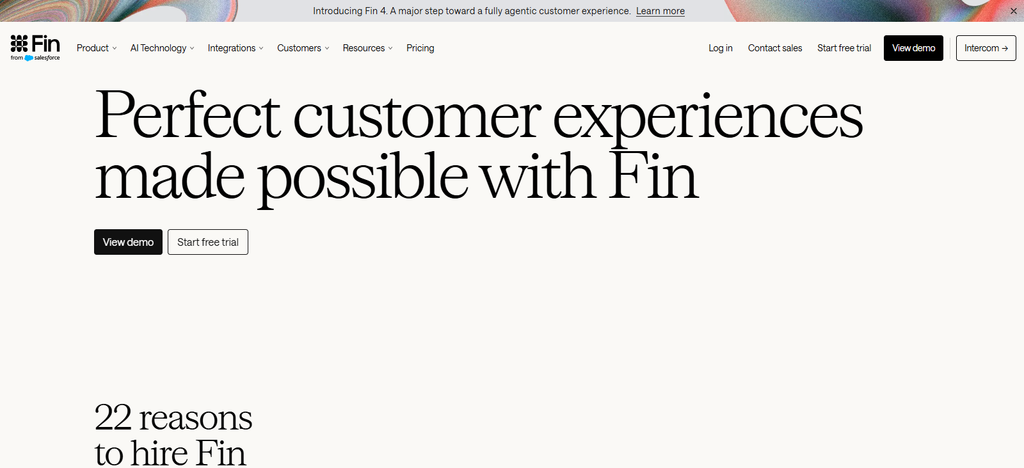
Website content updates weekly. Fin uses retrieval-augmented generation to retrieve relevant information and generate contextual answers. When it cannot resolve an issue, it forwards conversations to human agents with context. Pricing from $0.99 for successful outcome. Intercom seat charges vary depending on plan.
Intercom Fin Characteristics
- Knowledge Base Retrieval: Get answers from help center articles, PDFs, web pages and connected knowledge repositories.
- Connectivity to Multiple Sources: Connect to platforms like Notion, Confluence, Guru, Box and Salesforce.
- Contextual Responses: Generates personalized responses based on the customer conversation history and pertinent information.
- Multilingual Support: Helps companies to reply to customers questions in multiple languages.
- Human Handoff: Transfers unresolved conversations to human agents while maintaining conversation context.
- Automated Workflows: Manage customer requests beyond basic FAQs using Fin Procedures and configured actions.
- Knowledge Synchronization: Updates linked knowledge sources, allowing agents to utilize new information.
- Performance Analytics: Offers insights into resolution performance, customer interactions and effectiveness of AI agents.
4. HubSpot Customer Agent
Founded: 2006 – HubSpot
HubSpot Customer Agent assists companies in responding to customer requests using existing company content and CRM data. It can cite synced knowledge base articles, website content, and other supported sources of information to generate appropriate responses. Companies can use it across live chat and email, set up workflows, and leverage CRM context to personalize the interaction.
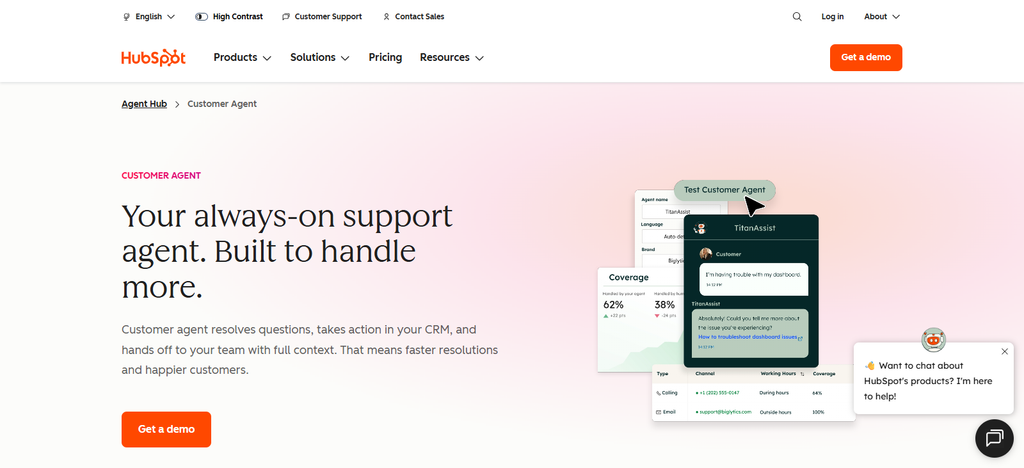
Updates to knowledge require synchronization of related content. The agent can answer source-backed queries, take configured actions like resetting passwords and booking meetings, and transfer conversations to human reps when confidence is low or escalation rules are breached.
To apply solutions, you need an eligible Professional or Enterprise subscription or HubSpot Credits, with eligible new users getting 14 days of introductory access.
HubSpot Customer Service Agent Characteristics
- CRM Knowledge Integration: Integrates with HubSpot knowledge base content and related customer information to provide right answers.
- Automated Customer Response: Manages customer inquiries via pre-defined support channels.
- Personalized Conversations: Leverages available CRM context to help drive more relevant conversations with customers.
- Knowledge Base Answers: Pulls information from synced website content and supported knowledge sources.
- Human Handoff: Transfers questions that need human assistance to customer support agents.
- Workflow Automation: Supports configured customer service actions like booking meetings and other business processes.
- Multichannel Deployment: Interacts with customers through eligible HubSpot communication channels.
- HubSpot Ecosystem: Works with Service Hub, CRM records, and other HubSpot business tools.
5. Freshworks Freddy AI
Founded: Freshworks – 2010
Freshworks Freddy AI helps customer service teams automate repetitive questions with AI agents built using the Freddy AI Agent Studio. Companies can use solution articles, question-and-answer content, and uploaded files as knowledge sources.
Its AI agents provide source-grounded answers, support 60+ languages and integrate with tools like Shopify, Stripe, Shiprocket, ShipStation and custom APIs. The knowledge can be preserved by updating the connected content and agent configuration.
For complex, sensitive or personal questions, a human handoff is available with the conversation context passed on to the appropriate representative. Freshdesk Growth starts at $19 per agent per month (when billed annually) and additional AI agent sessions cost $49 per 100 sessions.
Freshworks Freddy AI Characteristics
- AI Knowledge Retrieval: Answers customer questions based on solution articles, FAQs and supported uploaded content.
- Freddy AI Agent Studio: Businesses can use this to build AI agents and customize their actions for customer support.
- Multilingual Responses: We speak to our customers in over 60 languages.
- Automated Query Resolution: Supports repetitive support questions and common customer service requests.
- Human Agent Handoff: It transfers complex or unresolved customer interactions to human representatives.
- Third-party Integrations: Integrations with supported applications like Shopify, Stripe, and other business tools.
- AI Workflow Automation: Delivers automated actions and customer support workflows through configured integrations.
- Performance Insights: Enables teams to measure AI interactions and assess customer service automation.
6. Genesys Cloud CX AI
Founded: Genesys 1990
Genesys Cloud CX AI integrates virtual agents, knowledge management, contact center automation and omnichannel customer support. Its Knowledge Fabric connects enterprise information sources, including SharePoint, and structures documents as searchable content for AI-powered answers.
This data can be used by virtual agents in customer conversations and Agent Copilot helps human representatives find relevant information. Knowledge administrators can configure and test sources before release.
When a virtual agent cannot resolve an issue, contextual conversation transfers support human handoff Genesys Cloud CX is $75 per user per month for CX 1, and $240 per user per month for CX 4 (billed annually). Additional use of AI Experience may apply.
Genesys Cloud CX AI Characteristics
- Knowledge Fabric: Integrates enterprise knowledge sources to deliver contextual responses to customers.
- Virtual Agents: Automate customer conversations using AI-powered virtual agents.
- Omnichannel Communication: Allows you to interact with customers through both voice and digital service channels.
- Knowledge Management: Aids businesses in organizing, managing and delivering relevant information to customers and support agents.
- Human Agent Transfer: Directs unsolved customer interactions to the right agents.
Agent Copilot: Helps human support teams find information and handle customer conversations with greater efficiency.
Intelligent Routing – directs customer interactions according to defined routing rules and service requirements. - Contact Center Analytics: Delivers insights into customer interactions, agent performance and support operations.
7. Aisera
Founded: Aisera – 2017
Aisera offers enterprise conversational AI and agentic automation to businesses looking to answer customer questions from organizational knowledge. Its platform combines enterprise knowledge retrieval, generative AI and workflow automation to offer contextual responses across customer service channels. Businesses can connect enterprise applications and support systems such as Salesforce, Zendesk, ServiceNow and Genesys to help them retrieve information and resolve customer issues.
Knowledge management capabilities support organizations in keeping relevant information and improving self-service responses. When automated resolution is not suitable, human handoff allows complex requests to reach support representatives. Aisera does not publish a universal starting price for its enterprise AI agent platform. Pricing is usually customized based on deployment requirements, integrations and usage.
Aisera Characteristics
- Enterprise Knowledge Retrieval: Leverages enterprise information and linked knowledge sources to generate relevant customer responses.
- Conversational AI: Comprehends customer questions and answers in natural language.- Workflow Automation: Automates repetitive customer support processes and business actions that are preconfigured.
- Enterprise Integrations: Integrates with Salesforce, Zendesk, ServiceNow, and Genesys.
- Contextual Responses: Leverages relevant organization information to provide more useful customer support interactions.
- Human Escalation: Allows complex requests to be forwarded to human support teams.
- Self-Service Automation: Enables customers to find answers without manual assistance.
- Enterprise Scalability: Designed for larger organizations that need connected applications, automated workflows and centralized service operations.
8. Decagon
Founded: Decagon – 2023
Decagon is an enterprise AI customer experience platform that automates customer conversations across chat, email and voice. Its AI agents pull information from connected knowledge systems like Confluence, Contentful and Kustomer, and integrate with customer support platforms like Salesforce, Intercom and Zendesk.
Businesses can augment its knowledge capabilities with APIs and Model Context Protocol (MCP) connections to use additional applications and business data.
Knowledge sync allows agents to tap into existing support documentation while custom integrations provide for more specialized information needs. Live chat escalations, automated email routing, and voice call transfers give a human handoff. Decagon has custom enterprise pricing and doesn’t have a universal self-service starting price.
Decagon Characteristics
- AI Customer Conversations: Respond to customer queries with Conversational AI on supported channels.
- Knowledge Access: Contextual answers are derived through accessing connected enterprise content and knowledge systems.
- Agent Operating Procedures: Enables businesses to build AI agent workflows via natural-language commands.
- Multi-Channel Support: Customer interactions can be via chat, email and voice.
- Human Handoff: Transfers conversations to human representatives when further assistance is required.
- Enterprise Integrations: Integrates with customer support platforms and business applications to pull relevant information.
- AI Quality Monitoring: Leverages Watchtower to monitor interactions and assess agent performance.
- Workflow Configuration: Allows for customized customer service workflows for different business requirements.
9. Gorgias.ai
Founded: Gorgias – 2015
The Gorgias AI Agent is primarily aimed at ecommerce businesses that want to automate shopper questions and post-purchase customer support. Its knowledge base supports published help center articles, brand guidance, public website URLs, and uploaded documents as well as imported help center content.

Shopify Integration The AI agent has relevant store and order data for questions regarding shipping, returns, product availability and order changes. Businesses can update knowledge libraries as product information and policies change.
And human handoff enables complex conversations to be escalated to support reps with full context. Pricing is usage-based, typically starting at $0.90 per resolved interaction on most plans, with additional fees for helpdesk subscriptions and allowances based on the plan.
Gorgias AI Characteristics
- Ecommerce Knowledge Retrieval: Answer customer questions using product information, help articles and business policies.
- Shopify Integration: Pulls relevant store and order data to empower customer support.
- Order Tracking Automation: Helps customers with order status and shipping updates.
- Returns and Refund Support: Automatically handles eligible customer service requests for returns and refunds.
- Product Question Handling: Manages questions about product availability, specifications and store policies.
- Human Agent Handoff: Escalates difficult shopper conversations to customer service agents.
- Multichannel Support: Enable customers to connect on chat, email and social messaging channels.
- AI Resolution Analytics: Assists ecommerce teams in tracking automated resolutions and customer support efficacy.
10. Jotform AI Agents
Founded: Jotform – 2006
Jotform AI Agents helps businesses build conversational agents that can answer customer questions using the information you upload and the knowledge sources you connect. Their knowledge base supports external URLs, uploaded files, question and answer content and other information that provides background for customer responses.
Businesses can set agent instructions, set actions and integrate with third-party apps such as Google Workspace, Slack and OneDrive. Connected forms enable agents to gather customer information and finish form-based workflows while on the phone with customers.
Refreshing source material and agent configurations helps keep knowledge up to date. In configured workflows, human help can be added to customer requests that require additional attention. Instead of a single universal AI agent price, the price will depend on the Jotform subscription, conversation allowances and knowledge base limits you choose.
Jotform AI Agent Characteristics
- Document-Based Knowledge: Uses uploaded documents, URLs and question-answer content to answer customer questions.
- Custom AI Agents: Businesses can define agent instructions, personality, and customer interaction behavior.
- Conversational Responses: Produces natural language responses based on information from integrated knowledge sources.
- Workflow Integration: AI conversations integrate with configured forms and business processes.
- Third-Party Connectivity: Integrates with apps such as Google Workspace, Slack and OneDrive.
Customer Information Collection: Gathers customer data through conversations and associated forms. - Human Help Flows: Allows configured flows to route customers to additional help.
- Business Automation: Automates data collection, repetitive questions and form-based customer service tasks.
Important Comparison
| AI Agent | Founded Year | Pricing Model | Knowledge Sources |
|---|---|---|---|
| Zendesk AI Agents | 2007 | From $55/agent/month for Suite Team, plus usage | Help Center, external sources |
| Salesforce Agentforce | 1999 | From $2/conversation | Knowledge articles, files, web sources |
| Intercom Fin | 2011 | From $0.99/outcome | PDFs, URLs, Notion, Confluence, Box |
| HubSpot Customer Agent | 2006 | HubSpot Credits | Synced content, CRM data |
| Freshworks Freddy AI | 2010 | From $19/agent/month, plus usage | Articles, Q&As, files |
| Genesys Cloud CX AI | 1990 | From $75/user/month | SharePoint, Knowledge Fabric |
| Aisera | 2017 | Custom pricing | Enterprise-connected knowledge |
| Decagon | 2023 | Custom pricing | Confluence, Contentful, Kustomer |
| Gorgias AI | 2015 | From $0.90/resolved interaction | Help articles, URLs, documents |
| Jotform AI Agents | 2006 | Plan-dependent | URLs, files, Q&As |
Conclusion
How to select the best AI agents to respond to customer queries from internal knowledge bases in 2026? Depends on business requirements, knowledge sources, automation capabilities, pricing and customer support needs. Zendesk AI Agents, Salesforce Agentforce, and Intercom Fin and HubSpot Customer Agent, provide advanced knowledge-based customer support.
Freshworks Freddy AI, Genesys Cloud CX AI, Aisera and Decagon, provide advanced automation for growing and enterprise teams.
Gorgias AI is meant to be particularly useful for ecommerce businesses, and Jotform AI Agents can be used to drive document-based conversations and workflows. Evaluate answer accuracy, knowledge updates, human handoff, integrations and data security before selecting a platform to ensure reliable customer experiences.
FAQ
What Are AI Agents for Answering Customer Questions From Internal Knowledge Bases?
AI agents use artificial intelligence to retrieve information from internal documents, FAQs, company policies, product manuals and knowledge repositories. They generate relevant answers to customer questions without requiring manual support for every interaction.
Which AI Agent Is Best for Answering Customer Questions?
Zendesk AI Agents, Salesforce Agentforce and Intercom Fin are popular options for knowledge-based customer support. The best choice depends on knowledge source compatibility, automation requirements, integrations and pricing.
Can AI Agents Answer Questions From PDFs and Internal Documents?
Yes. Many AI agents support PDFs, Word documents, website URLs, help center articles and connected knowledge repositories. They retrieve relevant information from these sources to generate contextual customer responses.
How Do AI Agents Keep Their Knowledge Bases Updated?
AI agents use document synchronization, scheduled crawling, connected applications and manual content updates. These processes help maintain current information when businesses change product details, pricing, policies or support documentation.