




This article covers the best developments in Nvidia AI Technologies for Gaming and Automation. These innovations are changing gaming, machine learning, robotics, and enterprise automation.
Advancements in graphics, AI processing, real-time automation, and smart computing are seen in RTX Neural Rendering, Omniverse AI, DRIVE AI, and Nvidia Broadcast AI. These tools use advanced AI to create intelligent digital experiences.
What are Nvidia AI Technologies?
Nvidia AI offers NVIDIA-powered applications to accelerate gaming, automation, ML, robotics, and data offerings. They run interrelated software and deep learning tools on GPUs.
With Nvidia AI, ray tracing, AI graphics, intelligent robotics and automated vehicles and intelligent automated AI training modules are possible. Popular Nvidia AI offerings include DLSS, Tensor Cores, CUDA, Omniverse, and Jetson AI.
These options provide improved performance and realistic graphics combined with next-generation intelligent automation. These help consumers, developers, and gamers across industries.
Benefits of Nvidia AI Technologies
Enhanced Gaming Performance: DLSS and RTX improve frame rates, smoothness, and graphics rendering in games thanks to AI.
Superior Support for Machine Learning: Tensor Cores and Nvidia GPUs help developers and researchers accelerate AI model training, deep learning, and run massive datasets.
AI-Enhanced Ray Tracing: AI makes ray tracing faster and better. As a result, games and visuals can have more realistic lighting, shadows, and reflections.
Smarter AI in Automation: More intelligent processing enables better automation of industrial operations, robotics, warehouses, and smart manufacturing.
Quick Data Processing: Large datasets can be processed with ease. As a result, cloud computing and analytics become extremely performant.
Advanced Streaming and Content Creation: With Nvidia Broadcast AI, background effects, noise reduction, and streaming quality are tremendously improved.
Performance Without High Usage: When AI is employed, workloads on the GPU become optimized to reduce excessive strain without a cost to performance.
Next Level Robotics and Edge AI: Smart robotics and drones, as well as edge devices that can process AI workloads on the site, are made possible with Nvidia Jetson AI.
AI Solutions for Large Enterprises: Enterprises that focus on the large-scale deployment of AI and automation services can benefit from the Nvidia DGX systems.
How Nvidia AI Technologies Work
GPU-Based Parallel Processing
Nvidia has GPUs that can run thousands of calculations at once making AI Nvidia products extremely faster than CPU-based products.
Deep Learning Algorithms
Nvidia’s AI-powered systems employ deep learning and neural networks to comprehend advanced data sets and consequently make advanced intelligent decisions and recognize data patterns.
Tensor Core Acceleration
Nvidia’s GPUs possess additional cores called Tensor Cores and these enhance the speed at which Nvidia can perform real-time AI and ML tasks and compute AI.
AI Model Training
The data sets built on the Nvidia platforms train AI models for use in gaming, robotics, automation and healthcare as well as information science.
Real-Time Graphics Rendering
Techniques such as DLSS and RTX AI are machine learning technologies that allow in-game and real-time improvements to the quality of images, lighting and reflections in addition to enhancing game performance.
CUDA Parallel Computing
Nvidia CUDA enables parallel computing and allows scientists, developers and automation specialists to use GPU acceleration in artificial intelligence software.
Edge AI Processing
Nvidia Jetson devices are AI applications built directly into robots, drones and smart devices that rarely rely on backend cloud computing resources.
Cloud AI Integration
Nvidia platforms are built to interface with cloud computing at the level built for servicing large-scale AI workloads and automation for enterprises.
AI Data Optimization
Nvidia AI provides the capability of optimizing in an automated fashion how and where resources such as memory and processing power are distributed across workloads.
Simulation & Digital Twin Technology
Nvidia Omniverse allows for the testing of robotics, industrial automation and smart systems in virtual environments and AI simulations prior to deployment in the physical world.
Tips for Choosing Nvidia AI Technologies
Define Your Primary Use Case: Choose which Nvidia AI Tech product best suits your needs for gaming, machine learning, automation, robotics, streaming, and content creation.
Assess GPU Performance Prerequisites: VRAM, Tensor Cores, and RTX support should be considered when deciding which GPUs to purchase based on the load and how much AI processing is required.
Examine AI Software Compatibility: Confirm the Nvidia Tech product incorporates other platforms like CUDA, TensorRT, Omniverse, or other AI development tools you plan to use.
Evaluate Real-Time AI Capabilities: Gamers should focus on the DLSS, RTX AI, and AI frame generation technologies for more enhanced gameplay and improved graphics.
Determine Future Needs: Businesses and developers should opt for the AI technologies that best suit their needs for future automated or machine learning processes.
Assess Cost Efficiency: Select AI technologies that offer the best balance between performance, cost, and power consumption.
Confirm Cloud and Edge AI Compatibility: For automation and robotics, be sure to check that the Nvidia Jetson products offer cloud computing and edge AI.
Assess Cooling and Power Requirements: High-performance Nvidia AI GPUs need sufficient power and good cooling systems to operate stably.
Evaluate Price Against Available Features: Select the Nvidia AI technologies that achieve the best balance between costs and the sales or benefits that will be realized.
Investigate Future AI Investment: Opt for technologies that will be offered ongoing support for Nvidia’s AI technologies, especially drivers and software.
Key Point & Best Nvidia AI Technologies for Gaming & Automation
| Nvidia AI Technology | Main Purpose | Key Features | Best Use Cases |
|---|---|---|---|
| RTX Neural Rendering | AI-powered graphics rendering | Real-time AI visuals, frame enhancement, realistic lighting | Gaming, 3D graphics, virtual reality |
| Nvidia Omniverse AI | Virtual collaboration & simulation | Digital twins, real-time simulation, AI workflows | Industrial automation, design collaboration |
| Nvidia Broadcast AI | AI streaming enhancement | Noise removal, virtual backgrounds, eye contact correction | Streaming, video calls, content creation |
| Nvidia Maxine AI | AI video conferencing platform | AI audio/video enhancement, real-time translation | Business meetings, remote communication |
| Nvidia ACE (Avatar Cloud Engine) | AI-powered game characters | Intelligent NPCs, natural voice interaction, generative AI | Gaming, virtual assistants, metaverse |
| Nvidia Clara AI | Healthcare AI platform | Medical imaging, genomics, AI diagnostics | Hospitals, healthcare research, medical AI |
| Nvidia DRIVE AI | Autonomous vehicle AI | Self-driving systems, AI sensors, smart navigation | Autonomous cars, transportation automation |
| Nvidia Riva AI Speech | AI speech & language processing | Speech recognition, AI voice generation, translation | Virtual assistants, customer service |
| Nvidia Morpheus AI | Cybersecurity AI platform | Threat detection, AI security monitoring, fraud detection | Enterprise cybersecurity, network protection |
| Nvidia Triton Inference Server | AI model deployment | High-performance AI inference, scalable deployment | Machine learning, cloud AI applications |
1. RTX Neural Rendering
For modern gaming and visual computing, one of the most advanced AI graphics technologies from NVIDIA is RTX Neural Rendering. This technology combines AI Neural Networks with RTX Ray tracing and advanced techniques such as lighting, shadowing, texturing, and frame generation.
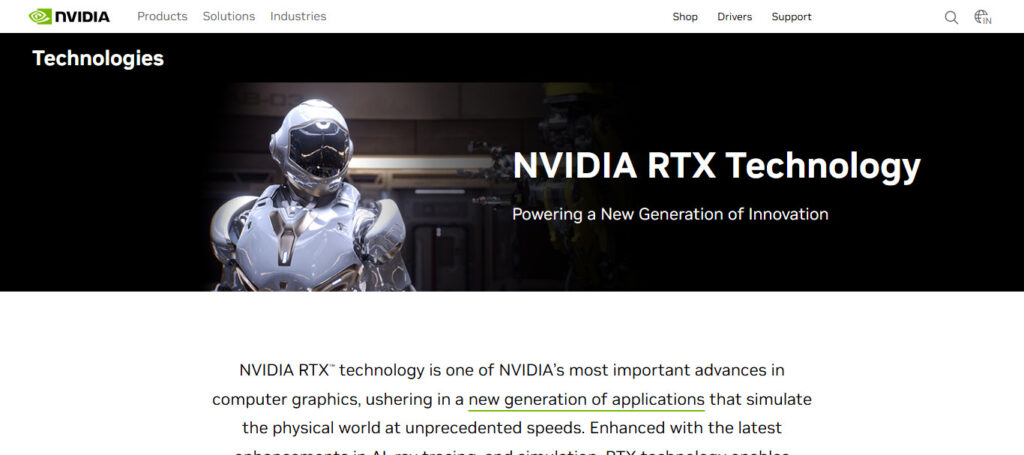
This technology is a perfect partner for NVIDIA RTX, which focuses on advanced gaming innovation to improve productivity and the overall gaming experience, and focuses more of the GPU’s resources on frame generation, which ultimately results in a higher frame rate for the game.
RTX is focused on advanced gaming innovation and is used in AAA gaming, virtual reality, and 3D design. It has become the industry standard for high-end, high-performance gaming.
RTX Neural Rendering Advantages & Disadvantages
Advantages
- AI rendering creates better gaming graphics
- DLSS leads to higher frame rates.
- Lighting and reflections can be rendered realistically.
- GPU load is less during gameplay.
- VR and 3D experiences are improved.
Disadvantages
- RTX GPUs are expensive.
- High power consumption.
- Expensive gaming hardware.
- Older games may not support.
- Increased system heating.
2. Nvidia Omniverse AI
Nvidia Omniverse AI is a real-time simulation and collaboration platform for developers, engineers, and businesses, that allows users to work together in virtual spaces via AI-driven simulations and digital twins. This platform allows industries to virtually design and test robotics, factory automation, smart cities, and industrial systems, omitting the need for a physical prototype.
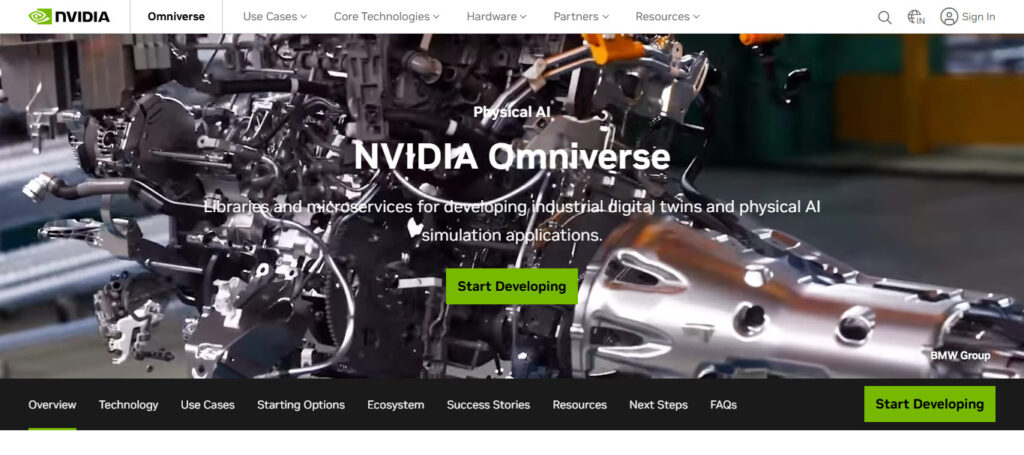
This is one of the best Nvidia AI Technologies for Gaming & Automation, Omniverse AI, as it allows creation and testing of virtual systems with collaboration tools. It is a great solution for architectural design and manufacturing, animation, and metaverse design and can help a company achieve innovative AI-driven systems in construction or design.
Nvidia Omniverse AI Advantages & Disadvantages
Advantages
- Collaboration can be done in real-time.
- Better AI simulations.
- Digital twins and automation can be incorporated.
- Industrial workflow optimization can be achieved.
- Great 3D renderings.
Disadvantages
- Strong hardware is always required.
- Hard to setup for beginners.
- Enterprise implementation is expensive.
- High-speed internet is required for real-time collaboration.
- Not always compatible with all software.
3. Nvidia Broadcast AI
Nvidia Broadcast AI is a streaming and video communication application that leverages artificial intelligence (AI) to optimize the quality of audio and video content, offering features such as noise suppression, background customization, virtual background, webcam framing, and eye contact correction.
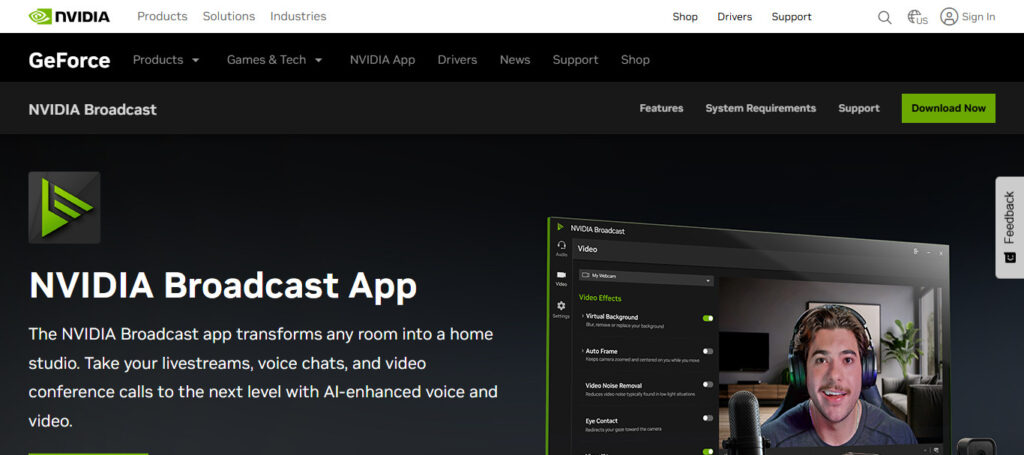
Through the use of Tensor Cores in Nvidia Graphics Processing Units (GPUs), this technology provides real-time AI enhancements to audio and video without a significant drop in system performance.
Best Nvidia AI Technologies for Gaming & Automation is considered one of the pioneers in content creation for streaming and video calling enhancements, allowing content creators to produce high-quality, professional streams and calls. Gamers, YouTubers, remote workers, and online instructors want high-quality options for audio and video communications, making this technology an excellent tool for creators.
Nvidia Broadcast AI Advantages & Disadvantages
Advantages
- Background noise is eliminated.
- AI can be used for better web cameras.
- Backgrounds can be set virtually.
- Streaming can be better with the AI.
- Streaming apps can be integrated seamlessly.
Disadvantages
- Only available for NVIDIA RTX GPUs.
- May affect other processes that use the GPU.
- May not have enough advanced customization options.
- Performance may vary from one person to another.
- Features may cause latency.
4. Nvidia Maxine AI
Nvidia Maxine AI is a highly advanced, artificial intelligence-powered, cloud-based video conferencing service that makes virtual communication easier. It is equipped with features such as AI-prompted video compression, real-time translation, voice suppression, animated facial compression, and optimization of network bandwidth.
Businesses and developers leverage Maxine AI to build more intelligent video conferencing solutions, enhancing virtual collaboration and communication at a lower bandwidth. Best Nvidia AI Technologies for Gaming & Automation consider Maxine AI a game changer in remote collaboration, facilitating more interactive and seamless virtual meetings.
It is an excellent solution for enterprise communications, customer service, online learning, and telehealth, enabling businesses to provide intelligent and high-quality AI-enhanced video communication solutions.
Nvidia Maxine AI Advantages & Disadvantages
Advantages
- Video conferencing can be made better with the AI.
- AI can b used for less bandwidth.
- Translation can be done in real-time for different languages.
- Better sound and visual clarity.
- Better remote communication.
Disadvantages
- Can be expensive for a company when hosted on the cloud.
- Must be hosted on the cloud for a company.
- Requires a good quality internet connection
- Poor functionality when offline
- Complex setup may require additional technical expertise
5. Nvidia ACE (Avatar Cloud Engine)
Nvidia ACE, or Avatar Cloud Engine, is an AI solution that builds smart digital actors and assistants in the virtual world. Generative AI, speech and facial recognition, Natural Language Processing (NLP), and Facial animation techniques are combined to introduce the next level of realism and interactivity in Non-Playing Characters (NPCs). Game developers can utilize this innovation to create AI NPCs that converse and interact within the game in real time.
Among the Best Nvidia AI Technologies for Gaming & Automation, Nvidia ACE is a major player in powering the future of gaming and the metaverse. It enhances human-like gameplay and virtual interactions, coupled with storytelling in game design, various virtual worlds, customer support, and AI assistants in different domains.
Nvidia ACE (Avatar Cloud Engine) Advantages & Disadvantages
Advantages
- Generates smart AI NPCs
- Adds advanced voiced interaction
- Increases immersion in gameplay
- Incorporates generative AI usage
- Accelerates metaverse creation
Disadvantages
- Technology still in early phases
- Resource intensive
- Incorporates AI training
- Underutilized by game developers
- High cost for widespread uptake
6. Nvidia Clara AI
Nvidia Clara AI focuses on healthcare and provides an artificial intelligence framework built on medical imaging, genomics, drug discovery, and advanced smart healthcare services. Clara AI enables clinicians and researchers to gain a competitive edge in the rapidly evolving healthcare landscape by helping in the processing of medical data using NVIDIA’s GPU-accelerated deep learning technology.
Clara AI advances the accuracy of AI healthcare research and medical image analysis. As one of the Best Nvidia AI Technologies for Gaming & Automation, Clara AI extends beyond gaming and automation into healthcare innovations.
Clara AI enhances MRI analysis, AI-based surgeries, medical robotics, and clinical research, providing healthcare professionals with the ability to make faster and better diagnoses, as well as offer more advanced care to patients.
Nvidia Clara AI Advantages & Disadvantages
Advantages
- Improves analysis of medical images
- Offers faster medical research
- Better diagnostics
- Facilitates AI surgeries
- Rapidly processes medical information
Disadvantages
- Primarily a medical tool
- High cost for required AI
- Need for medical professionals
- Boundary hurdles are required
- Large datasets of medical info are required
7. Nvidia DRIVE AI
Nvidia DRIVE AI is an AI platform that caters to the development of self-driving cars and the automation of transportation systems. Vehicles are able to understand their surroundings and safely navigate the world by combining several core components such as AI processing, sensor fusion, deep learning, and neural networks.
DRIVE AI aims to solve the end problem of transportation by collecting data from a multitude of sensor systems including cameras, RADAR, and LiDAR and integrating the data into a single beacon. Nvidia DRIVE AI is a core technology within the Best Nvidia AI Technologies for Gaming & Automation.
It powers autonomous vehicles, driver assist tools, smart taxis and transportation automation, ultimately aiding in the bettering of safety, effectiveness, and intelligent navigation for all vehicles on the road.
Nvidia DRIVE AI Advantages & Disadvantages
Advantages
- Empowers the system of self-driving cars
- Processes data from vehicle sensors in real time
- Increases safety of vehicles
- Improves driving accuracy
- Offers enhanced transport systems
Disadvantages
- Extremely advanced implementation required
- Requires costly sensors and hardware
- Regulations are strict for safety
- Requires extensive AI training
- Global full autonomy is very limited
8. Nvidia Riva AI Speech
Nvidia Riva AI Speech is a platform that provides the ability to create speech applications for real-time recognition, voice synthesis, and translation, as well as AI-empowered conversational abilities. It is a tool geared toward the rapid creation of intelligent voice assistants, AI-powered customer care chatbots, and AI-communication systems.
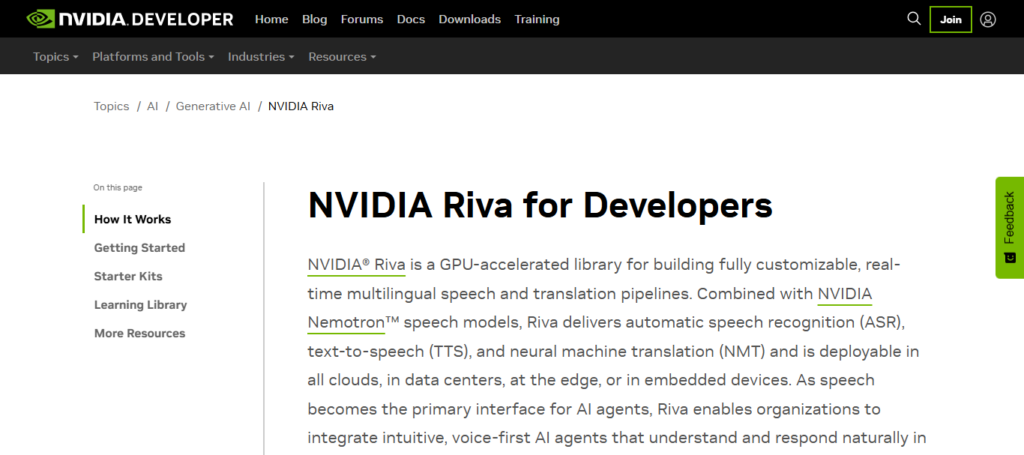
Riva AI accelerates communication and processing of natural language and voice. As an additional core offering of the Best Nvidia AI Technologies for Gaming & Automation, the advancement of Riva AI Speech creates better interfaces for voice and communication. Riva AI’s technology is present in virtual assistants, smart devices, voice systems for gaming, therapeutic and care systems in healthcare, and enterprise customer service tools.
Nvidia Riva AI Speech Advantages & Disadvantages
Advantages
- Offers the ability to hear and understand speech instantaneously
- Can convert speech to many different spoken languages
- Can generate speech in a human-like AI voice
- Makes digital assistants much more helpful
- Speeds up the ability to process languages through the use of powerful computer chips called the graphical processing unit (GPU)
Disadvantages
- Needs training of the AI model
- Requires extensive GPU memory
- The clarity of speech and of audio reduces the quality of the service
- Difficult deployment for organizations
- Support for only certain regional languages
9. Nvidia Morpheus AI
Nvidia Morpheus AI is a real-time AI-driven fraud prevention and cybersecurity platform. It uses Nvidia GPUs to conduct machine learning and analyze data. It identifies and predicts threats to the network. It increases the efficiency of cybersecurity for businesses, while decreasing the time of the response to attacks.
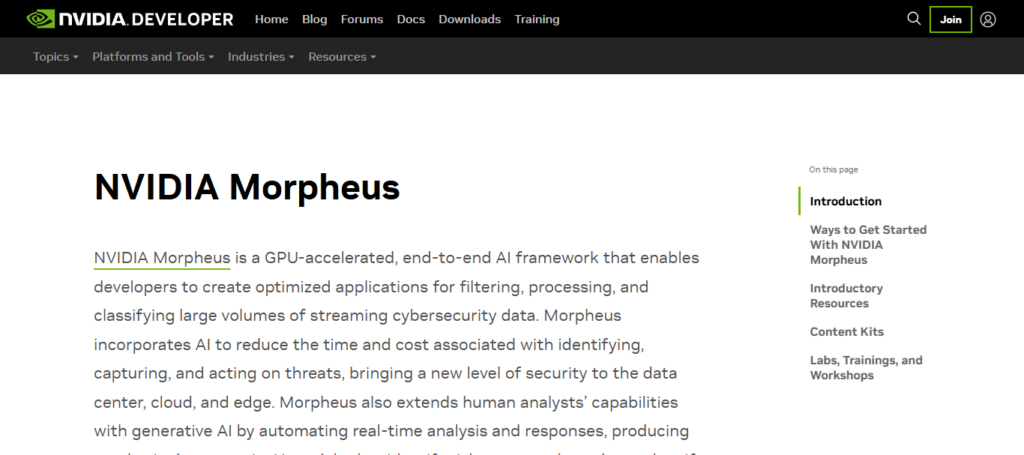
Within the Best Nvidia AI Technologies for Gaming & Automation, Morpheus AI is evidence that the automation of AI increases the security of cyberspace.
Financial systems, enterprise security, fraud detection, and other systems often implement real-time AI monitoring. Morpheus AI is widely used for its ability to offer protection to sensitive data and defend against threats that may compromise the data.
Nvidia Morpheus AI Advantages & Disadvantages
Advantages
- Quickly identifies cyber threats
- Includes AI-powered fraud detection
- Effectively analyzes large networks
- Increases automation of cyber protection
- Lessens time for security responses
Disadvantages
- Deployment is hard for large organizations
- Requires a skilled cyber protection team
- Costly for small businesses
- Demands a lot of processing power
- Requires AI models to be updated
10. Nvidia Triton Inference Server
Nvidia Triton Inference Server is a machine learning model server. It has made it easier for businesses to deploy and run models across the cloud, edge, and data center. It provides a lot of flexibility as it supports a variety of AI frameworks and increases the efficiency of the large-scale applications built on top of the AI.
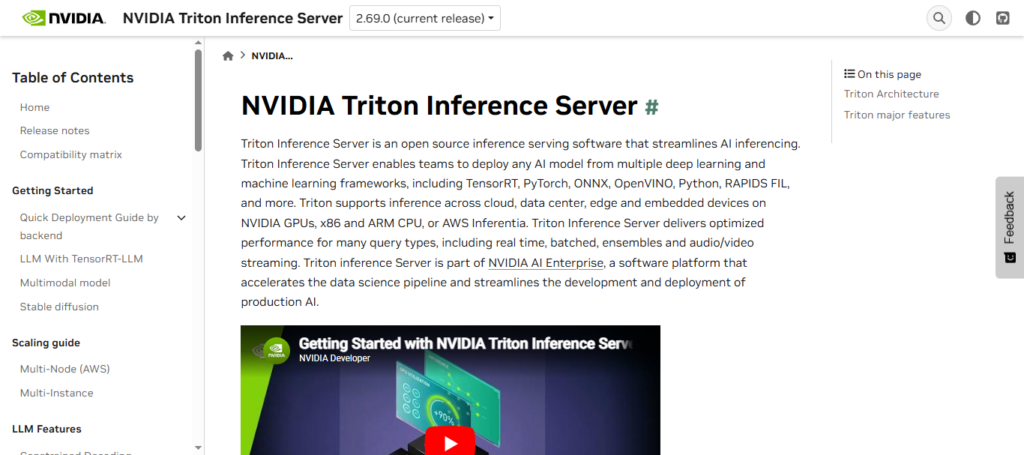
From the Best Nvidia AI Technologies for Gaming & Automation, Triton Inference Server is cornerstone to AI operations and automation. Its uses include recommendation systems, AI analytics, cloud computing, and other enterprise applications that rely on real-time machine learning.
Nvidia Triton Inference Server Advantages & Disadvantages
Advantages
- AI model deployment is faster
- Multiple AI frameworks are supported
- Better performance in inference
- Works well across cloud systems
- Better use of GPU resources
Disadvantages
- Technical know-how is needed
- Configuration can be cumbersome
- Costly for advanced infrastructure
- Needs to be regularly maintained
- Setting it up is challenging for newcomers
Nvidia AI Technologies Comparison Table
| Nvidia AI Technology | Main Category | Primary Function | Key Features | Best For | Advantages | Limitations |
|---|---|---|---|---|---|---|
| RTX Neural Rendering | Gaming AI | AI graphics rendering | Ray tracing, AI frame generation, realistic lighting | Gamers & 3D creators | Better visuals and higher FPS | Requires RTX GPU |
| Nvidia Omniverse AI | Simulation & Collaboration | Real-time virtual collaboration | Digital twins, AI simulation, 3D workflows | Enterprises & designers | Advanced simulation support | High hardware requirements |
| Nvidia Broadcast AI | Streaming AI | AI video & audio enhancement | Noise removal, virtual background, auto framing | Streamers & remote workers | Professional-quality streaming | GPU dependent |
| Nvidia Maxine AI | Communication AI | AI-powered video conferencing | Real-time translation, video compression, AI enhancement | Businesses & online meetings | Improved communication quality | Internet bandwidth needed |
| Nvidia ACE (Avatar Cloud Engine) | Generative AI | AI-powered digital avatars | Smart NPCs, voice interaction, facial animation | Gaming & metaverse | Realistic AI characters | Still evolving technology |
| Nvidia Clara AI | Healthcare AI | Medical AI processing | Medical imaging, genomics, diagnostics | Healthcare industry | Faster healthcare analysis | Specialized industry use |
| Nvidia DRIVE AI | Automotive AI | Autonomous driving systems | Sensor fusion, self-driving AI, navigation | Smart vehicles | Advanced vehicle automation | Expensive implementation |
| Nvidia Riva AI Speech | Speech AI | Voice & language processing | Speech recognition, translation, AI voice generation | Virtual assistants | Real-time speech processing | Requires AI training |
| Nvidia Morpheus AI | Cybersecurity AI | AI threat detection | Fraud detection, network monitoring, AI security | Enterprises & cybersecurity | Fast threat analysis | Complex deployment |
| Nvidia Triton Inference Server | Machine Learning AI | AI model deployment | Multi-framework support, scalable inference | AI developers & enterprises | Faster AI deployment | Technical setup required |
Future of Nvidia AI Technologies
NVIDIA’s future is extremely promising with increasing AI technology applications across an expanding range of sectors like gaming, automation, robotics, medicine, and cloud services. AI driven innovations will included more powerful, smart, and faster NVIDIA graphics processing units (GPUs), neural renderers, and real time AI with more advanced AI assisted gaming, autonomous robotics, intelligent manufacturing and transport, all driven via deep learning.
Within the expanding range of Best Nvidia AI Technologies for Gaming & Automation, NVIDIA will most likely continue expanding their AI efforts into Virtual Reality, Cybersecurity, Medical Diagnostics, and Enterprise Automation.
With all the recent advancements in AI, and NVIDIA’s exceptional cloud services, they will likely remain one of the top companies leading the charge in the development and deployment of next generation AI solutions and services across the globe!
Conclusion
In summary, NVIDIA maintains its pioneering influence in AI with tech that is reshaping gaming, automation, machine learning, healthcare, cybersecurity, and cloud computing. RTX Neural Rendering, Omniverse AI, DRIVE AI, and Triton Inference Server are examples of Nvidia’s innovation in Artificial Intelligence.
They improve GPU performance, resulting in faster and more advanced solutions. The Best Nvidia AI Technologies for Gaming & Automation enhance graphics and processing, and bring automation with smart, real-time decision-making.
Since the advancement of AI will continue, Nvidia is poised to be influential in the development of the future digital experience, autonomous systems, enterprise AI, and advanced computing.
FAQ
What are Nvidia AI technologies?
Nvidia AI technologies are advanced artificial intelligence solutions developed by NVIDIA to improve gaming, automation, robotics, machine learning, and cloud computing using GPU acceleration and deep learning.
Which Nvidia AI technology is best for gaming?
RTX Neural Rendering, DLSS, and Nvidia ACE are among the best Nvidia AI technologies for gaming because they improve graphics quality, frame rates, and AI-powered character interactions.
How does Nvidia AI improve gaming performance?
Nvidia AI improves gaming by using AI-based rendering, frame generation, ray tracing, and GPU optimization to deliver smoother gameplay and realistic visuals.
What is Nvidia Omniverse AI used for?
Nvidia Omniverse AI is used for real-time simulation, digital twins, virtual collaboration, industrial automation, and 3D content creation across multiple industries.