




In this article, I will discuss the Best AI Vector Search Platforms. With these platforms, businesses and developers can create advanced AI applications. Features of these platforms will include fast data retrieval, semantic search, and AI accuracy.
We will evaluate leading vector search solutions, features, advantages, applications, and use cases. Finally, we will assess how these solutions support modern AI technologies such as LLMs, RAG systems, and intelligent AI applications.
What Are AI Vector Search Platforms?
AI Vector Search Platforms are a sophisticated search technology used by artificial intelligence systems to find and retrieve meaning, context, and related information based on similarity, as opposed to keyword matching. These platforms render different types of data such as text, images, audio, and documents, into embeddings, and represemnt numerical format.
Vector databases and similarity search algorithms allow AI Vector Search Platforms to identify relevant information quickly and efficiently from large and complex data sets.
AI Vector Search Platforms are used to create sophisticated AI systems and components, including chatbots, recommendation systems, semantic search, and AI systems integration, as well as RAG and intelligent solutions based on retrieval-augmented generation.
Platforms such as Weaviate, Qdrant, Chroma, Redis Vector, FAISS, and Oracle AI Vector DB, among others, allow businesses to deliver AI solutions that quickly and accurately understand data meaning, retrieve relevant content, and provide personalized experiences.
How AI Vector Search Platforms Work?
AI Vector Search Platforms enable users to search for content across various platforms by converting different types of data to numerical representations called vector embeddings, and then analyzing the data with comparative algorithms. These platforms help AI applications understand context and relationships and the meaning of the content, going beyond matching keywords.
Data Collection and Processing
- AI Vector Search Platforms collect different types of data, including text documents, images, videos, audio files, and customer data.
- The collected data is cleaned, processed, and prepared before converting it into vector formats.
- This process helps AI systems understand large amounts of unstructured data.
Creating Vector Embeddings
- AI models convert data into numerical vectors called embeddings that represent the meaning and characteristics of information.
- Similar concepts receive similar vector representations, allowing AI systems to identify relationships between different data points.
- Embedding models such as language models and machine learning algorithms are used for this transformation.
Storing Data in Vector Databases
- After generating embeddings, AI Vector Search Platforms store them in specialized vector databases.
- These databases are optimized to manage millions or billions of vectors efficiently.
- Platforms like Weaviate, Qdrant, Chroma, and FAISS store and organize vector data for faster retrieval.
Vector Indexing
- Vector databases create indexes to make similarity searches faster and more efficient.
- Techniques such as Approximate Nearest Neighbor (ANN) algorithms help identify related vectors without scanning the entire database.
- Indexing means that the search time is minimized while the accuracy of results is preserved.
User Query Conversion
- Following a user inputting a search query, AI models immediately convert the query into vector embedding.
- The system will compare the query vector to the stored vectors in order to discover the most relevant data.
- This is how AI applications detect user intentions and consequently generate more related responses.
Similarity Search and Retrieval
- By employing mathematical tools, AI-Vector Search Platforms identify the similarity between vectors.
- The algorithms will compare vector distances and decide what is relevant.
- The retrieved data can be any type of data such as text documents, images, products, or any data that is related to the query.
Integration with Large Language Models (LLMs)
- Vector search platforms integrate with LLMs to provide more context to AI-generated answers.
- In Retrieval-Augmented Generation (RAG) systems, vector databases retrieve the pertinent data before an AI model generates an answer.
- This greatly helps in minimizing the number of inaccurate AI responses.
Real-Time AI Applications
- Real-time applications of AI Vector Search Platforms include chatbots, recommendation systems, AI assistants, and intelligent search engines.
- They provide instantaneous data access and results personalized to the preferences and behaviors of the users.
- Businesses use these platforms to build AI solutions that adapt smarter and more responsively.
Continuous Learning and Optimization
- Many AI-Vector systems continuously enhance their embeddings as and when new data becomes available.
- This helps AI applications maintain correct and latest search results.
- Continuous improvement leads to better results and higher accuracy over time.
Why AI Vector Search Platforms Matter for Smarter AI Apps?
AI Vector Search Platforms are crucial to modern AI applications because they allow systems to understand data not just by keywords. Instead, they assess the meaning and context and the relationships of the data. This, in turn, improves the performance of AI applications by enabling faster access to information and providing accurate and personalized results.
Improves AI Search Accuracy
- AI Vector Search Platforms allow applications to recognize the intent behind user queries as opposed to matching queries in an exact word-for-word manner.
- Vector Search Platforms perform information retrieval based on the semantic relationship between data. Search results are shown in a contextually meaningful way.
- This augments AI applications such as AI assistants, enterprise search, and knowledge management systems.
Enhances Retrieval-augmented Generation (RAG)
- Vector search platforms are a core component of an RAG system, which leverages external data and advice to better inform the generation capabilities of Large Language Models (LLMs).
- Vector search platforms retrieve the most relevant documents and data before the AI generates responses.
- This reduces AI hallucinations and improves the reliability of the content generated.
Enables Smarter AI Applications
- AI Vector Search Platforms provide intelligent applications such as chatbots, recommendation engines, virtual assistants, and personalized search systems with the ability to access relevant information and provide prompt and user-centered responses.
- For software developers, AI vector search platforms provide the infrastructure required to develop comprehensive AI construction systems that are user-centered and behavior-pattern-oriented.
Handles Large Volumes of Unstructured Data
- Contemporary businesses generate large volumes of unstructured textual and visual data that traditional search systems have difficulty analyzing.
Key Features to Look for in AI Vector Search Platforms
| Key Feature | Description |
|---|---|
| High-Speed Vector Search | AI Vector Search Platforms should provide fast similarity searches across millions or billions of embeddings. Advanced indexing techniques such as Approximate Nearest Neighbor (ANN) help deliver quick and accurate results for AI applications. |
| Scalability & Performance | A reliable vector search platform should handle growing data volumes and increasing AI workloads without performance issues. Enterprise applications require platforms that can scale efficiently with large datasets and high user demand. |
| Accurate Semantic Search | The platform should understand the meaning and context behind user queries instead of relying only on keyword matching. Semantic search improves the quality of results for AI assistants, knowledge systems, and search applications. |
| Hybrid Search Capability | Modern AI Vector Search Platforms should combine traditional keyword search with vector similarity search. Hybrid search improves accuracy by using both exact matches and contextual understanding for better information retrieval. |
| RAG Integration Support | Support for Retrieval-Augmented Generation (RAG) is important because it allows vector databases to provide relevant external information to Large Language Models (LLMs), improving AI response accuracy and reducing hallucinations. |
| Multiple Data Type Support | Advanced platforms should support different data formats, including text, images, audio, video, and documents. Multimodal vector search enables businesses to create more powerful AI applications. |
| Easy AI Framework Integration | Compatibility with popular AI frameworks, APIs, and tools such as LangChain, LLM platforms, and machine learning libraries makes development faster and easier. |
| Real-Time Search Capability | Low-latency search performance is essential for applications like recommendation engines, AI assistants, fraud detection, and personalized user experiences that require instant results. |
| Security & Data Privacy | Enterprise-grade security features such as access control, encryption, compliance support, and secure data management are important for protecting sensitive information. |
| Flexible Deployment Options | Platforms should support cloud, on-premises, and hybrid deployment models to meet different business requirements and infrastructure needs. |
| Metadata Filtering | Advanced filtering allows users to combine vector similarity search with structured data filters, improving search precision and providing more relevant results. |
| Developer-Friendly Tools | Simple APIs, documentation, SDKs, and integration options help developers quickly build and deploy AI-powered applications. |
Key Point & Best AI Vector Search Platforms
- Annoy (Spotify) – Lightweight approximate nearest neighbor search library optimized for fast similarity search at large scale.
- Weaviate – Open-source vector database with AI-native search, hybrid search, and RAG application support.
- Qdrant – High-performance vector database designed for semantic search, embeddings, and AI-powered retrieval systems.
- Chroma – Developer-friendly open-source vector database built for LLM applications and AI experimentation.
- Redis Vector – Adds vector similarity search capabilities to Redis for real-time AI applications and recommendation systems.
- ScaNN (Google) – Google’s scalable vector search library optimized for high-speed and accurate nearest neighbor retrieval.
- IBM Watson Discovery – Enterprise AI search platform with natural language processing and intelligent document retrieval features.
- Oracle AI Vector DB – Enterprise vector database technology integrated with Oracle Database for AI search and RAG workloads.
- LangChain – AI application framework that connects LLMs with vector databases for retrieval-augmented generation workflows.
- FAISS (Meta) – Facebook AI Similarity Search library designed for efficient large-scale vector indexing and similarity matching.
10 Best AI Vector Search Platforms for Smarter AI Apps
1. Annoy (Spotify)
Annoy (Spotify) is an approximate nearest neighbor search library that Spotify made open-source. It focuses on the problem of efficiently searching through high-dimensionality vector spaces.
It is designed to solve the problem of proactively searching for similar vectors in large, vector-based similarity datasets in an ordered manner. Annoy integrates tree-based algorithms for optimized indexing. This makes Annoy suitable for recommendation engines.

More generally, it is applicable to content discovery and recommendation as well as machine learning. As one of the Best AI Vector Search platforms, Annoy enables developers to perform embedding searches without needing to process an entire database.
It is programmable across multiple languages, and tends to be useful in apps where speed, functionality, and lightweight vector searches are of high importance.
Why Annoy (Spotify) Matters
| Key Point | Details |
|---|---|
| Fast Similarity Search | Annoy provides quick approximate nearest neighbor search, helping AI applications retrieve similar vectors efficiently. |
| Low Memory Usage | It is designed to work with limited memory resources, making it suitable for lightweight AI projects. |
| Recommendation Systems | Annoy supports recommendation engines by finding similar products, songs, videos, or content. |
| Simple Implementation | Developers can easily integrate Annoy without managing complex database infrastructure. |
| Large-Scale Data Handling | It can efficiently search millions of high-dimensional vectors for AI applications. |
| Open-Source Technology | Annoy provides free access to its source code, allowing customization and community-driven improvements. |
| Reliable Performance | It delivers consistent search speed for applications requiring fast vector retrieval. |
2. Weaviate
Weaviate is another open-source AI-native vector database designed with the same goal of building semantic embedded search systems with minimum effort and maximum performance. It enables enterprises to manage large and complex vector embeddings created by AI models.
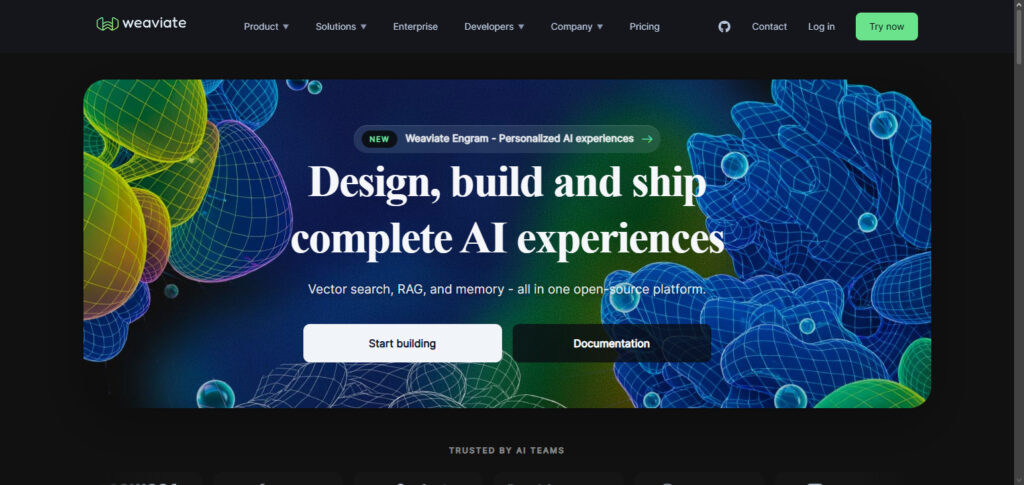
As one of the Best AI Vector Search platforms, Weaviate integrates traditional AI-assisted algorithms for keyword searches with state-of-the-art vector similarity searches in embedded space for improved accuracy and, also, increased performance.
It provides integration with multiple AI models, automatic vectorization, and scalable cloud deployments. Weaviate is used for the development of AI assistants, recommendation systems, enterprise search solutions, and knowledge management applications.
Why Weaviate Matters
| Key Point | Details |
|---|---|
| AI-Native Vector Database | Weaviate is built specifically for AI applications requiring vector storage and semantic search capabilities. |
| RAG Application Support | It helps developers create Retrieval-Augmented Generation systems by retrieving relevant information for LLMs. |
| Hybrid Search Capability | Weaviate combines keyword search and vector search for more accurate results. |
| Scalable Architecture | It supports enterprise-level applications with large datasets and growing AI workloads. |
| AI Model Integration | It connects with multiple embedding models and machine learning frameworks. |
| Semantic Understanding | It improves search accuracy by understanding user intent and contextual meaning. |
| Developer-Friendly Platform | Weaviate offers APIs and tools that simplify AI application development. |
3. Qdrant
Qdrant is an AI-Powered Vector Database that is open-source and offers high performance. Ideal for similarity search and AI Retrieval Applications. It allows developers to store vector embeddings coupled with additional metadata enabling users to perform advanced filtering to meet the needs of precision search and retrieval.
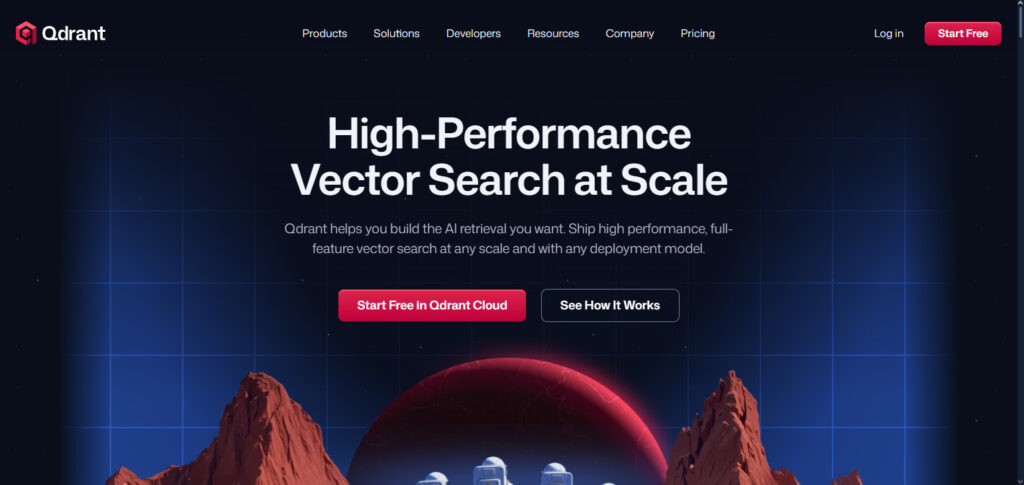
One of the Best AI Vector Search Platforms lets Qdrant index vectors quickly and search in real-time. It supports modern AI workloads such as RAG applications and recommendation engines.
Qdrant is designed for scalability, reliability, and production-level AI systems. Qdrant supports multiple programming languages and cloud deployment options, making it suitable for businesses developing intelligent search and machine learning applications.
Why Qdrant Matters
| Key Point | Details |
|---|---|
| High-Speed Vector Search | Qdrant provides fast similarity searches for AI applications requiring real-time results. |
| Metadata Filtering | It allows users to combine vector search with structured filters for precise retrieval. |
| RAG Workflow Support | Qdrant helps power AI assistants by providing relevant context to large language models. |
| Production Scalability | It is designed for enterprise workloads with large volumes of vector data. |
| Real-Time Applications | Qdrant supports recommendation engines, search systems, and personalization platforms. |
| Flexible Deployment | It can be deployed through cloud services, self-hosted environments, or enterprise setups. |
| Developer Accessibility | Qdrant provides APIs and integrations for easy AI application development. |
4. Chroma
Chroma is an open-source Vector Database designed for powering AI applications for large language models (LLMs). It assists developers in storage, management, and retrieval of embeddings for building applications such as chatbots, AI assistants, and document search systems.

One of the Best AI Vector Search Platforms lets Chroma quickly index vectors and perform searches in real time. It supports modern AI workloads such as RAG applications and recommendation engines. A developer-friendly platform offers easy integration into AI frameworks and machine learning workflows.
It supports embedding storage, similarity search, metadata filtering, and rapid prototyping. It is widely used by AI developers due to its lightweight architecture, flexibility, and ability to quickly develop retrieval-augmented generation applications.
Why Chroma Matters
| Key Point | Details |
|---|---|
| LLM Application Development | Chroma is designed for building AI applications powered by large language models. |
| Easy Embedding Management | It simplifies storing and retrieving AI-generated embeddings. |
| Rapid AI Prototyping | Developers can quickly test and build AI solutions using its lightweight architecture. |
| RAG Integration | Chroma supports retrieval-based AI systems that improve LLM response accuracy. |
| Open-Source Platform | It provides flexibility and customization for developers and researchers. |
| Simple Developer Experience | Chroma offers easy integration with popular AI frameworks and tools. |
| Flexible Data Retrieval | It helps applications find relevant information from large document collections. |
5. Redis Vector
Redis Vector implements vector similarity search within the Redis database. It provides businesses with the ability to integrate real-time data processing alongside powerful vector search throughout a single platform. As one of the Best AI Vector Search Platforms,
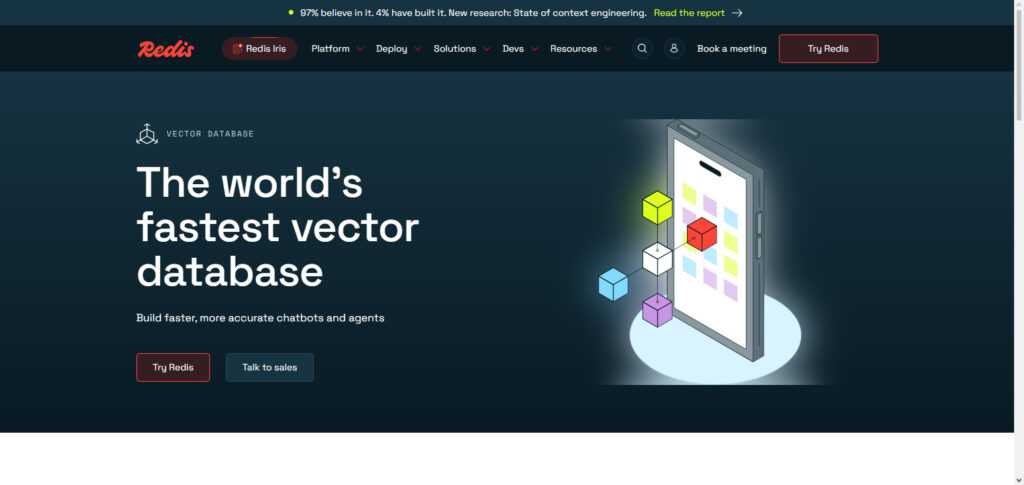
Redis Vector enables fast embedding retrievals for recommendation systems, semantic search, and other AI and ML applications with low latency. It provides indexing options, filtering features, and connection with various AI frameworks. Redis Vector is commonly used for real-time customer data and intelligent applications by entrepreneurs.
Why Redis Vector Matters
| Key Point | Details |
|---|---|
| Real-Time Vector Search | Redis Vector enables instant similarity searches for AI applications requiring low latency. |
| Single Data Platform | It combines traditional database features with AI vector search capabilities. |
| High Performance | Redis provides fast data access for recommendation systems and AI assistants. |
| Personalization Features | It supports customized user experiences through intelligent recommendations. |
| AI Application Support | Redis Vector powers chatbots, search engines, and machine learning solutions. |
| Scalable Infrastructure | It supports growing workloads with enterprise-level performance. |
| Easy Integration | Redis Vector works with popular AI frameworks and development tools. |
6. ScaNN (Google)
Google Research developed ScaNN (Scalable Vector Search) to optimize speed and accuracy of approximate nearest neighbor (Ann) searches. It is an improvement on earlier search technologies. It excels at handling large data sets (Embedding) used in AI and ML applications.
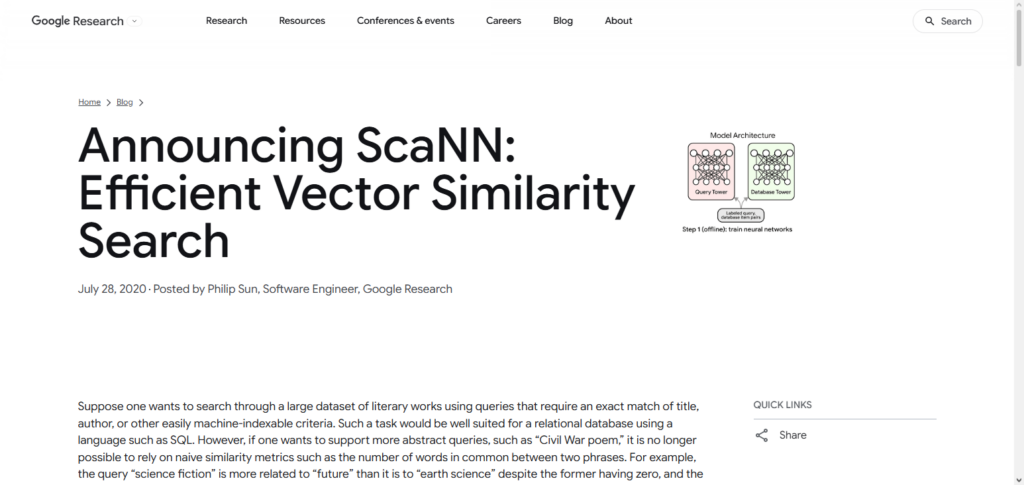
Among the Best AI Vector Search Platforms, ScaNN has proven to have dedicated optimization for specific uses and enhanced performance with advance indexing techniques and specialized hardware. ScaNN helps developers achieve efficient vector retrieval by optimizing search accuracy over computational performance.
Why ScaNN (Google) Matters
| Key Point | Details |
|---|---|
| High-Speed Search Technology | ScaNN improves the speed of searching large-scale vector datasets. |
| AI Performance Optimization | It balances search accuracy and computational efficiency for AI workloads. |
| Large Dataset Support | ScaNN is designed for handling millions or billions of embeddings. |
| Recommendation Systems | It helps improve content and product recommendations through similarity search. |
| Machine Learning Applications | ScaNN supports advanced AI and deep learning workflows. |
| Google Research Innovation | It provides optimized algorithms developed for large-scale AI systems. |
| Efficient Resource Usage | ScaNN reduces computing requirements while maintaining high search quality. |
7. IBM Watson Discovery
IBM Watson Discovery is a natural language-based AI search technology platform. It uses its natural language understanding to analyze and search through unstructured data sets. It helps organizations create enterprise search systems with contextual understanding.
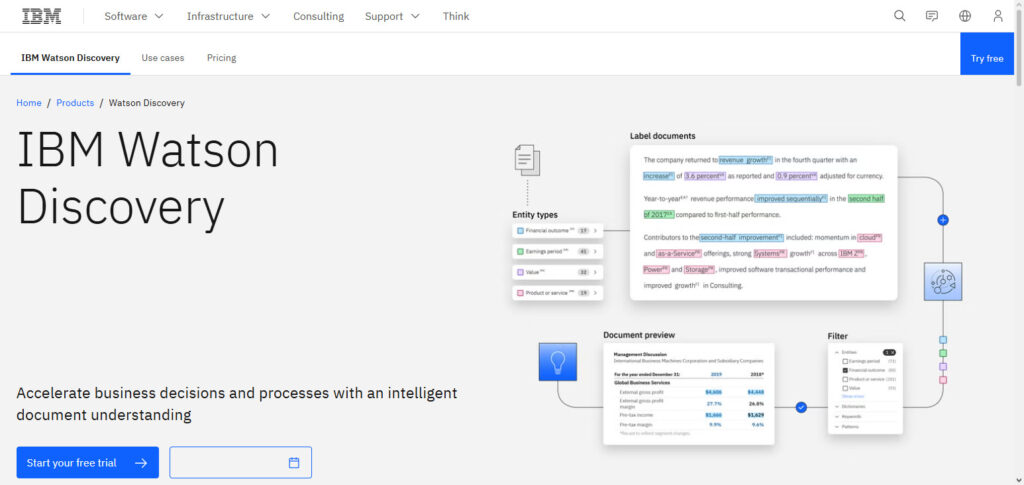
As one of the Best AI Vector Search Platforms, IBM Watson Discovery provides the means for organizations to conduct AI-driven knowledge discovery, analysis, and enterprise information retrieval. It allows organizations to discover valuable insights buried within their vast, unstructured data.
Why IBM Watson Discovery Matters
| Key Point | Details |
|---|---|
| Enterprise AI Search | IBM Watson Discovery helps organizations search and analyze large business data collections. |
| Natural Language Processing | It understands user queries using advanced AI and language technologies. |
| Document Intelligence | It extracts valuable insights from reports, contracts, and business documents. |
| Secure Data Handling | It provides enterprise security features for sensitive information. |
| Business Knowledge Discovery | It helps companies find hidden insights from unstructured data. |
| Industry Applications | It supports healthcare, finance, legal, and enterprise information systems. |
| AI-Powered Insights | It improves decision-making by providing accurate information retrieval. |
8. Oracle AI Vector DB
Oracle AI Vector DB combines an enterprise vector database capability with Oracle Database, enabling AI search and retrieval application support.

It allows enterprises to save numerous types of traditional business data in conjunction with AI-created vector embeddings to enable advanced similarity search. As one of the Best AI Vector Search Platforms, Oracle AI Vector DB facilitates the construction of RAG systems, AI assistants, and intelligent data applications in the enterprise.
While ensuring the security and flexibility of the data storage, it provides vector indexing, SQL-based queries, and integration with the Oracle Cloud services. Enterprises can leverage it to integrate enterprise data management with cutting-edge artificial intelligence technologies.
Why Oracle AI Vector DB Matters
| Key Point | Details |
|---|---|
| Enterprise AI Integration | Oracle AI Vector DB connects AI search capabilities with existing enterprise databases. |
| Secure Data Management | It provides enterprise-grade security for managing AI and business data. |
| RAG Application Support | It enables organizations to build AI assistants using trusted company data. |
| Database Compatibility | Businesses can use existing Oracle infrastructure for AI workloads. |
| Scalable AI Solutions | It supports large enterprise applications requiring reliable performance. |
| Advanced Search Capabilities | It enables semantic search using AI-generated embeddings. |
| Cloud Integration | It works with Oracle Cloud services for modern AI deployments. |
9. LangChain
LangChain is an open-source framework for developers to build AI applications using large language models and external data sources, tools, and vector databases. It supports retrieval-augmented generation, chatbot development, document analysis, and intelligent automation workflows.

As one of the Best AI Vector Search Platforms, LangChain enables smooth connections to vector databases such as FAISS, Chroma, Weaviate, and Qdrant. It provides components for managing embeddings, retrieval processes, and AI workflows.
LangChain is adopted by developers building sophisticated LLM applications that depend on contextual information retrieval and dynamic AI responses.
Why LangChain Matters
| Key Point | Details |
|---|---|
| LLM Application Framework | LangChain helps developers create applications powered by large language models. |
| Vector Database Integration | It connects AI models with vector databases for information retrieval. |
| RAG Development | LangChain simplifies building retrieval-augmented generation applications. |
| AI Agent Creation | It supports development of intelligent AI agents and automation workflows. |
| Flexible Ecosystem | It integrates with multiple AI tools, APIs, and databases. |
| Developer Productivity | It reduces complexity when creating advanced AI applications. |
| Custom AI Solutions | LangChain enables businesses to build personalized AI systems. |
10. FAISS (Meta)
FAISS (Meta), also known as Facebook AI Similarity Search, is an open-source library developed by Meta AI for similarity search and clustering of large-scale vector datasets. It is designed to handle billions of high-dimensional vectors using optimized indexing techniques.
As one of the Best AI Vector Search Platforms, FAISS provides powerful tools for AI researchers and developers working on recommendation systems, image retrieval, and machine learning applications.
It supports GPU acceleration, fast indexing, and scalable search operations. FAISS remains a popular choice for building high-performance vector search solutions due to its speed and flexibility.
Why FAISS (Meta) Matters
| Key Point | Details |
|---|---|
| Large-Scale Vector Search | FAISS enables efficient searching across billions of high-dimensional vectors. |
| High Performance | It provides optimized indexing methods for fast similarity search. |
| AI Research Support | FAISS is widely used in machine learning and AI experiments. |
| GPU Acceleration | It improves processing speed through GPU-based computation. |
| Recommendation Systems | FAISS helps find similar items for content and product recommendations. |
| Open-Source Availability | Developers can freely use and customize the technology. |
| Scalable AI Applications | It supports advanced search solutions requiring high-speed vector retrieval. |
Comparison Table: Best AI Vector Search Platforms
| AI Vector Search Platform | Type | Key Strength | Best For | Vector Search Capability | Scalability | AI Application Support |
|---|---|---|---|---|---|---|
| Annoy (Spotify) | Open-Source Vector Search Library | Fast and lightweight approximate nearest neighbor search | Recommendation systems, content matching, lightweight AI projects | High-speed similarity search with low memory usage | Suitable for medium to large datasets | Machine learning, recommendations, search applications |
| Weaviate | Open-Source Vector Database | AI-native database with hybrid search capabilities | RAG applications, enterprise AI search, AI assistants | Advanced semantic and hybrid vector search | Highly scalable for enterprise workloads | LLM apps, RAG, recommendation engines |
| Qdrant | Open-Source Vector Database | High-performance vector search with metadata filtering | Production AI systems, semantic search, recommendations | Fast similarity search with advanced filtering | Supports large-scale enterprise deployments | RAG, AI assistants, personalization systems |
| Chroma | Open-Source Vector Database | Simple and developer-friendly AI embedding storage | LLM applications, prototypes, AI experiments | Efficient embedding storage and retrieval | Best for small to medium AI projects | Chatbots, RAG apps, document search |
| Redis Vector | Vector Search Database Extension | Real-time vector search with low latency | Real-time AI applications, recommendations | Fast vector similarity search integrated with Redis | Enterprise-ready scalability | AI assistants, personalization, real-time search |
| ScaNN (Google) | Vector Search Library | Optimized large-scale similarity search performance | High-performance AI retrieval systems | Accurate and fast nearest neighbor search | Designed for massive datasets | Recommendations, ML systems, deep learning |
| IBM Watson Discovery | Enterprise AI Search Platform | Intelligent document search and NLP capabilities | Enterprise knowledge management | AI-powered semantic document retrieval | Built for enterprise data environments | Business search, document intelligence, analytics |
| Oracle AI Vector DB | Enterprise Vector Database | Combines vector search with Oracle database infrastructure | Enterprise AI applications and RAG systems | Secure AI-powered vector retrieval | Highly scalable enterprise database support | AI assistants, analytics, knowledge systems |
| LangChain | AI Development Framework | Connects LLMs with vector databases and external data | AI application development | Enables retrieval workflows through integrations | Depends on connected vector database | RAG, AI agents, chatbots, automation |
| FAISS (Meta) | Open-Source Vector Search Library | High-performance similarity search and indexing | AI research, recommendation systems, large-scale retrieval | Advanced vector indexing and GPU acceleration | Handles billions of vectors | Machine learning, image search, NLP applications |
Quick Comparison Summary
| Category | Best AI Vector Search Platform |
|---|---|
| Best Overall AI Vector Database | Weaviate |
| Best Performance for Production AI | Qdrant |
| Best for Beginners & AI Prototyping | Chroma |
| Best Real-Time Vector Search | Redis Vector |
| Best Large-Scale Search Performance | ScaNN (Google) |
| Best Enterprise AI Search | IBM Watson Discovery |
| Best Enterprise Database Integration | Oracle AI Vector DB |
| Best AI Application Framework | LangChain |
| Best Open-Source Vector Search Library | FAISS (Meta) |
| Best Lightweight Search Library | Annoy (Spotify) |
Conclusion
Best AI Vector Search Platforms enable companies to build intelligent search systems and recommendation engines and other AI-based systems and apps. Weaviate, Qdrant, Chroma, Redis Vector, and FAISS have features to support companies in vector embedding storage and retrieval. (*) IBM Watson Discovery and Oracle AI Vector DB provide enterprise level secure and scalable services.
Developers can opt for lightweight libraries such as Annoy or ScaNN to support high-speed similarity search. Specific frameworks like LangChain can provide tools to develop advanced RAG and LLM applications.
The key aspect when choosing the right AI vector search platform is the consideration of the performance, scalability, integration options, data considerations, and specific AI use cases. As the adoption of AI grows, vector search technology will continue to be a critical technology for building intelligent and efficient digital solutions.
FAQ
What are AI Vector Search Platforms?
AI Vector Search Platforms are technologies that store, index, and retrieve high-dimensional vector data generated by AI models. They help applications understand the meaning and context of text, images, audio, and other data types by using embeddings instead of traditional keyword matching. These platforms are widely used for semantic search, recommendation systems, AI assistants, and Retrieval-Augmented Generation (RAG) applications.
Why are AI Vector Search Platforms important for AI applications?
AI Vector Search Platforms improve the ability of AI systems to find relevant information quickly and accurately. They allow large language models (LLMs) to access external knowledge, improve search results, reduce incorrect responses, and provide more personalized experiences. Businesses use these platforms to build intelligent applications that can understand user intent and complex data relationships.
Which are the Best AI Vector Search Platforms in 2026?
Some of the Best AI Vector Search Platforms include Weaviate, Qdrant, Chroma, Redis Vector, FAISS (Meta), Annoy (Spotify), ScaNN (Google), IBM Watson Discovery, Oracle AI Vector DB, and LangChain. Each platform offers different features, including scalability, hybrid search, embedding management, database integration, and support for AI workflows.
Is Weaviate a good AI Vector Search Platform?
Yes, Weaviate is considered one of the leading AI Vector Search Platforms because it provides open-source vector database capabilities, hybrid search, AI model integrations, and strong support for RAG applications. It is suitable for developers and enterprises building AI-powered search engines, recommendation systems, and intelligent assistants.