

This article will identify the best AI Evaluation APIs used to test LLMs. AI Evaluation APIs are helpful for both developers and businesses, as they measure the performance of large language models by evaluating different assessment criteria, such as accuracy, safety, and reliability.
Evaluation APIs offer advanced testing capabilities, methods for benchmarking, and other valuable insights necessary to augment the quality of AI Applications. This article will also examine various LLM Evaluation APIs to address potential options for users.
What is AI Evaluation APIs?
AI Evaluation APIs assist developers and organizations in testing, quantifying, and analyzing the performance of AI models, mostly around large language models (LLM). When using these APIs, an organization can measure and evaluate various aspects of AI models, like their accuracy, relevance, quality of response, reasoning, safety, bias, and reliability.
Using these APIs, teams can analyze and compare various AI models, track outputs, identify gaps, and enhance performance. Most people who use AI Evaluation APIs do so for testing chatbots, AI Agents, RAG systems, and generative AI applications pre- and post-deployment. Because they provide automated benchmarks and insights, using AI Evaluation APIs leads to the development of more reliable, high-performing, and trustworthy AI solutions.
Criteria of AI Evaluation APIs for Testing LLMs
Accuracy Assessment:
The API should assess the degree of accuracy LLMs have with response generation and evaluate if the expected output aligns with the expected or reference output.
Evaluation of Response Quality:
A quality AI evaluation API should examine the relevance, clarity, completeness, and utility of the response given the user query.
Benchmarking:
The system should allow standard benchmarks and evaluation datasets to contrast LLMs at different models and use cases.
Safety and Bias:
Evaluation APIs should detect the presence of nefarious content, bias, hallucinations, and threats, to uphold the responsible use of AI.
RAG System Assessment:
The API should facilitate the assessment of retrieval augmented generation systems and evaluate accuracy of the context, quality of retrieval, and faithfulness of the answer.
Custom Evaluation Metrics:
Flexibility to design and implement custom evaluation metrics and testing criteria is critical.
Multi-Model Evaluation:
The API should evaluate multiple LLMs, both open-source and commercial, with no restrictions.
Human Feedback:
More advanced evaluation systems should have the capacity to accept reviewer feedback to enhance AI model performance.
Automation and Scale:
The systems should permit evaluation of automated testing and be scalable to large populations for enterprise use.
Ease of Integration:
AI evaluation should be effortless, facilitating connection with the multiple AI frameworks and other computing and development tools.
Continuous Evaluation:
An evaluation system should consistently assess LLM outputs, even post deployment, to sustain acceptable quality and reliability.
Key Point & Best AI Evaluation APIs for Testing LLMs
| AI Evaluation API | Key Points |
|---|---|
| LlamaIndex Eval | • Evaluates LLM applications, RAG pipelines, and AI agents• Provides response quality, relevance, and faithfulness metrics• Supports retrieval evaluation for document-based AI systems• Integrates with LlamaIndex workflows and data sources• Helps developers improve AI application accuracy |
| Anthropic Claude Eval | • Tests Claude-based applications and LLM safety performance• Evaluates reasoning, helpfulness, and response quality• Supports human feedback and automated evaluation methods• Focuses on reliability and responsible AI outputs• Useful for enterprise AI model testing |
| Google DeepMind Eval | • Provides advanced benchmarks for AI model capabilities• Tests reasoning, language understanding, and general intelligence tasks• Supports research-focused LLM evaluation workflows• Measures model performance across multiple datasets• Helps compare AI systems with standardized benchmarks |
| Microsoft Azure AI Eval | • Offers evaluation tools for Azure OpenAI and AI applications• Measures accuracy, safety, fairness, and performance• Supports automated and human-based evaluation methods• Integrates with Azure Machine Learning workflows• Designed for enterprise-grade AI monitoring |
| Hugging Face Evaluate | • Provides open-source evaluation libraries for AI models• Supports NLP, computer vision, and generative AI metrics• Includes accuracy, BLEU, ROUGE, and custom metrics• Works with thousands of models on Hugging Face Hub• Enables flexible community-driven model testing |
| Scale AI Eval | • Provides professional LLM evaluation and benchmarking services• Uses expert human feedback for model assessment• Tests accuracy, safety, and real-world performance• Supports custom evaluation datasets and workflows• Helps enterprises improve AI model reliability |
| Weights & Biases Eval | • Tracks and evaluates machine learning experiments• Provides LLM monitoring, testing, and comparison tools• Supports prompt evaluation and model performance tracking• Integrates with popular AI development frameworks• Helps teams manage AI model lifecycle quality |
| Truera Eval | • Provides explainable AI evaluation and model monitoring• Evaluates fairness, bias, accuracy, and reliability• Supports LLM quality and risk assessment• Offers detailed insights into model decisions• Helps organizations build trustworthy AI systems |
| Dynabench API | • Provides dynamic benchmarking for language models• Tests models using challenging real-world examples• Identifies weaknesses through adversarial evaluation• Helps researchers improve NLP model robustness• Supports continuous AI performance measurement |
| Eleuther Eval | • Open-source framework for evaluating language models• Supports hundreds of standardized AI benchmarks• Tests reasoning, knowledge, and language capabilities• Compatible with multiple open-source LLMs• Widely used for academic and research evaluations |
1. LlamaIndex Eval
LlamaIndex Eval is listed as one of the Best AI Evaluation APIs for Testing LLMs as it is designed for testing LLM-based applications, especially RAG systems and AI agents. This API helps developers quantify aspects of AI model performance, such as response quality, accuracy, and relevance, along with the model’s faithfulness and AI information retrieval capabilities.
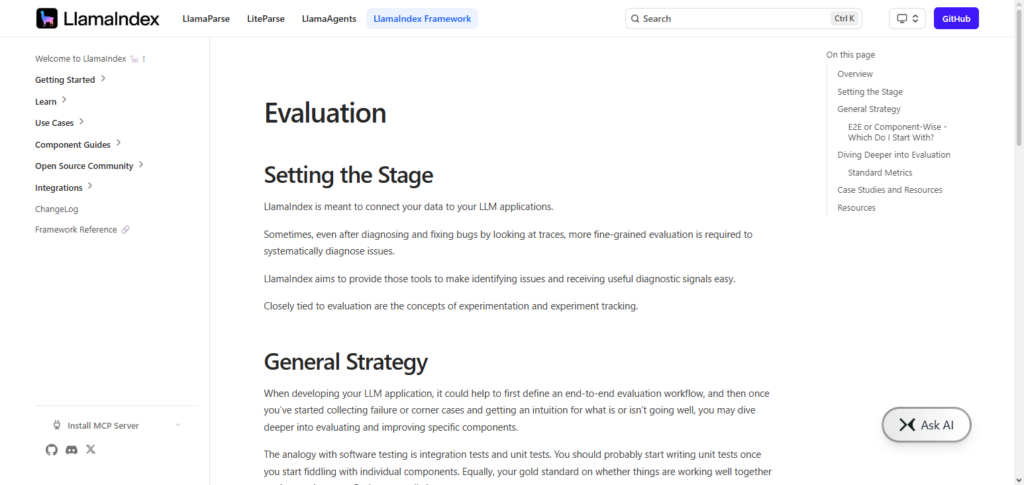
LlamaIndex Eval facilitates automated evaluation with customizable datasets and offers compatibility with various LLMs. This API is instrumental in testing the performance of chatbots, document-based AI systems, and knowledge systems. Developers can leverage the thorough system evaluation offered by LlamaIndex Eval to identify discrepancies and refine retrieval systems and AI models, ultimately leading to the enhancement of the application’s reliability.
LlamaIndex Eval Features, Pros & Cons
Features:
- LlamaIndex Eval can be used to evaluate large language models, rapid attention generation (RAG) pipelines, and artificial intelligence (AI) agents.
- It assesses the relevance, accuracy, and faithfulness of a response.
- Provides tools for the evaluation of customized datasets and metrics.
- It is capable of integration across various large language models and data sources.
- Provides assistance with the optimization of retrieval and generation workflows.
Pros:
- It is very useful for the evaluation of RAG-based applications.
- Excellent compatibility with LlamaIndex frameworks.
- Offers in-depth insights into the quality of AI.
- It is applicable for evaluation automation.
- It is beneficial for corporate knowledge management systems.
Cons:
- It is focused mostly on LlamaIndex-based applications.
- Customization requires some technical skill.
- Limited functionality for standalone benchmarking.
- Some of the more sophisticated features will require additional configurations.
- For evaluations, it might require other LLMs.
2. Anthropic Claude Eval
Anthropic Claude Eval is considered one of the Best AI Evaluation APIs for Testing LLMs since it specializes in assessing the performance, safety, and reliability of Claude-based AI applications. It considers the accuracy, reasoning, and instruction-compliance of AI systems, as well as response harmlessness.
Evaluation frameworks of this type enable the testing of AI systems in numerous contexts, such as customer service, content generation, and process automation in a corporate environment.
The evaluation methodology pioneered by Anthropic strongly focuses on the safe advancement of AI systems: the identification of possible detrimental effects, bias, and faulty outcomes is of primary concern. It enables the establishment of AI systems that are safer and more trustworthy while helping to improve model performance through the testing and analysis of feedback.
Anthropic Claude Eval Features, Pros & Cons
Features:
- This evaluator assesses responses from the Claude model in regard to quality and safety.
- Evaluates reasoning, helpfulness, and following of instructions.
- It has tools for the evaluation of AI safety and alignment.
- This framework has tools for the analysis of model behaviors.
- It is useful for the development of reliable AI applications.
Pros:
- This evaluator has a rich focus on the assessment of AI safety.
- It offers tools for the evaluation of advanced reasoning.
- It is useful for corporate AI testing.
- It is useful for the mitigation of harmful outputs from models.
- This evaluator was developed by an AI safety research focused organization.
Cons:
- This evaluative framework is focused primarily on the Claude models.
- It has limited assistance for other LLMs.
- Many of the evaluation tools will require some degree of customization.
- This evaluator is not very useful for assessing the safety of open-source models.
- Some advanced features will require additional configurations and technical skill.
3. Google DeepMind Eval
Google DeepMind Eval is one of the Best AI Evaluation APIs for Testing LLMs for advanced testing methodologies and AI capabilities measurement. Among its many evaluation features, DeepMind Eval focuses on LLMs’ reasoning, understanding of knowledge, and performance on language-related tasks.
DeepMind evaluation frameworks provide researchers with elaborate benchmarks and sophisticated testing mechanisms for AI model comparison. From these evaluations, researchers can ascertain a model’s strengths, weaknesses, and intelligence.
DeepMind Eval is extremely valuable for advanced ML model research, AI model building for academic purposes, and organizations that need to develop advanced, reliable, and capable AI technologies. DeepMind Eval helps researchers with an understanding of a model’s behavior.
Google DeepMind Eval Features, Pros & Cons
Features:
- Provides advanced AI benchmarking frameworks.
- Tests reasoning, knowledge, and language capabilities.
- Supports standardized evaluation datasets.
- Measures complex AI model performance.
- Useful for research-level AI testing.
Pros:
- High-quality research-based evaluation methods.
- Supports advanced AI capability analysis.
- Useful for comparing large models.
- Provides reliable benchmark results.
- Helps improve next-generation AI systems.
Cons:
- More research-focused than business-focused.
- Requires technical expertise to use.
- May involve complex setup processes.
- Limited beginner-friendly features.
- Some benchmarks require significant computing resources.
4. Microsoft Azure AI Eval
Microsoft Azure AI Eval is among the Best AI Evaluation APIs for Testing LLMs with a suite of evaluation and monitoring tools tailored for enterprise AI. It reviews LLMs on accuracy, relevance, safety, fairness, and performance. Azure AI Eval is a component of Azure AI and Azure ML.
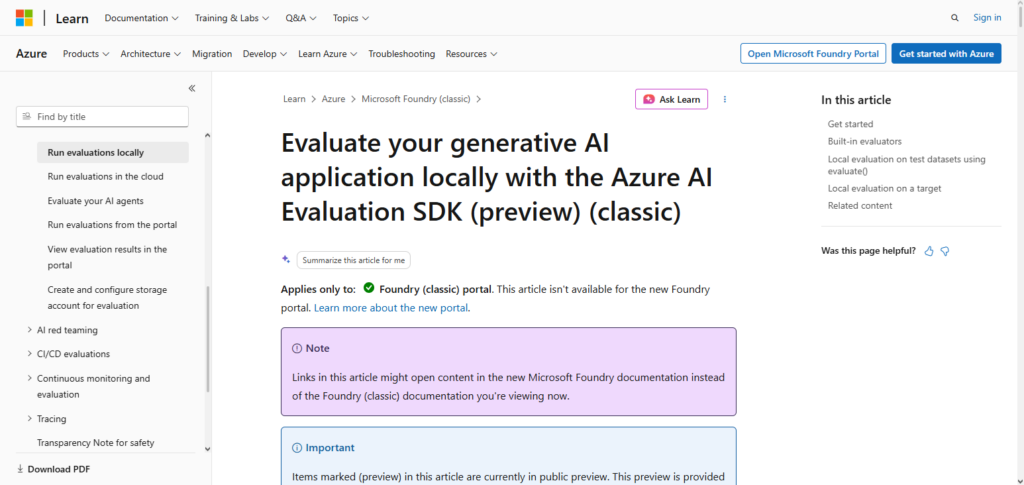
It allows the evaluation of generative AI throughout various stages of its development. Azure AI Eval provides an automated evaluation, analysis of human feedback, and the integration of responsible AI.
Enterprises are able to enhance the quality of their AI assistants, AI co-pilot, and enterprise applications with Azure AI Eval by recognizing quality gaps and ensuring the consistency and safety of their AI solutions.
Microsoft Azure AI Eval Features, Pros & Cons
Features
- Analyzes the accuracy, safety, and reliability of LLMs.
- Applicable to both Azure OpenAI and enterprise AI.
- Offers both automated and human evaluations.
- Has a seamless connection to Azure Machine Learning.
- Allows for the monitoring of Responsible AI.
Pros
- Excellent enterprise-level security.
- Highly compatible with Azure AI.
- Can be used for Large AI Deployments.
- Offers in-depth evaluation results.
- Focused on business uses.
Cons
- Only really useful for people in the Microsoft ecosystem.
- Will incur costs because of Cloud use.
- A lot of Azure knowledge is required to use the advanced features.
- Can be complicated for beginners.
- Inflexible outside of Azure.
5. Hugging Face Evaluate
Hugging Face Evaluate is an open access software offering included in the Best AI Evaluation APIs for Testing LLMs section, thanks to its versatility in aiding developers to assess the performance of AI models using flexible AI evaluation criteria.

This software supports NLP, Generative AI, the discipline of Machine Learning, and Computer Vision. Among the many metrics available to developers are: accuracy, precision, recall, BLEU and ROUGE. Developers can create personalized evaluation methods and metrics.
Custom evaluation methods and metrics have an easy integration with the thousands of AI models on the Hugging Face platform. This software is preferred by researchers and developers because it facilitates comparison between models, helps analyze the outputs of AI models and supports the advancement of AI applications through transparent model benchmarking.
Hugging Face Evaluate Features, Pros & Cons
Features
- Open-source AI evaluation libraries.
- Can be used for NLP, vision and generative AI.
- Offers various evaluation metrics.
- Allows for the creation of custom metrics.
- Works in the Hugging Face AI model ecosystem.
Pros
- Free and open-source platform.
- Can be used for thousands of AIs.
- Highly customizable evaluation.
- Large community of developer support.
- Good for ML workflows.
Cons
- Requires users to have programming skills.
- Has limited metrics for enterprise monitoring.
- More difficult to set up for beginners.
- Quality of results is determined by how the user sets the metrics.
- May need other tools to provide thorough assessments.
6. Scale AI Eval
Scale AI Eval is one of the Best AI Evaluation APIs for Testing LLMs, due to its ability to provide accurate professional level testing for advanced AI models. This platform incorporates evaluation methods that rely on the automation of processes, as well as human input, to measure the accuracy, safety and the reasoning of AI models, as well as their performance in the real world.

Through the creation of custom evaluation sets, Scale AI helps businesses benchmark their AI systems. Scale AI Eval provides evaluation sets for chatbots, copilots, autonomous AI agents and apps.
By assessing the gaps and constraints of AI models, Scale AI Eval assists companies to gain the trust of AI systems and language models, by decreasing the skews of the models and enabling the production of AI models of a better caliber.
Scale AI Eval Features, Pros & Cons
Features:
- Gives access to professional LLM testing.
- Uses both automated and human evaluations.
- Offers AI benchmarking services.
- Evaluates the accuracy, safety, and reliability.
- Assists in evaluating AI systems used in production.
Pros:
- Human evaluation helps improve accuracy.
- Designed for enterprise AI solutions.
- Offers flexible evaluation designs.
- Supports thorough evaluation performance analysis.
- Offers evaluation for advanced AI systems.
Cons:
- Out of reach for small budgets.
- Not designed for individual developers.
- Requires integration with other platforms.
- Usage-based pricing.
- Not entirely open-source.
7. Weights & Biases Eval
Weights & Biases Eval is one of the most prominent offerings in the Best AI Evaluation APIs for Testing LLMs lists. It enables teams to track and compare LLMs. It has functionality to let teams analyze prompts, outputs, and many other ML workflows and experiments.
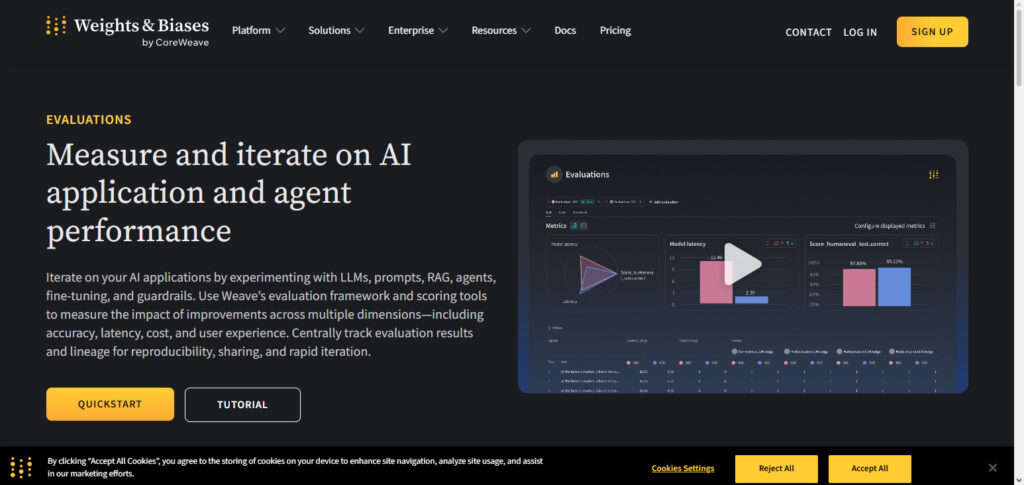
It enables teams to analyze and benchmark LLMs in different contexts and with different datasets, among other features. It is compatible with most popular AI frameworks and has workflows that support cross-collaboration among data scientists, engineers, and researchers.
Weights & Biases Eval is an LLMs management solution that is focused on the quality of LLMs and AI tools. It provides thorough and clear visualizations and analyses of experiments, evaluations, and the performance of LLMs and AI tools throughout the entire LLM and AI tool development process.
Weights & Biases Eval Features, Pros & Cons
Features:
- Logs LLM evaluations and experiments.
- Tracks prompts and model outputs.
- Supports comparison of AI metrics.
- Offers visualization and reporting.
- Builds on ML frameworks.
Pros:
- Superior tracing of experiments.
- Supports collaboration.
- Offers advanced analytics.
- Built on several frameworks.
- Supports the AI lifecycle.
Cons:
- Advanced features need a subscription.
- Can be complicated for new users.
- Tracking is prioritized over assessment.
- Requires integration.
- Can be too much for small projects.
8. Truera Eval
Truera Eval is one of the most advanced evaluation APIs focused on explainable AI, AI model monitoring, and trustworthy AI development in the Best AI Evaluation APIs for Testing LLMs categories. The API uses different AI model assessments, including accuracy, fairness, and reliability assessment.
The API helps understand the rationale behind the output of AI models and helps identify risks to improve model transparency. This API is also beneficial in highly regulated practices where responsible AI is a necessity. This API also helps AI developers assess the quality of models, and ensure that the developed applications meet the required business and regulatory compliance.
Truera Eval Features, Pros & Cons
Features:
- Provides explainable AI evaluation tools.
- Measures fairness, bias, and model reliability.
- Supports LLM monitoring and analysis.
- Provides insights into AI decision-making.
- Helps build trustworthy AI systems.
Pros:
- Strong explainability features.
- Useful for regulated industries.
- Helps detect AI risks and bias.
- Supports responsible AI practices.
- Provides detailed model insights.
Cons:
- Enterprise-focused pricing model.
- Requires AI expertise for full usage.
- Less popular among individual developers.
- Setup may require professional support.
- Limited open-source capabilities.
9. Dynabench API
The Dynabench API is an LLM testing tool from the Best AI Evaluation APIs for Testing LLMs with unique benchmark capabilities. Many benchmarks are static, meaning they assess models using fixed data and use the same data to evaluate new models. Dynabench adds new test cases that challenge and find new weaknesses in models.
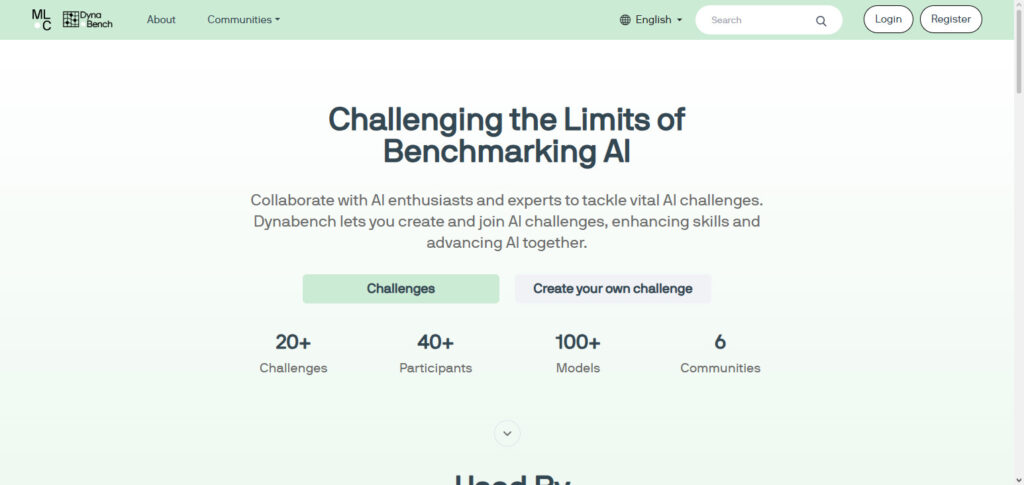
Unlike other benchmarks, Dynabench tests models with real world examples, adversarial examples, and feedback from human testers. With Dynabench, researchers and developers are able to evaluate model failures and test cases. Dynabench is an industry leader in testing the understanding and reliability of language models.
Dynabench API Features, Pros & Cons
Features:
- Provides dynamic AI benchmarking.
- Uses challenging real-world test cases.
- Supports adversarial model evaluation.
- Measures robustness and weaknesses.
- Helps improve NLP model performance.
Pros:
- Finds hidden model limitations.
- Provides realistic evaluation scenarios.
- Useful for research and development.
- Improves AI robustness.
- Supports continuous benchmarking.
Cons:
- Mainly focused on research applications.
- Requires technical implementation.
- Limited commercial features.
- Benchmark setup can be complex.
- May require additional evaluation tools.
10. Eleuther Eval
Eleuther Eval is an LLM testing tool from the Best AI Evaluation APIs for Testing LLMs with the ability to standardize language model testing at scale. Eleuther Eval enables testing at scale with hundreds of evaluation benchmarks across reasoning and understanding, mathematics, knowledge, and general AI capabilities.
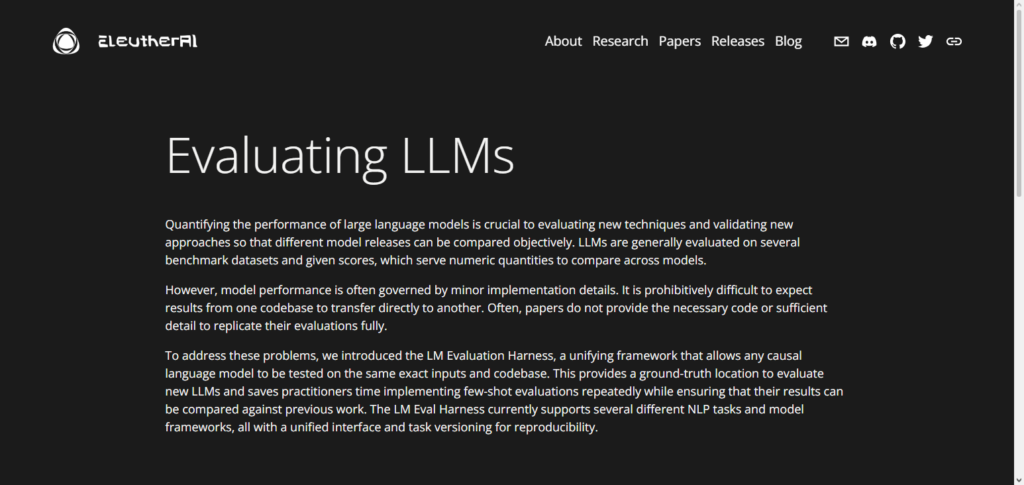
Eleuther Eval is frequently cited in research to compare the performance of open source language models to those of closed or commercial models.
Eleuther Eval provides clear evaluative outcomes for different AI architectures. Its modular and open-source structure allows the community to build new benchmarks and improve testing. Eleuther Eval is a crucial resource to understand language model capabilities and broaden research.
Eleuther Eval Features, Pros & Cons
Features:
- Open-source framework for LLM evaluation.
- Supports hundreds of AI benchmarks.
- Tests reasoning, knowledge, and language skills.
- Works with multiple LLM architectures.
- Provides transparent evaluation results.
Pros:
- Free and community-driven.
- Supports many open-source models.
- Widely used in AI research.
- Highly customizable benchmarks.
- Provides transparent performance comparisons.
Cons:
- Requires coding experience.
- Limited graphical interface.
- Setup can be challenging.
- Mainly focused on benchmarking tasks.
- May need additional tools for production monitoring.
Conclusion
Developers, researchers, and organizations working with large language models (LLMs) need to understand the accuracy, reliability, safety, and performance levels of models they are developing and using.
The following evaluation APIs provide a variety of tools, benchmarks, and performance evaluation/tracking features: LlamaIndex Eval, Azure AI Eval, Hugging Face Evaluate, Scale AI Eval, and Eleuther Eval. When deciding which one of these tools to integrate, consider the specific needs of your AI application.
Evaluation APIs are valuable for performing LLM safety tests, enterprise performance and reliability evaluations, research-focused evaluations, and more. Organizations developing LLMs can use these APIs to enhance and error-correct LLMs and create more reliable AI systems that can be used in production settings.
FAQ
Are AI Evaluation APIs useful for enterprise AI applications?
Yes, enterprise businesses use AI Evaluation APIs to monitor AI assistants, chatbots, copilots, and automation systems to ensure reliability, security, and compliance.
Which AI Evaluation API is best for open-source LLM testing?
Hugging Face Evaluate and Eleuther Eval are popular choices for open-source LLM testing because they provide flexible benchmarks, community support, and customizable evaluation metrics.
Do AI Evaluation APIs support custom evaluation datasets?
Yes, many platforms allow developers to create custom datasets and evaluation criteria based on specific business requirements, industries, and AI use cases.
What factors should be considered when choosing an AI Evaluation API?
Important factors include supported models, evaluation metrics, integration options, scalability, pricing, security features, customization options, and compatibility with existing AI workflows.