


This article analyzes the best AI dubbing platforms that creators, businesses, and media companies use to dub their content into multiple languages with advanced A.I.
These platforms employ AI voice cloning, speech recognition, translation, and lip-sync technology to generate more realistic multilingual videos. We will go over the major features, A.I. capabilities, pricing, and scenarios in which these tools are useful.
What Are AI Dubbing Platforms?
AI dubbing platforms are sophisticated software which, by means of AI, are able to automatically translate, synthesize voices, and produce lip-sync videos in multiple languages for audio-video content.
These tools create synthetic voices through a combination of technologies such as neural text to speech (TTS), voice cloning, and emotion modeling, so the voices produced become more human-like. Traditional dubbing incurs costs, time, and requires studios and voice actors.
In comparison, AI dubbing costs less and localizes more quickly. Film studios and streaming services are just some of the users of these tools. There is a growing interest in content localization in multiple languages, and the use of AI dubbing is expected to fuel many businesses involved in global communication.
Why AI Dubbing Platforms Are Important in 2026?
AI dubbing platforms become more essential in 2026 because of how they change how content is produced and consumed globally. Here are the main reasons:
Global scale: AI dubbing technology makes videos, lessons, and training products available in over 100 different languages.
Cost effectiveness: Traditional dubbing services charge thousands of dollars per project. AI dubbing technology makes these projects cost very little.
New opportunities for studios: Veritone, Papercup, Deepdub and other similar services can enable studios to localize hundreds of hours of videos in a matter of days.
Adapting to different cultures: Emotion modeling and lip-sync technology allow studios to preserve local language authenticity.
Promise of the future: Analysts expect the size of the AI dubbing industry to be around $3.6B by 2035. Streaming, e-learning, and enterprise adoption will drive this growth.
Bringing together technologies: Integrating technologies such as avatars and voice cloning will make communication and networking more instinctive.
How We Selected the Best AI Dubbing Platforms?
| Evaluation Criteria | Why It Matters for AI Dubbing Platforms |
|---|---|
| Voice Quality & Naturalness | Evaluated how realistic, human-like, and expressive the AI-generated voices sound compared to professional voice recordings. |
| Language Support | Analyzed the number of supported languages and regional accents for global content localization. |
| Translation Accuracy | Checked how effectively platforms maintain meaning, context, and cultural relevance during language conversion. |
| Lip-Sync Accuracy | Measured how well dubbed audio matches the speaker’s mouth movements and video timing. |
| Voice Cloning Technology | Considered the ability to replicate a speaker’s unique voice tone, style, and emotional expressions. |
| Emotion & Tone Preservation | Reviewed whether AI voices can maintain emotions such as excitement, seriousness, and storytelling style. |
| Multi-Speaker Support | Evaluated the ability to identify and generate different voices for conversations, interviews, and group videos. |
| Audio Editing Features | Considered tools like voice adjustments, background noise removal, subtitles, and timeline editing. |
| Video Localization Features | Analyzed additional capabilities such as subtitles, translation workflows, AI avatars, and multilingual video creation. |
| Ease of Use | Checked platform usability, dashboard experience, automation features, and learning curve for new users. |
| Integration & API Availability | Evaluated whether platforms provide APIs or integrations for businesses, developers, and large-scale workflows. |
| Pricing & Value | Compared subscription plans, free trials, usage limits, and overall value for creators and enterprises. |
| Commercial Usage Rights | Reviewed licensing policies for businesses using AI-generated voices in marketing, training, and media projects. |
| Security & Privacy | Considered data protection, voice ownership policies, and enterprise security standards. |
| Industry Use Cases | Evaluated adoption across industries like entertainment, education, marketing, gaming, and corporate training. |
Key Point & Best AI Dubbing Platforms
Veritone Voice
- AI voice cloning and synthetic speech platform for creating realistic digital voices.
- Best suited for media companies, enterprises, and professional content localization.
- Provides secure voice replication with enterprise-level voice management features.
Papercup AI
- AI dubbing platform focused on translating and localizing video content at scale.
- Uses machine learning to create natural-sounding multilingual voiceovers.
- Popular for media, news, and entertainment content distribution.
Deepdub AI
- Enterprise AI dubbing solution designed for movies, TV shows, and streaming content.
- Combines AI translation, voice cloning, and human quality control.
- Helps studios create high-quality multilingual entertainment content.
Respeecher AI
- Advanced voice cloning technology that recreates authentic human voices.
- Known for preserving emotions, tone, and speaking style in generated voices.
- Used in film production, gaming, and creative media projects.
Dubverse AI
- AI-powered video dubbing and translation platform supporting multiple languages.
- Provides voice generation, subtitles, and video localization tools.
- Designed for creators, marketers, and educational content providers.
Synthesia AI
- AI video creation platform with multilingual AI avatars and voice dubbing.
- Enables businesses to create training, marketing, and corporate videos.
- Offers AI presenters, voiceovers, and language translation features.
Sonantic (Spotify)
- AI voice technology focused on creating expressive and emotional synthetic voices.
- Developed realistic speech models for gaming and entertainment experiences.
- Integrated into Spotify’s voice technology ecosystem.
Speechify Dubbing
- AI dubbing tool that converts videos into multiple languages with natural voices.
- Uses advanced text-to-speech technology for fast content localization.
- Suitable for creators, educators, and accessibility-focused content.
HeyGen AI
- AI video platform offering voice translation, dubbing, and lip-sync technology.
- Creates multilingual videos while maintaining original speaker identity.
- Popular among marketers, influencers, and global businesses.
Murf AI Studio
- AI voice generation platform offering realistic voiceovers and dubbing tools.
- Provides multiple AI voices, editing features, and voice customization.
- Used for presentations, advertisements, e-learning, and marketing videos.
10 Best AI Dubbing Platforms
1. Veritone Voice
Veritone Voice provides Voice-as-a-Service (VaaS) at the enterprise level, offering a sophisticated platform for text-to-speech and speech-to-speech with over 150 languages and custom voice cloning. They provide a free trial, and enterprise level pricing is done on a case-by-case basis.
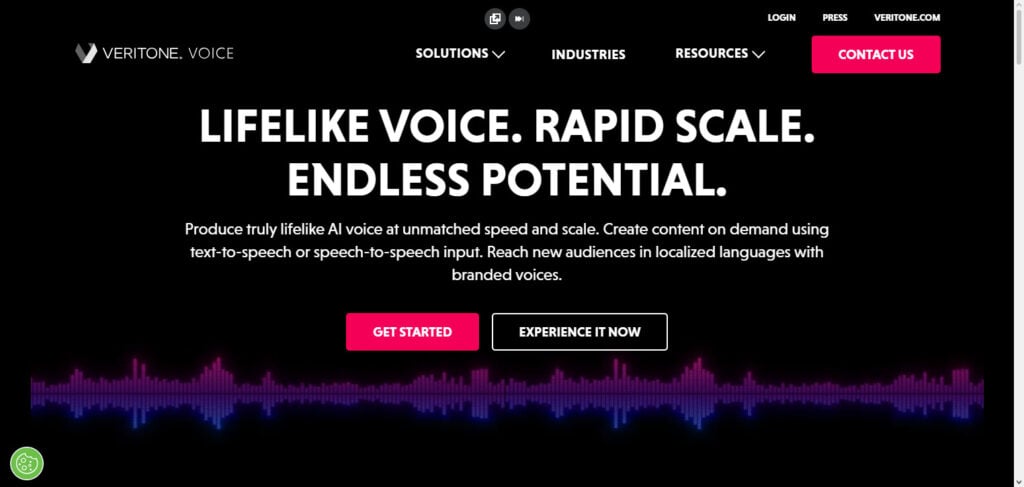
Veritone Voice, with its competitive ethical voice licensing, SOC 2 and ISO 27001 compliance, supports global voice localization production at competitive studio cost, and is geared for rapid growth in the public and private sector markets as well as the media. Best AI Dubbing Platforms – Veritone Voice.
Veritone Voice – Key Features & AI Capabilities
- Voice cloning technology to deliver voice replicas.
- Transcription of text into voice sound.
- Maintains vocal characteristics, tones, identities and appeareances.
- Enterprise level voice management and security controls.
- Designed for production and post production publishing workflows.
| Pros | Cons |
|---|---|
| Provides advanced AI voice cloning capabilities. | Mainly focused on enterprise users rather than beginners. |
| Creates realistic synthetic voices for professional applications. | Pricing details may not be suitable for small creators. |
| Offers secure voice management solutions. | Requires technical knowledge for advanced workflows. |
| Suitable for media and broadcasting industries. | Limited consumer-focused creative features. |
| Supports scalable voice production workflows. | Voice customization may require enterprise setup. |
2. Papercup AI
Papercup AI offers a combination of AI dubbing and a human-in-the-loop- system for quality assurance (QA), resulting in a seamless and sophisticated final product. Papercup AI supports over 70 languages, includes basic lip-sync, and offers enterprise-grade (ISO 27001, SOC 2) compliance.
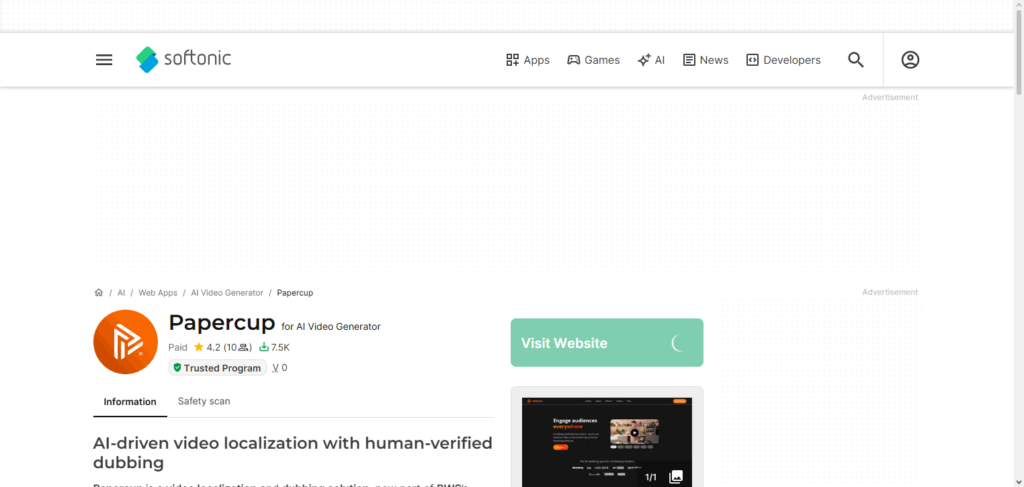
Papercup AI uses a custom quote system for pricing, usually through a per-minute enterprise contracts. Papercup AI is well-liked in the broadcast community, including Sky News and Bloomberg.
The market has seen a dramatic drop in AI Dubbing cost that range from $0.24 to $2.40 per minute, in sharp contrast to older systems that cost over $3,000 per minute. Papercup AI is well-positioned for steady growth with its focus on large enterprise clients. Best AI Dubbing Platforms – Papercup AI.
Papercup AI – Key Features & AI Capabilities
- Machine learning models for natural voice translations.
- Automates dubbing for speech translation and voice over.
- Maintains original style and the conversational flow.
- Built for media and enterprise large-scale video localization.
| Pros | Cons |
|---|---|
| Provides AI-powered video localization at scale. | Mostly designed for enterprise and media companies. |
| Produces natural multilingual voiceovers. | Pricing can be higher compared to creator-focused tools. |
| Helps reduce traditional dubbing time and cost. | Limited public information about pricing plans. |
| Supports large video content libraries. | May require human review for complex translations. |
| Focuses on professional content localization. | Less suitable for casual users. |
3. Deepdub AI
Deepdub AI has created a technology that plugs emotion-centric gaps for dubbing across 130+ languages and employs proprietary eTTS technology for personalized, culturally sensitive voice overs.
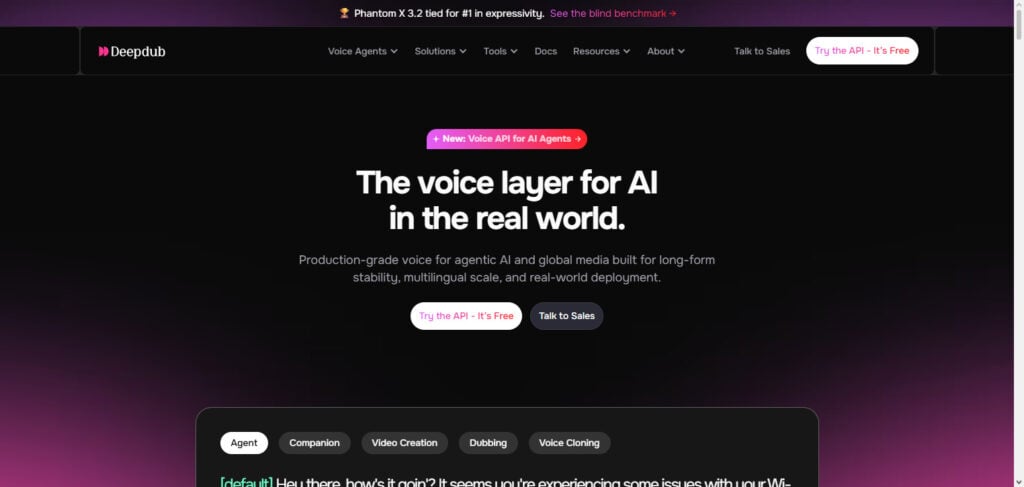
Prices begin at $2,083 per month with enterprise contracts costing about $25,000 per year in addition to pay-per-use plans. It provides real-time dubbing, voice cloning and accent control, which makes Deepdub AI especially well-suited to OTT platforms and corporate training. Having 109K monthly users,
Deepdub AI is growing quickly due to the rapidly growing AI dubbing market worth $1.16 B in 2026, but expected to reach $3.66 B by 2035 (14.2% CAGR). Enterprise-grade security and scalability strengthen Deepdub AI’s position in professional media localization. Deepdub AI is considered one of the best AI Dubbing platforms.
Deepdub AI – Key Features & AI Capabilities
- AI dubbing technology for entertainment content.
- AI voice over technology with voice generation.
- Voice matching for characters in localized productions.
- Quality assurance workflows technology for localized productions.
- Technology for studios to distribute video content.
| Pros | Cons |
|---|---|
| Designed for high-quality entertainment dubbing. | Primarily targeted toward professional studios. |
| Combines AI technology with quality control processes. | Not ideal for small individual creators. |
| Supports multilingual movie and TV localization. | Enterprise pricing may be expensive. |
| Helps scale global content distribution. | Complex workflows may require professional support. |
| Provides voice matching capabilities. | Setup process can take longer for large projects. |
4. Respeecher AI
Respeecher uses voice conversion technology from Hollywood movies, like The Mandalorian, to convert speech in over 790 languages. They provide basic speech to text at $9 a month compared to advanced dubbing at a $499 monthly cost.
Consent-based voice clones help Respeecher maintain an ethical edge. The film, gaming, and restoring archival industries are some of the first to adopt Respeecher technology.
They specialize in voice cloning and have already worked with Netflix and Warner Bros. Respeecher is still one of the more expensive options for dubbing, focused on long-form projects, but maintains realism and everyone’s performances. Best AI Dubbing Platforms – Respeecher AI.
Respeecher AI – Key Features & AI Capabilities
- AI technology for naturally generated voice replicas.
- Voice conversion technology preserves identity while generating emotions and vocal patterns.
- Technology for voice creation in entertainment and gaming.
- Professional voice automation technology.
| Pros | Cons |
|---|---|
| Creates highly realistic AI voice replicas. | Advanced features may be expensive. |
| Preserves voice tone, emotion, and speaking style. | Requires proper voice permissions and licensing. |
| Used in professional film and entertainment projects. | Not focused on simple video dubbing workflows. |
| Provides advanced voice transformation technology. | May require technical expertise for customization. |
| Offers high-quality voice cloning results. | Less suitable for basic content creators. |
5. Dubverse AI
Dubverse AI was founded in India and does multilingual video dubbing with coverage for 60+ languages and a focus on Indian languages. Pricing starts at $25/month (100 credits) with freemium and enterprise options. They have integrations with YouTube, Google Drive, and Dropbox, as well as collaboration tools and workflow automation.
Dubverse can process up to 5 hours a day on Pro plans, helping over 10,000 creators and major Indian media houses. The Indian market is growing because of the high number of regional languages within India. Dubverse helps educators and brands to localize content more affordable. Their credit based pricing makes them flexible to agencies and enterprises. Best AI Dubbing Platforms – Dubverse AI.
Dubverse AI – Key Features & AI Capabilities
- Offers automated AI video dubbing in multiple languages.
- Converts scripts into AI-generated voiceovers with translation support.
- Provides subtitle creation and video localization tools.
- Supports multiple speakers for dialogue-based content.
- Helps creators produce multilingual videos faster.
| Pros | Cons |
|---|---|
| Easy-to-use AI dubbing platform for creators. | Voice quality may vary depending on language. |
| Supports multiple languages and subtitles. | Advanced editing options are limited. |
| Helps create multilingual videos quickly. | Professional users may need more customization. |
| Suitable for YouTube, education, and marketing content. | AI voices may require manual adjustments. |
| Provides automated translation workflows. | Enterprise-level features are limited compared to premium tools. |
6. Synthesia AI
Synthesia is an AI video platform and a leader in enterprise AI avatars that dubs video to 130+ languages for $18-$30,000 a year. Synthesia also includes lip-sync dubbing and avatar technology, and they hold compliance for SOC 2, ISO 27001, and GDPR. Synthesia is a major player in corporate training and multilingual communication.
They service 90% of Fortune 100 companies. With 240+ avatars and support for 160+ languages, Synthesia dominates the market for AI video dubbing on a global scale. Best AI Dubbing Platforms – Synthesia AI.
Synthesia AI – Key Features & AI Capabilities
- Produces AI avatar videos which can speak and present in a natural way.
- Offers AI multilingual voices and video translation.
- Provides AI presenters for training, marketing, and business videos.
- Synchronizes AI avatar movements with generated speech.
- Enables mass video production without cameras or studios.
| Pros | Cons |
|---|---|
| Creates professional AI avatar videos easily. | Subscription plans can be expensive for individuals. |
| Supports multilingual video creation. | AI avatars may not fully replace human presenters. |
| Useful for corporate training and marketing. | Customization options depend on pricing plans. |
| Provides voice generation and translation features. | Less focused on advanced voice-only dubbing. |
| Reduces video production costs and time. | Some users may find AI-generated videos less personal. |
7. Sonantic (Spotify)
Delivers hyper-realistic voice synthesis. Sonantic, acquired by Spotify, has enterprise-only pricing. However, Spotify’s acquisition of the company has helped Sonantic reach millions of users.
It’s more emotionally focused than realistically focused, making it perfect for gaming, film, and music localization. The AI dubbing market is expected to grow from $1.15B in 2025 to $2.56B in 2030 (17.3% CAGR).
Hyperscalers, including Spotify, are expected to drive a large portion of the growth of the market. Sonantic’s emotional focus sets it apart from competition. However, they are currently available to enterprise customers only. Best AI Dubbing Platforms – Sonantic (Spotify).
Sonantic (Spotify) – Key Features & AI Capabilities
- Creates AI voices which can speak emotionally with a deep learning model.
- Optimizes voice generation aids for differentiated voices.
- Provides interactive speech generation models for gaming and other digital experiences.
- Focuses on natural speech generation for differentiated conversational speech.
- Provides advanced Voice models for gaming and digital experiences.
| Pros | Cons |
|---|---|
| Produces highly expressive AI-generated voices. | Not widely available as a standalone public tool. |
| Focuses on emotional and realistic speech. | Mainly associated with entertainment applications. |
| Developed advanced voice AI technology. | Limited accessibility for general users. |
| Suitable for gaming and interactive experiences. | Less suitable for everyday video dubbing needs. |
| Creates natural conversational voice experiences. | Enterprise availability may be restricted. |
8. Speechify Dubbing
Speechify has added dubbing and voice cloning tools. Price tiers include a free edition as well as Starter for $19/month (2 hours voiceover) and Creator for $49/month (8 hours). Premium listening plans are $29/month. It has tools for 60+ languages and workflows for dubbing that have per-second credit metering.
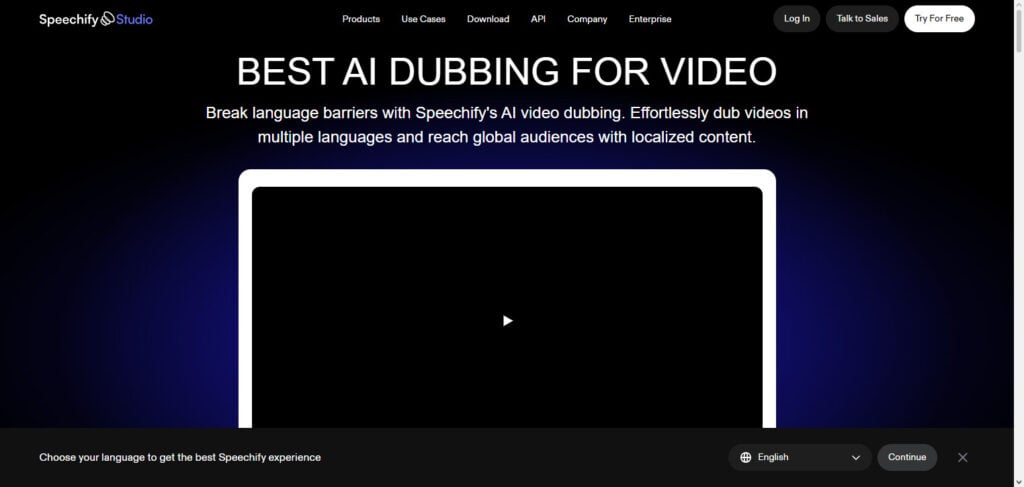
There have been good early signs of market adoption from YouTubers, teachers, and podcasters as Speechify attempts to own the space as a creator-centric dubbing tool. It is simple and fairly priced. However, enterprise dubbing requires higher tiers. Best AI Dubbing Platforms – Speechify Dubbing.
Speechify Dubbing – Key Features & AI Capabilities
- Localizes content by converting videos to other languages using AI dubbing.
- Generates intelligent voices using text to speech models.
- Offers audio content localization to creators and businesses in a timely manner.
- Provides multiple style voices, and languages.
- Increases content accessibility in other languages.
| Pros | Cons |
|---|---|
| Provides fast AI-powered video dubbing. | Advanced professional controls may be limited. |
| Supports natural text-to-speech voices. | Voice customization options may vary. |
| Useful for creators and educational content. | Complex projects may need additional editing. |
| Improves accessibility through multilingual audio. | May not match studio-level dubbing quality. |
| Easy workflow for beginners. | Limited enterprise localization features. |
9. HeyGen AI
HeyGen is a fast growing platform for creating AI Avatars and voice overs in more than 175 languages with lip syncing tech. Plans start at $29/month for Creators, go up to $149/month for the Business plan, and are also available for enterprise users at custom quotes.
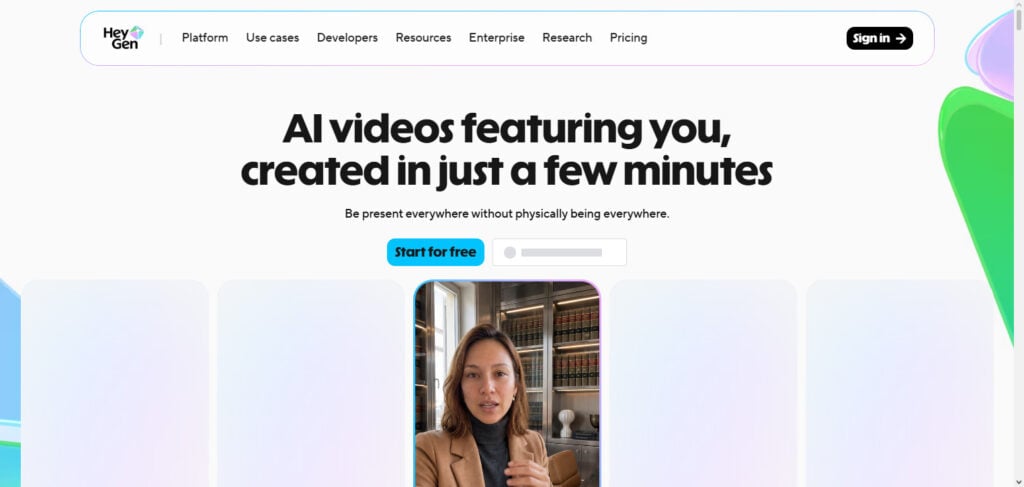
The main billing unit in HeyGen is credits, with Avatar IV/V costing 20 credits/minute. HeyGen crossed $100M in ARR in 2025 while serving more than 100,000 businesses.
HeyGen’s Avatars and translation technologies open new avenues in marketing and training, and help in simplifying multilingual interactions. HeyGen has been recorded the fastest growing product in 2025 by G2. Best AI Dubbing Platforms – HeyGen AI.
HeyGen AI – Key Features & AI Capabilities
- Produces AI voice dubbing with video translation.
- Uses AI technology to sync lips and video speech translated with natural voice.
- Offers voice cloning, keeping speakers’ characteristics and identities.
- Creates videos in multiple languages with AI voices and avatars.
- Helps businesses localize communication and marketing in multiple languages.
| Pros | Cons |
|---|---|
| Offers AI video translation with realistic lip-sync. | Premium features require paid plans. |
| Supports voice cloning and multilingual videos. | Heavy usage can become costly. |
| Easy-to-use interface for creators and businesses. | AI voices may still need human editing for emotions. |
| Creates AI avatar videos quickly. | Some advanced features are limited by plan level. |
| Suitable for marketing and global communication. | Not designed for complex movie dubbing workflows. |
10. Murf AI Studio
Murf AI Studio is the leading voiceover and dubbing software that lets you choose from 200+ voices across 30+ languages. You can sign up for Murf AI Studio for $19 per month ($75 for the enterprise plan), and for $66 per month (8 hours of generated voice).
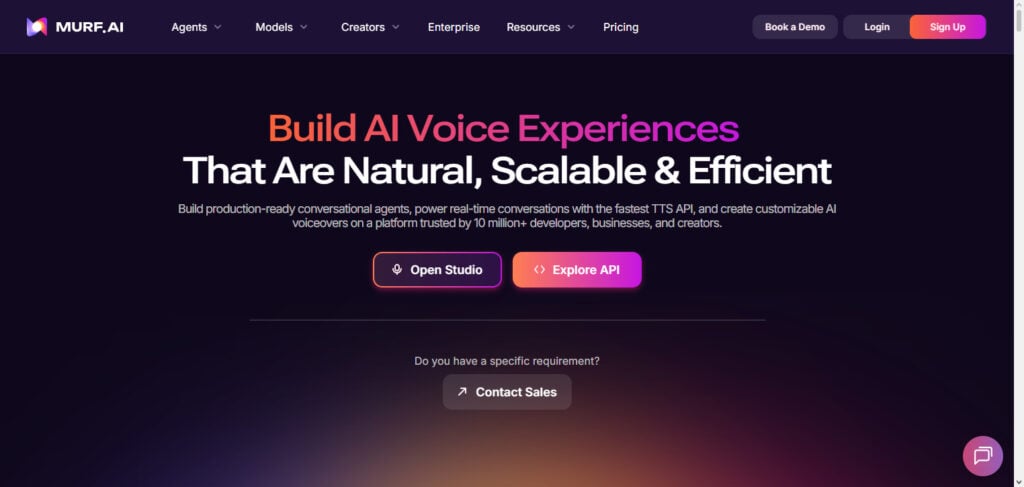
Murf bills by the hour of voice generated, which makes it great for teams. Murf AI Studio helps over 6 million users across 195 countries, including Forbes 2000 companies. Murf AI Studio is the voiceover tool of choice for corporate learning and development and marketing teams, as they offer an easy to use software with natural sounding voices.
Voice cloning is available with enterprise plans at Murf AI Studio, but other businesses often pick Murf AI Studio over the other artificial intelligence dubbing software on the market. Best AI Dubbing Platforms – Murf AI Studio.
Murf AI Studio – Key Features & AI Capabilities
- Generates professional AI voiceovers using advanced text-to-speech technology.
- Offers a wide range of AI voices, accents, and speaking styles.
- Provides voice customization for pitch, speed, and tone adjustments.
- Includes audio editing tools for presentations and videos.
- Supports e-learning, marketing, podcasts, and business content creation.
| Pros | Cons |
|---|---|
| Provides realistic AI voice generation. | Some premium voices require paid subscriptions. |
| Offers multiple voices, accents, and customization options. | Limited advanced dubbing features compared to specialized tools. |
| Includes professional audio editing capabilities. | Voice cloning options may be limited. |
| Suitable for presentations, ads, and e-learning. | Large projects may require higher-tier plans. |
| Easy-to-use platform for beginners and professionals. | May need external tools for complete video localization. |
Conclusion
AI dubbing software change the way companies, creators, and media firms create content in multiple languages. Platforms leverage advanced technologies in voice cloning, speech recognition, and lip-sync technology. These automate the process of dubbing and localization of videos for multiple audiences with a fraction of the cost of traditional dubbing.
The best AI dubbing software depends on needs like, content, languages supported, voice quality, price, and flexibility. Purpose built software for businesses and video creators include HeyGen AI and Synthesia AI. Those designed for media localization include Deepdub AI and Papercup AI. The best options for advanced voice cloning and other voice replication technologies are Respeecher AI and Veritone AI.
In 2026 voice AI will be more advanced and AI dubbing will be used by all firms for all international content distribution, including online courses, marketing, and entertainment, as well as corporate communication. The right international AI dubbing software, if it has target language translation, lifelike voices, advanced security, and multiple features, will ensure firms sell their products globally.
FAQ
What are AI dubbing platforms?
AI dubbing platforms are software solutions that use artificial intelligence to translate and replace original audio with AI-generated voices in different languages. They combine technologies like speech recognition, machine translation, voice synthesis, and lip-syncing to create localized video content.
Which are the best AI dubbing platforms in 2026?
Some of the best AI dubbing platforms include HeyGen AI, Synthesia AI, Deepdub AI, Papercup AI, Respeecher AI, Veritone Voice, Dubverse AI, Speechify Dubbing, Murf AI Studio, and Sonantic. Each platform offers different features for creators, businesses, and entertainment companies.
How does AI dubbing work?
AI dubbing works by converting spoken audio into text using speech recognition, translating the content into another language, generating a realistic AI voice, and synchronizing the new voice with the original video using lip-sync technology.
Can AI dubbing replace human voice actors?
AI dubbing can speed up the localization process and reduce production costs, but human voice actors are still valuable for emotional performances, complex storytelling, and premium entertainment content where creativity and expression are essential.